15/04/2017

World Must Hit Zero Carbon Emissions 'Well Before 2040', Scientists Warn

The IndependentIan Johnston

New research suggests it will be an ‘enormous challenge’ to prevent global warming getting out of hand
An elderly man exercises on the banks of the Songhua River in Jilin, China, as smoke billows from huge chimneys.  Reuters
Humans must reduce net greenhouse gases emissions to zero “well before 2040” in order to ensure global warming does not go above 1.5 degrees Celsius by the end of the century, scientists have warned after carrying out a study using a sophisticated new computer model.
The analysis suggests that efforts to prevent temperatures rising to potentially dangerous levels may have to rely heavily on “negative emissions” technology that is still in its infancy.
Commenting on the study, Professor Richard Betts, head of climate impacts at the UK’s Met Office Hadley Centre, said the “important” research spelled out the “enormous challenge” ahead.
Under the Paris Agreement on climate change, the world committed to prevent global warming from going above 2C but also attempt to restrict it to as close as 1.5C as possible amid mounting evidence that dangerous effects could kick in sooner than previously thought.
The new study, described in a paper in the journal Nature Communications, is one of the first to use the new FeliX computer model, which includes social and economic factors along with environmental ones.
One of the researchers, Dr Michael Obersteiner, of the International Institute for Applied Systems Analysis near Vienna, said: “The FeliX model ... provides a unique systemic view of the whole carbon cycle, which is vital to our understanding of future climate change and energy.
“The study shows that the combined energy and land-use system should deliver zero net anthropogenic emissions well before 2040 in order to assure the attainability of a 1.5C target by 2100.”
This does not necessarily mean that humans would have to stop burning fossil fuels in little over 20 years, as the researchers included natural carbon sinks – such as forests – and the use of carbon-capture technology in their calculations.
So some emissions would be allowed, if enough carbon was taken out of the atmosphere by either natural or artificial processes.
In the Nature Communications paper, the researchers wrote: “Roughly speaking, and based on current technologies, energy sector emissions will need to peak within the next decade.
“By 2100, the market share of fossil fuels will need to fall to less than a fourth of total primary energy demand to preserve the possibility of meeting the [Paris Agreement] targets.”
They said “full decarbonisation” would probably have to rely on the combined use of carbon-capture technology, which is still being developed, and the burning of biofuels.
The idea is that trees and other plants would absorb carbon and then be burned in power plants with the emissions prevented from getting back into the atmosphere by carbon-capture, creating a giant machine to suck CO2 from the air.
However some doubt this will be possible on a scale large enough to have a significant effect, given the need to use land to grow crops and raise animals.
And the paper said: “If coupling of [carbon-capture-and-storage] technology with bioenergy production is ultimately found to be unfeasible, uneconomical or unacceptably burdensome on ecosystems, then alternative negative emissions technologies (for example, direct air capture) will need to be substituted.
“In the absence of these fail-safes, fossil fuels will need to be phased out completely and well before 2100.”
Professor Betts, of Exeter University, who has played a leading role in the Intergovernmental Panel on Climate Change’s work, said the research should help world leaders establish what they have to do.
“This important paper provides much-needed detail on how the countries of the world might meet their commitments under the Paris Agreement,” he said.
“It is clear that it is an enormous challenge, especially if we do not develop ways to remove carbon dioxide from the atmosphere and put these into practice.”
Gareth Redmond-King, head of climate and energy policy at conservation group WWF, said the paper showed just how pressing the need was to take action.
“Once again, climate scientists are sounding an alarm to remind us of the urgent need to act now to tackle climate change,” he said.
“Melting ice caps, dying coral reefs, plummeting wildlife populations, rising sea levels and extreme weather – they all get worse and worse as the Earth’s temperature rises.
“Similar analysis recently showed that, on current levels of emissions, we’ll have reached enough to warm by 1.5 degrees as soon as four years’ time!
“We know how to solve this problem – we have the technologies to provide clean electricity at a much greater scale than we’ve already achieved.
“And we know that reversing deforestation preserves a hugely important global carbon sink to absorb more of our emissions.  So what will it take to convince all the signatories to the historic Paris agreement that they need to act now?
“Here in Britain, that means we need the UK government to get their finger out and publish their now long-overdue Emissions Reduction Plan.  We need ambitious, robust, long-term plans to slash emissions and protect our environment.”
The Government has repeatedly delayed publication of the Emissions Reduction Plan, the key strategy that is supposed to lay out how the UK will reduce its production of greenhouse gases, even though there is a legal requirement to produce one. The ongoing failure to come up with a plan could ultimately lead to legal action against Ministers.
Bob Ward, policy and communications director at the Grantham Research Institute on Climate Change and the Environment, said he feared politicians would place too much store on the potential of carbon-capture.
“There’s a great danger that policymakers believe some of these targets are feasible to achieve, but without realising that it depends on the large-scale use of unproven negative emissions technology,” he said.
“It would be far more sensible if we were planning for the future on the basis we might not have that and therefore cutting emissions much more strongly in the short-term, rather than thinking we can do it in a more gradual way, then have suddenly a magic wand of negative emissions towards the end of the century.”
Mr Ward said the latest research suggested the 1.5C target was unlikely to be achieved. Last year temperatures were about 1.1C above pre-industrial levels, boosted slightly by the natural El Nino weather system.
But the world should still try to minimise the risks partly because of emerging evidence that a tipping point could be reached that would lock in sustained rises in sea levels, Mr Ward said..
“The work I’ve seen suggests it’s going to be near impossible to stay below 1.5C, but it might be possible to overshoot slightly then come back down within 50 years or so,” he said.
“It’s worth considering because there is modelling that suggests somewhere between 1.5C and 2C of warming we may pass a [sea level rise] threshold. If you go beyond 1.5C, and the closer you get to 2C, we would be seeing sea level rise continuing for many centuries and therefore result in very large accumulative rises.”
The FeliX model is freely available to be downloaded and used by anyone.

Links

14/04/2017

Government Given 21 Days To Explain Climate Change Failures Or Face Legal Action

The IndependentIan Johnston

Exclusive: Environmental lawyers at campaign group ClientEarth set deadline amid concern over repeated delays to publication of Government’s key plan to reduce greenhouse gas emissions
The UK has seen dramatic decreases in emissions from power stations but cuts in transport and heating are proving more difficult. PA
ClientEarth – the team of environmental lawyers that has twice taken Ministers to court and won – has given the Government 21 days to explain why it has failed to produce a plan setting out how the UK will fight climate change as required by law.
Under the terms of Britain’s Climate Change Act, the Government must come up with a way to cut greenhouse gas emissions by 57 per cent by 2032.
According to official figures, the UK’s emissions fell by 33 per cent between 1992 and 2014, largely because of the surge in renewable electricity generation and the switch from coal to gas-fired power stations.

Climate change is altering global air currents, scientists warn

But, with most homes heated by gas and most vehicles still using petrol or diesel, the UK is a long way off meeting the 2032 target.
The Government’s Emissions Reduction Plan is supposed to set out how this will be achieved and was due to be published at the end of last year, but has been repeatedly delayed.
It is thought further significant cuts could involve policies that are too radical for the current Government, particularly during the upheaval caused by Brexit. For example, as part of its efforts, Norway has pledged to ban petrol-powered cars by 2025. Such a move is not considered likely in the UK.
ClientEarth has a track record of forcing the Government to obey the law, twice forcing Ministers to rethink substandard plans to bring air quality to within minimum EU safety standards.
In a letter to Climate Change Minister Nick Hurd seen by The Independent, ClientEarth said it was “increasingly concerned” that the Emissions Reduction Plan had still not been published.
“The strength of the [Climate Change] Act is that it enables long-term advance planning and investment,” the letter said.
“An ambitious plan now will put the UK on the pathway to real emissions reductions and real investment in the 2020s and 2030s.
“Failure now to produce an ambitious plan that will put the UK on track to meet the legally binding fourth and fifth carbon budgets will only compound the earlier failures.”
ClientEarth has warned that it believes the Government could have been in breach of the Climate Change Act for years because its emissions plan for the fourth carbon budget – the target level of emissions for the mid-2020s – does not actually achieve the necessary reductions.
The fifth budget, which runs up to 2032, was set by Ministers last year and requires its own emissions plan.
The letter did not threaten legal action, but said ClientEarth would “appreciate a response within 21 days” spelling out when the plan would be published or reasons for the continued delay.
It also suggested the Government could instead publish a draft plan for consultation “as a matter of urgency” so interested parties could help it produce an effective strategy.
Karla Hill, director of programmes at ClientEarth, told The Independent that if no substantive response was received, it might take the Government to court – but would prefer not to.
“Legal action is an option if we don’t get any firm indication as to what they are planning to do,” she said.
“Our ultimate goal in all of this is for the Government to produce a good plan and we’re not really interested in going to court just to force them to produce a plan they are legally obliged to produce any way.
“Our strong preference is for litigation to be a last resort.”
She spelled out the importance of the plan.
“The Emissions Reduction Plan is critical. It is important because it will send a signal that the Government is serious about the Climate Change Act,” Ms Hill said.
“And it will drive huge amounts of investment into clean infrastructure and technology that will reduce emissions in the UK through the 2020s and into the 2030s.
“Delay and inaction is not really an option under the Climate Change Act or under the international commitments the Government has made.
“They ratified the Paris Agreement late last year, that’s a binding international commitment.
“Delay is what we are seeing at the moment, but inaction is not an option. Delay will make action more costly.”
Speaking to an MPs’ committee hearing earlier this year, Mr Hurd said the plan was so important it was felt the need to get it right was more important than the legal requirement to publish it “as soon as practically possible” after the carbon budget is set.
A spokesperson for the Department for Business, Energy and Industrial Strategy, which deals with climate change issues after Theresa May abolished the dedicated department, said: “The Plan is a priority for this Government and our intention is still to publish it as early on in 2017 as possible, so that we can move on to the delivery stage.
“We are undertaking critical preparatory work to ensure we get it right and provide clear guidance on how the Government is planning to reduce emissions through the 2020s.”

Links

Adani Boast Puts $1b Coal Project Loan In Doubt, As New Footage Shows Abbot Point Spill Damage

Fairfax - Heath Aston | Michael Koziol | Amy Remeikis

A potential $1 billion federal government loan to Indian conglomerate Adani for its proposed coal mine has been called into question because comments by the company appear to conflict with infrastructure funding guidelines.
Public finance for Australia's biggest open-cut coal pit has become the latest political battleground, as alarming new footage emerged of the environmental damage done to wetlands bordering Adani's Abbot Point coal terminal in Queensland by cyclone Debbie.

Research by the independent Parliamentary Library, passed to Fairfax Media, found statements by Adani on the financial viability of the Carmichael project in Queensland's Galilee Basin could render it ineligible to accept funding for a mine-to-port rail line from the $5 billion Northern Australia Infrastructure Fund.
In December, Adani spokesman Ron Watson confidently declared that access to the $1 billion concessional loan through the infrastructure fund was "not make or break" for the $16 billion project moving to production. "It's not critical," Mr Watson said of the loan at the time.
Under the infrastructure fund's investment eligibility criteria three, loans should only be extended if "financial assistance is necessary to enable the project to proceed, or to proceed much earlier than it would otherwise".
According to the Parliamentary Library: "Mr Watson's statement may well have ruled the project ineligible for funding under the NAIF. His statement points to the possibility that criteria three will not be met."
As the political heat over Carmichael rose on Wednesday, Adani shifted position, telling Fairfax Media the loan facility was critical to making the rail line financially feasible because of requests by the Queensland and federal governments that competing coal projects in the Galilee share the line.
"That has increased our costs," Mr Watson said, adding it would require "expansion of line capacity, maybe additional loops and so forth".
Coal dust on the beaches next to the Abbot Point coal loading facility. Photo: Dean Sewell/Oculi 
"The cost of providing access to potential other users is significant. I think it requires the NAIF input to make it feasible."
A spokeswoman for the Minister for Resources and Northern Australia, Matt Canavan, would not comment on whether eligibility criteria could be tweaked to facilitate the loan, which Deputy Prime Minister Barnaby Joyce has already said should be approved.
A picture of the Abbot Point coal loading facility showing coal water run-off moving north-west into the wetlands and coal dust on the beaches. Photo: Dean Sewell
But she did back the company's stance that the multi-use nature of the 390-kilometre rail line was a significant factor in funding and feasibility.
"Adani has always said the rail line would be open access and the government has always said multi-use access would be a condition of any application being considered," she said.
Malcolm Turnbull meets Gautam Adani in Delhi. Photo: AAP
Mr Joyce sought to ratchet up pressure on Bill Shorten over the loan on Wednesday, claiming the Opposition Leader "no longer seems to believe in blue-collar workers".
"Mr Shorten should start backing in labourers and the union movement who actually want these jobs and the National Party in this instance is standing with the CFMEU and the AWU to try to make sure we get these jobs moving," he said.
An image showing environmental damage to wetlands bordering Adani's Abbot Point coal terminal.  Photo: Dean Sewell
Mr Shorten again gave his backing to the Carmichael project, but on the basis that it "stacks up" financially.
"I haven't seen the case made for the taxpayer to underwrite a billion-dollar loan, underwritten by Australian taxpayers, to build a rail line," he said.
GALLERY Abbott Point coal pollution
Prime Minister Malcolm Turnbull, who met billionaire Adani Group founder Gautam Adani during his visit to India, has insisted the loan will be "assessed scrupulously independently".
Pictures and video footage taken from a helicopter and a drone above the Abbot Point terminal, which will handle Carmichael's output, has led to renewed warnings by conservationists about destruction of the onshore environment and Great Barrier Reef if the coal expansion goes ahead.
Images show black sludge throughout the wetlands, home to the endangered wading bird the Australian painted snipe, and what appear to be coal lumps on the adjacent beach, a turtle nesting ground.
Australian Conservation Foundation president Geoff Cousins said the area "looks trashed".
"It's a tragic and shocking picture of what the future of the reef coast looks like if we don't stop digging up coal," he said.
"The Adani companies have proven they can't be trusted with the environment and the climate. The idea that we'd spend public money propping up their operations beggars belief."
The Queensland Labor government has been treading a fine line on Carmichael between environmental issues and the need for mining jobs.
Behind the scenes, the pervading belief in Queensland has been that Adani would not get the finance necessary to break ground.
But that belief has started to shift, according to a Queensland government source, who said a "scaled back" project could go ahead.
"If it starts smaller, Adani don't need as much funding to get going ... if the government puts in $1 billion, it is even less and they can still expand it down the track if necessary."

Links

Climate Change Curbs Must Be Central To Foreign Policy, Global Institutions Tell Australia

Fairfax - Fergus Hunter | David Wroe

A group of global institutions, including the World Bank, has told the Turnbull government that containing the effects of climate change must be a central pillar of Australia's new foreign policy.
The group, including the Asian Development Bank, Pacific Islands Forum and Australian Chamber of Commerce and Industry, says mitigation and adaptation will be needed to address the economic and security impacts of widespread environmental upheaval.

Billion dollar reef risk
Foreign Minister Julie Bishop is looking to establish a new "philosophical framework" to guide Australia's  engagement with the world. On top of a public submission process, the government recently summoned all ambassadors home to participate in an unprecedented meeting.
In the newly published submissions to the white paper process, the World Bank said 300 million people in the Asia-Pacific region were in danger of falling into extreme poverty as a result of climate change, natural disasters, disease and economic shocks.
The powerful financial institution asserted that 13 of the 30 countries most vulnerable to the impacts of global warming were in Australia's neighbourhood.
"Environmental sustainability – particularly efforts aimed to mitigate climate change and its effects on water scarcity, natural disasters, and small island states – is also important to Australia's security and wellbeing," it argued.
The Asian Development Bank described climate change as a "growing threat to prosperity and stability in the region". The 67-member development funding body said Asia, with booming and vulnerable populations, faced an $8 trillion infrastructure funding gap, and urged funding for climate change curbs and preparation.
"Huge investments in renewable energy, energy efficiency, sustainable transport and smart cities are needed," its submission said. "Countries must also invest in adaption through resilient infrastructure, smart agriculture, and better disaster preparedness."
Julie Bishop is looking to establish a new "philosophical framework" to guide Australia's foreign policy. Photo: Bloomberg
The Settlement Services Advisory Board – appointed by federal government to advise on migrant settlement – warned sea level rises, erosion and more intense natural disasters would result in climate refugees.
Destruction of communities in the low-lying countries of the Asia-Pacific region could unleash a flood of displaced people, destabilising the region. According to projections, a one-metre sea level rise could swallow 20 per cent of Bangladesh and displace 30 million citizens. The Maldives has speculated about buying Australian land to accommodate the country's population in future.
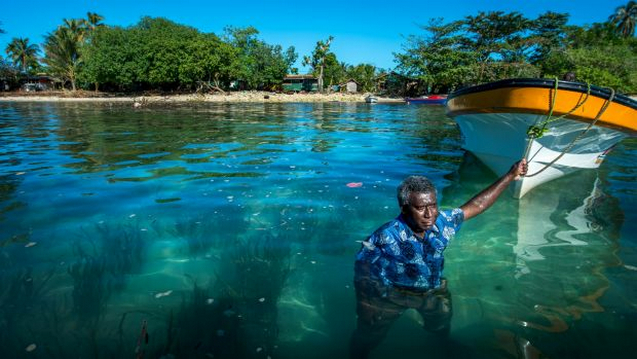
Jackson Kiloe, the Premier of Taro in the Solomon Islands, standing where the shoreline used to be.  Photo: Penny Stephens
"In the context of evidence of the impact of climate change on the Asia-Pacific region, it is imperative that Australia is proactive in its commitment to meeting and continually increasing emission reduction targets," the advisory board stated.
"A possible solution to address future migration challenges from climate change would be to build the capacity of populations who are likely to seek refuge in Australia."
Hundreds of submissions to the foreign policy white paper cover a vast array of policies, from navigating the relationships with China and the United States to maintaining free trade and boosting foreign aid spending.
In calling for government policy to protect vulnerable people and the environment, non-government organisations including World Vision, Save the Children, wildlife preservation group WWF and the Australian Council for International Development all touch on climate change as a threat relevant to their work.
The Australian Chamber of Commerce and Industry said global warming presented a growing risk to Australia's interests, including business.
"Viewed on its own, reducing emissions in Australia will have little impact on global atmospheric [greenhouse gas] concentrations," it wrote. "This is why Australia needs to support economic growth and assist regional partners to develop in a way that limits adverse environment impacts."
The Pacific Islands Forum, a group of 17 states, describe natural disasters and climate change as "major obstacles to future development" and a danger exacerbated by booming populations.
Climate change – which scientific consensus has found to be driven by human-generated greenhouse gas emissions –gradually lifts air and ocean temperatures, making weather patterns more unpredictable, intensifying natural disasters, raising sea levels and undermining critical environmental processes.
United States Secretary of Defence James Mattis recently told Congress that climate change was a driver of instability that had to be considered by the military.
Australia's 2016 Defence white paper labelled it a "major challenge for countries in Australia's immediate region".

Links

13/04/2017

Northern NSW Is No Stranger To Floods, But This One Was Different

The Conversation

Lismore received a drenching from the tail end of Tropical Cyclone Debbie. AAP Image/Dave Hunt
The devastating flood damage wreaked by Tropical Cyclone Debbie has left many residents in northern New South Wales facing an enormous cleanup that could take months.
Any Lismore local will tell you that flooding is a fact of life in the Northern Rivers. In the floods of 1954 and 1974, the Wilsons River rose to a record 12.17 metres. This time around, the river peaked at 11.59m, breaching the flood levee built in 2005 for the first time.
So what are the conditions that caused those historic floods? And are they any different to the conditions of 2017?
Like the current flood, cyclonic rains also caused the 1954 and 1974 events. But unlike those past events, both of which were preceded by prolonged wet weather, almost all of the extreme rainfall from ex-Tropical Cyclone Debbie fell within 24 hours.
More interesting still is the fact that we are not currently experiencing La Niña conditions, which have historically formed the backdrop to severe flooding in eastern Australia.
The 1974 mark still stands as Lismore’s record. Ricky Lewis, Author provided
The 1954 flood was preceded by an east coast low from February 9-11, followed by a decaying tropical cyclone from February 19-22. Thirty people were killed as flood records were set in Lismore, Kyogle, Casino, Nimbin and Murwillumbah. Some places received more than 1,000mm of rain in 14 days.
In 1974, former Tropical Cyclone Zoe unleashed torrential rain over Lismore, Wyrallah and Coraki. From March 10-13, some stations received almost 1,000mm in just four days. One analysis described the flood as a once-in-70-year event.
This time around, the remains of Tropical Cyclone Debbie delivered extreme rainfall to northern NSW towns including Murwillumbah, Chinderah and Lismore, despite having crossed the coast several days earlier and more than 1,200km to the north. Floods as far apart as Rockhampton in central Queensland and northern New Zealand show the storm’s colossal area of influence.
During the event, 20 rainfall stations in Queensland and 11 sites in NSW recorded their wettest March day on record. Mullumbimby, in the Brunswick River catchment, received a staggering 925mm during March – over half the annual average in a single month – causing major flooding in the region.
The heaviest rainfall in the Wilsons River catchment was at Terania Creek, which received 627mm over March 30-31, 99% of it in the 24 hours from 3am on March 30. Lismore recorded 324.8mm of rain in the 18 hours to 3am on March 31, its wettest March day in more than 100 years. A little further out of town, floodwaters submerged the gauge at Lismore Airport, so unfortunately we do not have reliable figures for that site.
March 2017 rainfall across Australia. Tropical Cyclone Debbie’s track down the east coast is visible in the trail of above-average falls. Bureau of Meteorology
 The main difference between the current flooding and the 1954 and 1974 floods is that the previous events both occurred against a background of sustained La Niña conditions. These tend to deliver above-average tropical cyclone activity and high rainfall totals, which increase flood risk.
During the early 1970s, Australia experienced the longest period of La Niña conditions in the instrumental record. This unleashed phenomenal deluges across virtually the entire country. By the end of 1973, many catchments were already saturated as the wet season started early, culminating in the wettest January in Australia’s rainfall records.
In 1974 the Indian Ocean was also unusually warm (what meteorologists call a “negative Indian Ocean Dipole (IOD) phase”), further enhancing rainfall in the region. When negative IOD events coincide with La Niña conditions in the tropical Pacific, the warm sea temperatures reinforce one another, resulting in more evaporation and increased rainfall. This double whammy resulted in the exceptionally wet conditions experienced across the country during 1974.
In January 1974, the Northern Territory, Queensland and Australia as a whole recorded their wettest month on record, while South Australia and New South Wales recorded their second-wettest January on record. Torrential monsoon rains in the gulf country of Queensland transformed the normally dry interior into vast inland seas, flooding all the way to Lake Eyre in the arid zone of South Australia.
Vast swathes of Australia were much wetter than average during the mid-1970s. Bureau of Meteorology
In contrast, Tropical Cyclone Debbie formed under neutral conditions, rather than during a La Niña. In fact, the Bureau of Meteorology is currently on El Niño watch, meaning that there is double the normal risk of an El Niño event bringing low rainfall and high temperatures to Australia by mid-2017.
So, unlike the 1950s and 1970s, the current flooding happened despite the absence of conditions that have driven major flooding in the past. It seems extraordinary that such a damaging cyclone could develop under these circumstances, and deliver such high rainfall over such a short time. This suggests that other factors may be at play.
A rapidly warming climate means that storms are now occurring in a “super-charged” atmosphere. As temperatures increase, so does the water-holding capacity of the lower atmosphere. The oceans are also warming, especially at the surface, driving up evaporation rates. Global average surface temperature has already risen by about 1℃ above pre-industrial levels, leading to an increase of 7% in the amount of water vapour in the atmosphere.
Ocean evaporation, before and after ocean warming. Climate Council
Of course, it is hard to determine the exact impact of climate change on individual storms. However, climate scientists are confident about the overall trends.
Australia’s land and oceans have warmed by 1℃ since 1910, with much of this warming occurring since 1970. This influences the background conditions under which both extremes of the rainfall cycle will operate as the planet continues to warm. We have high confidence that the warming trend will increase the intensity of extreme rainfall experienced in eastern Australia, including southeast Queensland and northern NSW.
While it will take more time to determine the exact factors that led to the extreme flooding witnessed in March 2017, we cannot rule out the role of climate change as a possible contributing factor.
CSIRO’s latest climate change projections predict that in a hotter climate we will experience intense dry spells interspersed with periods of increasingly extreme rainfall over much of Australia. Tropical cyclones are projected to be less frequent but more intense on average.
That potentially means longer and more severe droughts, followed by deluges capable of washing away houses, roads and crops. Tropical Cyclone Debbie’s formation after the exceptionally hot summer of 2016-2017 may well be a perfect case in point, and an ominous sign of things to come.

Links

Adani Firms On $1bn Loan As Turnbull Promises To 'Fix' Native Title Problems

AFRPhillip Coorey


Turnbull to fix native title for Adani

Indian billionaire Gautam Adani has told Malcolm Turnbull his company will seek a taxpayer-funded concessional loan of up to $1 billion to support his proposed $21.7 billion coal mine in Queensland.
And the Prime Minister has assured him the native title hurdles threatening the project will be "fixed".
Following a meeting with Mr Adani and his executives in New Delhi on Monday night, Mr Turnbull cautioned the loan – to help build a $2 billion railway line to link the mine to the coast – would have to be approved on its commercial merits by the independent board which administers the $5 billion Northern Australia Infrastructure Fund.
"They are enthusiastic to make an application to the NAIF," Mr Turnbull said. "It will be assessed scrupulously independently." He said the loan may not be enough to guarantee the whole project and it was up to Mr Adani to satisfy the project's commercial challenges.
But Deputy Prime Minister and Nationals leader Barnaby Joyce argued the loan should be approved, saying it was "a tipping point issue" as to whether the mine went ahead.
"I know the greenies will go off their heads … but I can deal with that," Mr Joyce said.
Labor leader Bill Shorten re-emphasised his opposition to giving the company a loan, saying the entire project should rest on its commercial merits. He also said it would be unfair to other companies in Australia. "Other mining companies are not getting billion-dollar railways built for them. I'm not convinced that the taxpayer of Australia should underwrite the risk of the project," Mr Shorten said.

Stuck in Senate
During the meeting on Monday, Mr Adani expressed concern at a Federal Court decision in February on native title which has threatened the giant coal mine as well as 125 other developments.
The government moved swiftly by introducing legislation – with the initial support of Labor – to overturn the decision, but it has become stuck in the Senate. Mr Turnbull said "the issue needs to be fixed and will be fixed" when Parliament resumes in May.
The legislation seeks to overturn the McGlade decision that upheld the Native Title Act requirement that all traditional owners are needed to sign an Indigenous land use agreement or the agreement is invalid.
The decision related to a claim in Western Australia but put in doubt 126 projects nationwide, including Adani's Carmichael mine. Soon after, members of the Wangan and Jagalingou clans lodged documents in the Federal Court in Brisbane challenging claims Adani had the consent of all traditional owners to proceed with the mine.
The legislation never passed Parliament because it would make permanent the changes to the Native Title Act whereas Labor wanted it only to specifically address the 126 projects affected. Mr Turnbull said he would adjust the legislation to satisfy Labor and protect the Adani project.
But over time, the government would press the Senate crossbench to support the broader changes.
"It's a decision that can't be allowed in practical terms to let stand," Mr Turnbull said. "We can advance the other amendments at a later date."
The Adani proposal is enormously controversial with environmental groups but Mr Turnbull said it was economically vital. "Plainly there's a huge economic benefit from a project of this kind," he said. "This project, if it's built, will create tens of thousands of jobs."
Mr Turnbull left for Mumbai on Tuesday night where the focus switched to trade and energy.

Key areas of disagreement
In a business speech, he announced the formation of the India Economic Strategy, led by former senior diplomat Peter Varghese, to try to exploit the economic relationship with India as plans for a free trade deal falter.
Mr Turnbull and his Indian counterpart, Narendra Modi, have attempted to breathe life into the FTA by commissioning senior officials to hold talks and identify the key areas of disagreement. For India, that is agriculture, for Australia it is labour mobility.
But the India Economic Strategy is a different approach to the FTA.
"The strategy will look beyond the immediate horizon. It will provide a plan to unlock the opportunities that will help us grow together, with a map that will guide our partnership through to 2035," Mr Turnbull said.
"It is not about Australia 'discovering India' but cementing India as a priority economic partner. "It will explore how to strengthen existing economic collaboration, whilst identifying new ways to do business together.
"It will identify how Australia's extensive reform experience can best support India's economic reform agenda and modernisation."
And it will recommend new ways to maximise mutual benefits, including by engaging at the sub-national level – many Indian states have globally significant economies in their own right, Mr Turnbull said.

Links

Loss Of Coral Reefs Caused By Rising Sea Temperatures Could Cost $1tn Globally

The Guardian | 

Devastation of world's coral reefs could cost $1tn

The loss of coral reefs caused by rising sea temperatures could cost $1 trillion globally, a report from Australia’s Climate Council has projected, with the loss of Queensland’s Great Barrier Reef alone costing that region 1m visitors a year, imperilling 10,000 jobs and draining $1bn from the economy.
The longest global coral bleaching event on record, which began in 2014 and has affected some reefs in consecutive years, has given reefs little chance to recover, and should be a “wake-up call” to act to save the natural and economic assets, the Climate Council’s Lesley Hughes said.
“The extraordinary devastation being experienced on the Great Barrier Reef is due to the warming of our oceans, driven by the burning of coal, oil and gas,” Hughes said. “It would have been virtually impossible for this to have occurred without climate change.”
Hughes argued it was a false dichotomy in public debate “to pit the environment against the economy”.
“This isn’t just an environmental issue. The Great Barrier Reef is one of Australia’s greatest economic assets. It’s responsible for bringing in more than $7bn each year to our economy, while also supporting the livelihoods of around 70,000 people. A healthy Great Barrier Reef underpins the tourism industry and the jobs that it supports.”
The $1 trillion figure for the value of the world’s coral reefs is derived from a 2015 report led by Ove Hoegh-Guldberg, director of the University of Queensland’s Global Change Institute, which found that worldwide, reefs supported 500 million people across 50 nations.
The cooler water temperatures brought by Cyclone Debbie are expected to offer Queensland reefs some relief from the bleaching events of 2016 and 2017, though this is expected to be only temporary, and could be offset by the physical damage caused by the Category 4 tropical cyclone.
Professor Will Steffen, climate councillor and emeritus professor at the ANU, said bleaching events were likely to become more frequent and more severe in Australia over the next two to three decades, which could devastate the long-term health of the reef and its ability to regenerate.
“The only way to protect coral reefs in Australia and around the world is to stop greenhouse gas emissions. Australia is the caretaker of the Great Barrier Reef and we are lagging well behind the rest of the developed world when it comes to doing our part to effectively combat climate change.
“Emissions are flatlining in China and declining in the United States and in other OECD countries. In comparison, Australia’s emissions continue to grow. We’ve got to stop and then reverse this trend and we’ve got to do it now. There is no time to lose.”
Australian emissions grew by 0.8% in 2016, the council’s report says.
Steffen said the opening of new coalmines in Queensland’s Galilee Basin was inconsistent with protecting the Great Barrier reef, and reducing Australian – and global – carbon emissions.
This week the Australian Research Council’s centre of excellence for coral reef studies released the results of its latest aerial surveys, which assessed 800 individual reefs.
The surveys show the 2016 and 2017 mass bleaching events have now affected two-thirds of the reef. Only the reef’s southern third has emerged unscathed. This year’s bleaching event was most intense in the reef’s middle third, while last year’s was further north.
The federal and state governments’ efforts to save the reef have been laid out in a joint long-term plan through to 2050. Combined, they spend about $200m annually to protect and preserve the reef.
Announcing new measures last month – including offering financial incentives to farmers who reduce nitrogen and sediment run-off into the reef – environment minister Josh Frydenberg said the government was working with local communities to improve the reef’s health and maintain it for future generations.
“These new projects complement existing efforts and demonstrate how we can make private investment work effectively alongside public funding to maximise results for the reef from each dollar invested. Collaborative partnerships like the ones announced today are critical to address the threats and pressures faced by the reef.”
Both the federal and state governments support Indian conglomerate Adani’s proposed Carmichael coalmine in the Galilee Basin in central Queensland, which environmental groups and climate scientists have argued will cause massive carbon emissions, and endanger local species and groundwater supplies.

Links

Lethal Heating is a citizens' initiative