12/06/2017

Alan Finkel’s Emissions Target Breaks Australia’s Paris Commitments

The Guardian

Chief scientist’s report flies in the face of previous recommendations on reducing electricity emissions
The report by the chief scientist, Alan Finkel, has modelled a clean energy target that would reduce electricity emissions by 28% on 2005 levels. Photograph: David Crosling/AAP
Less than two weeks ago, Alan Finkel told the Senate his landmark report would help Australia meet the commitments it made in Paris to reduce its economy-wide emissions by 28% below 2005 levels by 2030.
But his recommendations on the future of the National Electricity Market, released today, appear to fly in the face of those very commitments.
Before Senate estimates Finkel said: “We are very cognisant of the commitment that the nation has made through the Paris accords.
“We absolutely need to deal with the issue of ensuring that the electricity sector can do its fair share in helping the nation to meet its obligations under the Paris accord – the COP21 accord.”
Now today, his landmark review of the National Electricity Market has modelled cuts to emissions of the electricity sector that are the same as what the entire economy needs to do: 28% below 2005 levels by 2050. He said anything deeper, which had been suggested in other reports, would cause problems.
Finkel suggested those cuts should be achieved with a “clean energy target” – which is equivalent to what has been called a Low Emissions Target. The result by 2030 will be one where renewables are responsible for just 42% of electricity generation.

The Finkel review: Politics over science

But what is the electricity sector’s fair share?
Well it’s a lot more than that recommended by Finkel’s report.
How do we know it needs to be higher? We can look at a report from the Climate Change Authority, that Finkel himself co-wrote, that examined how much the electricity sector needed to do.
After examining several scenarios for meeting Australia’s emissions reduction targets, it concluded: “The common finding is that the electricity sector can contribute deep, cost-effective emissions reductions as part of national action to meet global temperature goals.”
The electricity sector has to do much of the heavy lifting for several reasons.
  • it’s the biggest source of carbon emissions – producing more than a third of the country’s total.
  • many other industries can’t easily reduce emissions – it’s very hard to reduce the emissions from the agriculture sector, for example.
  • decarbonising the electricity sector will help other sectors decarbonise – for example, if cars stop using petrol and shift to electricity, we will need the electricity system to be low-emissions in order to see an actual reduction in emissions.
That last point was made by the Climate Change Authority report. “Substantial decarbonisation of electricity supply can facilitate emissions reductions in other sectors, as electricity can displace their direct use of fossil fuels,” it said.
But in his report today, Finkel said any deeper cuts could be problematic. “The adoption of a more ambitious target would have larger consequences for energy security as such a target would likely see a higher level of [variable renewable energy] incentivised,” Finkel wrote.
Bill Hare, the a leading climate scientist and CEO at Climate Analytics has spent a lot of time modelling precisely this issue
“From a scientific perspective this is quite shocking because the almost universal consensus from the modelling exercises for how to achieve the Paris agreement has the power sector doing a lot more than the rest of the economy everywhere in the world,” Hare said.
This conclusion appears to have been crafted to fit with the politics of the present government.
Bill Hare, climate scientist
“I think this conclusion appears to have been crafted to fit with the politics of the present government rather than the science and understanding of these systems,” he said.
Hare said he doesn’t know of any work globally that supports Finkel’s claim that deeper cuts to emissions will put the system’s reliability or security at risk.
Dylan McConnell from Melbourne University said an additional problem with having shallow cuts in emissions in the electricity sector, was that it was the cheapest place to make the cuts – so the overall cost to the economy of meeting our Paris commitments will be more expensive.

How deep do emissions cuts need to be in the electricity sector?
Finkel’s report for the Climate Change Authority can help us answer that.
The report found the electricity sector’s emissions intensity should drop by about 69% between 2015 and 2030. (From 0.81 tonnes per megawatt hour in 2015 to 0.25 tonnes by 2030.)
According to their modelling of a Clean Energy Target making this cut, they found it would reduce total emissions from the electricity sector by more than 60% from 2015 levels.
(While Paris commitments are made with reference to 2005 levels, when total national emissions were much higher, emissions from the electricity sector, were roughly similar in 2005 and 2015.)
So, far from Finkel’s recommendation actually getting the electricity sector to do it’s fair share, if implemented, it would guarantee Australia does not meet its targets made in Paris, since it is about half as demanding on the electricity sector as it needs to be.
McConnell said there is no evidence that deeper cuts will cause problems for the security or reliability of the system – and modelling from the Australian Energy Market Operator has demonstrated that.

A way forward
It seems likely that the weak recommendations made by Finkel were intended to give something palatable to a Coalition government containing a conservative rump that wants state-subsidised fossil fuel generation, seemingly just for the sake of it.
But as things stand, Australia doesn’t have an emissions reduction policy. In fact, Australia has emission growth policies, with the government’s own projections demonstrating current policies will cause carbon emissions to grow for decades.
A mechanism like the one Finkel proposed will at least cut emissions, even if by an amount that will still lead to catastrophic climate change.
But more hopefully, if it is implemented in the right way, it could be “ratcheted up” by future governments
For example, if the 28% target is not legislated, but rather left as a regulatory leaver, it is something that could be increased later. To maintain confidence among investors looking to build energy infrastructure, it would help if the legislation required the target to move in only one direction (up).
Others have lined up to criticise Finkel’s recommendations on how to deal with the variability of some renewable sources, as their penetration increases.
Finkel has proposed a “generator reliability obligation” which would set a minimum level of dispatchable generation in a region, and when that threshold is crossed, all new generators would be required to be paired with some dispatchable power – batteries, other storage, or gas that can be switched on quickly.
Hugh Saddler from the Australian National University says that’s a badly designed mechanism.
“If implemented, this recommendation would seem certain to greatly complicate, slow-down and add to the administrative overhead cost of building new renewable generation. It would involve putting together a consortium of multiple parties with potential differing objectives and who would otherwise be competing with each other in the wholesale electricity market,” Saddler said.
He said that instead, a separate market mechanism should be created to incentivise dispatchable generation. “The would be far more economically efficient, and thus less costly to electricity consumers, than the messy processes required under the Report’s obligation approach.”
Consumer advocates at the Public Interest Advocacy Centre (Piac) also criticised Finkel’s approach. “Requiring new renewable energy operators to invest in energy storage technologies or come up with other ways of addressing their variable output is expensive and unnecessary,” Craig Memery, team leader at Piac’s energy and water consumers’ advocacy program, said.
“Requiring new renewable energy operators to invest in energy storage technologies or come up with other ways of addressing their variable output is expensive and unnecessary,” Memery said.
This particular recommendation was endorsed by the coal industry, though.
The chief executive of the Minerals Council of Australia, Brendan Pearson, said: “The minerals sector also welcomes the concept of Generator Reliability Obligations and Energy Security Obligations. These could provide an important means of ensuring that new generation can provide reliable and secure power.”

Links

11/06/2017

India Will Sell Only Electric Cars Within The Next 13 Years

World Economic ForumCallum Brodie

Poor air quality kills 1.2 million people in India every year. To help battle that staggering statistic the Indian government is instituting a plan to help get fossil fuel powered vehicles off the road. The plan calls for the end of gas powered vehicle sales by 2030. 
In India, almost as many people die from air pollution as cigarette smoke. Image: REUTERS/Rupak De Chowdhuri
Every car sold in India from 2030 will be electric, under new government plans that have delighted environmentalists and dismayed the oil industry.
It’s hoped that by ridding India’s roads of petrol and diesel cars in the years ahead, the country will be able to reduce the harmful levels of air pollution that contribute to a staggering 1.2 million deaths per year.
India’s booming economy has seen it become the world’s third-largest oil importer, shelling out $150 billion annually for the resource – so a switch to electric-powered vehicles would put a sizable dent in demand for oil. It’s been calculated that the revolutionary move would save the country $60 billion in energy costs by 2030, while also reducing running costs for millions of Indian car owners.

Image: Bloomberg
India’s Energy Minister Piyush Goyal says the government will financially support the initiative for the first two or three years, but the production of electric vehicles will be “driven by demand and not subsidy” after that.
Image: Shutterstock
Air pollution a big problem in India
More than a million people die in India every year as a result of breathing in toxic fumes, with an investigation by Greenpeace finding that the number of deaths caused by air pollution is only a fraction less than the number of smoking-related deaths.
The investigation also found that 3% of the country's gross domestic product was lost due to the levels of toxic smog.
In 2014, the World Health Organization determined that out of the 20 global cities with the most air pollution, 13 are in India.
Efforts have been made by the country’s leaders to to improve air quality, with one example coming in January 2016 when New Delhi’s government mandated that men could only drive their cars on alternate days depending on whether their registration plate ended with an odd or even number (single women were permitted to drive every day).
While such interventions have enjoyed modest success, switching to a fleet of purely electric cars would have a much greater environmental impact.
Indeed, it’s been calculated that the gradual switch to electric vehicles across India would decrease carbon emissions by 37% by 2030.

Oil firms facing uncertain future
As India’s ambitious electric vehicle plans begin to take shape, oil exporters will be frantically revising their calculations for oil demand in the region.
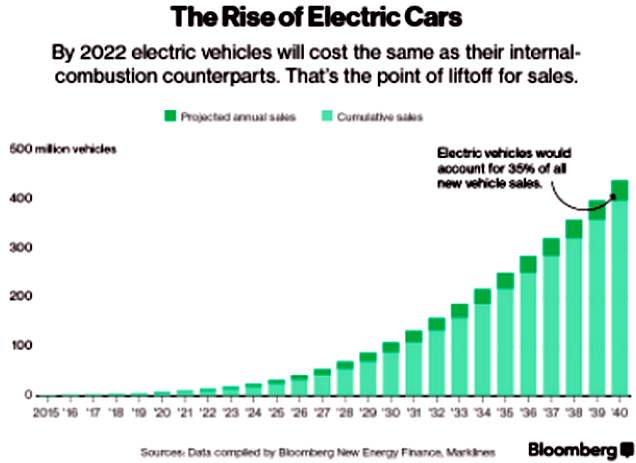
In its report into the impact of electric cars on oil demand, oil and gas giant BP forecast that the global fleet of petrol and diesel cars would almost double from about 900 million in 2015 to 1.7 billion by 2035.
Image: BP

Image: EVvolumes.com     
Almost 90% of that growth was estimated to come from countries that are not members of the OECD (Organisation for Economic Co-operation and Development), such as India and China.
China is also gearing up for a move away from gas-guzzling cars.
Last month, the Chinese confirmed they intend to push ahead with plans that will see alternative fuel vehicles account for at least one-fifth of the 35 million annual vehicle sales projected, by 2025.
Oil bosses claim it’s too early to tell what the implications of a move away from petrol and diesel cars will be. However, Asia has long been the main driver of future oil demand and so developments in India and China will be watched extremely closely.

Links

To Slow Climate Change, India Joins The Renewable Energy Revolution

The Conversation

French President Emmanuel Macron, left, welcomes Indian Prime Minister Narendra Modi, before their meeting at the Elysee Palace in Paris, France, Saturday, June 3, 2017. AP Photo/Kamil Zihnioglu
On June 3, two days after President Trump announced that the United States would withdraw from the Paris climate accord, Indian Prime Minister Narendra Modi exchanged a hug with French President Emmanuel Macron during an official visit to Paris. Modi and Macron pledged to achieve emissions reductions beyond their nations' commitments under the Paris Agreement, and Macron announced he will visit India later this year for a summit on solar power.
For observers who equate India's energy production with a reliance on coal, this exchange came as a surprise. Modi's internationally visible pledge would put India three years ahead of schedule to achieve its "Intended Nationally Determined Contribution" to the Paris climate agreement. Instead of shifting to 40 percent renewables by 2030, India now expects to surpass this goal by 2027.
As the United States retreats from international action on climate with a bewildering lurch toward coal, other countries are assuming leadership in the most far-reaching energy transformation since the beginning of the Industrial Revolution. China is cementing its role as a dominant producer of solar panels and wind turbines, and a number of European countries are continuing their slow move away from fossil fuels.
India, meanwhile, is emerging as a major market for renewable energy, laying out aggressive plans for investments in solar and wind. This shift is not about a starry-eyed prime minister seeking to garner international goodwill. It is the result of a fundamental energy and economic transition already underway, which India's leadership has recognized.
Parabolic dishes at the India One solar thermal power plant, Rajasthan. Brahma Kumaris/Flickr, CC BY-NC
An energy pricing revolution
Prime Minister Modi's renewable energy agenda aims to increase India's grid-tied renewable energy capacity from roughly 57 gigawatts in May 2017 to 175GW in 2022, with most of the increase coming through a major expansion in solar. India's installed capacity for solar energy has tripled in the last three years to its current level of 12GW. It is expected to jump by more than 100GW over the next six years, and increase further to 175GW before 2030.
Coal currently provides nearly 60 percent of India's of total installed electricity generating capacity of 330GW, but the government projects it will decline substantially as solar power ramps up. In May 2017 alone, the states of Gujarat, Odisha and Uttar Pradesh canceled thermal energy plants – that is, those powered by coal – with a combined capacity of nearly 14GW of power.
Price decline is perhaps the biggest reason India is shelving its plans for new coal-based power plants. Over the past 16 months, the cost of producing utility-scale solar electricity in India has fallen from 4.34 rupees per kilowatt-hour in January 2016 to 2.44 rupees (a little over 3 cents) in May 2017 – cheaper than coal. For the moment, large-scale solar and wind are roughly similar in price and lower than nuclear and fossil fuels.
Meenakshi Dewan tends to maintenance work on the solar street lighting in her village of Tinginaput, India. Solar power is bringing electricity to rural areas in India that are not connected to the national power grid. Abbie Trayler-Smith / Panos Pictures / Department for International Development/Flickr, CC BY-NC-ND
Prices this low for utility-scale renewable power in emerging economies are unprecedented but also exciting. Only last year, when the Indian state of Rajasthan held an electricity solar power auction, energy analysts deemed one company's bid to supply solar power for 4.34 rupees per kilowatt-hour too low, and possibly leading to project failure. But solar energy prices are still falling as a result of fierce competition, lower costs all along the supply chain and favorable interest rates.
Large, credible international companies such as SoftBank Group of Japan, Taiwan's Foxconn Technology, and India's Tata Power are jumping into this highly competitive market. And the shift is not just happening in India. Solar prices in Chile and the United Arab Emirates fell below 3 cents per kilowatt-hour in 2016. Indeed, where emerging economies are installing new power generation capacity, the economic argument in favor of renewables is strong and getting stronger.
Additional drivers of this revolution include the local and global pollution costs of extracting, transporting, refining and consuming fossil fuels. In opting for renewables, India and China are responding to widespread local protests against air and water pollution and the human health impacts of continued reliance on fossil fuels.
For poor countries, domestic solar power generation has another side benefit. It saves them foreign exchange by substituting solar energy for imports of oil, gas and coal.

Three key conditions
Three conditions are critical for this structural shift to continue in India and globally: growth in energy demand, innovation to make electricity grids more reliable and adequate land for installing solar modules.
Per capita electricity use in India is among the lowest of the emerging economies. Therefore, it is likely that demand will continue to rise to meet increasing availability of electricity.
India's national grid came into existence relatively recently in 2013 with the connection of its different regional grids. The grid must become more robust to cope with the range and intermittency of some forms of renewables-based power. One silver lining, however, is that high electricity demand periods in India for commercial activities and air conditioning occur during the day, when solar production is at its peak.
India's high population density means that freeing up land for solar installations will require careful zoning and land use planning. National policy should require greater emphasis on land areas that are less critical for other productive uses or for biodiversity conservation and ecosystem management.
Smog obscures the Taj Mahal on Jan. 26, 2017. Air pollution, mainly from fossil fuel combustion, is discoloring the building's white marble. Kathleen/Flickr, CC BY
Solar diplomacy
Renewable power offers a relatively low-cost solution to energy security challenges, conserves scarce foreign exchange and reduces fossil-fuel-based pollution. These benefits led India and France to propose an International Solar Alliance for "sunshine" countries in the tropics at the Marrakech climate change conference in November 2016. These countries receive strong solar radiation that fluctuates very little throughout the year, thereby providing favorable conditions for low-cost solar power generation.
ISA is a treaty-based intergovernmental organization that already counts 123 countries as members. It is committed to increasing adoption of solar power production by sharing technological knowledge and by mobilizing $US1 trillion in financing from international development banks and the private sector by 2030. The Modi-Macron embrace extends far beyond France and India.
Broader adoption of renewable power production in emerging economies is not the only solution to climate change challenges. But it is a central plank in global strategies to manage climate change-related problems. Countries such as India, China, France and ISA members are demonstrating that a failure of U.S. leadership need not stand in the way of a renewables revolution.

Links

Alan Finkel Auditions For The Role Of Australia's Chief Political Scientist

Fairfax - Peter Hannam

Friday marks an important day in Australia's efforts to settle on climate action but those hoping chief scientist Alan Finkel has puzzled out a durable and effective solution are likely to be disappointed.
Debate this week has focused on the means of how to achieve a cut in pollution, whether by a so-called clean energy target or an alternative route. But quite where the various rules and new mechanisms will take us in terms of carbon cuts has largely been sidelined.


Labor moves to end climate change policy wars
The federal opposition is indicating it may back a plan for cleaner energy through a low emissions target, a move which could bring to an end 10 years of climate policy wars.

The review recommends the electricity sector merely meets the 28 per cent cut in 2005-level emissions by 2030 pledged to the Paris climate accord by the Abbott-Turnbull governments.
Given the electricity sector is widely viewed as the industry best placed to make substantial - and relatively low cost - pollution cuts, Finkel's target is underwhelming. Instead, he recommends the government by 2020 prepare a whole-of-economy strategy for 2050 with no specifics other than "it may be appropriate" for governments to ask the sector do more than 28 per cent.
The result is a report that is as much a roadmap for politicians to get out of the energy and climate mire rather than one that serves Australia's climate goals - and what other nations expect of us.
The problem with the 28 per cent figure - which the government says Finkel chose himself - is the electricity sector has always been expected to lead the reduction event both in Australia and almost every other nation.
If that's all the power sector delivers, Australia will get nowhere near the 2030 Paris goal it has promised because other parts of the economy are much harder to tackle especially without an economy-wide carbon price.
The electricity sector is no longer expected to punch above its weight. Photo: Joe Armao
Biggest polluterThe power industry is Australia's biggest polluter, emitting 187.5 million tonnes of carbon dioxide-equivalent pollution in 2015, or about 35 per cent of the total.
Its concentrated nature and competitive renewable energy alternatives make the transition to a low-emissions future also among the cheapest pathways.
That's why major international bodies from the Intergovernmental Panel on Climate Change to the International Energy Agency model swifter falls in energy sector emissions than Finkel has used when calculating how to keep global warming to less than two degrees above pre-industrial levels. (See IEA chart below.)

The revelation that Finkel set such a low mark was met with disbelief from some climate experts. Responses ranged from "you must have heard wrong" or "this is absolutely catastrophic - Australia is basically saying good bye to the Paris target".
Typical was Bob Ward, a policy director at the Grantham Research Institute on Climate Change and the Environment, at the London School of Economics and Political Science.
"Most of the emissions reductions achieved so far by the UK have been in the power sector...[and] the same is true for emissions cuts in the United States," Mr Ward said.
"Making cuts in other sectors will be harder, and in transport, for instance, reducing emissions through the introduction of electric vehicles will depend on a supply of low-carbon power," he said. "It is difficult to see how Australia could follow a radically different path to cutting its emissions by 2030."
Chief Scientist Dr Alan Finkel has presented his electricity market report to the COAG leaders meeting in Hobart on Friday. Photo: Alex Ellinghausen
Hugh Saddler, an honorary associate professor at the Australian National University, put it bluntly: "What are they going to do, cut the cattle herd by 28 per cent by 2030?".
Proof that Australia may reduce its climate ambitions will need to await the government's fuller Review of Climate Policies due later this year. Still, after Donald Trump's recent decision to pull the US out of the Paris accord, it's natural global interest will focus on other countries wavering in their commitment.

Power play
In Finkel's defence, the terms of reference limited his focus "to develop a national reform blueprint to maintain energy security and reliability".
Still, he could have picked from the Climate Change Authority's special review last year of the electricity sector. Relative to 2015 levels (which were slightly lower than in 2005), that review modelled falls of 69-74 per cent to 2030.
Those briefed on Thursday suggested Finkel had taken a thoughtful approach with a keen eye on what was politically feasible.
That's why his report backs a clean energy target rather than an emissions intensity scheme given a tentative tick in Finkel's preliminary report. The Turnbull government stamped on that latter concept within days of its release in December.
Finkel decided on something that had a fighting chance of bipartisan support, one person said of the final report. Anything more ambitious would fail because of likely opposition within the federal coalition.
Another state's delegate was not overly worried about the 28 per cent target saying it was important to set up the architecture for the transition out of coal, and have the option of ramping it higher later.
Whether that plan wins support of a sceptical federal opposition and the Greens remains to be seen.
Another sought Finkel's suggestions for other sectors, such as transport and agriculture - where government policy is largely absent. The scientist is understood to have said that wasn't his instructions.
That broader study could be Finkel's next job, one of those briefed joked to Fairfax.

Links

10/06/2017

Finkel Review: Households Could Save Up To $1000 Over A Decade Under Clean Energy Target

Fairfax | 

Australian households would save about $90 a year, or up to $1000 on their electricity bills over a decade to 2030 under the Clean Energy Target proposed by the Finkel review of the electricity sector, compared to a business-as-usual scenario for it.
The review, released on Friday at the Council of Australian Governments meeting, argues Australia has a "once-in-a-generation" opportunity to reshape the national electricity market; take advantage of technological change; improve the security and reliability of the system; reward small and large consumers who reduce electricity demand and meet a 26-28 per cent emissions reduction target by 2030.

Labor moves to end climate change policy wars
The federal opposition is indicating it may back a plan for cleaner energy through a low emissions target, a move which could bring to an end 10 years of climate policy wars.

It also highlights a warning from the Australian Energy Market Operator that next summer, both Victoria and South Australia could face electricity supply interuptions following the closure of the Hazelwood coal-fired power station.
Another key recommendation of the report is that power generators should in future have to give three years' notice before closing down.
"This will signal investment opportunities for new generation and give communities time to adjust to the loss of a large employer," Dr Alan Finkel said.
The Turnbull government should also, in its current review of climate change policy, which is due to be released at the end of the year,  should look to set a post-2030 emissions reduction goal through to 2050 to give greater certainty to the sector, and investors.
The report focuses on four key outcomes: how to deliver energy security, reliability, affordability for households and business, and meet Australia's emissions reductions targets.
The call for a new Clean Energy Target (CET) is, as expected, one of the key recommendations of the review and its promise of lower power prices for households will be crucial in Mr Turnbull and Energy Minister Josh Frydenberg convincing conservative MPs the CET is the policy to adopt.
Chief Scientist Dr Alan Finkel's review of the electricity market promises lower prices under a Clean Energy Target. Photo: Alex Ellinghausen
The report examined the effectiveness of the CET and an emissions intensity scheme (EIS) and modelled how both, if calibrated to hit a 28 per cent emissions reduction by 2030, and zero emissions by 2070, would work.
Under the scenarios examined, both a CET and EIS would deliver cheaper power prices for households and consumers, all the way through to 2050, compared to the "business-as-usual" scenario, but a CET would deliver slightly cheaper prices than EIS.
"In the long-term, the CET scenario saw more electricity produced by brown coal than the EIS scenario because there is no penalty for high emissions generators. However, marginally more renewable capacity was built in the CET policy scenario that led to slightly higher overall resource costs over the modelling period," the report notes.
"Under both the CET and EIS scenarios, the renewable generation mix in 2030 was 42 per cent of the generation sent out."
The Renewable Energy Target should be abolished after 2020 and replaced by the CET, the review said.
Dr Finkel's review noted that while energy sector stakeholders had pushed for an EIS, the federal government had ruled one out. Therefore a CET, which has similar ability to reduce emissions, was the preferred option.
The report warns the national electricity market is under stress because of policy uncertainty and says "action should be taken with the aim of creating a market environment in which the electricity sector has the confidence to invest."
"The impact of a high degree of market uncertainty is ultimately borne by consumers in the form of a more costly, less reliable system."
The report predicts that, under a business-as-usual scenario, a CET or an EIS, the use of coal power will decline in the decades to 2050 as older generators come to the end of their life and because "investors have signalled that they are unlikely to invest in new coal-fired generation".
Increasing energy efficiency, greater use of solar on homes and storage will partially offset this but, the report states, it is incumbent on state and federal governments to take "decisive action to ensure the transition to the future grid . . . is smooth and that the electricity system continues to serve the interests of all consumers".
Part of Dr Finkel's blueprint for a more secure electricity sector are measures including obligations on new generators to provide essential services to maintain voltage and frequency.
New wind and solar generators, for example, would have to be able to supply reliable despatchable power - meaning they would have to build a battery, have pumped hydro storage or gas-fired power.
New generators will be required to guarantee supply of electricity when needed at a level determined following regional assessments by the national market operator in a bid to avoid blackouts like the one that crippled South Australia earlier in the year.
Dr Finkel has recommended better system planning, with a system-wide grid plan to inform network investment decisions and ensure security is preserved in each region of Australia.
This would also include a list of potential priority projects to enable development of renewable energy zones.
"Security and reliability have been compromised by poorly integrated variable renewable electricity generators, including wind and solar. This has coincided with the unplanned withdrawal of older coal and gas-fired generators," Dr Finkel said.
The report calls for a new "Energy Security Board" to drive implementation of the blueprint and deliver an annual health check on the state of the electricity system.
Reliability would be further reinforced through a "Generator Reliability Obligation" implemented by the Australian Energy Market Commission and the Australian Energy Market Operator following improved regional reliability assessments.
"The National Electricity Market is 5000 kilometres long, spans five states and one territory and has more than 9 million metered customers. It's essential that we get it right," Dr Finkel said.

Links

Finkel Review Anticipates Lower Power Prices, But Weak Electricity Emissions Target

The Guardian

Report by the chief scientist, Alan Finkel, models a clean energy target that would reduce electricity emissions by 28% on 2005 levels
The Finkel review aims for lower power prices as Australia moves towards a greater share of renewables, but with an unambitious emissions reduction target. Photograph: Bloomberg/Bloomberg via Getty Images
Australia’s chief scientist says a new clean energy target will deliver lower power prices to consumers than the status quo, but his report also models a scheme with a low target for emissions reduction from the electricity sector.
In his much anticipated review of the national electricity market, Alan Finkel has examined a scheme with an emissions reduction target of 28% on 2005 levels by 2030, rather than the reductions of 60% that some experts say would be necessary for Australia to meet its whole-of-economy pollution reduction target under the Paris climate accord.
Finkel’s report, given to the Turnbull government and the premiers on Friday, says the clean energy target (CET) modelled by the review would result in lower residential and industrial electricity prices than leaving policy settings unchanged.
It says the CET scenario is more favourable to the hip pocket than an emissions intensity trading scheme – a form of carbon trading supported by a range of experts and industry stakeholders – but the CET would see more electricity produced by brown coal “because there is no penalty for high emissions generators”.
The report also warns governments that setting a higher target for electricity than a 28% reduction on 2005 levels by 2030 trajectory “may have consequences for security, cost and reliability”.
The proposed CET would replace the existing renewable energy target in 2020. Modelling undertaken for the review estimates that by 2030, 42% of electricity demand will be met by renewable generation.
As reported by Guardian Australia on Thursday, the Finkel report recommends that power generators face new security and reliability obligations, and it says ageing power plants should provide energy regulators with three years’ notice before they close.
Finkel says all new generators intending to connect to the national electricity market must meet technical requirements to contribute to fast frequency response and system strength.
He says the new rules would require minimum levels of inertia in each region. “This will make the system better able to withstand disruptions like generator outages or interconnector failures,” the report says.
In addition to the notice before shutdown requirements, which are designed to stop a repeat of the Hazelwood closure, the report says the Australian Energy Market Operator (Aemo) should also publish a register of expected closures to assist long-term investor planning.
With a new CET encouraging gas fired power, Finkel recommends Aemo be given “expanded visibility on gas contracts so that it can plan responses to shortages”.
He also calls for an expansion of gas supply. “Governments should also work with communities to encourage safe exploration and production, based on best available evidence, performance data and appropriate financial rights for landholders”.
Ahead of the release of the report, the deputy prime minister Barnaby Joyce said he would be happy to accept a new CET provided it allowed for the construction of new coal-fired power stations.
Joyce said if Australia walked away from coal exports and coal-fired power generation people would need to be “prepared to be poorer”.
The former prime minister Tony Abbott declared on Wednesday it would be a “big mistake” for the government to adopt an emissions target that knocked out new high-efficiency coal-fired power stations.
While Labor has been signalling it will bring an open mind to the review, the shadow climate change minister, Mark Butler, said “you can’t have a clean energy target that defines clean energy to include coal-fired power”.
“Barnaby Joyce was out this morning saying that a clean energy target must accommodate the building of new coal-fired power stations. A CET that accommodates new coal-fired power stations is an oxymoron; it is a contradiction in terms”.
Speaking to reporters at the Council of Australian Governments meeting in Hobart, the prime minister, Malcolm Turnbull, said there was “no barrier to building a coal-fired power station” in the system envisaged by Finkel.
“There is nothing in the clean energy target that would prevent a new coal-fired power station being built,” the prime minister said.
Challenged on whether a coal fired power station would be built in the absence of substantial government subsidy, Turnbull said: “Thank you for your opinion on that but others would differ. Time will tell”.
Turnbull said a CET had a number of “very strong virtues.” He said the system was technology neutral and administratively familiar. “It would follow on from the renewable energy target and business is used to it”.
The Greens climate and energy spokesman Adam Bandt said the new arrangements proposed by Finkel were weaker than the system proposed by John Howard in 2007.
“The Finkel report is full of good ideas, but the key proposal of a CET is far worse than the version John Howard announced in 2007 and will see consumers subsidise gas and let coal keep polluting,” Bandt said.
“Bill Shorten and Labor cannot end the climate wars by running up the white flag and blindly signing up to a deal with the Liberals.”
Finkel told reporters after Friday’s Coag meeting in the system he was proposing, there was “no prohibition of any kind that prevents that coal from being built.”
The chief scientist said it was “conceivable” that new coal fired power stations could be built, and he said it was “probably more likely that the existing coal stations will run longer than they would under a business as usual model” because there was now a price signal to determine future investment decisions.
He said his recommendations did not have an eye to political considerations. Finkel said he approached the task “absolutely objectively”.
Asked whether the 28% target was too low ball to meet Australia’s Paris commitments, Finkel said his intention was to ensure “the electricity sector does at least its fair share in meeting those international obligations”.
He said it was up to the government to determine whether a 28% target was acceptable and it was beyond the scope of his terms of referene to determine how the economy wide emissions reductions should happen.
“How those obligations are met across the whole of the economy is beyond the terms of reference,” Finkel said.
The review examined the relative market share of technologies under a business as usual case and a CET system.
By 2030, if policies remained as they currently are, 14% of generation would come from wind, 8% from hydro, 3% from large scale solar, 1% from biomass, and 9% from rooftop solar.
Coal would make up 57% and gas 8%. Large scale intermittent generation – from wind power and large scale solar – would be 17%.
By 2030, under a CET, the relative mix would see 18% of generation from wind, 8% from hydro, 6% from large scale solar, 1% from biomass, and 9% rooftop solar.
Coal would drop to 53% and gas to 5%. Large scale intermittent generation would be 24% of the market.

Links

The Finkel Review At A Glance

The ConversationMadeleine De Gabriele | Michael Hopkin | Wes Mountain

The Finkel review aims to introduce certainty into Australia’s energy market. Reuters/Tim Wimborne
The long-awaited report from Chief Scientist Alan Finkel into Australia’s National Electricity Market was released today.
The key recommendation is the adoption of a Clean Energy Target. This mandates that energy retailers provide a certain amount of their electricity from “low-emissions” generators – sources that produce emissions below a threshold level of carbon dioxide per megawatt.
Crucially, Dr Finkel has not made a recommendation as to the precise threshold or the number of certificates to be issued, saying:
The Panel acknowledges that the specific emissions reduction trajectory that should be set for the electricity sector is a question for governments.
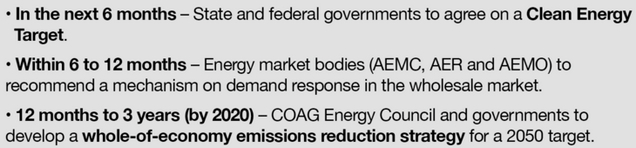
At a minimum, the electricity sector should have a trajectory consistent with a direct application of the national target of 26-28% reduction on 2005 levels by 2030, as per Australia’s international obligations under the Paris Agreement.
The Finkel Review at a glance

Recommendations

Next steps

From the Chief Scientist

Links

Lethal Heating is a citizens' initiative