There is currently just one climate scientist on the Climate Change Authority. There may soon be none.
David Karoly. He sees dark times ahead, and not just because he's looking through sunglasses.
Does the government take its own climate change advice seriously?
Does it even want a body whose role is to give it expert advice?
These are the questions being asked by Professor David Karoly,
a climatologist at the University of Melbourne. There's a tiny bit of
background to this story so we'll help you along with a short list.
Founded in 2012, the CCA is the body that advises the government on climate change mitigation initiatives.
In other words, it tells them WHAT TO DO about
climate change. For several years now, the CCA has done this job well.
And for a while, the government listened.
Of late, the CCA and the government have not been getting along so well. In 2016, it produced a report called the Special Review of Australia's Climate Goals and Policies. The government turned its nose up at that, rejecting many key recommendations.
Resignations followed. Among them was economist John Quiggin, who quit the CCA in March this year. Here's a sample of his disgruntled, almost despairing resignation letter: "The government's refusal to accept the advice of its own Authority, despite wide support for that advice from business, environmental groups and the community as a whole, reflects the comprehensive failure of its policies on energy and the environment. These failures can be traced, in large measure, to the fact that the government is beholden to right-wing anti-science activists in its own ranks and in the media. Rather than resist these extremists, the Turnbull government has chosen to treat the vital issues of climate change and energy security as an opportunity for political point scoring and culture war rhetoric."
The Climate Change Authority now faces a new
crisis that could effectively strip its credibility to the bone. The CCA
could have no climate scientists on it.
Right now, there is just one climate scientist on the Authority. As mentioned, he is the eminent climatologist Professor David Karoly of the University of Melbourne. His five-year term ends on June 30. He fears he will not be replaced by a climate scientist.
Wait. The Climate Change Authority could soon have no climate scientists on it?
What??? Mickrick via Getty Images
HuffPost Australia asked the government to
clarify whether Prof. Karoly's position would be filled by a climate
scientist -- or indeed by any scientist -- when his term expires.
A spokesman for Environment and Energy Minister
Josh Frydenberg said only that "Government appointments to the CCA will
be made consistent with the CCA's legislation".
We were not intimately familiar with said piece of legislation,
so we looked it up, and discovered that there's no requirement for a
climate scientist to be on the CCA. Which means Frydenberg may choose
not to appoint one.
Josh Frydenberg. Bloomberg via Getty Images
One more time. The body which advises the
government on what to do about climate change may soon have nobody with
expertise in climate science -- the very subject which underpins the
body's existence.
For the record, the other current CCA members
include businesspeople, a natural resources expert, an energy expert and
a CEO -- Shayleen Thompson -- who is a climate change policy expert.
But does the body have any real teeth?
Here's what does David Karoly told us about the future direction of the CCA in Episode 4 of Breaking The Ice, HuffPost Australia's podcast series about the people behind the climate science: "The policy of the current government is that the climate change authority should be dissolved. And that seems to be what they're trying to do.."
Naturally, we put that statement to the government for comment. Are they indeed trying to dissolve the CCA? They told us: "We continue to fund the CCA on a year by year basis."
So that's about the shape of that. People who've
been on the Climate Change Authority say the government is hostile to
climate science. The government ignores many of the Authority's key
recommendations.
Meanwhile the government will neither confirm nor deny anything about its future -- including the crucial issue of whether a climate scientist will be part of the nine member board after June 30.
When US President Donald Trump announced that his country would be pulling out of the Paris agreement, the immediate reaction across the globe was one of despair, anger and helplessness.
The Paris agreement is widely seen as the last opportunity for the
world to unite and limit the increase in global temperature to 2 degrees Celsius. How can this international agreement remain relevant when the world's second-largest polluter chooses to remain outside its ambit and is not willing to be held responsible?
This wasn't the first time that the United States has reneged on a climate deal. George W. Bush's government had refused
to ratify the Kyoto Protocol (1997), which proved to be the death knell
for the agreement and international cooperation at large. An entire
decade was wasted with countries sparring over who was really
responsible for the mess we found ourselves in, until Paris.
But 20 years is a long time, and between Kyoto and Paris, we find
ourselves living in a completely different geopolitical and economic
global framework.
The good news is that this time around, there might be reasons to not
despair. Within the climate diplomacy framework, cities led by powerful
mayors are effectively asserting themselves like nation-states and
showing themselves willing to act collectively.
City coalition for climate Speaking at the press conference
about the US withdrawal from the Paris agreement, President Trump
declared that he was "elected to represent the citizens of Pittsburgh,
not Paris. Within minutes of his speech, the mayor of Pittsburgh issued a statement reaffirming the city's commitment to the Paris agreement.
He issued an executive order
committing his city to the accord by continuing efforts to end the use
of landfills, reduce energy consumption by half and develop a fossil
fuel-free fleet of city vehicles.
Mayor Bill Peduto was not alone. All in all, 175 mayors
(and counting) of the biggest cities across the country, cutting across
party lines and representing 51 million Americans, reaffirmed their
commitment to the Paris agreement.
On social media, #wearestillin quickly became viral while US mayors pledged their commitment to climate change on an eponymous website listing all supportive cities.
Since Trump's decision to pull out, US states have jumped in. On June 6, Hawaii enacted legislation in support of its Paris commitments. The same day, California independently signed an accord with Germany, with the aim of empowering local communities to combat climate change.
It's not just US cities that support the Paris Agreement.Carlos Jasso/Reuters
Powerful, independent cities
This isn't the first time that cities have found themselves at the
centre stage of international politics. In fact, historically, most
global cities have preceded their respective nation-states by over 5,000 years. But by the late 19th century, when the concept of the Westphalian sovereign
nation-state developed in modern international relations, and countries
became the main actors on the diplomatic stage, the political clout of
cities diminished.
Over the last decade, this has changed significantly. For starters,
some cities have grown so big that by virtue of their economic might,
they're now able to assert themselves independently. New York's GDP
(US$1.45 trillion) is larger than that of Spain (US$1.1 trillion) or South Korea (US$1.38 trillion).
São Paulo state in Brazil is wealthier than Argentina, Uruguay, Paraguay and Bolivia combined, and Guangdong in China is richer than Russia or Mexico.
Most big cities in the world have also been able to organise
themselves under a common international forum, which only further
enhances their bargaining power.
Local Governments for Sustainability (ICLEI), United Cities and Local Governments (UCLG) or the Cities Climate Leadership Group (C40) are a few such examples.
These hybrid and often complex networks have been particularly
successful in fostering innovative modes of cooperation between the
private sector and cities.
The private insurance industry is working with several cities across the world to identify and quantify risks
as well as design mitigation strategies and post-disaster financing
instruments. It's a win-win situation for both parties as the insurance
industry helps develop cities' climate resilience and, in return, gains
access to new markets.
City diplomacy
Former New York mayor Michael Bloomberg is a strong proponent of this form of city diplomacy. He had once cheekily remarked:
We're the level of government closest to the majority of the world's
people. We're directly responsible for their well-being and their
futures. So while nations talk, but too often drag their heels, cities
act.
True to his word, within a few hours of President Trump's press
conference, Bloomberg had managed to organise a coalition through the Cities Climate Leadership Group (C40), which he chairs.
On June 2 2017, addressing a joint press conference
with French President Emmanuel Macron at the Élysée Palace, Bloomberg
assured the international community that the US will meet its Paris
commitment, and through a partnership among cities, states, and
businesses, will seek to remain part of the Paris agreement.
He went a step further and pledged US$15 million, the amount that the
Bonn-based secretariat of the UN Framework Convention on Climate Change
(UNFCCC) stands to lose as a result of Washington's decision to pull
out of the deal.
Accepting Bloomberg's proposal, Christina Figueres of the UNFCCC has
even promised to evolve a method for cities to be able to independently
declare their Intended Nationally Determined Contributions (INDCs), a
responsibility earlier reserved only for countries in the Paris
agreement.
IMAGE
City leaders have also been active members of the 2016-founded Global covenant of mayors for climate and energy, an international alliance of mayors grouping 7,450 cities across the world dedicated to fighting climate change.
President Trump's decision to pull out of the deal seems to have
inspired action not just in American cities but also in the developing
world.
The cost of climate change
Last week, India announced
that it does not plan to build any new coal plants after 2022. It has
also committed to generating 57% of its power through renewable sources
by 2027, far exceeding its earlier target and three years before
schedule.
Aided by a favourable market and falling technology costs, countries
such as India and China are keen to assume global leadership.
Indian mayors are also particularly conscious of the financial cost
of climate change. The 2015 floods that hit the southern state of Tamil
Nadu and particularly the city of Chennai, caused a US$3 billion loss to the Indian economy.
Chennai is now seeking to learn resilience strategies from other Indian
cities that have faced similar disasters and adapted successfully.
An aerial view shows a flooded residential colony in Chennai on December 6 2015.Anindito Mukherj/Reuters
One of them is Surat, in Gujarat, on the west coast of India. The industrial, fast-growing town has been severely affected by climate change. In the last decade, Surat has experienced over 23 floods as well as an outbreak of plague in 1994.
But the town has made great strides
towards resilience. From building early warning response systems,
mapping communities vulnerable to flooding, setting up a system of
evacuation shelters, securing the electricity grid, preventing
vector-borne diseases and groundwater management programs, Surat has
been able to drastically reduce the effects of climate change-induced
disasters.
Globally, since 2000, climate change disasters are estimated to have cost a whopping US$2.5 trillion. The case for clean energy, resilience and sustainability is increasingly an economic one rather than purely environmental.
Climate is cities' responsibility
Cities have an added incentive and responsibility to act before it's
too late. Almost all of the world's cities are dealing with one or more
of the harmful effects of climate change. After all, 90% of the world's
urban areas are in proximity to coastal land, which puts most cities at
risk of flooding due to rising sea levels.
Cities also consume ⅔ of the world's energy and are responsible for over 70% of global CO² emissions.
It is critical that cities have plans in place to deal with climate
change and its effects, develop resilient infrastructure and have
contingency plans for disaster recovery.
Former US president Barack Obama had committed to reducing US greenhouse gas emissions 26% to 28% by 2025, from their 2005 levels.
If the enthusiasm of the mayors over the last few weeks is anything
to go by, President Trump's decision to pull out of the Paris agreement
only seems to have reinvigorated efforts, strengthened resolve and
motivated local leadership to redouble efforts to tackle climate change.
Some US mayors are even confident of bettering Obama's commitment.
If cities, states, businesses, and civil society are able to work
together and tap into networks of other cities while maintaining the
right kind of momentum, Trump pulling the US out of the Paris deal might
just turn out to be a blessing in disguise.
The new study also confirms the planet is warming 20 times faster than Earth's fastest natural climate change
Stalagmites and stalactites in the caves of Diros in Greece.
Photograph: Alamy Stock Photo
Earth's last ice age ended about 12,000 years ago. The warmer and
more stable climate that followed allowed for the development of
agriculture and the rise of human civilization. This important period
encompassing the past 12,000 years is referred to as the Holocene geological epoch. It also created a "conundrum" for climate scientists, because global temperatures simulated by climate models didn't match reconstructions from proxy data.
To be specific, the overall temperature change during the Holocene
matched pretty well in reconstructions and models, but the pattern
didn't. The best proxy reconstruction from a 2013 paper
led by Shaun Marcott estimated more warming than models from 12,000 to
7,000 years ago. Then over the past 7,000 years, Marcott's
reconstruction estimated about 0.5°C cooling while model simulations
showed the planet warming by about the same amount. A new paper
led by Jonathan Baker may help to resolve that discrepancy. The
scientists examined stalagmites from a cave in the southern Ural
Mountains of Russia. The ratio of oxygen isotopes
in the stalagmites can be used to estimate past winter temperatures.
The Marcott study had one known shortcoming – the proxy temperature data
they used mostly represented the summer season. And as Baker explained,
changes in the Earth's orbital cycles have caused cooling in the
northern hemisphere summer and winter warming during the Holocene:
Because our orbit is elliptical, we're not always the same distance from the sun. About 10,000 years ago, Earth was closest to the sun during summer and farthest during winter. Today it is the opposite. Based on this variable alone, we would expect winter warming and summer cooling in the northern hemisphere (and vice versa in the southern hemisphere) over the last 10,000 years.
During the period from 15,000 to 7,000 years ago, temperatures were
rising because large ice sheets were disappearing. That was especially
true in the summer because back then, the Earth was closest to the sun
during that season.
So the Marcott temperature reconstruction, which was
predominantly based on summer temperature proxies, estimated a lot of
warming from 15,000 to 7,000 years ago (more than in model simulations),
then a small cooling thereafter, while models simulate a slight warming
over the past 7,000 years due to a slow rise in greenhouse gases.
The
stalagmite data in the Baker study show that winter temperatures
behaved differently and can reconcile the discrepancies between the
Marcott reconstruction and model simulations.
This suggests that the
climate models are right – Earth's surface temperature warmed rapidly at
the end of the last ice age, from about 17,000 to 7,000 years ago, then
the rate of warming slowed as the climate stabilized. However, it
didn't reverse into a cooling trend, because atmospheric greenhouse gas
levels were rising.
Then of course came the Industrial Revolution 200 years ago, and
carbon dioxide levels consequently shot up due to humans burning fossil
fuels. As a result, temperatures have spiked as well. Over the past 130
years, global surface temperatures have risen about 20 times faster than when the Earth transitioned out of the last ice age. Over the past 40 years, the rate of global warming has been 3 times faster yet.
And that's in comparison to Earth's fastest natural climate change,
when it's transitioning from an ice age to a warm period. Over the past
7,000 years, when human civilization was able to develop and thrive,
Earth's temperatures and climate were quite stable. The temperature
change during the past 7,000 years was about 0.5°C.
Humans have caused
that much warming in just the past 25 years. If we follow through with
the Paris agreement and manage to limit global warming to 2°C over a
200-year period, in that best-case scenario the Earth would still warm
20 times faster than a natural ice age transition. If we fail to cut
carbon pollution, that rate could speed to more than 50 times faster
than Earth's fastest natural climate change.
There are several important points we can take from the Baker study.
First, climate models are able to simulate climate changes over the
history of human civilization fairly accurately.
Second, when there's a
discrepancy between data and models, people have a tendency to distrust
the models, but sometimes the problem lies more in the data.
Third, if
not for the human influence, the climate would continue the stable
conditions of the past 7,000 years, during which time human civilization
developed and thrived.
Fourth and most importantly, humans are in the process of
destabilizing the climate, and we're already causing global warming at a
rate 20 times faster than Earth's fastest natural climate change.
That's why climate scientists are so concerned, and why the Paris
agreement is so important.
In a recent paper,
Justin Ritchie, a Ph.D. candidate in resources and the environment at
the University of British Columbia, and his co-author, UBC professor
Hadi Dowlatabadi, pointed out that global estimates of the amounts of
coal that are economically and technologically recoverable have fallen
by two-thirds since the 1990s. This observation also formed the
substance of my 2009 book, Blackout: Coal, Climate and the Last Energy Crisis, so it’s nice to see the point taken up by others. However,
Ritchie and Dowlatabadi go a step further and think through the
implications of the ongoing coal reserves downgrades for climate
modeling.
The Intergovernmental Panel on Climate Change (IPCC) has for years
produced computer-generated models of several possible trajectories for
future greenhouse gas emissions through the remainder of the century.
These “representative concentration pathways,” or RCPs, include an extreme high emissions case,
RCP 8.5, that is commonly referred to as “business as usual.” In this
scenario, “coal use in particular increases almost 10 fold by 2100”
according to IPCC authors.
At the 2015 American Geophysical Union meeting in San Francisco, at a
session co-organized by Post Carbon Institute and other organizations,
PCI Fellow David Hughes gave a presentation
in which he showed that actual recoverable fossil fuel reserves are
consistent only with low-emissions RCP scenarios. The new paper from
Ritchie and Dowlatabadi reaffirms much of Hughes’s argument (though
Hughes looked more broadly at reserves of all fossil fuels, plus
uranium).
What does this downgrading of likely carbon emissions mean for
climate change modelers, climate activists, policy makers, and concerned
citizens? According to Ritchie, the implication is clearly not as
simple as “don’t worry, fossil fuel depletion will solve climate change
for us.” Instead, “The same finding that shrinks CO2 emissions may also
lower the cost of dealing with global warming, making the Paris
Agreement that addresses climate change easier to achieve,” as a Bloomberg article
on Ritchie’s paper puts it. That’s because costs of climate action are
typically measured against the economic growth presumed to occur if the
world continues burning coal and other fossil fuels at ever-increasing
rates extrapolated from recent decades. If those extrapolations are
unrealistic (too high), then keeping emissions within a two-degree
Celsius limit will be easier and cheaper.
Ironically, Ritchie’s and Hughes’s questioning of likely future
carbon emissions (no official change has filtered through the IPCC
apparatus as of yet) occurs just as Donald Trump undertakes telegenic
coal advocacy and abandons the Paris climate accord. In view of the
reality that America’s best coal has already been dug and burned, the
notion that the industry can somehow be revived at our president’s whim
would be laughable—except that the sad joke is on the hundreds of
thousands of coal country voters who fell for Trump’s fake promises.
Why has the world dragged its feet in adopting more realistic fossil
fuel resource estimates? Pushback from the fossil fuel industry is
certainly understandable: coal, oil, and gas companies—whether traded on
stock markets or government owned—derive market value from their
assets, which consist of future production potentials. Lower reserves
estimates translate to lower asset valuations. The motives of climate
scientists and activists in overestimating burnable carbon reserves are
harder to divine; one can only guess that they accept at face value the
numbers from the fossil fuel industries, and then pad those numbers
further out of caution (more on this in a moment). In any case, more
realistic fossil fuel reserves estimates should help us come to terms
with reality in several ways—not only with regard to climate modeling,
but economic expectations and political prospects as well.
Every few years, the IPCC issues a major new “assessment” crammed
with data and models, aimed at informing policy makers. Unfortunately,
these assessments are also filled with what Oliver Gedens has called “magical thinking.”
For example, the most recent IPCC assessment (its fifth, released in
2014) described a series of computer-generated models of energy and
emissions pathways that would keep the world below two degrees C. Eighty
percent of these rely on negative emissions technologies, of which the
primary one is Bio Energy with Carbon Capture and Sequestration (BECCS).
The idea with BECCS is to grow enormous amounts of biomass, burn it,
then capture the carbon and bury it. In order to capture and bury enough
carbon to make enough of a difference, lots of biomass would be needed;
by Gedens’s calculations an area larger than the size of India would
have to be planted in fast-growing crops destined to be combusted. The
carbon dioxide that’s captured would have to be compressed and moved
through thousands of miles of pipelines to old, depleted oil and gas
wells to be buried forever, requiring an infrastructure comparable to
that of the current global oil industry. The costs would be enormous, as
would be the risks.
Again, unrealistic assumptions about fossil fuel reserves, and
therefore emissions, lead to unrealistic (i.e., implausibly expensive
and risky) methods for keeping those emissions down. The only realistic
solution to our climate crisis is not to put so much carbon in the
atmosphere in the first place. But that path runs counter to
expectations about economic growth—which requires energy. And that is
almost surely at the root of the IPCC’s assumptions about future fossil
fuel consumption (regardless of whether those fossil fuels are actually
available to be consumed).
So far humanity has increased the global atmospheric CO2
concentration from 280 parts per million to over 400 ppm—an already
dangerous level. David Hughes figures burning our remaining realistic
reserves of coal, oil, and natural gas would send us to about 550 ppm.
There’s an easy way of not getting to 550 ppm: leave most of
those fossil fuel reserves in the ground. But that would sink the
economy, unless we very rapidly develop alternative energy sources
(nuclear, which is expensive and risky; or solar and wind, which are
more realistic alternatives). Is it even possible to make the energy
switch so quickly and completely as to avoid major bumps along the road?
Building alternative energy infrastructure will itself require energy,
and during the crucial early stages of the transition most of that
energy will have to come from fossil fuels. There’s no way to bootstrap the energy transition
process with energy from, say solar panels and wind turbines, because
wind, and especially solar, technologies take years to energetically pay
for their own manufacture and installation. So to avert burning even
more fossil fuels than we otherwise would (in order to build all those
solar panels, wind turbines, electric cars, heat pumps, and so on),
resulting in a big pulse of carbon emissions, we would have to severely
curtail the use of fossil fuels for current purposes—the maintenance of
business as usual. That would also imperil economic growth. And we are
talking about a remarkably small time window available for the shift,
compared with the decades required for past energy transitions. It’s all
so complicated that one can get a headache just thinking about it.
The main stumbling block that leads policy makers to twist their
logic into pretzels is economic growth. Remove the requirement for
growth, and it’s barely possible (not easy, but possible) to reconcile
carbon reserves, emissions, energy sources, and warming targets—if
governments somehow dedicate enough money and policy effort to the job.
However, with further economic growth as an absolute requirement, the
resulting climate models fester with internal contradictions and with
assumptions about speculative technologies that very few people believe
can be scaled up sufficiently, and that may have economic,
environmental, and political repercussions that no one is prepared to
deal with.
We cannot afford to hide the implications of realistic fossil fuels
reserves estimates behind magical thinking. Perhaps the most important
of those implications is that the world is probably just about at peak
energy right now, give or take a decade. If we act immediately and
strongly to rein in climate change, then a peak in world energy usage
will likely occur more or less immediately. If we don’t act, then we may
have another decade before fossil fuel depletion results in peak energy
anyway. Our energy mix will shift: in the case of strong climate
policy, oil will start to decline first (due to depletion), probably
before 2020, and coal as well (due to policy), with natural gas growing until roughly 2020-2050, when it peaks globally from depletion. Without strong climate policy, coal peaks anyway
(due to depletion) around 2025 (Chinese coal consumption appears to
have peaked in 2013-2014). The amount of energy we get from nuclear
power probably won’t change much over this time period. Renewables will
contribute a larger share, depending on investment levels and policy
supports, but cannot realistically expand far enough, fast enough, to
maintain energy growth and therefore economic growth.
So overall, one way or the other, we have just about hit the maximum
burn rate our civilization is likely to achieve, and it’s mostly
downhill from here. That has implications for robust economic growth
(it’s essentially over), and hence for war and peace, inequality,
political stability, and further population expansion. Dealing with the
end of energy growth, and therefore economic growth, is the biggest
political and social challenge of our time—though it’s unlikely to be
recognized as such. (Our biggest ecological challenges consist of
climate change, species extinctions, and ocean acidification.) The
impacts of the end of growth will likely be masked by financial crashes
and socio-political stresses that will rivet everyone’s attention while a
quiet trend churns away in the background, undoing all our assumptions
and expectations about the world we humans have constructed over the
past couple of centuries.
If we’re smart, we will recognize that deeper trend and adapt to it
in ways that preserve the best of what we have accomplished, and make
life as fulfilling as it can be for as many people as possible, even
while the amount of energy available to us ratchets downward. We’ll act
to rein in population growth and aim for a gradual overall population
decline, so that per capita energy use does not have to decline
as fast as total use. We’ll act to minimize ecological disruption by
protecting habitat and species. We’ll make happiness, not consumption,
the centerpiece of economic policy.
If we’re not so smart, we’ll join the dinosaurs.
The Guardian - Katharine Murphy People were less happy to consider coal generation with 100% capture and storage as a 'low emission' energy source
Thirty-six per cent of voters in the Guardian Essential Poll said they
didn't know whether a low emissions target or a carbon trading scheme
was best.
Photograph: Bloomberg via Getty Images
Australian voters would back a new low emissions target over
emissions trading as a policy to reduce carbon pollution, but are not
sure about including "clean" coal in the mix, according to the latest
Guardian Essential poll.
The latest survey of 1,785 voters, which follows Tuesday night's
three-hour Coalition party room meeting in which significant concerns
were ventilated about the Finkel review, also taps significant community concerns about the rising threat of terrorism in Australia.
Seventy-four per cent of the sample said the threat level in
Australia had increased over the past few years, and 46% believe the
Turnbull government should be spending more on counter-terrorism
measures.
A new clean energy target is the centrepiece of the review of the national electricity market by Australia's chief scientist, Alan Finkel, handed to the prime minister and the state premiers on Friday.
While Coalition MPs spent Tuesday night arguing about the impact of
the clean energy target on power prices in the biggest internal
Coalition stoush about climate policy since 2009 – and the energy
minister, Josh Frydenberg, said afterwards it was too soon to say whether the Coalition would ultimately adopt the policy – Australian voters seem sanguine about the idea.
Forty-five per cent of the Guardian Essential sample preferred a low
emissions target to carbon trading, while 20% endorsed an emissions
intensity scheme. Thirty-six per cent said they didn't know which option
was best.
The voters most likely to prefer a low emissions target were people
aged 65+ (51%), Liberal/National voters (51%) and high-income earners.
Greens voters preferred carbon trading to a target.
Government conservatives, egged on by the Canberra-based lobby group
representing the resources industry, are pushing to have high-efficiency
coal included the new scheme, but the new poll suggests voters aren't
sure.
The Finkel review - Politics over science
Asked whether they thought coal generation with 100% capture and
storage should be considered a "low emission" energy source under the
proposed low emissions target, 27% of the sample agreed, 29% said no,
and 44% of the sample weren't sure.
In an interview with Guardian Australia this week, Finkel said it would be "surprising" if governments went on to legislate a clean energy target that "incentivised" new coal-fired power stations.
He also pointed out that modelling commissioned as part of the review
did not predict any construction of new coal-fired power. "Under the
modelling, none came in," the chief scientist said.
But with internal pressure mounting from conservatives, the prime
minister used question time to insist Finkel had proposed a clean energy
target which "does not penalise coal, [and] does not prohibit the
construction of a coal-fired power station or indeed a gas-fired power
station".
Turnbull said: "What he seeks to do there is to provide incentives
for lower emission technologies including, but not exclusively,
renewables."
Frydenberg repeated that sentiment after the internal debate at
special party room meeting. "Dr Finkel has made it very clear he is not
putting in place any prohibitions on coal or any form of generation
capacity".
"He is putting in place incentives for lower emission generation. It
is not a price on carbon or a tax on coal. Indeed, it has similarities
to what John Howard put forward back in 2007".
Voters most likely to think coal should be in the mix were Coalition
supporters (36%), men (33%) and older people. People most likely to have
the contrary view were Greens voters (55%), people under 24 (37%), and
South Australians (35%), with that state having a high proportion of
wind energy.
With the energy fight expected to drag on for many weeks as the
government finalises its response to the Finkel review, this week's
Guardian Essential poll has Labor still ahead of the Coalition in the
national political contest on the two party preferred measure, 52% to
48%.
The gap between the major parties narrowed in the month following the May budget, but within the poll's margin of error, which is 3%. This week's two party preferred result was the same as last week.
The
apparent narrowing of the gap between the major parties has come at a
time when terrorism has been firmly back in the headlines, both
domestically and internationally.
The survey asked voters whether they approved of the way Turnbull was
handling the terror threat. Forty-seven per cent approved of the prime
minister's handling of the issue, down 9% since October 2015, and 24%
disapproved, up 7%.
The questions in 2015 were put to voters during the Turnbull
honeymoon – shortly after he took the Liberal party leadership from
Abbott.
Voters most likely to approve of Turnbull's handling of the issue
were Liberal/National voters (68%) and people aged 65+ (61%). Men (51%
approve) were also more likely to approve than women (45%).
Interestingly, the group most likely to disapprove of the prime
minister's approach were voters signalling their intention to vote
independent or other (38%), followed by Labor voters.
Forty-six per cent thought the government should be spending more on
anti-terrorism measures, which is up 7% from when the question was
previously asked in March 2015, and 9% thought the government should be
spending less (down 3%).
Voters were asked about the balance between security and personal
liberty. They were asked whether they thought there should be more
restrictions on rights and freedom for some people so there could be
more security for others – or whether they thought laws already went too
far in restricting freedom.
Fifty-four per cent thought there should be more restrictions on
rights and freedom in an attempt to combat terrorism. Twelve per cent
thought current restrictions went too far, and 19% thought they struck
the right balance.
People more inclined to support restrictions were older voters (79%),
"other" party and independent voters (68%) and Liberal/National voters
(66%).
The cohort most likely to think the right balance is being struck were Greens voters (36%) and young people (29%).
Concern from voters about the threat level was roughly the same as when questions were previously asked eight months ago.
Voters most likely to think the terror threat had increased were
older – 88% of 55-64 year olds, and 87% of over 65s – as well as
Liberal/National voters (81%).
Fossil fuel sees 'decisive break' from period of demand growth
Carbon emissions show little or no growth for third year: BP
The Coming Storm of Climate Change
It's the end of an era for coal.
Production of the fossil fuel dropped by a record amount in 2016, according to BP Plc's
annual review of global energy trends.
China, the world's biggest
energy consumer, burned the least coal in six years and use dropped in
the U.S to a level last seen in the 1970s, the company's data show.
Coal, the most polluting fuel that was once the world's fastest growing
energy source, has been a target of countries and companies alike as the
world begins to work toward the goals of the Paris climate agreement.
Consumption is falling as the world's biggest energy companies promote
cleaner-burning natural gas, China's economy evolves to focus more on
services than heavy manufacturing and renewable energy like wind and
solar becomes cheaper.
"The fortunes of coal appear to have taken a decisive break from the
past," BP's Chief Economist Spencer Dale said at a briefing in London on
Tuesday. The most important outcome of this "is carbon emissions, which
saw little or no growth for a third consecutive year."
The shift
away from coal in most of the world's major economies comes as U.S.
President Donald Trump is seeking to revive the fuel, having promised
during his election campaign to restore lost jobs in mining areas such
as West Virginia.
Coal's decline has been driven largely by competition
from cheap shale gas, prompting skepticism that the country's withdrawal
from the Paris climate agreement will do much to halt the slide.
U.S.
demand for coal fell by 33.4 million tons of oil equivalent last year
to 358.4 million, the biggest decline in the world in absolute terms, BP
data show.
Global consumption dropped 1.7 percent last year
compared with an average 1.9 percent yearly increase from 2005 to 2015,
according to BP. China, which accounted for about half of the coal
burned in the world, used 1.6 percent less of the fuel, compared with an
average 3.7 percent annual expansion in the 11 preceding years.
"At
the heart of this shift are structural, long-term factors," Dale said.
These include "the increasing availability and competitiveness of
natural gas and renewable energy, combined with mounting government and
societal pressure to shift away from coal towards cleaner, lower-carbon
fuels."
Consumption of coal fell in every continent except Africa, the BP
data show. Germany, Europe's biggest user, consumed 4.3 percent less
coal. U.K. demand fell 52.5 percent, the biggest percentage decline
among the world's major economies, according to BP's data.
In
Asia, China's decline was partially offset by higher consumption in
India and Indonesia, where the fuel is still so cheap and readily
available that utilities prefer it over natural gas for electricity
generation.
"Chinese hunger for energy is being tempered by moves
to a more sustainable growth pathway and the rapid expansion of
renewables, which spells even further trouble for coal in the years to
come," Jonathan Marshall, an analyst at the London-based Energy and
Climate Intelligence Unit, said by email.
Global carbon emissions,
which grew at an annual average rate of about 2.5 percent in the 10
years to 2013, remained stagnant in the past three years, Dale said.
While some of this reflects weaker economic growth, the majority
reflects faster declines in "the average amount of carbon emitted per
unit of GDP," he said.
Still, there needs to be a "significant fall" in emissions in order to meet the Paris climate goals, Dale said.
The
world consumed 1.6 percent more oil last year, with India's use
expanding 7.8 percent, or 325,000 barrels a day, and China's 3.3
percent, according to the data.
Demand from the Organization for
Economic Cooperation and Development, a group of industrialized nations,
grew 0.9 percent in 2016, compared with an average annual decline of
0.9 percent over the previous decade.
Abbott and his followers seem determined to perpetuate the current energy policy uncertainty.
If Tony Abbott wants to preserve a role for coal power, he should embrace Alan Finkel's Clean Energy Target plan with both arms rather than declare war on it.
In
fact, he should embrace the Emissions Intensity Scheme option -
detested by hardline conservatives like Abbott so intensely that the
Turnbull government abandoned it in December - because that is the
policy option that preserves the largest role for existing coal plants
out to 2050.
That's according to the modelling by energy consultants Jacobs Group (Australia) for the Finkel review of energy security.
Abbott
and his followers seem determined to perpetuate the current energy
policy uncertainty, under which the Renewable Energy Target tops out in
2020 (subsidies are available until 2030) and there is no other policy
signal to help guide investment and meet our Paris emissions reduction
goals.
Under business as usual, coal power falls to a fifth of total demand. Jacobs Group (Australia)
But Jacobs modelling clearly shows that coal would still be supplying a
larger amount of power in 2050 under an Emissions Intensity Scheme (EIS)
or a Clean Energy Target (CET) than it would be under the "business as
usual" scenario.
Under business as
usual, coal's share of grid electricity supply would fall from 137,000
gigawatt hours in 2020 to less than 50,000 GWh in 2050. By contrast,
under the CET coal plants would still be pumping out 57,000 GWh by 2050,
and under an EIS coal would still be supplying 61,000 GWh.
No-one wins from chaos
The
result seems perverse. It comes about, according to Jacobs, because
business as usual - essentially the suite of policies bequeathed to the
nation by the shortlived Abbott Prime Ministership - is not good for
plant owners or investors.
Uncertainty is highest, investment
signals are muddy and coal plant owners have the least incentive to
invest in the minimal upgrades and maintenance needed to prolong the
lives and efficiency of their plant.
Under a Clean Energy Target, coal use would be higher than under business as usual. Jacobs Group (Australia)
Output and reliability
fall, plants close earlier, and more costly gas generation is required
to fill the gap, pushing prices for consumers and industry higher than
if there were clearer investment signals under a CET or an EIS.
In
short, no-one wins from chaos. Without continuing policy signals to
encourage investment in wind and solar power, which increases supply and
reduces wholesale prices because they have near zero marginal operating
costs, retail prices are 7-10 per cent higher than they would be under a
CET or an EIS. Industrial prices are more than 10 per cent higher
under business as usual than under a CET or an EIS.
Coal is in decline
Old King Coal can bow out of the energy mix gracefully or disgracefully.
Coal would retain a larger role under an Emissions Intensity scheme than under business as usual or a Clean Energy Target. Jacobs Group (Australia)
The harsh reality for coal boosters like Abbott is that under any of these scenarios we are managing the decline of coal.
Total
demand increases from about 200,000 GWh today to about 230,000 GWh in
2050. Coal's share of total demand falls from just more than two-thirds
today to somewhere between a fifth and a quarter in 2050.
As
Jacobs modelling shows, the withdrawal can be managed with optimal
minimal plant upgrades and maintenance under CET/EIS policies, or the
plant owners can do the bare minimum under business as usual, resulting
in less efficiency, greater emissions, more unexpected failures and
closures.
Hazelwood's closure in March - after just five months
notice - is a good example. Owners Engie of France and Mitsui of Japan
faced a $400 million bill - partly under pressure from Worksafe Victoria
- to make the plant fit for use. They saw the writing on the wall and
chose to close it.
Electricity prices are lowest under a Clean Energy Target, the Jacobs than under an Emissions Intensity Scheme or business as usual. Jacobs Group (Australia)
Coal plants are uneconomic
Abbott
and some of his followers dismiss Finkel - and by implication Jacobs'
modelling - as "magic pudding" economics, or something akin to snakeoil.
All modelling depends on assumptions, and all assumptions are open to challenge.
One
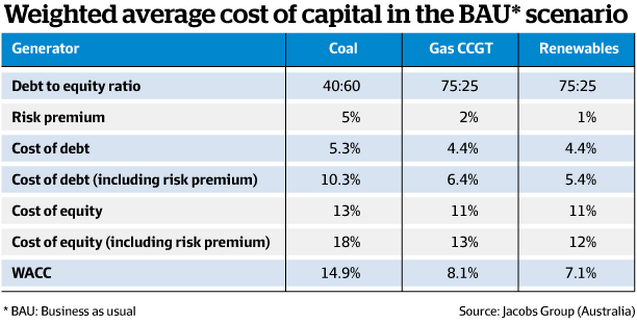
of Jacobs' assumptions adds a 5 per cent risk premium to the cost of
building new coal plants, on the grounds that it faces risks - stronger
climate policies, carbon prices etc - that could curtail their lives
early, before the investors or lenders have got their money back.
Coal plant has a much higher cost of capital than renewable or gas plant because of the risks. Jacobs Group (Australia)
Jacobs also assumes coal plant investors can borrow less than wind or gas plant investors, for the same reasons.
On
this basis, Jacobs attributes a 14.9 per cent average cost of capital
to coal pant, compared to just 8.1 per cent to gas plant and 7.1 per
cent for renewable plant.
That helps to make coal plant uneconomic. Coal advocates are likely to seize on it as another reason to dismiss the modelling.
But
it doesn't look all that unreasonable. No coal plants have been built
in Australia for 10 years, partly because business now ascribes a carbon
cost to new investments.
Clean coal is barely competitive
Jacobs'
modelling doesn't include a carbon price. BHP Billiton assumes a carbon
price of $US24 ($32) a tonne of carbon dioxide under current policies,
and $US50 ($62) a tonne of CO2 under stronger policies aimed at limiting
temperature increases to 2 degrees Celsius - the baseline Paris
commitment.
That would add $22 to $43 a MWh to the $81/MWh price
of power from an ultra-supercritical coal plant - the most efficient
commercial plant - modelled by the Finkel Review.
The Finkel
review finds new ultra-supercritical coal plant costs uncompetitive with
wind even without a carbon price and even when some storage is added to
a wind plant. They're barely competitive with large scale solar.
BHP applies a carbon price of $US24 ($A32) a tonne to new investments under current policies, rising to $US50 of stronger policies are implemented to limit temperature increases to 2 degrees Celsius. BHP Billiton
If anything, the risks
are all on coal. It takes years to approve and build, adding to the
risk. In the meantime, the cost of wind, solar and batteries is falling
rapidly.
Finkel's findings on all-in costs look conservative.
Other forecasters, such as Bloomberg New Energy Finance, find the cost
of wind and solar even more competitive with coal than Finkel.
The latest wind farm deals confirm this. Origin Energy's sale of Stockyard Hill and AGL Energy's sale of Silverton
wind farm included power purchase agreements at $52/MWh and $65/MWh
respectively - less than new coal plant without a carbon price.