Victoria Embankment in London. There are rising concerns over air pollution in Britain, particularly in large cities.Credit
Daniel Leal-Olivas/Agence France-Presse — Getty Images
LONDON — Scrambling to combat a growing air pollution crisis, Britain
announced on Wednesday that sales of new diesel and gas cars would
reach the end of the road by 2040, the latest step in Europe's battle
against the damaging environmental impact of the internal combustion
engine.
Britain's plans match a similar pledge made this month by France, and are part of a growing global push to curb emissions and fight climate change by promoting electric cars. Carmakers are also adjusting, with Volvo notably saying recently that it would phase out the internal combustion engine in the coming years and BMW deciding to build an electric version of its popular Mini car in Britain.
But the shift to electric vehicles will be a gradual one, and the target set by Britain is less ambitious than some of the effortselsewhere. President Trump's decision to withdraw the United States from the Paris climate accord has also dented optimism.
Britain's new clean air strategy, published on Wednesday,
calls for sales of new gas and diesel cars and vans to end by 2040. The
government will also make 255 million pounds, or $332 million,
available for local governments to take short-term action, such as
retrofitting buses, to reduce air pollution.
"It
is important that we all gear up for a significant change which deals
not just with the problems to health caused by emissions, but the
broader problems caused in terms of accelerating climate change,"
Michael Gove, the country's environment secretary, told the BBC.
Chris
Grayling, the transport secretary, promised a "green revolution in
transport," adding that the government wanted nearly every car and van
on Britain's roads to have zero emissions by 2050.
The
strategy document was published after a protracted legal battle in
which ministers were ordered by the courts to produce new plans to
tackle illegal levels of nitrogen dioxide.
In France, the promise to end sales of traditional cars was made as part of a renewed commitment to the Paris accord.
In
Britain, which is also committed to the Paris treaty, the measures have
particular political significance because of rising concern over the
level of air pollution, particularly in large cities like London. Poor air quality, much of it a result of pollution from vehicles, is estimated to cause between 23,000 and 40,000 deaths nationwide every year.
Frederik
Dahlmann, assistant professor of global energy at Warwick Business
School, described Wednesday's announcement as "an important step" that
set a clear long-term target, and "also gives car buyers an incentive to
consider the different types of engine options available in light of
the long-term development of the market."
Still,
he said, the long-term nature of the announcement left a significant
question hanging: "How does the government intend to improve air quality
and reduce transport related emissions in the short term?"
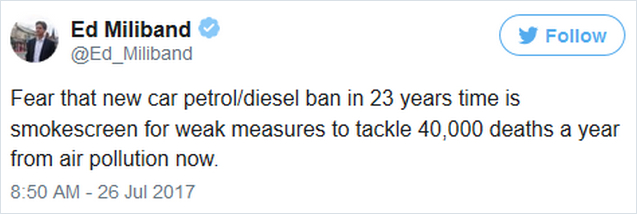
Critics,
including Ed Miliband, a former leader of the opposition Labour Party
leader and an ex-environment secretary, argued that the government was
failing to tackle the current pollution crisis.
IMAGE
Another
former environment secretary, Ed Davey of the centrist Liberal
Democrats, described the government's failure to commit to a plan to
compensate diesel car owners who scrap or retrofit highly polluting
vehicles as a "shameful betrayal."
Others
also say the country's efforts are not aggressive enough — France has
also set 2040 as its target, but Norway intends to sell only electric
cars from 2025, and India wants to do so by 2030.
Cars
typically have a life span of around 15 years, so even if Britain
follows through with its target, conventional engines are likely to be
on the country's roads more than a decade later.
Britain's
decision is, however, the latest indication of how swiftly governments
and the public in Europe have turned against diesel and internal
combustion engines in general.
Automakers,
though reluctant to abandon technologies that have served them well for
more than a century, are increasingly resigned to the demise of engines
that run on fossil fuels. They are investing heavily in battery-powered
cars as they realize their traditional business is threatened by Tesla
or emerging Chinese companies, which have a lead in electric car
technology.
The shift away from internal combustion engines is in large part a result of growing awareness of the health hazards of diesel.
Cities
like Madrid, Munich and Stuttgart are considering diesel bans. Sales of
diesel cars are plunging. Political leaders are under pressure to end
the de facto subsidies of diesel fuel that prevail in Europe.
European
countries kept taxes on diesel lower than on gasoline in the belief
that it was kinder to the planet. Diesel engines do spew less carbon
dioxide, a cause of global warming, than gasoline engines. But they
produce more nitrogen oxides, a family of gases that cause asthma and
are responsible for the smog that sometimes blankets London and other
major cities.
Rather
than encourage a shift back to gasoline cars, governments and
automakers are focusing increasingly on electric cars. They are the only
vehicles that emit neither nitrogen oxides like diesel nor large
amounts of carbon dioxide like gasoline.
But
the impending shift has raised doubts about whether countries like
Britain will be able to create the infrastructure, and generate the
electricity, needed for such a radical change in the way people travel.
Jack
Cousens, a spokesman for Britain's largest motoring organization, the
AA, said there would need to be "significant investment in order to
install charging points across the country, especially fast-charge
points," and added that it was questionable whether the electricity grid
"could cope with a mass switch-on after the evening rush hour."
As a trio of lawsuits claim compensation for sea rises resulting from fossil fuel emissions, campaigners say carbon majors must change their business models
Houses hanging over a cliff in Pacifica, San Mateo County, California.
Storms and powerful waves have been intensifying erosion in the area.
Photograph: Josh Edelson/AFP/Getty Images
Three Californian communities have launched legal action against some
of the world’s biggest oil, gas and coal companies, seeking
compensation for the current and future costs of adapting to sea level
rises linked to climate change.
San Mateo and Marin Counties, coastal communities in northern California, and Imperial Beach, a city in San Diego County, have filed complaints against 37 “carbon majors”, including Shell, Chevron, Statoil, Exxon and Total.
They claim greenhouse gas emissions from the fossil fuel companies’
activities over the last 50 years have locked in substantial sea level
rises, which will cause billions of dollars’ worth of damage to
properties and businesses, as well as endangering lives. According to the complaint, the defendants “have known for nearly 50
years years that greenhouse gas pollution from their fossil fuel
products has a significant impact on the Earth’s climate and sea
levels”. Rather than working to reduce impacts, the complaint claims the
companies engaged in a “co-ordinated, multi-front effort to conceal and
deny their knowledge of these threats”.
A spokeswoman for Shell said “we believe climate change is a complex
societal challenge that should be addressed through sound government
policy and cultural change to drive low-carbon choices for businesses
and consumers, not by the courts.” A spokesman for Statoil said this
lawsuit was not the first against the industry and that “previous cases
have been dismissed as [providing energy while meeting climate
commitments] is a political, not a judicial, issue”.
Exxon and Chevron declined to comment specifically on the litigation. BP and Total did not respond to the Guardian’s request for comment.
Climate change litigation
“This an unprecedented moment for climate change litigation,” says
Sophie Marjanac of campaigning lawyers Client Earth, which is monitoring
the case.
Coastal California is already experiencing the effects of rising sea
levels, says Deborah Halberstadt, executive director of the state’s
Ocean Protection Council which recently released a study
(pdf) about the threat of rising seas. “The rate of ice loss from the
Greenland and Antarctic ice sheets could rapidly accelerate, leading to
extreme sea-level rise, [...] with potentially catastrophic impacts for
California,” she says.
Serge
Dedina, the mayor of Imperial Beach, a low income coastal community in
San Diego County, says that up to 30% of the city could be affected by
climate change. “As the lowest-income, highest poverty-rate city in San
Diego County, we have no capacity to pay for the extensive adaptation
measures.”
It’s a similar story for Marin County. Within 15 years, says county
supervisor Kate Sears, flooding could affect tens of thousands of
residents and cause upwards of $15.5bn (£11.9bn) in property damage.
“This lawsuit is intended to shift those costs back where they belong –
on the fossil fuel companies,” she says.
“We are at the point of no return in fighting climate change,” says
San Mateo supervisor Dave Pine, “and if we don’t reduce emissions there
will be catastrophic impacts.” Potential property damage in the county
is estimated to be in the region of $39bn, with sea level rises set to
affect more than 100,000 residents (pdf).
This isn’t the first time fossil fuel companies have found themselves
facing legal action over climate change. Kivalina – an Alaskan barrier
island community of fewer than 400 people – filed a lawsuit in 2008
against oil companies including BP and Chevron demanding up to $400m for
relocating their village in the face of rising sea levels. They were
ultimately unsuccessful, with their case dismissed on the basis that it
was a political question, not one for the courts.
The island village of Kivalina. Photograph: Jonathan Ernst / Reuters/Reuters
“This claim has a better chance,” says Marjanac, “we have better
climate science now.” She also believes the “vacuum in the US at a
federal level” when it comes to climate change, may make the state court
more willing to step in.
She does, however, acknowledge there are significant hurdles to
success. These include the “utility argument”: that companies are
providing energy to the world, something that is demanded and
sanctioned.
Pressure heating up on carbon majors
While all parties acknowledge the claim is likely to be prolonged,
awareness raising is an important element. “This kind of litigation is a
vital tool in the spreading effort to force oil companies to change
their business models,” says Jeremy Leggett, founder of solar energy
company Solarcentury.
Exxon, Total, Shell and Statoil are among those already making some shifts away from fossil fuels.
Shell’s CEO, Ben van Beurden, announced
earlier this month that the company would invest up to $1bn per year in
its New Energies division to explore alternative energy. But the energy
transition will be “change that will take place over generations”, he
said, not a revolution.
Exxon told the Guardian “oil and natural gas will remain prominent in
meeting global energy”, but a spokesman said the firm is working on
alternatives and “invests about $1bn a year to support a broad portfolio
of R&D projects ranging from advanced biofuels to carbon capture.”
Total
has made significant investments including the purchase last year of
battery company Saft for $1bn. And Statoil has established Statoil Energy Ventures with $200m in investment capital for four to seven years.
However, many campaigners and analysts remain sceptical. “These
investments amount to lip service,” says Kelly Mitchell, climate and
energy director for Greenpeace USA, “while [fossil fuel companies] dump
resources into more fossil fuel projects around the world, lobby
politicians and lock us into decades of fossil-fuel infrastructure.”
Leggett sees varying levels of seriousness among the big players. “No
company has admitted the game is up yet. Some have taken out
substantial hedged bets in the form of significant investments in clean
energy, notably Total and Statoil. Others have dug in, seemingly for a
fight to the death,” he says.
“The bottom line,” says Mitchell, “is that these companies are
clinging to an outdated business model that is not compatible with a
safe climate and liveable communities.”
A Delta plane lands as a U.S. Airways plane waits to take off at San Francisco airport. (Reuters/Lucy Nicholson)
Two California coastal counties and one beach-side city touched off a
possible new legal front in the climate change battle this week, suing
dozens of major oil, coal, and other fossil fuel companies for the
damages they say they will incur due to rising seas.
The three
cases, which target firms such as Chevron, ExxonMobil, BP and Royal
Dutch Shell, assert that the fossil fuel producers are collectively
responsible for about 20 percent of global carbon dioxide emissions
between 1965 and 2015. They claim that industry “knew or should have
known” decades ago about the threat of climate change, and want
companies to pay the costs of communities forced to adapt to rising
seas.
“We’re already living the impact of sea level rise,” said
Marin County Supervisor Kate Sears. She said a county vulnerability
study found hundreds of county businesses and other assets could be at
risk in coming years.
“This lawsuit is a natural next step in how
we address the expense we’ve already had in planning for and trying to
remediate the impacts of sea level rise, but also in addressing the
impacts we expect in the future.”
The
suits represent a variation on several largely unsuccessful attempts
to hold individual companies responsible for their contribution to
climate change.
In 2009, the vulnerable Alaskan coastal village
of Kivalina used similar logic to sue a string of fossil fuel companies.
The case failed when an appellate court ruled that federal action by the Environmental Protection Agency “displaces” their claim.
An even bigger setback came in 2011 when the Supreme Court decided against a public nuisance suit brought
by eight states and New York City against a group of electric utilities
— ruling, once again, that since EPA had begun to take action on
climate change, the claim had been displaced.
The California
cases are also proceeding under a legal doctrine called “public
nuisance” (among other claims), which charges that under California
common law, the companies have injured the counties and city by
contributing to rising seas, and more frequent and severe flooding as a
result.
But the difference is that this time, they are making
state level nuisance claims rather than federal ones, which have already
failed as courts pointed out that those worried about climate change
had other recourses, such as EPA action.
The
lawsuits were filed in California courts by Marin and San Mateo
counties and the City of Imperial Beach, which sits south of San Diego
near the Mexico border. Each cites specific damages expected from rising
seas.
San Mateo cited worries about the flooding of the San
Francisco Airport, along with up to $24 billion in assets being put at
risk.
Marin County estimated nearly $16 billion of homes and
businesses were threatened, and that with 6.7 feet of sea level rise, 7
percent of coastal roads would be “exposed to higher average sea level
and storm threats at several locations.”
Imperial Beach cited the
potential for “over $106 million” in property damages because of
coastal erosion and argued the town has few resources to adapt to rising
seas.
Vic Sher, a partner at the firm of Sher Edling who is
helping lead the legal challenge, said the goal behind the lawsuits is
to shift the “very real and very large costs of dealing with sea level
rise” from ordinary citizens to the companies responsible for knowingly
contributing to global warming.
He
likened the cases to past litigation that sought to hold tobacco
companies accountable for the public health toll of smoking, as well as
efforts to force lead paint manufacturers to renovate homes where health
risks remain.
“This is a very straightforward case for damages
for wrongful conduct,” Sher said. “You have communities that are already
injured, that have already spent a lot of money and are going to have
to spent a lot more money in the future.”
Royal Dutch
Shell declined to comment Wednesday, and ExxonMobil did not respond to a
request for comment. The American Petroleum Institute, a trade group
for oil and gas companies, also declined to comment on the pending
litigation.
David Bookbinder, chief counsel with the Niskanen
Center, a libertarian think tank, expects more such suits to be brought
in different localities around the country.
“The California
Supreme Court is going to view disappearance of its coastline quite
differently than the Supreme Court might view it,” Bookbinder said.
A
strength of the lawsuit, note some legal observers, lies in the fact
that sea level rise is easily measurable, constant (unlike
climate-affected weather events), and very strongly linked to a warming
planet. Moreover, analyses have become more and more precise when it
comes to mapping which locations will be inundated, or subjected to
greater flooding risks, for a given level of rising seas.
Bookbinder
said there could be a time when the science is powerful enough to try
to assess blame for other climate related changes, such as droughts, but
that sea level rise is a stronger and simpler case right now.
“What’s
different about these lawsuits is the way in which they rely on the
current state of climate science and the current state of information
about what these companies knew, when they knew it and what they did
with their knowledge,” added Michael Burger, executive director of the
Sabin Center for Climate Change Law at Columbia University. “Over the
last several years, a lot of information has come to light … What we
know now is fundamentally different from what we knew years ago.”
But
there are clear legal hurdles, too. The companies will surely point out
that each individual corporation contributed only a small fraction to
climate change, or resulting sea level rise. In addition, the companies
themselves did not directly emit carbon into the atmosphere, but rather
sold gasoline and other products that consumers used to power their
cars and homes.
“The litigants misunderstand nuisance law,” said
Scott Segal, an attorney with Bracewell LLP who represents energy
companies in D.C. “Commentators have suggested that nuisance law, a
relative backwater in property law, is based upon conditions in which
there are distinct producers and recipients of pollution. However, in
the case of global climate change, a molecule of carbon is literally
around the world in seven days. The requisite causation needed for
nuisance suits is missing and unprovable.”
“It’s possible the
suits will go nowhere, that they will be one offs that end in
dismissal,” added Burger. After all, he said, there have been a number
of previous lawsuits filed against the fossil fuel industry, raising
public nuisance and other common law claims, and none have been entirely
successful.
“But I think the potential here is that it becomes a
first-of-its-kind set of lawsuits,” he said, agreeing with Bookbinder
that other local governments are likely to pursue similar claims. “And
you wind up with a groundswell of litigation that puts real pressure on
the fossil fuel industry and on the government.”
Still, he added,
“These are not easy cases to win. The plaintiffs will certainly have
their work cut out for them convincing a judge, or perhaps a jury, that
these particular companies bear enough of a burden of blame that they
should be held responsible in a court of law.”
The best shot at large-scale climate action under the Trump administration might lie with a lawsuit set to go to trial early next year.
The plaintiffs pose with climatologist James Hansen (top, third from left) and two attorneys. Clayton Aldern/Grist
Juliana v. United States has a plot suitable for a Disney movie:
An eclectic group of 21 kids (and their lawyers) fighting to save the
world by forcing the federal government to adopt a science-based plan to
reduce emissions. Their lawsuit got a boost this past week when climate
scientist James Hansen published a paper in support of their cause.
The time may be right for Juliana
and other lawsuits like it to gather real momentum, paving the way for
meaningful victories, says Michael Burger, executive director of the
Sabin Center for Climate Change Law at Columbia University. He says that
a "groundswell of litigation" could put "real pressure" on industries
and governments to pay for local adaptation projects and make firm
commitments to reduce emissions, all within Trump's first term.
Legal experts say Juliana
has helped open a new front in the battle against climate change in the
United States and around the world. It's the culmination of years of
legal strategizing by Our Children's Trust, the advocacy group that
helped organize the effort. Our Children's Trust has brought related
suits in all 50 states, as part of a buckshot strategy to get one of them to break through.
"This
case is especially crucial in the fight against climate disruption,"
says Kassie Siegel, director of the Center for Biological Diversity's
Climate Law Institute. Cases like Juliana, she says, empower young people to advocate for their rights, and that "drives social change."
The buzz about Juliana
comes amid a flurry of legal challenges to the Trump administration's
efforts to dismantle environmental rules. Just this week, a series of lawsuits
were filed in California as a direct challenge to the oil industry on
climate change grounds, using a legal theory similar to the landmark
tobacco industry lawsuits of the 1990s. The administration's quest to
roll back or reverse pending Obama-era EPA regulations is also getting
blocked in the courts.
When it comes to climate change, "so far, the Trump administration is losing more frequently than it's winning," says Burger.
At the heart of this suit is the principle of intergenerational equity. In essence, the 21 plaintiffs in Juliana
say that the federal government's refusal to take serious action
against climate change unlawfully puts the well-being of current
generations ahead of future generations.
This argument might have helped spur legal action abroad, too. Since Juliana was filed in 2015, similar lawsuits have been brought by youth in Pakistan, New Zealand, and India, Burger says.
"Worldwide, there is a great deal of interest in the Juliana
case not just because of the practical outcome that it might or might
not achieve, but because of what it represents," he says. "Deeply held
values about environmental protection, about intergenerational equity,
about the need to address climate change — these things can be linked to
specific legal rights embodied in constitutions or in common law."
So far, the courts agree. In November, they scored their first major victory,
when a federal district court allowed the suit to go to trial. Judge
Ann Aiken set a judicial precedent in her decision, ruling that climate
change may pose an unconstitutional burden on younger generations. "I
have no doubt that the right to a climate system capable of sustaining
human life is fundamental to a free and ordered society," she wrote.
Late last month, a trial date for the Juliana
case was scheduled for next February in Eugene, Oregon. It's sure to
set a dramatic spectacle of the kids and their lawyers on one side of
the room against representatives of the Trump administration on the
other, with the future of the climate on the line.
In his paper published on Wednesday, Hansen — whose granddaughter Sophie Kivlehan is a plaintiff in the case — presented an updated scientific basis
for the suit's claims. The new study, which has 14 coauthors from
around the world, concludes that the burden climate change has placed on
younger generations is now so huge that continuing on a high-emissions
scenario would cost a minimum of $89 trillion (and as much as $535
trillion) to clean up by the end of this century. And that cleanup job
would rely mainly on the still-unproven technology of negative emissions
— literally sucking carbon dioxide out of the atmosphere.
Such a
burden "unarguably sentences young people to either a massive,
implausible cleanup or growing deleterious climate impacts or both," the
paper argues. The best alternative, Hansen says, is a court-ordered
mandate to reduce emissions now.
After decades working as a NASA climate scientist and at times being politically pressured into silence, Hansen quit his post in 2013 in part to help build the scientific evidence backing the Juliana
case. "It's hard to solve this politically," he said on a conference
call with the media this week. "That's why we need to take advantage of
the fact that the judiciary is less subject to that pressure."
To be sure, the ultimate success of Juliana
hinges on the composition of the Supreme Court, if the case makes it
that far. That fact makes Burger and his colleague, Michael Gerrard,
less optimistic. "I can't foresee a scenario where there are five votes
to uphold such a ruling," says Gerrard. Burger called success in a
Supreme Court during Trump's first term "a near impossibility."
But
victory in the Supreme Court isn't the only objective for the kids and
their lawyers. This is a trailblazing case, designed to pave the way for
future success of other cases, too.
"This is strategic impact
litigation," says Burger. "As you can see from the global interest, it's
already had a real impact. It's starting to shape the conversation
about climate change."
When it comes to convincing climate change deniers, Al
Gore says, "Mother Nature is more persuasive than the scientific
community." Claire Harbage/NPR
Former Vice President Al Gore helped shape the conversation about climate change with An Inconvenient Truth. Now he's back with a sequel — called An Inconvenient Sequel: Truth to Power, due out next month —and it follows Gore as he continues the crusade he made famous with that first film.
The
movie shows Gore standing in Miami floodwater, flying over imploding
boulders of ice in Greenland and in Paris — trying to push the climate
agreement over the finish line.
President Trump, however, promised last month to undo that victory when he announced plans to pull the U.S. from the Paris climate accord.
"I did my best to convince him to stay in the Paris agreement," Gore tells NPR's Steve Inskeep in one of two recent Morning Edition interviews. "And I thought that there was a chance he would come to his senses, but I was wrong."
Still, Gore is hopeful about reversing the effects of global climate change.
"[O]ne
of the big differences between today and a decade ago is that we do
have the solutions now," he says. Renewable energy like solar and wind
electricity, he says, have evolved just like other technologies such as
mobile phones and TVs so that "when production scales up they come down
even faster in cost."
The first clip from the sequel to 'An Inconvenient Truth'. Paramount Pictures
Interview Highlights On recutting the movie to address President Trump's withdrawing of the Paris climate accord
We
always anticipated that we could not end the movie until we realized
who was going to win the election and what would happen thereafter. And I
will tell you that when President Trump made his announcement that the
U.S. will pull out of the Paris agreement I was deeply concerned that
other countries might use that as an excuse to withdraw themselves. But
I've been gratified that the entire rest of the world has doubled down
on their commitments to the Paris agreement and that here in this
country so many governors and mayors and business leaders have stepped
up to fill the gap and say "We're still in Paris." And I really think,
and the scientists think now as well, that we have an excellent chance
of meeting the commitments that former President Obama made in the Paris
agreement regardless of what Donald Trump says. On whether he thinks Trump believes in human-caused climate change
I don't know. I have heard him say different things. I've heard him
say in public things that would lead you to believe that he doesn't
believe in it. But the scientific community has been virtually unanimous
for a couple of decades and now there's a new participant in the
debate: Mother Nature. The other big change from 10 years ago is that
these climate-related extreme weather events are way more common —
unfortunately way more destructive. Here in the U.S. we've had 11
once-in-a-thousand-year events in the last seven years. Last year was
the hottest year globally ever measured. The second hottest was the year
before, the third hottest was the year before that. And Mother Nature
is more persuasive than the scientific community.
On those who dismiss climate change science because they've lost faith in experts
I
think that one cause of this populist authoritarianism that we've seen
not just in the U.S. but in Poland and Turkey and the Philippines and in
Hungary ... is that the expert blueprint for globalization that has
been touted for quite some time has caused those who feel left behind to
feel real anger that middle-income wages have stagnated for decades and
I think that generalized anger at how things are going extends over
into a vulnerability to listen to demagogic claims that the scientific
community doesn't know what it's talking about when they warn us of the
climate crisis.
On climate change's role in the 2016 election for Hillary Clinton
I
know the events I did for [Hillary Clinton] in the 2016 election evoked
a powerful response. I didn't see any other events that were devoted to
climate so maybe I missed that. I think that a lot of national politicians are told by their
pollsters and experts that they ought to focus on other issues, but I
think that's changing quite a bit. And I think that the partisan divide
is now fading on climate, I really do. I think the Democratic
Party should focus much more on [climate change]. And I believe that's
beginning to happen. If you look at Jerry Brown in California, Jay
Inslee in the state of Washington, Andrew Cuomo in the state of New York
and many others, we're now beginning to see a surge of interest in
people who want to get away from the fossil fuel utilities, they want
energy freedom, they want energy choice, and I think it will be a much
bigger political plus in the years to come.
Links
Watch the first clip from the sequel to 'An Inconvenient Truth.' Paramount Pictures.
USA TODAY NETWORK
A new global temperature baseline casts doubt on humanity's ability to meet the Paris target
Credit: MamiGibbs Getty Images
The temperature baseline used in
the Paris climate agreement may have discounted an entire century's
worth of human-caused global warming, a new study has found.
Countries in the Paris climate agreement set a target of keeping
warming below 2 degrees Celsius by curbing carbon emissions compared to
their preindustrial levels. But a new study shows that the preindustrial
level used in the agreement, based on temperature records from the late
19th century, doesn't account for a potential century of rising
temperatures caused by carbon dioxide emissions. Accounting for those
gases, released from about 1750 to 1875, would add another one-fifth of a
degree to the baseline temperature, the study found.
Published yesterday in Nature Climate Change, the research
suggests there's less time than previously believed to address global
warming, said Michael Mann, a climatologist at Pennsylvania State
University.
The study estimates that there may have already been 0.2 degree
Celsius of warming, or 0.36 degree Fahrenheit, built into Earth, he
said. That means the Paris Agreement would have to be more aggressive,
according to the study, which was also written by researchers from the
universities of Edinburgh and Reading in the United Kingdom.
“When you take that into account, it turns out we have 40 percent less carbon to burn than we thought we had,” Mann said.
When it comes to climate change science, researchers typically use
atmospheric carbon dioxide levels from the late 19th century as a
guideline, because that's when instrumentation was developed to
accurately measure temperatures. Researchers use models that combined
observed temperatures with simulated sea surface temperatures and
surface air temperatures to determine temperatures from 1401 to 1800.
The new baseline casts doubt on humanity's ability to meet the Paris
target of holding temperatures below 1.5 to 2 degrees Celsius above
preindustrial levels.
“The probability of exceeding the thresholds and timing of exceedance
is highly dependent on the pre-industrial baseline,” the authors wrote.
Mann cautioned that there is still time to stave off the worst
effects of warming, and that the Paris Agreement is the best path to get
there. Still, he said, the study suggests the world's carbon budget —
the amount of carbon dioxide the world can burn while keeping global
temperatures below 2 degrees — may be smaller than nations realize.
The advent of the internal-combustion engine sparked a major release
of carbon dioxide into the atmosphere that has warmed the Earth. The
Paris climate accord is the broadest attempt in human history to limit
those emissions. Re-establishing a new baseline would put more pressure
on countries around the world. The study came after Trump announced he
was withdrawing the United States from the Paris Agreement in order to
get a “better deal.”
Before the age of industrialization, the amount of atmospheric carbon
dioxide was about 280 parts per million (ppm), scientists have
determined. They measured air bubbles frozen in Arctic ice to ascertain
that number. The early decades of industrialization, fueled by economic
growth in Europe, may have added 30 to 40 ppm of carbon dioxide to the
atmosphere, according to Mann.
Now, atmospheric CO2 is rising at a record pace and is already at 410
ppm. It's expected to climb for decades. A growing body of research
suggests that the continuing rise in atmospheric CO2 could eventually
make some places on the planet uninhabitable, cause sea levels to swamp
coastal cities and lead to millions of refugees.
“The Paris commitments were seen as at least getting us on to the
right path and putting in place a framework where we could tighten the
framework in the years ahead,” Mann said. “Our studies suggest it's even
more urgent than we might have thought, because Paris, at least by this
measure, doesn't even get us halfway there. It gets us a third of the
way there.”
The global pact is supposed to review the best available science
every few years to inform progress toward limiting global temperature
rise. The study released yesterday is exactly the type of research that
could inform future negotiations, said Andrew Light, a distinguished
fellow at the World Resources Institute and a former senior climate
change adviser in the Obama administration.
“There has always been a strong tie between the scientific community
and the negotiations process,” he said. “The forum where most of this
stuff gets hashed out is the IPCC [the Intergovernmental Panel on
Climate Change] ... [and] there will be more of an ongoing opportunity
for parties to think about whether or not they need to revise their
targets in response to this.”
Reprinted from Climatewire with permission from E&E News. E&E provides daily coverage of essential energy and environmental news at www.eenews.net.
A young, fit US soldier is marching in a Middle
Eastern desert, under a blazing summer sun. He's wearing insulated
clothing and lugging more than 100 pounds of gear, and thus sweating
profusely as his body attempts to regulate the heat. But it's 108
degrees out and humid, too much for him bear. The brain is one of the
first organs affected by heat, so his judgment becomes impaired; he does
not recognize the severity of his situation. Just as his organs begin
to fail, he passes out. His internal temperature is in excess of 106
degrees when he dies.
An elderly woman with
cardiovascular disease is sitting alone in her Chicago apartment on the
second day of a massive heatwave. She has an air conditioner, but she's
on a fixed income and can't afford to turn it on again—or maybe it broke
and she can't afford to fix it. Either way, she attempts to sleep
through the heat again, and her core temperature rises. To cool off,
her body's response is to work the heart harder, pumping more blood to
her skin. But the strain on her heart is too much; it triggers cardiac
arrest, and she dies.
Such scenarios could
surely happen today, if they haven't already. But as the world warms due
to climate change, they'll become all too common in just a few
decades—and that's according to modest projections.
AFP/Getty Images
This is not meant to scare you quite like this month's cover story in New York magazine, "The Uninhabitable Earth." That story was both a sensation and quite literally sensational, attracting more than two million readers
with its depiction of "where the planet is heading absent aggressive
action." In this future world, humans in many places won't be able to
adapt to rising temperatures. "In the jungles of Costa Rica, where
humidity routinely tops 90 percent, simply moving around outside when
it's over 105 degrees Fahrenheit would be lethal. And the effect would
be fast: Within a few hours, a human body would be cooked to death from
both inside and out," David Wallace-Wells writes. "[H]eat stress in New
York City would exceed that of present-day Bahrain, one of the planet's
hottest spots, and the temperature in Bahrain 'would induce hyperthermia
in even sleeping humans.'"
These scenarios are
supported by the science. "For heat waves, our options are now between
bad or terrible," Camilo Mora, a geography professor at University of
Hawaii at Manoa, told CNN last month. Mora was the lead author of a recent study, published in the journal Nature,
showing that deadly heat days are expected to increase across the
world. Around 30 percent of the world's population today is exposed to
so-called "lethal heat" conditions for at least 20 days a year. If we
don't reduce fossil-fuel emissions, the percentage will skyrocket to 74
percent by the year 2100. Put another way, by the end of the century
nearly three-quarters of the Earth's population will face a high risk of
dying from heat exposure for more than three weeks every year.
Even the best-case scenario shows that nearly half of humanity will be exposed regularly to deadly heat by the year 2100.
This
is the worst-case scenario. Even the study's best-case scenario—a
drastic reduction in greenhouse gases across the world—shows that 48
percent of humanity will be exposed regularly to deadly heat by the year
2100. That's because even small increases in temperature can have a
devastating impact. A study published in Science Advances
in June, for instance, found that an increase of less than one degree
Fahrenheit in India between 1960 and 2009 increased the probability of
mass heat-related deaths by nearly 150 percent.
And
make no mistake: Temperatures are rising, in multiple ways. "We've got a
new normal," said Howard Frumkin, a professor at the School of Public
Health at the University of Washington. "I think all of the studies of
trends to date show that we're having more extreme heat, and we've
having higher average temperatures. Superimposed on that, we're seeing
more short-term periods of extreme heat. Those are two different trends,
and they're both moving in the wrong direction." Based on those trends,
the US Global Change Research Program predicts
"an increase of thousands to tens of thousands of premature
heat-related deaths in the summer ... each year as a result of climate
change by the end of the century." And that's along with the deaths
we've already seen: In 2015, Scientific American noted that nine out of the ten deadliest heat waves ever have occurred since 2000; together, they've killed 128,885 people.
In
other words, to understand how global warming wreaks havoc on the human
body, we don't need to be transported to some imagined dystopia.
Extreme heat isn't a doomsday scenario but an existing, deadly
phenomenon—and it's getting worse by the day. The question is whether
we'll act and adapt, thereby saving countless lives.
There
are two ways a human body can fail from heat. One is a direct heat
stroke. "Your ability to cool yourself down through sweating isn't
infinite," said Georges Benjamin, executive director of the American
Public Health Association. "At some point, your body begins to heat up
just like any other object. You go through a variety of problems. You
become dehydrated. Your skin dries out. Your various organs begin to
shut down. Your kidneys, your liver, your brain. As gross as this may
sound, you in effect, cook." (So maybe Wallace-Wells wasn't being
hyperbolic after all.)
Heat
death can also be happen due to a pre-existing condition, the fatal
effects of which were triggered by high temperature. "Heat stress
provokes huge amounts of cardiovascular strain," said Matthew Cramer of
the Institute of Exercise and Environmental Medicine. "For these people,
it's not necessarily that they've cooked, but the strain on their
cardiovascular system has led to death." This is much more common than
death by heat stroke, but is harder to quantify since death certificates
cite the explicit cause of death—"cardiac arrest," for instance, rather
than "heat-related cardiac arrest."
In both
scenarios, the body's natural ability to cool itself off through
sweating has either reached its capacity or has been compromised through
illness, injury, or medication. There are many people who have reduced
capacity for sweating, such as those who have suffered severe burns over
large parts of their bodies. Cramer,
who studies heat impacts on burned people, says 50,000 people suffer
severe burn injuries per year in America, and the World Health
Organization considers burns "a global public health problem," with the majority of severe burn cases occurring in low- and middle-income countries.
Bodies
that are battling illness or on medication may also struggle with heat
regulation. Diuretics tend to dehydrate people; anticholinergics and
antipsychotics reduce sweating and inhibit heat dissipation. An analysis
of the 2003 heat wave in France that killed 15,000 people suggested
that many of these deaths could have been avoided had people been made
aware of the side effects of their drugs. As for illnesses, "Anything
that impairs the respiratory or circulatory system will increase risk,"
said Mike McGheehin, who spent 33 years as an environmental
epidemiologist at the Centers for Disease Control and Prevention.
"Obesity, diabetes, COPD, heart disease, and renal disease." Kidney
disease, mental illness, and multiple sclerosis. The list goes on and
on.
This summer has presented many opportunities for bodies to break down from heat. Temperature records, some more than a century old, have been broken across California, Nevada, Utah, Idaho and Arizona. (Speaking of Arizona, it's been so hot there that planes can't fly.) And it's not just America. Last month, Iran nearly set the world record for highest temperature ever recorded. The May heatwave that hit India and Pakistan set new world records as well, including what the New York Timescalled
"potentially the hottest temperature ever recorded in Asia": 129.2
degrees Fahrenheit. Worldwide, 2017 is widely expected to be the second-hottest year, after 2016, since we began keeping global average temperature records in 1880.
A Pakistani resident helps a heatstroke victim at a market area during a heatwave in Karachi on June 23, 2015. RIZWAN TABASSUM / Getty Images
These
trends have public health professionals concerned about how people are
going to deal with the heat when it comes their way. "Clearly this is
one of the most important problems we're going to see from a public
health perspective," Benjamin said. "This is not a tomorrow problem.
It's a significant public health problem that we need to address today."
It's
a public health problem especially in cities, says Brian Stone, a
professor at Georgia Tech's City and Regional Planning Program. "Our
fundamental work shows that larger cities are warming at twice the rate
of the planet," he said, describing a phenomenon known as urban heat islands, where built-up areas tend to be hotter than surrounding rural areas, mainly because plants have been replaced by heat-absorbing concrete.
Global warming is making that phenomenon worse. "We're really worried
about the rate of how quickly we're starting to see cities heat up,"
Stone said.
According
to Stone's analysis, the most rapidly warming city is Louisville,
Kentucky, followed by Phoenix, Arizona, and Atlanta, Georgia. But he's
less concerned about cities like Phoenix, which already have
infrastructure to deal with brutally high temperatures, than he is about
Chicago, Buffalo, and other cities in the northern United States that
have really never had to deal with extreme heat. That is precisely why
the Chicago heat wave of 1995 that killed 759 people was so deadly.
According to the Chicago Tribune,
the city was "caught off guard," and had "a power grid that couldn't
meet demand and a lack of awareness on the perils of brutal heat."
In other words, Stone and others say, excessive death rates are not always due to just extreme temperatures, but unusual
temperatures. People are more likely to die when they are confronted
with temperatures they don't expect and thus aren't prepared for. That's
why officials in cities not experiencing heat-related extremes need to
improve emergency response systems, now. "Those people have got to start
thinking in term of, 'two years ago we had four hot days, the year
after we had eight hot days,'" Benjamin said. "Public health systems
should be put in place to respond to prolonged heat waves. Emergency
cooling centers where people can go should be built. Identify where the
people who are most socially isolated live." Absent preventative action,
heat-related deaths in New York City could quintuple by the year 2080,
according to recent research.
Some cities have already started to prepare. Stone recently completed a heat adaptation study
for Louisville that includes not only emergency management planning but
also ways the city can prevent itself from getting so hot (by improving
energy efficiency and installing green roofs, for instance). But as for
now, he said, it's rare to see a city actually adopt policies
supportive of heat management. "We do see flooding adaptation plans—New
York City has one, and New Orleans has one—but heat adaptation planning
is a very new idea, in the US and really around the world," he said. "It
takes a lot to convince a mayor that a city can actually cool itself
down. It's not intuitive."
The good news is
that humans adapt to heat, both physiologically (through
acclimatization) and socially (with air conditioning, for instance).
That will continue, according to the US Global Change Research Program,
which states with very high confidence that adaptation efforts in humans
"will reduce the projected increase in deaths from heat."
"It's a quintessential public health problem in that it impacts the most disenfranchised of our society."
But
there's a limit to this. "There's no way to adapt to heat that's more
than a certain amount," Frumkin said. "And socially, there's always
going to be people we miss, who don't have access to air conditioning."
McGeehin noted those people will likely be poor, elderly, and minority
populations. "It's a quintessential public health problem in that it
impacts the most disenfranchised of our society. Young, healthy,
middle-class people will largely be left alone," he said.
Air
conditioners also have limits, especially in cities where blackouts can
occur. "It is inevitable," Stone said, that large cities will see
blackouts during future heat waves. "The number of blackouts we see year
over year is increasing dramatically," he said. "Whether that's caused
by the heatwave or just happens during the heatwave doesn't really
matter.... The likelihood of an extensive blackout during a heatwave is
high, and getting higher as we add more devices and stressors to the
grid."
It's a "cruel irony," Frumkin said, that
as the world gets hotter, we need more air conditioning, and thus
consume more electricity. And if that electricity comes from fossil fuel
sources, it will create more global warming, which in turn will
increase the demand for air conditioning. The answer, he said, is to
"decarbonize the electric grid." But that's easier said than done,
especially when the Trump administration is devoted to increasing the
use of fossil fuels to support the country's electrical grid.
As with many other efforts to fight climate change, though, cities don't need Washington's help
to take action on heat adaptation. "Cities can manage their own heat
islands on their own, and that's where we most need to be focused,"
Stone said. But that will require convincing elected leaders that
extreme heat is big a threat as, say, rising seas—and one that can't be
addressed with something as obvious as a sea wall. That's the challenge,
says McGeehin: "Heat as a major natural disaster is mostly overlooked
in this country." It's a quiet killer, and perhaps more lethal because
of it. How Climate Change Is Already Affecting Earth Though the planet has only warmed by one-degree Celsius since the
Industrial Revolution, climate change's effect on earth has been
anything but subtle. Here are some of the most astonishing developments
over the past few years.
This story originally appeared on New Republic and is part of the Climate Desk collaboration. Links