12/08/2017

How Fossil Fuel Money Made Climate Change Denial The Word of God

Splinter* - Brendan O'Connor

Illustration by Jim Cooke/GMG
In 2005, at its annual meeting in Washington, D.C., the National Association of Evangelicals was on the verge of doing something novel: affirming science. Specifically, the 30-million-member group, which represents 51 Christian denominations, was debating how to advance a new platform called “For the Health of a Nation.” The position paper—written the year before An Inconvenient Truth kick-started sense of public urgency around climate change—included a call for evangelicals to protect God’s creation, and to embrace the government’s help in doing so. The NAE’s board had already adopted it unanimously before presenting it to the membership for debate.
At the time, many in the evangelical movement were uncomfortable with its close ties to the Republican anti-environmental regulation agenda. That year, a group called the Evangelical Alliance of Scientists and Ethicists protested the GOP-led effort to rewrite the Endangered Species Act, and the NAE’s vice president of governmental affairs Richard Cizik pushed for the organization to endorse John McCain and Joe Lieberman’s cap-and-trade bill. “For the Health of a Nation,” which Cizik also pushed, was an opportunity to draw a bright line between their support of right-wing social positions on abortion and civil rights and a growing sentiment that God’s creation needed protection from industry.
“Evangelicals don’t want themselves identified as the Republican Party at prayer,” the historian and evangelical Mark Knoll said at the time in support of the platform.
He was wrong. The rank-and-file membership rejected the effort. Like the oil and utilities industries, they decided that recognizing climate change was against their political interests.
At the behest of a group called the Interfaith Stewardship Alliance, the board buckled, releasing a statement in February 2006 “recognizing the ongoing debate” on global warming and “the lack of consensus among the evangelical community on the issue.” Just days later, an outside group of 86 evangelical leaders, under the aegis of the Evangelical Climate Initiative, issued a “Call to Action” declaring that climate change was real and that “millions of people could die from it in this century.”
Conservative groups, funded by fossil fuel magnates, spend approximately one billion dollars every year interfering with public understanding of what is actually happening to our world.
For his trouble, Cizik was targeted by a collection of hard right Christians, who petitioned the NAE board to muzzle him or force him to resign. “Cizik and others are using the global warming controversy to shift the emphasis away from the great moral issues of our time, notably the sanctity of human life, the integrity of marriage, and the teaching of sexual abstinence and morality to our children,” their letter read. It also implied that Cizik, who had worked for the NAE for nearly three decades, supported abortion, giving condoms to children, and infanticide.
The NAE didn’t silence Cizik, but it didn’t take up his cause, either. (Ultimately, his undoing was not climate change, but same-sex marriage. “I would willingly say that I believe in civil unions,” he told NPR’s Terry Gross in May 2007. “I don’t officially support redefining marriage from its traditional definition, I don’t think.” He was fired ten days later.)
The NAE did eventually endorse climate action in 2015. But it was too late. By that time, a corps of right-wing Christians, funded by fossil-fuel interests, had hijacked the public and political machinery of the evangelical movement. They are now in the White House, where the anti-environmental agenda is dominated by Christian fundamentalists like EPA Commissioner Scott Pruitt while the more moderate views of former ExxonMobil CEO Rex Tillerson are ignored. This is the story of how they did it.
At a town hall in Michigan last May, Republican Rep. Tim Walberg assured his constituents that, while the climate may be changing, they don’t need to be concerned. “As a Christian, I believe that there is a creator in God who is much bigger than us,” he told them. “And I’m confident that, if there’s a real problem, He can take care of it.”
This idea—that whatever happens in God’s creation happens with His blessing—has deep roots in the American evangelical community, especially among the elite fundamentalists who walk the halls of power in Washington, D.C. For years, an evangelical minister named Ralph Drollinger has held weekly Bible studies for members of Congress, preaching that social welfare programs are un-Christian and agitating for military action against Iran. (In December 2015, he expressed his desire to shape Donald Trump into a benevolent, Christian dictator.) Drollinger also teaches that climate change caused by humans is impossible in light of God’s covenant with Noah after the Flood: “To think that man can alter the earth’s ecosystem—when God remains omniscient, omnipresent and omnipotent in the current affairs of mankind—is to more than subtly espouse an ultra-hubristic, secular worldview relative to the supremacy and importance of man,” he wrote recently.
Conservative groups, funded by fossil fuel magnates, spend approximately one billion dollars every year interfering with public understanding of what is actually happening to our world. Most of that money—most of the fraction of it that can be tracked, anyway—goes to think tanks that produce policy papers and legislative proposals favorable to donors’ interests, super PACs that support politicians friendly to industry or oppose those who are not, or mercenary lobbyists and consultants, in some instances employing the same people who fought to suppress the science on smoking. In terms of impact, however, few investments can rival the return that the conservative donor class has gotten from the small cohort of evangelical theologians and scholars whose work has provided scriptural justifications for apocalyptic geopolitics and economic rapaciousness.
The Cornwall Alliance is an enforcer, stifling dissent in the evangelical community, smothering environmentalist tendencies before they gain a following.
“Throughout the history of the church, people have always found ways to use God and scripture to justify empire, to justify oppression and exploitation,” Kyle Meyaard-Schaap, an organizer with a pro-environmental Christian group called Young Evangelicals for Climate Action (YECA), told me. “It’s a convenient theology to hold, especially when we are called to drastic, difficult action.”
Many of these soothsayers are gathered together in an organization called the Cornwall Alliance—formerly known as the Interfaith Stewardship Alliance, the same group that mobilized against Cizik’s environmental proposal—a network with ties to politicians and secular think tanks across the conservative landscape. In 2013, Cornwall published an anti-environmentalist manifesto called Resisting the Green Dragon. “False prophets promise salvation if only we will destroy the means of maintaining our civilization. No more carbon, they say, or the world will end and blessings will cease,” it warns. “Pagans of all stripes now offer their rival views of salvation, all of which lead to death.” Members of the Cornwall Alliance and their ilk are not simply theoreticians but enforcers, stifling dissent in the wider American evangelical community, smothering environmentalist tendencies before they gain a following.
“Prayer for a Free Market Economy and Energy Abundance,” Cornwall Alliance. Illustration by Jim Cooke; photo by Shutterstock
The pull of fossil-fuel interests and the religious right is so strong that even conservative politicians who privately believe climate change is caused by humans have kept that view secret. Sen. Sheldon Whitehouse, a Democrat from Rhode Island, has said that he knows of at least a dozen Republicans in the Senate who accept climate science and want to take action, but feel they can’t do so for fear of the political repercussions—despite the fact that recent polling shows a majority of Republican voters believe that the United States “should play a leading role” on climate action. Half a dozen politically connected evangelical Christians who are active on Capitol Hill backed up Whitehouse’s claim to Splinter, saying they have either first- or second-hand experience with politicians who admit in private that they accept climate science even as they oppose regulations and reforms in public.
Bob Inglis, a former GOP congressman from South Carolina who lost his seat to a primary opponent during the Tea Party surge of 2010, told Splinter that there are Republican senators and representatives who want to take climate action but are “terrified” to do so. Reverend Mitch Hescox, president of the Evangelical Environmental Network, estimated that there are as many as 20 senators who would take action for climate and clean energy—but only if there were grassroots support to do so. Dr. Katharine Hayhoe, director of the Climate Science Center at Texas Tech and an evangelical Christian who believes in climate change, suspects that the “vast majority” of those who dismiss climate science in Congress are secret believers. “We don’t have a lot of years for these people to come out of the closet,” Cizik, the ousted NAE board member, said.
Still, Inglis, Hescox, Hayhoe, and other evangelical Christians were not willing to expose the politicians who feel that climate action is simply too great a political risk. They fear that Republicans who are seen to support climate action, or even waver on opposing it, would immediately be subject to well-funded primary challenges by more ideologically committed candidates in the same way that Inglis was. “I don’t want to scare them off before I have the grassroots support for them,” Rev. Hescox told me.
The most prominent climate hardliner in the U.S. Congress is Sen. Jim Inhofe. “Senator Inhofe will take an act of God to be changed,” Rev. Hescox said with a laugh when I asked whether the Oklahoma politician would ever see the light. “That one’s in God’s hands, not mine.” In 2012, while promoting his book The Greatest Hoax: How the Global Warming Conspiracy Threatens Your Future, Inhofe told a Christian radio program, “God’s still up there. The arrogance of people to think that we, human beings, would be able to change what He is doing in the climate is to me outrageous.” In 2015, the Heartland Institute and the Heritage Foundation—two of the most influential and well-funded think tanks in the conservative political world—honored Inhofe with the Political Leadership on Climate Change Award. In his speech accepting the award, the then-chairman of the Senate Environment and Public Works Committee lauded the think tanks, telling their members that they “are on the right side of the Lord on all of these things,” and that God “will richly bless you for it.”
Together, Cornwall, Heartland, and Heritage have been able to set the terms of the conservative conversation—evangelical or otherwise—about the climate.
Former Inhofe staffers and aides are flooding through leadership positions at the EPA, now led by Pruitt. About a month after Donald Trump took office, Drollinger began leading a weekly Bible study for members of the president’s cabinet. “It’s the best Bible study that I’ve ever taught in my life,” he told CBN News in a recent interview. “They are so teachable; they’re so noble; they’re so learned.”
A copy of Pruitt’s personal calendar, released by the EPA in response to Freedom of Information Act requests from Splinter and other outlets, shows that Pruitt began attending in mid-March. All visitors hosting events in congressional buildings need to be sponsored by a member of the House or the Senate. Drollinger’s Capitol Ministries boasts 49 sponsoring representatives (including Walberg, who is a graduate of evangelical Taylor University and Wheaton College) and eight sponsoring senators, including Joni Ernst of Iowa, who neither accepts climate science nor denies it outright, and Mike Rounds of South Dakota, who allows that the climate is changing but claims to feel that human activity is one small cause among many. Both Ernst and Rounds sit (with Inhofe) on the Senate Environment and Public Works Committee; their offices did not respond to requests for comment.
Drollinger declined to be interviewed for this story, and a Capitol Ministries spokesperson wrote in an email that not all of the minister’s congressional sponsors share his views. In a 2015 interview with the Southern Baptist Theological Seminary (of which he is a trustee), Pruitt said he believes that, under a proper reading of the Constitution, “government would be kept out of religion, not religion out of government.” At a ceremony in the White House Rose Garden announcing the United States’ withdrawal from the Paris agreement, Pruitt, in a linguistic nod to his fellow evangelicals, declared: “We owe no apologies to other nations for our environmental stewardship.” An EPA spokesperson insisted that any questions about the administrator’s religious views be submitted in writing, and stopped responding to emails after I did so.
“The greatest solution, if we did face a problem, which I don’t believe we do, is not central planning, is not putting U.N. bureaucrats in charge—it’s innovation and technology,” Marc Morano, a former speechwriter for Inhofe and prominent climate skeptic, told me. “If we really do face a crisis, the solutions will just happen naturally. You don’t need all this alarm. Whatever’s going to happen to address the problem, if there is a problem, is going to happen on its own.”
“There’s a wing of the evangelical church that’s historically distrustful of science and of modernity,” Meyaard-Schaap, the YECA organizer, told me, citing the publication of Darwin’s On the Origin of Species in 1859 and the Scopes Monkey Trial in 1925. “This was a faction of the church that had been here for a while, who had significant cultural power and saw that power diminishing,” he said. “In the face of what they saw as significant threats to their identity, that wing of the church decided that their best reaction was to retreat, to pull away from public life, to invest in their own institutions, to calcify this resistance to modernity and science.”
This retreat lasted until the Reagan administration. In 1984, right-wing Christian leaders and theologians formed a group dubbed the Coalition on Revival for the express purpose not only of re-politicizing evangelicals but of guiding them towards a particular fundamentalist worldview. In its own words, the Coalition’s aim was to “influence, penetrate, and permeate” every aspect of society and to “rebuild civilization on the principles of the Bible.” To accomplish this, members of the Coalition sought “to take every thought captive to the obedience of Christ.”
As luck would have it, the “Christian World View of Economics” is avowedly business-friendly.
Over the course of the next two years, the Coalition—guided by Christian Reconstructionists like the influential R.J. Rushdoony, who believed that the United States should adopt Old Testament laws—staked out positions on the correct, Christian worldview on seventeen different spheres of human life, including government, law, the family, education, and science. A precocious young scholar named E. Calvin Beisner served as the group’s general secretary, helping to draft the “Manifesto for the Christian Church,” which was signed not only by religious groups like the Family Research Council and the Home School Legal Defense Association, but also by a Republican congressman, a representative from the National Republican Senatorial Committee, and a White House liaison. Beisner also chaired the Economics Committee, which ultimately produced a twenty-one page document detailing Christian positions on economic issues. In an email, Beisner confirmed that he still endorses both documents.
As luck would have it, the “Christian World View of Economics” is avowedly business-friendly, condemning any economic policy that would impede the enrichment of industrialists and financiers. “The root cause of all poverty—spiritual and material—is the Fall of man,” the paper proclaims. “The Bible and observation confirm that most poverty is due to disobedience to God’s laws by individuals and their societies.” The only way to deliver humanity from poverty, then, is to reshape society according to Christian doctrine—which, as the Coalition interpreted it, looks an awful lot like free-market capitalism.
In the decades since its publication, the coalition’s members have risen, fallen, and risen again in American politics. Beisner went on to found the Cornwall Alliance; one of the first Cornwall Declaration’s signers was Bill Bright—who was a mentor to the Trump Administration’s unofficial preacher Ralph Drollinger. “Cornwall doesn’t matter to your average politician, but it plays a very important role in buttressing evangelical resistance to climate action, or even acknowledging that climate change exists,” Bruce Wilson, researcher and co-founder of Talk to Action, told me in an email. “Evangelicals can point to the Cornwall Alliance as apparent evidence that there’s a broad coalition of conservative evangelical and fundamentalist academics and theologians who reject climate change science.” The group’s board of advisors has included a number of other Coalition on Revival alumni, including founder and director Jay Grimstead.
Chart by Jim Cooke
For almost 20 years, Beisner and members of the Cornwall Alliance have worked with establishment conservatives to bolster opposition to climate change: The Heartland Institute identifies him as a policy advisor on its web site, and he speaks regularly at the institute’s annual conference on climate change (though in an interview he curiously denied ever actually giving any policy advice to Heartland). The Heritage Foundation hosted the 2015 premier of Where the Grass is Greener, a documentary produced by the Cornwall Alliance. In May, Beisner and senior executives from Heartland, Heritage, and a slew of other billionaire-funded political entities like Americans for Prosperity and the Competitive Enterprise Institute sent a letter to Donald Trump urging him to withdraw from the Paris climate agreement and asking him to stop funding United Nations global warming programs.
Together, Cornwall, Heartland, and Heritage have been able to set the terms of the conservative conversation—evangelical or otherwise—about the climate. They determine what science is acceptable, which proposed solutions can be considered, and what the consequences of inaction might look like. “There’s a very strong connection between those institutions and the evangelical Right,” Rev. Hescox told me. “Their denial of the science—and really portraying this as a big government issue—is why there was so much pushback among evangelicals.”
The Cornwall Alliance, joined by scientists associated with organizations partly funded by ExxonMobil, continued hammering away at Christian groups that supported action on climate change. In 2008, it launched the bizarrely named “We Get It!” campaign, which targeted the Evangelical Climate Initiative and was endorsed by a slew of conservative organizations, including the Family Research Council and David Barton’s WallBuilders.
“The ‘We Get It!’ declaration speaks for me, and I believe it speaks for the vast majority of evangelicals, who are as tired as I am of being misrepresented by people who don’t bother to get their theology, their science, or their economics right,” Inhofe said in a statement. “Consequently, they put millions of the world’s poor at risk by promoting policies to fight the alleged problem of global warming that will slow economic development, and condemn the poor to more generations of grinding poverty and high rates of disease and early death.” According to journalist and historian Frances FitzGerald’s new book, The Evangelicals: The Struggle to Shape America, the campaign was funded in part by Koch Industries.
In 2013, Cornwall (with assistance from the Heritage Foundation) launched the Resisting the Green Dragon campaign, which the sociologist Antony Alumkal calls “a case study in the paranoid style, using rhetoric that is extreme even by Christian Right standards in order to scare laypeople away from [environmentalism].” The campaign included both a book, written by physicist and “lay theologian” James Wanliss,” and a 12-part DVD series starring luminaries of the evangelical right, all laying out the case that green Christian movements are born of a “spiritual deception” that puts the needs of nature before people—a demonic worldview that requires an explicitly Christian response.

Resisting the Green Drago Promo

“History is...not a matter of fate, conservation, or man’s abilities, but of the decree of God,” Wanliss writes. “At the same time, God commands men to take dominion in the name of Christ, to fill the earth and multiply. This is not possible without a wholehearted embrace of Jesus Christ, on a global scale...Rather than seeking to save the planet on terms dictated by the Green Dragon, Christians ought to be preaching the only message that can save the planet—the gospel of liberty in Jesus Christ.”
Recently, Beisner, a prolific writer equally comfortable deploying poststructural literary theory or Calvinist theology, has infused his rhetoric with even more fire and brimstone. “We are made in the image of the Creator. So we don’t have to leave nature as we found it,” he argued recently. “We can steward the earth to enhance its fruitfulness, beauty, and safety. And we can do it to glorify God and serve our neighbors.” In May, he described the climate marches as “thuggery—typical of communist movements from the French Revolution through the socialist revolutions of the 1840s and the Russian and Chinese revolutions.” A prayer for the free market economy published on the Cornwall website reads:
Dear Father in Heaven,
We pray that trade and business across the globe would flourish. We pray for the leaders of the countries and various international institutions who decide economic policy. Please give them wisdom and let them uphold an economic system that is not restrictive.
We also pray for an abundance of energy that will support the growing economies of the world.
We ask You to help people understand the importance of conventional and clean energy sources like coal and nuclear to the developing nations of the world. Lord, let Your wisdom guide the decision makers in academia and governmental institutions.
We pray this in Jesus name,
Amen
Beisner sent fundraising emails before and after the Trump administration’s announcement that it would withdraw from the Paris climate accord, asking supporters to donate money to the Cornwall Alliance and to implore the administration to pull out of the agreement. Beisner says that the group doesn’t take corporate money and that most contributions come from small donors. But the Cornwall Alliance is in fact a project of a 501(c)(3) nonprofit called the James Partnership, run by Chris Rogers, of CDR Communications, a Virginia-based consulting firm. The James Partnership, financial records show, is embedded in the very same world of shadowy corporate political spending as Heritage and Heartland.
Given that it is a relatively small operation with relatively low overhead, the money that the Cornwall Alliance receives is a vanishingly small fraction of the hundreds of millions spent by the Koch, the Mercer, or the DeVos families. (The Kochs are oil, coal, and gas scions; Robert Mercer is a hedge fund manager who, with his daughter Rebekah, fueled Trump’s rise; Education Secretary Betsy DeVos and her husband Dick are long-time Republican donors).
Their money flows through a multitude of nonprofits, front groups, and donor-advised funds. (A donor-advised fund is a kind of money-laundering service for philanthropists who don’t want anyone to know where their money is going: They make a contribution to the fund, and then tell the fund where to send the money; as a nonprofit, the fund has to disclose all of the grants that it makes, but it does not need to disclose its own donors, nor what direction those donors attached to their money.) Donors Trust, the “dark money ATM” of the conservative movement, contributed $1,001,500 to the James Partnership between 2009 and 2015; in most years, this constituted around half of the Partnership’s total revenue.
“Maybe God will express his judgement through the climate system. One experimental way of trying to test that would be to end abortions and see if climate change ended.”
In 2013, Donors Trust gave only $35,000, but another nonprofit, the Institute for Faith, Work, and Economics swooped in with a $100,000 grant; together these accounted for 46.3 percent of the Partnership’s revenue. (Beisner wrote a chapter on why capitalism is less harmful to the environmental than socialism in a forthcoming book to be published by the Institute.) The Institute is controlled by EvangChr4 Trust, a nonprofit dedicated to convincing lawmakers and academics of the Biblical foundations of free-market capitalism; both are run by Paul Brooks, a retired Koch Industries executive. Channelling millions of dollars from the Koch brothers’ Freedom Partners nonprofit, EvangChr4 Trust has also made significant donations to the virulently homophobic and anti-choice Family Research Council—a Coalition on Revival signatory—and CitizenLink (a.k.a. the Family Policy Alliance), the political action arm of Focus on the Family. Both EvangChr4 and the Institute for Faith, Work, & Economics were listed in tax documents as “related organizations” of the Koch brothers’ now-defunct voter database project, Themis Trust; Brooks was also a trustee of Themis. He did not return multiple requests for comment; nor did the Institute.
Donors Trust refers clients to Donors Capital if they are planning to contribute more than one million dollars; the executive director and co-founder of the Acton Institute for the Study of Religion and Liberty, where Beisner is an adjunct fellow, sits on Donors Capital’s board of directors. Acton’s other co-founder, a Catholic priest, is also part of the Cornwall Alliance. Both Heritage and Acton have received millions of dollars in funding from donor-advised funds administered by the National Christian Foundation, and, as with contributions that come from Donors Trust and Donors Capital, it’s difficult to know whose money is going where when it passes through NCF. As it turns out, the organization that would eventually become the Cornwall Alliance began in 1999, as a project of the Acton Institute, which has received millions from Donors Capital, Donors Trust, NCF, and private foundations controlled by the Koch, DeVos, and Bradley families.
Beisner declined to identify Cornwall or the James Partnership’s more significant donors. When I asked about the contributions from Donors Trust, he said, “You need to deal with the actual evidence rather than just writing it off as bought and paid for by somebody.” Rogers declined to comment.
The “evidence” against climate change, as Beisner and the Cornwall Alliance’s network of scholars interpret it, indicates that whatever fluctuations are happening in the global climate are insignificant—that to whatever extent the climate is changing, the consequences of those changes are not catastrophic. “We think that an infinitely wise God designed, and an infinitely powerful God created, and an infinitely faithful God sustained the Earth and its various subsystems for the benefit of all the living creatures in the Earth,” Beisner told me.
“It could of course always be the case that the all-wise, all-powerful, all-faithful God has so designed the system as to react to abusive action in a manner that expresses God’s judgement on that abuse,” he said. “We abort millions of babies every year. Maybe God will express his judgement of that through the climate system. We have millions of people killed in unjustified wars. Maybe God expresses his judgement of that through the climate system. Or God doesn’t like our pulling coal and oil and natural gas out of the Earth, so he’s going to make the climate system react in a way that would not seem likely on our prior thinking basis.” He added later: “One experimental way of trying to test that would be to end the abortions and see if the climate change ended.”
“A free market economy is the closest approximation in this fallen world to the system of economy revealed in the Bible.”
In 2015, Beisner wrote a position paper on economics and the environment for Acton with Michael Cromartie, a Cornwall advisor and longtime courtier of the secular media. Free markets encourage both competition and stewardship, they argued paradoxically, and are “essential to human welfare.” Therefore, capitalism must have “a moral priority on our thinking about how society ought to be ordered.” The influence of the Coalition on Revival’s Economics “World View” from nearly two decades earlier is clear: “A free market economy is the closest approximation in this fallen world to the system of economy revealed in the Bible.” So concludes nearly four centuries of Calvinist thought, decades of fundamentalist resentment, and several billion dollars in political spending.
Those billions are paying off. Not only have the people who funded Cornwall successfully stopped the government from pursuing policies that might make the lives of people who are living with the consequences of climate change a little bit better, but under the Trump administration their lackeys are actively working to dismantle what little progress has been made. When Drollinger teaches that God’s covenant with Noah means that the consequences of climate change not only will not but in fact cannot be as devastating as scientists believe, he echoes a lengthy essay published by the Cornwall Alliance in 2009 that lays out the same argument. Typical of the organization’s style, it appears to the casual observer like any policy paper drawn up at one of D.C.’s many think tanks and nonprofits; in reality, the document blends quotations from scripture with pseudo-scientific data—citing, for example, the Mercer-funded Oregon Institute of Science and Medicine. During Pruitt’s confirmation hearing, Republican Sen. John Barrasso favorably cited Beisner and the Cornwall Alliance’s support for the Oklahoma attorney general.
“A guy who has given full-throated defenses of coal has told me privately, ‘Coal is dead. We know that. We’re just trying to figure out how to move on.’ Meanwhile he keeps on talking about coal,” Rep. Inglis told me. “Members of Congress are afraid of the people they represent, but they’re terrified of the activists within their own party, because that’s who takes you out in a primary.”
The former congressman recalled visiting Paul Ryan’s district with RepublicEn, his new climate lobby group, to talk about climate change with the House speaker’s constituents. A pair of vocal, anti-environmental activists disrupted the bipartisan event. “At the end of the night, one of my guys said, ‘You realize those are two of the most important activists in Paul Ryan’s district? These two ladies, you sit them in a phone bank, they would wear out multiple cell phone batteries destroying Paul Ryan if they thought he’d gone soft on them.” (When I asked whether he cited that example because Speaker Ryan has privately expressed support for climate action, Rep. Inglis demurred. “Better not go into that,” he said with a laugh.)
“A lot of people tend to go where they find theology that matches their own opinions,” Reverend Hescox told me. “It’s much easier for people, rather than being challenged by the Bible, to find some version of the faith that matches what their pre-existing belief structure is.”
Meyaard-Schaap believes that the green evangelical movement already has sufficient support in Congress for climate action; the issue now is getting the electorate to communicate to their representatives that this is, in fact, what they want. “I continue to believe wholeheartedly that grassroots power is more powerful than small, monied interests. If politicians recognize that there is a bona fide grassroots movement around this issue, and that their seat—regardless of how much money they might be getting from the other side—is in danger, that’s when you get their attention,” he told me. “I think in the next five or ten years, as more and more young evangelicals get plugged into the political process, that grassroots movement is going to grow to the point where politicians who might be getting money from the fossil fuel industry will say, ‘Look, this isn’t gonna cut it. I can’t protect my seat anymore and I have to change tack.’”
Morano dismissed these efforts. “Everything that needs to happen is happening. It’s going to happen naturally,” he said. “If you’re concerned about global warming, sit back and watch the innovation happen. It’s amazing.”
He added: “We just have to have the courage to do nothing.”

*This post was produced by the Special Projects Desk of Gizmodo Media Group.

Links

Fossil Fuel Subsidies Are A Staggering $5tn Per Year

The Guardian

A new study finds 6.5% of global GDP goes to subsidizing dirty fossil fuels
In this photo taken on November 19, 2015, smoke belches from a coal-fired power station near Datong, in China’s northern Shanxi province. Photograph: Greg Baker/AFP/Getty Images
Fossil fuels have two major problems that paint a dim picture for their future energy dominance. These problems are inter-related but still should be discussed separately. First, they cause climate change. We know that, we’ve known it for decades, and we know that continued use of fossil fuels will cause enormous worldwide economic and social consequences.
Second, fossil fuels are expensive. Much of their costs are hidden, however, as subsidies. If people knew how large their subsidies were, there would be a backlash against them from so-called financial conservatives.
A study was just published in the journal World Development that quantifies the amount of subsidies directed toward fossil fuels globally, and the results are shocking. The authors work at the IMF and are well-skilled to quantify the subsidies discussed in the paper.
Let’s give the final numbers and then back up to dig into the details. The subsidies were $4.9 tn in 2013 and they rose to $5.3 tn just two years later. According to the authors, these subsidies are important because first, they promote fossil fuel use which damages the environment. Second, these are fiscally costly. Third, the subsidies discourage investments in energy efficiency and renewable energy that compete with the subsidized fossil fuels. Finally, subsidies are very inefficient means to support low-income households.
With these truths made plain, why haven’t subsidies been eliminated? The answer to that is a bit complicated. Part of the answer to this question is that people do not fully appreciate the costs of fossil fuels to the rest of us. Often we think of them as all gain with no pain.
So what is a subsidy anyway? Well, that too isn’t black and white. Typically, people on the street think of a subsidy as a direct financial cost that result in consumers paying a price that is below the opportunity cost of the product (fossil fuel in this case). However, as pointed out by the authors, a more correct view of the costs would encompass:
not only supply costs but also (most importantly) environmental costs like global warming and deaths from air pollution and taxes applied to consumer goods in general.
The authors argue, persuasively, that this broader view of subsidies is the correct view because they “reflect the gap between consumer prices and economically efficient prices.”
Without getting too deep into the weeds, the authors discuss both consumer subsidies (when the price paid by a consumer is below a benchmark price) and producer subsidies (when producers receive direct or indirect support which increases their profitability). The authors then quantify what benefits would be achieved if the fossil fuel subsidies were reformed.
Interested readers are directed to the paper for further details, but the results are what surprised me. Pre-tax (the narrow view of subsidies) subsidies amount to 0.7% of global GDP in 2011 and 2013. But the more appropriate definition of subsidies is much larger (8 times larger than the pre-tax subsidies). We are talking enormous values of 5.8% of global GDP in 2011, rising to 6.5% in 2013.
The authors also broke the results down by fossil fuel type and usage (coal, petroleum, natural gas, electricity). It is not clear to me how the authors separated the various fuel sources out of electrical generation; however, the results show that petroleum and coal receive much larger subsidies compared to their counterpart fuels. The authors organized results by geographical region and found that the top three subsidizers of fossil fuels are China, USA, and Russia, respectively. The European Union is a bit less than half of the entire US subsidy. Other notable countries and regions are discussed.
There are two key takeaway messages. First, fossil fuel subsidies are enormous and they are costs that we all pay, in one form or another. Second, the subsidies persist in part because we don’t fully appreciate their size. These two facts, taken together, further strengthen the case to be made for clean and renewable energy. Clean energy sources do not suffer from the environmental costs that plague fossil fuels.
I asked one of the authors, Dr. Coady, why their work is important. He told me:
A key motivation for the paper was to increase awareness among policy makers and the public of the large subsidies that arise from pricing fossil fuels below their true social costs—this broader definition of subsidies accounts for the many negative side effects associated with the consumption of these fuels. By estimating these costs on a global scale, we hope to stimulate an informed policy debate and provide renewed impetus for policy reforms to reap the large potential benefits from more efficient pricing of fossil fuels in terms of improved public finances, improved population health and lower carbon emissions.
As a climate scientist, I focus almost exclusively on the scientific questions related to climate change. But equally important are the economic issues that, when dealt with, will usher in a new era of energy.

Links

Australia Faces Potentially Disastrous Consequences Of Climate Change, Inquiry Told

The Guardian |

Former defence force chief decries Australia’s response to climate challenge as a ‘manifest failure of leadership’
Climate scientists warn security threats posed by climate change have been underestimated and Australia has been ‘walking away’ from research that would help the country prepare. Photograph: Bureau of Meterology
Military and climate experts, including a former chief of the defence force have warned that Australia faces potential “disastrous consequences” from climate change, including “revolving” natural disasters and the forced migration of tens of millions of people across the region, overwhelming security forces and government.
Former defence force chief Adm Chris Barrie, now adjunct professor at the strategic and defence studies centre at the Australian National University, said in a submission to a Senate inquiry that Australia’s ability to mitigate and respond to the impacts of climate change had been corrupted by political timidity: “Australia’s climate change credentials have suffered from a serious lack of political leadership”.
The inquiry into the security ramifications of climate change also heard from some of the country’s leading climate scientists, who warned the security threats posed by climate change had been underestimated, and complained Australia had been “walking away” from exactly the type of research that would help the country prepare.
Other experts, however, counselled against “alarmist” predictions and said the focus of climate change response should be on those people most acutely affected by it, rather than the security concerns of developed countries most able to respond.
Barrie said the security threat of climate change was comparable to that posed by nuclear war, and said the Australian continent would be most affected by changing climate.
“We will suffer great effects from these changes, such as new weather patterns; droughts, sea-level rises and storm surges, because we have substantial urban infrastructure built on the coastal fringe; ravages of more intense and more frequent heatwaves and tropical revolving storms.”
But he said the existential impacts of climate change were likely to be first, and most severely, felt across Australia’s region, the Asia-Pacific rim, the most populous region in the world, and one that will be home to seven billion people by 2050.
Barrie posited a scenario in which the glaciers in the Tibetan Plateau and Himalayan-Hindu Kush ranges – which reliably deliver fresh water into China, the Mekong Delta, Myanmar, Bangladesh, India and Pakistan – would disappear.
“A serious shortage of fresh water brings famine; starving people are a very serious security problem. The question then becomes ‘what will happen if starving people on the rim of Asia are looking for a new home?’
“Historical evidence suggests that under such circumstances mass migration of these people will occur. It follows that several tens of millions of people might seek better fortunes in Australia and possibly New Zealand.
“Most other options for settlement in our region would already have high population densities. Our security forces, and all arms of government, would be overwhelmed in such a scenario.”
The Australian Defence Force has been examining the potential insecurities caused by climate change for a decade. Within Defence, there are serious concerns over the vulnerability of military bases to climate impacts, and the military’s reliance on fossil fuels.
But Barrie said political action lagged far behind and Australia’s hyper-politicised debate over climate had hampered decisive government action.
“Our current posture is a manifest failure of leadership,” he said.
Scientists at the ARC Centre for Climate Extremes, led by Andy Pitman from the University of New South Wales, said in their submission that climate scientists could help the country prepare for these sorts of threats but that investments in the required work was not occurring.
They noted many assessments of the threats to national security posed by climate change may be an underestimation, and called for a “high-level taskforce to examine risks associated with climate change and national security”.
“Most assessments linking climate change with climate risk have assumed changes are well described by the average,” they said, arguing this needed to be “urgently modified”.
They said that focusing on average temperature rise masks more serious changes that will occur in relation to extreme events and “compound events”.
“We do not know where or when extreme events will hit, which regions will become less vulnerable and which regions will suddenly emerge to be vulnerable,” they say.
They said those problems could be solved, but that Australia was not devoting enough research to the issue.
They also noted that while infrastructure and systems are often built to be resilient against isolated events – such as sea-level rise or a storm – that design often assumes they will happen in isolation, but if they occur together they could be “catastrophic”.
Again, the scientists said Australia was not focussing on the topic and noted that the US was examining compound events including the co-occurrence of droughts and heatwaves.
“Australia lags behind the US and some European countries in examining, assessing and responding to climate-change risks in terms of national security,” they said.
“Vulnerabilities associated with national security and climate change are already increasing and exist now. These are not ‘future issues’ that can be left for a decade before strategies are considered. The creation of a high-level taskforce to examine risks associated with climate change and national security is urgent and overdue.”
Jane McAdam, director of UNSW’s Kaldor centre for international refugee law told the inquiry climate change functioned as a “threat amplifier”, that magnified risk and exacerbated existing crises.
“Disasters become disasters on steroids: more frequent and more intense. Climate change is also a process. Slow-onset impacts such as sea-level rise or desertification take place over time, resulting in a gradual deterioration of living conditions that ultimately renders land uninhabitable.”
But she said the prospect of massive, sudden international migration was highly unlikely, and focused on the wrong people.
“Reasoned, empirically-grounded analysis has too often been overshadowed by alarmist and ill-informed assumptions about the numbers of people on the move, and the nature of that movement. As a result, the security analysis has been ‘flipped’ away from the needs of the most vulnerable communities to instead focus on the national security of developed states, premised on the flawed notion that they will be inundated by people fleeing the impacts of climate change.”
McAdam said most displacement and migration would occur within countries, not across national borders.
“Longer-term movement will generally be gradual rather sudden, and movement that is sudden (for instance, in the aftermath of a disaster) will often require temporary relief rather than permanent migration. There is scant evidence to justify claims that there will be mass outflows of people across international borders which will threaten international, regional or national security, or generate new risks of Islamist terrorism or fundamentalism.”
McAdam said internal displacement could generate low-level social tensions and potential conflict over key resources such as land, housing, food, water and employment.
The parliamentary inquiry has also heard climate change has already contributed to and worsened conflicts across the world, including in Mali, Yemen, and the Arab Spring and civil war in Syria from 2011.
The International Committee of the Red Cross said the destruction of the natural environment or access to scarce resources was often used as a weapon of war.
“In armed conflict, the natural resources on which people rely are often attacked in contravention of IHL [international humanitarian law] provisions. This can take the form of theft or killing of livestock, theft of land, drainage or poisoning of water resources, destruction of places of trade and livelihood. Removing the basis of communities’ resilience and capacity to adapt to changing weather conditions imperils their survival and contributes to displacement and poverty.”

Links

11/08/2017

Solar Is Now The Most Popular Form Of New Electricity Generation Worldwide

The Conversation

Solar PV outstripped coal as the leading source of new electricity generation worldwide last year. AAP Image/Lukas Coch
Solar has become the world’s favourite new type of electricity generation, according to global data showing that more solar photovoltaic (PV) capacity is being installed than any other generation technology.
Worldwide, some 73 gigawatts of net new solar PV capacity was installed in 2016. Wind energy came in second place (55GW), with coal relegated to third (52GW), followed by gas (37GW) and hydro (28GW).

New energy build in 2016
Source: REN21/IRENA/WNA
Together, PV and wind represent 5.5% of current energy generation (as at the end of 2016), but crucially they constituted almost half of all net new generation capacity installed worldwide during last year.
It is probable that construction of new coal power stations will decline, possibly quite rapidly, because PV and wind are now cost-competitive almost everywhere.
Hydro is still important in developing countries that still have rivers to dam. Meanwhile, other low-emission technologies such as nuclear, bio-energy, solar thermal and geothermal have small market shares.
PV and wind now have such large advantages in terms of cost, production scale and supply chains that it is difficult to see any other low-emissions technology challenging them within the next decade or so.
That is certainly the case in Australia, where PV and wind comprise virtually all new generation capacity, and where solar PV capacity is set to reach 12GW by 2020. Wind and solar PV are being installed at a combined rate of about 3GW per year, driven largely by the federal government’s Renewable Energy Target (RET).
This is double to triple the rate of recent years, and a welcome return to growth after several years of subdued activity due to political uncertainty over the RET.
If this rate is maintained, then by 2030 more than half of Australian electricity will come from renewable energy and Australia will have met its pledge under the Paris climate agreement purely through emissions savings within the electricity industry.
To take the idea further, if Australia were to double the current combined PV and wind installation rate to 6GW per year, it would reach 100% renewable electricity in about 2033. Modelling by my research group suggests that this would not be difficult, given that these technologies are now cheaper than electricity from new-build coal and gas.

Renewable future in reach
The prescription for an affordable, stable and achievable 100% renewable electricity grid is relatively straightforward:
  1. Potential sites for pumped hydro storage in Queensland, alongside development sites for solar PV (yellow) and wind energy (green). Galilee Basin coal prospects are shown in black. Andrew Blakers/Margaret Blakers, Author provided
    Use mainly PV and wind. These technologies are cheaper than other low-emission technologies, and Australia has plenty of sunshine and wind, which is why these technologies have already been widely deployed. This means that, compared with other renewables, they have more reliable price projections, and avoid the need for heroic assumptions about the success of more speculative clean energy options.
  2. Distribute generation over a very large area. Spreading wind and PV facilities over wide areas – say a million square kilometres from north Queensland to Tasmania – allows access to a wide range of different weather, and also helps to smooth out peaks in users’ demand.
  3. Build interconnectors. Link up the wide-ranging network of PV and wind with high-voltage power lines of the type already used to move electricity between states.
  4. Add storage. Storage can help match up energy generation with demand patterns. The cheapest option is pumped hydro energy storage (PHES), with support from batteries and demand management.
Australia currently has three PHES systems – Tumut 3, Kangaroo Valley, and Wivenhoe – all of which are on rivers. But there is a vast number of potential off-river sites.
In a project funded by the Australian Renewable Energy Agency, we have identified about 5,000 sites in South Australia, Queensland, Tasmania, the Canberra district, and the Alice Springs district that are potentially suitable for pumped hydro storage.
Each of these sites has between 7 and 1,000 times the storage potential of the Tesla battery currently being installed to support the South Australian grid. What’s more, pumped hydro has a lifetime of 50 years, compared with 8-15 years for batteries.
Importantly, most of the prospective PHES sites are located near where people live and where new PV and wind farms are being constructed.
Once the search for sites in New South Wales, Victoria and Western Australia is complete, we expect to uncover 70-100 times more PHES energy storage potential than required to support a 100% renewable electricity grid in Australia.
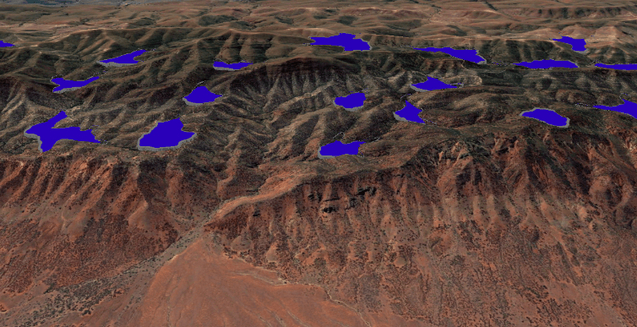
Potential PHES upper reservoir sites east of Port Augusta, South Australia. The lower reservoirs would be at the western foot of the hills (bottom of the image). Google Earth/ANU
Managing the grid
Fossil fuel generators currently provide another service to the grid, besides just generating electricity. They help to balance supply and demand, on timescales down to seconds, through the “inertial energy” stored in their heavy spinning generators.
But in the future this service can be performed by similar generators used in pumped hydro systems. And supply and demand can also be matched with the help of fast-response batteries, demand management, and “synthetic inertia” from PV and wind farms.
Wind and PV are delivering ever tougher competition for gas throughout the energy market. The price of large-scale wind and PV in 2016 was A$65-78 per megawatt hour. This is below the current wholesale price of electricity in the National Electricity Market.
Abundant anecdotal evidence suggests that wind and PV energy price has fallen to A$60-70 per MWh this year as the industry takes off. Prices are likely to dip below A$50 per MWh within a few years, to match current international benchmark prices. Thus, the net cost of moving to a 100% renewable electricity system over the next 15 years is zero compared with continuing to build and maintain facilities for the current fossil-fuelled system.
Gas can no longer compete with wind and PV for delivery of electricity. Electric heat pumps are driving gas out of water and space heating. Even for delivery of high-temperature heat for industry, gas must cost less than A$10 per gigajoule to compete with electric furnaces powered by wind and PV power costing A$50 per MWh.
Importantly, the more that low-cost PV and wind is deployed in the current high-cost electricity environment, the more they will reduce prices.
Then there is the issue of other types of energy use besides electricity – such as transport, heating, and industry. The cheapest way to make these energy sources green is to electrify virtually everything, and then plug them into an electricity grid powered by renewables.
A 55% reduction in Australian greenhouse gas emissions can be achieved by conversion of the electricity grid to renewables, together with mass adoption of electric vehicles for land transport and electric heat pumps for heating and cooling. Beyond this, we can develop renewable electric-driven pathways to manufacture hydrocarbon-based fuels and chemicals, primarily through electrolysis of water to obtain hydrogen and carbon capture from the atmosphere, to achieve an 83% reduction in emissions (with the residual 17% of emissions coming mainly from agriculture and land clearing).
Doing all of this would mean tripling the amount of electricity we produce, according to my research group’s preliminary estimate.
But there is no shortage of solar and wind energy to achieve this, and prices are rapidly falling. We can build a clean energy future at modest cost if we want to.

Links

Tibet's Fragile Ecosystem Is In Danger. China Must Change Its Flawed Environmental Policy

The Guardian*

Rising temperatures on the roof of the world make Tibet both a driver and amplifier of global warming. China’s unchecked mining and dam building has to be reigned in
‘In the age of climate change the future of Asia and by extension that of our planet Earth hinges on the developments in Tibet, the roof of the world.’ Photograph: Adrian Bradshaw/EPA
As Australia continues to battle a water crisis and the challenges facing the world’s driest inhabited continent, Tibet on the other hand is Asia’s water tower, its principal rainmaker and the largest source of fresh water, feeding over a billion lives in Asia including China.
At an average elevation of 4,000 meters above sea level and with an area of 2.5m sq km, Tibet is the world’s highest and largest plateau. It’s nearly two-third the size of the European continent. If Tibet were still a sovereign nation it would be the world’s tenth largest. It has the largest concentration of the world’s tallest mountains and is called the earth’s third pole because it has the largest reservoir of glacial ice after the two poles. Tibet is also a treasure trove of minerals, oil and natural gas reserves and a leading producer of lithium in China.
The Chinese scientists have over the years been proposing an increase in nature reserves across Tibet considering the fragile ecosystem on the plateau. In April this year China unveiled its grand plans on turning the entire stretch of Tibet into a national park.
The Chinese government has been declaring more and more national parks and nature reserves across Tibet in recent years, and this is a welcome gesture. The Chinese government must take into consideration the fragility and delicate nature of Tibet’s environment and reign in the factors that contribute to environmental crises in Tibet: rapid urbanisation, transfer of Chinese population into Tibet, unchecked mining on Tibet’s sacred mountains, and damming of Tibet’s rivers to facilitate hydro power projects.
In light of such robust projects, Tibetans are not only deprived of their traditional way of living, but are made peripheral beneficiaries of the projects.
The real beneficiaries are the Chinese officials who pocket their share of the gain, the Chinese companies and the Chinese employers benefitting from the economic opportunities.
We are not against Chinese developmental projects in Tibet per se, but we propose that the real beneficiaries of any development must be Tibetans in Tibet. Any projects that China undertake must be environmentally sustainable, culturally sensitive and economically beneficially to local Tibetans.
China’s rolling of its strategic and economic imperatives in Tibet has greater implications on the larger environmental consequences caused by climate change.
Today, the Chinese government’s flawed environmental and developmental policies have turned this resource-rich plateau and fragile ecosystem into a hub of its mining and dam building activities. This not only changes the water map of Asia for the worse but also contributes to an environmental crisis, which in turn contributes to climate change across Asia. The rising temperatures on the roof of the world make Tibet both a driver and amplifier of global warming.
2016 has been a year of natural disasters: a glacial avalanche in Aru in the Ngari region (Western Tibet), and mud floods and a landslide in Amdo (eastern Tibet). Between June and July 2017 alone, four distinct cases of floods were reported in Kham (south east region of Tibet). These are the cumulative effect of climate change.
More cases of natural disasters are imminent. The Chinese government must consider these impending threats and accordingly orient its urban development project towards mitigating the increasing threats posed by climate change.
China has escalated military control over Tibetan borders, expanded mining based on the rich resources of the Tibetan plateau in order to fuel China’s economic development and has dramatically expanded infrastructure with a strategic road and rail network. It seeks to raise the productivity of the industrial cities of Xi’an, Chongqing and Chengdu at the foot of the Tibetan plateau and to address the progressive scarcity of water resources in the North and North-East of China with water sourced in Tibet.
Tibet is facing two critical issues: Its political and environmental future. Of the two, the latter is a bigger issue given the implications for Asia and the rest of the world.
Tibet symbolises the three crises that confront Asia today; a natural resources crisis, an environmental and a climate crisis. These three are interlinked and potentially pose a threat to the ecological wellbeing and climate security not just of Asia but even of Europe, North America and Australia. According to leading scientists, the recent heat waves in Europe are linked to loss of ice on the Tibetan plateau. A team led by Hai Lin, an atmospheric scientist at Environment Canada in Quebec found that the greater snow-cover in Tibet, the warmer the winter in Canada.
Such formidable scenarios demand greater global attention and a forward-looking leadership to assuage the larger affects of an environmental crisis befalling Tibet. The world leaders must act prudently and not allow political constrains to dwarf redressal mechanism at institutional level to an impending global environmental crisis.
Veerabhadran Ramanathan from the Center for Atmospheric Sciences at the Scripps Institution of Oceanography, University of California, San Diego has rightly said that “our understanding of global climate change would be incomplete without taking into consideration what’s happening to the Tibetan plateau.”
Tibet’s environment impinges on regional and global security. The global efforts to reign in China’s policies in Tibet underpinning an oversight of the importance of Tibet’s environment and sensitivity over its fragile ecosystem, must be robust. In the age of climate change the future of Asia and by extension that of our planet Earth hinges on the developments in Tibet, the roof of the world.

*Dr Lobsang Sangay is president of the Central Tibetan Administration

Links

New York Times Guilty Of Large Screw-Up On Climate-Change Story

Washington PostErik Wemple

The New York Times building. (Andrew Burton/Getty Images)
The New York Times on Wednesday appended a correction to a story about a climate change study:
Correction: August 9, 2017
An article on Tuesday about a sweeping federal climate change report referred incorrectly to the availability of the report. While it was not widely publicized, the report was uploaded by the nonprofit Internet Archive in January; it was not first made public by The New York Times.
That correction, which sits at the foot of the story, dutifully straightens out the record. Yet given the magnitude of the screw-up, it should sit atop the story, surrounded by red flashing lights and perhaps an audio track to instruct readers: Warning: This story once peddled a faulty and damaging premise.
That premise suggests that the Trump administration is stifling a damaging draft report — part of the congressionally mandated National Climate Assessment — with dire warnings about climate change. "The average temperature in the United States has risen rapidly and drastically since 1980, and recent decades have been the warmest of the past 1,500 years, according to a sweeping federal climate change report awaiting approval by the Trump administration," noted the lead of the article, which was written by Lisa Friedman.
As it detailed the conclusions of the draft report, the New York Times highlighted an equally scary prospect: That without the intervention of the New York Times, it might not have seen the light of day. Examples:
  • "One government scientist who worked on the report, and who spoke to The Times on the condition of anonymity, said he and others are concerned it will be suppressed."
  • "A copy of it was obtained by The New York Times."
  • "The draft report by scientists from 13 federal agencies, which has not yet been made public, concludes that Americans are feeling the effects of climate change right now."


Environmental Protection Agency Administrator Scott Pruitt and U.S. Ambassador to the United Nations Nikki Haley said in interviews broadcast on June 4 that the Paris climate agreement hampered the U.S. economy. (Bastien Inzaurralde/The Washington Post)

As part of its corrective effort, the New York Times has pulled the language saying that "a copy of it was obtained by the New York Times," as well as the mistaken assertion that it has "not yet been made public." Even so, the article continues to carry this line: "Another scientist involved in the process, who spoke to The New York Times on the condition of anonymity, said he and others were concerned that it would be suppressed." As well as this one: "Scientists say they fear that the Trump administration could change or suppress the report."
Though it may be the case that certain scientists maintain such fears, that's a pretty tough position in light of the fact that the report "was uploaded by the nonprofit Internet Archive in January" and publicized by the New York Times in August.
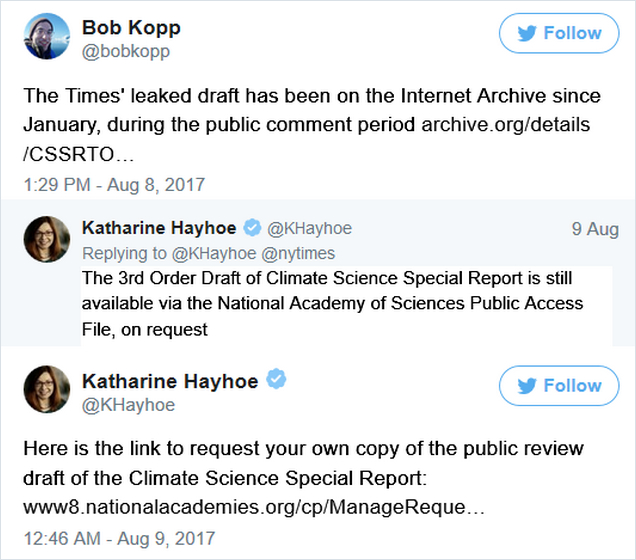
It is unclear how such a mistake came about. Maybe reporter Lisa Friedman failed to consult one Bob Kopp, or others who cited the error on Twitter:
IMAGE
Any intimation that the Trump administration is blocking or somehow suppressing a dire climate-change study is explosive stuff, in large part because it would align with actual transparency problems. As Philip Rucker and Ed O'Keefe reported in June, Republicans in Congress have complained that federal agencies aren't sharing information; the White House began banishing live coverage of briefings; and it ended the Obama practice of releasing White House visitor logs.
So this whole climate-change report is another case-in-point, right? No, at least not yet:
IMAGE
White House press secretary Sarah Huckabee Sanders blasted away in a statement: "It's very disappointing, yet entirely predictable to learn The New York Times would write off a draft report without first verifying its contents with the White House or any of the federal agencies directly involved with climate and environmental policy. As others have pointed out – and The New York Times should have noticed – drafts of this report have been published and made widely available online months ago during the public comment period. The White House will withhold comment on any draft report before its scheduled release date."
Next up: A tweet about the "failing" New York Times from a certain fellow.
New York Times Washington bureau chief Elisabeth Bumiller says of the draft report's status: "We were just not aware that somebody involved in the report had put a draft on this nonprofit Internet site," she says. "It was not a well-known site to us and the point is that the people who shared the draft with us were not aware of it either. That doesn't change the larger point that scientists were worried that the government wouldn't approve the report or release it through normal channels." When pressed on Sanders's criticism, Bumiller said, "We spent a lot of time trying to sort out where it had appeared before," said Bumiller. "Again, we just didn't know. The reporter just didn't know and the editors didn't know and once it was brought to our attention, we sorted it out" and ran a correction.
At a June panel discussion hosted by the Washington Press Club Foundation, CNN senior congressional reporter Manu Raju spoke about the stakes involved with factual integrity these days. "You just cannot screw up in this environment because they'll use every small mistake to come after you and suggest that you have some nefarious motive in your reporting," he said.

Links

Lethal Heating is a citizens' initiative