31/08/2017

Harvey Didn’t Come Out Of The Blue. Now Is The Time To Talk About Climate Change.

The Intercept

Evacuees wade down a flooded section of Interstate 610 as floodwaters from Tropical Storm Harvey rise in Houston on Sunday, Aug. 27, 2017.
Now is exactly the time to talk about climate change, and all the other systemic injustices — from racial profiling to economic austerity — that turn disasters like Harvey into human catastrophes.
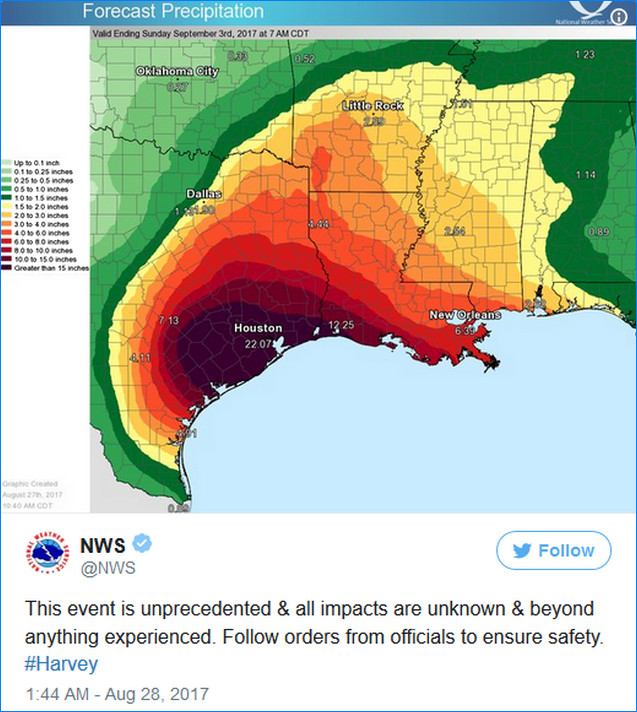
Turn on the coverage of the Hurricane Harvey and the Houston flooding and you’ll hear lots of talk about how unprecedented this kind of rainfall is. How no one saw it coming, so no one could adequately prepare.
What you will hear very little about is why these kind of unprecedented, record-breaking weather events are happening with such regularity that “record-breaking” has become a meteorological cliche. In other words, you won’t hear much, if any, talk about climate change.
This, we are told, is out of a desire not to “politicize” a still unfolding human tragedy, which is an understandable impulse. But here’s the thing: every time we act as if an unprecedented weather event is hitting us out of the blue, as some sort of Act of God that no one foresaw, reporters are making a highly political decision. It’s a decision to spare feelings and avoid controversy at the expense of telling the truth, however difficult. Because the truth is that these events have long been predicted by climate scientists. Warmer oceans throw up more powerful storms. Higher sea levels mean those storms surge into places they never reached before. Hotter weather leads to extremes of precipitation: long dry periods interrupted by massive snow or rain dumps, rather than the steadier predictable patterns most of us grew up with.
The records being broken year after year — whether for drought, storm surges, wildfires, or just heat — are happening because the planet is markedly warmer than it has been since record-keeping began. Covering events like Harvey while ignoring those facts, failing to provide a platform to climate scientists who can make them plain, all while never mentioning President Donald Trump’s decision to withdraw from the Paris climate accords, fails in the most basic duty of journalism: to provide important facts and relevant context. It leaves the public with the false impression that these are disasters without root causes, which also means that nothing could have been done to prevent them (and that nothing can be done now to prevent them from getting much worse in the future).
It’s also worth noting that the Harvey coverage has been highly political since well before the storm made landfall. There has been endless talk about whether Trump was taking the storm seriously enough, endless speculation about whether this hurricane will be his “Katrina moment” and a great deal of (fair) point-scoring about how many Republicans voted against Sandy relief but have their hands out for Texas now. That’s politics being made out of a disaster — it’s just the kind of partisan politics that is fully inside the comfort zone of conventional media, politics that conveniently skirts the reality that placing the interests of fossil fuel companies ahead of the need for decisive pollution control has been a deeply bipartisan affair.
In an ideal world, we’d all be able to put politics on hold until the immediate emergency has passed. Then, when everyone was safe, we’d have a long, thoughtful, informed public debate about the policy implications of the crisis we had all just witnessed. What should it mean for the kind of infrastructure we build? What should it mean for the kind of energy we rely upon? (A question with jarring implications for the dominant industry in the region being hit hardest: oil and gas). And what does the hyper-vulnerability to the storm of the sick, poor, and elderly tell us about the kind of safety nets we need to weave, given the rocky future we have already locked in?
People rest while waiting to board a bus headed for San Antonio at an evacuation center in Corpus Christi, Texas, on Friday, Aug. 25, 2017. Photo: Nick Wagner/Austin American Statesman/AP
With thousands displaced from their homes, we might even discuss the undeniable links between climate disruption and migration — from the Sahel to Mexico — and use the opportunity to debate the need for an immigration policy that starts from the premise that the U.S. shares a great deal of responsibility for the key forces driving millions from their homes.
But we don’t live in a world that allows for that kind of serious, measured debate. We live in a world in which the governing powers have shown themselves all too willing to exploit the diversion of a large-scale crisis, and the very fact that so many are focused on life-and-death emergencies, to ram through their most regressive policies, policies that push us further along a road that is rightly understood as a form of “climate apartheid.” We saw it after Hurricane Katrina, when Republicans wasted no time pushing for a fully privatized school system, weakening labor and tax law, increasing oil and gas drilling and refining, and flinging the door open to mercenary companies like Blackwater. Mike Pence was a key architect of that highly cynical project — and we should expect nothing less in Harvey’s wake, now that he and Trump are at the wheel.
We are already seeing Trump using the cover of Hurricane Harvey to push through the hugely controversial pardoning of Joe Arpaio, as well as the further militarization of U.S. police forces. These are particularly ominous moves in the context of news that immigration checkpoints are continuing to operate wherever highways are not flooded (a serious disincentive for migrants to evacuate), as well as in the context of municipal officials tough-talking about maximum penalties for any “looters” (it’s well worth remembering that after Katrina, several African-American residents of New Orleans were shot by police amid this kind of rhetoric.)
In short, the right will waste no time exploiting Harvey, and any other disaster like it, to peddle ruinous false solutions, such as militarized police, more oil and gas infrastructure, and privatized services. Which means there is a moral imperative for informed, caring people to name the real root causes behind this crisis — connecting the dots between climate pollution, systemic racism, underfunding of social services, and overfunding of police. We also need to seize the moment to lay out intersectional solutions, ones that dramatically lower emissions while battling all forms of inequality and injustice (something we have tried to lay out at The Leap and which groups, such as the Climate Justice Alliance, have been advancing for a long time.)
And it has to happen right now – precisely when the enormous human and economic costs of inaction are on full public display. If we fail, if we hesitate out of some misguided idea of what is and is not appropriate during a crisis, it leaves the door wide open for ruthless actors to exploit this disaster for predictable and nefarious ends.
It’s also a hard truth that the window for having these debates is vanishingly small. We won’t be having any kind of public policy debate after this emergency subsides; the media will be back to obsessively covering Trump’s tweets and other palace intrigues. So while it may feel unseemly to be talking about root causes while people are still trapped in their homes, this is realistically the only time there is any sustained media interest whatsoever in talking about climate change. It’s worth recalling that Trump’s decision to withdraw from the Paris climate accord — an event that will reverberate globally for decades to come — received roughly two days of decent coverage. Then it was back to Russia round-the-clock.
A little more than a year ago, Fort McMurray, the town at the heart of the Alberta boom in tar sands oil, nearly burned to the ground. For a time, the world was transfixed by the images of vehicles lined up on a single highway, with flames closing in on either side. At the time, we were told that it was insensitive and victim-blaming to talk about how climate change was exacerbating wildfires like this one. Most taboo was making any connection between our warming world and the industry that powers Fort McMurray and employed the majority of the evacuees, which is a particularly high-carbon form of oil. The time wasn’t right; it was a moment for sympathy, aid, and no hard questions.
But of course by the time it was deemed appropriate to raise those issues, the media spotlight had long since moved on. And today, as Alberta pushes for at least three new oil pipelines to accommodate its plans to greatly increase tar sands production, that horrific fire and the lessons it could have carried almost never come up.
There is a lesson in that for Houston. The window for providing meaningful context and drawing important conclusions is short. We can’t afford to blow it.
Talking honestly about what is fueling this era of serial disasters — even while they’re playing out in real time — isn’t disrespectful to the people on the front lines. In fact, it is the only way to truly honor their losses, and our last hope for preventing a future littered with countless more victims.

Links

If Donald Trump Won't Tackle Climate Change, Then Chicago Will

The Guardian*

Across the US, towns and metropolises like mine are united to meet the Paris climate agreement’s targets and protect our residents and businesses
‘Chicago also created the largest bike-sharing program in North America.’ Photograph: ddp USA/Rex/Shutterstock

While the Trump administration is dropping the mantle of leadership on climate change, American cities from coast to coast are picking it up. From small towns to metropolises and from the coasts to the heartland, Republican and Democratic mayors are united in common cause to curb emissions, shrink our carbon footprints and fight for a greener future.
Rather than accepting the White House’s wrongheaded withdrawal from the Paris climate agreement, cities are redoubling our efforts to meeting the landmark accords’ benchmarks. We not only have the power to take action, but unlike Washington we have the will to get the job done.
Just days after Donald Trump’s shortsighted decision, I signed an executive order formalizing Chicago’s commitment to adopting the guidelines of the Paris agreement and reducing greenhouse gas emissions by 26-28% by 2025 (compared with 2005 levels).
Chicago has a head start in this effort. We already cut carbon emissions by 7% from 2010-15, while our economy expanded by 12%.
How did we do it?
First, in 2012 we closed Chicago’s last two remaining coal plants.
Second, we retrofitted over 54m sq ft of buildings to make them more energy efficient, earning Chicago first place in the nation for green building adoption and the distinction as the only large American city to be granted the US Environmental Protection Agency energy tar partner of the year award.
Third, to encourage alternatives to driving, Chicago is in the middle of an unprecedented $8.5bn modernization of our mass transit system. We also created the largest bike-sharing program in North America, adding 108 miles of new protected bike lanes and 47 miles of off-street public bike paths, earning Chicago the accolade of the best city in the country for cyclists from Bicycling Magazine.
Fourth, our Drive Clean Chicago initiative has supported $37m in low and emission zero vehicles, the equivalent of taking 1,700 cars off the road a year. We are now in the process of procuring Chicago’s first fleet of electric buses, charging stations and hybrid police vehicles.
These steps are just a downpayment on the work ahead to meet the benchmarks of the Paris climate agreement. Looking over the horizon, by 2025 Chicago will be the largest city in the country where every public building is powered by 100% renewable energy. Outside our buildings, we are converting all of our city streetlights to LED by 2021.
American cities have the power and the will to take action collectively and in our own communities. We control the levers of planning, land use and development – and we can use these tools to turn promises and commitments into results.
This fall, Chicago will host the first North American Climate Summit, a new forum for leaders from across the US, Canada and Mexico to exchange innovative ideas and strengthen coordination and collaboration in our common fight for a sustainable future.
The summit will build on the strength of successful existing partnerships including the C40 Cities Climate Leadership Group as well as Climate Mayors, a bipartisan coalition of more than 300 municipal leaders from across the US. We are also proud to partner with America’s Pledge, a coalition made up of 227 cities and counties, nine states and more than 1,600 businesses committed to upholding the Paris climate agreement.
In Chicago and cities across America, we are sending a clear signal: we will not be deterred and we will not let the truth about climate change be obscured. When the Trump Environmental Protection Agency took down information on climate science from their website, Chicago put it up on our city website. More than a dozen other American cities followed suit.
Something is wrong when a president will do anything to protect every Confederate statue in every city and town, but not one thing to protect those cities and towns from rising sea levels, severe storms and other climate change impacts that threaten municipalities’ very existence.
We hope that Washington finds the courage to lead, but in the meantime we are going to keep pushing forward by cutting emissions, reducing our reliance on coal and adopting the Paris climate agreement locally. Our residents and businesses demand nothing less.

*Rahm Emanuel is the mayor of Chicago

Links

30/08/2017

Houston, You Have A Problem, And Some Of It Of Your Own Making

Fairfax - Peter Hannam

Yes, Houston, you do have a problem, and – as insensitive as it seems to bring it up just now – some of it is your own making.
Let's be clear upfront. I unreservedly wish that all of your millions of citizens get safely through Tropical Storm Harvey, and the biblical-scale deluge and floods that are forecast to swamp your city in coming days.

Harvey: Catastophic flooding continues
Houston is facing worsening historic flooding in the coming days as Tropical Storm Harvey dumps rain on the city, swelling rivers to record levels.

But, as the self-styled "world capital of the oil and gas industry", there's a connection between rising global greenhouse gas levels and the extreme weather now being inflicted that some of your residents have understood for decades and had a hand in.
Houston and its surrounds are home to some 5000 energy-related firms, 17 of which are counted among the Fortune 500 list of largest US companies.
The nearby Gulf Coast is also one of the biggest oil-refining centres anywhere. Not for nothing, the local football team was named the Houston Oilers before it up-rigged elsewhere to become the Tennessee Titans.
One thing that hasn't changed for almost 200 years is scientists' basic understanding humans could alter the chemistry of the atmosphere. By releasing more carbon dioxide, methane (also known as natural gas), and other greenhouse gases, the atmosphere would trap more heat and alter our climate in the process.
The links between fossil fuels and climate change – clear to all but a handful of (often industry-funded) scientists – were hardly promotional talking points oil firms have been keen to trumpet.
In fact, as an important research paper by Harvard University researchers Geoffrey Supran and Naomi Oreskes released last week showed, the largest of them – ExxonMobil – deliberately told the public a story at odds with their own research.


Houston Police SWAT officer Daryl Hudeck carries Connie Pham and her 13-month-old son Aiden after rescuing them from their home. Photo: AP
By stoking doubts about the climate change consequences of burning fossils, the behemoth misled voters for four decades, successfully stymieing demands for action in the US and abroad, including in Australia.
Although ExxonMobil is headquartered in another Texan city, Dallas, it bases many operations in Houston. The company has picked Houston to host a sprawling new campus north of the city that will reportedly house 8000 employees.
Hurricane Harvey as it crossed the Gulf coast on Saturday. Photo: NOAA
IMAGE

Climate connection
Those seeking to discourage debate about Harvey's climate boost will argue there hasn't been a major (category three or stronger) hurricane crossing the continental US coast in almost 12 years.
Houses were left inundated in Rockport, Texas, with heavy rain still falling in the region. Photo: Alex Scott
Scientists and climate models, though, argue a warming planet won't necessarily equate to more frequent and more intense tropical cyclones in all basins every year. Decadal patterns are what you need to watch.
The western Pacific is one basin where scientists are increasingly confident of a discernable trend that is not good news for the large populations in China, Japan and the Philippines – among others – that are exposed. One study last year found as much as a four-fold increase in the number of super typhoons.
A photo taken from the International Space Station shows Hurricane Harvey over Texas on Saturday. Photo: Jack Fischer/NASA via AP
Indeed, scientists are increasingly able to tease out a global warming signal in extreme weather events of many kinds.
These include a study last year that found the probability of an extreme rainfall event in the central US Gulf Coast had increased 1.4 times because of anthropogenic climate change.
A separate study in 2013 examined, among others, the contribution of climate change to super storm Sandy, which left a damage bill of $US60 billion ($75 billion) across the north-eastern US in 2012.
"Our future scenarios of Sandy-level return intervals are concerning, as they imply that events of less and less severity (from less powerful storms) will produce similar impacts," the paper found. "Further aggravating, the frequency and intensity of major storms/surges are likely to increase in a warming climate."

Impacts made worse
Andrew King, a climate extremes research fellow at the University of Melbourne and the ARC Centre of Excellence for Climate System Science, said the complexity of cyclones makes it difficult to attribute climate change to events such as Hurricane Harvey.
"These are hard to simulate, extreme cyclones, on the grid scale of climate models," he says.
What is clearer, though, is a warming atmosphere makes heavy rainfall events more possible. Each degree increase allows the atmosphere to hold roughly 7 per cent more moisture.
Similarly, rising sea levels means any storm surge accompanying a cyclone will be worse. "Even a small increase in sea levels creates a big increase of the extent of a storm surge going inland," King said.
Sea levels are rising globally – at about 3.4 millimetres a year – as glaciers and land-based ice sheets melt, and warming oceans expand.
Michael Mann, a prominent US climate scientist based at Pennsylvania State University, noted in a Facebook post how unusually warm Gulf waters, provided the energy for Harvey's near-record rate of intensification as it neared the coast.
Mann also points to the unusually stationary nature of the hurricane, which is leading to a "seemingly endless deluge" that could dump as much as 1.3 metres of rainfall before it's done.
IMAGE
"This pattern, in turn, is associated with a greatly expanded subtropical high pressure system over much of the US right now, with the jet stream pushed well to the north," Mann says. "This pattern of subtropical expansion is predicted in model simulations of human-caused climate change."
When the clean-up eventually begins in Houston and other regions battered and drenched in this week's tempest, questions about what protection will be needed for the next big storm will no doubt surface.
Given its unusual dependence on fossil-fuel industries, though, it will be interesting to watch if Houston queries – tactfully and delicately – its own contribution to the catastrophe.
IMAGE
Links

It's A Fact: Climate Change Made Hurricane Harvey More Deadly

The Guardian*

We can’t say that Hurricane Harvey was caused by climate change. But it was certainly worsened by it
A family evacuate their home after flooding from Hurricane Harvey, Houston, Texas, 27 August. Photograph: Joe Raedle/Getty Images
What can we say about the role of climate change in the unprecedented disaster that is unfolding in Houston with Hurricane Harvey? There are certain climate change-related factors that we can, with great confidence, say worsened the flooding.
Sea level rise attributable to climate change – some of which is due to coastal subsidence caused by human disturbance such as oil drilling – is more than half a foot (15cm) over the past few decades (see here for a decent discussion). That means the storm surge was half a foot higher than it would have been just decades ago, meaning far more flooding and destruction.
In addition to that, sea surface temperatures in the region have risen about 0.5C (close to 1F) over the past few decades from roughly 30C (86F) to 30.5C (87F), which contributed to the very warm sea surface temperatures (30.5-31C, or 87-88F).
There is a simple thermodynamic relationship known as the Clausius-Clapeyron equation that tells us there is a roughly 3% increase in average atmospheric moisture content for each 0.5C of warming. Sea surface temperatures in the area where Harvey intensified were 0.5-1C warmer than current-day average temperatures, which translates to 1-1.5C warmer than “average” temperatures a few decades ago. That means 3-5% more moisture in the atmosphere.
That large amount of moisture creates the potential for much greater rainfalls and greater flooding. The combination of coastal flooding and heavy rainfall is responsible for the devastating flooding that Houston is experiencing.
Not only are the surface waters of the Gulf of Mexico unusually warm right now, but there is a deep layer of warm water that Harvey was able to feed upon when it intensified at near record pace as it neared the coast. Human-caused warming is penetrating down into the ocean. It’s creating deeper layers of warm water in the Gulf and elsewhere.
Sea surface temperatures in the region have risen about 0.5C (close to 1F) over the past few decades
Harvey was almost certainly more intense than it would have been in the absence of human-caused warming, which means stronger winds, more wind damage and a larger storm surge. (As an example of how this works, we have shown that climate change has led to a dramatic increase in storm surge risk in New York City, making devastating events like Hurricane Sandy more likely.)
Finally, the more tenuous but potentially relevant climate factors: part of what has made Harvey such a devastating storm is the way it has stalled near the coast. It continues to pummel Houston and surrounding regions with a seemingly endless deluge, which will likely top out at nearly 4ft (1.22m) of rainfall over a days-long period before it is done.
The stalling is due to very weak prevailing winds, which are failing to steer the storm off to sea, allowing it to spin around and wobble back and forth. This pattern, in turn, is associated with a greatly expanded subtropical high pressure system over much of the US at the moment, with the jet stream pushed well to the north. This pattern of subtropical expansion is predicted in model simulations of human-caused climate change.
More tenuous, but possibly relevant still, is the fact that very persistent, nearly “stationary” summer weather patterns of this sort, where weather anomalies (both high-pressure dry hot regions and low-pressure stormy/rainy regions) stay locked in place for many days at a time, appears to be favoured by human-caused climate change. We recently published a paper in the academic journal Nature on this phenomenon.
In conclusion, while we cannot say climate change “caused” Hurricane Harvey (that is an ill-posed question), we can say is that it exacerbated several characteristics of the storm in a way that greatly increased the risk of damage and loss of life. Climate change worsened the impact of Hurricane Harvey.

*Michael E Mann is distinguished professor of atmospheric science at Pennsylvania State University, director of the Penn State Earth System Science Center and author of three books, including The Hockey Stick and The Climate Wars, Dire Predictions, and The Madhouse Effect.

Links

Is Hurricane Harvey A Harbinger For Houston’s Future?

The Conversation

Houston’s Interstate Highway 45 was totally submerged in the deluge. REUTERS/Richard Carson
Over the past week we have seen two major tropical storms devastate different parts of the world. First Typhoon Hato struck Hong Kong and Southern China killing at least a dozen people. And over the weekend Hurricane Harvey made landfall from the Gulf of Mexico, bringing extremely heavy rain to southern Texas and causing devastating floods in Houston.
IMAGE
Tropical cyclones are, of course, a natural feature of our climate. But the extreme impacts of these recent storms, especially in Houston, has understandably led to questions over whether climate change is to blame.

How are tropical cyclones changing?
Tropical cyclones, called typhoons in the Northwest Pacific and hurricanes in the North Atlantic, are major storm systems that initiate near the Equator and can hit locations in the tropics and subtropics around the world.
When we look at the Atlantic Basin we see increases in tropical storm numbers over the past century, although there is high year-to-year variability. The year 2005, when Hurricane Katrina devastated New Orleans, marks the high point.
There is a trend towards more tropical storms and hurricanes in the North Atlantic. US National Hurricane Center LARGE IMAGE
We can be confident that we’re seeing more severe tropical cyclones in the North Atlantic than we did a few decades ago. It is likely that climate change has contributed to this trend, although there is low statistical confidence associated with this statement. What that means is that this observed increase in hurricane frequency is more likely than not linked with climate change, but the increase may also be linked to decadal variability.

Has Harvey been enhanced by climate change?
Unlike other types of extreme weather such as heatwaves, the influence of climate change on tropical cyclones is hard to pin down. This is because tropical cyclones form as a result of many factors coming together, including high sea surface temperatures, and weak changes in wind strength through the depth of the atmosphere.
These storms are also difficult to simulate using climate models. To study changes in tropical cyclones we need to run our models at high resolution and with interactions between the atmosphere and the ocean being represented.
It’s much easier to study heat extremes, because we can do this by looking at a single, continuous variable: temperature. Tropical cyclones, on the other hand, are not a continuous variable; they either form or they don’t. This makes them much harder to model and study.
Tropical cyclones also have many different characteristics that might change in unpredictable ways as they develop, including their track, their overall size, and their strength. Different aspects of the cyclones are likely to change in different ways, and no two cyclones are the same. Compare that with a heatwave, which often have similar spatial features.
For all these reasons, it is very hard to say exactly how climate change has affected Hurricane Harvey.

So what can we say?
While it’s hard to pin the blame for Hurricane Harvey directly on climate change, we can say this: human-caused climate change has enhanced some of the impacts of the storm.
Fortunately, in Harvey’s case, the storm surge hasn’t been too bad, unlike for Hurricanes Katrina and Sandy, for example. This is because Harvey did not travel as far, and weakened rapidly when it made landfall.
We know that storm surges due to tropical cyclones have been enhanced by climate change. This is because the background sea level has increased, making it more likely that storm surges will inundate larger unprotected coastal regions.
Building levees and sea walls can alleviate some of these impacts, although these barriers will need to be higher (and therefore more expensive) in the future to keep out the rising seas.
Rockport, Texas, was one of the coastal towns flooded by Hurricane Harvey. EPA/Darren Abate
Deluge danger
Harvey’s biggest effect is through its intense and prolonged rainfall. A low pressure system to the north is keeping Harvey over southern Texas, resulting in greater rainfall totals.
IMAGE
The rainfall totals are already remarkable and are only going to get worse.
We know that climate change is enhancing extreme rainfall. As the atmosphere is getting warmer it can hold more moisture (roughly 7% more for every 1℃ rise in temperature). This means that when we get the right circumstances for very extreme rainfall to occur, climate change is likely to make these events even worse than they would have been otherwise. Without a full analysis it is hard to put exact numbers on this effect, but on a basic level, wetter skies mean more intense rain.

Houston, we have a problem
There are other factors that are making this storm worse than others in terms of its impact. Houston is the second-fastest growing city in the US, and the fourth most populous overall.
IMAGE
As the region’s population grows, more and more of southern Texas is being paved with impermeable surfaces. This means that when there is extreme rainfall the water takes longer to drain away, prolonging and intensifying the floods.
Hurricane Harvey is likely to end up being one of the most costly disasters in US history. It is also likely that climate change and population growth in the region have worsened the effects of this major storm.

Links

29/08/2017

Renewable Energy Booming But Could Soon Turn To Bust, Analysts Warn

Fairfax

Australia produced enough renewable energy to power 70 per cent of households last financial year, new data shows, but advocates warn the booming industry will flounder unless the Turnbull government commits to a clean energy target.
The government is sharply divided over whether to adopt the target, the central recommendation of Chief Scientist Alan Finkel's review of the national electricity market.
Sunverge chief executive Ken Munson said Australia's high penetration of rooftop solar, where one in five homes use power from the sun, put the country at the forefront of the transforming energy industry. 
New data to be released on Monday shows Australia produced enough renewable energy to power 7.1 million homes, or 70 per cent of households, in the year to June.
This avoided carbon pollution equal to removing 8.1 million cars from the road for a year – more than half the cars in Australia.
Minister for Environment Josh Frydenberg. Photo: Alex Ellinghausen
The data, known as the Renewable Energy Index, was produced by analysts Green Energy Markets and funded by advocacy group GetUp!
It shows renewables comprised 17.2 per cent of electricity generated in Australia's east and west coast main grids last financial year, up from 7 per cent a decade ago.
Green Energy Markets director of analysis and advisory, Tristan Edis, said the industry had recovered from an "investment drought" under former prime minister Tony Abbott, whose government cut the renewable energy target.
Mr Edis said investors had recovered confidence under Prime Minister Malcolm Turnbull but the boom "could soon turn to bust" unless the government adopts a clean energy target, which would provide investment certainty beyond 2020 when the renewable energy target peaks.
Australia produced enough renewable energy to power 70 per cent of households last financial year, new data shows. Photo: Jessica Shapiro
The index showed at the end of June this year, 46 large-scale renewable energy projects were being built. They are expected to create enough construction jobs to employ 8868 people fulltime for a year.
Almost 150,000 small-scale rooftop solar systems were installed during the year to June, which will deliver about $1.6 billion in power bill savings over the next decade, or almost $10,000 per system.
Environment Minister Josh Frydenberg said Australia's energy market was in transition "as we move to a lower-emissions future".
"It is not about stopping the transition or renewables versus fossil fuels, it's about managing the transition to ensure affordable and reliable energy supply," he said.
Mr Frydenberg cited Clean Energy Council figures showing there was a record $8 billion of renewable investment underway, delivering more than 4000MW of new renewable generation capacity.
He has previously said the clean energy target, if implemented, would not come into effect until 2020 so there was "no rush" for the government to make a decision.
GetUp! environmental justice campaign director Miriam Lyons said the new data showed the renewable energy industry was now a "major player".
"It reveals a dramatic shift in public sentiment towards green energy ... [and that] public support for renewables has been resilient in the face of so many political attacks," she said.
The index, to be updated monthly, will track the renewable energy Australia produces, jobs created, pollution reduced and savings on power bills from rooftop solar.

Links

Supply Crunch Casts Shadow Over Australian Solar Boom

RenewEconomy -

The unexpected boom in China’s solar PV installation this year may have an unfortunate impact on the ambitious plans of many in Australia’s surging solar sector – a bottleneck in module supplies and price rises by the end of the year.
Source: Flickr
The supply crunch has been predicted by market analyst IHS, as part of its forecast for a record 90GW of solar PV to be installed across the world in 2017, with 45GW of this to be installed in China alone.
The size of China’s installations – nearly equivalent to the size of Australia’s entire grid capacity – has taken analysts by surprise, because it was generally assumed that the strong first half installation was due to the expiry of a generous geed-in tariff on July 1.
But the installation rates have continued unabated, with 11.3GW installed in July alone, and IHS says the China demand is consuming a large proportion of the global PV module supply, leading to increased prices and lead times that extend into 2018.
“The latest installation forecast implies that the PV module supply chain is at the very upper end of what it can produce within a year. In reality, the final number of module shipments for 2017 is likely to be limited by the supply of polysilicon.
“As a result of the tight supply, projects are being delayed” and as a result IHS Markit has cut its forecast for installations outside of China in 2017 by 7GW.
Australia, which is experiencing a boom in large-scale solar projects, and in rooftop solar, is also expected to be affected.
“This high China demand has a great impact on pricing and availability in markets sourcing modules from China, such as Australia,” says IHS analyst Josefin Berg.
“Many of the large PV projects secured modules earlier in the year, and may not be impacted. But we do expect some of the large projects that initially were planned for 2017 completion to be pushed into 2018.”
Solar farm developers and contractors confirmed to RenewEconomy that the supply crunch was starting to have an impact. “Absolutely, there is high demand for modules at the moment,” said one. “There is a global shortage, pricing has gone up the past 6 weeks,” said on wholesaler.
According to Reneweconomy’s data, there are more than 2,300MW of large-scale solar plants either under construction or about to build across Australia, and another 12GW of projects in the pipeline – although it seems clear that not all these will be built.
Most solar projects are effectively being built without subsidy, because the off-takers are generally taking the renewable energy certificates that will be generated by the plant.
Only those companies with deep enough pockets to fund the equity component are able to take the “merchant risk” and sell into the wholesale market and benefit from the current high price of LGCs. However, few of these plants are actually under construction.
The competitive nature of the contract market is being exacerbated by the fact that the big retailers are close to filling their legislated mandates, and the corporate PPA market is only just emerging. This is keeping margins fine, and a rise in module prices – even as little as 10 per cent – could have an impact on returns and pricing.
Global module pricing is also being affected by the Suniva trade case in the US, where a tariff on Chinese module imports is being considered.
Solar module prices have rebounded to the mid US40c/watt, a 25 to 30 per cent increase over prices just a few months earlier, which Deutsche Bank says is driven also by stronger global demand, lack of supply chain inventory and supply shut-downs at some Chinese companies that are transitioning standard lines into higher efficiency lines.
“Although China demand is likely to slow down in (the second half), demand is not falling off a cliff and the recently introduced China target suggests that China demand would remain relatively stable in 2018 timeframe while demand in rest of the world continues to grow,” it said in an analysis two weeks ago.
“Across the supply chain, poly, wafer and Taiwanese cell prices have also started increasing over the past few months, reflecting the overall tightness in solar supply chain.”
As an example of how price variations can affect project pipelines, Deutsche says that a tariff of 10c/watt could impact 80 per cent of the pipeline of large-scale solar projects in the US.
In Australia, however, that impact may not be so great because solar is competing against soaring wholesale prices and huge retail prices, meaning that the savings for business consumers in particular remain substantial, once management turns their mind to it.
In recent months, Australian major energy users, like Sun Metals, Telstra, the Whyalla steel plant, Nectar Farms, and numerous smaller businesses are also investing heavily in wind and solar and storage, some up to the level of 100 per cent.
Four of the world’s biggest companies – Apple, Amazon, Google and Facebook, have vowed to source all their electricity needs from renewable energy within a few years, and they have also been joined by the likes of IKEA and brewing giant In-Bev, the owner of Foster’s.
Apple and Foster’s have yet to announce their plans to make their Australian operations 100 per cent renewables, but PPAs for solar plants are expected to feature high in their strategy.
In an earlier report, Deutsche Bank said that the global average unsubsidised levelized cost of delivered solar would be cheaper than coal in more than 50 markets by 2022.
This would represent 5,000GW of available market potential, underlining a point made earlier this week by UNSW solar pioneer Martin Green, who expects prices to fall to $US10/MWh in some parts of the world, with prices in the mid $US20/MWh to be standard elsewhere, pushing the world towards annual installation targets of 1,000GW by the mid 202s, compared to just under 100GW now.

Links

Lethal Heating is a citizens' initiative