08/01/2018

Cooking The Books On Climate Change Policy

Fairfax

Two reports released on the same day, from the same government department with two very different sets of findings.
The Turnbull government's climate change policy review would have you believe we are well on our way to reaching our international commitment of a 26-28 per cent reduction by 2030.


Only problem is we are not.
Omitted from the final public presentation are spreadsheets the department quietly released on a separate database a week before Christmas that shows Australia will be at least 140 million tonnes above its target by 2030 at the current rate of growth.
There has been an extraordinary 7600 per cent increase in small scale solar power.  Photo: PA
While the policy review states: "we have a record of meeting and beating our emissions reduction targets and are on track to meet our 2030 target," the department's emissions report admits clearly: "Australia's emissions have risen in the past three years."
The rise has come on the back of the expansion of the liquefied natural gas sector. The report says that will be offset in the future by "flat electricity demand, the renewable energy target and the announced closures of coal power stations".
Under the government's national energy guarantee, the electricity sector – Australia's largest emitter –must achieve a proportionate decrease in emissions to meet our Paris obligations.
Slice 26 per cent of electricity emissions off the total target and the economy is still cumulatively 600 million tonnes short of meeting its 2030 benchmark.
Minister for Environment and Energy Josh Frydenberg.  Photo: Alex Ellinghausen
That means the transport, agriculture and waste sector have to somehow find more savings than an entire sector that is weaning itself off the biggest polluter of all: coal-fired power.
It will only reach its target if the closure of Liddell power station goes ahead despite the Turnbull government's best attempts to prevent it.
Australia's emissions projections as contained within the policy review.  Photo: Climate Change Policy Review
Fuel efficiency standards, electric cars and the extraordinary 7600 per cent increase in small-scale solar power driven by consumers over the past decade will help, but they wont be enough.
As the department's report says: "The key drivers of emissions to 2030 are increases in transport activity linked to population and economic growth and increases in herd numbers in agriculture linked to international demand."
Which means the economy needs to slow down or rural voters and the Nationals are likely to be gearing up for a fight over farming.
Given the choice between the two, it's likely a government of either stripe will take the third option.
Throw Paris out the window when it comes to crunch time.
An independent analysis commissioned by the Greens suggests the size of the abatement is now so great that it would require us to take all cars off the road or cows off farms, not in a decade, but tomorrow.
The laughable proposition underscores the size of the task in the decade to come.
The first step in addressing that gap is admitting that it exists. Which why the deliberate omission of a chart in a review that clearly shows Australia sailing way above its targets in the climate change policy reviews is so striking.

The department and Environment Minister Josh Frydenberg consulted no less than 270 stakeholders and received 357 submissions but the government's obfuscation in omitting the offending chart from its final policy review is remarkable.
By pretending it doesn't exist, it has given themselves room to move.
Into that space falls the government's concessions to "stakeholders", aka big business, which have been carefully worded to essentially allows companies to increase their emissions if their production does.
"One option would be to broaden access to baseline increases, so all facilities have an up-to date baseline that reflects their individual circumstances," the policy review states.
"In addition, baselines could be regularly updated to reflect actual production. This would see baselines increase with production, supporting business growth. If production falls, the baseline would automatically fall in proportion."
The concessions typify the government's unshakeable faith in the market to deliver cleaner, cheaper outcomes.
Undoubtedly, consumers are becoming more energy conscious, the rapid increase in the uptake of household solar systems from 22,000 in 2008 to 1.7 million in 2017 and the expected growth of electric vehicles to 15 per cent of all new cars by 2030 are both examples, but without another major technological revolution it is difficult to see how consumers will drive all the gains needed on their own accord.
Tellingly, the only factors not accounted for in the projections beyond the national energy guarantee, as estimated above, are the ministerial forum on light vehicle emissions and "the work of the Council of Australian Governments".
Neither have achieved much so far, and the size of the total task is now so great that it risks becoming in policy what it always was in name, a target – to be missed when the final shot is taken.

Links

07/01/2018

Climate Change Has Quadrupled Ocean 'Dead Zones,' Researchers Warn

Huffington PostBy Mary Papenfuss

Suffocating oceans could lead to ecosystem collapse, the study says.


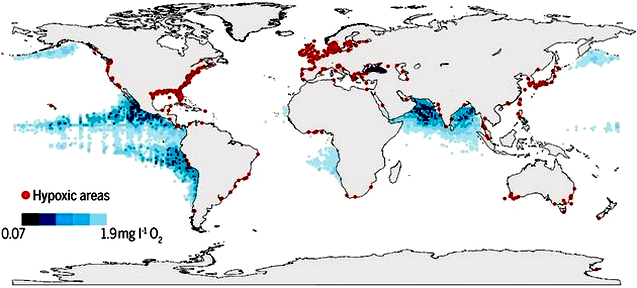
The size of oxygen-starved ocean “dead zones,” where plants and animals struggle to survive, has increased fourfold around the world, according to a new scientific analysis.
The growth of the zones is yet another consequence of global warming — including increasing ocean temperatures — triggered by greenhouse gases and, closer to the coasts, contamination by agricultural runoff and sewage.
Declining Oxygen in the Global Ocean and Coastal Waters/Science 
“Rising nutrient loads coupled with climate change — each resulting from human activities — are changing ocean biogeochemistry and increasing oxygen consumption,” says the study published in the journal Science. Ultimately, such changes are “unsustainable and may result in ecosystem collapses, which ultimately will cause societal and economic harm.”
The analysis of the oxygen-starved zones was conducted by a team of scientists from the Global Oxygen Network (GO2NE),  created in 2016 by the Intergovernmental Oceanographic Commission of the United Nations.
Researchers determined that open-ocean “oxygen-minimum” zones have expanded since 1950 by an area roughy equivalent to the size of the European Union. The volume of ocean water completely devoid of oxygen has more than quadrupled in that time, the study found. The number of hypoxic, or oxygen depleted, zones along coasts has increased up to 10 times, from less than 50 to 500.
Denise Breitburg, a marine ecologist at the Smithsonian Environmental Research Center and lead author of the study, called the plunge in ocean oxygen “among the most serious effects of human activities on the Earth’s environment.” Oxygen is “fundamental to life in the oceans,” she said in a statement.
“If you can’t breathe, nothing else matters,” Breitburg told The Associated Press. “As seas are losing oxygen, those areas are no longer habitable by many organisms.”
But the threat isn’t just to life in the oceans, which account for about half of the oxygen on the planet.
Major extinction events in Earth’s history have been associated with warm climates and oxygen-deficient oceans,” the study warns.
Consequences for ocean life can be significant even in areas where oxygen is merely low. Sea life may be stunted and immune responses impaired in such areas, resulting in poor survival rates and a decrease in healthy diversity, scientists warn.
The scientists recommend salvaging oxygen-starved areas by tackling climate change and nutrient pollution, focusing on protecting particularly vulnerable sea life with no-catch or no-fishing zones, and increasing and improving surveillance of areas where oxygen is plummeting.
Breitburg concedes that addressing global warming can seem daunting, but she says focused local efforts to protect areas can be effective. She points to changes in the Chesapeake Bay, where nitrogen pollution dropped 24 percent from its worst levels after sewage treatment and protections mandated by the Clean Air Act began. Areas of the bay with zero oxygen zones have nearly vanished, according to Breitburg.
Even with “ambitious emission reductions,” however, numerical models project “further oxygen declines during the 21st century,” the study warns.

Links

Show This Cartoon To Anyone Who Doubts We Need Huge Action On Climate Change

VoxAlvin Chang | David Roberts


This is Earth. It's a crisp fall day. So why would you believe Earth is in a dire situation?


Let's look a little deeper. The brown area below represents all the fossil fuels — oil, coal, and natural gas — that humans have identified as recoverable with current technology. The black spot is what we’re currently harvesting with mines and wells.


So what if, tomorrow, all the world leaders got together and decided to stop building new mines and wells?


And then we used all the fuel in existing mines and wells.
What would that do to Earth?


It would release about 1.1 trillion tons of carbon dioxide into the atmosphere.
Scientists have figured out that this scenario would almost certainly drive up the Earth’s average temperature by more than 2 degrees Celsius (3.6 degrees Fahrenheit), relative to preindustrial levels. That’s not a big deal, right?


Actually, it would be a massive catastrophe. The human suffering would be unthinkable.
When most of us think about Earth warming by 2 degrees, we think about it being, well, 2 degrees warmer.


But that's not quite right. First of all, it means Earth would get an average of 2 degrees warmer. This means some regions, especially on land, will get much hotter — far more than 2 degrees.
The Arctic, which houses much of the world’s ice, would warm by almost 11 degrees Fahrenheit.
The US Southwest, already suffering from increased drought, could warm by almost 10 degrees Fahrenheit, enough to create near-permanent "superdroughts."


The other problem is that Earth’s ecosystems would behave differently. For humans, it would mean rising sea levels, freshwater shortages, reduced agricultural productivity, food stress, and the conflicts and emigration that come in their wake.


A lot of people will die, and not because they burn to death. It'll be because we don't have enough food and water.
It would be like slightly heating up a fish tank, which is okay for the fish but kills the algae the fish eats.


All of this will be well underway by the time we hit 2 degrees — and the further we go past it, the worse it will get.
So we all agreed, in Paris, not to let it happen.
About 200 countries, including all the world’s major emitters, agreed at a summit in Paris in 2015 that letting the planet warm beyond 2 degrees is unacceptable, and even 2 degrees is awful. We vowed to do our best to stop warming at 1.5 degrees — although most climate researchers believe that target is no longer realistic.


That’s why we hear so much about efforts to stop warming at 2 degrees.
But how do we do it?
First, we figure out how much carbon dioxide we’re allowed to emit.

When we burn fossil fuels, we emit several harmful gases. But we focus on carbon dioxide for one reason: It stays in the atmosphere for centuries, accumulating and trapping heat.
This means we can calculate how much carbon dioxide it would take to warm the Earth a certain amount.
According to our best calculations, it would take about 843 billion tons of carbon dioxide to warm Earth about 2 degrees.


If we decide to keep using fossil fuels at the same rate, we’ll hit our limit in 21 years.
Currently we emit about 39.2 billion tons of carbon dioxide per year — and that number is only rising. But if we were able to keep it at that amount, what would happen?
After one year, our mug would look like this:


It’s not a huge hit. But after 21.5 years, we’d be here:


That’s the year 2037.
If we reduce emissions until we get to zero in the year 2065, we still need to invent world-changing technology.
Let’s say that over the next 49 years, we drive down our use of fossil fuels all the way to zero.
It’s an optimistic long shot. But this is the scenario climate scientist Joeri Rogelj proposes:


The kicker is that even in this crazily ambitious scenario, we have to rely on "negative emissions" technologies that pull carbon out of the air and bury it.
The problem: We have no clue if that’s even possible.
Negative emissions technologies have not been tested or proven at any scale. We are literally gambling our species’ future on the idea that we’re going to be able to invent it and scale it up to enormous size ... by 2065.


Let’s say, somehow, we get to no emissions in 2065 — and we invent this world-changing technology.
We’ve saved the world, right?
Not definitely. It would only give us a 66 percent chance at staying under 2 degrees.


Remember when we all agreed in Paris that 2 degree warming cannot happen? This long shot is what they were committing to.


Given the evidence, the global community has committed not to let the Earth warm by more than 2 degrees. In doing so, countries committed to rapidly reducing and eliminating all production and use of coal, oil, and natural gas and to inventing and scaling up negative emissions technology.
The problem is they don’t seem to realize that’s what they committed to.
No country is taking this long shot seriously. This means Earth will probably warm past 2 degrees. It’s terrifying.
Right now, the cool fall wind is flowing through windows, and everything feels fine. Nothing seems dire. So it’s understandable why many of us don’t feel this is an urgent political priority.


But here’s the reality: We're heading toward a global catastrophe that will cause unthinkable human suffering. The data is clear: We need to turn the ship now — or else we’ll never be able to avoid disaster.


But no country is taking this 2 degree goal seriously. It hasn’t even been mentioned in a presidential debate.
Instead, we’re focusing on threats that feel more imminent. It's just the way most humans are calibrated. So our true test is figuring out a way to comprehend that a mortal threat is on the horizon, and act accordingly.


Links

Three New Year’s Resolutions That Can Help Fight Climate Change

New York Times - Kendra Pierre-Louis

Simone Noronha
Here are three things you can do to help reduce your personal contribution to climate change while pursuing goals you might already have, like moving more, spending less and tracking your progress.

Walk the walk
If your goals for 2018 include getting more exercise, consider committing to walking or bicycling distances under a mile.
Roughly 20 percent of car trips in the United States fall into this category, and the average car produces 411 grams of carbon dioxide per mile. That’s the equivalent of the weight of a football or a can of soup.
Walking that mile instead of driving not only cuts emissions but also contributes to the 150 minutes of moderate aerobic activity that the Centers for Disease Control recommends adults get each week. Bicycling is about twice as fast as walking, so if you’re biking you might want to commit to cycling distances under two miles. Want to track your activity? Try downloading a fitness tracking app to your smartphone.
One economist caused a stir in a 2013 article by suggesting that driving could account for fewer emissions than walking because of the agricultural emissions that are generated while producing the food that fuels the walking. But the author assumes that a car gets 40 miles per gallon, not the 25 m.p.g. that is the current United States average.
And even if you drive a hybrid, it’s still worth it to walk. While the author assumed that people would need to eat more to make up the extra calories burned off while walking, Americans already eat more calories than we need. Walking is as much a doughnut offset as a carbon offset.

Waste not
This doesn’t mean we shouldn’t care about food-related emissions. Worldwide, agriculture accounts for 18 percent of greenhouse gas emissions. Luckily, we can help slash emissions — and save money — without drastically altering our diets.
One way is to waste less food. According to the Food and Agriculture Organization of the United Nations, about a third of the food produced worldwide never gets eaten. Throughout the world, some of that waste happens during production and distribution. But consumers and restaurants in North America throw away almost 40 percent of available food.
Geremy Farr-Wharton, a researcher at the Queensland University of Technology, found that color-coding our refrigerator contents (green for fresh produce, red for meat) can reduce food waste. There are even refrigerator management apps like FridgePal and Best Before that track the food in your fridge and when it will spoil. If apps aren’t your thing, a weekly refrigerator check — preferably before grocery shopping — can also help, as can monthly fridge eat-downs where you spend the last few days of the month using up everything that’s left in your fridge.
A number of businesses are also stepping up to cut waste on the production side by selling ugly produce. Producers toss about half of all fruits and vegetables in the United States, in part because they think we won’t buy “imperfect” produce that fails to meet aesthetic standards. Businesses like Imperfect Produce hope to bridge that gap by selling ugly but otherwise normal produce at a discount of 30 to 50 percent.

Measure up
There’s some truth to the saying “What gets measured gets managed,” and quantification has become something of a cultural obsession. Oroeco, an app available on both Android and iOS, takes that zeal and applies it to tracking personal carbon emissions.
Oroeco helps quantify the carbon emissions associated with purchases, investments, dietary choices and preferred modes of transport. It allows users to set goals, track performance and even compare their performance with friends. The app is still relatively new, and it isn’t perfect, but it can be a useful tool to get you moving in the right direction.
Other apps can help you lower your carbon footprint, too. My colleague Hiroko Tabuchi recently detailed the apps that she uses to stay aware of her personal contribution to global warming. The list includes the CO2 app from the International Civil Aviation Organization that she uses to track her greenhouse-gas emissions when she flies so she can invest in carbon offset credits. You can check out Hiroko’s full list here.

Links

06/01/2018

Why Snowy 2.0 Is A Write-Off From The Start

AFR - Bruce Mountain*

The Snowy scheme has the Prime Minister's eye. Alex Ellinghausen
Nine months ago Snowy Hydro, the electricity generator and retailer owned by the Commonwealth, Victoria and NSW governments, announced that it would be carrying out a feasibility study into a massive expansion of the Snowy hydro generation system to add 2000 megawatts of pumped hydro generation capacity.
Snowy Hydro's announcement of the feasibility study followed an earlier announcement from the Prime Minister that Snowy 2.0 was expected to cost $2 billion.
The feasibility study was published shortly before Christmas and the final investment decision is expected by the end of 2018. All economic analysis has been excluded from the public version of the feasibility study.
But the publicly available version does report the "base cost" of Snowy 2.0 (to Snowy Hydro) is likely to be in the range from $3.8 billion to $4.5 billion. This "base cost" excludes land and developments costs, funding and financing costs, GST, project management or hedging costs. And the feasibility study warns that there are risks, opportunities and contingency amounts that significantly affect this range.
In addition to the costs that Snowy Hydro incurs, Snowy 2.0 will be the largest point connection in the National Electricity Market's history and will require massive transmission expansion along the Great Dividing Range. TransGrid in NSW provided early estimates of transmission costs in NSW related to Snowy 2.0 of $0.6 billion to $1.4 billion. Estimates of the requirement in Victoria are not yet known but are likely to be even higher because the necessary upgrade to Victoria will be even larger.
So, in round numbers, a conservative estimate of the total capital outlay attributable to Snowy Hydro 2.0 will be at least $8 billion, four times more than the prime minister suggested when announcing this project. It would be surprising if the estimate at the time of the final investment decision is any lower than this, and the actual build cost will surely be yet higher, quite possibly significantly so.
Will it nonetheless be money well spent?
This is very unlikely. Pumped hydro is an inefficient storage technology. Australia already has significant pumped hydro capacity – 900 megawatts (MW) at Tumut 3 in Snowy and 500 MW at Wivenhoe in Queensland. Both are rarely used because they are inefficient.
The feasibility study says that at capacity, Snowy 2.0 will only produce about 1 kilowatt hour for each 1.5 kilowatt hours needed to pump water to the top reservoir. Add to that 10 per cent for losses in transmitting electricity from generators in the Hunter and Latrobe valleys to pump the water uphill. And then add another 10 per cent for losses in transmitting the stored electricity back to the main load centres in Sydney and Melbourne where most of it will be consumed.
In other words, Snowy 2.0 will use about 1.8 kilowatt hours for each kilowatt hour that it actually delivers to consumers. By comparison, a battery installed on a customer's premises or on the local grid can be expected to use about 1.1 kilowatt hour for each kilowatt hour delivered.
It is inconceivable that Snowy 2.0 will produce revenues that are vaguely close to that needed to compensate its capital outlays. This is because the volume of electricity it can produce, valued at the difference between the price paid to pump water uphill and the price received when running the water back down the hill again, will be much too small.
Experience in other countries is also instructive. The feasibility study likens Snowy 2.0 to the Dinorwig pumped hydro plant in Wales. Dinorwig, along with the smaller Ffestiniog, has comparable capacity to Snowy 2.0. In its most recent market transaction six months ago, the market value of Dinorwig and Ffestiniog was established at $236 million, a small fraction of its initial build and subsequent refurbishment costs.
It is almost certainly the case in Australia that the market value of Snowy 2.0 will be a small fraction of its likely construction cost. If they decide to proceed with Snowy 2.0, the Commonwealth, NSW and Victorian governments will be forced to substantially write down their investment, at tax payers' expense. Or, if they can not stomach that, electricity consumers will be forced to fund the deadweight.
There is time to dodge this bullet. At the very least, independent investment advisors should now be asked to opine, in publicly available reports, on likely market valuations of Snowy 2.0, before any further contemplation of this project.
More generally, unravelling the mess that is the electricity market in Australia demands independent, rigorous and impartial advice. This is always valuable but even more so when such advice is not likely to be popular with sectional political, industry or customer interests.
Deep institutional reforms are needed to ensure energy market institutions are rewarded for providing such advice rather than for telling ministers what they want to hear.

*Bruce Mountain is the director of consultancy Carbon and Energy Markets (CME).

Links

'All Happening Very Quickly': Tesla Battery Sends A Jolt Through Energy Markets

Fairfax - Peter Hannam

When it comes to hype, there is probably nobody as outlandish as US-based billionaire Elon Musk and his Tesla corporation.
Who else would plan to blast one of his new electric vehicles into space aboard his company's SpaceX rocket bound for Mars?
Power play: Tesla's battery may represent a new dawn for the industry. Photo: Joe Armao
"Payload will be my midnight cherry Tesla Roadster playing Space Oddity," Musk tweeted last month. "Destination is Mars orbit. Will be in deep space for a billion years or so if it doesn't blow up on ascent."
A mini version of the hyperbole has been on show in Australia, following the installation late last year of a 100-megawatt lithium ion battery – the world's largest. Musk famously offered to supply it for free if his firm couldn't build it within 100 days.
It arrived in time for this summer's strains on the electricity system, and may come in handy as the mercury soars this weekend over a region of Australia in arc from Adelaide to Tasmania and up to Brisbane and beyond.
The big battery, located next to the Hornsdale wind farm in the mid-north region of South Australia, has already been active, drawing interest from well beyond these shores.
The Los Angeles Times and Washington Post were among international publications to cover the battery's early success in shoring up Australia's electricity grid.
Interest was sparked in part by the battery's quickfire response – just 0.14 seconds – to inject electricity into the network following the failure of a 559-MW unit of Loy Yang A in Victoria's Latrobe Valley.
A Tesla car charging station at the wind and solar battery plant outside Jamestown in South Australia. Photo: AAP
"It appears to be far exceeding expectations," the LA Times trumpeted. "In the last three weeks alone, the Hornsdale Power Reserve [as the battery is known] has smoothed out at least two major energy outages, responding even more quickly than the coal-fired back-ups that were supposed to provide emergency power."

'Lumbering coal'
The concept of the battery beating out coal-fired power was a key part of the story, prompted by an article on the RenewEconomy website, headlined: "Tesla big battery outsmarts lumbering coal units after Loy Yang trips".
All smiles now: SA Premier Jay Weatherill tours the new Tesla battery site at the start of December. Photo: AAP
"By the time that the contracted Gladstone coal unit had gotten out of bed and put its socks on so it can inject more into the grid – it is paid to respond in six seconds – the fall in frequency had already been arrested and was being reversed," the report said.
As impressive as it seemed, the reality, though, was probably more prosaic.
Hazelwood Power Station in Victoria closed in March 2017, with more coal-fired plant closures to come. Photo: Pat Scala
Analysis by Dylan McConnell, a researcher at Melbourne University's Climate & Energy College, found each of Gladstone's six units increased output and had supplied 75MW of the shortfall before the battery "had done anything".
It also appears that at least for the Loy Yang unit tripping on December 14, the battery was not "enabled" in the back-up market for Frequency Control Ancillary Services (FCAS). In other words, probably weren't paid for that intervention.

'Outstanding'
While the hype rings a bit hollow in that instance, there's no doubt the battery has been making a difference, responding to four coal generator trips in December alone.
Franck Woitiez, managing director at Neoen – the French operator of the battery – told Fairfax Media its performance had been "outstanding". (Tesla, as is its wont, declined to comment.)
"We are very proud of the battery performance throughout December and the start of January," Mr Woitiez said, adding the company had received "quite a few inquiries" about its operations.
Critics have quibbled at the battery's size, highlighting that alone it could only supply perhaps 30,000 homes for an hour or so, at a cost guessed at $US50 million ($64 million).
But such figures ignore the many benefits – including supporting the security of the grid – that are only beginning to be understood.
"The battery has been dispatched on multiple occasions for both energy and FCAS," a spokesman for the the Australian Energy Market Operator tells Fairfax.
For December, "the battery was dispatched for energy on over 380 separate five-minute dispatch intervals, and enabled on over 4600 separate dispatch intervals in one or more FCAS markets", he said.

'Significant' savings
The SA government also spruiks the benefits.
"It is difficult to determine price trends at this early stage, however the battery has been active in the Raise and Lower Regulation Frequency Control and Ancillary Services [R-FCAS] markets since commissioning," a SA government spokesman tells Fairfax.
"The cost of Raise and Lower R-FCAS in SA in December 2016 was $502,320, compared with just $39,661 in December 2017, following the operation of the battery," he said.
"In recent times FCAS services have cost South Australians about $50 million each year," he says. "The battery is expected to significantly reduce the cost."
According to Mr McConnell, the battery dispatched about 2.5 gigawatt-hours of electricity while consuming about 3 gigawatt-hours, representing a round-trip efficiency of about 80 per cent.
"The performance to date has been very impressive. It's ramp-up from zero output to maximum in seconds (or less) is something that we haven't seen in the electricity market before," Mr McConnell said, noting the current fleet of "fast start" units take five to 10 minutes to synchronise to the grid and start providing power.
Cases of the Tesla battery responding without being "enabled" could also be part of its testing, and there may also be arrangements with the SA government separate from the FCAS market, he said.

Victoria moves too
A smaller 20-MW battery deal signed with last week between Neoen and the Victorian government – again using Tesla – will provide similar benefits to Victoria when it comes online in mid-2019.
The site, next to a wind farm near the western Victorian town of Stawell, could be the first of perhaps a dozen or more battery and storage ventures in the pipeline, according to the Smart Energy Council.
"What we're seeing in South Australia and in Victoria is really the tip of the iceberg for projects that will be coming along," John Grimes, the head of the council, said.
Bruce Mountain, director of Carbon and Energy Markets, a consultancy, said the battery is already proving its worth with the full implications still to come.
"The biggest single source of insecurity to the power system is a trip of a major coal thermal generator unit simply because they are so large – [it's] not the wind or the sun, or people switching on their airconditioners," he says.
Batteries are also useful in taking up excessive supply should demand suddenly drop, affecting the frequency of the grid on the upside.
"In the olden days, this was simply sent out to large heatloads, which would just heat up, and waste all the energy into the air," he said.

Slowing down progress
The arrival of batteries and other storage that can be immediately released has exposed flaws in the existing market. One issue remains the fact generators supply at five-minute intervals that are priced on the average over half an hour, with an alignment of the two not due to kick in for years.
"Bringing the settlement period in line with the trading period, which will come from 2021, will be a major step in allowing batteries to compete effectively and get their full value," Mountain said.
That delayed implementation is "symptomatic" of how the industry, including regulators, continues to be dominated by major, centralised operators, he said. (AGL, Energy Australia and Origin Energy are the three biggest so-called gentailers, combining generation and energy retailing.)
"They do all they can to slow down progress and ensure the market compensation mechanisms don't suit them," Mountain said. "And the energy market authorities have generally been in their pockets."
The power industry has been struggling for years as ageing coal-fired power plants close and shifting federal and state policies have created busts and booms in renewable energy. Troubles included South Australia and its 1.7 million residents being hit by a blackout following a storm in September 2016 and NSW narrowly dodging major forced outages during a heatwave in February 2017.

Snow job
Mountain is scathing of the federal government's response, not least its promotion of the Snowy 2.0 pumped hydro scheme as a way to support the grid.
By his estimates, it will need 1.8 megawatt-hours to generate each MW-hour of storage for the proposed scheme that Prime Minister Malcolm Turnbull has touted as one of his government's major responses to the nation's energy crunch.
"There is no doubt at all that the revenues it will produce won't compensate the capital costs," Mountain says, estimating it would take as much as a decade to build and balloon out to $8 billion – or four times Turnbull's initial estimate.
"It took them a couple of months to build Musk's battery, which is essentially a white good that you plug and play," he said.
"I've got absolutely no doubt that batteries will win hand over fist."
Households and businesses are also seeing batteries emerge as a viable option to add to solar panels, reducing exposure to higher power prices.
Mountain estimates batteries and solar PV with grid back-up are "now competitive on any grid offer" in South Australia, and the same is true for about a third of residents in Victoria and NSW.
"It will be true for two-thirds in a couple of years' time – if not in a year's time," Mountain predicts. "It's all happening very quickly."

Links

Climate Change Is An Overwhelming Problem. Here Are 4 Things Executives Can Do Today

Harvard Business ReviewJohn Elkington


clement m./unsplash
Today’s climate challenge is so far beyond our collective experience that it demands a radically different kind of engagement from senior leadership teams in the private sector. The threats that climate change poses to business, markets, and, indeed, capitalism are peculiarly hard for most top teams to spot, let alone act on.
Our brains evolved to respond reflexively to immediate threats but ignore or downplay systemic crises that creep up on us. Such market dynamics behave like vortices — a whirlwind in the air, or a whirlpool in water. When a vortex is just beginning to form, it is virtually invisible unless you have extremely good peripheral vision and happen to know what you are looking for. In this stage, things move at a deceptively slow pace. Even the best-designed vessels — or ventures — find themselves drawn inexorably into the danger zone. Then, suddenly, there’s a point of no return.
Such slow — but ultimately exponential — dynamics characterize what I call the carbon vortex. Picture the three major hurricanes photographed from space in the autumn of 2017 in a single, unparalleled NASA image. Think, too, of the forecast that carbon dioxide emissions, instead of declining, will probably have spiked by 2% in 2017, in part because much economic growth in China is still fueled by coal.
But as the carbon vortex gains momentum, there is also evidence of an equal and opposite vortex pulling us toward breakthrough innovation and a more sustainable future. Remember the Norwegian Sovereign Wealth Fund’s landmark commitment to run down its coal industry holdings. Or Siemens explaining that the major job cuts planned for its gas turbine business have been partly triggered by the renewable energy boom. GE, which decided to double down on coal, despite its much-vaunted “Ecomagination” platform, is now caught in the same market riptide, eliminating thousands of jobs from its power division.
It is clear that much of the world is at a market inflection point, where issues that were once seen as peripheral surge into the mainstream. As Generation Investment Management put it in “The Transformation of Growth,” their 2017 white paper, “The Sustainability Revolution appears to have the scale of the Industrial Revolution and the Agricultural Revolution — and the speed of the Information Revolution. Compared to these three previous revolutions, the Sustainability Revolution is likely to be the most significant event in economic history.”
Change of this scale can be hard to fathom, so I’d like to offer four early steps to help your top team get a grip, spot the potential silver linings in the gathering storm clouds, and, over time, learn how to “speak carbon” with growing fluency.

1. Plunge into the data
“Even a vortex is a vortex in something,” noted George Bernard Shaw. “You can’t have a whirlpool without water; and you can’t have a vortex without gas.” So in what medium is the carbon vortex forming? Look around, and it is clear that the vortex is forming in multiple arenas, among them the worlds of science, technology, business models, and, crucially, money. Imbibe the data.
The capital markets may have been slow to engage, but the Norwegian example above suggests acceleration. A growing number of indices now show the trajectory. Consider the work of Carbon Tracker on the growing risks of stranded assets and the death spiral impacting coal. See, too, PwC’s Low Carbon Economy Index 2017, tracking the rate of the low carbon transition in each G20 economy. The top performers in 2016 were China and the UK, which reduced their carbon intensities by 6.5% and 7.7%, respectively. They are still exceptions, but their trajectories signal where the carbon vortex is likely to take us.

2. Embark on a learning journey
Growing numbers of senior teams are going on “learning journeys,” visiting regions and organizations that are at the cutting edge of change, typically guided by organizations like Leaders Quest. If we were putting together such a learning journey for 2018, we might include the OECD in Paris for its work on the links between carbon dioxide emissions and GDP, and the UK government in London for its national carbon budgeting — and its recently announced commitment to improve the country’s emissions intensity ratio.
Elsewhere, we would want to visit Tesla and the X Prize Foundation in California, the latter for its Carbon X Prize — with a growing emphasis on the role of financial markets. We would want to visit Noah Deich’s Center for Carbon Removal, with its work on the new carbon economy, and Bernard David because of his work with the Global CO2 Initiative, spotlighting the most carbon-intensive sectors — cement and concrete and iron and steel, particularly in China. These are people who are pushing for gigaton-level improvements in our carbon emission and drawdown strategies. We will also be keeping a close eye on HBR’s Future Economy Project.

3. Swallow hard — and raise the price of carbon
If we are to meet climate pledges made under the Paris climate agreement, the cost of emitting carbon dioxide must rise to $50–$100 per ton by 2030, dramatically higher than the current EU price of less than $6. This was the conclusion of the Commission on Carbon Prices, a group of leading economists supported by the World Bank. Supporting the call for a worldwide carbon pricing scheme is a group of more than 200 businesses and governments, including oil majors Shell and BP.
Meanwhile, to help drive down the cost of sustainable energy, over 100 companies, including Google, Unilever, and Tata Motors, have joined the Climate Group’s RE100 platform. This shares the business case for switching to 100% renewable electricity, while working to address barriers. Consider joining.

4. Invert the vortex 
It is easy to be spooked by downward spirals, and an easy reflex action is to demonize carbon and talk of radical decarbonization. But that risks blinding us to the semi-magical aspects of this element, which is the basis of life on Earth. We need to rethink our relationship with carbon, but it’s no accident that people like Noah Deich speak in terms of the new carbon economy. Carbon will not disappear; indeed, it will be integral to the circular economy.
Among those working to reimagine carbon are Paul Hawken with his Project Drawdown platform, billed as the “most comprehensive plan ever proposed to reverse global warming,” and the carpet tile company Interface, with its ambitious Climate Take Back strategy.
This inversion approach is also championed by the Carbon Productivity Consortium, anchored by the German materials company Covestro. The aim: to work out how best to invest an increasingly squeezed global carbon budget for much-enhanced economic, social, and environmental returns. The Consortium has launched a free-to-use carbon productivity tool to help companies identify and begin to pull the levers of change. Its four stages spell RIPL: Recouple, Improve, Product and business model design, and Loop. So far, the tool focuses on fossil fuels, but eventually must expand to embrace the entire carbon cycle.
Even the biggest waves of change start with just a few ripples. You’ll need a multi-decade strategy for making business sense of the carbon vortex, but the only way to get there is to start somewhere — and to start today.

Links

Lethal Heating is a citizens' initiative