26/02/2018

The Art Of Climate Change Gallery 2: How Is Climate Change Affecting Our World?

Environmental Graphiti

Environmental Graphiti® is a venture that uses art to dramatize the critical science of climate change in an effort to expand public awareness of this urgent issue.
ART makes the science more accessible. Science makes the art more meaningful. Together they tell the story of climate change in a unique and powerful way.
The art in this series is based on the compelling data that describes the various factors that have contributed to climate change over the last two hundred years. Click on image title to see graphic data source.

      Gallery 2: How Is Climate Change Affecting Our World?

Trends In Strength Of Hurricanes Impacting Us
Climate change increases the impact, strength and intensity of hurricanes:  warmer oceans increase hurricane strength and create more evaporation, which turns to vapor and results in heavier rains; rising sea levels enhance the effect of storm surges causing greater flooding; changes in Gulf Stream patterns are also believed to cause stalling of storms over land with unprecedented levels of rain. LARGE IMAGE

Drought
Climate change will affect the world’s future supply of water - severe seasonal drought is predicted in various parts of the South and Western United States. LARGE IMAGE

Warning - The Many Plagues Of Climate Change
The effects of climate change are far-reaching.  Though global warming is an essential element of climate change, other significant impacts include intense heat waves, melting ice caps and glaciers, rising and acidified oceans, and increased risk of  drought, famine, forest fires, powerful storms, flooding, vector-borne diseases, species extinction and detrimental impacts to human health. LARGE IMAGE

Great Lakes Ice Cover Decline
The average annual ice coverage for the Great Lakes during  2003-2013 was less than 43% of the coverage over the prior half-century, lower than any other decade during the period of measurement. Less ice, together with more frequent and intense storms, leaves shoreline vulnerable to increased risk of erosion and flooding. LARGE IMAGE

Fire
Every 2 degees (Farenheit) rise in temperature means a 200% to 400% increased risk of forest and other wildfires. In 2015 more than 10 million acres were burned - an area larger than the State of Maryland. According to the New York Times (September 22, 2015), climate change has lengthened fire seasons in the U.S. by an average of 78 days since 1970, and the six worst fire seasons in the last 50 years have occurred since 2000. The catastrophic Santa Rosa wildfires of 2017 were preceded by the hottest summer in more than a century, drying out vegetation, followed by heavy rains which added more brush and grassland to burn. LARGE IMAGE

Heat
Greenhouse gases trap heat in our atmosphere leading to rising global temperatures, melting of land and sea ice, rising oceans, devastating heat waves, floods and more. LARGE IMAGE

Sea Level Rise
Warming seas and melting ice have caused Global Mean Sea Levels (GMSL) to rise 7-8 inches since 1900. An additional rise of 1 to 4 feet is likely, and up to 8 feet possible, by 2100. Sea levels will be higher than the global average for US Eastern and Gulf Coasts. "Human-caused climate change has made a substantial contribution to GMSL rise since 1900 ..., contributing to a rate of rise that is greater than during any preceding century in at least 2,800 years." LARGE IMAGE

Seasonal Global Temperature Cycles 1880-2017
According to a monthly analysis prepared by NASA scientists, April 2016 was the hottest in 137 years of record-keeping, and April 2017 was the second warmest. This graph shows the month-to-month, year-to-year global temperature patterns over seasonal cycles from 1880-2017. LARGE IMAGE

Melting Of Arctic Land-Based Ice
Increasing temperatures over the last two decades have cause the melting of mountain glaciers, small ice caps and the Greenland ice sheet. The future rate of melting of land-based ice is a significant factor in determining the amount of future sea level rise. LARGE IMAGE

Hotter Summers
The above graphs show the deviation from mean summer temperatures from the period 1951-2013. The green dotted line represents the average temperature range in summer from 1951-1980, the base measurement period. The significant warming shifts occurred, remarkably, during the lifetime of the typical baby boomer. This trend has continued since 2013. LARGE IMAGE

Vulnerability To Sea Level Rise
Rising sea levels put various areas across the globe, as well as along the U.S. coastline, at risk for serious flooding, permanent loss of land and other impacts. LARGE IMAGE

Ocean Heat
Our oceans have absorbed much of the heat produced by increasing CO2 levels.  Thermal expansion from  increased temperatures accounts for about 40% of the global sea-level rise observed over the last 60 years. 2016 average sea-surface temperatures were the warmest on record.  Warmer temperatures contributed to significant coral bleaching, causing the loss of corals supporting thousands of species of marine life.  Fish species migrating to cooler waters have disrupted fishing villages and commercial fisheries. LARGE IMAGE

Extreme Precipitation
Since the 1980's intense, single-day events have represented a larger percentage of precipitation, with 8 of the top 10 such years occurring since 1990.  The total amount of land area experiencing higher levels of annual precipitation has also significantly increased during this period. LARGE IMAGE

Projected Arctic Sea Ice Decline
Model simulations project an essentially ice-free Arctic summer before mid-century. LARGE IMAGE

Longer Frost-Free Season In Southwest Stresses Crops
The number of frost-free days in the Southwest growing season has increased significantly since the 1980's which, together with more frequent heatwaves, drought, and fewer outbreaks of cold,  accelerates crop ripening, reduces yields, increases water consumption and stresses livestock. California produces about 95% of the U.S. supply of various fruits and nuts. The changing climate conditions are likely to reduce yields of many crops and negatively affect the region's economy. LARGE IMAGE

2 Feet
Global sea levels have been rising since the late 1800's. An additional rise of 1-4 feet is considered likely by 2100, and some models project higher levels. According to the Environmental Protection Agency, sea level rise will have a greater impact in certain areas, depending on pre-existing conditions.  For example, a conservative estimated rise of 2 feet would result in a relative rise of 2.9 feet at Hampton Roads, Virginia, and 3.5 feet at Galveston, Texas. Other U.S. cities like Miami and New Orleans, face similar disproportionate risks. LARGE IMAGE

Current And Projected Arctic Conditions
Both the Arctic and Antarctic are projected to lose sea ice, but various models project the summer Arctic polar ice cap will disappear almost entirely in the latter part of the 21st century. LARGE IMAGE

Links

World's Coral Reefs Face New Peril From Beneath Within Decades

Fairfax - 

The world's coral reefs, already enduring multiple threats from bleaching to nutrient run-off from farming, also face another challenge - this time from below.
New research, published in the journal Science on Friday, has found the sediments on which many reefs are built are 10 times more sensitive to the acidifying oceans than the living corals themselves. Some reef bases are already dissolving.
Not loving it enough: coral reefs face multiple threats from climate change, including as it turns out, from below. 
The study used underwater chambers at four sites in the Pacific and Atlantic oceans, including Heron Island in the Great Barrier Reef, and applied modelling to extrapolate results for 22 reefs in three ocean basins.
As oceans turn more acidic, the corals themselves produce less of the calcium carbonate that forms their base. Instead of growing, the reef bases start to dissolve.
"The public is less aware of the threat of ocean acidification [than warming waters]," said Bradley Eyre, a professor of biogeochemistry at the Southern Cross University and the paper's lead author.
“Coral reef sediments around the world will trend towards dissolving when seawater reaches a tipping point in acidity - which is likely to occur well before the end of the century,” he said.
At risk will be coral reef ecosystems that support tourism, fisheries and the many other human activities, he said.
The ocean's acidity has increased about 30 per cent since the start of the industrial revolution, as seas absorb about one-third of the build-up of greenhouse gases in the atmosphere.
Coral reefs provide important habitats for many species, such this reef at Tufi in Papua New Guinea.
“It is vital that we put pressure on governments globally to act in concert to lower carbon dioxide emissions as this is the only way we can stop the oceans acidifying and dissolving our reefs,” Professor Eyre said.
Rates of dissolving reef sediment will depend on their starting points, including their exposure to organic sediment. The Hawaiian reef studied is already showing signs of its sediment dissolving, with higher organic nutrient levels likely to be contributing, he said.
"Carbonate sediments in Hawaii are already net dissolving and will be strongly net dissolving by the end of the century," the paper said.
Living corals themselves appear to be able to resist the acidification process, with mechanisms and strategies to resist some of the impacts.
Still, the study said the transition of the dissolution of reef sediment "will result in the loss of material for building shallow reef habitats such as reef flats and lagoons, and associated coral cays". It is unknown if the reefs will face "catastrophic destruction" once the erosion begins, the paper said.
Over time, as coral bases begin to dissolve, they are more likely to become more vulnerable to cyclones and other threats, Professor Eyre said.
He said further study was needed to understand how reefs would be affected by temperatures, rising organic and nutrient levels and more acidic waters in combination, he said.
The impact of bleaching - such as the two mass events in the 2015-16 and 2016-17 summers on the Great Barrier Reef - would most likely accelerate the breakdown of reefs by "making more sediment and organic matter available for dissolution", the paper said.

Links

25/02/2018

The Art Of Climate Change Gallery 1: Why Is Our Climate Changing?

Environmental Graphiti

Environmental Graphiti® is a venture that uses art to dramatize the critical science of climate change in an effort to expand public awareness of this urgent issue.
ART makes the science more accessible. Science makes the art more meaningful. Together they tell the story of climate change in a unique and powerful way.
The art in this series is based on the compelling data that describes the various factors that have contributed to climate change over the last two hundred years. Click on image title to see graphic data source.

       Gallery 1: Why Is Our Climate Changing?

Temperature And CO2 For Last 1,000 Years
CO2 emissions and temperatures had been relatively stable over most of the last 1,000 years, but have increased dramatically over the last 100 years. LARGE IMAGE

Emission Levels Determine Temperature Rises
Earth’s temperature has risen approximately 1.5 degrees Fahrenheit over the last 100 years. A rise of an additional 3 to 11 degrees is projected by the year 2100, depending on the level of future carbon emissions.  LARGE IMAGE

Carbon Emissions In The Industrial Age
Emissions from burning coal, oil and gas, (and producing cement), account for about 80% of the total global carbon emissions from human activities.  LARGE IMAGE

Carbon Emissions 1958 - 2013
Although carbon dioxide (CO2) occurs naturally in our atmosphere, levels have increased dramatically over the last 50 years (from approximately 300 to 400 parts per million).  LARGE IMAGE

Buy Throw Away Buy
In Laudato Si, Pope Francis’s 2015 seminal encyclical on climate change, he laments consumerism (referring to it as “our throwaway culture”) and its destructive impact on the planet, global warming and climate change.  “Humanity is called to recognize the need for changes of lifestyle, production and consumption, in order to combat this warming or at least the human causes which produce or aggravate it.“ Over-consumption has a huge impact on greenhouse gas emissions. According to Diana Ivanova, one of the lead authors of a recent study published in the Journal of Industrial Ecology:   “…(B) between 60-80 percent of the impacts on the planet come from household consumption. If we change our consumption habits, this would have a drastic effect on our environmental footprint as well.”  LARGE IMAGE

Radiative Forces From Greenhouse Gases
Significant increases in various heat-trapping greenhouse gases (such as CO2, methane, nitrous oxide and others) have contributed substantially to the warming of our atmosphere.  LARGE IMAGE

Greenhouse Gases By Industry Sector
Every sector of our economy contributes to the critical problem of greenhouse gas emissions which trap heat in our atmosphere and lead to global warming.  LARGE IMAGE

Deforestation
Greenhouse gases emitted when forests are cleared account for a fifth of global emissions from human activities.  LARGE IMAGE

Relative Strengths Of Warming And Cooling Influences
The net combined effect of natural and human influences is a strong warming, almost all of which comes from human activities.  LARGE IMAGE

Global Temperature And Carbon Dioxide
The marked increase of CO2 emissions since the industrial age correlate closely with rising temperatures.  LARGE IMAGE

Precipitation Vs Temperature
“It is virtually certain that, in the long term, global precipitation will increase with increased global mean surface temperature.” Rising temperatures caused by CO2 emissions increase water vapor and global precipitation. Most of the warmth generated by these emissions is absorbed by the oceans, which also has the effect of increasing evaporation and precipitation.  LARGE IMAGE

Trends In Global Methane Emissions
Methane (CH4) traps far more atmosopheric heat than carbon dioxide. Although methane’s global warming effects last only a few decades, (compared to CO2 which remains in the atmosphere for centuries), it can warm the planet 86 times as much as CO2 before it decays into CO2*.  In recent years, global methane levels have been hitting new highs. Over 60 percent of global methane emissions come from human activities such as industry, agriculture, and waste management.  LARGE IMAGE

2 And 3.6 Degrees
Climate scientists have warned for some time: In order to avoid extremely serious climate change impacts, global temperature increases should be limited to no more than 2 degrees Celsius (3.6 degrees Fahrenheit) over pre-industrial levels. At the recent COP21 Paris Conference (December 2015) 195 countries agreed to hold the increase to "...well below 2 degrees Celsius ... and to pursue efforts to limit the temperature increase to 1.5 degrees Celsius ...".  LARGE IMAGE

Number Image - 400
The global concentration of carbon dioxide in the atmosphere has reached 400 parts per million (ppm) for the first time in recorded history (from pre-industrial levels of 280 ppm). Current CO2 levels are more than 100 ppm higher than at any time in the last one million years, and may be higher than at any time in the last 25 million years.  LARGE IMAGE

Multiple Indicators Of Climate Change
Many different groups have observed various changes which are consistent with what would be anticipated in a warming world, based on a range of climate indicators.  LARGE IMAGE

Links

Seven Climate Change Myths That Big Oil Continues To Perpetuate

The Conversation - 

kiss/Shutterstock
In the last month alone, major players within the fossil fuel industry – “big oil” – have made some big announcements regarding climate change. BP revealed plans to reduce its greenhouse gas emissions by acquiring additional renewable energy companies. Royal Dutch Shell defended its US$1-US$2 billion green energy annual budget. Even ExxonMobil, until recently relatively dismissive of the basic science behind climate change, included a section dedicated to reducing emissions in its yearly outlook for energy report.
But this idea of a “green” oil company producing “clean” fossil fuels is one that I would call a dangerous myth. Such myths obscure the irreconcilability between burning fossil fuels and environmental protection – yet they continue to be perpetuated to the detriment of our planet.

Myth 1: Climate change can be solved with the same thinking that created it
Measures put in place now to address climate change must be sustainable in the long run. A hasty, sticking plaster approach based on quick fixes and repurposed ideas will not suffice. Yet this is precisely what some fossil fuel companies intend to do. To address climate change, major oil and gas companies are mostly doing what they have historically excelled at – more technology, more efficiency, and producing more fossil fuels.
But like the irresponsible gambler that cannot stop doubling down during a losing streak, the industry’s bet on more, more, more only means more ecological destruction. Irrespective of how efficient fossil fuel production becomes, that the industry’s core product can be 100% environmentally sustainable is an illusion.
A potential glimmer of hope is carbon capture and storage (CCS), a process that sucks carbon out of the air and sends it back underground. But despite being praised by big oil as a silver bullet solution for climate change, CCS is yet another sticking plaster approach. Even CCS advocates suggest that it cannot currently be employed on a global, mass scale.

Myth 2: Climate change won’t spell the end of the fossil fuel industry
According to a recent report, climate change is one factor among several that has resulted in the end of big oil’s golden years – a time when oil was plenty, money quick, and the men at the top celebrated as cowboy capitalists.
Now, to ensure we do not surpass the dangerous 2°C threshold, we must realise that there is simply no place for “producers” of fossil fuels. After all, as scientists, financial experts, and activists have warned, if we want to avoid dangerous climate change, the proven reserves of the world’s biggest fossil fuel companies cannot be consumed.

Myth 3: Renewables investment means oil companies are seriously tackling climate change
Compared to overall capital expenditures, oil companies renewables’ investment is a miniscule drop in the barrel. Even then, as companies such as BP have demonstrated before, they will divest from renewables as soon as market conditions change.
Big oil companies’ green investments only produce tiny reductions in their overall greenhouse gas emissions. BP calls these effects “real sustainable reductions” – but they accounted for only 0.3% of their total emissions reductions in 2016, 0.1% in 2015, 0.1% in 2014, and so on.

Myth 4: Hard climate regulation is not an option
One of the oil industry’s biggest fears regarding climate change is regulation. It is of such importance that BP recently hinted at big oil’s exodus from the EU if climate regulation took effect. Let’s be clear, we are talking about “command-and-control” regulation here, such as pollution limits, and not business-friendly tools such as carbon pricing or market-based quota systems.
There are many commercial reasons why the fossil fuel industry would prefer the latter over the former. Notably, regulation may result in a direct impact on the bottom line of fossil fuel companies given incurred costs. But climate regulation is – in combination with market-based mechanisms – required to address climate change. This is a widely accepted proposition advocated by mainstream economists, NGOs and most governments.

Myth 5: Without cheap fossil fuels, the developing world will stop
Total’s ex-CEO, the late Christoph de Margerie, once remarked: “Without access to energy, there is no development.” Although this is probably true, that this energy must come from fossil fuels is not. Consider, for example, how for 300 days last year Costa Rica relied entirely on renewable energy for its electricity needs. Even China, the world’s biggest polluter, is simultaneously the biggest investor in domestic renewables projects.
As the World Bank has highlighted, in contrast to big oil’s claims about producing more fossil fuels to end poverty, the sad truth is that by burning even the current fossil fuel stockpile, climate change will place millions of people back into poverty. The UN concurs, signalling that climate change will result in reduced crop yields, more waterborne diseases, higher food prices and greater civil unrest in developing parts of the world.


Myth 6: Big oil must be involved in climate policy-making
Fossil fuel companies insist that their involvement in climate policy-making is necessary, so much so that they have become part of the wallpaper at international environmental conferences. This neglects that fossil fuels are, in fact, a pretty large part of the problem. Big oil attends international environmental conferences for two reasons: lobbying and self-promotion.
Some UN organisations already recognise the risk of corporations hijacking the policy-making process. The World Health Organisation, for instance, forbids the tobacco industry from attending its conferences. The UN’s climate change arm, the UNFCCC, should take note.

Myth 7: Nature can and must be “tamed” to address climate change
If you mess with mother nature, she bites back. As scientists reiterate, natural systems are complex, unpredictable, and even hostile when disrupted. Climate change is a prime example. Small changes in the chemical makeup of the atmosphere may have drastic implications for Earth’s inhabitants.
Fossil fuel companies reject that natural systems are fragile – as evidenced by their expansive operations in ecologically vulnerable areas such as the Arctic. The “wild” aspect of nature is considered something to be controlled and dominated. This myth merely serves as a way to boost egos. As independent scientist James Lovelock wrote, “The idea that humans are yet intelligent enough to serve as stewards of the Earth is among the most hubristic ever.”

Links

24/02/2018

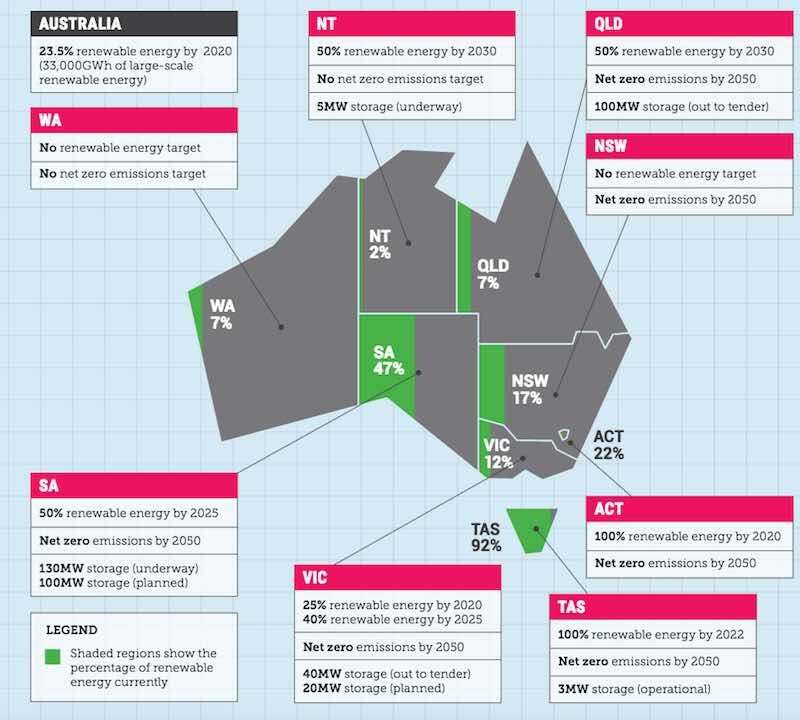
States Must Get Australia Back On Track, Amid Turnbull’s Climate Train Wreck

RenewEconomy - Leigh Ewbank

Source: Climate Council 2017 LARGE IMAGE
The slow train wreck of climate change policy is still unfolding in Australia. National emissions are rising on the Federal Coalition’s watch, and Australia will fail to meet the meagre emissions cuts it pledged to the Paris Agreement.
Regressive political forces at the national level have seen states and territories step up and lead on climate change. But they’ll have to make the most of existing initiatives and ramp up public investment to maintain the momentum.
States and territories have outshined the federal government in recent years. From the ACT adopting a renewable energy target of 100 percent by 2020 to South Australia’s enthusiasm for solar-thermal and battery storage (as well as this week’s impressive announcements). Even the NSW Liberal government has set a target of zero emissions by 2050.
Victoria is a part of this story too. A year ago today, the Andrews government strengthened the state’s climate change laws after winning the support of The Greens and crossbenchers.
The legislation brought the state’s climate change laws inline with the Paris Agreement. It enshrined a target of net-zero emissions by 2050 and requires the government to set interim Emissions Reduction Targets every five years.
The Andrews government’s 2017 legacy also includes the country’s first legislated ban on fracking and onshore gasfields as well as a Victorian Renewable Energy Target of 40 by 2025.
With state elections on the horizon, those who are concerned about climate change want to know one thing: How will the states and territories lead on climate change in 2018?
Despite alarming melting of the polar icecaps, unprecedented bleaching of the Great Barrier Reef, and parts of the country experiencing record heat, the Turnbull government’s attention is on political scandals rather than substantive policy issues.
The pace of progress on climate policy in South Australia and Tasmania will become clear after elections in March. Here in Victoria, the government has plenty of time to secure gains before the state heads to the polls in November.
In the coming months the Andrews government will, for the first time, set Emissions Reduction Targets for 2025 and 2030.
Victoria can help put Australia back on track but only with a commitment to science-based targets that are in line with the global goal of limiting warming to 1.5°Celsius. For Victoria to prepare its economy for the climate change challenge, it’s essential to do the heavy lift of cutting emissions now
In Australia’s most progressive state, a Labor government trumping Turnbull’s weak climate change targets will be popular with voters—especially environmentally conscious voters.
With global warming accelerating, progress on renewables and climate legislation must be followed by serious investment. This makes the budget the logical next step for climate change action.
There’s no ‘one-size-fits-all’ solution for climate change. Communities in rural and regional areas face qualitatively different impacts to those in urban and inner-city neighbourhoods. What unites them all is the need for government support.
The annual budget process is where governments reveal their priorities. Citizens look closely at budget allocations towards healthcare, education, and infrastructure.
When will we see governments make investing in climate change action a priority?
It will take a sizeable public investment to prepare our cities and towns for the impacts of climate change. A clear program of infrastructure investment is needed to cope with the impact of rising sea levels, increased bushfire risk, and extreme weather. And projects to rein in emissions need support too.
If preparing our communities and economy for the immediate impact and future challenges isn’t the preserve of government, then what is?
Climate change is not going away. If the Federal Coalition government won’t lead then it’ll be up to the states and territories to do the lifting.
The first government to commit to a ‘climate-focused’ budget would position itself as a national leader.

Links

Electric Vehicles No 'Silver Bullet' For Climate Change: Environment Commissioner

Fairfax - 

Electric vehicles will not be a silver bullet as the ACT looks to cut transport emissions after 2020, the ACT's Environment and Sustainability Commissioner has warned.
Speaking as the ACT government responded to her report on the territory's implementation of climate change reforms, Dr Kate Auty said Canberrans needed to embrace a mix of emission-cutting measures to reduce the risks associated with a warming climate.

You can't miss the ACT's new electric and hybrid buses.  Photo: Rohan Thomson
Transport will account for 60 per cent of greenhouse gas emissions once the ACT converts to 100 per cent renewable energy in 2020, with passenger vehicles contributing about 75 per cent.
Dr Auty said Canberrans needed to "move away from thinking there's a silver bullet like electric vehicles" and embrace other methods of transport like ride sharing, public transport or cycling.

The ACT's environment commissioner Kate Auty. Photo: NeCTAR.
"Electric vehicles are like everything else - one answer to a complex challenge we've been set by our own conduct in respect to greenhouse gas emissions and I'd urge people to think about all the other parts of the transport conundrum and make sure we're doing whatever we can," Dr Auty said.
Climate Change Shane Rattenbury said the ACT's upcoming 2045 Zero Net Emissions strategy would tie into other policy work on future transport planning to encourage people to move away from using private vehicles.
The government adopted 16 of Dr Auty's 17 recommendations about how it could improve on its climate change reforms, including better communicating how to make changes on an individual level.
"Everybody has a part to play, we can't make this somebody else's problem," Mr Rattenbury said.
ACT minister for climate change and sustainability Shane Rattenbury. Photo: Sitthixay Ditthavong 
"Our role as government is to make it easy for people to change their behaviour and to be aware of what they need to do.
"We've got a huge amount of work to do in that space to improve walking and cycling infrastructure, improve public transport and to transition to a electrified vehicle fleet, all of these are challenges ahead of us and that's the next horizon to get stuck into."
Overall Dr Auty said the ACT was doing "more than our share of heavy lifting" when it came to tackling climate change.
She said every action towards cutting emissions made a difference, no matter the size jurisdiction.
"Every time a sub-national government steps away from its responsibilities and says it's small beer, and I don't think I need to do it, we are saying we're happy to live with a 2- and a 4-degree future and if we're saying that it means we're giving up," Dr Auty said.

Links

Radical Change Urged Over 20 Years To Attain Climate Goals: Institute

Reuters - Alister Doyle

OSLO - The world will need sweeping changes over the next 20 years ranging from energy use to food production to achieve climate goals set by almost 200 nations, the new heads of a top environmental think-tank said on Friday.
FILE PHOTO: A man walks over a bridge as smoke rises from chimneys of a thermal power plant in Shanghai February 23, 2015. REUTERS/Carlos Barria/File Photo
Both said “revolutions” were needed to tackle climate change, such as capturing greenhouse gas emissions from power plants that burn fossil fuels or by reforming agriculture, where meat production and fertilisers are big sources of greenhouse gases.
Developed nations should set an example, such as Germany where Chancellor Angela Merkel is under pressure to end the use of coal in power generation.
“When Germany is not in a position to phase out coal can we expect that Poland or Indonesia or Vietnam or Turkey ... can phase out coal?” Ottmar Edenhofer, new co-director of the Potsdam Institute for Climate Impact Research, told Reuters.
Edenhofer, formerly the institute’s chief economist, and new co-director Johan Rockstrom, a Swedish scientist, said governments were far from achieving the core goal in the 2015 Paris Agreement of limiting a rise in global average temperatures to “well below” two degrees Celsius (3.6 Fahrenheit) above pre-industrial times.
“We have just literally 20 years to either succeed or fail” in the goals of getting the planet on a more sustainable path, Rockstrom said in a joint telephone interview.
The University of Pennsylvania rated the Potsdam Institute as the world’s top environment policy think-tank this month.
The institute plans to exploit more data to try to grasp under-appreciated long-term harm from natural disasters linked to climate change such as floods, droughts or storms.
Poor families in developing nations often focus, for instance, on rebuilding their homes after a natural disaster but sometimes stopped sending their children to school even after reconstruction, Edenhofer said.
The institute could use more satellite data, for instance the amount of light emitted at night by villages in developing nations, as a gauge of local poverty and vulnerability, he said. The poorest have the least access to electricity.
Rockstrom and Edenhofer were named by the institute on Friday to succeed Hans Joachim Schellnhuber in October.

Links

Lethal Heating is a citizens' initiative