10/03/2018

We Can’t Fix Climate Change Without Fixing Gender Equality

Huffington PostLiz Hutchins

When women are allowed a seat at the table, we all benefit
MATHILDE BELLENGER via Getty Images
2018 marks 100 years since most British women were granted the right to vote. Right now, a global movement is growing to expose the horrific scale of sexual assault around the world. #MeToo has become a shout of shared experience and a call to arms. The crescendo of women’s voices clamouring for change is loud, urgent, and powerful.
While the world stutters to respond to women saying “Time’s up”, we also face another stark and urgent challenge: climate change.
The impacts of climate change are not felt equally. Whilst poverty and geography are important dividing lines, so too is gender. Climate-change induced disasters disproportionately affect women. When disaster strikes, women, who still often play the primary role of looking after children and the elderly, are the last to evacuate; leading to higher female death tolls. Around 90% of the 150,000 people killed in the 1991 Bangladesh cyclone were women. They typically have less access to emergency response information and if they do survive, women, especially in poor or marginalised communities, are often less able to rebuild and recover.
Solutions to climate change need to work for everyone – yet women’s voices and needs are still often excluded from the decision-making table. The problem of climate change is simply too big to overlook half the world’s population and ignore female talent.
We can’t fix climate change without fixing gender equality but thankfully, there are already some amazing women stepping-up and leading the charge for a more equal, more sustainable world.
From Rachel Carson, the American marine biologist who, through her 1962 book Silent Spring, changed the way we think about the environment. To Berta Cáceres, the murdered Honduran environmental activist who successfully forced the world’s largest dam builder to pull out of the Agua Zarca Dam. To Christiana Figueres - a driving force in negotiating the 2015 Paris climate agreement. Negotiating the agreement was a feat that many said couldn’t be done. It commits the world to pursue efforts to keep global temperature rises to1.5°C, and if honoured, it will save countless millions of lives – in the coming decades and in generations to come.
Equality and sustainability are two sides of the same story. The global economic system’s “business-as-usual” has had terrible consequences for our environment; as we use more and more of the earth’s resources with little care for what happens next. It has also led to huge inequality. It’s time to reimagine, and create, a different kind of world, with equality and sustainability at its heart. Where both resources and power are shared fairly.
When women are allowed a seat at the table, we all benefit. It’s becoming well-known that companies with women on their boards perform better, the same is true for women and climate change.There are already examples from around the world which have shown the positive impact that involving women can have on mitigating climate change and dealing with disasters.
The urgency of the climate crisis is real and acute, but we cannot focus on climate activism, without also working to create a fairer, more equal society.
In 2018, as we celebrate those who fought for a woman’s right to vote, we need to capture some of the spirit of the great women who came before us and with hope, passion and perseverance, together we can build a better world.
Why women will save the planet- the pioneering new book from Friends of the Earth and C40 Cities is available now from Zed books.

Links

09/03/2018

Tourism Is The Australian Industry Least Prepared For Climate Change, Report Says

The Guardian

Beaches, wildlife, the Great Barrier Reef, unspoilt natural wilderness and national parks all considered threatened
A Climate Council report says not enough is being done to prepare for damage to Australia’s greatest tourism drawcards. Photograph: Greg Torda/Arc Centre Coral Reef Studies/EPA 
Tourism is Australia’s most vulnerable and least prepared industry to deal with climate change despite the fact it is already feeling its effects, according to an advocacy group report.
The report by the Climate Council, based on 200 source documents and articles, says while tourism is growing at an extraordinary pace – an 8% jump in visitors last financial year – not enough is being done to prepare for damage to the country’s greatest drawcards.
The five biggest attractions as reported by Tourism Australia – in order: beaches, wildlife, the Great Barrier Reef, unspoilt natural wilderness, national parks including rainforests and other forests – are all considered threatened by climate change.
The report says federal and state governments have mostly underplayed or ignored the risk to tourism. The government’s national Tourism 2020 plan makes no mention of the need to cut greenhouse gas emissions or improve sustainability in the industry.
Last month, the head of Queensland’s Association of Marine Park Tourism Operators, Col McKenzie, called climate scientist Terry Hughes “a dick” and urged the federal government to cut research funding due to his public comments about rising water temperatures harming the reef. McKenzie said it had turned tourists away.
Ecologist and report co-author Prof Lesley Hughes said it should not be controversial to discuss the threat climate change posed to the industry.
Beyond the often cited back-to-back years of bleaching on the reef in 2016 and 2017, she cited as examples beach erosion due to rising sea levels and a projected accelerating growth in extremely hot days in the red centre and the Top End across this century.
“Most government and industry plans on tourism are focused on growth but they don’t also look at the other side of the coin, which is the risks,” she said. “When people come here they might do other things – cultural things such as visiting the Sydney Opera House – but really the overwhelming attractions are natural icons and it’s very clear they are all already being affected.”
Government data cited in the report underlines the extent of the tourism boom. International visitors spent $40.6bn last financial year and were served by a tourism industry that employs 580,200 people, 5% of the country’s total workforce. The government estimates that, for every dollar generated by the tourism industry, a further 90c is spent elsewhere in the economy.
New Zealand provided the most visitors, though Austrade expects it will be overtaken by second-placed China this year. Britain, the United States and Singapore round out the top five. Tourism Australia this week launched a major advertising campaign in the US during the Super Bowl based on the Crocodile Dundee movie franchise. Starring actors Chris Hemsworth and Danny McBride, the campaign emphasises Australia’s natural beauty.
The industry’s growth has made tourism Australia’s second-largest export after iron ore. It is a significantly larger employer than coalmining or oil and gas extraction, which in 2014-15 employed 39,000 and 22,000 people respectively.
Hughes said, despite this, the future of fossil fuel industries and jobs received far more attention in the national conversation. “It’s cognitive dissonance at its most extreme,” she said.
Examples of industries already being affected by global warming include ski tourism, which has seen a trend of increasing reliance on artificial snow as seasons she shortened over the past 25 years.
“That’s a classic illustration that tourism industries will need to adapt and diversify to find other ways to bring people to those regions,” Hughes said.
The report highlights some hotels, resorts, airlines and zoos have taken steps to cut pollution but says a national plan is lacking. Hughes called on more tourism operators to lobby governments to help the industry adapt and diversify.
“I would also like to see operators be part of the lobby for better climate and energy policy,” she said.

Links

Patterns of Climate Change Litigation During Trump Era

New York Law Journal - Michael B. Gerrard* | Edward McTiernan*

Under Barack Obama, climate litigation was mostly industry and red states seeking to block regulations. And now under Donald Trump, it is largely about environmental groups and blue states trying to preserve the rules adopted under President Obama, and to seek novel remedies to get around federal hostility to action on climate change.
Michael B. Gerrard and Edward McTiernan
Litigation about climate change took off in the early 2000s.
Its focus has varied with the occupant of the White House.
Under George W. Bush, most suits were brought by environmental groups and blue states, frustrated by the lack of federal action, seeking to push regulations or impede fossil fuel projects.
Under Barack Obama, climate litigation was mostly industry and red states seeking to block regulations.
And now under Donald Trump, it is largely about environmental groups and blue states trying to preserve the rules adopted under President Obama, and to seek novel remedies to get around federal hostility to action on climate change.
More than 100 lawsuits were filed in the United States in 2017 raising claims concerning either the impacts of climate change or reducing greenhouse gas emissions; 82 of them were specifically about federal deregulation.
These suits are all tracked on a website we maintain, www.climatecasechart.com.

Challenging Obama-Era Regulations
The Clean Power Plan, the Obama Administration’s premier climate rule, was aimed chiefly at reducing the burning of coal to generate electricity.
The Supreme Court stayed the rule in February 2016 pending the final conclusion of legal challenges.
The U.S. Court of Appeals for the District of Columbia Circuit heard argument en banc in September 2016.
But President Trump campaigned on a pledge to repeal the rule, the Environmental Protection Agency (EPA) has begun the necessary rulemaking process to do so, and meanwhile the D.C. Circuit is holding the case in abeyance.
Industry has filed several lawsuits challenging standards for energy efficiency, refrigeration, vehicular emissions, and renewable fuels.
One notable case was Mexichem Fluor v. EPA, a challenge to an EPA rule prohibiting certain uses of hydroflourocarbons (a group of chemicals that are powerful greenhouse gases).
In August 2017, the D.C. Circuit partially vacated the rule on the grounds that it exceeded EPA’s statutory authority. 866 F.3d 451 (D.C. Cir. 2017).
In January 2018, the court denied reconsideration and rehearing, which had been sought by several manufacturers of substitute chemicals, and by environmental groups.
Both sides of the climate fight have launched suits under the Freedom of Information Act and its state counterparts seeking documents held by public entities.
Environmental groups have filed several lawsuits seeking action on various petitions that were filed with the Obama Administration but never finally acted upon.

Challenging Trump-Era Deregulation
The Trump Administration is seeking to revoke virtually all Obama-era climate-related rules.
Most of these actions are being challenged in court as soon as they become ripe for litigation.
The principal issues being raised in these cases are:
  • Were proper procedure followed, especially for public input?
  • Was sufficient reason given for changing policy?
  • Was the change consistent with underlying statutes?
Several cases challenge stays and postponement of compliance dates for Obama Administration rules, or the withdrawal, delay or failure to publish rules that were in process when President Trump effectively imposed a freeze on new environmental rules.
A few of these cases have been decided.
In Clean Air Council v. Pruitt, concerning an EPA rule on methane leaks from oil and gas operations, the D.C. Circuit found that the administration could not delay the effective date of the rule without going back through the Administrative Procedure Act process. 862 F.3d 1 (D.C. Cir. 2017).
In State of California v. Bureau of Land Management, the court enjoined BLM’s suspension of a rule concerning the venting, flaring and leakage of natural gas, finding that BLM’s reasoning behind the suspension “is untethered to evidence contradicting the reasons for implementing the rule.” No. 17 cv-07186 (N.D. Cal. Feb. 22, 2018).
Another decision (not explicitly about climate change, but involving a key program aimed at reducing energy use) found that the Department of Energy was improperly delaying energy efficiency standards for certain home appliances and industrial equipment. Natural Resources Defense Council v. Perry, No.v17-cv-03404 (N.D. Cal. Feb. 15, 2018).
Most of these challenges are procedural; if they succeed they will slow down deregulation efforts but not necessarily stop them entirely, though of course if there is a change in control of Congress after this November’s midterm elections, deregulation could be further impeded.

Challenging Fossil Fuel
Multiple suits challenge fossil fuel projects, such as natural gas pipelines and liquefied natural gas facilities.
The most common claim is that climate change was not sufficiently considered in violation of the National Environmental Policy Act (NEPA).
Especially significant in this category is Sierra Club v. Federal Energy Regulatory Commission, which held that FERC’s consideration of a natural gas pipeline running through Alabama, Georgia and Florida needed to consider the greenhouse gases that would be emitted downstream when the gas is burned. 867 F.3d 1357 (D.C. Cir. 2017).
Several other cases are pending that raise this issues of downstream emissions and cumulative analysis.
Challenges have also been filed to the leasing of onshore and offshore lands and National Monument lands for fossil fuel development.
On the other hand, several project applicants have sued states for denying permits for natural gas pipelines and coal export terminals.

Failure to Adapt to Climate Change
Litigation is beginning to emerge challenging the failure to adapt to the climate change that is coming.
Most notable is Conservation Law Foundation v. Exxon Mobil, which alleges that an oil terminal near Boston Harbor has not taken sufficient action to protect against oil spills that might be caused by coastal storms. No. 16-cv-11950 (D. Mass.).
The suit has survived a motion to dismiss and is now being further litigated.
The same plaintiffs have also filed a similar suit against Shell Oil in Rhode Island.
Claims are also being asserted in NEPA lawsuits about failure to consider climate impacts in environmental impact statements for infrastructure projects.

Money Damages Against Fossil Fuel Companies
Several suits were brought in the late 2000s and early 2010s based on the federal common law of nuisance, seeking money damages from fossil fuel companies for injuries allegedly cause by climate change.
All these cases were dismissed, primarily on the grounds that the federal common law of nuisance was displaced by the Clean Air Act.
However, whether state common law claims are preempted or otherwise available remain open questions.
Since July 2017 a rash of new cases have been filed under state common law nuisance and other doctrines—eight brought by California counties and cities, plus one by the City of New York.
Some of these suits seek general money damages; some seek compensation for building sea walls and other protections against sea level rise.
All of them are in their early stages.
On February 27, the U.S. District Court for the Northern District of California ruled that the cases brought by San Francisco and Oakland should stay in federal court, and suggested that the federal common law of nuisance applies to them because of the global nature of the challenged actions.

The Exxon Litigation Industry
In 2015, following several journalistic investigations, New York Attorney General Eric Schneiderman announced he was investigating Exxon Mobil under the Martin Act, New York’s blue sky securities law.
This law had been used by his predecessors Eliot Spitzer against several Wall Street firms, and Andrew Cuomo against electric utilities and Peabody Energy, a big coal company.
Massachusetts Attorney General Maura Healey launched a similar investigation.
The two states subpoenaed extensive records from Exxon and its accountants, PricewaterhouseCoopers (PwC).
The New York Court of Appeals declined to hear PwC’s claims that its papers enjoyed an accountant-client privilege. No. 2017-862 (N.Y. Sept. 12, 2017).
Exxon has fought back on multiple fronts.
It sued Attorneys General Schneiderman and Healey in federal court in Texas saying the investigations were politically motivated and improper.
That suit was transferred to the U.S. District Court for the Southern District of New York, where it is now pending.
Exxon is also challenging Ms. Healey’s investigation in Massachusetts state court.
Exxon has also started a proceeding in Texas seeking pre-lawsuit discovery against the lawyers representing the California cities and counties in the public nuisance litigation mentioned above.
This too seems to be aimed at establishing that the lawsuits are politically motivated.
Exxon also complained that while the cities and counties that are suing them said they are threatened by sea level rise, some of their municipal bond disclosures were silent about this threat.

Constitutional and Public Trust Litigation
Our Children’s Trust, a group based in Oregon, helped organize several lawsuits around the country asserting that the ancient public trust doctrine applies to the atmosphere and requires governments to take steps to protect against climate change.
Most of these suits were dismissed, but one has gotten traction.
In Juliana v. United States, the U.S. District Court in Oregon denied a motion to dismiss, found that the public trust doctrine may have a constitutional basis in substantive due process, allowed discovery to proceed, and set a trial for February 5, 2018. See 217 F. Supp. 3d 1224 (D. Or. 2016).
When the District Court denied defendants leave to appeal, they started a mandamus proceeding in the Ninth Circuit, which stayed the litigation and heard oral argument on December 11.
A decision is now awaited.
Several other constitutional suits have also been filed around the United States.
Decisions have been rendered by courts in the Netherlands, Norway, Pakistan, South Africa, and Colombia and the Inter-American Court of Human Rights finding that various constitutional, human rights, international law, and other doctrines may apply to climate change; some but not all of these decisions have granted substantive relief.

*Michael B. Gerrard is a professor and Faculty Director of the Sabin Center for Climate Change Law at Columbia Law School, and Senior Counsel to Arnold & Porter.
*Edward McTiernan, a partner in Arnold & Porter, is former General Counsel of the New York Department of Environmental Conservation.


Links

Landmark Case Challenges Land Clearing Based On Climate Change Impact

The Guardian

Northern Territory government-approved land clearing likely to cause up to 3 megatonnes of C02-equivalent greenhouse gas emissions
The majority of Australia’s land-clearing has occurred in Queensland, but other states and territories look like they could be following in its footsteps.
A landmark court case in the Northern Territory is set to consider a challenge to a massive land-clearing approval based on its impacts on climate change.
The case, brought by the Environment Centre NT, is believed to be the first of its kind in Australia, using the consideration of greenhouse gas emissions from clearing as a lever to seek to have an approval overturned.
“I think it’s groundbreaking,” said Shar Molloy, director of ECNT.
In November 2017, the Northern Territory government approved the clearing of 20,432 hectares of land on the Maryfield station property – an area more than three times the size of Manhattan.
The clearing application was referred to the Northern Territory Environmental Protection Agency, which decides whether an action requires a full environmental assessment.
The NTEPA briefly considered the greenhouse gas emissions from the action concluding that they “are likely to make a considerable contribution to the NT’s annual greenhouse gas emissions”.
But the assessment went on to say the NTEPA did not consider that would be a “significant impact” on the environment. The reasoning they gave was that the NT government does not have a policy on the matter.
Despite the proposed clearing being the largest ever approved in the NT, and previous smaller applications forced to undergo environmental assessment, the NTEPA decided a full environmental assessment was not needed for the Maryfield clearing.
It went on to recommend to the pastoral lands board, which is the final decision maker, that the clearing be approved with a number of conditions related to biodiversity.
The pastoral lands board then approved the clearing, but ignored some of those conditions.
The ECNT, represented by the Environmental Defenders Office NT, is alleging that both the NTEPA and the pastoral lands board failed to properly consider the impacts of the clearing on greenhouse gas emissions.
It is widely thought to be the first Australian case to challenge the approval of a land clearing action on the basis of its impact on climate change.
Given the scale of the clearing, EDO NT principal lawyer Gillian Duggin said “it is of substantial public interest for the court to explore the errors we say exist in their decision making processes”.
“The decisions challenged by this case have drawn attention to the significant weaknesses in the current legal and policy frameworks for land clearing and climate change in the Northern Territory – this is a major concern for our client,” Duggin said.
Molloy said they decided to take up the case because they were shocked by the scale of the approval, and the fact it occurred without a full environmental assessment.
“This huge clearing permit granted should never have been granted. It will wipe out intact forest and woodland, threatens native wildlife, and will increase the NT’s greenhouse gas emissions,” said Molloy.
“It is the biggest clearing permit ever granted in the NT. For the NT EPA to find a full environmental assessment was not necessary is completely untenable.”
Glenn Walker from The Wilderness Society said the clearing is likely to cause up to about 3 megatonnes of CO2-equivalent greenhouse gas emissions. That figure is based on detailed scientific studies of clearing on nearby properties, and is difficult to get a firm estimate of.
“On a territory scale, the emissions from this one station, and the deforestation that could occur, is equal to 15 to 20% of the Northern Territory’s annual emissions,” said Walker. “That’s an enormous dent in their emissions reduction efforts.”
Duggin said that while it is concerning that the NT government has failed to put in place an emissions or climate change policy, that does not mean the EPA can avoid considering greenhouse gas emissions when assessing clearing proposals.
“In this case, however, it is the responsibility of the EPA to make its decisions according to the legislation that exists, notwithstanding the absence of a climate change policy. Our client will argue that hasn’t occurred in this instance”, said Duggin.
Bruce Lindsay, a lawyer at Environment Justice Australia in Melbourne said the case would be keenly watched by environmental lawyers around the country, and there could be scope for similar challenges elsewhere.
“I think under our amended Climate Change Act 2017 in Victoria there is scope for decision makers and policy makers to be required to take account of climate change, although in rather hedged language,” said Lindsay. “This has not yet been tested in a judicial proceeding.”
Land clearing in Australia has been a significant contributor to the country’s greenhouse gas emissions.
In 1990, before short-lived land-clearing controls came into law in Queensland, a quarter of Australia’s total greenhouse gas emissions were caused by deforestation. Emissions from land clearing dropped after 2010 but are rising sharply again.
While in recent decades, the majority of the country’s clearing has occurred in Queensland, other states and territories look like they could be following in Queensland’s footsteps.
In 2016 and 2017, the NT government approved about 45,500 hectares of land for clearing through the Pastoral Lands Board. That was an almost tenfold jump over the average of the previous 12 years of about 4,600 hectares, which was already an area two-thirds the size of Manhattan.

Links

08/03/2018

Climate Change 'Impacts Women More Than Men'

BBC - Mary Halton

Over 70% of those displaced by flooding in Pakistan in 2010 were women and children. Getty Images
Women are more likely than men to be affected by climate change, studies show.
UN figures indicate that 80% of people displaced by climate change are women.
Roles as primary caregivers and providers of food and fuel make them more vulnerable when flooding and drought occur.
The 2015 Paris Agreement has made specific provision for the empowerment of women, recognising that they are disproportionately impacted.
Millions in Nigeria, Cameroon, Chad, Niger and the Central African Republic rely on Lake Chad. Getty Images
In central Africa, where up to 90% of Lake Chad has disappeared, nomadic indigenous groups are particularly at risk. As the lake's shoreline recedes, women have to walk much further to collect water.
"In the dry season, men go to the towns... leaving women to look after the community," explains Hindou Oumarou Ibrahim, coordinator of the Association of Indigenous Women and People of Chad (AFPAT).
With dry seasons now becoming longer, women are working harder to feed and care for their families without support. "They become more vulnerable... it's very hard work," Ibrahim recently told the BBC's 100 Women initiative.

A global problem
It is not just women in rural areas who are affected. Globally, women are more likely to experience poverty, and to have less socioeconomic power than men. This makes it difficult to recover from disasters which affect infrastructure, jobs and housing.
Shanika Reaux with her baby Tatiana were displaced by Hurricane Katrina. Getty Images
After Hurricane Katrina in 2005, African American women were among the worst affected by flooding in Louisiana. As sea levels rise, low-lying cities like New Orleans will be increasingly at risk.
"In New Orleans, there was much higher poverty among the African American population before Katrina," says Jacquelyn Litt, professor of women's and gender studies at Rutgers University.
"More than half the poor families in the city were headed by single mothers," she told BBC News.
"[They] are reliant on interdependent community networks for their everyday survival and resources. The displacement that happened after Katrina essentially eroded those networks. It places women and their children at much greater risk."
In the immediate aftermath of extreme events, emergency shelters can be inadequately equipped to support women. The Superdome, in which evacuees were temporarily housed after Hurricane Katrina, didn't have enough sanitary products for the women accommodated there.
Katrina impact: Women and children waiting to be evacuated outside the New Orleans Superdome. Getty Images
Increased incidences of violence against women, including sexual assault and rape, have also been documented in the wake of disasters.

'Natural' disasters?
Much as climate change is accelerated by human behaviours, the impact of weather and climate events is influenced by societal structures. Disasters do not affect all people equally.
In the wake of the 2004 tsunami, an Oxfam report found that surviving men outnumbered women by almost 3:1 in Sri Lanka, Indonesia and India.
While no one cause was clear, there were similar patterns across the region. Men were more likely to be able to swim, and women lost precious evacuation time trying to look after children and other relatives.
Another study spanning 20 years noted that catastrophic events lowered women's life expectancy more than men; more women were being killed, or they were being killed younger. In countries where women had greater socioeconomic power, the difference reduced.

Half the world
In recognition of this vast disparity, governments and organisations working on climate change are gradually moving to include women's voices in policy and planning.
Women farmers in Durban protesting the impact of climate change on their livelihoods. Getty Images
The UN has highlighted the need for gender sensitive responses to the impacts of climate change, yet the average representation of women in national and global climate negotiating bodies is below 30%.
The numbers don't improve at the local level.
"Women are often not involved in the decisions made about the responses to climate change, so the money ends up going to the men rather than the women," environmental scientist Diana Liverman told the BBC's Science in Action programme on the World Service this week.
As an author for the Intergovernmental Panel on Climate Change (IPCC), whose reports influence climate change policy, Liverman has been monitoring the numbers of women involved.
Twenty-five percent of those nominated to participate in the next report are women. "IPCC has been very receptive to this and is actually discussing how they can support women better," explains Liverman.
"Women are half the world. It's important they participate in all major decisions,"
"Climate change is not a fight for power," points out Hindou Oumarou Ibrahim, "it's a fight for survival."

Links

US Government Can Be Sued By Children Over Climate Change: Court

Fairfax - Jonathan Stempel (Reuters)

New York: A US federal appeals court has rejected the American government's bid to halt a lawsuit by young people claiming that President Donald Trump and his administration are violating their constitutional rights by ignoring the harms caused by climate change.
Students at a climate rally in San Francisco last week. Photo: AP
By a 3-0 vote, the 9th US Circuit Court of Appeals in San Francisco said the administration had not met the "high bar" under federal law to dismiss the Oregon lawsuit, which was originally brought in 2015 against the administration of Barack Obama.
The lawsuit started during the Obama administration. Photo: AP
The potentially far-reaching case is one of a handful seeking to have courts address global warming and its causes.
Twenty-one plaintiffs, now aged 10 to 21, accused federal officials and oil industry executives of knowing for decades that carbon dioxide emissions from the burning of fossil fuels destabilise the climate, but refusing to do anything about it.
They said this has deprived them of their due process rights to life, liberty and property, including to live in a habitable climate.
Students at a rally for clean energy in San Francisco last week. California opposes a Trump administration plan to scrap a policy slashing climate-changing emissions from power plants. Photo: AP
US District Judge Ann Aiken in Eugene, Oregon in November 2016 refused to dismiss the lawsuit, saying a quick dismissal without addressing the merits could sanction the government's alleged "knowing decision to poison the air."
In seeking to overturn that ruling, the government said letting the case proceed could lead to burdensome litigation, and provoke a "constitutional crisis" by pitting courts against Trump and the many other Executive Branch officials named as defendants.
A South Korean environmental activist protests against the US withdrawal from the Paris climate accord last year. Photo: AP
But in Wednesday's decision, Chief Judge Sidney Thomas said the dismissal request was premature, and deciding whether the plaintiffs' claims were too broad could be addressed through the normal legal process.
"Litigation burdens are part of our legal system, and the defendants still have the usual remedies before the district court for non-meritorious litigation," Thomas wrote. "Claims and remedies often are vastly narrowed as litigation proceeds; we have no reason to assume this case will be any different."
The US Department of Justice, which handled the government appeal, did not immediately respond to requests for comment.
Julia Olson, who represented the plaintiffs and is executive director of Our Children's Trust, which advocates for improving the climate, in an interview welcomed the decision.
"It's very exciting," she said. "It will be the first time that climate science and the federal government's role in creating its dangers will go on trial in a US court."
The lawsuit was returned to Aiken for further proceedings.

Links

New Scenarios Show How The World Could Limit Warming To 1.5c In 2100

Carbon Brief - Zeke Hausfather

Civil Society 1.5C protest at COP21. Credit: Takver.
In the 2015 Paris Agreement on climate change, nearly every country on Earth pledged to keeping global temperatures “well below” 2C above pre-industrial levels and to “pursue efforts to limit the temperature increase even further to 1.5C”.
However, at the time, scientists had only modelled energy system and carbon mitigation pathways to achieve the 2C target. Few studies had examined how the world might limit warming to 1.5C.
Now a paper in Nature Climate Change presents the results from a new modelling exercise using six different “integrated assessment models” (IAMs) to limit global temperatures in 2100 to below 1.5C.
The results suggest that 1.5C is achievable if global emissions peak in the next few years and massive amounts of carbon are sucked out of the atmosphere in the second half of the century through a proposed technology known as bioenergy with carbon capture and storage (BECCS).

Defining the 1.5C target
One challenge with the goal of limiting warming to 1.5C above pre-industrial levels is that it was not clearly defined in the text of the Paris Agreement. For example, scientists disagree on what, exactly, pre-industrial temperatures were and how best to define them, as well as what dataset to use.
There is also not a clear consensus if the target should be to aim to have even odds of the world reaching 1.5C warming by 2100, or seek to try and avoid having temperatures exceed 1.5C by aiming for an even lower warming amount. Because uncertainties in climate sensitivity mean that we could have anything between 1.5C and 4.5C warming per doubling of CO2 emissions, scientists tend to plan to avoid the worst case where climate sensitivity ends up being on the higher end of the range.
In the case of the 2C target, the Paris Agreement’s “well below” language has been interpreted as ensuring that there is no more than a 33% chance of exceeding 2C – and, therefore, a 66% chance of staying below it. But the 1.5C target could be interpreted as either aiming for a 50% chance of staying below 1.5C, or a 66% chance similar to the 2C target. This may sound like a small distinction, but it has large impacts on the resulting carbon budget and ease of meeting the target.
In their new paper, a team of 23 energy researchers choose the stricter interpretation of the target, aiming for a 66% chance of avoiding more than 1.5C warming in the year 2100. However, they allow for temperatures to exceed 1.5C over the course of the century as long as they fall back down to below 1.5C by the year 2100. This is known as an “overshoot” scenario.

1.5C only possible in some future pathways
To assess viable pathways to limit warming to 1.5C, the researchers use the new Shared Socioeconomic Pathways (SSPs) developed in preparation for the next Intergovernmental Panel on Climate Change (IPCC) assessment report due early next decade. These SSPs – which Carbon Brief will explore in more depth in the coming weeks – present five possible future worlds that differ in their population, economic growth, energy demand, equality and other factors.
Each world could have multiple different climate trajectories, though some will have a much easier time reducing emissions than others. The new climate trajectory associated with avoiding more than 1.5C warming in 2100 is called Representative Concentration Pathway 1.9 (“RCP1.9”), which is a world where the radiative forcing from greenhouse gases is limited to no more than 1.9 watts per meter squared (W/m2) above pre-industrial levels. This is lower than the range of RCPs previously used by climate modellers, which went from 2.6 up to 8.5W/m2.
The six IAMs all find viable 1.5C scenarios in SSP1, which is a pathway that focuses on “inclusive and sustainable development”. Four of the six models find pathways in SSP2, which is a middle of the road scenario where trends largely follow historical patterns. No models show viable 1.5C pathways in SSP3, which is a world of “regional rivalry” and “resurgent nationalism” with little international cooperation.
Finally, only one of the models has a 1.5C pathway in SSP4, which is a world of “high inequality”, while two models have viable pathways in SSP5, a world of “rapid economic growth” and “energy intensive lifestyles”.

Emissions must peak quickly
To limit warming to below 1.5C, all the models that the researchers examined require that global emissions peak by 2020 and decline precipitously thereafter. After 2050, the world must reduce net CO2 emissions to zero and emissions must be increasingly negative throughout the second half of the 21st century.
Even with these rapid reductions, all the scenarios considered still overshoot 1.5C warming in the 2040s, before declining to around 1.3-1.4C above pre-industrial levels by 2100. Models with more rapid reductions – generally associated with SSP1 – have less temperature overshoot than those with more gradual reductions.
The figure below shows both CO2 emissions (left) and global warming above pre-industrial (right) across all the 1.5C models examined. The lines are coloured based on the SSP used.
CO2 emissions in gigatons (Gt) CO2 (left) and global mean surface temperature relative to preindustrial (right) across all RCP1.9/1.5C scenarios included in Rogelj et al 2018. Data available in the IIASA SSP database. Chart by Carbon Brief using Highcharts.

The models show a remaining 1.5C “carbon budget” from 2018 to 2100 of between -175 and 400 gigatonnes of CO2 (GtCO2). This range is consistent with estimates from the IPCC’s 5th Assessment Report.
The wide range is largely a result of differences in emissions of non-CO2 greenhouse gases, such as methane and nitrous oxide, which vary by a factor of between two and three across the models by 2100. Some models with higher non-CO2 emissions have a remaining carbon budget of less than zero, requiring more CO2 to be removed from the atmosphere than added by the end of the century. In these simulations, the carbon budget for 1.5C has already been used up.
The central estimate across the models is that the remaining 2018-2100 carbon budget is around 230 GtCO2. At the current rate of emissions, this would allow roughly six years until the entire 1.5C budget is exhausted, with a range of zero to 11 years across all the models.

Replacing fossil fuels with renewables
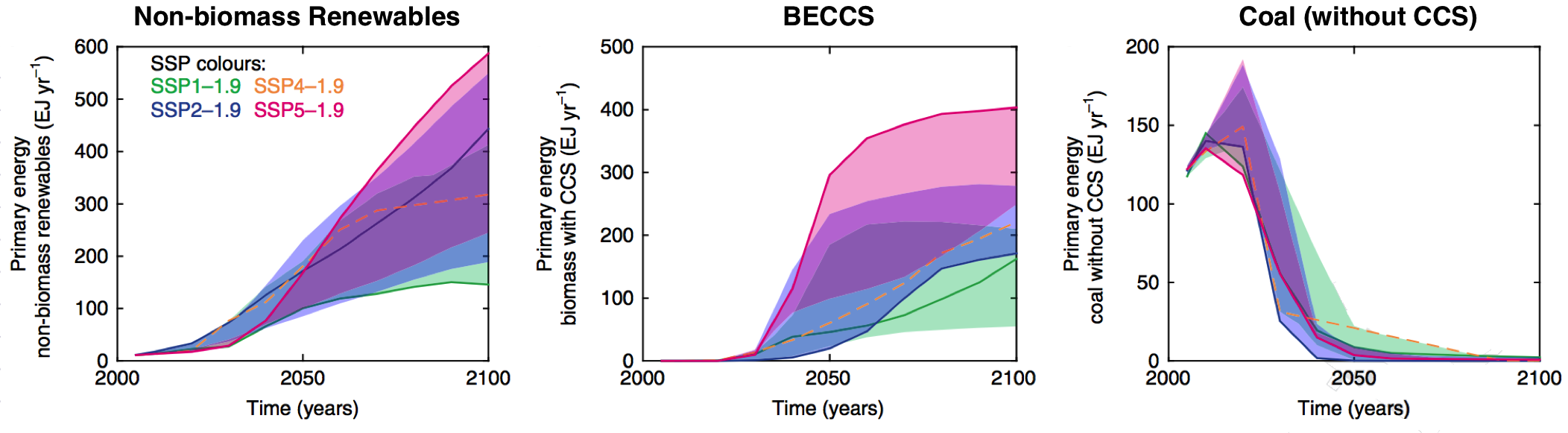
The study explores the different ways that global energy needs can be met, while also cutting GHG emissions in order to meet the 1.5C goal. Limiting warming to below 1.5C requires that the world rapidly phase out all types of fossil fuels – or at least those without accompanying carbon capture and storage (CCS). At the same time, the world need to quickly ramp up the use of zero and net-negative carbon energy sources – things such as BECCS that generate energy while actually removing CO2 from the atmosphere.
The figure below shows the use of renewables (left), net-negative BECCS (centre) and coal without CCS (right) across all the 1.5C models. The colours show which SSPs the model simulations use.
Global primary energy use in exajoules (EJ) for non-renewable biomass (left), BECCS (center), and coal without CCS (right) across all RCP1.9/1.5C scenarios. Adapted from Figure 2 in Rogelj et al 2018. LARGE IMAGE
In most models, overall energy use actually increases between 2018 and 2100, by between -22% and +83%, with a central increase of 22%.
However, the models also show that energy efficiency is quite important in the short term – at least, while most energy comes from fossil fuels. This is particularly important in the transportation and building sectors, where rapid decarbonisation is more difficult than in power generation.
The models show an estimated 60-80% of all energy coming from renewables globally by 2050. Some models also show a much larger role for nuclear power, though others do not.
To limit warming to 1.5C, coal use without carbon capture declines by around 80% by 2040, with oil similarly mostly phased out by 2060. This would require most petrol or diesel vehicles to be phased out by 2060, with electric or other low-carbon alternative fuel vehicles making up the vast majority of sales well before that date. Future natural gas use is more mixed in the models, with some showing increases and some decreases by mid-century.

Emissions must go negative
Negative emissions are needed in the latter half of the century to pull the extra CO2 out of the atmosphere. This is because emissions cannot fall fast enough in the models to avoid exceeding the allowable carbon budget to avoid 1.5C warming.
Most of the models emit roughly 50-200% more CO2 than the allowable carbon budget over the course of the century, before pulling the extra CO2 back out.
The models assume widespread adoption of BECCS starting between 2030 and 2040 and then rapidly scaling up. By 2050, many models have BECCS producing more than 100 exajoules (EJ), roughly the same amount of energy globally as coal provides today. By 2100, BECCS will be around 200EJ compared to 300EJ for all non-biomass renewable energy.
The figure below shows the amount of CO2 sequestered by CCS (both from BECCS and fossil fuels) across all the models. Carbon capture ramps up after 2020 and could be 20 GtCO2 or higher by the end of the century, which is around half of global CO2 emissions in 2018.
Annual CO2 sequestered by carbon capture and storage in gigatons (Gt) CO2 by year and SSP across all RCP1.9/1.5C scenarios. Adapted from Figure 3 in Rogelj et al 2018.
The models produce estimates of global forest cover changes between -2% and 26% between today and 2100, with most models showing significant increases in forest cover. Both BECCS and afforestation require a lot of land. Most models show a decline in global cropland scenarios roughly equal to the area currently used for agriculture across the entire European Union.
However, most of the models used in the study do not include afforestation as an explicit mitigation option, so afforestation and other “natural” negative emissions technologies could potentially play a larger role in the future. The specific technologies used for future negative emissions may be different and somewhat less reliant on BECCS, but non-BECCS approaches are largely excluded from the models due to remaining uncertainties in cost and effectiveness at scale.
Similarly, the amount of BECCS used differs quite a bit between models and across SSPs, with SSP1 requiring the least negative emissions and SSP5 requiring the most due to its slower emissions reductions and higher overall energy use.
Dr Joeri Rogelj, the paper’s lead author from the International Institute for Applied Systems Analysis (IIASA) in Austria, tells Carbon Brief:
“This indicates that a focus on sustainable lifestyles that limit energy demand can strongly reduce the reliance on BECCS.”
One interesting consequence of the 1.5C target is a reduced use of fossil fuels combined with CCS, compared to what is found in 2C scenarios. This is because fossil fuels with CCS still results in methane emissions from coal mining or gas handling, as well as CO2 emissions due to imperfect capture and leakage. These extra emissions can become too important to allow at a large scale in a 1.5C world.

Much more difficult to reach 1.5C than 2C
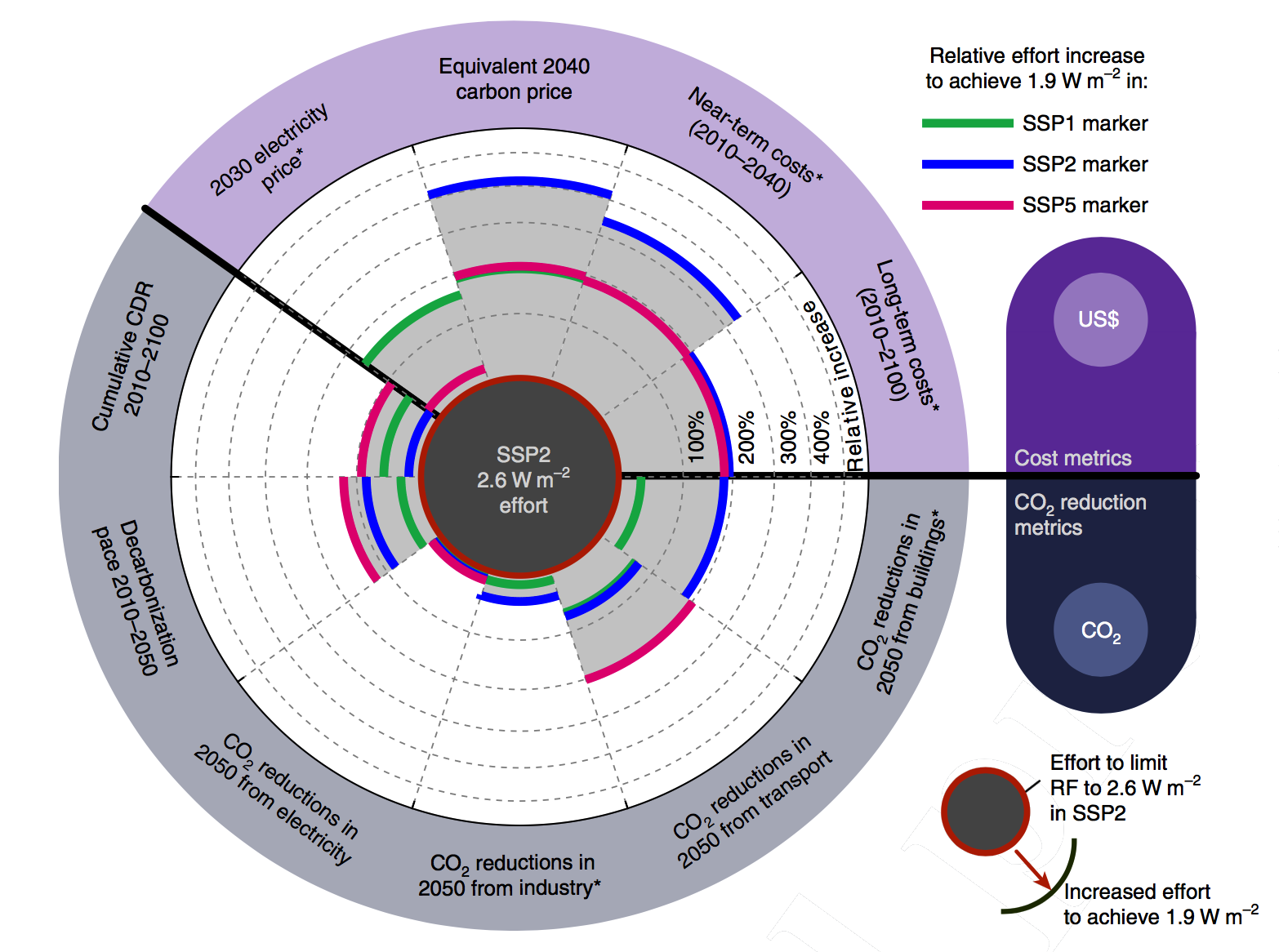
In addition to exploring the details of what it would take to limit warming to 1.5C, the paper also compares it to existing 2C scenarios across a number of different categories. The figure below shows the difference between 1.5C and 2C scenarios across both economic and CO2 reduction metrics. Each dashed line represents a 100% increase in cost or effort in a 1.5C world compared to a 2C world.
Relative increases in cost and CO2 reduction metrics for 1.5C scenarios compared to 2C scenarios for various SSPs. Each dashed line represents a 100% increase in cost or reduction amount, up to a 500% increase. Taken from figure 4 in Rogelj et al 2018. LARGE IMAGE
The largest increases are in carbon prices, which must be between 200% and 400% higher, and in near-term costs, which are 200% to over 300% higher. These increases in short-term costs are driven by the more severe near-term emission reductions needed. Long-term costs are also expected to be around 200% higher.
For CO2 reduction metrics, a 1.5C world requires approximately two to three times larger reductions in CO2 from buildings and transport than in a 2C world. These sectors are more difficult to decarbonise than power generation as they involve the direct combustion of fossil fuels that are less easily replaced.

Difficult, but possible?
The new scenarios in this study are important because they show that there are possible trajectories and technological pathways that can limit warming to below 1.5C in 2100. However, all of the models included overshoot 1.5C of warming in the middle of the century. Most also rely on massive amounts of still-unproven negative emissions later in the century to allow a more feasibly gradual reduction in emissions in the near-term.As Dr Glen Peters, a senior researcher at the CICERO Center for International Climate Research in Norway who was not involved in the study, tells Carbon Brief:
“Limiting temperature to 1.5C is getting close to what models can deliver, with only certain socioeconomic, technological and resource assumptions amenable to 1.5C pathways. How to transform the model results into a viable society transformation remains the elephant in the room. The 1.5C scenarios require radical reductions in unabated fossil fuel use, rapid expansion of non-fossil energy sources and planetary-scale carbon dioxide removal. Failing to meet any of those core building blocks will make 1.5C quickly infeasible.”

Note: Accompanying the publication of the study is a newly updated SSP emissions and scenario database, which includes data for all SSP scenarios.

Links

Lethal Heating is a citizens' initiative