30/03/2018

U.S. Judge Dismisses Exxon Lawsuit To Stop Climate Change Probes

Reuters - Jonathan Stempel

NEW YORK (Reuters) - A federal judge on Thursday dismissed Exxon Mobil Corp’s (XOM.N) lawsuit seeking to stop New York and Massachusetts from probing whether the oil and gas company covered up its knowledge about climate change and lied to investors and the public about it.
The logo of Exxon Mobil Corporation is shown on a monitor above the floor of the New York Stock Exchange in New York, December 30, 2015. REUTERS/Lucas Jackson/File Photo
 U.S. District Judge Valerie Caproni in Manhattan rejected as “implausible” Exxon’s argument that the states’ Democratic attorneys general, Eric Schneiderman and Maura Healey, were pursuing politically motivated, bad faith fraud investigations in order to violate its constitutional rights.
Caproni dismissed the lawsuit with prejudice, meaning the Irving, Texas-based company cannot bring it again.
Exxon is evaluating its legal options, spokesman Scott Silvestri said in an email.
“We believe the risk of climate change is real and we want to be part of the solution,” he added. “We’ve invested about $8 billion on energy efficiency and low-emission technologies such as carbon capture and next generation biofuels.”
The case is one of several, including shareholder and employee lawsuits, centered on whether Exxon has for decades lied about climate change, including its impact on energy prices and the environment and its ability to develop reserves, and taken public positions inconsistent with what it knew.
Schneiderman, in a statement, welcomed the end of what he called Exxon’s “frivolous, nonsensical lawsuit that wrongfully attempted to thwart a serious state law enforcement investigation.”
Healey called Caproni’s decision “a turning point in our investigation and a victory for the people.”
Exxon sued in June 2016, after receiving subpoenas seeking documents about its historical understanding of climate change, and communications with interest groups and shareholders.
The company accused Schneiderman and Healey of conspiring to “silence and intimidate one side of the public policy debate,” violating its rights to free speech and due process and against unreasonable searches.
Much of Exxon’s case was based on a March 2016 news conference with the attorneys general and former U.S. Vice President Al Gore, which it called a bid to coerce its adoption of policies that they and climate change activists preferred.
Caproni, however, said “nothing that was said can fairly be read to constitute declaration of a political vendetta against Exxon.”
She said the belief by Schneiderman and Healey, “apparently” shared by Exxon, that climate change is real does not mean they had no reason to believe Exxon may have fraudulently “sowed confusion” to bolster its bottom line.
Nowhere, she said, did Exxon suggest that the attorneys general believed the company “was itself confused about the causes or risks of climate change.”
The case is Exxon Mobil Corp et al v Schneiderman et al, U.S. District Court, Southern District of New York, No. 17-02301.

Links

29/03/2018

'Harder And Riskier': Carbon Removal Needed If Paris Goals Don't Rise

Fairfax - Peter Hannam

Greenhouse gas emission cuts must be at least 20 per cent deeper than pledged under the Paris climate accord or the world will have to begin the costly direct removal of atmospheric carbon to avoid dangerous climate change, a new study argues.
The Germany-based researchers examined the action needed if nations failed to deliver greater carbon curbs by 2030 but still kept global warming to under 2 degrees, compared with pre-industrial levels.
"Each tonne of CO2 we don't emit, we don't have to remove from the atmosphere afterwards in an expensive and strenuous way," said Jessica Strefler from the Potsdam Institute for Climate Impact Research and the lead author of the paper published on Thursday in Environmental Research Letters.
Emissions impossible? Delays in cutting emissions make it more likely that carbon will have to be directly captured if dangerous climate change is to be avoided.
Computer simulations indicate an industry "comparable" to the size of the global petroleum sector, and able to capture and store at least 5 billion tonnes of C02 annually, will be required - and possibly much larger.
Such carbon removal - whether by reafforestation ($31 per tonne) or direct air capture ($652 per tonne) - would be costly.  "One way of paying for these technologies is imposing a price on carbon emissions and using these revenues to pay for carbon dioxide removal," Dr Strefler told Fairfax Media.
Strengthened Paris goals - known as nationally determined contributions (NDCs) - could preclude the need for carbon extraction but only if they were sharply increased.
"We would have to roughly halve 2030 emissions compared to current pledges, and halve them again every decade until 2050," Dr Strefler said. "If we do not strengthen the NDCs significantly, CO2 reduction will be necessary to achieve the 2-degree target."
The projections underscore the challenges nations will face when delegates gather in Katowice, Poland, in December. Australia, which has pledged to cut 2005-level carbon emissions by 26-28 per cent by 2030, will be among the countries pressed to do more.
Evidence of climate change mounts, and includes the past four years recording "exceptionally warm" temperatures.  Last year was the hottest year on record that was not an El Nino year, while the Arctic - the world's fastest-changing region - just completed its warmest winter.

IMAGE

Pep Canadell, a research scientist with the CSIRO and executive director of the Global Carbon Project, said the German study used a simplified model that, if anything, underestimated the scale of the challenge.
For instance, it assumed a global carbon price of $US50 per tonne by 2020 for a cost-effective scenario - "something very far from our real world", Dr Canadell said.
"For every year we delay reaching peak emissions and decline, the harder and riskier it will get to avoid the worst impacts of climate change," he said.
"[It's] riskier because we will need to rely more on CO2 removal at scales well beyond what we can achieve from planting trees and producing ever more bioenergy."
An inter-generational ethical issue is rapidly emerging, "leaving the hard parts" for the next generation to take care of, such as the removal of atmospheric CO2, he said.
Preliminary data for 2017 shows emissions from fossil fuels and industry rose 1.5 per cent from a year earlier, resuming growth after stabilising for the first time in decades between 2014 and 2016,  the World Meteorological Organisation said in its State of the Global Climate in 2017 report.

Links

10 Things: All About Ice

NASA - Kristen Walbolt

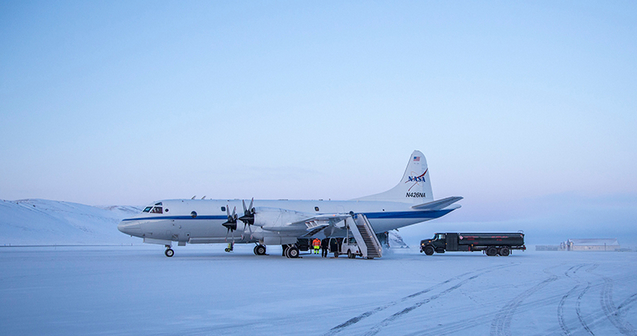
Credit: Michael Studinger, Operation IceBridge project scientist. More on this image›

1. Earth’s changing cryosphere
This year, NASA will launch two satellite missions that will increase our understanding of Earth’s frozen reaches. Snow, ice sheets, glaciers, sea ice and permafrost, known as the cryosphere, act as Earth’s thermostat and deep freeze, regulating temperatures by reflecting heat from the Sun and storing most of our fresh water.

2. GRACE-FO: Building on a legacy and forging ahead
The next Earth science satellites set to launch are twins! The identical satellites of the GRACE Follow-On mission will build on the legacy of their predecessor GRACE by also tracking the ever-changing movement of water around our planet, including Earth’s frozen regions.GRACE-FO, a partnership between NASA and the German Research Center for Geosciences (GFZ), will provide critical information about how the Greenland and Antarctic ice sheets are changing. GRACE-FO, workingtogether, will measure the distance between the two satellites to within 1 micron (much less than the width of a human hair) to determine the mass below.
Greenland has been losing about 280 gigatons of ice per year on average, and Antarctica has lost almost 120 gigatons a year with indications that both melt rates are increasing. A single gigaton of water would fill about 400,000 Olympic-sized swimming pools; each gigaton represents a billion tons of water.

3. ICESat-2: 10,000 laser pulses a second
In September, NASA will launch ICESat-2, which uses a laser instrument to precisely measure the changing elevation of ice around the world, allowing scientists to see whether ice sheets and glaciers are accumulating snow and ice or getting thinner over time. ICESat-2 will also make critical measurements of the thickness of sea ice from space. Its laser instrument sends 10,000 pulses per second to the surface and will measure the photons’ return trip to satellite. The trip from ICESat-2 to Earth and back takes about 3.3 milliseconds.

4. Seeing less sea ice

Summertime sea ice in the Arctic Ocean now routinely covers about 40 percent less area than it did in the late 1970s, when continuous satellite observations began. This kind of significant change could increase the rate of warming already in progress and affect global weather patterns.

5. The snow we drink
In the western United States, 1 in 6 people rely on snowpack for water. NASA field campaigns such as the Airborne Snow Observatory and SnowEx seek to better understand how much water is held in Earth’s snow cover, and how we could ultimately measure this comprehensively from space.

6. Hidden in the ground
Permafrost – permanently frozen ground in the Arctic that contains stores of heat-trapping gases such as methane and carbon dioxide – is thawing at faster rates than previously observed. Recent studies suggest that within three to four decades, this thawing could be releasing enough greenhouse gases to make Arctic permafrost a net source of carbon dioxide rather than a sink. Through airborne and field research on missions such as CARVE and ABoVE – the latter of which will put scientists back in the field in Alaska and Canada this summer – NASA scientists are trying to improve measurements of this trend in order to better predict global impact.

7. Breaking records over cracking ice
Last year was a record-breaking one for Operation IceBridge, NASA’s aerial survey of polar ice. For the first time in its nine-year history, the mission carried out seven field campaigns in the Arctic and Antarctic in a single year. In total, the IceBridge scientists and instruments flew over 214,000 miles, the equivalent of orbiting the Earth 8.6 times at the equator.
On March 22, NASA completed the first IceBridge flight of its spring Arctic campaign with a survey of sea ice north of Greenland. This year marks the 10th Arctic spring campaign for IceBridge. The flights continue until April 27 extending the mission’s decade-long mapping of the fastest-changing areas of the Greenland Ice Sheet and measuring sea ice thickness across the western Arctic basin.

8. OMG
Researchers were back in the field this month in Greenland with NASA’s Oceans Melting Greenland survey. The airborne and ship-based mission studies the ocean’s role in melting Greenland’s ice. Researchers examinetemperatures, salinity and other properties of North Atlantic waters along the more than 27,000 miles (44,000 km) of jagged coastline.

9. DIY glacier modeling
Computer models are critical tools for understanding the future of a changing planet, including melting ice andrising seas. A new NASA sea level simulator lets you bury Alaska’s Columbia glacier in snow, and, year by year, watch how it responds. Or you can melt the Greenland and Antarctic ice sheets and trace rising seas as they inundate the Florida coast.

10. Ice beyond Earth
Ice is common in our solar system. From ice packed into comets that cruise the solar system to polar ice caps on Mars to Europa and Enceladus—the icy ocean moons of Jupiter and Saturn—water ice is a crucial ingredient in the search for life was we know it beyond Earth.

Links

28/03/2018

Study Asserts Climate Change Could Make South Asia Uninhabitable In Our Lifetime

Futurism - Chelsea Gohd

New research shows how, by the year 2100, many regions in South Asia could become so hot that humans could no longer survive there.
Foggy Morning India Gate. Prasenjeet Gautam
Climate Change
The consequences of climate change are not only real and imminent, but increasingly catastrophic.
Currently, climate change has been attributed to dangerously increasing temperatures, sea levels rising, the extinction of a variety of species, and much more.
Without fierce opposition, the effects of climate change will only become more and more destructive. Natural disasters, mass flooding, food shortages and other crises are all possible (some already happening, in fact) if current trends continue.
One part of the world may even become uninhabitable in our lifetime.
Elfatih Eltahir, a professor at MIT, recently published new research in the journal Science Advances that shows how, by the end of the century, areas in South Asia could be too hot for humans to survive there.
In a Skype interview from Khartoum, Sudan with CBC News, Eltahir said, “The risk of the impacts of climate change in that region could be quite severe.”
Eltahir and his colleagues analyzed this projected situation under two conditions: a “business-as-usual” model and a model in which we increase our efforts to mitigate emissions.
The team concluded that the “business-as-usual” model was not only most likely, but would yield unlivable conditions by the year 2100.


How long will deadly India heatwave continue? BBC News

The Only Way is Forward
The effects of the projected heat waves will not fall over sparse landscapes that would be easily escapable.
They will wash over the densely populated, agricultural areas of South Asia, directly threatening the lives of countless inhabitants who — because many of the people living there live in poverty — will be essentially trapped in the deadly conditions.
Climate change has already taken lives, and isn’t slowing down.
This deadly heat wave scenario would only be a piece of the puzzle in the year 2100.
Where will the people of the agricultural regions of South Asia go if the rest of the planet is also facing the catastrophic effects of global warming? (That is, of course, if they are able to leave at all in future socioeconomic conditions.)
The only way is forward, and the only way forward includes our best efforts against climate change.

Links

Anti-Pipeline Campaigners Found Not Guilty By Judge Because 'Protest Against Climate Change Crisis' Was Legal 'Necessity'

The Independent - Andrew Buncombe

'We're part of the the movement that is standing up and saying we won’t let this go by on our watch'
More than a dozen protesters who clambered into holes dug for a high pressure gas pipeline said they had been found not responsible by a judge after hearing them argue their actions to try and stop climate change were a legal “necessity”.
Karenna Gore, the daughter of former Vice President Al Gore, was among more than 198 people who were arrested because of their 2015 actions protesting the pipeline in West Roxbury, Massachusetts, a suburb of Boston. Thirteen people were to go on trial this week, though prosecutors downgraded their original criminal charges to one of civil infraction.
Karenna Gore said the protesters were part of a movement that was not allowed to let such things happen 'on our watch'.
Speaking outside the court afterwards, Ms Gore, 44, Director of the Centre for Earth Ethics at Union Theological Seminary in New York, said the court’s decision was historic. “What happened today was really important,” she said.
“The people….were found not responsible by reason of necessity. The irony is that we are making ourselves responsible. We’re part of the the movement that is standing up and saying we won’t let this go by on our watch. We won’t act like nothing’s wrong.”
On Tuesday, Judge Mary Ann Driscoll of West Roxbury District Court, found all 13 defendants not responsible, the equivalent of not guilty in a criminal case. She did so after each of the defendants addressed the judge and explained why they were driven to try and halt the pipeline’s construction.
Roxbury Defendants
Marla Marcum of the Climate Change Disobedience Centre, which supported the activists, said that each of the 13 had addressed the judge about why they had been part of the protests against the pipeline, which was constructed by Houston-based company Spectra Energy.
“At the end, she said they were all not responsible by reason of legal necessity,” she said. She said the group had an audio recording of the hearing which it intended to post online.
Neither Ms Driscoll or the court clerk was available for comment. However, one member of the court’s staff who asked not to be named, told The Independent the judge had found them not responsible. The person denied, however, that the judge had made the ruling on the grounds of legal necessity.


The environmentalist and academic Bill McKibben, who was to appear as a defence witness for the defendants, said on Twitter: “Good golly! A few minutes ago a Boston judge acquitted 13 pipeline protesters on the grounds that the climate crisis made it necessary for them to commit civil disobedience. This may be a first in America.”
Spectra Energy, which was last year bought by the Canadian firm Enbridge Inc, did not immediately respond to inquiries.


Mothers Out Front in West Roxbury

Links

AGL Lines Liddell Up For Pumped Storage, Dismisses Chinese 'Approach'

Fairfax - Peter Hannam

AGL Energy is proceeding with plans to replace its Liddell power station with other energy sources including pumped hydro, dismissing a report that a Chinese textile group offered to buy the ailing power plant.
The nation's biggest energy company said it had not had any approach from Shandong Ruyi, the owner of the giant Cubbie Station cotton farm.
A News Corp newspaper reported the Chinese firm had contacted the Prime Minister's office in December, indicating an interest in buying the Hunter Valley power plant that AGL plans to close in 2022.
AGL Energy's Liddell power plant, with Lake Liddell in the foreground, and the company's Bayswater power plant behind. Photo: Simone De Peak
"We remain committed to our NSW Generation Plan as the most economic way to fully replace the Liddell plant, as reviewed and confirmed by [the Australian Energy Market Operator]," an AGL spokesman said.
It's understood the PM's office did not inform AGL of any Chinese interest and considers the report to be a "non-story".
Minister for the Environment and Energy, Josh Frydenberg, told Sky News he was "aware there had been expressions of interest" in Liddell "but it is up to those companies to directly approach AGL".
Doug Jackson, an AGL executive group manager, told Fairfax Media that Lake Liddell - which currently provides cooling for the adjacent power station - is one of two sites in the Hunter now being looked at for possible pumped hydro.
The two plants, still at the pre-feasibility stage, were in the order of 200-250 megawatts of capacity each, compared with the 1680-MW capacity of the coal-fired plant.
Pumped hydro typically requires an upper and lower reservoir. During times of low-cost power - such as during windy days - the operator pumps water to the higher reservoir, to be released to generate hydropower when power prices are high.
Don Harwin, the NSW Minister for Energy, said the state was keen to boost pumped hydro, particularly to support the three renewable energy priority zones announced last week. An Australian National University study last year identified 8600 such sites in NSW, and the Berejiklian government is looking to prioritise development of the most promising pumped storage areas.
“Pumped hydro is 'nature’s battery' and the world’s most established bulk energy storage technology, making up 97 per cent of global energy storage capacity,” Mr Harwin said.
“We need a mix of generation sources to maintain our security into the future. If we can harness our natural assets we can have an affordable, clean and secure energy future for NSW,” he said.
AGL's Mr Jackson declined to specify the location of the second Hunter site. He added that mine voids could be among the suitable locations.
Either project, though, could turn out to be much cheaper and faster to build than the much bigger Snowy 2.0 pumped hydro plan touted by the Turnbull government.
Current estimates put the cost of that project at more than $2000 per megawatt of storage, or in excess of $4 billion.
"Lake Liddell is a pretty easy one to get going in a few short years," Mr Jackson said, noting the existing access to power transmission among its advantages.
The Snowy Hydro 2.0 project has been touted by the Turnbull government. Photo: Supplied
Links

Marine Heatwave Recorded In Tasman Sea Breaks Records, Prompts Joint Climate Report

ABC News - Carla Howarth

Warm water events have taken their toll on Tasmania's kelp forests. (Mick Baron: Eaglehawk Dive Centre)
The Tasman Sea experienced a "marine heatwave" over summer that pushed the surface temperature to a record high, climate scientists say.
Following a particularly hot summer on both sides of the Tasman and in between, the Bureau of Meteorology and New Zealand's National Institute of Water and Atmospheric Research teamed up to release a "special climate statement".
New Zealand's summer was the hottest ever recorded, while Tasmania had its hottest November-January on record.
"Tasmania had its warmest November on record and its second-warmest December and second-warmest January," senior BOM climatologist Dr Blair Trewin said.
"In New Zealand, they had their hottest summer on record and January was their hottest month on record, so it was exceptionally warm on both sides of the Tasman."
Dr Trewin said the water surface temperature in the southern Tasman Sea was also exceptionally high.
"They were more than two degrees above average in December and part of January," he said.
Tasmania had its hottest November on record in 2017. (Supplied: Bureau of Meteorology)
"And for the November to January period, they were easily the highest on record — 0.6 of a degree on any other year."
Dr Trewin said the record temperatures were caused by a "very persistent" belt of high pressure from Tasmania to New Zealand in November last year that remained stationary for three weeks.
"That allowed the ocean waters to heat up under very constant sunshine without being disturbed," he said.
"Ocean waters take a long time to warm up or cool down, so they stayed persistently warm right through until the end of January before coming back a bit closer to average in February," Dr Trewin said.
Tasmania's waters have experienced a number of marine heatwaves in recent years, taking its toll on abalone stocks and kelp forests.

Urge to document 'major climate event'
The collaboration was a first between the two organisations, who said the purpose of the report was to "document major events and act as a historical record".
"Sea surface temperatures in the southern Tasman Sea rose to exceptionally high levels in late 2017 and early 2018," the report begins.
"These temperatures were far above any others previously observed at that time of year in the region, and extended west from New Zealand to Tasmania and mainland southeast Australia."
Dr Trewin said scientists had identified a long-term warming trend in the world's oceans.
"You're seeing these extremes emerge in different places in individual years but when you look at the overall number of significant marine heatwaves, it's only going in one direction and that's upwards," he said.

Alarm over extreme weather events
Acting Climate Council CEO Dr Martin Rice said the weather patterns were alarming.
"For Australia to tackle climate change and curb current extreme weather trends, we need to quickly and deeply cut our greenhouse gas pollution by continuing our transition to clean, affordable and reliable renewable energy and storage technologies," he said.
"Worsening climate change, driven by the burning of coal, oil and gas, is causing temperatures to rise at unprecedented rates and is making extreme weather events across Australia and elsewhere more intense, damaging and costly.
"As 2018 gets underway, we've already seen the country hit with a series of extreme weather events, including tropical cyclones, severe heatwaves, intense rainfall and bushfires."

Links

Lethal Heating is a citizens' initiative