14/07/2018

Which Countries Have Not Ratified The Paris Climate Agreement?

Climate Home News - 

Nearly three years after it was agreed, more than a tenth of global emissions are generated in countries that have not formally adopted the deal
The Eiffel Tower in Paris, illuminated in green to celebrate the entry into force of the Paris Agreement, the most ambitious climate change agreement in history, on November 4, 2016 (Photo: Jean-Baptiste Gurliat/ Mairie de Paris)
Liberia is about to join 178 other parties in ratifying the Paris Agreement, after its senate voted in June to approve the deal.
The west African nation will soon finalise the ratification process at the UN headquarters in New York, according to a government official.
There are 197 signatories to the Paris Agreement. But once Liberia makes it official, 19 nations will remain yet to ratify, including some major emitters. In total, these countries account for 11.5% of global greenhouse gas (GHG) emissions.
International agreements can be signed, but they only become binding through ratification. That can take an act of parliament or some other formal acceptance. Different countries have different processes.
Once ratified, the agreement commits governments to submit their plans to cut emissions. Ultimately they will have agreed to do their bit to keep global temperatures well below 2C above pre-industrial times and to endeavour to limit them further to 1.5C.
Here are some of the hold outs.

Russia
Russia is the largest emitter that has not yet ratified the Paris Agreement, with approximately 5% of global emissions in 2015. Its pledge to the deal, proposed to reduce emissions 25% to 30% below 1990 levels by 2030.
Nationally, large state-owned fossil fuel companies, support Russia’s energy needs and wield huge political power. There is a pro-Paris lobby made up of businesses and climate groups: the Russian Partnership for Climate Protection.
On the international stage, Russia has supported climate cooperation. The Kremlin spoke in support of the agreement following US President Trump’s announcement that his country intended to withdraw. No Russian ratification yet though.
Power lines from a Russian coal station (Photo: Peretz Partensky)
Turkey
Since the adoption of the UN climate convention in 1992, Turkey has more heavily relied on fossil fuels, particularly coal, to keep up with increasing energy demands. Its emissions increased 135.4% between 1990 and 2016.
Turkey has a peculiar beef with the Paris Agreement, stemming from its decision to sign up to the convention as a developed country.
Turkey has since argued that it is a developing country and has won special circumstances, allowing it to opt out of supplying finance. But it still cannot access climate cash, a condition president Recep Tayyip Erdoğan has said must change if Turkey is to ratify the agreement.

Iran
As a major producer of oil and natural gas exporter, Iran’s energy sector accounts for around 77% of its total emissions. Despite its fossil fuel empire, the country has developed the renewable energy industry under a number of national plans and funds.
Its emissions pledge in Paris, however, was uninspiring; the country suggested it would intend to mitigate its GHG emissions by 4% in 2030 compared to a business as usual scenario.
Iran’s reluctance to ratify the Paris Agreement stems from an unwillingness to shift their economy. Economic sanctions from the international community are also a sticking point.
Windmills in Manjeel, Iran (Photo: Ali Madjfar)
Colombia
Colombia’s parliament passed a bill ratifying the Paris Agreement in June 2017, but the country has yet to bring that to the UN. Around 10% of the Amazon rainforest grows within Colombia’s borders, levels of deforestation are increasing. In 2017, tree loss jumped by 46% from 2016 according to a recent report by the World Resources Institute (WRI).
“I am pleased that Congress approved that Colombia is part of the Paris agreement @COP21, which confirms our commitment to the environment,” said President Juan Santos on Twitter.
The country’s diplomats may be holding off until the UN general assembly meets in September, which runs parallel with Climate Week, to officially deliver their ratification to the UN.

San Marino
San Marino has a tiny 0.27mtCO2 emission share (that’s a minuscule percentage of the global total). The ratification of the Paris Agreement is on the agenda of the next session of the Great and General Council (parliament), to be held from 19 to 27 July.

As of 12 July 2018, the countries yet to formally ratify the agreement were:
  • Angola
  • Colombia
  • Equatorial Guinea
  • Eritrea
  • Guinea-Bissau
  • Iran
  • Iraq
  • Kyrgyzstan
  • Lebanon
  • Liberia
  • Libya
  • Nicaragua
  • Oman
  • Russia
  • San Marino
  • South Sudan
  • Suriname
  • Syria
  • Turkey
  • Uzbekistan
  • Yemen
Links

UN Security Council Considers ‘Cycle Of Conflict And Climate Disaster’

Climate Home News

Sweden chaired the influential body’s first session focusing on climate change in seven years, calling for international coordination to address the risks
Chadian community advocate Hindou Ibrahim addresses the UN security council (Pic: UN Photo/Eskinder Debebe)
Climate change is contributing to instability in many parts of the world, the UN security council heard on Wednesday, in its first debate dedicated to the topic in seven years.
A community advocate from Chad and Iraq’s water minister testified to the interplay of water scarcity and conflict in their homelands.
Swedish foreign minister Margot Wallström and UN deputy chief Amina Mohammed, fresh from a trip to the drought- and terrorist-stricken Lake Chad basin, led calls for a coordinated international response.
“It is past time for us to deepen our understanding of how climate change interacts with drivers of conflict,” said Wallström, chairing the meeting.
Wallström, whose country holds the rotating presidency of the security council this month, announced the launch of a Stockholm-based climate security knowledge hub later this summer and proposed that Mohammed provide an “institutional home” for the issue at the UN.
“Fragile countries are in danger of becoming stuck in a cycle of conflict and climate disaster. Where resilience is eroded, communities may be displaced and exposed to exploitation,” said Mohammed, a former environment minister for Nigeria.
China and several European, African, South American and small island states endorsed efforts to integrate climate considerations into peacebuilding globally. Delegates also floated the appointment of a new special representative of the UN secretary-general on climate and security.
Russia stressed that it was not the security council’s role to drive climate action, however. “We are creating an illusion that the council will tackle climate issues and that there will be some kind of turning point,” said envoy Dmitry Polyanskiy, adding this was a “misguidance”.
The relationship between environmental pressures and conflict is complex and disputed. Climate change is typically described as a “threat multiplier,” rather than a primary cause of war. Weather extremes can hit the availability of water, food and other essentials, stoking tensions between rival groups.
Hindou Ibrahim of the International Indigenous Peoples Forum on Climate Change described how in her native Sahel region, drought traps farmers and herders in poverty and makes them vulnerable to recruitment by terrorist organisations.
Young people need opportunities to make a peaceful living, she said. “You must give them something beyond hope, because they do not deserve to just survive, they deserve a life.”
The security council is expected to put out a presidential statement in the coming days on next steps.
Camilla Born, an advisor to the Swedish government, told Climate Home News the signal for action was stronger than last time it was discussed at this forum.
“Previously, you had the recognition that you needed climate-related information in reporting, but it was quite a soft recommendation,” said Born. “The difference between now and 2011 is you can now see climate change reshaping the security landscape. Every representative of a more fragile or vulnerable country was speaking about their personal experience.”
There was “a lot of alignment between countries about what was needed,” she added. That included the bureaucratic work of gathering and analysing data as well as mobilising political leadership.

Links

Australia’s Regulators Still Can’t Imagine A Clean Energy Future

RenewEconomy - 

Well, hallelujah. It turns out Australian households are going to get free electricity – at least on the generation side – if you believe the modelling that has been shoved at us from the Energy Security Board and now the Australian Competition and Consumer Commission.
According to ACCC data released in its voluminous and damning report on the electricity market on Wednesday, the average household bill in Australia is $1,636 a year, of which $560 is made up from wholesale electricity.
According to the ESB modelling, they are going to be able to reduce household bills by $400 a year thanks to the reduction in prices of the wholesale market, initially due to the impact of more wind and solar via the renewable energy target, and then by the National Energy Guarantee.
The ACCC reckons that its suite of measures – quite separate to the NEG – will reduce the price of wholesale electricity by $155 a year.
Bingo! If you believe these numbers, then the cost of wholesale power will be reduced to just $5 in the average household bill.
It’s a nonsense, of course – just part of the merry-go-round of hand-wringing, economic theory, useless promises and “concern for consumers” that has been used as cover for the outrageous surge in electricity prices over the past decade.
ACCC chair Rod Sims is right. Customers are getting screwed at every turn – by inflated network prices, in the wholesale market because of lack of competition (although, he says extraordinarily, apparently not because of abuse of market power), and in retail bills.
This has been going on in full sight of the ACCC, state pricing regulators, federal regulators and state and federal governments for nearly a decade now.
We, and others, have been writing about it for years. So have the regulators themselves, in equally voluminous reports, and any number of analysts. But precisely nothing of consequence has ever been done about it by the authorities.
Instead, they have actually made it worse, rejecting and delaying rule changes and policies that could encourage efficiency, demand management, and battery storage – all of which could have moderated prices.
About the only protection the consumer has had is to install rooftop solar, and lately battery storage. Unsurprisingly, rooftop solar is the main target whenever the authorities are galvanised into action.
Sims made a big deal out of network prices way back in 2011, when he was head of IPART, the pricing regulator in NSW. He didn’t do much about it then, although he did try to push through retrospective changes to the premium feed-in tariffs for rooftop solar in the state.
That feed-in tariff – 60c/kWh gross – was overly generous, no doubt about it – and the government and the regulators had been told as much by the industry itself, who warned them that it would need to be scaled back, and early.
But politics is politics and they ploughed on, resulting in a cost blowout, drastic action, sudden closure, the threat of retrospective changes and a major conflict with the industry. The retrospective changes didn’t go ahead, but the boom in the solar market came to a crunching end.
Now Sims is targeting rooftop solar again. Of all the 50-something measures canvassed by Sims on Wednesday, none was so drastic as the call for the federal government’s small scale renewable energy scheme (SRES) to be abolished by 2021. One option canvassed was to kill it immediately.
This is a problem. A big problem, and a frightening one for consumers.
Not only has rooftop solar delivered protection from the outrageous pricing of the electricity market as a whole, they have also brought wider benefits – from reducing peaks and pushing hem into the evening, and moderating wholesale prices.
It is also the future the energy.
The Australian Energy Market Operator, network owners, the CSIRO, and analysts such as Bloomberg New Energy Finance say that distributed generation – which includes rooftop solar and battery storage and demand management – will account for nearly half of capacity and generation by 2050, if not earlier.
BloombergNEF this week said this transition was inevitable and would likey bring an early closure of coal generation, all things being equal.
But all things are not equal, barriers remain, chief among them the need to think differently about the grid, rather than seeing wind and solar and other technologies as a barely tolerated add-ons to a market for fossil fuels.
You can see that thinking has not caught on with conservatives, and particularly not the Coalition government. For the life of them, they can’t see beyond the need for baseload or how dispatchable capacity could come from anything other than coal, gas or nuclear.
And it’s not caught on with regulators either. As I reported way back in 2011, at the height of the debate over the solar tariffs, Sims and AEMC chairman John Pierce let it be known what they thought of solar – that it was, and always would be, an expensive option to produce electricity and reduce emissions.
Worse, they seem to resent the fact that people who have invested in rooftop solar benefit from lower bills than those that don’t. How dare they cut their bills!
Rooftop solar has fallen in price by some 70 per cent since those days, and by most forecasts outside of vested interests and ideologues will be the dominant form of generation across the globe. Even the IEA sees solar as the biggest contributor to electricity by 2050.
And this is what is frustrating about the ACCC report.
It ignores the need for emissions reductions. As ITK analyst David Leitch points out here, and as The Greens point out, you can’t claim “technology neutrality” and be serious about decarbonising the grid at the same time.
Not only that, the ACCC pretends the gaming in the markets is not happening, and it does not address the inflated pass-through cost of green schemes that make them look more expensive than they are.
It’s interesting to note that they do recognise that the cost of the LRET (large scale renewable scheme) will disappear to zero or negligible levels from about 2020/21, but their call to blow up the small scale solar scheme does not make sense.
For one, it’s a scheme that is being gradually wound back anyway. The benefits of added solar to the grid far outweigh the 40c-a-day average cost of the scheme.
If the regulators really wanted to be clever, then maybe find a smart way to ensure that low-income households and renters and others get to have solar, and storage.
Instead, they apply the hand-brake, to slow down the transition. This has been the story of Australia’s energy market for more than a decade.
Almost every report done by a statutory authority has refused to contemplate what a decarbonised grid might look like. Sims falls into the same trap.
And because technologies like rooftop solar and battery storage will start in the home, or the business, the only hope for consumers, it would seem, is that AEMO comes up with something sensible in its Integrated System Plan.
The ACCC’s proposal for some sort of auction scheme for new projects to bid for a government-funded tariff for years 6-15 of the asset life – so to help lock in debt – looks interesting, although is largely dismissed by Leitch in his analysis.
But it seems to be an assessment and an admission that the NEG will not attract new investment in of itself – as so many different analyses have concluded.
It’s just a little depressing that prime minister Malcolm Turnbull still thinks this might be taken up by new coal plants, that the Nationals and others are convinced that it would be, and that Sims solution to back-up power is to “drill, baby drill.”
“We’re not advocating one technology or another,” Turnbull said in a radio interview on Thursday. “We don’t need to subsidise one technology or another. We’ve got to get lower prices. That’s what I’m on about, lower electricity prices.” Clearly, he’s not about leading a party taking climate change seriously.
“It is throughly disheartening that this nonsense is being bandied around by the highest authorities in the land in complete disregard of the native impacts on climate, health and the economy,” one energy industry veteran emailed me today.
“It makes me want to give up and stick my head in the sand along with the rest of the population.” Exactly what the fossil fuel industry and their spokespeople in the government are hoping.
How the state governments can possibly reach a conclusion about the NEG on August 10, given the implications of what Sims is proposing, and with the finer detail of the NEG delivered just a week earlier, is beyond comprehension.
“Trust us about the details,” say the big business lobby groups who have championed the NEG, at the same time as saying that adding any more renewables to the system would cripple the economy. It seems the energy wars are only just beginning.

Links

Massive Surge In Rooftop Solar Would Bring End To Australia’s Coal Era

RenewEconomy - 

The biggest threat to Australia’s legacy coal fired generators is not the explosion of wind and solar farms, or even the settings of the country’s emissions policy: Right now, it’s the continued boom in rooftop solar.
That’s the assessment of Bloomberg New Energy Finance, which is expecting a massive surge of “behind the meter” solar PV capacity, referring to the solar that is installed by homes and businesses mostly to supply their own electricity needs.
And the big driver of this over the next decade will not just be the household sector that will continue to grow from its current 7GW of capacity across more than 2 million homes, or the “commercial” sector, the smaller business sector that is currently booming and will install nearly as much.
It will also come from big industrial users, who are expected to account for nearly half of the 58GW that will be installed in Australia by 2050, and will be installing more than 2GW a year by the late 2020s (That’s the green shades and lines in the graph above).
“Consumers are going to be the most influential generator in terms of volume”, says Kobad Bhavnagri, the lead analyst from BloombergNEF Australia.
“There will be more capacity behind the meter than the total current capacity in the National Electricity Market (NEM),” he tells RenewEconomy after the presentation of the company’s New Energy Outlook in Sydney on Tuesday.
“It is a massive slab of capacity … and it will be the biggest single contributor to generation.”
Bhavnagri – interviewed before the ACCC recommended that rooftop solar subsidies be abolished by 2021, rather than progressively wound down by 2030 – says the rooftop solar uptake is happening quite separately from the dynamics of the wholesale market, and it will have consequences.
“The most significant is that it will have the biggest impact is pushing coal out of the system,” Bhavnagri says.
“You can forget about the carbon price, you can forget about the NEG (National Energy Guarantee), what will push coal out of system is rooftop solar PV.”
That’s because the “duck curve” created by solar PV will change the dynamic of the system, putting the emphasis on flexible and dispatch able power.
Coal generators simply don’t have that flexibility, and if the solar boom continues as planned, Australia will reach 40 per cent penetration of rooftop solar (as a percentage of total installed capacity) by 2030.
(Maybe this explains the ACCC recommendations to slow down the rollout of rooftop solar and enourage the government instead to provide contacts to new “dispatchable” generators, including coal and gas plants).
Bhavnagri expects rooftop solar owners will install battery storage, adding to the benefits of the system. BloombergNEF expects that rooftop solar capacity to be paired with 58GWh of behind the meter battery storage.
That’s because the falling cost of battery storage means the combination will soon be economic, with the pink lines indicating the spread between different states. In South Australia, for instance, it is already “economic”, which BloombergNEF says is less than a 10 year payback.
What Bhavnagri does want to see is  a change in tariff design, towards a “genuine’ time of use metering system, for electricity and solar exports, that will encourage households “to give system what it needs and therefore will lower  costs for everyone.”
This and the growth of rooftop solar will encourage users to shift their load to the middle of the day – be it industrial processes, electric vehicle charging or air conditioning.
“Actually we want the load shape to change. That will help renewables generally,” Bhavnagri says.
“By the mid 2020s it’s going to have as good a payback period as solar PV only. Therefore we expect to have material uptake from early to mid 2020s.”

Links

13/07/2018

Australia Falls Further In Rankings On Progress Towards UN Sustainable Development Goals

The Conversation | 

Australia’s exported greenhouse emissions are higher per person than Saudi Arabia’s. AAP Image/Richard Wainwright
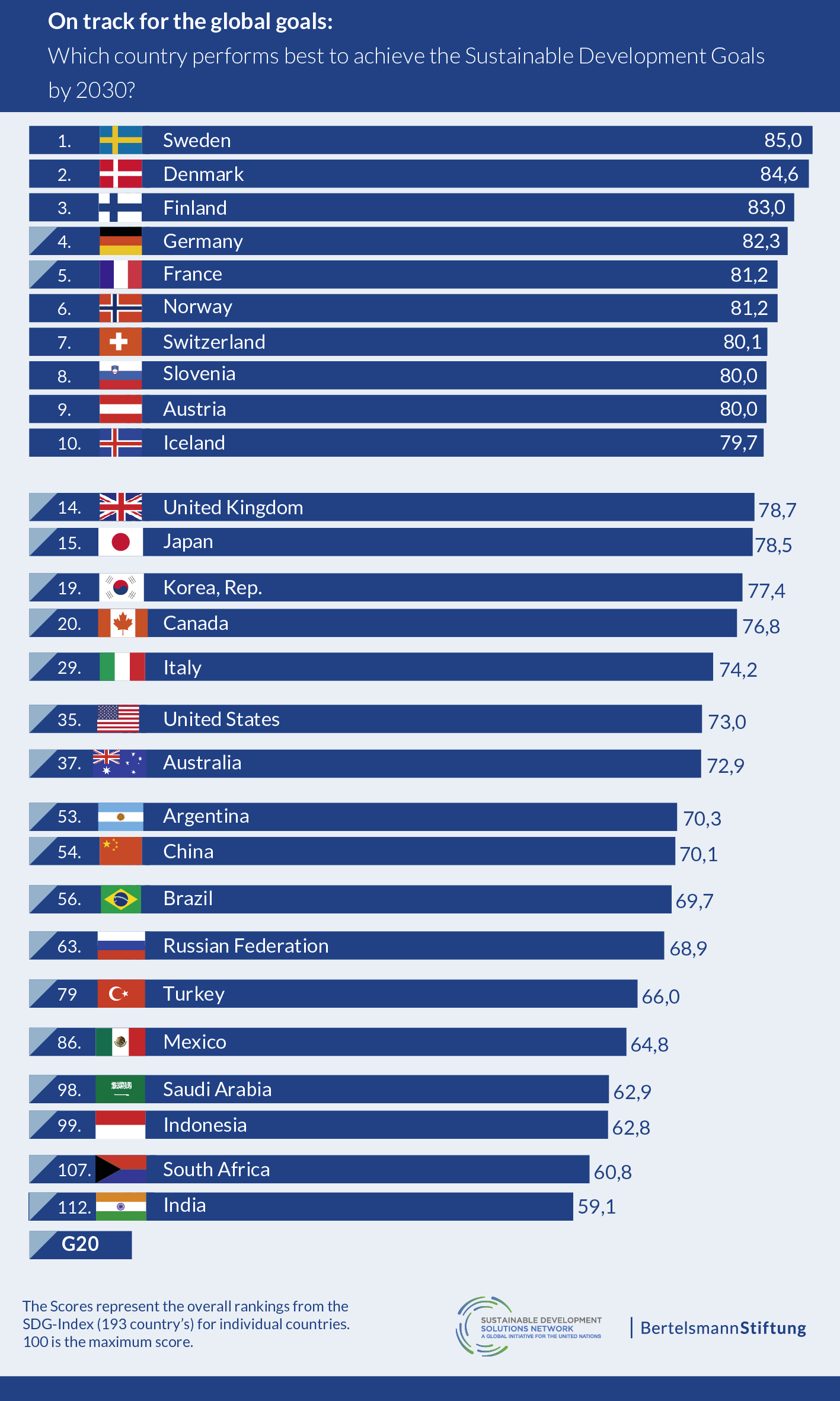
Australia is performing worse than most other advanced countries in achieving the Sustainable Development Goals (SDGs), according to the global SDG Index, which compares different nations’ performance on the goals.
According to the SDG Index, released yesterday in New York, Australia is ranked 37th in the world – down from 26th last year, and behind most other wealthy countries including New Zealand, Canada, the United States and the United Kingdom.
The best-performing countries are the northern European nations of Sweden, Denmark, Finland and Germany, all of which have a history of balancing economic, social and environmental issues.
The SDG Index measures progress against the 17 SDGs agreed by all countries at the United Nations in 2015. The goals encompass a set of 169 targets to be met by 2030 to achieve economic prosperity, social inclusion and environmental sustainability.
Yet despite the progress made by some countries, all nations still have a way to go to achieve all of the goals.

Australia: the world’s worst on climate action
The latest SDG Index shows that Australia is performing relatively well in areas such health and wellbeing, and providing good-quality education. But its results for the environmental goals and climate change are among the worst in the OECD group of advanced nations.
The new index ranks Australia as the worst-performing country in the world on climate action (SDG 13). The measure takes into account greenhouse gas emissions within Australia; emissions embodied in the goods we consume; climate change vulnerability; and exported emissions from fossil fuel shipments to other countries.
One of the reasons why Australia has slumped so far in the rankings is that the SDG Index is now taking into account the so-called “spillover” effects that countries have on other nations’ ability to meet the SDGs. These effects may be positive, such as providing development aid; or negative, such as importing or exporting products that create pollution.
The report shows that G20 nations account for the largest negative economic, environmental, and security spillover effects. Despite being among the richest nations in the world, the US, the UK and Australia are rated worst in the G20 for negative spillovers.
The UK, for instance, rates particularly badly on the tax haven score, which makes it harder for other countries to raise the tax revenue needed to provide health, education and other services to their citizens.
This year’s SDG Index also includes a key environmental spillover indicator: carbon dioxide emissions embodied in fossil fuel exports, calculated using a three-year average of coal, gas and oil exports.
Australia’s annual exported CO₂ emissions are a colossal 44 tonnes per person. This outstrips even Saudi Arabia (35.5 tonnes per person), and is orders of magnitude larger than the figure for the US (710kg per person).

G20 leading the way?
With all countries still falling short of achieving the SDGs, the SDG Index also assesses what actions G20 governments are taking to help close this gap. Most G20 countries have begun to implement the goals but there are large variations among G20 countries in how the SDGs are being embraced by political leaders and translated into action.
Composite score of national coordination and implementation mechanisms for the SDGs in G20 countries. SDSN and Bertelsmann Stiftung, 2018 SDG Index and Dashboards Report
Brazil, Mexico and Italy have taken the most significant steps among G20 countries to achieve the goals, illustrated for instance by the existence of SDG strategies, coordination units in governments, or online platforms. India and Germany have at least partially already undertaken an assessment of investment needs.
According to this assessment, Australia has taken some initial steps to support SDG implementation. Supportive actions taken by the government include setting up a cross-departmental committee, co-chaired by the Department of Foreign Affairs and Trade and the Department of Prime Minister and Cabinet, to coordinate Government SDG activities. The Senate has established an inquiry to examine the opportunities to implement the goals.
Significantly, the federal government has also prepared a Voluntary National Review report on progress in implementing the goals, which it will present to the UN’s High Level Political Forum next week. The report addresses how Australia is performing against each of the goals and includes many case studies of implementation from business, civil society, academia, youth and all levels of government. It is accompanied by a new Australian SDG case study hub. Many of these activities occurred after the cut-off period for the SDG Index, so Australia’s overall performance on SDG implementation is actually higher than the SDG Index gives it credit.
However, Australia is not taking more deliberative action to address the SDGs, such as developing a national implementation plan or setting aside funding for SDG implementation. Nor are individual departments identifying the gaps in Australia’s SDG performance and identifying what they plan to do differently to address them.
Given Australia’s poor performance on some of the SDGs there is clearly a need for targeted action if we are to achieve the goals by the 2030 deadline.

Links

Combating Climate Change Could Create 24 Million Jobs By 2030

Asian Correspondent - Max Walden

Source: William Bossen / Unsplash
CLIMATE change provides a major threat to more than a billion of workers, as well as opportunities to create employment for millions around the world if addressed correctly, according to a new report.
The World Employment and Social Outlook 2018 released in May by the International Labour Organization (ILO) claimed that at least 1.2 billion people rely on a healthy and sustainable environment in their work – particularly those in agriculture, fisheries and forestry.
Climate change poses grave risks to future employment. The ILO reported that 23 million working life years have been lost to natural disasters since 2000, and climate change will see disasters occur more frequently and with greater severity.
Around 2 percent of total working hours – the equivalent of 72 million fulltime jobs – will be lost by 2030 due to heat stress, it said.
“The effects of environmental degradation on the world of work are particularly acute for the most vulnerable workers,” it said. “Rural workers, people in poverty, indigenous and tribal peoples and other disadvantaged groups are affected the most by the impact of climate change.”


As such, climate change and environmental degradation further exacerbate global inequality, which has risen sharply in recent decades. According to the World Inequality Report 2018, the top 1 percent of individuals have captured twice as much income growth as the bottom 50 percent since 1980.
The ILO claimed that 18 million more jobs would be created if the world could meet the Paris Agreement’s goal of keeping the increase in global temperatures to just 2°C above pre-industrial levels.
It projected that while shifts away from carbon and resource intensive industries toward greener technology would see 6 million jobs lost in the short-term, it would also see the creation of 24 million jobs, “meriting complementary policies to protect workers and ensure that the transition is just.”
Demonstrators dressed as Donald Trump and as a polar bear are seen during a demonstration in Bonn against the COP 23 UN Climate Change Conference hosted by Fiji but held in Bonn, Germany November 11, 2017. Source: Reuters/Wolfgang Rattay
Some 23 countries have already succeeded in growing their economies while simultaneously reducing greenhouse gas emissions and their environmental footprint, the report’s authors said.
Cambodia, for example, since 2013 has mainstreamed green growth into its national economic development plan and employment legislation.
Mongolia, meanwhile, identifies “green employment” as a priority, aiming to provide income to 80 percent of its working age population through decent employment and to increase resilience to the negative impacts of climate change.
“Low-income and some middle-income countries need support to develop data collection, identify and adopt best practices, strengthen implementation and finance both mitigation and adaptation strategies in order to achieve a just transition to environmentally sustainable economies and societies for all,” concluded the report.

Links

Greenpeace And Getup Launch Campaign To Kill National Energy Guarantee

The Guardian

Exclusive: Television ads in Victoria and Queensland aim to get state governments to veto Turnbull’s set piece policy
A Greenpeace protest. Greenpeace and GetUp will attempt to have the national energy guarantee vetoed by the states because it is not ambitious enough in emissions reduction. Photograph: Greenpeace
The Queensland and Victorian governments will be hit with a new television advertising campaign in an effort to persuade them to torpedo the national energy guarantee at a critical meeting in early August.
The activist group GetUp has combined with Greenpeace to bankroll what it describes as hard-hitting television advertisements targeting the two Labor-held states ahead of a meeting of energy ministers in August that will make or break the Turnbull government’s signature energy policy.
Opponents of the national energy guarantee have been frustrated that the Victorian government thus far has been muted in its public criticism of the scheme, and fear the Australian Capital Territory – which has been persistently critical – won’t sink the Neg at the Coag energy council unless one of the larger states is also on board.
With the Queensland energy minister, Anthony Lynham, calling in key stakeholders on Thursday to take soundings on the policy, GetUp’s national director, Paul Oosting, told Guardian Australia the activist group “expects all states to use their veto power” in August and fight for a national energy policy that would cut pollution and assist the transition to renewables.
The Australian Conservation Foundation echoed GetUp’s stance, declaring the current policy “unsupportable” because the emissions reduction target is insufficient to see Australia meet its commitments under the Paris agreement, and the policy as drafted makes it difficult to adjust the level of ambition.
The ACF’s Gavan McFadzean said: “What every state and territory government needs to understand is that if they sign up to this Neg, they own it and its woefully inadequate 26% pollution reduction target, locked in to 2030.
“It won’t be just Malcolm Turnbull’s Neg, or Tony Abbott’s, but Daniel Andrews’ and Annastacia Palaszczuk’s as well.”
The Turnbull government needs the backing of states that are in the national electricity market to implement the Neg, with any one jurisdiction possessing the power to kill the scheme.
Business groups have lined up in support of the Neg, urging a truce in the decade-long toxic political battle over climate and energy policy. They want a settled policy mechanism to give energy market participants certainty to invest.
Privately, some business stakeholders would also be relaxed about the commonwealth legislating a scheme that would make ramping up the level of ambition in the emissions reduction target easier to achieve – understanding that could help get the Labor states over the line on the mechanism.
But adding that flexibility could sink the policy when it returns for consideration by the Coalition party room, assuming the states don’t end it first.
The energy policy fight has been complicated in recent weeks by a renewed push by some Nationals and conservative Liberals to make ongoing support for coal part of the quid pro quo for supporting the Neg.
The states are also processing a new report this week from the Australian Competition and Consumer Commission, which recommended major changes to the electricity market, including the commonwealth underwriting new generation projects in order to get more competition into the system and lower prices for consumers.
The energy minister, Josh Frydenberg, has added the new ACCC report to the agenda for discussion at the critical August meeting.
Nationals this week have attempted to front-run the debate and shape public perceptions of the report by claiming the ACCC investigation supports government backing of new coal generation, when the relevant recommendation is clearly technology-neutral.
The ACT’s climate change minister, Shane Rattenbury, told Guardian Australia the report was being used by Liberals and Nationals “shamelessly to back up each of their internal arguments about the Neg”.
He warned: “Unless the Coalition sorts out what the Neg will finally look like, it will be impossible for Coag to endorse or reject it.”
Frydenberg and the prime minister, Malcolm Turnbull, have both said the proposed government underwriting would apply to all technologies that met the criteria, including, potentially, coal projects, as well as gas and renewables with battery back-up.
But Turnbull has also pushed back against the Nationals. On Thursday Turnbull said: “We are not in the business of subsidising one technology or another. We’ve done enough of that. I mean, frankly, too much of that has been done.”
He said subsidies for various forms of energy were in the process of winding down “and we should simply allow the technologies to compete”.
Turnbull said the outcome the government was seeking was lower energy prices.
The shadow federal climate change minister, Mark Butler, has declared it is a “fantasy” that anyone would seek to build a new coal-fired power station underwritten by the commonwealth, and he warned government MPs against hijacking a useful investigation by Australia’s competition watchdog.
Butler said the idea of the government underwriting new market entrants with generation projects was an idea “very worthy of consideration, but unfortunately it’s already been hijacked by these ideological zealots in the Coalition party room”.
“Everyone in the industry has recognised that building new coal-fired power stations, one isn’t suitable for the nature of the market in the future; it’s not sufficiently flexible, it’s more expensive than other power options, but also there is very substantial carbon risk, regulatory risk, price risk, associated with building new, high polluting, or high emitting assets,” Butler said.
“That’s why the industry won’t go near it, investors, bankers, won’t go near it, because they understand quite how risky it is.”

Links

Lethal Heating is a citizens' initiative