23/07/2018

‘Climate Kids’ Suit Against Government Allowed To Proceed

Washington Post - Associated Press

FILE - In this July 18, 2018, file photo, lawyers and youth plaintiffs lineup behind a banner after a hearing before Federal District Court Judge Ann Aiken between lawyers for the Trump Administration and the so called Climate Kids in Federal Court in Eugene, Ore. The lawsuit filed by young activists who say the government is failing to protect them from climate change is still alive. In San Francisco on Friday, July 20, 2018, the 9th U.S. Circuit Court of Appeals rejected the government’s second request for an order directing a lower court to dismiss the case. (Chris Pietsch/The Register-Guard via AP, File) (Associated Press)
PORTLAND, Ore. — A lawsuit filed by young activists who say the government is failing to protect them from climate change is still alive.
In San Francisco on Friday, the 9th U.S. Circuit Court of Appeals rejected the government’s second request for an order directing a lower court to dismiss the case.
The lawsuit brought by 21 children and young adults asserts the government has long known that carbon pollution causes climate change but has failed to curb greenhouse gas emissions. They are seeking various environmental remedies.
The judges said the government’s first request failed to meet the high bar for having the case dismissed at this stage.
A trial is set to begin Oct. 29 in Eugene, Oregon.

Links

Youth Climate Change Activists March On Washington, D.C.

Teen Vogue - Kristen Doerer

Teen Vogue Kristen Doerer
The Youth Climate March began in a drizzle, with a forecast of steady, unrelenting rain on the way. The forecast didn’t disappoint, but the young activists who took the streets didn’t either.
Hundreds of young people from across the nation gathered on the national mall in Washington, D.C. on Saturday, July 21, for the protest planned by the environmental youth group Zero Hour.
The march was the last in a three-day string of events in Washington, D.C. organized by the youth and POC led group, including a lobby day and a Youth Climate Art Festival.
“I’m here because I know this an urgent problem we need to solve and we need to address,” 18-year-old Maeve Secor of Baltimore, Maryland, told Teen Vogue at the march. “I’m really worried about the water levels rising; that’s really going to affect Baltimore, especially with the impact climate change has on the low-income population.”
Meave went to Congress to lobby with other members of Zero Hour on Thursday, where she spoke with staffers. “We have a pledge for public officials to not take any more money from fossil fuel companies. They’re basically paying off public officials with campaign funds to not pass climate change legislation,” Meave explained.
A sea of umbrellas, ponchos, and climate change signs formed as the rally launched shortly after 10:30 a.m. The band Dispatch performed under umbrellas before a D.C. inter-tribal drum group. Then, a coalition of youth from Standing Rock addressed the crowd.
“I’m standing here for all the indigenous people who couldn’t be here today. This is my purpose, this should be all of our purposes — to protect our Mother Earth,” said Tokata Iron Eyes of the Standing Rock Reservation. “As an indigenous people, I know no other way. My grandmother has taught me how to live off the earth.” Tokata added that her reservation is still fighting the Dakota Access Pipeline.
“It’s not if, it’s when the Dakota Access pipeline breaks. It’s five minutes before it gets into our water,” said Standing Rock’s Bobbi Jean, who spoke next. “This isn’t just an indigenous issue, it’s a human rights issue.”
Bobbi also spoke about the need to support the environment through one’s wallet. “Remember to divest in your banks,” she said, singling out big banks like Chase and Wells Fargo, which reportedly support fossil fuels, before shouting out federal credit unions.
Standing Rock activist Daniel Grassrope took the microphone next and led a chant. “Respect our water,” he exclaimed, with the crowd echoing him. “Honor our treaties, honor our rights, we stand with our brothers, and our sisters, we stand with with our people.”
Indigenous rapper Xiuhtezcatl Martinez: The power of the people is more powerful than the people in power. These are our times.
18-year-old indigenous rapper Xiuhtezcatl Martinez drew the crowd in closer after that. “The power of the people is more powerful than the people in power. These are our times,” Xiuhtezcatl said.
When 7-year-old Havana Edwards stepped onto a stage, the D.C. activist known as “the tiny diplomat” spoke about her experience traveling the world with her family, and seeing how climate change and education affect other youth.
“For all the kids out there listening today, we’ve got this,” she said.
Some activists shared how climate change had hit close to home. Iris Fen Gillingham, who grew up Catskill Mountains of New York, spoke about how a flood destroyed her family’s organic vegetable field, and forced her parents to stop selling produce for a living. Emily Wang, 14, of Howard County, Maryland told Teen Vogue that she’s particularly worried about the pollution in China.
“I have a bunch of family there, and I don’t want them to have health problems because of the pollution,” Wang said.
By 12:30 p.m., the march took off, with hundreds of protesters holding signs, parachutes, and banners, many dressed in raincoats or ponchos, unfazed by the rain. At the front of the march was the coalition that protested the Dakota Access Pipeline at Standing Rock.

Chants of “Water is life," “Take it to the street. Take it to the polls,” and “What do we want? Justice! When do we want it? Now!” broke out as activists drummed.
“The rain persisted more than we hoped. It comes to show, there’s this huge cloud over us, but we are still marching,” said Madeline Tew, 15, as she marched with a coffee cup in hand. As one of Zero Hour’s founding members from New Jersey, Madeline spent over a year planning the march, and says that she knows a lot of people who have been displaced by Hurricanes Sandy and Irene.
Teen Vogue Kristen Doerer
Another core Zero Hour organizer, 20-year-old Kibiriti Majuto of Charlottesville, Virginia, said that it’s time to stand up to corporate power: “It’s important to take to the streets, because fossil fuel companies have more power than actual people.” He urged teens to do a self-evaluation and ask themselves: “What can I do to change climate change? This administration is not with us, so we have to find a solution with our own hands.”
Yelling into a megaphone, Kibiriti began another chant as the group approached the Supreme Court: “Corporate crime scene!”
“Hunger, violence, racism, poverty — every kind of inequality that exists today is going to get worse as climate change dries up our resources. That’s something the older generation doesn’t realize,” 17-year-old Anna Brooks of Silver Spring, Maryland, told Teen Vogue during the march.
“We don’t have any time to wait,” Elsa Mongistu said, noting she’s privileged to not be on the frontlines of climate change, but she knows it’s only a matter of time. The 16-year-old from Greensboro, North Carolina urged others to get involved. “It’s going to impact you also, don’t be selfish. Just because you’ve been able to avoid the issue, doesn’t mean other people have been.”
By the time activists marched down East Capitol Street and arrived in Lincoln Park, some had given up on their raincoats and simply enjoyed the rain.
“The rain brings out the real ones,” said local native youth activist Sebi Medina Tayac. He instructed the hundreds of remaining activists to circle around the drummers and link arms or hands as part of a “unity dance.”
As the dance came to an end, the march did as well. The rain came down harder, but the crowd, energized and ready for change, was slow to disperse.

Links

22/07/2018

A Global Heat Wave Has Set The Arctic Circle On Fire

New York Magazine - 

Fire burns in Karbole, Sweden. Photo: Mats Andersson/AFP/Getty Images
From Japan to Sweden, and Oman to Texas, a global heat wave is setting records, igniting wildfires, and killing dozens all across the world this week.
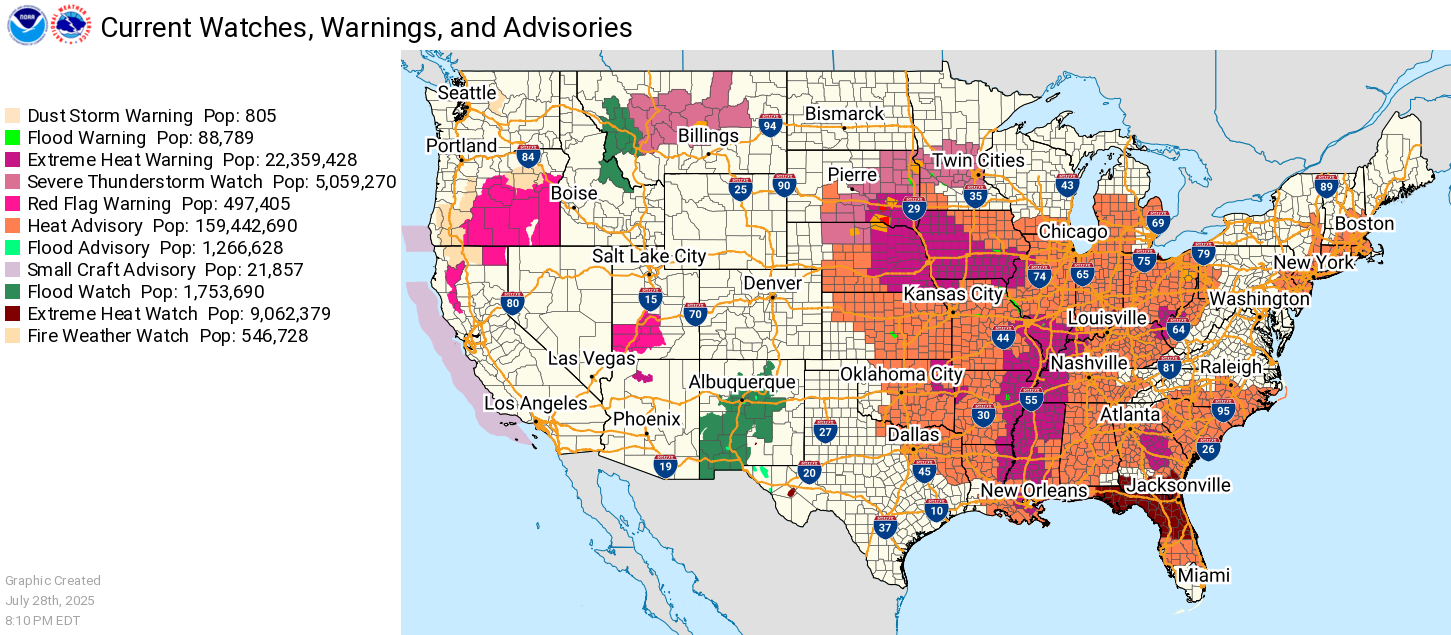
The south-central region is home to the highest temperatures in the U.S. this week, with nearly 35 million people living under excessive heat warnings issued by the National Weather Service. Temperatures are expected to be in the triple digits across Texas this weekend, marking the most severe heat wave in the state since 2011.
The Texas heat has already led to record-breaking days for the Texas power grid twice this week. Things aren’t any better elsewhere in the region, with heat indexes in Oklahoma, Arkansas, and Louisiana reaching up to 110 degrees.
IMAGE

Across the globe in Kyoto, Japan, Thursday marked the seventh straight day of temperatures that exceeded 100 degrees, breaking all known records for the ancient capital city. At least 30 people have died in Japan during the heat wave, which has complicated rescue efforts following floods and landslides that killed more than 200 in western Japan earlier this month.
On Thursday alone ten people died and 2,605 people were sent to hospitals in Tokyo due to heat, the Japan Times reports. The day before, Tokyo rescue workers set a record by responding to more than 3,000 emergency calls.
Meanwhile, in Sweden, the Arctic Circle is on fire.


An extreme heat wave has caused dozens of forest fires in Sweden, affecting regions as far north as the Arctic Circle. Deutsche Welle

High temperatures and a prolonged drought have caused 49 fires to ignite across Sweden, with temperatures reaching 90 degrees as far north as the Arctic Circle this week. According to the Washington Post, temperatures in Scandinavia typically settle in the 60s and 70s this time of year, meaning the current heat wave is making things around 20 degrees hotter than normal.
The list of areas experiencing extreme temperatures keeps going: An Algerian city earlier this month broke the record for the highest temperature ever in Africa when it hit 124.3 degrees and a city in Oman recorded the highest low temperature — 108.7 degrees — ever recorded on Earth. In Quebec, more than 90 people were killed by extreme heat in early July.
It’s impossible to talk about these extreme temperatures without talking about climate change. Heat domes — high-pressure areas that trap hot air and increase temperatures — are being blamed for these heat waves and they have become more common as the climate has warmed. Research has also repeatedly linked the warming climate to heat waves.
As climate scientist Ben Santer, who linked the burning of fossil fuels to the intense heat waves, told the Los Angeles Times this week, “This isn’t a big scientific surprise.”

Links

Climate Campaigners Lose High Court Battle Over Carbon Target

The Guardian - Press Association

Charity had argued the government was in breach of international obligations under the Paris agreement
Greg Clark, the business secretary, leaves 10 Downing Street. Photograph: Wiktor Szymanowicz/REX/Shutterstock
Environmental campaigners have lost their high court challenge against the government over its policy for tackling climate change.
The charity Plan B Earth brought legal action against the government’s stance on the 2050 carbon target, set out under the Climate Change Act 2008.
The charity and 11 UK citizens aged nine to 79 – including the publisher Dame Carmen Callil – wanted to bring a judicial review against the business secretary, Greg Clark.
But Mr Justice Supperstone rejected Plan B Earth’s case on Friday, saying it was “unarguable”.
Lawyers for the charity previously argued the government should have, in light of the current scientific consensus, gone further than its original target of reducing carbon levels by 2050 to 80% of that present in 1990.
They said the decision not to amend the 2050 target put the UK in breach of its international obligations under the Paris agreement on climate change and was influenced by the government’s belief that a “more ambitious target was not feasible”.
At a hearing on 4 July, Jonathan Crow QC told the court: “The secretary of state’s belief that he needs to have regard to what is feasible, rather than what is necessary, betrays a fundamental misunderstanding of the scheme of the 2008 act and must be quashed.
“All of the individual claimants are deeply concerned about climate change.”
The barrister argued the business secretary’s “continuing refusal” to amend the 2050 target means the UK is playing “Russian roulette with two bullets, instead of one”.
But, refusing permission for a full hearing, Mr Justice Supperstone said Plan B Earth’s arguments were based on an “incorrect interpretation” of the Paris agreement.
He said: “In my view the secretary of state was plainly entitled ... to refuse to change the 2050 target at the present time.
“I do not consider it arguable that the secretary of state’s refusal to amend the 2050 target is an unlawful exercise of his discretion.”
Tim Crosland, director of Plan B Earth, said the charity was “surprised and disappointed” by the ruling and plans to appeal.
He said: “We consider it clear and widely accepted that the current carbon target is not compatible with the Paris agreement.
“Neither the government nor the committee on climate change suggested during our correspondence with them prior to the claim that the target was compatible.
“Indeed, it was only in January of this year that the committee published a report accepting that the Paris agreement was ‘likely to require’ a more ambitious 2050 target.
“Moreover the government acknowledged in these proceedings that it was uncontroversial that the 2050 target was insufficient to meet the 1.5C target, one of the key aspects of the Paris commitment.
“In these circumstances, Plan B and the other 11 claimants continue to consider that a full hearing on an issue of such urgent and vital importance is necessary.
“As with other legal campaigns confronting powerful vested interests it takes time to break through, and time is not on our side.
“We’ll be doing everything possible to accelerate the process. Wildfires raging in the Arctic Circle must surely be a wake-up call.”

Links

Australian Governments Concede Great Barrier Reef Headed For 'Collapse'

Fairfax - Nicole Hasham

The world’s climate change path means the Great Barrier Reef is headed for “collapse” according to a plan endorsed by state and federal governments that critics say turns a blind eye to Australia’s inadequate effort to cut carbon emissions.
The federal and Queensland governments on Friday released a “new and improved” Reef 2050 Plan to save the iconic natural wonder, which explicitly acknowledges climate change poses a deadly threat to the reef.
The comments depart starkly from previous official efforts to downplay damage wrought on the reef for fear of denting the tourism industry.
Global temperature rises this century must be kept below 1.5 degrees to ensure the Great Barrier Reef's survival, the government plan says. Photo: E.Matson, AIMS


Based on current climate projections, the outlook for coral reefs generally is “one of continuing decline over time, and in many regions, including the Great Barrier Reef, the collapse and loss of coral reef ecosystems”, the plan says.
It concedes that consecutive coral bleaching events and other stressors “have fundamentally changed the character of the reef”, which is one of the most diverse ecosystems on the planet.
“Coral bleaching is projected to increase in frequency ... those coral reefs that survive are expected to be less biodiverse than in the past,” the plan says.
Critics say the revised Reef 2050 Plan ignores Australia's weak emissions reduction targets. Photo: Australian Institute of Marine Science
The reef is the world’s largest living structure, covering an area roughly the size of Italy.
Coral reefs are particularly sensitive to the effects of climate change including higher sea temperatures, ocean acidification and more intense storms and cyclones.
The plan recognised that “holding the global temperature increase to 1.5°C or less is critical to ensure the survival of coral reefs”.
“Respected coral scientists have documented in peer-reviewed journals that most of the world’s coral reefs will not survive unless the global temperature increase is limited to 1.5°C above pre-industrial levels,” it said.
Fish swim among bleached coral in the Great Barrier Reef. Photo: Ove Hoegh-Guldberg
However WWF-Australia head of oceans Richard Leck said Australia’s emissions reduction efforts were not even in line with limiting warming to 2°.
He cited a 2017 report by the United Nations environment program that found Australia’s greenhouse gas emissions were set to far exceed its pledge under the Paris accord. This agreement aims to limit global temperature rises this century to well below 2° and to pursue efforts to limit the increase to 1.5°.
“It is simply not good enough for the revised plan to suggest the global community must work to limit warming when Australia is not doing its fair share,” Mr Leck said.
The Australian Marine Conservation Society’s reef campaign director Imogen Zethoven said increased recognition of climate change as a threat to the reef must be followed by action.
She said scientific research soon to be published showed that if global temperature rises reached an average 2.4°, the Great Barrier Reef would suffer bleaching events twice a decade from 2041. This would occur as early as 2035 if average temperature rises reached 4.3°.
Bleaching events would be far less frequent under an average temperature rise of 1.6°, Ms Zethoven said.
“The onset of twice-a-decade bleaching will then become the onset of annual bleaching and eventually [the entire reef] will be affected,” she said.
Environment and Energy Minister Josh Frydenberg said Australia’s Paris target was ambitious and the nation was “on track to meet and beat its 2020 target, we will also meet our 2030 target”.
The Queensland government has previously said millions of dollars in federal reef spending is essentially useless unless matched by efforts to tackle climate change
Labor environment spokesman Tony Burke said the federal government had neglected the reef by allowing large-scale land clearing in nearby catchments, which damages water quality.

Links

Google Boils Down Water Data For New U.N. Environment Site

Reuters - Sophie Hares

Google will produce geospatial maps to show where water has disappeared due to climate change and urbanisation
Men on camels cross the water as a woman washes clothes in Lake Chad in Ngouboua, January 19, 2015. REUTERS/Emmanuel Braun
TEPIC, Mexico - Vast quantities of raw satellite imagery and data will be distilled into an online platform showing how water ecosystems have changed, and how countries can manage them to prevent further loss, said Google and the United Nations.
Focussing initially on fresh water ecosystems such as rivers and forests, Google will produce geospatial maps and data for a publicly available platform to be launched in October in partnership with the U.N. Environment Program (UNEP).
"It's basically a time slide... you can go back in time, and what it does is show you where water has disappeared," said Elisabeth Mullin Bernhardt, a programme manager at UNEP, on Monday.
"It can show you where water never was and now is there. It can show you where water is seasonal."
For Africa's Lake Chad, for example, access to comprehensive data and images showing surrounding land and rivers could help explain why the lake, on which so many depend, is drying up so quickly, said Kenya-based Bernhardt.
Given that most countries share water sources, the information could also be used to encourage neighbouring nations to work together on strategies to manage rivers or lakes, she said.
Google is using artificial intelligence and cloud computing to process a massive amount of satellite imagery and data, stretching back over three decades, before it can be analysed, said Rebecca Moore, director of Google Earth and Earth Engine.
"Much of the world does not have access to good data about the state of their forests, their rivers and lakes and coastal eco-systems and how they've been changing over time," Moore told the Thomson Reuters Foundation by telephone.
"It's a critically important time because there are dramatic changes going on, due to climate change and urbanisation and a number of factors that are in some cases significantly depleting fresh water supply."
Improved information could lead to better investment in environmental services as countries try to meet their Sustainable Development Goals, said UNEP.
Agreed at the U.N. in 2015, the 17 global goals include targets to end poverty and hunger, combat climate change, and provide universal access to water and sanitation by 2030.
Governments are currently reviewing progress on the goals at U.N. headquarters in New York, where UNEP and Google announced the satellite initiative.
While researchers will focus on water ecosystems, the platform could be expanded to include issues such as desertification or plastics in the world's oceans, said Bernhardt.

Links

21/07/2018

'It's Dire': Farmers Battle Their Worst Drought In 100 Years – Photo Essay

The Guardian - Brook Mitchell |

In central-western New South Wales some families on the land are facing ruin as the rain stays away

It’s a pretty tough old time,” says Coonabarabran farmer Ambrose Doolan. “But if you’re working with your family and everyone is looking out for each other, you count your blessings.” In the central-west region of New South Wales, farmers continue to battle a crippling drought that many locals are calling the worst since 1902. In Warrumbungle shire, where sharp peaks fall away to once fertile farmland, the small town of Coonabarabran is running out of water. The town dam has fallen to 23% of its capacity and residents are living with level-six water restrictions. There are real fears the town will run dry.
An aerial view of the cattle feeding operation on the property Toorawandi
Ambrose Doolan
Doolan and his wife, Lisa, run 9,000 acres with Angus cattle outside of the town on their property, Toorawandi.
Their son Mick has followed them into the farming business and has his own property, and their daughter Emily, a town planner, returned home this year to work on the family farm.
“What a year to do it,” Doolan says.
“My dad didn’t want me to be a farmer and I think this is why. We were a bit the same with our son, we didn’t want him to be a farmer. But you are what you are.”

Ambrose Doolan works on their property outside Coonabrabran

An aerial view of the cattle-feeding operation

My dad didn’t want me to be a farmer and I think this is why.

Ambrose Doolan
Last year the Doolans recorded their fourth-lowest average rainfall and it has been followed by even drier conditions. They have sold whatever stock they can and spend their entire days at the moment feeding the cattle that remains because the pastures have dried up.
Harry Taylor plays on the dust bowl
Sheep on the Taylor family farm
Farmers in this part of NSW are importing almost all food for their livestock from as far away as South Australia as prices rise with demand. The continued cost of buying feed is causing many to question their future on the land. The NSW government recently approved an emergency drought relief package of $600m, at least $250m of which will cover low-interest loans to assist eligible farm businesses to recover. The package has been welcomed but, in the words of a local farmer, “it barely touches the sides”. With the prospect of a dry El Niño weather pattern hitting the state in spring, the longer-term outlook is dire.
Jessica Taylor, with Bony, 18 months, and Charlie, 4.
Jess Taylor and her husband, Robert, are fourth-generation farmers, running a mixed sheep and cattle farm 25km north-west of Coonabarabran. They are raising four children, two not yet in school, while dealing with the stress of nearly two years without substantial rain. Bills from trucking in food for their sheep and cattle are running as high as $20,000 a month.
Heidi and Harry Taylor play in one of the
many empty dams on their family farm
Jess Taylor at work on the family farm
Robert Taylor scrapes the last of the
 family's grain stores out to feed livestock
Heidi and Harry play near
the bones of dead livestock
Robert left the property recently to take up shearing work to bring in much-needed cash, leaving Jess to manage the farm and care for their children on her own. “There’s just no income. Whatever the farm is making is going back into feed for whatever we have left,” she says. “It’s hard, it’s hard to know what to do.”
Harry Taylor, 6, picks up a lamb to try and feed it cotton seed.
The family sold their healthier stock last year before the market “took a huge dive”, Jess says. The ewes on the property are abandoning their lambs because the dry pastures and lack of food have reduced their ability to produce enough milk. “We’ve got close to 30 orphan lambs that we’re hand-feeding,” Jess says. “We lost quite a few of them in the cold snap that just came through despite doing the best we could for them.”
The family takes a sheep orphaned from the flock to the house
The sheep on the dry land of the Maryborough property
Charities such as Buy a Bale, where people can purchase hay bales for local farmers, have been some assistance. The Taylors’ oldest son, Harry, asked for rain for his sixth birthday. While much of NSW experienced a wet start to winter, the dark skies over Coonabarabran have yet to deliver relief. The Taylors say they will not be taking up the government’s loan, as they are already struggling with considerable debt.
Coral Jerry, 80, on the family farm


The Jerry family, also fourth-generation farmers, run sheep and cattle on their property Maryborough, 40km north-east of Coonabarabran.
At the head of the family is Coral Jerry, 80, who lives on the farm alone after her husband of 55 years died in 2015.
She is hand-feeding 40 orphaned lambs four to five times a day while her son Greg, his wife, Tanya, and their son Brett manage the farm.


Financially, we’re on our borderline now
Greg Jerry


The Jerry family farm Maryborough
Coral Jerry, 80, feeding a lamb
Things have become so desperate the Jerrys are mixing expired baby formula with their imported cotton seed to add nutrition for their struggling animals. “It’s a never-ending story at the moment,” Greg says. “Every week there’s a chance of some sort of rain but when it happens it’s usually one or two mils, which does nothing ... We actually got 19 mils the other day, which was beautiful.”

Greg Jerry on the farm
The load of wool pictured is the last income the family expects from the farm for another 12 months

Sheep eating expired baby formula
with imported cotton seed

Sheep following the family truck

Tanya Jerry cares for a sheep to weak to eat

He says it would take 100mm of rain to deliver long-term improvement to a property that currently “looks a bit like the surface of the moon”. “Financially, we’re on our borderline now,” he says. “We destocked as much as possible early on as it got worse and worse. But what we’re left with now is pretty much unsaleable in the condition they’re in.”
Harry Taylor,6, wears what he calls his ‘monster hat’.
The bones of dead livestock have become a common sight
on the Taylor family farm ‘Windy Hill’ during the drought.
Links

Lethal Heating is a citizens' initiative