As disasters strengthen, it's time to recognise climate change is now a major human rights risk, says Amnesty International's new chief
Kumi Naidoo, secretary general of
Amnesty International, speaks at his inaugural press conference at the
Nelson Mandela Foundation in Johannesburg, South Africa, August 16,
2018. Credit: Amnesty International
LONDON - Amnesty International’s new
chief, Kumi Naidoo, has little patience for U.N. climate change talks
that have made slow progress for decades but left the world heading for
disaster.
“The return on investment I would say should cause us
to pause and reflect,” Naidoo said in an interview this week, as talks
resumed in Bangkok on hammering out guidelines to put the painstakingly
agreed 2015 Paris climate deal into practice.
Even now, as head
of a global human rights group, the former Greenpeace executive director
will keep an eye on the climate change proceedings because the threats
are fast converging, he said.
“It’s abundantly clear climate
change impacts are having - and will continue to intensify having -
human rights impacts. So Amnesty has to embrace this,” Naidoo told the
Thomson Reuters Foundation, after taking the organization’s reins in
August.
Around the world, climate change is putting more people
at risk from extreme heat waves, wilder storms, sea level rise and
worsening droughts, floods and wildfires.
If not quickly
tackled, scientists say, global warming is likely to bring large-scale
food and water shortages and force more people to migrate, while
exacerbating problems such as human trafficking, land conflicts and
early marriage of girls.
“We
are at five minutes to midnight. We’re right there at the precipice,”
said the South African-born activist, who spent his youth as an
anti-apartheid campaigner.
But protection for those hit by
climate-related disasters is limited. People forced to leave their homes
by climate pressures like recurring drought, for instance, are not
classified as refugees and cannot access the same support systems.
Amnesty
International has been working to get climate change recognized as a
human rights issue since at least 2009, Naidoo said - and has long
helped environmental activists.
“I’m not starting with a blank slate,” said the group’s new secretary general.
But
with the backing of its 7 million members, Naidoo now aims to move
climate threats closer to the forefront of Amnesty’s work.
“This
is about securing our children and their children’s future. We must not
make the mistake of framing climate change as an environmental issue
only,” he said.
Kumi Naidoo,
International Director of Greenpeace, arrives at a hearing at the
International Tribunal for the Law of the Sea in Hamburg, November 6,
2013. The Netherlands will ask an international court on Wednesday to
order Russia to release 30 people detained during a protest against oil
drilling in the Arctic. REUTERS/Fabian Bimmer
Climate Lawsuits
One
particularly promising avenue for action is the growing crescendo of
lawsuits brought against oil companies and other climate polluters,
Naidoo said.
So far more than a thousand climate-related cases
have been filed, according to the Sabin Center for Climate Change Law at
Columbia Law School.
Among them, 21 young plaintiffs in the U.S.
state of Oregon charge that the nation’s fossil fuel-heavy energy
system deprives them of their “constitutional rights to life, liberty
and property”.
A separate case filed by a Peruvian farmer
against a German power giant argues its emissions have contributed to
flooding threats in his community.
The Philippines’ Commission on
Human Rights, similarly, this year began holding public hearings on
whether fossil fuel companies have violated the rights of Filipinos,
hard-hit by fiercer hurricanes.
Even if they fail, the legal
actions “open up public awareness, and you help contribute to
development of climate law and case law around climate change”, Naidoo
said.
“If you apply existing human rights conventions and the
logic many courts follow in regard to human rights, we’re in pretty good
shape to win some battles,” he added.
Trump An Ally?
The
bearded social justice campaigner also has long advocated civil
disobedience and other frontline action to bring change. He was arrested
in 2012 while occupying a Russian oil platform with Greenpeace, and has
engaged in hunger strikes.
Driving climate action fast enough to
keep human rights risks from spinning out of control will require
building new alliances, not least between climate and rights
campaigners.
“There has to be a different message that speaks to
the urgency of the problem, the scale of what it means for food, the
economy, jobs. We need to spell that out more clearly,” he said.
He
counts U.S. President Donald Trump as an ally in the effort - not least
because he has spurred about 400 local governments in the United States
to push ahead with their own climate action plans in defiance of
Washington.
Leaders such as Canada’s Justin Trudeau and France’s
Emmanuel Macron are more problematic, he said, because they talk about
climate action but do too little.
“Saying the right things creates a false sense of complacency,” Naidoo said.
Meanwhile
the worsening of climate impacts - from hurricanes and flooding to
wildfires - in rich countries, including the United States, opens up
opportunities to press ahead, he said.
“This is not an issue that
respects national boundaries,” Naidoo noted. “We either get this right
together or continue to drag our feet and engage in symbolic half
measures - and ultimately rich countries will not be immune.”
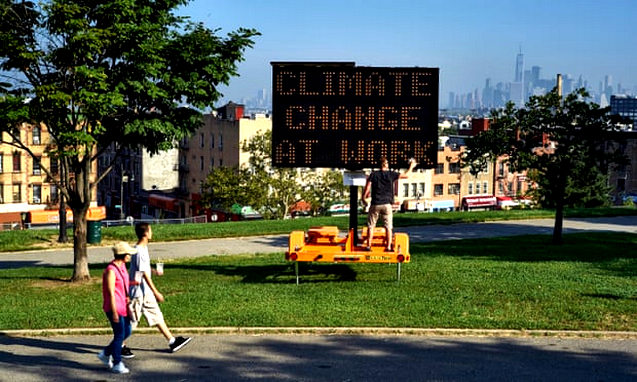
'Art can play a valuable role': climate change installations appear in New York
Climate Signals, a public art project by Justin Brice Guariglia, in
collaboration with the Climate Museum and the mayor’s office on climate
change.
Photograph: Justin Brice Guariglia
The existential threat of climate change is being spelled out to New
Yorkers via a selection of flashing highway signs that have been placed
around the city.
The 10 large solar-powered signs have been placed in locations in
each of New York’s five boroughs, including areas deemed particularly
vulnerable to the sea level rise and powerful storms associated with
climate change, including the Rockaways in Queens and the west side of
Manhattan.
Messages such as “Climate change at work” and “Climate denial kills”
will be displayed in English, as well as in languages commonly spoken in
the areas they will be deployed, such as Spanish, Russian and French.
The signs are part of a project by the Climate Museum and a host of partners, including the New York City’s mayor’s office. The installation, called Climate Signals, has been done by Justin Brice Guariglia, an artist who regularly focuses on environmental themes in his work.
Photograph: Courtesy of the artist and The Climate Museum
“These signs sound a warning about the climate crisis and they call
us to think and act on the issue,” said Miranda Massie, director of the
Climate Museum. “When you see a flashing traffic signal your initial
response is that there are uncertain conditions ahead, and that is
exactly what climate change is. This is the perfect medium for bringing
up this alert.”
Some of the sites will include elements such as voter registration
and appearances by climate scientists. Massie said the work is not
overtly activist in nature, despite the unfolding agenda of Donald
Trump, a native of Queens, to dismiss the science of climate change and
dismantle policies that reduce greenhouse gas emissions.
“Anyone who is aware of the climate crisis is appalled and alarmed by
the disgraceful assault by the administration on climate progress,” she
said. “But this project isn’t political in a narrow sense, it’s about
social and cultural action. We need a social shift to deal with climate
change. It shouldn’t be a political lightning rod.”
Daniel Zarrilli, New York City’s chief resilience officer, said:
“Climate change is one of New York City’s greatest challenges and
requires creative approaches to educate and engage all of us about its
risks and solutions. Art can play a valuable role in this effort.”
Malcolm Turnbull is merely the latest leader to discover that action on emissions remains a difficult step to take.
Australia is suffering drought and politicians who struggle to tackle climate change. Credit: Brook Mitchell/Getty
Australia has two pressing environmental problems: climate change and
finding a leader who can tackle it. Large swathes of the country are
suffering the effects of a seven-year drought, the bush fire season has
hit those parts two months early, and the destruction of the Great
Barrier Reef grows more severe each year. Yet late last month, the
country’s attempts to make some modest changes to its energy policy to
help reduce greenhouse-gas emissions blew up an internal storm in the
ruling Liberal party that cost Prime Minister Malcolm Turnbull his job.
To
lose one prime minister to political fights about climate-change policy
is unfortunate. Two would be careless, but Turnbull is actually the
third Australian premier to fall in this way in under a decade. What is
going on? And what does this turmoil say about attempts to rein in
damaging carbon emissions elsewhere?
All politics is local, and
Australian climate politics more so than most. Although Australian
scientists are world leaders in several areas of climate science,
including atmospheric monitoring of the Southern Hemisphere and
understanding the causes of sea-level rise, the nation remains heavily
reliant on coal for jobs and electricity. It mines more than half a
billion tonnes of the stuff each year, and sells almost three-quarters
of that abroad. The rest is burnt in Australian power stations, with
electricity generation accounting for around one-third of the nation’s
greenhouse-gas emissions.
It’s no coincidence that when Turnbull’s
political colleague (and then-treasurer) Scott Morrison wanted to
criticize environmentalists last year, he brought a lump of coal to
parliament and spoke about it in glowing terms. Last week — after
Turnbull confirmed he was quitting politics — his son complained about
the “undue level of influence” of the coal lobby. Morrison, who replaced
Turnbull as prime minister, has yet to announce the fate of the
disputed policy, the National Energy Guarantee, which would force
emissions generators to show they are meeting annual standards. He has
at least said that the country will not withdraw from the Paris climate
agreement, a move being pushed by some government members.
He
should stand firm. Although the Paris agreement is weak compared with
the scale of what is needed, it represents a political triumph and one
that places so few binding demands on nations that any withdrawal would
be little more than crowd-pleasing theatrics. And most of the crowd
won’t be pleased: a June poll showed that 59% of Australians saw climate
change as a pressing threat and one that needed action — the highest
percentage in a decade.
A larger-scale survey last year of 38 countries showed a similar level of concern.
But politicians in many of these places, even those fully behind the
need for action on emissions, are also finding it difficult to follow
through on pledges. Take Canada, where Justin Trudeau’s government last
month announced it was scaling back plans for a carbon tax. Last week,
Nicolas Hulot, the French environment minister, resigned, claiming that
governments around the world are not taking sufficient steps to tackle
green issues such as climate change. And the reckless stance of US
President Donald Trump continues to erode climate regulations and
embolden climate sceptics. New Zealand, for one, still has ambitions for
emissions-reducing laws, but many of the other promises the country
made in Paris — including actual cuts to carbon emissions and boosts in
foreign aid to help poorer countries adapt — are weakening under
political pressure.
Many of those poorer countries are on the
front line and will suffer heavily as the weather worsens. So will
Australia. Droughts there are projected to increase in length and
severity as a result of climate change. Heatwaves, floods and bush fires
are also linked to global warming, and are predicted to become more
common and more extreme. The country’s island neighbours in the Pacific
are likely to be inundated as sea levels rise. As a result, Australia,
whose draconian refugee policy is a source of shame to many citizens, is
likely to face an increase in climate refugees.
That these topics
are now routinely debated amid mounting public concern about global
warming is a victory of sorts for scientists, who must continue their
efforts to make the case for action, and to research and speak out about
the consequences. And although the current political drama in Australia
paints a depressing picture, there is a glimmer of hope. A decade after
the financial crash wrested away attention and momentum, climate change
is once again at the top of the political agenda.
Things can
change quickly in politics, and Australia has a chance to force that
change. Already the opposition Labor party has promised a new
emissions-reduction scheme. And next year, the country will again vote
on its leader. For whoever wins that election, curbing climate change
should be at the top of their to-do list — and they must be given the
chance to hang around long enough to do so.
Tropical corals have been identified off Sydney's northern beaches
and are "absolutely proliferating", providing habitat for a range of
other species typically found much further north, according to the diver
who found them.
Josh Sear, an underwater naturalist and
photographer, has watched branching corals - whose scientific name is
Pocillopora aliciae - gain purchase on large sandstone boulders in the Cabbage Tree Bay area near Manly in the past couple of years.
Newcomers: A headband damselfish swims amid a hard coral species now found off waters near Sydney. Photo: John Sear
Initially
in waters of about 13-15 metres depth, the corals have spread to the
nearby popular Shelly Beach region and are found at depths of about
three metres.
Remarkably, the corals are already providing habitat
for a range of tropical fish and crab species not normally found this
far south.
"Every year there are new ones coming down," Mr Sear said. "These are way out of their normal range."
Species are shifting globally as temperatures rise with climate change. Corals in Japan, for instance, have been moving poleward at the rate of 14 kilometres a year. In Australia, it is the strengthening and warming East Australian Current driving species southwards along the east coast.
Coral coloniser: The Pocillopora aliciae species of coral is now proliferating off the coast near Manly. Photo: John Sear
David Booth, a marine ecologist at the
University of Technology Sydney, said the corals being found off Manly
had previously been recorded off Port Stephens about 120 kilometres to
the north.
"As far as we are aware, this is the furthest south of any tropical coral recorded," Professor Booth wrote in a paper published last month in the Coral Reefs journal.
"There's a thermal niche that didn't exist before," he told Fairfax Media.
A trapezia crab, which typically spends
its whole life within the Pocillopora species of coral, has also been
found in waters off Sydney. Photo: John Sear
Corals
"are the start" for species migrating since they provide shelter and
food for a range of other creatures such as fish and crabs that are now
showing off Sydney, he said.
"It's like new apartment blocks have arrived in town," Professor Booth said.
A mystery about the multi-species migration, though, is "how the heck they got here", he said.
Symbiotic moves
For
instance, Mr Sear has identified and photographed a species of goby and
shrimp that co-exist in the tropics normally 1000 kilometres to the
north.
The shrimp is blind and digs holes for the goby, which in turn protects it.
Even with the symbiotic relationship, it remains unclear how both species so quickly arrived this far south, Mr Sears said.
Travelling south: a tropical goby and a
shrimp that have a symbiotic relationship can now be found off Sydney’s
northern beaches. Photo: John Sear
Professor Booth said the key may be the increasing ability of coral
larvae and other species to survive through winters as waters warm.So
far, there is little sign that the newcomers have dislodged other
species in the Sydney areas at least, although it has happened elsewhere
along the east coast.
"The
big boulders of sandstone are just perfect for corals," Professor Booth
said, noting the area is known locally as "the Barrens". They're "not
so barren now", he said.
The
Cabbage Tree Bay area is a protected zone, and earmarked to form part
of the NSW government's proposed marine park for the Sydney region.
A damselfish swims near corals off Manly, on Sydney's northern beaches. Photo: John Sear
Reef stresses
Tropical species
may be expanding their range with warmer waters but the same force -
climate change - is also playing havoc where sea temperatures rise too
high.
A paper out on Wednesday in Nature Communications
found the mass bleaching that killed about half of the Great Barrier
Reef's corals over two consecutive summers did not spare deeper reefs
either.
The researchers, including Ove Hoegh-Guldberg and other
Australian-based scientists, found a summer upwelling of cooler water
had provided "thermal relief" for corals in 2016.
That
upwelling, however, subsided, leading to severe bleaching of 40 per
cent of the deep reefs and about 6 per cent mortality, the paper found.
While
much less than the death rates of shallow-reef corals, the delayed
impacts of the bleaching may have triggered more mortality after the
surveys were done.
The researchers noted deeper corals could
provide a source of larvae that can help the recovery of harder-hit
shallow reefs. However, that aid would be limited since the deeper reefs
are home to a relatively small proportion of species compared with
those closer to the surface.
Investors have been urged to “step up the pressure” on companies to
act on climate change as annual meeting season approaches, with a report
arguing corporate Australia is paying lip-service to the issue.
Environmental
non-profit Market Forces says many of Australia’s 100 biggest listed
companies are continuing to take a "superficial" approach to disclosure
and action on climate change and emissions, despite warnings by
regulators and lawyers of potential business and legal risks.
Almost 40 per cent of companies examined had increased emissions over the past year, Market Forces said. Photo: Bloomberg
Market Forces
research, to be released on Tuesday, suggests that of 74 ASX100
companies in sectors dubbed “high risk” for climate change impacts - as
defined last year by a G20-led task force on climate risk disclosure -
only 55 per cent identified climate change as a material business risk,
and more than 80 per cent did not have a plan to reduce their own
emissions.
Almost 40 per cent of ASX100 companies studied had
increased their emissions over the past year, the Market Forces research
said.
The NGO - which is affiliated with Friends of the Earth -
has urged investors to “escalate” climate change as an issue in their
discussions with companies, and divest shaes in companies that are
“unable or unwilling” to align with the goals of the 2015 Paris climate
agreement.
“There
is a growing recognition of climate risk, but few companies are
actually undertaking the hard yards to fully address the issue,” Market
Forces analyst Will van de Pol said.
The Market Forces research comes as the new Morrison government grapples with internal divisions on its approach to climate change, emissions and the Paris agreement. New Defence Minister Marise Payne is attending the Pacific Islands Forum this week where climate change is expected to be a major topic of discussion.
Prime Minister Scott Morrison (right) and deputy Josh Frydenberg have grappled with internal divisions on carbon emissions. Photo: Mark Graham/Bloomberg
It also comes as regulators consider
how climate change may impact the financial system, with the Australian
Securities and Investments Commission (ASIC) assessing how ASX300 companies
disclose climate change risks, and the Council of Financial Regulators -
which includes ASIC, the Australian Prudential Regulation Authority
(APRA), the Reserve Bank and federal Treasury - creating a working group
on the issue. ASIC has said company directors should take seriously warnings that they risk future legal action if they fail to consider risks related to climate change.
Risky business
A
third of companies studied “explicitly encourage” emissions reductions
through their executive or director bonus schemes, Market Forces said, a
number that had doubled since Market Forces’ last examined the issue in March.
But
just three companies – South32, AGL and Stockland – had started
reporting climate risks in line with the so-called "TCFD" rules nailed
down by the G20's task force last year, which have been endorsed by
major companies and investors.
Another four companies -
Commonwealth Bank, BHP, Westpac and ANZ - “came close” to fully adopting
the TCFD recommendations, Market Forces said, while others had promised
to do so for their 2019 reporting.
The
TCFD recommendations are anchored on the Paris agreement's pledge to
keep global warming to well below 2 degrees. In July, the Australian
Securities Exchange's corporate governance council - in proposed new
guidelines - said companies should boost their disclosure of climate
change risk, including reporting with the TCFD rules if they had
"material exposure".
The Market Forces research found that while
65 per cent of companies studied unequivocally accepted climate science,
27 per cent were unclear in their language and 8 per cent had not
formally acknowledged the science of climate change.
In June,
research from the Australian Council of Superannuation Investors found
that 22 ASX200 companies had adopted or promised to adopt the TCFD rules
while 10 more were "reviewing" them.
AGM focus
Mr van de
Pol pointed to South32 as a company that was "getting it right, coupling
detailed climate risk disclosures with action to reduce exposure".
But
he questioned why ASX Ltd was not following the suggestions of its own
corporate governance council in not disclosing detailed climate risk
information, saying the listed company was exposed to climate risk
because "high risk-exposed mining, materials and big financial companies
dominate the ASX".
ASX Ltd said it was "difficult to conclude"
the company had a material exposure to listed companies directly at risk
to climate change, given ASX Ltd was a "diverse, service-based
organisation". The technology sector was its fastest growing sector, it
said.
It would comply with the corporate governance council's
recommendations on an "if not why not" basis once they were finalised,
ASX Ltd said.
Whitehaven Coal was among the lowest-scoring
companies in the Market Forces research, which found that the coal miner
- a vocal proponent of "High Energy Low Emission" (HELE) coal
fired-power stations - had not disclosed any risks it may face from
climate change or listed it as a material business risk.
Market
Forces has launched shareholder resolutions against Whitehaven Coal
ahead of its AGM in October, calling on the company to ensure its
strategy was “consistent” with the Paris agreement. The vote would be a
"litmus test" on investors' willingness to push companies on climate,
Market Forces said.
Whitehaven
has said it will recommend shareholders vote against the resolutions.
"We are not going to pre-empt the proceedings of the AGM," a Whitehaven
spokesman said when asked for comment. "We will recommend shareholders
not support resolutions requisitioned by shareholders representing
0.0016 per cent of the company’s shares on issue for the sole purpose of
supporting Market Forces’ ongoing anti fossil fuels campaign."
It did not comment on Market Forces' research.
In the past two years, Market Forces has coordinated a series of shareholder resolutions pushing companies including QBE,
Santos and Oil Search to disclose more about climate risks. None of the
resolutions have been successful, but they have won the backing of some major investors, with the QBE resolution in May attracting more than 18 per cent support.
The step up in the number of such agenda items, from Market Forces and others, has met with frustration
from some boards and the body representing investor relations
professionals, partly due to the time and resources they say it takes
for companies to deal with them. Companies targeted have urged
shareholders not to vote for them.
On Monday, a Danish container ship - the Venta Maersk - set off from Busan in South Korea packed with Russian fish and Korean electronics.
On September 22 it will dock at Bremerhaven in Germany.
This animation outlines research into the
behaviour of the Arctic sea ice and shows how the quantity of older and
thicker ice has changed between 1984 and 2016. Vision courtesy: NASA
Climate Change.
The bit in between could change the world.
Thanks
to climate change, the Venta was able to take a short cut over the top
of the globe – the first container ship to do so – through the Bering
Strait between Russia and Alaska, above the desolate Siberian coast,
past worried polar bears, melting permafrost and huge new Chinese-funded
gas fields, through Arctic waters that Russia wants to control, and
down past Norway, where this week a group of academics, analysts and
policymakers were fretting over what it all means.
They gathered
in Tromso, Norway’s northernmost city, 350 kilometres above the Arctic
Circle. It’s dark here for 48 days in winter, but this week Tromso was
warmer than Sydney.
The
experts were invited to Tromso by Konrad-Adenauer-Stiftung, a German
think tank whose board of directors includes both German Chancellor
Angela Merkel and her widely-touted successor Annegret Kramp-Karrenbauer.
The one-day seminar, titled "Changes in the Arctic Security Landscape", announced it was time to look at “current and future security challenges in the Arctic”.
A visitor walks past an inflatable model
of a TOR-M2DT Arctic short-range air defence missile system at the Army
2018 expo in Kubinka, Russia. Photo: Bloomberg
“We are moving into a new Cold War,” one attendee said (the seminar was held under the Chatham House Rule,
to encourage frankness, so speakers cannot be identified). “The Arctic
is caught between East and West … and it is moving to the East.
“We’re in a different territory now.”
Some
talked about the effects of climate change on the nuclear deterrent,
others about the temptation of mineral riches in Greenland. Many rued the US retreat from international affairs.
All were concerned about the Arctic’s role in climate change. They
pondered if treaties and multilateral forums will be enough to keep the
great powers reined in as this new playground opens up.
Outside,
the sun struck blue sparks off Tromso’s harbour, and a French navy
patrol boat set out to sea after a friendly visit in this increasingly
tense part of the world.
It’s
not just commercial shipping making moves in the Arctic. The rapidly
thinning sea ice is making way for warships, as the world’s great powers
look north and see untapped wealth and strategic opportunities - or
threats.
An iceberg melts in Kulusuk, Greenland, near the Arctic Circle. Photo: AP
Russia is modernising its Northern Fleet,
the biggest of the country's four fleets, which includes Russia’s only
aircraft carrier. In June it held its biggest "alarm exercise" in a
decade off the coast of Norway (which it neglected to warn about the
operation), sending 36 naval vessels steaming out of the Barents Sea
including a missile cruiser, anti-submarine ship and destroyer, The Barents Observer reported, firing cruise missiles, mines and torpedoes.
The
nuclear and diesel-powered warships were joined by 20 aircraft and 150
rocket and artillery weapons systems deployed along the Kola Peninsula,
in a demonstration of how Russia would react to a massive enemy attack.
Norwegian
fighter jets scrambled to meet the opposition off their north-east
coast. Shortly after, NATO warships sailed north in a manoeuvre the
alliance claimed had “long been planned”. The US Navy’s Arctic strategy,
released in 2014 and intended to last 16 years, was updated this year
because “the damn thing melted”, as Navy Secretary Richard Spencer put
it.
And
there’s another player in the game – potentially the biggest of all. In
July, China’s Vice-Admiral Shen Jinlong met his Russian counterparts in
Murmansk, where they discussed “existing threats in the world’s oceans
[and] possible practical forms of co-operation”, the Northern Fleet’s
press release said.
The Chinese research vessel and icebreaker Xuelong (Snow Dragon) in the Antarctic in December 2016. Photo: CCTV screen grab
Almost exactly a year ago China’s only
icebreaker, the Snow Dragon, spent the northern summer deep in the
western Arctic, on an 83-day mission that visited waters off Norway and
Canada. It travelled far north of the Northern Sea Route ploughed by the
Venta, in a part of the world some experts predict will be routinely
navigable within a few decades.
When the Snow Dragon first sailed over the top of Russia from the Pacific to the Atlantic in 2012, expedition leader Huigen Yang told Reuters
“to our astonishment … the most part of the Northern Sea Route is
open”. Ever since, China’s interest in the region has intensified. It
now has plans for a second, nuclear-powered icebreaker, and China is
funding research on how submarines can function under the Arctic ice.
“The
Arctic has always reflected the wider world,” says Rasmus Gjedsso
Bertelsen, professor of northern studies at the Arctic University of
Norway in Tromso.
“But the wider world before was Western-dominated.”
He
warns against the trap of "presentism" – assuming that modern times are
unique and there are no lessons in history. And he is wary of "Arctic
exceptionalism", the idea that somehow this region is a special zone of
science, exploration and peace.
In fact the Arctic has been a
commercial and military zone for centuries. Catholic Europe ate Arctic
dry fish on Fridays, the Napoleonic wars played out in part here, and
manoeuvres during the Crimean War were arguably why Russia sold Alaska
to the US in 1867 rather than Britain/Canada, Bertelsen says.
Russia under President Vladimir Putin behaves more like a super power. Photo: AP
Our view of a pristine, peaceful Arctic springs from recent history: the brief post-Cold War period.
“You
had this omnipotent, unipolar America, a bankrupt Russia, and China
biding its time,” he says. “We should not confuse Russian behaviour at
that time with a reform of the Russian mind. Now, because of rising oil
prices and the rule of Vladimir Putin, you have a Russia which behaves in a way much more to be expected from a great power.
“And great powers don’t behave very well – or rather they only behave as well as others force them to do.”
The
seminar saw strong debate over how much Russia is seeking to rule the
Arctic rather than share its stewardship. Some pointed to Russia’s
friendly role in promoting coastguard and rescue cooperation, and in
scientific fields. Others said the Arctic is the key to nuclear
deterrence - the flight path for bombers and inter-continental ballistic
missiles and home to key missile defence systems – and that issue will
determine whether the region ends in “complete co-operation or going to
hell in a handbasket”.
Security
concerns often mirror economic concerns. And as climate change alters
the physical landscape, the economic landscape of the Arctic is changing
just as fast.
“Look carefully at the Yamal project,”
Bertelsen says. It’s an extraordinary new LNG project on Russia’s
Arctic coast – a $US27 billion ($37 billion) plant, to be serviced by 15
new ice-class tankers on order from Korea worth another $US5 billion,
tapping an immense gas reserve the equivalent of 4 billion barrels of
oil. A lot of this is financed by Chinese money, as sanctions against Russia forced it to look east for cash.
“China
and the other Asian countries are looking especially to the Russian
Arctic as a source of energy,” Bertelsen says. “In the West we think of
gas as a fossil fuel to be phased out. But air pollution in China is very serious
and their big problem is coal. It’s obvious they have to do something
about that, and replacing coal with gas is the quick fix.”
An LNG tanker sits at anchor outside Hammerfest, northern Norway, last year. Photo: Bloomberg
The Arctic is incredibly rich in fossil
fuels: an area the size of Africa holds more than a fifth of the
world’s oil and natural gas reserves. About 80 per cent is gas, and
thanks to a quirk of geology most of the gas is above Russia.
This
has already led to territorial disputes, as Russia tries to stake its
claim to a continental shelf stretching almost to the pole. Both the US
and China want to minimise Russia’s "exclusive" zone.
And there is
a vicious circle here – the climate change making it easier to get the
gas down to Asia will be accelerated by the carbon emitted by that gas.
One
of the big concerns at the seminar was how climate change concerns are
ignored or at least compartmentalised in the Arctic. Russia has been
slow to acknowledge the scientific consensus, the US has performed a
sudden U-turn, and China argues that it should not suffer for the
ecological sins of the developed world.
“You’d think [the US and
Russia] are members of the Flat Earth Society,” one attendee complained.
“And in the worsening geopolitical climate it’s much more difficult to
achieve cooperative efforts.”
One successful multilateral
agreement in the Arctic has been on ‘black carbon’ – the pollution put
out by shipping that stains the ice and accelerates climate change,
among other ill effects.
The Venta is running on “ultra-low sulphur” fuel, mandated in the far northern seas, to reduce its pollution potential.
And
the very fact of a northern sea route is a plus for the climate, some
argue. As travel times decrease so do carbon emissions. Using the
Northern Sea Route (NSR) rather than the Suez Canal to get from Asia to
Europe would reduce emissions by between half and three-quarters.
Already,
shipping data shows sailing times on the NSR have fallen from 20 days
in the 1990s to 11 days, mainly due to there being less sea ice. After
the 2050s all types of vessels should be able to go straight over the
pole, saving even more time. Unescorted navigation in the high Arctic
may even be possible as early as the 2030s, though winters will still
require icebreakers.
According to one forecast, by 2020 up to 15 per cent of China’s international trade will go through the NSR.
But Bertelsen warns not to get carried away.
He
points out there’s a difference between "destination shipping" – the
trucking of oil and gas down from the Arctic – and "transit shipping" of
containers around the world.
“Container
shipping is like a bus line,” he says. “It has stops along the way and
very few passengers go from end to end. The old trunk line via the
Malacca Strait, the Indian Ocean, the Suez Canal and the Mediterranean
passes a lot of people, a lot of economic activity. But with the passage
north of Russia - there’s nobody there.”
There are other
practical problems. Dedicated satellites now track sea ice to send
warnings down to ships in the Arctic, but significant Titanic-style
risks remains and only Russia currently has a decent fleet of
icebreakers. And the Bering Strait is not very deep, restricting the
size of ship that can access the Arctic from Asia.
Maersk itself
insisted it did “not see the Northern Sea Route as an alternative to our
usual routes”, saying the Venta’s voyage was “a trial to explore an
unknown route for container shipping and to collect scientific data”.
But when China is involved, there are always more than just commercial considerations.
In January Beijing staked its claim in clear terms, issuing its first White Paper on the Arctic.
The
paper described China as a "near-Arctic state" and said countries south
of the Arctic Circle had the right to engage in scientific research and
navigation, resource extraction, fishing and the laying of cables and
pipelines.
It was a clear marker, and a warning, that it intends to be a major player.
The paper discussed a “Polar Silk Road”,
anticipating that China would make extensive use of the new shipping
routes to Russia and northern Europe – as well as the North-West Passage
into the Canadian Arctic, and even the polar route straight over the
top.
Some point to Greenland as a destination China has in mind.
A 2007 US diplomatic cable published by WikiLeaks
predicted “Greenland is on a clear track towards independence”, and as
the Danish protectorate’s ice sheets melt, mineral riches are being
exposed.
There is not just oil (but there is a lot of that – more than Alaska, perhaps) but also diamonds, rubies, uranium, zinc and rare earths, the minerals essential to the electronics boom that powered China’s renaissance.
Greenpeace activists prepare to scale an oil rig off the coast of Greenland. Photo: Greenpeace
And China is starting to open its
pockets in Greenland, offering money to expand airports, to explore and
exploit mineral deposits. It even tried to buy an abandoned US naval
facility, only to be blocked at the last minute.
If
Chinese money is the catalyst for Greenland’s independence, finally
weaned off its big Danish subsidy, then gratitude could give China a lot
of influence in the fledgling country.
But this could prove
another Arctic flashpoint: the US Air Force base at Thule in Greenland
plays a crucial role in missile defence.
Elisabeth
Bauer, head of the Nordic Countries Project at
Konrad-Adenauer-Stiftung, has been interested in the Arctic for a
decade, but her ears really pricked up in 2015 at a discussion on when
the Arctic might be ice-free.
“That really causes a lot of
challenges to the Arctic and I thought that might be really important
for the future of the economy, of security, the future of East-West
trade and so on,” she says.
“So I thought we have to do something on that topic.”
She’s cautious about making any bold predictions.
“At the moment you really can’t see what will happen in the future,” she says.
She points to this week's seminar, with some of the world’s most knowledgeable Arctic experts disagreeing on central issues.
“It
shows we have to be careful to look at this. It is a struggle of
interests on one end, and a struggle on principles and values on the
other end. We don’t know at the moment who will be the winner.”
This illustration picture taken in Paris on August 20, 2018 shows a figurine of a worker with a jackhammer on an earth globe. Joël Saget, AFP
Two hundred of the world’s most prominent artists and scientists
signed an open letter in French daily Le Monde on Monday calling for
urgent political action to address the “global catastrophe” facing
mankind and other species. The letter,
penned by actress Juliette Binoche and astrophycist Aurélien Barrau,
called on politicians to act “firmly and immediately” in tackling climate change and the “collapse of biodiversity”, described as the “greatest challenge in the history of mankind”. “It
is time to get serious,” the signatories said. “The sixth mass
extinction is taking place at unprecedented speed. But it is not too
late to avert the worst.” The letter said it was up to politicians to take all necessary measures, however unpopular they may be. Binoche was joined by
fellow French actresses Isabelle Adjani, Marion Cotillard and Catherine
Deneuve as well as artist Anish Kapoor; actors Bradley Cooper, Willem
Defoe, Ethan Hawke, Ralph Fiennes, Jude Law, Charlotte Rampling and John
Tuturro; directors David Cronenberg and Wim Wenders; and many others. Prominent
scientists who signed on included astrophysicist Françoise Combes,
climatologist Jean Jouzel, mathematician Mikhaïl Gromov and physicist
Carlo Rovelli. The letter comes as French President Emmanuel Macron is under pressure to do more to deliver on his green promises after his high-profile ecology minister, Nicolas Hulot, suddenly resigned, citing his disappointment with progress on the environment. A
popular figure, Hulot resigned live on-air during a radio interview
last week, saying he felt "all alone" in the government on environmental
issues and blasting lobbies and big business for hindering the fight
against climate change. Signatories Isabelle Adjani, actrice; Laure Adler, journaliste; Pedro Almodovar, cinéaste; Laurie Anderson, artiste; Charles Aznavour, chanteur; Santiago Amigorena, écrivain; Pierre Arditi, acteur; Niels Arestrup, acteur; Ariane Ascaride, actrice; Olivier Assayas, cinéaste; Yvan Attal, acteur, cinéaste; Josiane Balasko, actrice; Aurélien Barrau, astrophysicien (Institut universitaire de France); Nathalie Baye, actrice; Emmanuelle Béart, actrice; Xavier Beauvois, cinéaste; Alain Benoit, physicien (Académie des sciences); Jane Birkin, chanteuse, actrice; Juliette Binoche, actrice; Benjamin Biolay, chanteur; Dominique Blanc, actrice; Gilles Boeuf, biologiste; Mathieu Boogaerts, chanteur; John Boorman, cinéaste; Romane Bohringer, actrice; Carole Bouquet, actrice; Stéphane Braunschweig, metteur en scène; Zabou Breitman, actrice, metteuse en scène; Nicolas Briançon, acteur, metteur en scène; Irina Brook, metteuse en scène; Valeria Bruni Tedeschi, actrice, cinéaste; Florence Burgat, philosophe; Gabriel Byrne, acteur; Cali, chanteur; Sophie Calle, artiste; Jane Campion, cinéaste; Isabelle Carré, actrice; Emmanuel Carrère, écrivain; Anne Carson, auteure et professeure; Michel Cassé, astrophysicien; Laetitia Casta, actrice; Bernard Castaing, physicien (Académie des sciences); Antoine de Caunes, journaliste, cinéaste; Alain Chamfort, chanteur; Boris Charmatz, chorégraphe; Christiane Chauviré, philosophe; Jeanne Cherhal, chanteuse; François Civil, acteur; Hélène Cixous, écrivaine; Isabel Coixet, cinéaste; Françoise Combes, astrophysicienne (Collège de France); François Cluzet, acteur; Gregory Colbert, photographe, cinéaste; Bradley Cooper, acteur; Brady Corbet, acteur; Béatrice Copper-Royer, psychologue; Marion Cotillard, actrice; Denis Couvet, écologue; Camille Cottin, actrice; Clotilde Courau, actrice; Franck Courchamp, écologue (Académie européenne des sciences); Nicole Croisille, chanteuse; David Cronenberg, cinéaste; Alfonso Cuaro, cinéaste; Willem Dafoe, acteur; Philippe Decouflé, chorégraphe; Sébastien Delage, musicien; Vincent Delerm, chanteur; Alain Delon, acteur; Catherine Deneuve, actrice; Claire Denis, cinéaste; Philippe Descola, anthropologue (Collège de France); Alexandre Desplat, compositeur; Manu Dibango, musicien; Hervé Dole, astrophysicien (Institut universitaire de France); Valérie Dréville, actrice; Diane Dufresne, chanteuse; Sandrine Dumas, actrice, metteuse en scène; Romain Duris, acteur; Lars Eidinger, acteur; Marianne Faithfull, chanteuse; Pierre Fayet, physicien (Académie des sciences); Ralph Fiennes, acteur; Frah (Shaka Ponk), chanteur; Cécile de France, actrice; Stéphane Freiss, acteur; Thierry Frémaux, directeur de festival; Jean-Michel Frodon, critique, professeur; Marie-Agnès Gillot, danseuse étoile; Pierre-Henri Gouyon, biologiste; Julien Grain, astrophysicien; Anouk Grinberg, actrice;Mikhaïl Gromov, mathématicien (Académie des sciences); Sylvie Guillem, danseuse étoile; Arthur H, chanteur; Ethan Hawke, acteur; Christopher Hampton, scénariste; Nora Hamzawi, actrice; Ivo Van Hove, metteur en scène; Isabelle Huppert, actrice; Agnès Jaoui, actrice, cinéaste; Michel Jonasz, chanteur; Camelia Jordana, chanteuse; Jean Jouzel, climatologue (Académie des sciences); Juliette, chanteuse; Anish Kapoor, sculpteur, peintre; Mathieu Kassovitz, acteur; Angélique Kidjo, chanteuse; Cédric Klapisch, cinéaste; Thierry Klifa, cinéaste; Panos H. Koutras, cinéaste; Lou de Laâge, actrice; Ludovic Lagarde, metteur en scène; Laurent Lafitte, acteur; Laurent Lamarca, chanteur; Maxence Laperouse, comédien; Camille Laurens, écrivaine; Bernard Lavilliers, chanteur; Sandra Lavorel, écologue (Académie des sciences); Jude Law, acteur; Patrice Leconte, cinéaste; Roland Lehoucq, astrophysicien; Gérard Lefort, journaliste; Nolwenn Leroy, chanteuse; Peter Lindbergh, photographe; Louane, chanteuse; Luce, chanteuse; Ibrahim Maalouf, musicien; Vincent Macaigne, metteur en scène, acteur; Benoît Magimel, acteur; Yvon Le Maho, écologue (Académie des sciences); Andreï Makine, écrivain de l’Académie Française; Abd al Malik, rappeur; Sophie Marceau, actrice; Virginie Maris, philosophe; André Markowicz, traducteur; Nicolas Martin, journaliste; Vincent Message, écrivain; Wajdi Mouawad, metteur en scène; Nana Mouskouri, chanteuse; Jean-Luc Nancy, philosophe; Arthur Nauzyciel, metteur en scène; Safy Nebbou, cinéaste; Pierre Niney, acteur; Helena Noguerra, chanteuse; Claude Nuridsany, cinéaste; Michael Ondaatje, écrivain; Thomas Ostermeier, metteur en scène; Clive Owen, acteur; Corine Pelluchon, philosophe; Laurent Pelly, metteur en scène; Raphaël Personnaz, acteur; Dominique Pitoiset, metteur en scène; Denis Podalydès, acteur; Pomme, chanteuse; Martin Provost, cinéaste; Olivier Py, metteur en scène; Susheela Raman, chanteuse; Charlotte Rampling, actrice; Raphaël, chanteur; Régine, chanteuse; Cécile Renault, astrophysicienne; Robin Renucci, acteur; Jean-Michel Ribes, metteur en scène; Tim Robbins, acteur; Muriel Robin, actrice; Isabella Rossellini, actrice; Brigitte Roüan, actrice, cinéaste; Carlo Rovelli, physicien (Institut universitaire de France); Eric Ruf, directeur de la Comédie-Française; Céline Sallette, actrice; Rodrigo Santoro, acteur; Marjane Satrapi, cinéaste; Kristin Scott Thomas, actrice; Albin de la Simone, musicien; Abderrahmane Sissako, cinéaste; Marianne Slot, productrice; Patti Smith, chanteuse, écrivaine; Sabrina Speich, géoscientifique; Marion Stalens, réalisatrice; Kristen Stewart, actrice; Tom Stoppard, dramaturge; Peter Suschitzky, chef opérateur; Malgorzata Szumowska, cinéaste; Béla Tarr, cinéaste; Gilles Taurand, scénariste; Alexandre Tharaud, musicien; James Thierrée, danseur, chorégraphe; Mélanie Thierry, actrice; Danièle Thompson, cinéaste; Melita Toscan du Plantier, attachée de presse; Jean-Louis Trintignant, acteur; John Turturro, acteur; Hélène Tysman, pianiste; Pierre Vanhove, physicien; Karin Viard, actrice; Polydoros Vogiatzis, acteur; Rufus Wainwright, chanteur; Régis Wargnier, cinéaste; Jacques Weber, acteur; Wim Wenders, cinéaste; Sonia Wieder-Atherton, musicienne; Bob Wilson, metteur en scène; Lambert Wilson, acteur; Jia Zhang-ke, cinéaste; Elsa Zylberstein, actrice