22/09/2018

On The Attack Against Climate Change

New York TimesAlina Tugend

A woman collecting plastic in Haiti, where the Plastic Bank began its work three years ago. The company aims to stop plastic before it gets into the ocean. Credit Plastic Bank
Thousands of organizations around the world are trying in big ways and small to confront the challenges of climate change. Here are 10 examples.

Under the Sea
Coral reefs are beautiful to look at, but they also play a crucial role as coastal barriers when storms or flooding hits, absorbing about 97 percent of wave energy.
But because of rising temperatures, coral cover in the Caribbean is estimated to have decreased by about 80 percent in the last few decades, said Joseph Pollock, Caribbean coral strategy director at the Nature Conservancy. He added that in 2016, a marine heat wave was estimated to have killed about a third of the shallow corals on Australia’s Great Barrier Reef.
The Nature Conservancy in partnership with Secore International, a conservation organization and a leader in coral restoration, are using an innovative approach to address the problem: helping coral reproduction.
Coral mating works this way, Dr. Pollock said: Many coral species spawn by putting out bundles of eggs and sperm one night a year.
“It’s like the craziest singles bar ever,” he said.
Researchers know when those nights are, so they go out, collect the eggs and sperm and then mix them together to cross-fertilize, grow them for a few days or weeks until they become coral juveniles, then place them back in the sea.
The survival rate is about 10 percent, Dr. Pollock said, but that’s much better than the survival rate without the help of the scientists. And compared with other restoration techniques, the cross-fertilization creates greater genetic diversity, and that creates more resilience.
The work is focused on the Caribbean now, but Dr. Pollock said the hope is that it can be used throughout the world.
“The aim of the work is to develop tools and techniques that are low cost and don’t require a huge amount of super specialized personnel and infrastructure,” he said.
One of the solar microgrids that have been installed by Resilient Power Puerto Rico since Hurricane Maria knocked out most of the island’s power grid last year. Credit Resilient Power Puerto Rico
A New Kind of Power
After Hurricane Maria swept through Puerto Rico last year and knocked out almost all of its power grid, most residents were left without electricity for months. Jonathan Marvel, one of the founders of Marvel Architects, was born and raised in Puerto Rico. He wanted not only to help bring back power but also do it in a way that would be more environmentally sustainable than it was before the storm.
So, with colleagues and friends, he created Resilient Power Puerto Rico, to develop and install solar microgrids for as many people as he could in the most efficient way possible. The organization, which received an early donation of batteries from Tesla, focused its efforts on areas with high-density, low-rise housing and installed the grids on rooftops of community centers that typically serve 3,000 to 4,000 people.
Their work complements other efforts not only to rebuild the island but also to make its infrastructure more resilient and environmentally green.
One benefit of the solar microgrids is that they can store solar power — allowing them to operate if the main power source is disrupted — which solar panels alone can’t do.
So far, 28 microgrids have been installed, serving close to 100,000 people, Mr. Marvel said, and 30 more are almost finished. The cost, covered by donations from companies and individuals, is about $25,000 to $30,000 per solar hub.
Almost all of the power on the island is supplied by fossil fuels, but Puerto Rico is “an ideal locale to use solar power and renewable energy because it has so many more solar days than in many parts of the world,” said Mr. Marvel, whose offices are based in Manhattan and San Juan. “We want to keep the candle burning with solar energy, not fossil fuel.”

Saving the Soil
The role that soil plays in climate change is often ignored, but changing the way it is managed could have a big impact on global warming.
Unfortunately, most soil has become less productive, with environmental consequences, said Michael Doane, managing director for agriculture and food systems at the Nature Conservancy. That’s because it has been eroded through too much tilling, lack of adequate ground cover and a failure to diversify crops.
“This living ecosystem has become dead and we’re trying to bring it back to life,” Mr. Doane said.
One pilot program, now taking place on more than 100 American farms in about six states, is focused on reducing or eliminating the amount of tillage done on farms. It is done under the auspices of the Soil Health Partnership, a collaboration of environmental groups, farmers, academics and industry working to alter soil health practices.
Tillage is actually detrimental to soil,” he said. One of the main problems is that tilling releases carbon stored in the soil, which becomes carbon dioxide when exposed to air and contributes to global warming. Tilling also makes the earth more susceptible to erosion and less able to absorb heavy rainfalls.
One solution is using plants — either rotating crops or using ground cover such as grass, depending on what’s needed to repair the soil — to cover the soil before and after the main cash crop is planted. Diverse plant cover has been found to make the soil healthier and helps control weeds, Mr. Doane said.
“We want to try to avoid soil bare of plant cover,” he added. “Instead, our vision is a continuous living cover.” Calling it “nature’s solution to climate change,” he said the process of photosynthesis — where plants store the carbon in the soil and release oxygen — could be “a very cost-effective way to mitigate climate change.”
This won’t work on every farm, because each is different, but “we know this works for many farmers in many situations — we have good data on that,” Mr. Doane said.
And the process can make farms more productive by creating soil that can better hold water and recycle nutrients, meaning farmers can spend less money on fertilizer.
“If we’re going to solve climate change,” he said, “We have to find economic solutions for people who don’t know they’re solving climate change.”

Up on the Roof
Keeping cool is becoming more and more difficult as temperatures across the world spike. In addition, air-conditioning uses hydrofluorocarbons, which contribute substantially to global warming.
One solution, which numerous cities around the world have embraced, is called cool roofs, which is simply painting dark rooftops with a reflective white paint or wrapping them with a light membrane that reduces the absorption of heat. This not only addresses the “urban heat island” effect — urban areas tend to be significantly warmer than surrounding rural areas due to human activities — but also helps decrease strain on electric grids and alleviate air pollution.
A Yale University study cites a finding that if every roof in the United States were painted white, the urban heat island effect would be decreased by one-third.
New York City, for example, has a CoolRoofs Initiative. Since 2009, 5,000 volunteers have painted more than five million square feet of rooftops in the city, according to the Mayor’s Office of Sustainability.
In India, where only 10 percent of the households have air-conditioning units, two cities — Hyderabad and Ahmedabad — ran cool-roof demonstration projects. In Ahmedabad, volunteers and others painted 3,000 roofs in slum areas with white lime paint, said Anjali Jaiswal, director of the Natural Resources Defense Council’s India program. The environmental organization worked on the projects with local partners.
DuPont, which has a research center in Hyderabad, owns Tyvek, a synthetic material that is often used in construction and can cover dark roofs. The company donated the material to cover 25 roofs in the city. Both paint and the coverings are considered equally effective, Ms. Jaiswal said.
Cool roofs can reduce indoor temperature by three to nine degrees Fahrenheit, she added, for as little as seven cents a square foot or $4 a home.
As incomes and temperatures rise, so is demand for air-conditioning, she said. An important aspect of addressing climate change will be both developing more environmentally friendly units and reducing the demand for them.
Both Indian cities are now developing a citywide cool-roofs policy mandating them for all municipal buildings and working with business leaders’ corporate responsibility programs to expand them throughout the cities.
For relatively little cost, Ms. Jaiswal said, cool roofs are “saving lives, reducing temperatures and responding to climate change.”

Turning Plastic Into Money
Collecting plastic to recycle as a way to earn money is nothing new. But David Katz, founder and chief executive of the Plastic Bank, has created a virtuous cycle of buying and reselling the plastic.
The company’s idea, which last year received one of the United Nations’ “Momentum for Change” climate solutions awards, aims to stop plastic before it even gets to the ocean by having collectors pick it up around canals, waterways and other areas that lead into the ocean. Through partnerships between the Plastic Bank and major corporations such as the German-based Henkel, the plastic is then reused. That cuts down on the emissions that cause greenhouse gasses used to make new plastic.
According to research from the nonprofit Earth Day Network, about eight million metric tons of plastic pollution are discarded into the ocean every year, equivalent to one garbage truck full of plastics being dumped every minute.
Plastic Bank, based in Vancouver, British Columbia, started its work in Haiti three years ago; now about 2,000 collectors there can either receive cash, buy goods or services — such as cooking oil, LED lights or topping off pay-as-you-go cellphones — at one of the 40 recycling outlets around the country. They also have the ability, through the Plastic Bank’s app developed in partnership with IBM, to transfer the money into an online savings account.
In Haiti, where more than half the people live on less than $2 a day, a full-time collector can receive several dollars a day, Mr. Katz said.
The company also trains and supports local people who run the recycling outlets.
The Plastic Bank has expanded to Brazil, and Indonesia; this month, it opened its first site in the Philippines and in the first week, Mr. Katz said, collected around 120,000 bottles.

Neighbors Helping Neighbors
Constance Okollet had never heard of climate change, but she knew that her village in Uganda had been devastated by a 2007 flood that affected most of the country. She knew the weather was growing increasingly unpredictable, making the farming of the typical crops such as maize, sorghum and millet ever more difficult and sending a population that had been poor but self-sufficient spiraling into destitution.
“We thought God was punishing us,” Ms. Okollet said. She suggested to her neighbors that they form a group to help one another and was elected to lead what was soon called the Osukuru United Women Network.
At first, they helped each other in small ways, such as pooling their savings. Then in 2009, Ms. Okollet heard on the radio that Oxfam, the global relief organization, was holding a meeting focused on food insecurity in the area, and she decided to go.
Once at the meeting, she said: “They kept talking about climate change and I asked, ‘What are you people talking about? What do you mean by that?’”
She learned. And she and other members of the network (which now includes some men) have since begun awareness education about climate change — its impact and how to adapt — through workshops in churches and wherever people gather.
They have undertaken numerous larger projects as well. The network received a $5,000 grant from the Global Greengrants Fund, a nonprofit that provides small grants to local groups working on environmental issues. The money went to buy six teams of oxen, which are much faster than the traditional hand tilling. An acre can be tilled in two days, compared with a hoe, which can take four weeks. Ms. Okollet said. This makes it easier to time the planting to good weather.
Two years ago, 60 members of the network were also flown to Nairobi, Kenya, to learn how to make and sell charcoal briquettes; deforestation means firewood is scarce and the briquettes in any case are greener. They mix ash, dry leaves and water, which when dried, actually even cook better than wood, she said.
“We also sell the briquettes to make money — even $1 can help,” she said. “You can pay your school fees or start a small business, and you don’t have to take a loan from the bank.”
Peatland restoration outside Moscow. The abandonment of drained peatlands in parts of Russia has created not only widespread land degradation but also huge quantities of carbon dioxide, which contributes to global warming. Credit Kirill Shahmatov
Restoring Peatlands
Peatlands may not be the first thing people think about when focusing on climate change, but the abandonment of drained peatlands in parts of Russia has created not only widespread land degradation, but also huge quantities of carbon dioxide, through peat oxidation. And carbon dioxide contributes to global warming.
Over the decades, millions of acres have been drained and used for agriculture, forestry and the extraction of peat, a fuel used for heating and electrical energy. But when it was no longer profitable to dig out the peat, many of the areas were deserted, said Jozef Bednar, project manager for Wetlands International.
“Peatland ecosystems play a crucial role in global climate,” said Dr. Bednar, noting that they store several times more carbon dioxide, the leading greenhouse gas than any other ecosystem. As such, he added, “the world’s peat bogs represent an important ‘carbon sink’ — a place where carbon dioxide is stored below ground and can’t escape into the atmosphere and exacerbate global warming.”
Dr. Bednar offered one staggering number: Peatlands cover only 3 percent of the global total land area, but emit twice as much carbon dioxide as the world’s forests, which cover more than 30 percent. The peatlands drained by people are prone to fires and the accompanying smoke spreads long distances, creating serious health problems.
Wetlands International, along with its partners under the International Climate Initiative of the German government, began a major restoration of the peatlands after the extensive peat fires in the Moscow region in 2010. The goal is to return the peatlands to their original waterlogged state. With the help of experts, this is done by correctly blocking drainage ditches and channels so the peatlands’ water-storage capacity is re-established, Dr. Bednar said.
The project was awarded a United National “Momentum for Change” climate solutions award last year and, to date, about 100,000 acres of drained peatlands have been restored in Russia and the process can be replicated in other countries facing the same problem, he added.

Climate Literacy
Climate and climate change are complicated, and while schools are a good place to learn about it, not all teachers have the knowledge and resources to teach the topic. That’s why the United States National Oceanic and Atmospheric Administration and a partnership of federal agencies, education-focused nongovernmental organizations, teachers and scientists wrote “The Essential Principles of Climate Literacy,” a curriculum guide for teachers.
Available since 2009, but in the process of being updated for release at the end of the year, it is for at all ages and all forms of education, said Frank Niepold, a senior climate education program manager for NOAA and lead author of the guide.
“In the 1990s, less than 1 percent of the national standards for science education was related to climate change. Now about 30 percent is,” he added.
At the same time, the partnership established a website, Cleanet.org, that offers climate and energy educational resources — including quizzes- and guidance for teachers.
Mr. Niepold estimated that over 50 percent of children in kindergarten through 12th grade nationwide are learning from all or some of the climate literacy framework, and “we’re on our way to 75 percent,” he said.
Other countries are also using the guide in creating their own curriculums and standards, he added, and this month the National Science Teachers Association released its position paper on teaching climate science, referencing the Essentials of Climate Literacy as one of its sources.
“Students are aware of climate change and want to know more and want to be part of solving it,” Mr. Niepold said. “And they know that requires an understanding of the fundamentals.”
An Ethiopian baby delivered with help from WeCareSolar, a nonprofit whose Solar Suitcases have been received by 3,500 facilities in 27 developing countries. Credit Liz Hale
Fighting Energy Poverty
When Laura Stachel, an obstetrician, took a two-week trip to a remote hospital in Nigeria 10 years ago, she was interested in maternal health, not solar energy. But what she saw there changed her mind and her life.
She knew maternal mortality was high: Worldwide, Dr. Stachel said, about 300,000 women and two million newborns die every year from pregnancy and childbirth complications. But she did not realize the extent of what has been called energy poverty.
The hospital in northern Nigeria that she visited did not have electricity for 12 hours a day. Daytime cesarean sections were done by ambient light, and once, when it occurred in the middle of the night and the power went out, one was performed by the light of Dr. Stachel’s headlamp.
She told the stories to her husband, Hal Aronson, who holds a doctorate in environmental sociology and has focused on solar energy issues for years. He designed and built what is now called a Solar Suitcase: solar equipment that is easy to transport, install and use in areas where power supplies are unreliable.
The kit, the size of a suitcase, comes with everything needed from solar panels to medical lighting to fetal monitors. As news about the Solar Suitcases was spreading, Dr. Stachel and Dr. Aronson also started the nonprofit WeCareSolar, which has received grants from foundations, corporations and individuals. Last year, it received a United Nations “Momentum for Change” climate solutions award.
Working in partnership with nonprofits and United Nations agencies, about 3,500 facilities in 27 developing countries around the world have received the Solar Suitcases. It costs $3,000 to support a clinic with a Solar Suitcase for five years, Dr. Stachel said, including all the equipment, transportation and training.
The organization also works to train local people to install and maintain solar power.
The health impact is clear, but so is the impact on the environment, she said. Diesel fuel generators and kerosene lamps are polluting and generate carbon dioxide. But perhaps even more important, the move toward solar would reduce the reliance on fossil fuel — something that some major American hospitals are now trying to do.
“We could leapfrog right past that and go right to clean, green electricity,” she said.

Greener Refrigeration
Supermarkets around the world are major users of hydrofluorocarbon refrigerants, which contribute to ozone depletion and global warming — and in Chile, they are the biggest user. So, it is fitting that a supermarket chain called Jumbo has become the first in the country to adopt new refrigeration technology that is far more climate friendly than traditional methods.
The new refrigeration technology uses transcritical CO2, which is a refrigerant that has a much smaller effect on the ozone layer and global warming. Hydrofluorocarbon refrigerants had replaced ozone-depleting chlorofluorocarbons, but because their effects on global warming are so severe, there has been a worldwide effort to find a replacement. Hydrofluorocarbons have 1,000 times the heat-trapping potency of carbon dioxide.
Under the Montreal Protocol’s Kigali Amendment, countries must meet specific targets and timelines to replace hydrofluorocarbon refrigerants with more environmentally friendly alternatives.
So far, Jumbo has installed the systems in three supermarkets in Chile and will convert four more stores in the near future, said Claudia Paratori Cortés, coordinator of the Ozone Unit in in the Office of Climate Change in Chile’s Ministry of Environment.
Ms. Cortés said comparisons between two types of refrigeration — transcritical C02 and one containing hydrofluorocarbons — found that the transcritical C02 systems were 20 percent to 40 percent more energy efficient, saving around $20,000 annually.
In addition, she said, the residual heat from the transcritical CO2 systems can be used to heat water and therefore save energy.

Links

Geologists Are Feuding About The Collapse Of Civilization

The Atlantic*

The year’s most acrimonious scientific fight is a mega-drama over a mega-drought.

Asmaa Waguih / Reuters

This summer, the decree went out: We are living in a new geological chapter in the planet’s 4.5-billion-year history.
For a certain corner of the world, this was big news. You have probably heard of the Jurassic period (when dinosaurs ruled the Earth) or the Cambrian explosion (when complex animal life arose). Now we had a new name for our own neighborhood in time: We modern humans—you, me, and Jesus of Nazareth—were all born in the Meghalayan age. According to the global governing body of geologists, this new era began 4,200 years ago, when a global mega-drought sent ancient societies around the world into starvation and collapse.
How interesting!, you may think. I love science! And perhaps in an earlier era, that’s all you would have had to think. The dawn of the Meghalayan would have earned some wide-eyed headlines, made life slightly easier for a few researchers, and promptly been relegated to a second-round Jeopardy! question.
Instead, the Meghalayan kicked off one of the cattiest, most intransigent fights among earth scientists that I can remember—a battle that now concerns some of the most profound questions up for scholarly debate today, including the importance of climate change, the likelihood of societal collapse, and the ultimate place of humanity in the universe.
Not that you would always know this from listening to them. “What the fuck is the Meghalayan?” a tenured professor of geology asked me in July. “It’s silly,” another said. Meanwhile, the new age’s beleaguered advocates claimed an “incredible press campaign” had misrepresented their work.
This week, the fight spilled into the pages of one of the country’s most prestigious journals, as a critic raised a new concern with the embattled age. A short article published Thursday in Science contends that the Meghalayan is premised on faulty archaeology. There is scant evidence, it says, that the worldwide mega-drought around 2200 B.C., which started the Meghalayan, brought ancient society to its knees.
“There was no sudden, universal civilizational collapse,” writes Guy Middleton, a visiting archaeologist at Newcastle University, in the piece. “Overall, the archaeological and historical evidence suggests that 2200 B.C. was not a threshold date.”
Middleton’s point is larger than just the Meghalayan: He is siding with a group of scholars, mostly at European universities, that argues that climate change has almost never led to war or total ruin in the past. He writes as much in his piece: “Climate change never inevitably results in societal collapse, though it can pose serious challenges, as it does today.”
Does climate change cause more war?
The Meghalayan’s architects did not mince words in their response.
“This is a totally misleading piece of writing, which displays a lamentable grasp of the facts,” said Mike Walker, a professor at the University of Wales and the leader of the team that proposed the Meghalayan.
“I do not see a single accurate claim,” agreed Harvey Weiss, a professor of archaeology at Yale who, also helped write the Meghalayan proposal.
In a series of emails, Weiss lambasted his critic’s credentials. “Middleton, a pop-archeology writer, failed archaeology Ph.D., and English-as-a-second-language instructor in Japan, now claims archeo-expertise in matters about which he knows nothing, and gets great audience in Science—of all journals!” he wrote.
“For me, the most intriguing question is, ‘Why does Science publish this rubbish?’” he said in another message, sent several hours later under the subject line “and Weiss added … ”
“I see you’ve been talking to Harvey Weiss!” Middleton replied when I told him about some of these charges without identifying their source. Middleton is the author of a book about societal collapse, and he holds a doctorate in Aegean prehistory. He has also “proudly” taught English for Academic Purposes classes at Tokyo University and Northumbria University, he said, writing: “It has put bread on the table since 2002 and paid me through my Ph.D.”
It wasn’t always clear that the Meghalayan would arouse this level of controversy. The new age was meant to be an aid for geologists and climate scientists who study the past 11,700 years of Earth’s history. This period of time—called the Holocene epoch—contains nearly all of modern human history and is crucial to the study of contemporary climate change.
But much to the chagrin of some scientists, the Holocene epoch is not clearly chunked into subdivisions. This ambiguity makes it hard to compare scientific conclusions: One researcher might consider the year 2000 B.C. to be “late Holocene”; another might think it the “mid-Holocene.” So in 2010, the International Commission on Stratigraphy, which standardizes geological timelines, convened a panel to fix this problem by subdividing the Holocene into thirds.
After years of discussion and debate, the commission finalized those new subdivisions in July. The “late Holocene,” it said, would start with the advent of a global mega-drought 4,200 years ago. Since the best record of this worldwide drying event comes from a stalactite in Meghalaya, India, the new age would be called the Meghalayan.
The July paper proposing the new age described the mega-drought of 2200 B.C. as “one of the most pronounced climatic events” to afflict human communities since the end of the Ice Age. It offers a tour of a world in catastrophe circa 2200 B.C.: In Egypt, the Old Kingdom “seems to have collapsed” after the Nile’s floods faltered. In Mesopotamia, the Akkadian empire crumbled, a disaster “linked to sudden acidification.” Throughout the Levant, people abandoned towns and cities. In modern-day Pakistan, the urban Harappan civilization—which once flourished in the Indus Valley—transitioned to a “rural, post-urban society.” In China, multiple Neolithic cultures failed. Settlement around the Yangtze and Yellow Rivers seems to have reached a nadir.
Middleton disputes almost all of these conclusions. Take Egypt, for instance. The pharaoh did lose power during that period, he writes, but he largely chalks this up to bureaucratic changes: “There was no disruption to Egyptian civilization, no dark age, and no mass starvation and death,” he writes.
Weiss directly contests some of these claims. “The great hallmarks of the Old Kingdom, the pyramid royal tombs cease to be built after the … mega-drought,” he said in an email. “Central government diffused to the provinces. Nile flow was diminished significantly—and thereby agricultural revenues for Old Kingdom pharaohs and their pyramid constructions.”
“I don’t think you can point to just the climate and say that the climate caused the collapse of the Old Kingdom,” said Peter Der Manuelian, a professor of Egyptology at Harvard who was not connected to either Meghalayan effort. “There’s also changes to the kingship, to the bureaucracy, economic factors, and also this general desiccation [of the environment]. Some people lean more toward the climate, and some lean more toward economics or the kingship.”
But he agreed that there was “definitely some fragmentation” in the Old Kingdom around 2200 B.C. “But thinking these days is that it was not anarchy, total collapse, and chaos and starvation,” he said.
Middleton takes a skeptical view of the idea that the 23rd century B.C. was especially devastating for human society. “I think that if you take a two-century period, you are indeed likely to find lots of changes and potentially things that modern scholars might sometimes term collapse (not necessarily helpfully),” he told me in an email. “Two hundred years separates us from the Napoleonic Wars … Take any 200 years of archaic or classical Greece or modern Europe and see how much the world changes in different ways.”
He declined to say whether the Meghalayan should be reexamined. “The Meghalayan may exist stratigraphically, that is ultimately for geologists to determine,” he told me. “As a threshold for human cultures, and in terms of the archaeology, the Meghalayan seems to me to be questionable and rather pointless.”
Walker, the professor who led the Meghalayan team, told me that “the archaeological record has no relevance whatsoever” in helping to set the new age. The mega-drought that set in 4,200 years ago is the important boundary in time, he said, adding: “I cannot understand why Science, which is supposed to be a flagship journal for global science, would publish such a poorly researched article as this.”
Middleton’s article ran as a short, two-page “perspective” in Science. In a statement, a spokeswoman for Science said that articles like Middleton’s “are examined by members of Science’s Board of Reviewing Editors (outside practicing scientists) who are experts in the related topic, as well as by Science’s in-house editors who handle papers in related areas.”
Middleton’s “call for archaeologists to pursue more interdisciplinary collaborations and publish in journals so that their latest assessments are visible to the wider discourse—for further evaluation—is one that makes it a good candidate for a perspective,” she added.
Even if Middleton’s criticism prompts no change to the Meghalayan, it points to a scholarly battle that remains unresolved. As I wrote earlier this year, scholars across economics and the social sciences currently do not agree about whether environmental change increases the chance of war and societal collapse. European scholars tend to dispute such a link; American scholars have mostly affirmed it.
“A decade ago Jared Diamond’s book was called Collapse. But reading it carefully suggested that numerous societies had actually survived remarkably in the face of environmental adversity,” said Simon Dalby, a professor of political economy at the Balsillie School of International Affairs who mostly disputes a climate-conflict connection. The next few centuries “are likely to be much less conducive to human flourishing than the last few centuries, but humanity will survive unless some major disease event transpires.”

*Robinson Meyer is a staff writer at The Atlantic, where he covers climate change and technology. 

21/09/2018

At This Rate, Earth Risks Sea Level Rise Of 20 To 30 Feet, Historical Analysis Shows

Washington PostChris Mooney

New research finds that a vast area of Antarctica retreated when Earth’s temperatures weren’t much warmer than they are now.
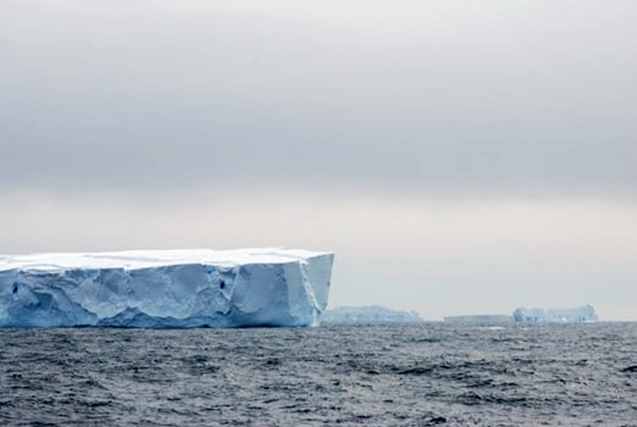
A flotilla of tabular icebergs adrift in the Southern Ocean, near the outlet of the Wilkes Subglacial Basin, East Antarctica. (Christina Riesselman)
Temperatures not much warmer than the planet is experiencing now were sufficient to melt a major part of the East Antarctic ice sheet in Earth’s past, scientists reported Wednesday, including during one era about 125,000 years ago when sea levels were as much as 20 to 30 feet higher than they are now.
“It doesn’t need to be a very big warming, as long as it stays 2 degrees warmer for a sufficient time, this is the end game,” said David Wilson, a geologist at Imperial College London and one of the authors of the new research, which was published in Nature. Scientists at institutions in Australia, New Zealand, Japan and Spain also contributed to the work.
The research concerns a little-studied region called the Wilkes Subglacial Basin, which is roughly the size of California and Texas combined and contains more than 10 feet of potential sea-level rise. Fronted by three enormous glaciers named Cook, Mertz and Ninnis, the Wilkes is known to be vulnerable to fast retreat because the ice here is not standing on land and instead is rising up from a deep depression in the ocean floor.
Moreover, that depression grows deeper as you move from the current icy coastline of the Wilkes farther inland toward the South Pole, a downhill slope that could facilitate rapid ice loss.
What the new science adds is that during past warm periods in Earth’s history, some or all of the ice in the Wilkes Subglacial Basin seems to have gone away. That’s an inference researchers made by studying the record of sediments in the seafloor just off the coast of the current ice front.
Here, they found several layers of sediments that appeared to come from beneath where the ice currently lies, providing a hint that when these layers of the seafloor were laid down, Wilkes contained either less ice or no ice at all.
Those sediments corresponded in time to several well-known past warm periods, when seas rose considerably. But what’s worrying is that these eras were in many cases not much warmer than the planet already is right now.
The shape of the bedrock beneath Antarctica, showing the very deep Wilkes Subglacial Basin, using data from the Bedmap2 project. (Stewart Jamieson/Durham University).
Humans have caused about 1 degree Celsius (1.8 degrees Fahrenheit) of warming above the preindustrial planetary temperatures experienced before the year 1880 or so. The world has pledged to avoid a warming above 2 degrees Celsius, and even hopes to hold the warming to 1.5 degrees, but current promises made by countries are not nearly enough to prevent these outcomes.
In other words, we are already on a course that could heat the planet enough to melt some or all of the Wilkes Basin.
“We say 2 degrees beyond preindustrial, and we’re already beyond preindustrial,” Wilson said. “So this is potentially the kinds of temperatures we could see this century.”
The study cannot reveal, however, just how quickly ice emptied out of the Wilkes Basin. The past warm periods in question are thought to have been driven by slight variations in Earth’s orbit as it rotates around the sun, leading to stronger summer heat. That warmth was maintained for thousands of years.
“What we definitely can say is that during the [geological] stages where temperatures were warm for a couple of degrees for a couple of millennia, this is where we see a distinct signature in our records,” Wilson said. “We can’t necessarily say things didn’t happen quick, but we can’t resolve that in our data.”
The new research “contributes to the mounting pile of evidence that East Antarctica is not as stable as we thought,” Isabella Velicogna, a glaciologist at the University of California at Irvine, said by email. Velicogna was not directly involved in the paper.
“What I found particularly interesting is that the authors came to their conclusions using a data record off shore, not directly beneath the ice (which would be ideal), but this is clearly putting more incentive into studying this part of East Antarctica in more detail,” she wrote.
“The only way to obtain unequivocal evidence of the ice sheet retreat they describe is to drill through the ice sheet itself into the basin,” added Reed Scherer, an Antarctic expert at Northern Illinois University. “Until that gets done, this study from just offshore provides the clearest evidence yet that marine terminating glaciers of both East and West Antarctica are at risk for the future as global temperatures rise.”
The new research comes just as the U.S. and British governments prepare to launch a multiyear research project to study Antarctica’s huge and remote Thwaites glacier, which is in West Antarctica and is viewed as the largest risk to coastlines in this century.
The situations of Thwaites and Wilkes are eerily similar — both feature enormous amounts of ice resting on the seafloor, rather than on land, and downward slopes that create what scientists call a “marine ice sheet instability.” And both contain enough ice to unlock 10 feet or more of sea-level rise.
Thwaites is “sitting in a very unfortunate spot … resting over some of the deepest bedrock in West Antarctica,” Ted Scambos, a senior research scientist at the National Snow and Ice Data Center in Boulder, Colo., said at a planning event at Columbia University on Wednesday.
The new study suggests that Thwaites is the beginning, not the end, of our worries. One key difference, though, is that Thwaites is already losing 50 billion tons of ice per year, whereas the Wilkes region appears to be relatively unchanged for now, according to Wilson.
But it may simply be that while the world is already warm enough to awaken West Antarctica, just a bit more warmth will cause the same to happen to parts of the much larger East Antarctic ice sheet. That would not only explain a lot about the link between past sea levels and past temperatures in Earth’s history — it would further illuminate the future we’re heading toward.

Links

Why Australia Is Heading For Epic Failure On Carbon Emissions

New Daily

Under current policies Australia will miss its Paris commitments by 21 percentage points. Photo: Getty
Since replacing Malcolm Turnbull a month ago, Prime Minister Scott Morrison has seemingly taken climate change mitigation off the policy table altogether.
His new energy minister, Angus Taylor, says carbon emissions don’t matter because we’re already on track to meet our Paris Agreement targets “without interventions” – a claim that The New Daily debunked here.
Given the Morrison government’s dropping of any pretence of a climate policy, The New Daily thought it worth taking a thorough look at exactly how Australia is doing on the greenhouse gas emissions front.
We asked three simple questions: What are Australia’s greenhouse gas emissions? Who or what is responsible for them? And how are we planning to reduce them?
The answers were surprisingly easy to find. They were all contained in this 40-page document from Mr Taylor’s own department, the Department of Environment and Energy. It made for grim reading.
In summary: Australia released 554 million tonnes of carbon dioxide and other greenhouse gases last year, and that’s set to go up, not down, by 2030; the single biggest contributor to this is coal-fired electricity generation, with car exhaust fumes and cow belches not far behind; and as things stand we are doing very little at a national level to deal with this dire problem.

The four main culprits
The government highlights eight main sources of greenhouse gas emission, all listed in the chart below. For simplicity’s sake we’ll concentrate on the four biggest ones: electricity generation, direct combustion, transport and agriculture.


Electricity generation
Electricity generation is by far the biggest contributor to Australia’s greenhouse gas emissions, and as the graphic below shows, coal is by far the biggest resource used to generate electricity.
In 2017 electricity generation accounted for 190 Mt CO2-e. That’s 34 per cent of total greenhouse gas emissions.
(Side note: Mt CO2-e means million tonnes of carbon dioxide or equivalent measure of greenhouse gases. Other greenhouse gases include methane, nitrous oxide, chlorofluorocarbons (CFCs) and hydrofluorocarbons (HFCs).
Given solar, wind and hydro are emissions free, the vast bulk of that 190 million tonnes comes from gas, liquid fuel and, above all, coal.

The Rudd-Gillard Labor government introduced two key policies that significantly reduced emissions from the electricity sector: the Renewable Energy Target (RET) and the carbon tax.
The closure of the Hazelwood coal-fired power station and the planned closure of the Liddell coal-fired power station in 2022 will also push emissions down.
However, the Coalition scrapped the carbon tax, and will not renew the RET when it expires in 2020. So after Liddell closes, there are no policies or events that will further reduce emissions in the sector.
Malcolm Turnbull’s National Energy Guarantee would have forced electricity generators to reduce their emissions, but Mr Morrison has already dropped that policy.
As a result, the COAG Energy Council predicts the sector is now on track to miss its 2030 target of a 26 to 28 per cent emissions reduction on 2005 levels.

A strange aspect of all this …
This brings up an important point. Under the Paris Agreement, the Coalition government agreed to reduce greenhouse gas emissions by 26 to 28 per cent on 2005 levels by 2030 – across the entire economy.
The electricity sector is by far the biggest emitter in the economy, and one in which emissions can be quite easily reduced. However, the government has only ever aimed to reduce emissions in this sector by that same figure, 26 to 28 per cent.
Given the success of previous measures, a more aggressive renewables policy, for example, combined with a NEG-style policy or even an emissions trading scheme or carbon tax, could theoretically push emissions down by much more than the 26 to 28 per cent target.
The electricity sector, in other words, could quite easily do more of the heavy lifting on emissions reduction for the entire economy, if the government decided to make that a priority.

The other three
It would make sense to do this, because as things stand reducing emissions in the transport and agriculture sectors is going to be extremely difficult.
Emissions from both sectors, in fact, are on track to rise significantly. Transport in particular: thanks to the rapidly increasing population, emissions are expected to go from 96 million tonnes of carbon in 2017 to 112 million in 2030.
The federal government formed the ‘Ministerial Forum on Vehicle Emissions’ in 2015, but as yet little solid policy has emerged from it.
Emissions from agriculture come primarily from the methane produced during cows’ and sheep’ digestion processes (we’re talking burps, not farts). Reducing emissions would mean reducing the number of livestock, which would likely be seen as an outright assault on the beef, lamb and dairy industries – not a fight many politicians will want to start.
Emissions from direct combustion – that is, the burning of fossil fuels to heat homes and power industry – is set to decline by 2 per cent between now and 2030. However there does not appear to be any clear national policy to reduce it by any more than this – though there is a lot states can do and are doing in this area.
All of which leaves us where exactly? If we’re to meet even the most modest emissions reduction target of 26 per cent below 2005 levels by 2030, our greenhouse gas emissions should be no more than 437 Mt CO2-e. On current trends they will be 570 Mt CO2-e – just 5 per cent below 2005 levels.
Which means we’re on track to miss our 2030 Paris Agreement targets by a massive 21 percentage points.

Links

Australian Businesses Must Do More To Disclose Climate Change Risks To Investors, ASIC Says

The Guardian

Financial analysts say regulator’s report makes it clear ‘many Australian companies are not meeting their legal requirements’
A vehicle passes through a flooded street. An Asic review found few listed companies outside of the ASX 200 were disclosing climate change risks to their investors. Photograph: STR/AAP 
Australian companies should be doing more to disclose risks to their business from climate change, according to a report by the corporate regulator Asic.
The review, published on Thursday, examined climate risk disclosures by 60 companies in the ASX 300, in 25 recent initial public offering (IPO) prospectuses, and across 15,000 annual reports.
Of the 60 companies, Asic found 17% identified climate change as a material risk to their business.
The regulator said that while most ASX 100 companies had considered the potential risks posed to them by climate change at least to some extent, the practice of disclosing these risks to investors was “considerably fragmented, with information provided to the market in differing forms across a wide range of means of disclosure”.
“In some cases, the review found climate risk disclosures to be far too general, and of limited use to investors,” Asic said in a statement.
The review found few listed companies outside of the ASX 200 were disclosing climate risks to their investors.
Discussion of climate change in annual reports had also gone backwards, particularly for companies outside the ASX 100.
It found the percentage of annual reports of all listed companies that contained climate change-related content had fallen from 22% in 2011 to 14% in 2017.
“Climate change is a foreseeable risk facing many listed companies in the Australian market in a range of different industries,” the Asic commissioner John Price said.
“Directors and officers of listed companies need to understand and continually reassess existing and emerging risks (including climate risk) that may affect the company’s business – for better or for worse.”
He said climate change disclosure practices were still evolving and Asic would “monitor market practice as it continues to evolve and develop in this area”.
But financial analysts said the report highlights problems with Australia’s generic risk disclosure laws for companies and the understanding of how they apply to climate change.
“It shows there’s a difference between what Asic says the laws say and what companies are doing,” said Will van de Pol, a campaigner at Market Forces.
“It’s clear from this report and our financial research that many Australian companies are not meeting their legal requirements.
“It means that investors are being left in the dark about the risk to the companies that they own from climate change.”
He said it was up to investors to demand detailed risk disclosure from companies and for the regulator to take action against companies that failed to meet disclosure requirements.
Dan Gocher, director of climate and environment at the Australasian Centre for Corporate Responsibility, said the results in the review suggested mandatory reporting of climate risks might need to be considered.
“In the absence of that, this is the result,” he said. “It points to a systemic issue. Without mandatory reporting from Asic it will require a cultural change.”
He said investors should be taking action against companies that weren’t making progress.
“We’re suggesting they used the tools that they’ve got and the only ones are voting against directors and voting against remuneration,” he said.

Links

20/09/2018

Planet At Risk Of Heading Towards “Hothouse Earth” State

Stockholm Resilience Centre

Keeping global warming to within 1.5-2°C may be more difficult than previously assessed
A study published in Proceedings of the National Academy of Sciences shows that there is a risk of Earth entering “Hothouse Earth” conditions where the climate in the long term will stabilize at a global average of 4-5°C higher than pre-industrial temperatures and sea level 10-60 m higher than today. Photo: rudy_ath/Wikimedia Commons
Story highlights
  • Even if the carbon emission reductions called for in the Paris Agreement are met, there is a risk of Earth entering what the scientists call “Hothouse Earth” conditions
  • A “Hothouse Earth” climate will in the long term stabilize at a global average of 4-5°C higher than pre-industrial temperatures with sea level 10-60 m higher than today
  • Maximizing the chances of avoiding a “Hothouse Earth” requires not only reduction of carbon dioxide and other greenhouse gas emissions but also enhancement and/or creation of new biological carbon stores
An international team of scientists has published a study in Proceedings of the National Academy of Sciences (PNAS) showing that even if the carbon emission reductions called for in the Paris Agreement are met, there is a risk of Earth entering what the scientists call “Hothouse Earth” conditions.
A “Hothouse Earth” climate will in the long term stabilize at a global average of 4-5°C higher than pre-industrial temperatures with sea level 10-60 m higher than today, the paper says.
The authors conclude it is now urgent to greatly accelerate the transition towards an emission-free world economy.
"Human emissions of greenhouse gas are not the sole determinant of temperature on Earth. Our study suggests that human-induced global warming of 2°C may trigger other Earth system processes, often called “feedbacks”, that can drive further warming - even if we stop emitting greenhouse gases," says lead author Will Steffen from the Australian National University and Stockholm Resilience Centre.
"Avoiding this scenario requires a redirection of human actions from exploitation to stewardship of the Earth system.”
Currently, global average temperatures are just over 1°C above pre-industrial and rising at 0.17°C per decade.
Places on Earth will become uninhabitable if “Hothouse Earth” becomes the reality
Johan Rockström, co-author
Places on Earth will become uninhabitable
The authors of the study consider ten natural feedback processes, some of which are “tipping elements” that lead to abrupt change if a critical threshold is crossed. These feedbacks could turn from being a “friend” that stores carbon to a “foe” that emits it uncontrollably in a warmer world.
These feedbacks are: permafrost thaw, loss of methane hydrates from the ocean floor, weakening land and ocean carbon sinks, increasing bacterial respiration in the oceans, Amazon rainforest dieback, boreal forest dieback, reduction of northern hemisphere snow cover, loss of Arctic summer sea ice, and reduction of Antarctic sea ice and polar ice sheets.
"These tipping elements can potentially act like a row of dominoes. Once one is pushed over, it pushes Earth towards another. It may be very difficult or impossible to stop the whole row of dominoes from tumbling over. Places on Earth will become uninhabitable if “Hothouse Earth” becomes the reality," warns co-author Johan Rockström, former executive director of the Stockholm Resilience Centre and incoming co-director of the Potsdam Institute for Climate Impact Research.
Hans Joachim Schellnhuber, Director of the Potsdam Institute for Climate Impact Research, says, "We show how industrial-age greenhouse gas emissions force our climate, and ultimately the Earth system, out of balance. In particular, we address tipping elements in the planetary machinery that might, once a certain stress level has been passed, one by one change fundamentally, rapidly, and perhaps irreversibly. This cascade of events may tip the entire Earth system into a new mode of operation.”
“What we do not know yet is whether the climate system can be safely 'parked' near 2°C above preindustrial levels, as the Paris Agreement envisages. Or if it will, once pushed so far, slip down the slope towards a hothouse planet. Research must assess this risk as soon as possible."

Global map of potential tipping cascades. The individual tipping elements are color-coded according to estimated thresholds in global average surface temperature (tipping points; 18,43). Arrows show the potential interactions among the tipping elements, based on expert elicitation, which could generate cascades. Note that although the risk for tipping (loss of) the East Antarctic Ice Sheet is proposed at >5 degrees Celsius, some marine-based sectors in East Antarctica may be vulnerable at lower temperatures.
Cutting greenhouse gases is not enough
Maximizing the chances of avoiding a “Hothouse Earth” requires not only reduction of carbon dioxide and other greenhouse gas emissions but also enhancement and/or creation of new biological carbon stores, for example, through improved forest, agricultural and soil management; biodiversity conservation; and technologies that remove carbon dioxide from the atmosphere and store it underground, the paper says.
Critically, the study emphasizes that these measures must be underpinned by fundamental societal changes that are required to maintain a “Stabilized Earth” where temperatures are ~2°C warmer that the pre-industrial.
"Climate and other global changes show us that we humans are impacting the Earth system at the global level. This means that we as a global community can also manage our relationship with the system to influence future planetary conditions. This study identifies some of the levers that can be used to do so," concludes co-author, Katherine Richardson from Center for Macroecology, Evolution and Climate at the University of Copenhagen.

Links

What Do Gen X And Gen Y Worry About Most? Climate Change

University of Melbourne - Julia Cook | Hernán Cuervo | Jenny Chesters

Climate change is their number one cause for concern and they aren’t impressed by government efforts to tackle environmental challenges
Takver/Flickr
Two generations of Australians believe one of the most important issues facing the country right now is climate change.
The latest Life Patterns report by the University of Melbourne shows that many members of both Gen X and Gen Y see climate change as Australia’s most significant and urgent issue.


For many members of Gen X and Gen Y in Australia, climate change is the most pressing issue facing the country. Picture: Takver/Flickr
While people in Gen X are worried specifically about what climate change will mean for their own children, those in Gen Y are generally more concerned about the impact of climate change on future generations.
Generally, when many of us think about the issues that concern us we commonly focus on things that impact upon our day-to-day lives. But, when we asked Australians from the two generations to nominate the three most important issues facing the nation, many set aside individual concerns, turning instead to a collective, global issue.
The Life Patterns study is a two-decade project following two groups of Australians since they left school – one now aged 44-45 that left school in 1991 (our ‘Gen X’ cohort) and another now aged 29-30 that left school in 2006 (our ‘Gen Y’ cohort).
It aims to provide a holistic understanding of the ways in which young (and not-so-young) Australians are responding to our rapidly changing world.

Climate change and the future
Many of the older participants say their concerns for the environment are linked directly to their worries over the future their children could face.
One mother from rural Victoria states: The uncertain climate-change reality is an enormous concern for me regarding my children’s future.
Members of the younger group have similar concerns. One female participant working in administration and management in Melbourne says: [We need to] make sure as a generation we minimise our environmental footprint and contribute to leaving this planet in way that supports future generations.


For Gen X in particular, their concerns about the environment relate to how their children will fare in a climate change future. Picture: Getty Images
This subtle difference is grounded in specifically who they are concerned about.
The older group is generally more worried about the impact of environmental issues on their own children, while the younger cohort worry about the impact on future generations more generally.

Putting climate change on the agenda
However, while specific views of what actually needs to be done varies, participants from both groups consistently expressed grave concerns about the general lack of action towards climate change mitigation from the current government.
A man in the Gen X group who is married with one child and living in Melbourne writes: Government inaction on climate change in this country is a crying shame. Look at what they are doing in terms of addressing climate change in California, in Germany, in Scandinavia, even in China. But here, it’s all too hard apparently.
Similarly, a woman in the Gen Y group living with her partner in regional NSW says: I’m concerned about the environment and the lack of action by government to fix problems.

On a more personal note…
Job security, drug abuse and housing affordability came in as issues number two, three and four for the younger cohort.
In contrast, the older cohort ranked these issues far below cost of living, which came in at number two, followed closely by security/terrorism, politics/government, the economy and education.


The environment was the most important issue for both the Gen X and the Gen Y cohorts in the latest Life Patterns report. Picture: Supplied
These differences can be explained in large part by differing life stages.
At the age of 28 or 29, many younger participants who are looking to settle down and start a family are confronted with increasingly difficult property and job markets. But, at the age of 43 or 44, the older participants who have already started a family are dealing with the everyday expenses associated with education and childcare.
So, Gen Y participants are concerned primarily with issues around their ability to access the resources they feel they need for a worthwhile life, while Gen X participants are more concerned about issues directly relating to social stability.
A member of the younger group living in Sydney says: I have a Master’s degree and my wife is well paid, we are not in a position to buy a home near Sydney in the next five to eight years. No matter how hard we try and save, the goalposts keep shifting and so too the dream of raising a family in a home of our own.
In contrast, a member of the older group living in Canberra with his wife and two children says: Economic policies in Australia are failing to support local productivity and creating uncertainty and instability.
For the most part, as much as these perspectives provide a snapshot of contemporary Australia, they also reflect two generations’ different life stages.
But in a world where we usually only hear about the generational divide – climate change and its future impact for the environment is a pressing concern shared by young and not-so-young Australians.

The Life Patterns study has been supported by a number of grants from the Australian Research Council.

Links

Lethal Heating is a citizens' initiative