04/12/2018

Children Demand Climate Change Action Through Protests And Lawsuits

Christian Science Monitor - Lin Taylor | Reuters

Though children are too young to vote, they're finding ways to take action in other ways: In Australia, thousands of students skipped class Nov. 30 to protest the government's climate policies, and in the US and Canada, groups of young people are suing their governments.
Thousands of students gather in Sydney during a rally demanding the government act on climate change. The coordinated rallies were held in close to 30 cities and towns on Nov. 30, 2018. Dan Himbrechts/AAP Image/AP
Skipping school, marching on the streets, and suing governments, children who are too young to vote are demanding more action on climate change, as world leaders gather at a major UN summit in Poland this week.
"We will be the main victims of climate change. It will be our generation who suffer the consequences," said Sydney student Aisheeya Huq, 16, who skipped school on Nov. 30 to protest, along with tens of thousands of children across Australia.
The nationwide strikes were inspired by 15-year-old Stockholm student Greta Thunberg, who misses school every Friday to demonstrate outside Sweden's parliament. She plans to do so until the country reaches its ambitious goals to curb carbon emissions.
"It's amazing that kids are protesting and they are making their voices heard. This is our last chance, we can't mess this up," Ms. Thunberg told the Thomson Reuters Foundation.
Youth-led climate organizations and actions are springing up around the globe. Their desire for change stems from personal experience of and worry about climate change, as well as a desire to hold their governments to account, their members say.
Half the world's population is now under 30 years old, and are increasingly vocal on political and social issues, with climate change the biggest concern for youths from 180 countries, according to a 2017 World Economic Forum survey.

Ambitious climate pledges
The 2015 Paris Climate Agreement pledged countries to shift the world economy away from fossil fuels and limit the rise in global temperatures to avert more extreme weather, rising sea levels, and the loss of plant and animal species.
The United States has since said it will withdraw from the deal.
Global leaders will meet in Poland from Dec. 2 to Dec. 14 to produce a "rule book" on how to reach these targets and implement the 2015 Paris deal agreed by nearly 200 nations.
Australia, one of the largest carbon emitters per capita, has vowed to lower emissions by 26 percent from 2005 levels by 2030, a figure that new prime minister Scott Morrison said his administration would not revise.
Rebuking the school walkouts, Mr. Morrison said in parliament on Dec. 3 that there should be "more learning in schools and less activism" on climate change.
Global temperatures are on course for a rise of 3 degrees to 5 degrees Celsius (5.4 degrees to 9 degrees Fahrenheit) this century, far overshooting a global target of limiting the increase to 2 Celsius or less, the United Nations World Meteorological Organization said Nov. 29.
Scientists say meeting a 1.5 Celsius target would keep the global sea level rise 3.9 inches lower by 2100 than a 2 Celsius target, which could give people living on the world's coasts and islands time to adapt to climate change.

Lawsuits launched by young people
The climate projections have prompted some young people to sue their governments.
"Not taking action on something that you recognize is dangerous is a violation of our rights, because we have the right to live," said 17-year-old student Bernadette Veilleux-Trinh, part of a group that is suing the Canadian government.
Official data regularly shows that Canada has little chance of meeting its climate change goals of reducing emissions by 30 percent from 2005 levels by 2030.
ENvironnement JEUnesse, the organization that launched the class action on behalf of under-35s in Quebec province on Dec. 3 said the Canadian government must do more.
"I really feel like this is an emergency for all of us. Words are really not enough when it comes to climate change," said Catherine Gauthier, head of the Montreal-based youth climate advocacy group.
Across the border in the United States, the second largest contributor of carbon emissions after China, 21 children and young adults are also taking the government to court.
The group, with ages between 8 and 19 when the lawsuit was filed in 2015, accused federal officials and oil industry executives of violating their due process rights by knowing for decades that carbon pollution poisons the environment but doing nothing about it.
“These are people who are put in office to work for the general public, but they keep taking actions that are directly linked to worsening climate change,” said Oregonian Avery McRae, 13, who is one of the plaintiffs.
President Trump, who vowed to withdraw from the Paris deal, has argued the accord would hurt his nation's economy and provide little tangible environmental benefit.
Mr. Trump and some cabinet members have repeatedly cast doubt on climate change science, despite a recent government report projecting that climate change will cost the US economy hundreds of billions of dollars by the end of the century.
“I am worried about my future. The future is what I’m fighting for. This is a global movement, and we need everyone on board,” Ms. McRae said.

Links

Climate Change: 'World At Crossroads' Warning As Key Talks Begin

BBC - Matt McGrath


Climate change: How 1.5C could change the world

Four senior figures behind efforts to limit climate change have warned that the planet "is at a crossroads" as key talks opened a day early in Poland.
In a rare move, four former presidents of the United Nations-sponsored talks called for decisive action.
The meeting in Katowice is the most critical on climate change since the 2015 Paris agreement.
Experts say that drastic cuts in emissions will be needed if the world is to reach targets agreed in Paris.
Negotiators at the COP24 conference convened a day early because they are under pressure to make progress.
Meanwhile, the World Bank has announced $200bn in funding over five years to support countries taking action against climate change.


Climate activist: 'It's high time that Poland phased out coal'

What's so different about this meeting?
This Conference of the Parties (COP) is the first to be held since the landmark Intergovernmental Panel on Climate Change (IPCC) report on limiting global temperature rise to 1.5C came out in October.
The IPCC stated that to keep to the 1.5C goal, governments would have to slash emissions of greenhouse gases by 45% by 2030.
But a recent study showed that CO2 emissions are on the rise again after stalling for four years.
In an unprecedented move, four former UN climate talks presidents issued a statement on Sunday, calling for urgent action.
They say "decisive action in the next two years will be crucial".
"What ministers and other leaders say and do in Katowice at COP24 will help determine efforts for years to come and either bring the world closer to meeting the goals of the Paris Agreement - including protecting those most vulnerable to climate change - or push action further down the road.
"Any delay will only make it harder and more expensive to respond to climate change."
The statement was issued by Frank Bainimarama of Fiji, Salaheddine Mezouar of Morocco, Laurent Fabius of France and Manuel Pulgar Vidal of Peru.
Meanwhile, the gap between what countries say they are doing and what needs to be done has never been wider.
"The IPCC report made crystal clear that every bit of warming matters, especially for the least developed countries," said Gebru Jember Endalew, who chairs the group of poorest nations in the negotiations.
"It also gave some hope by confirming that limiting global warming to 1.5C is still possible. Here in Katowice, we must work constructively together to ensure that goal can become a reality."
In fact, so urgent is the task that some negotiators started their meetings on Sunday, a day before the official start.

Why is Sir David Attenborough attending?
The celebrated broadcaster and naturalist will be sitting in what's termed the "people's seat" at these talks.


'Continuation of civilisation is in your hands,' Attenborough tells world leaders

The idea is for the occupant to represent the millions of people around the world who are being affected by climate change.
At the opening ceremony, politicians will hear Sir David give a speech made up of climate change comments submitted by the public.

Will global leaders be attending?
Yes, some 29 heads of state and government are due to give statements at the opening of the meeting.
The number is way down on the stellar cast that turned up in Paris in 2015, which perhaps indicates that many are seeing this as more a technical stage on the road to tackling climate change than a big bang moment.
But for the likes of China and the EU, the meeting is critical. They will want to show that international co-operation can still work even in the age of President Trump.

How years compare with the 20th Century average
2018

Source: NOAA

So will cutting carbon be the main focus of the meeting?
Rather than spending all their time working on how to increase ambitions to cut carbon, conference delegates are likely to focus on trying to finalise the technical rules of how the Paris agreement will work.

A collage of children's drawing about climate change laid out on a glacier in Switzerland. FABRICE COFFRINI
While the agreement was ratified in record time by more than 180 countries in 2016, it doesn't become operational until 2020.
Before then, delegates must sort out common rules on measuring, reporting and verifying (checking to avoid the misreporting of) greenhouse gas emissions, and on how climate finance is going to be provided.
"The rulebook is the thing that will absorb most of the negotiators' capacity at this year's COP," said Camilla Born, from the climate change think tank, E3G.
"It's no surprise, as agreeing the Paris rules is both technically and politically a complicated task - but it is worth it!"
Right now, that rule book runs to several hundred pages with thousands of brackets, indicating areas of dispute.


But what about limiting emissions?
Under the Paris agreement, each country decides for itself the actions it will take when it comes to cutting carbon. Some observers believe that the changed mood and the urgency of the science will prompt action.
"We are hoping that at COP24, countries will make declarations of how they will raise their ambitions by 2020. This is a very important moment," said Fernanda Carvalho with campaign group WWF.
"Two years is a short time span for that to happen. Countries need to act fast."

Why is the UN process slow-moving?
There is much frustration with the snail-like pace, especially among some campaigners who feel that the scale of the threat posed by rising temperatures hasn't been fully grasped by politicians.
Greta Thunberg, who has refused to go to school in Sweden in protest over climate change, will be attending COP24. HANNA FRANZEN
"Governments across the world have completely failed to protect their citizens," said a spokesperson for Extinction Rebellion, the social movement that pushes for radical change on climate issues.
"Instead, they have pursued quick profit and big business. We need this to change. At COP24, we want to ensure that the focus is not just on getting the technical Paris rulebook as robust as possible, but also that governments do not lose sight of the bigger picture. We are not doing enough."
Others involved in the UN process say that real progress is being made in tackling one of the most complex problems ever faced by the world.
"You have to recognise that things that negotiators and others have worked so hard to put in place are making a real difference," said Achim Steiner, who heads the United Nations Development Programme.
"We have a $300bn renewable energy economy at work today - it's not peanuts, it's an energy revolution that has unfolded on the back of, yes, a sometimes sticky climate negotiation process."

How much of a role will money play in making progress in Poland?
Many developing countries see progress on issues around finance to be critical to moving forward. They have been promised $100bn every year from 2020 as part of the Paris agreement.
Some are sceptical about what they see as foot-dragging and obfuscation by richer countries when it comes to handing over the cash. Negotiators say that moving forward on finance is the lynchpin of progress in this meeting.
"A key finding of the recent IPCC report, and one that has often been overlooked, is that without a dramatic increase in the provision of climate finance, the possibility of limiting warming to 2C (to say nothing of the safer 1.5C goal), will irretrievably slip away," said Amjad Abdulla, chief negotiator for the Alliance of Small Island States.

Are there concerns the meeting is in a country reliant on coal?
Yes - among government negotiators and observers alike. The fact that the conference is taking place in a strong coal region, in a city that is home to the biggest coal company in the EU, is troubling to many.
Poland is highly dependent on coal, getting close to 80% of its electricity from the fossil fuel - and the widespread use of lower quality coal to heat homes, especially in the colder months, leads to smog and respiratory illnesses.
However, the Polish government says that it is sticking with the fuel, and has announced that it is planning to invest next year in the construction of a new coal mine in Silesia.
This bullish approach has drawn condemnation from some.
"We hope that the Polish government will seize this opportunity to embrace and promote a just transition that guarantees that the energy system is transformed while leaving no one behind," said Sébastien Duyck, a senior attorney at the Centre for International Environmental Law.
"Unfortunately, this week's announcement by the [meeting's] Polish presidency that it will include coal companies as sponsors of the COP sends a very worrisome signal before the conference even begins."

Will President Trump and the US feature at all?
Although the US has withdrawn from the Paris agreement, it cannot leave until 2020, so its negotiators have been taking part in meetings and have not obstructed the process. America is expected to participate in COP24.
However, given the President's well known love of coal, it has been reported that the White House will once again organise a side event promoting fossil fuels. A similar event at the last COP provoked outrage from many delegates.

Links

Climate Change: CO2 Emissions Rising For First Time In Four Years

BBC - Matt McGrath

Carbon emissions have not yet peaked in many countries the report says. Getty Images
Global efforts to tackle climate change are way off track says the UN, as it details the first rise in CO2 emissions in four years.
The emissions gap report says that economic growth is responsible for a rise in 2017 while national efforts to cut carbon have faltered.
To meet the goals of the Paris climate pact, the study says it's crucial that global emissions peak by 2020.
But the analysis says that this is now not likely even by 2030.
The report comes days before a major UN climate conference starting in Poland from 2-14 December.

What is the emissions gap?
For the last nine years, UN Environment have produced an assessment of the latest scientific studies on current and future emissions of greenhouse gases.
It highlights the difference between the level of greenhouse gas emissions that the world can sustain to keep temperatures within safe limits, with the levels that are likely based on the promises and actions taken by countries.
This year's report records the largest gap yet between where we are and where we need to be.


Why are emissions rising again?
Between 2014 and 2016, global emissions of CO2 from industry and the production of energy were essentially stable while the global economy grew modestly - but in 2017 these emissions went up by 1.2% pushed along by higher GDP.
While renewable energy sources are booming in countries like India, carbon emissions haven't yet peaked. Getty Images
While the rise might seem small, it needs to be seen in context of efforts to keep global temperatures from rising by more than 1.5C, as recently outlined in a key IPCC report.
According to the UN, to keep the world below that target, global greenhouse gas emissions in 2030 would have to be 55% lower than today.
"There is still a tremendous gap between words and deeds, between the targets agreed by governments worldwide to stabilise our climate and the measures to achieve these goals," said Dr Gunnar Luderer, from the Potsdam Institute for Climate Impact Research and one of the authors of the study.
The scientists say that to tackle the gap, nations must raise their ambition five fold to meet the 1.5C goal.
Right now, the world is heading for a temperature rise of 3.2C by the end of this century the report says.

No peaking?


One key aspect of the study is about the peaking of global greenhouse emissions.
The report says that peaking of emissions in 2020 is "crucial for achieving the temperature targets in the Paris agreement," but the scale of the current efforts is insufficient.
The study says that by 2030, around 57 countries representing about 60% of global emissions will have peaked. Nowhere near where the world needs to be.

Does the report point the finger at countries that are doing badly?
In some ways yes. The study says that countries including Argentina, Australia, Canada, the EU (including the UK), South Korea, Saudi Arabia, South Africa and the US, are falling short of achieving their nationally determined contributions for 2030.
The burning and clearing of forests in Asia contributes hugely to emissions. Getty Images
Three countries, Brazil, China and Japan are currently on track, while three others, India, Russia and Turkey are set to beat their targets.
The authors believe that some of these achievements may be down to setting relatively low targets for their national plans.

Is there any positive news in the report?
Undoubtedly, yes.
The UN is placing great hopes in what it terms "non-state actors", meaning local, city and regional governments, businesses and higher education institutions can have major impacts on the future gap.
They estimate that, right now, more than 7,000 cities from 133 countries and 6,000 companies with at least $36 trillion in revenue have pledged to take climate action.
But the authors believe this is just scratching the surface. With over 500,000 publicly traded companies worldwide, there are many more that can take steps that cumulatively would have a significant impact on the gap.
The study says that there is the potential to cut emissions from this sector by 19 gigatonnes of CO2 equivalent per year by 2030 - that's enough to keep the world on a 2 degree path.

The future is fiscal?
The report also suggests that government tax plans could be hugely important in tackling emissions.
It says that carbon taxes or carbon trading systems cover only 15% of the global carbon output, which could rise to 20% if China implements its planned market. But the report says that half of the emissions from fossil fuels are not taxed at all and only 10% are priced at a level consistent with keeping warming to 2C.
Subsidies for fossil fuels like coal will have to be phased out to meet climate targets. Getty Images
"When governments embrace fiscal policy measures to subsidise low-emission alternatives and tax fossil fuels, they can stimulate the right investments in the energy sector and significantly reduce carbon emissions," said Jian Liu, UN Environment's chief scientist.
"If all fossil fuel subsidies were phased out, global carbon emissions could be reduced by up to 10% by 2030. Setting the right carbon price is also essential. At $70 per tonne of CO2, emission reductions of up to 40% are possible in some countries."

What happens now?
This report is aimed at informing delegates to next week's key climate conference in Katowice, Poland. Negotiators will be trying to finish the rules on how to implement the rule book of the Paris agreement - but the report's authors hope it can push countries to greater levels of ambition.
"Germany and Europe could demonstrate leadership in this area by pledging complete greenhouse gas neutrality by 2050 and a clear strengthening of the emission reduction targets for 2030," said Dr Gunnar Luderer.

Links

Climate Change: Where We Are In Seven Charts And What You Can Do To Help

BBC - Nassos Stylianou | Clara Guibourg | Daniel Dunford | Lucy Rodgers


Getty Images
Representatives from nearly 200 countries are gathering in Poland for talks on climate change - aimed at breathing new life into the Paris Agreement.
The UN has warned the 2015 Paris accord's goal of limiting global warming to "well below 2C above pre-industrial levels" is in danger because major economies, including the US and the EU, are falling short of their pledges.
But scientists at the Intergovernmental Panel on Climate Change (IPCC) - the leading international body on global warming - last month argued the 2C Paris pledge didn't go far enough. The global average temperature rise actually needed to be kept below 1.5C, they said.
So how warm has the world got and what can we do about it?

1. The world has been getting hotter
The world is now nearly one degree warmer than it was before widespread industrialisation, according to the World Meteorological Organization (WMO).
The global average temperature for the first 10 months of 2018 was 0.98C above the levels of 1850-1900, according to five independently maintained global data sets.
How years compare with the 20th Century average
2018

Source: NOAA
The 20 warmest years on record have been in the past 22 years, with 2015-2018 making up the top four, the WMO says.
If this trend continues, temperatures may rise by 3-5C by 2100.
One degree may not sound like much, but, according to the IPCC, if countries fail to act, the world will face catastrophic change - sea levels will rise, ocean temperatures and acidity will increase and our ability to grow crops, such as rice, maize and wheat, would be in danger.


2. The year 2018 set all sorts of records
This year saw record high temperatures in many places across the world amid an unusually prolonged period of hot weather.
Large parts of the northern hemisphere saw a succession of heatwaves take hold in Europe, Asia, North America and northern Africa - a result of strong high pressure systems that created a "heat dome".
Over the period shown on the map below (May to July 2018), the yellow dots show where a heat record was broken on a given date, pink indicates places that were the hottest they had ever been in the month shown, and dark red represents a place that was the hottest since records began.

The hottest that this location has ever been...
Tap or click to explore the data
Source: Robert A. Rohde/Berkeley Earth. Map built using Carto

The concern is that such hot and cold weather fronts are being blocked - stuck over regions for long periods - more frequently because of climate change, leading to more extreme weather events.


3. We are not on track to meet climate change targets
If we add up all the promises to cut emissions made by countries that have signed the Paris climate agreement, the world would still warm by more than 3C by the end of this century.

Over the past three years, climate scientists have shifted the definition of what they believe is the "safe" limit of climate change.
For decades, researchers argued the global temperature rise must be kept below 2C by the end of this century to avoid the worst impacts.
Countries signing up to the Paris agreement pledged to keep temperatures "well below 2C above pre-industrial levels and to pursue efforts to limit the temperature increase even further to 1.5C".
But scientists now agree that we actually need to keep temperature rises to below 1.5C.


4. The biggest emitters are China and the US
The countries emitting the most greenhouse gases by quite a long way are China and the US. Together they account for more than 40% of the global total, according to 2017 data from the European Commission's Joint Research Centre and PBL Netherlands Environmental Assessment Agency.

The US's environmental policy has shifted under the Trump administration, which has pursued a pro-fossil fuels agenda.
After taking office, President Donald Trump announced the US would withdraw from the Paris climate change agreement.
At the time, Mr Trump said he wanted to negotiate a new "fair" deal that would not disadvantage US businesses and workers.


5. Urban areas are particularly under threat
Almost all (95%) of cities facing extreme climate risks are in Africa or Asia, a report by risk analysts Verisk Maplecroft has found.
And it's the faster-growing cities that are most at risk, including megacities like Lagos in Nigeria and Kinshasa in the Democratic Republic of Congo.
Some 84 of the world's 100 fastest-growing cities face "extreme" risks from rising temperatures and extreme weather brought on by climate change.


6. Arctic sea ice is also in danger
The extent of Arctic sea ice has dropped in recent years. It reached its lowest point on record in 2012.

Sea ice has been reducing for decades, with melting accelerating since the early 2000s, according to the UK Parliament's Environmental Audit Committee.
The Arctic Ocean may be ice free in the summer as soon as the 2050s, unless emissions are reduced, the committee has said.
The WMO found the extent of Arctic sea ice in 2018 was much lower than normal, with the maximum in March the third lowest on record and the September minimum the sixth lowest.


7. We can all do more to help
While governments need to make big changes - individuals can play a role too.
Scientists say we all have to make "rapid, far-reaching and unprecedented changes" to our lifestyles, in order to avoid severely damaging climate change.
The IPCC says we need to: buy less meat, milk, cheese and butter; eat more locally sourced seasonal food - and throw less of it away; drive electric cars but walk or cycle short distances; take trains and buses instead of planes; use videoconferencing instead of business travel; use a washing line instead of a tumble dryer; insulate homes; demand low carbon in every consumer product.
The single biggest way to reduce your environmental impact on the planet is to modify your diet to include less meat - according to recent studies.

Scientists say we ought to eat less meat because of the carbon emissions the meat industry produces, as well as other negative environmental impacts.
A recent study published in the journal Science highlighted a massive variation in the environmental impact of producing the same food.
For example, beef cattle raised on deforested land produces 12 times more greenhouse gas emissions than those reared on natural pastures.

 Crucially, the analysis shows that meat with the lowest environmental impact still creates more greenhouse gas emissions than growing vegetables and cereal crops in the least environmentally-friendly way.
But as well as altering our diets, research suggests that farming practices need to change significantly to benefit the environment.

Links

03/12/2018

'New Weapon': Courts Offer Hope For Driving Serious Climate Action

Fairfax - Peter Hannam

In the not so far-off future, if your home is flooded by extreme rain or razed by an unseasonable bushfire, the first people to turn up on your property after the emergency crews could be bearing legal documents.
In Australia and around the world, crack teams of lawyers and eminent law schools are systematically exploring available legal options to sue for climate justice - or seeking to create new ones where they don't exist.
Chasing firefighters: How long before legal action takes the lead on climate action?Credit:QFES Media
"The truth is there's a huge number of people about to litigate," said Martijn Wilder, a partner at Baker McKenzie and an author featured in a special issue of The Australian Law Journal devoted to climate change and the law. "What we see all of a sudden is that people are realising litigation is a new weapon."
Describing the need to curb greenhouse gas emissions as "an existential battle", Wilder predicts people will be able to sue for the impacts of climate change and have a good chance of winning. "No doubt it's going to happen - it's inevitable," he says. "Governments have a duty of care, they have a responsibility."

Climate summit starts
Evidence of that care will be on display over the next couple of weeks from Sunday as delegates from the almost 200 nations that signed the 2015 Paris climate accord gather for a UN summit in the Polish city of Katowice.
Australia will be led by Environment Minister Melissa Price, who on Friday released the latest emissions figures showing carbon pollution continues to climb, reaching seven-year highs for the end of the financial year.
Australian emissions by quarter, 2008 to 2018
Source: Department of the Environment and Energy
The meeting also comes days after the World Meteorological Organisation released its state of the global climate report warning the planet was on an emissions trajectory that would lift temperatures as much as five degrees by 2100 versus pre-industrial times.
The year 2018 is likely to be the fourth warmest on record - trailing only the previous trio of years.
Among the key topics of the talks will be settling on the agreed rules for the greenhouse gas cuts promised at Paris ahead of the agreement coming into force in 2020.
"I'm not expecting a train wreck at all but a lot has to be done in little time," Bill Hare, director of tracking group Climate Analytics, tells Fairfax Media from Katowice.
Also of interest will be whether countries that can claim credits for exceeding their pledges during the previous accord, the Kyoto Protocol, can use them to count for the Paris pact that runs to 2030. Australia is one of them.
But besides the bickering over national pledges, businesses, academics and activists will be
busy examining the fast developing field of climate law.
"It'll feature in the backrooms and the siderooms, for sure," Hare says. "We certainly see more and more companies engaging with this issue."

One thousand cases
And no wonder.
A flurry of legal action is under way in a host of nations, particularly the litigious United States. The UK's Grantham Research Institute on Climate Change and the Environment at the London School of Economics estimates as many as 1000 climate court cases have been tried or are under way.
The Paris Agreement itself has spawned 139 framework laws addressing mitigation (cutting emissions) and adaptation - dealing with the consequences of the climate disruptions experienced and expected in a warmer world.
But perhaps wary of nations keeping their promises - the Paris targets were deliberately non-binding legally to ensure almost all nations signed up - leading legal minds have been busy formulating an alternative use of law.
“In some ways, climate litigation is born out of a certain despair with the current political process," says Matthew Rimmer, professor of  intellectual property and innovation at Queensland University of Technology, adding there has been a "great explosion of different forms".
Rimmer reels off a list of legal avenues from tort, such as public nuisance and negligence, to public trust and consumer and corporations law. He likens the process of probing to the advance of Native Title Law in Australia, where the Mabo decision "was one of many pieces of litigation going on" when it broke though and "was quite transformative”.
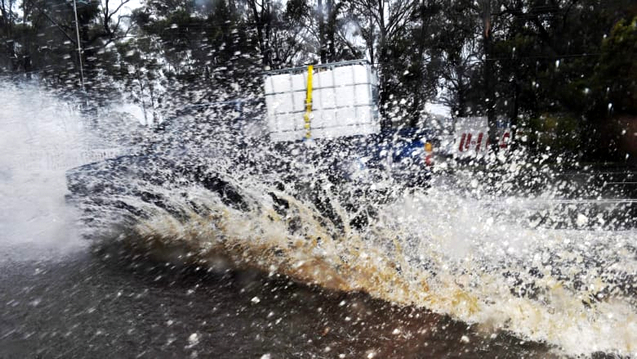
Sydney's 'one-in-a-100 year' rain event this week left a damage bill of at least $10 million. Credit: Nick Moir
Going Dutch
Brian Preston, the chief judge of the NSW Land and Environment Court, has helped lead global efforts to develop legal principles that could  lower the barriers to successful climate litigation with or without a Paris accord.
He highlights perhaps the most famous climate lawsuit to date - the  2015 Urgenda Climate Case in which 886 Dutch citizens sued their government to roughly double emissions cuts - as revealing the pitfalls and the promise of such cases.
For one thing, governments will keep appealing, as Dutch authorities have done again in November.  The fact most environmental law is based in statute now, such as protecting clean air and clean water, also limits the roll-out of similar Urgenda cases in places such as Australia, Preston says.
"That makes it more difficult, like the Lord of the Rings - to get one ring that solves it all - because it’s all going to be statute specific," he says. Australia's lack of bill of rights also curbs Urgenda's applicability here.
Preston has seen firsthand a pushback from US lawyers in the past year,  in part inspired by the Trump presidency's backing of the fossil fuel industry, against development of a "model statute" for the International Bar Association.
That statute was designed to “find what the barriers are to successful litigation in various jurisdictions and then lower those barriers, but that hasn’t yet to come to light” because American lawyers blocked it, he says.
”They saw a wave of litigation, and said, 'we don’t want to encourage it',” he says, adding he was "annoyed" at the intervention after working on the model for almost three years.

Cautionary tales
Preston says the examples of tobacco and asbestos - where legal operations were later found to be harmful and subject to damage claims - offer what should be cautionary tales for fossil fuel firms.  “They keep looking at what is the liability risk today but that’s not what it should be - it should be the risk in the future."
With asbestos, the court never proceeded with 100 per cent certainty but rather probability. Likewise, the fast-developing science of climate change attribution, which can ascertain the odds of an extreme weather event happening without human-induced carbon emissions.
"Attribution science is making more probable that we will have this event,” such as severe flooding or heatwaves, Preston says. “Therefore, you can get the link from greenhouse gas emissions to harm here by probabilistic reasoning."
Emma Herd, chief executive officer of the Investor Group on Climate Change, says international pressures are already nudging corporate behaviour, as the Task Force on Climate-Related Financial Disclosures.

'Obligations'
Lawsuits at home, such as against industry super fund REST, are also similarly raising the accountability stakes.
REST is facing claims it breached its trustee duties by failing to properly factor climate change-related risks into its investment decisions.
Herd recalls arguing with one director "with an engineer background" who defiantly argued that "the climate had always changed" said he "didn't believe the science".
Despite personal reservations, however, this director "nevertheless recognised the company had obligations" to identify its exposure to fossil fuel and climate risks, and to disclose them, she says.
"There's a clear market demand for increased disclosure," Herd says. "It's happening faster than people anticipated."
Tania Constable, chief executive of the Minerals Council of Australia, said her organisation "expects member companies to comply with all disclosure requirements under Australian law and international law where applicable".
"Our member companies are not only aware of this issue, but are taking action to mitigate risks," she says.

'Chill factor'
Jacqueline Peel, a professor of environmental law at Melbourne University, says "eventually governments will realise the policies they have in place are anachronistic compared to where companies are".
Barriers to Australian climate action include the fact that, unlike in the US, plaintiffs can be up for the government's legal costs as well as their own if they lose. “It’s a real chill factor on litigation,” Peel says.
Kelly O’Shanassy, chief executive of the Australian Conservation Foundation, knows that issue well, with her organisation slapped with overall costs of $230,000 for its 2015 failed challenge and appeal against the Adani coal mine in Queensland. (The mine said this week it would proceed by self-funding after banks baulked.)
“Even big not-for-profit organisations like ACF struggle to mount public interest cases as they often push the boundaries of the financial risk a responsible board can tolerate," O'Shanassy says. 

ACT takes advice
Among Australian jurisdictions,  Victoria has the most detailed climate change legislation after passing an act last year that locks in a goal of net zero emissions by 2050 and requires five-yearly reviews of progress.
The ACT, meanwhile, wants to examine ways it can lower barriers to climate litigation that could involving the territory undertaking lawsuits of its own for damages and other remedies. (See more detail here.)
"I've asked my department about what options are available," Shane Rattenbury, climate minister in the Labor-Greens government, says.
He's particularly angered by the way fossil fuel companies, such as Exxon in the US, have been revealed to have behaved. "They knew about climate change all along, they buried the science, they fought hard to prevent it being released, and they kept selling their health-damaging products," he says.
Exxon has been involved in a number of legal actions, including a case brought by New York’s attorney-general in October, which claims the company defrauded shareholders by downplaying the risks of climate change to its business, the New York Times has reported.
Melbourne University's Peel, meanwhile, says it's notable that a significant proportion of recent cases has been brought by young people, whether by children in the US or a law student in New Zealand.
In echoes of the mass protests of students this week demanding governments lift their climate game, the actions suggest "they can see pretty clearly that it’s their future" on the line, she says.
“Litigation has the appeal of action and fighting for their rights," Peel says. "These ideas motivate them a lot.”

Links

The Climate Apocalypse Is Now, And It’s Happening To You

Wired - 

David Paul Morris/Bloomberg
What people say they know about climate change is a roller coaster of human ignorance—wait, everyone knows that but no one knows that? It’s striking to learn (according to Yale’s climate survey program) that 74 percent of women and 70 percent of men believe climate change will harm future generations of humans, but just 48 and 42 percent, respectively, think it’s harming them personally.
It is, of course, in lots of ways. Yet fewer than half of Americans think climate change is a right-here, right-now problem. So it’s critical that a new report on the impact of climate change is about the present as much as the future. The topline results: 157 million more people experienced a heat wave in 2016 than in 2000—12.3 million Americans. That heat and the injuries that can come from it cost the world 153 billion hours of labor—1.1 billion in the US. The geographic range of the mosquitoes that carry dengue fever, Zika, malaria, and chikungunya is spreading. So is the range of the bacterium that causes cholera. Global crop yield is going down.
You’re like, old news! But you might be thinking of last week’s apocalyptic climate-is-broken report. That was volume 2 of the fourth National Climate Assessment. Today’s red alert is the 2018 Lancet Countdown, a British medical journal’s annual accounting of how climate change affects public health.
Some confusion here would be understandable. What both reports have in common (along with the Intergovernmental Panel on Climate Change’s October report on a 1.5-degree planetary temperature increase) is immediacy. These reports are designed to show climate change happening now, today—and to actually spur people to do something about it. How? Show them how climate change affects them personally, and describe those effects in ways that transcend their politics. Global warming is causing “present-day changes,” the Lancet report says. On a telephone briefing for reporters, Renee Salas, director of emergency medicine at Massachusetts General Hospital and the lead author of the report’s US chapter, described seeing more patients with asthma attacks and heat stress. “Viewing climate change as a public health emergency is literally second nature,” Salas said.
Still, these reports tackle immediacy with different strategies. The Lancet Countdown focuses on health. For NCA4, the approach was a little more subtle. Its hundreds of authors started by considering their audience. The 1990 Global Change Research Act says these quadrennial reports are specifically for the president and congress. Climate change affects the American southwest very differently than the northeast, so breaking regional effects into chapters makes that data more useful for people in congress, who can see specific effects on their districts. (NCA isn’t the only research that does this; you can drill down as far as county-by-county economic effects, if you’re into it.)
Breaking out climate impacts by region and by sector gives the report a potentially wider impact. “The idea is that risks are most salient if they apply to you,” says Robert Lempert, a principal researcher at RAND and an author of the report. “We very much intended it to speak to, call them decision-makers, on many levels—not just the federal government.” Lempert says they were thinking of water management agencies, land managers: the people who write the guidances.
Over the 20 years of the NCA’s life, science has gotten better. So has the thinking about how to tell people about that science in ways they can understand it. Talking about tens of thousands of deaths and tens of billions of dollars can help with that. “Over the last 20 years of doing this, we’ve gotten better at thinking about the economic costs,” says John Furlow, a development and aid expert at Columbia University’s International Research Institute for Climate and Society and an author of NCA4. “And we have more examples.”
Pretty much everyone (even oil companies, but not the president) now understands that burning fossil fuels sends gases into the atmosphere and increases global temperatures. In recent years, climate science has gotten better at attribution, at figuring out more precisely how much of a hurricane, wildfire, or drought was caused by that warming and those gases. “We can see impacts on things that people care about, and that’s leading us to shorter timescales and more concrete examples,” Furlow says. “The science enables us to attribute some things more or less to climate than just to ongoing trends, and to parse the way those things interact.”
The Lancet report attempts much the same kind of grounding in individual experience. Carbon dioxide counts in parts-per-million and error margins on global circulation models aren’t the most intuitive ways to talk about the end of the world. Abstract numbers and distant-future scenarios don’t cut it. “Today’s babies, by adulthood, will live on a planet without an Arctic. Prevalence of heatstroke and extreme weather will have redefined global labour and production beyond recognition,” as an editorial accompanying the report puts it. “Multiple cities will be uninhabitable and migration patterns will be far beyond those levels already creating pressure worldwide.” Cats and dogs living together; mass hysteria. Your planet’s on fire, kids.
But how all this immediacy and personalization will actually work might depend on how immediate the issue is, and who the person is. “Most of the mitigation decisions are taken at the federal and state level. Or in principle they are; maybe not at the moment at the federal level,” says Robert Kopp, director of the Institute of Earth, Ocean, and Atmospheric Scientists at Rutgers University and another author of the National Climate Assessment. “But the adaptation decisions are taken at all levels, perhaps more at the local level than anywhere else.”
The Lancet report is full of straightforward policy recommendations, like “cut carbon emissions, dummies.” By law, the NCA can’t do that. “We were perhaps a little more conscientious about that this time, because we didn’t want there to be anything in there that would cause the administration to try to kill the report,” Furlow says. “Given the administration’s history on climate—calling it a hoax and everything—I think there was concern we might have trouble getting it out the way it was written.” (That doesn’t seem to have been the case; all the authors I’ve talked to say that the executive branch didn’t interfere with its contents.)
But the NCA can (and does) tailor its analyses to the people who might best put them into effect. Lempert’s chapter on adaptation, for example, leverages the basic assumptions of a civil engineer. “In some sense the structure of the chapter is to try and get them to do things,” he says. Past climate no longer predicts the present or the future—that idea is what scientists call stationarity, and it’s pretty much dead. The planet’s past performance is no longer a predictor of future results. So if engineers have been making infrastructure assumptions (sea wall height, 100-year flood levels, days of the year above a certain temperature), well, they should probably not do that. How they feel about climate change as a political issue doesn’t matter. “Even in the red parts of Florida, people will vote for bond issues to raise the water treatment plants, and let’s not talk about why,” Lempert says.
Engineers won’t be these reports’ only users. Consider lawyers. The NCA is, after all, a government report acknowledging the damage caused by climate change. So it might be evidence in lawsuits against climate emitters. “We used the last assessment for that purpose and this is even stronger,” says Steve Berman, managing partner at Hagens Berman Sobol Shapiro, a firm involved in a few of those lawsuits. “It also takes away a lot of the oil industry argument that this science is still nascent, and that no one is really certain there will be all of these impacts.”
Those lawsuits happened because cities, states, and environmental groups didn’t feel like they were getting results from the executive or legislative branches. So far, the executive seems to be disregarding NCA4. But in January the Democrats take over the House of Representatives, and some of them have been agitating for climate action. “This is a powerful piece of artillery for any legislator who is interested in advocating for action,” says Michael Burger, executive director of the Sabin Center for Climate Change Law at Columbia Law School. The report might also make it harder for the Trump Administration to weaken EPA rules on carbon dioxide. The EPA under President Obama determined that carbon dioxide was a harmful pollutant that should be regulated under the Clean Air Act, and the NCA reaffirms that conclusion.
None of those things necessarily change any minds. They might not move the needles on the Yale climate survey. But maybe they don’t have to. As the New Yorker writer Osita Nwanevu argued recently on Twitter, denialism isn’t a commonly held position. The real problem is an absence of climate policy. Ideally, the constructions of the IPCC reports, the National Climate Assessment, and the Lancet Countdown won’t just make a policy more obvious, but help clear a path to a policy going into effect. The clock’s ticking.

Links

It Should Not Be Up To Australia's Schoolchildren To Stop Adani

Fairfax - Ebony Bennett*

The Coalition government under Scott Morrison appears to have forgotten the first rule of holes: when you’re in one, stop digging. It’s far too early to describe the Morrison government as terminal; the six months or so till a mooted May federal election is a long time in politics. But the government seems content to write off the message from Liberal voters in Wentworth and Victoria, particularly on climate change, because they do not represent its ‘base’. God only knows where the Liberal base is if it isn’t located in blue ribbon Liberal seats, but who are we to argue?
Coalition government policies under John Howard, Tony Abbott, Malcolm Turnbull and now Scott Morrison have failed to reduce Australia’s greenhouse gas emissions. Australia’s emissions are rising when they should be falling. Worse, the Morrison government appears determined to back policies and projects that will increase emissions and fuel global warming.
There were 114 fires burning across Queensland on Friday. Credit: QFES Media


It was sickening to watch the Minister for Resources and Northern Australia Matt Canavan welcome Adani’s announcement that it was ready to start construction of its mega coal mine before Christmas, at the same time as bushfires raged across Queensland during an unprecedented heatwave.
Mining and burning coal is a major cause of the greenhouse gas pollution that is heating the atmosphere, cooking the Great Barrier Reef and intensifying the extreme weather conditions Queensland is currently experiencing.
For the first time in Queensland’s history, the state’s fire danger warning was raised to ‘catastrophic’, the new category of fire danger that had to be invented following the Black Saturday fires of 2009. It is only five years since the Bureau of Meteorology had to add new colours – deep purple and pink – to indicate temperatures beyond its 50-degree cap. Australia’s extreme heat and fire danger is now literally off the charts.
As far as divine signs to stop burning fossil fuels go, more than a hundred bushfires in Queensland’s tropical north rainforest country during the wet season could not be more obvious. Thousands of residents were given ‘Leave Now’ warnings, with authorities bluntly warning residents who refused to flee that they could "burn to death" and that the firestorm could create "dead man zones" which would be impossible to survive, even in a car. Even on the beach.
“I'm sure that some people have probably got very good and elaborate systems of pumps and dams and systems and they believe that I'll be OK and I know what I'm doing and I've done this before," said Fire and Emergency Services Minister Craig Crawford, who experienced Victoria’s Ash Wednesday fires firsthand as a firefighter. "Today is not one of those days. Today is different. We are expecting a firestorm."
"Australia’s extreme heat and fire danger is now literally off the charts."
Queensland residents described 20-metre-high flames fanned by "tornado-like" winds. The heatwave is set to continue. There is no rain forecast. Watching a senior minister tweet photos of bushfire devastation in Queensland while applauding Adani’s coal mine is like watching someone hand out cigarettes to cancer patients.
Is it any wonder thousands and thousands of students turned out in force across Australia on Friday for the School Strike 4 Climate? Australia’s kids are willing to sacrifice their education to stop Adani because they know it is their future at stake, it is their generation who will be forced to clean up the policy mess that ministers like Matt Canavan have left them.
But of course, it should not be up to Australia’s schoolchildren to stop Adani. The Labor party, Australia’s likely future government, should give voters a real choice at the next election and commit to stop Adani’s mine by any means available to it.
Adani’s mine is a dud project for any one of a dozen reasons. No bank would touch it, Adani has had to finance the mine itself. There won’t be many jobs in it, Adani boasts "When we ramp up the mine, everything will be autonomous from mine to port". Traditional owners do not consent to the mine on their land and are challenging Adani before a full federal court bench next year. Adani is still under investigation for potential environmental breaches in Australia and it has an appalling record of environmental destruction and prosecutions overseas, including allegations of corruption, fraud and money laundering.
The federal Environment Department found Adani probably broke the law in its environmental application by giving false evidence. Federal and Queensland governments are yet to sign off on key water plans which water scientists say are grossly inadequate to protect precious water. As Queensland burns and suffers through drought, it seems grossly unfair that Adani has been granted a license to extract 12.5 billion litres of water every year for 60 years, nearly as much as all local farmers combined, without a full environmental impact assessment, as documents obtained by Lock The Gate Alliance under Queensland's Right To Information laws showed. And the Queensland government is still offering Adani a secret royalty subsidy.
Frankly Australia’s next government should not only stop Adani, it should put a moratorium on all new coal mines. Even with a ban on new mines, Australia Institute research shows Australia's coal production would decline only gradually as existing mines reached the end of their economic lives. If Adani’s coal mine goes ahead, with flat world demand for coal, every new coal mine opened in new coal regions like the Galilee simply reduces production in existing coal regions like the Hunter Valley, Bowen Basin and Surat Basin. This will lead to the closure of some mines and layoffs in others. A moratorium on new coal mines would protect existing coal jobs. It is impossible to limit global warming while building new coal mines.
The Morrison government’s determination to use taxpayers’ money to underwrite new coal-fired power is also concerning. Just as you can’t dig yourself out of a hole, you can’t reduce electricity prices by building coal-fired power stations - the most expensive form of new energy to build. Renewable energy and battery storage are cheap and getting cheaper and renewables have been putting downwards pressure on electricity prices for years now.
But Minister for Energy Angus Taylor appears determined to invest in coal - like investing billions of taxpayers’ dollars in Video Ezy while blaming the world for streaming Netflix. Coal-fired fired power stations aren’t even that reliable and our ageing fleet increasingly fails in the heat when we need them most. The Australia Institute’s Gas and Coal Watch has tracked 109 separate breakdowns at coal-fired power stations this year: 67 at black coal plants and 42 at brown coal plants, hardly  'reliable’.
Taxpayers should be concerned the Government is gearing up to sign risky contracts for billions of dollars, possibly without the authority to do so. It is policy on the run from a government in panic mode, only it is Australian taxpayers, not the Liberal and National parties, who will be left on the hook for any liability arising from the Minister’s rushed process.
The Liberal party is perfectly entitled to keep its ‘homophobic, anti-women, climate-change deniers’ branding - as Kelly O’Dwyer so succinctly put it - if it thinks it’s onto a winner. The only danger now is that the Coalition will mire Australia in its climate policy bog as it doubles down on coal and digs itself further away from the political mainstream.

*Ebony Bennett is deputy director at The Australia Institute

Links

Lethal Heating is a citizens' initiative