18/12/2018

Climate Negotiators Reach An Overtime Deal To Keep Paris Pact Alive

New York Times - Brad Plumer

Michal Kurtyka, president of the climate talks in Katowice, Poland, leapt over his desk as the final session ended. Credit Janek Skarzynski/Agence France-Presse — Getty Images
KATOWICE, Poland — Diplomats from nearly 200 countries reached a deal on Saturday to keep the Paris climate agreement alive by adopting a detailed set of rules to implement the pact.
The deal, struck after an all-night bargaining session, will ultimately require every country in the world to follow a uniform set of standards for measuring their planet-warming emissions and tracking their climate policies. And it calls on countries to step up their plans to cut emissions ahead of another round of talks in 2020.
It also calls on richer countries to be clearer about the aid they intend to offer to help poorer nations install more clean energy or build resilience against natural disasters. And it builds a process in which countries that are struggling to meet their emissions goals can get help in getting back on track.
The United States agreed to the deal despite President Trump’s vow to abandon the Paris Agreement. Diplomats and climate change activists said they hoped that fact would make it easier for the administration to change its mind and stay in the Paris Agreement, or for a future president to embrace the accord once again. The United States cannot formally withdraw from the agreement until late 2020.
The United States agreed to the deal despite President Trump’s vow to abandon the Paris Agreement. Credit Gabriella Demczuk for The New York Times
Observers said United States negotiators worked constructively behind the scenes with China on transparency rules. The two countries had long been at odds because China had insisted on different reporting rules for developing countries, while the United States favored consistent emissions-accounting rules and wanted all countries to be subject to the same outside scrutiny.
“The U.S. got a clear methodology to make sure that China and India are meeting their targets,” said Jake Schmidt, international policy director at the Natural Resources Defense Council. “That creates the level playing field they have been asking for.”
Many of the attendees at this year’s United Nations climate talks — known as COP24, shorthand for their formal name — expressed disappointment at what they saw as half measures to deal with a mounting climate crisis. Greenhouse gas emissions are still rising around the world, and millions of people are facing increased risks from severe droughts, floods and wildfires.
But supporters of the deal reached Saturday said that they hoped the new rules would help build a virtuous cycle of trust and cooperation among countries, at a time when global politics seems increasingly fractured.
“Particularly given the broader geopolitical context, this is a pretty solid outcome,” said Elliot Diringer, executive vice president of the Center for Climate and Energy Solutions. “It delivers what we need to get the Paris Agreement off the ground.’’
“The fundamentals are in place,” Mr. Diringer added.
Not every country got what it wanted at the meeting, which had been scheduled to end on Friday. Developing nations were hoping for more robust promises on climate aid, but that issue has been postponed for future talks.
The negotiations over the Paris rule book, often dense and technical, were frequently bogged down by sharp political disputes inside the saucer-shaped convention center here in Katowice, at the heart of Poland’s coal country.
Midway through the conference, a huge fight over climate science, with the Trump administration at the center, threatened to derail the negotiations altogether.
Most delegates at the talks had wanted to formally endorse a major report issued in October by the United Nations scientific panel on climate change, which said that fossil-fuel emissions would have to fall roughly in half within 12 years to avoid severe climate disruptions.
But the United States and three other big oil producers — Saudi Arabia, Kuwait and Russia — tried to weaken the statement’s language, enraging delegates from some of the most at-risk nations. By Friday, negotiators had crafted compromise language that expressed “appreciation and gratitude” for the report.
Then, on Friday, Brazil’s delegation held up the talks all through the night because it was fiercely opposed to proposed changes in rules around carbon trading markets. Negotiators eventually agreed to table the issue until next year.
Edson Duarte, the Brazilian environment minister, at the talks in Katowice. Credit Omar Marques/SOPA Images/LightRocket via Getty Images
With a diplomatic framework still alive and rules of the road in place, analysts said it was now up to individual countries to come back before the 2020 talks with concrete pledges to cut emissions more deeply. A few countries, including Chile, Vietnam and Norway, have already said they will start that review process.
When world leaders signed the Paris agreement in 2015, they said they would try to limit the rise in global temperatures to roughly 1.5 degrees Celsius, or 2.7 degrees Fahrenheit, above preindustrial levels to avoid climate-related disasters like widespread food shortages and mass coral die-offs.
But with global fossil-fuel emissions still rising each year, the planet is now quite likely to cross that temperature threshold within 35 years.
“The real test is what happens when countries go home,” said Alden Meyer, director of policy and strategy at the Union of Concerned Scientists. “All the decision text in the world doesn’t cut a molecule of carbon. You need action on the ground.”
In some countries, political obstacles to climate action are mounting.
For instance, at the Poland talks, several European Union officials pledged that the bloc would pursue stronger measures to cut emissions before 2020. But inside the union, discussions over a more ambitious climate target have dragged on, in part because Britain is distracted by Brexit; France is struggling with “Yellow Vests” protests; and Germany is grappling with its own difficulties in phasing out coal.
“We can’t ignore that there are a lot of headwinds,” said Laurence Tubiana, France’s former climate change envoy and a key architect of the Paris agreement.
Some experts at the talks argued that the march of cheaper, cleaner energy technologies would do far more to break the deadlock around climate policy than any complicated treaties could.
“Look at countries like China and India that are going ahead with renewables for their own reasons,” said Saleemul Huq, director of Bangladesh’s International Center for Climate Change and Development. “That’s what we need: for countries to move in that direction because it makes sense to them, not because they signed up for an agreement and they’re supposed to.”
Even some of the exhausted politicians in the thick of this week’s climate negotiations were ready to acknowledge the limits of diplomacy.
“Of course it’s important to have these rules, but a lot of the real action is happening by entrepreneurs; it’s happening by business people; it’s happening by the finance sector; by the money flowing; it’s happening at the city and state level,” said Catherine McKenna, Canada’s environment minister.
“Climate change is a complicated problem,” she said, “and it’s not going to be solved by national governments alone.”

Links

'Missed Opportunity': Australia's 'Difficult' Position In UN Climate Change Talks

Fairfax - Megan Gorrey

Australia's "constructive" role at the United Nations climate change talks in Poland was undermined by its continued support for fossil fuels at home, experts say.
The two week-long summit ended in the city of Katowice on Sunday with an agreement on a so-called rulebook to increase transparency of national emissions-reduction pledges made three years earlier at the Paris Conference of the Parties (COP21).
Delegates to the UN's COP24 climate summit in Katowice, Poland. Credit: AP
But negotiators from nearly 200 countries deferred other decisions, including how to raise aid for developing nations and standard accounting rules for carbon credits, until next year's conference in Chile or possibly later.
The guidelines set out how those countries will report and monitor national emissions pledges. Nations will also be under pressure to lift their goals by 2020 as current targets fall far short of the Paris agreement to keep  global warming to well below 2 degrees.
The Polish climate package, agreed a day over schedule, coincided with Labor's national conference in Adelaide, where protesters urged Opposition Leader Bill Shorten to stop the Adani coal mine in Queensland.
Australia's role at Katowice included leading the so-called Umbrella block of nations although the country copped flak for its presence at a pro-coal event and staying silent on issues such as human rights and debate over a key science report on the impacts of 1.5 degrees of warming.
A protester is dragged off stage by security at Labor's national conference in Adelaide. Credit: Alex Ellinghausen
Economist Frank Jotzo from the Crawford School of Public Policy at ANU, said the outcome of the overall negotiations showed the UN's climate efforts were "holding tight".
"The main goal was to agree on the rules from the Paris agreement, and that has been achieved."
Professor Jotzo said Australia appeared to have played a "constructive" role in negotiations.
He said the revised emissions targets outlined in the rulebook would be "an important point for Australia" going forward, particularly with next year's looming federal election.
"An important political decision will be whether [the government] puts forward a stronger target that 26 to 28 per cent [from 2005 levels by 2030], and if so, how strong and under what conditions.
"If there's a change in government at the next election, a Labor government would need to pay attention to the issue of a revised target fairly soon."
Mr Shorten reiterated on Sunday that an ALP government would lift the reduction target to 45 per cent.
Environment Minister Melissa Price did not respond to requests for comment. Ms Price last week reiterated the Morrison government's confidence Australia will meet its 2030 goal of cutting 2005-levels of carbon pollution by just over a quarter.
But independent MP Kerryn Phelps said Australia had "missed a great opportunity to stamp out a position as a global leader in renewable energy technologies".
"Australia has the technical capacity and the raw materials to be a world leader, but we appear to be aligning ourselves with countries that seem to want to continue their reliance on fossil fuels."
Her criticism was echoed by Simon Bradshaw, who was at the conference as climate change adviser for Oxfam Australia, which is a member of the Climate Action Network.
"Australia’s credibility in the talks has been hampered by our lack of action back home. As ever, there was strong concern over Australia’s rising emissions and the proposed Adani mine.
Dr Bradshaw said the government had further harmed its reputation by lining up next to the Trump administration at a side event promoting fossil fuels, and by continuing to push its coal agenda at home.
"While Australia played a fairly constructive role in some of the more technical aspects of the negotiations, it was squarely among those looking to lower the ambition of the outcome."

Links

The Guardian View On COP24: While Climate Talks Continue, There Is Hope

The Guardian - Editorial

The agreement struck in Poland is not strong enough, but the UN process is all we have 
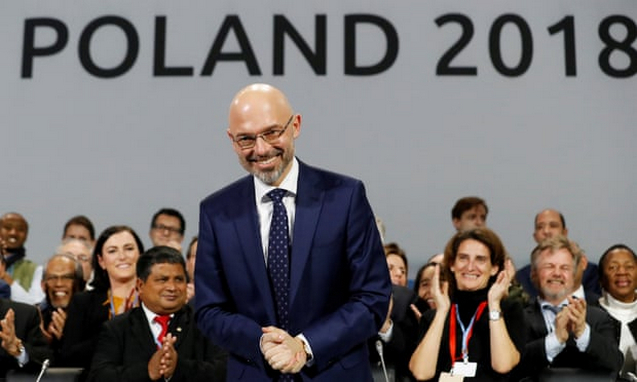
COP24 President Michal Kurtyka smiles after agreement is reached during the closing session in Poland. Photograph: Kacper Pempel/Reuters
The first thing to say about the compromise struck at climate talks in Poland at the weekend is that it came as a relief. Ever since President Trump’s announcement in 2017 that the US would withdraw from the Paris agreement, the question has been whether the UN process could continue to work. Much like the communique that came out of the recent G20, the agreement on a set of rules to implement promises made in Paris shows that while multilateralism has been damaged, it is not dead. Flawed and inadequate though it is, the process that has developed since the UN Framework Convention on Climate Change was signed in Rio in 1992 is still the best hope we have of staving off the most terrifying impacts of global warming.
The sticking point of carbon credits, with new demands from Brazil regarding the treatment of forests, was pushed back to next year. But the agreement on how governments will measure and report on emissions cuts is important. The dynamic that previously pitted developing against developed countries has significantly shifted.
Minds will now turn to the next deadline: 2020, when countries must demonstrate that they have met old targets and set new, much tougher ones. This round of talks, which the UK aims to host, is even more crucial following recent warnings from the Intergovernmental Panel on Climate Change (IPCC) that current goals are nowhere near ambitious enough. While these set the planet on a course towards a 3C rise in temperatures, scientists believe even 1.5C would bring serious consequences. We have around 12 years in which to bring an unstable situation under control.
Drastic changes to the global economy are the only option, underpinned by a rapid shift to low and zero-carbon energy, along with adaptation and mitigation measures including new mechanisms to manage migration. The US’s refusal, in Poland, to embrace the IPCC’s findings, along with Russia, Saudi Arabia and Kuwait, was wrong-headed and a hint of troubles ahead. Next year UN secretary general António Guterres will attempt to break the logjam when he hosts a climate summit with heads of state.
Once, the UK claimed a global leadership role on the environment, which was at least partly justified by the 2008 Climate Change Act. Political paralysis connected to Brexit is not the only reason why it now sits on the margins, while increasing cooperation between the EU and China is one of the more hopeful recent signs. The UK’s bid to host the 2020 summit should focus minds, not least on the contradictions of an energy policy that combines phasing out coal with the promotion of fracking. While the UN framework is essential, it cannot do the heavy lifting of cutting emissions, which will be done by nation states or not at all.
This month’s pledge by Danish shipping giant Maersk to be carbon neutral by 2050 was important. Businesses too have a responsibility to the societies in which they operate. But governments cannot wait for the private sector, let alone the energy companies on whose riches so much of the global economy rests. They, and the politicians who champion them, are the vested interests against whom the battle for the future must be fought. Some long-term investors are starting to recognise the risks. So are more and more people, as extreme weather linked to warmer temperatures becomes more frequent. Greta Thunberg, the 15-year-old Swedish activist who addressed the UN in Poland, was right to say “the only sensible thing to do is pull the emergency brake”.

Links

17/12/2018

‘1,000 Little Steps’: Global Climate Talks End In Progress But Fail To Address The Galloping Pace Of Climate Change

Washington Post - Brady Dennis | Griff Witte | Chris Mooney

“In the climate emergency we’re in, slow success is no success."
Participants leave town on Friday, even as negotiations drag on at the end of the two-week United Nations summit on climate change in Katowice, Poland. (Czarek Sokolowski/AP)
KATOWICE, Poland — Weary climate negotiators limped across the finish line Saturday night after days of round-the-clock talks, striking a deal that keeps the world moving forward with plans to curb carbon emissions. But the agreement fell well short of the breakthrough that scientists — and many of the conference’s own participants — say is needed to avoid the cataclysmic impacts of a warming planet.
The deal struck Saturday at a global conference in the heart of Polish coal country, where some 25,000 delegates had gathered, adds legal flesh to the bones of the 2015 Paris agreement, setting the rules of the road for nearly 200 countries to cut their production of greenhouse gases and monitor one another’s progress.
While President Trump announced his intentions to withdraw the United States from the Paris agreement, the Obama administration had already joined, and the text of the agreement doesn’t allow for formal withdrawal until late 2020. In the meantime, the U.S. remains involved in the negotiations and sends an annual delegation.
Trump has rejected the science behind climate change, and his administration has adopted policies that will roll back efforts to cut emissions. If Trump does not win reelection in 2020, a subsequent president could rejoin the Paris agreement.
The agreement reached in Poland prods countries to step up their ambition in fighting climate change, a recognition of the fact that the world’s efforts have not gone nearly far enough. But, like the landmark 2015 agreement in Paris, it does not bind countries to hit their targets. And observers questioned whether it was sufficient given the extraordinary stakes.
“We are driven by our sense of humanity and commitment to the well-being of the earth that sustains us and those generations that will replace us,” Michal Kurtyka, the Polish environmental official who presided over the two-week international summit, said late Saturday as the marathon talks drew to a close.
Kurtyka noted the difficulty of finding global consensus on issues so technical and, in many ways, politically fraught. “Under these circumstances, every single step forward is a big achievement,” he said. “And through this package, you have made 1,000 little steps forward together.”
The agreement from the COP24 climate talks in Katowice, Poland, falls short of what many scientists believe is necessary. Credit: AP
Approval of the agreement prompted a standing ovation from the delegates. But even as they cheered, the outcome raised immediate questions about whether the steps taken in Katowice were big enough as global emissions continue to rise.
“In the climate emergency we’re in, slow success is no success,” said Durwood Zaelke, president of the Institute for Governance and Sustainable Development. “In an emergency, if the ambulance doesn’t get you to the hospital in time, you die. If the firetruck doesn’t get to your house in time, it burns down.”
Negotiators said the agreement was the best that could have been expected given the limited agenda for the talks and the need for a global consensus. Virtually every nation on Earth was represented at Katowice, ranging from small island countries that threaten to be swallowed by rising seas — and that pushed for a crisis-level response — to the United States.
The world’s largest economy and its second-largest polluter played an at-times contentious role in the negotiations, with its officials rankling fellow delegates by initially refusing to accept a landmark climate report and later putting on a presentation touting the virtues of fossil fuels.
But fellow negotiators said the United States was mostly notable for its absence.
“The U.S. was the driving force in the run-up to Paris. Once they decide to no longer be a part of the agreement, they can’t be a driver,” said Jochen Flasbarth, a top German delegate.
Flasbarth said the minimized U.S. role was particularly apparent in negotiations with China, which did not feel as much pressure to ramp up its commitment in fighting climate change as it otherwise might have. China is the world’s largest producer of greenhouse gases.
“The U.S. role here is somewhat schizophrenic — pushing coal and dissing science on the one hand, but also working hard in the room for strong transparency rules,” said Elliot Diringer, executive vice president of the Center for Climate and Energy Solutions, a nonprofit based in Virginia. “Over the long haul, making the agreement operational will do more to strengthen climate ambition than any immediate political signals.”
In a statement, the U.S. State Department said that while the administration’s position on the Paris agreement — the U.S. is leaving — remains unchanged, the latest meeting helped the U.S. with “holding our economic competitors accountable” when it comes to adequately reporting their greenhouse gas emissions.
“The United States is not taking on any burdens or financial pledges in support of the Paris Agreement and will not allow climate agreements to be used as a vehicle to redistribute wealth,” the statement said. “We will work with our many partner countries to innovate and deploy a broad array of technologies that promote economic growth, improve energy security, and protect the environment.”
In another sign of a more difficult environment for climate negotiations this year, text establishing a large part of a planned carbon trading system was scuttled after Brazil, one of the world’s leading greenhouse gas producers, blocked proposals for counting certain emissions.
Brazil led a push for lenient rules that other nations said would weaken the system, which is intended to incentivize emissions cuts by creating a market price. With negotiators unable to reach a deal, the issue was punted until next year — a move that Boston College environmental law professor David Wirth said could “delay or undermine confidence among the private sector in undertaking climate-friendly investments — one of the most important purposes of the Paris Rulebook.”
This year’s conference — an annual U.N.-sponsored exercise now in its 24th year — came against the backdrop of increasingly dire assessments by scientists.
An October report from the U.N.’s Intergovernmental Panel on Climate Change warned that the world was far off-track in its efforts to avoid the most catastrophic impacts from warming temperatures. It concluded that a “rapid and far-reaching” transformation of the world’s energy, transportation and other sectors will be necessary over the next dozen years to avoid warming the globe more than 1.5 degrees Celsius (2.7 degrees Fahrenheit) above preindustrial levels.
But rather than lighting a fire under the world to move with more urgency, the report became a source of political friction during the talks in Poland.
Early in the summit, the Trump administration joined Saudi Arabia, Russia and Kuwait in blocking official acceptance of the report’s findings, arguing that any agreement should merely “note” its existence rather than “welcome” its warnings.
The final text of the agreement says that the world “recognizes” the role of the IPCC, “expresses appreciation and gratitude” to the scientists who produced it, “welcomes” its timely completion and “invites” nations to “make use of the information” it contained.
This treatment is “one of the clearest illustrations that any sense of urgency is lacking in the [conference] outcome,” said Joeri Rogelj, a scientist with the International Institute for Applied Systems Analysis in Austria who led the key second chapter of the IPCC report. “After the initial failure … to welcome the IPCC report which they had asked for, the final text now expressed its appreciation and gratitude to the IPCC and the scientific community for delivering the report on time, but then fails to acknowledge any of the report’s findings.”
The fight over how to address the report encapsulated the U.S. shift under Trump, from pushing fellow countries to act more aggressively to refusing to acknowledge the conclusion of the world’s top scientists.
A chorus of activists, diplomats and national delegates — none more vocal than the coalition of small island states suffering rising sea levels — had implored leaders of the summit to recognize the content of the IPCC report. The issue continued to be debated into the conference’s closing hours, along with a bevy of more technical disagreements.
The conference was scheduled to end Friday, but repeated deadlines for closing out the talks came and went, with negotiators haggling through Friday night and again on Saturday. By then, some negotiators had nearly lost their voices. Bleary-eyed journalists slept on chairs or FaceTimed with their loved ones from afar. U.N. staffers, security officials and the rest of the dwindling crowd at the cavernous conference center — built on the site of a former coal waste dump — speculated over when the talks would finally reach their end.
A worker dismantles the exhibition pavilion of Austria after the UN Climate conference ended, but negotiators from almost 200 countries continued haggling over the fine print of the Paris climate accord in Katowice, Poland, Saturday. Credit: AP
The once-busy pavilions — which had pulsated with a seemingly endless stream of lectures and demonstrations of new technologies — were being broken apart. A group of Pacific Islanders sat in a small circle, playing a guitar and drums. A group of Austrians seemed determined to clear out any remaining wine, beer and sweets in their corner of the conference center and to invite passersby to join in.
After two weeks under the cold, unremittingly gray skies of December in Poland, negotiators are due to meet in the sun and warmth of Santiago, Chile, next winter. In between, the U.N. is hosting a climate summit in September that observers say now takes on crucial importance as a measure of whether countries are serious about raising their carbon emissions targets.
Manuel Pulgar-Vidal, who led a previous round of U.N. climate talks and is now leader of the World Wildlife Fund’s global climate and energy practice, said world leaders will need to come through in New York on the promises they have made in Katowice.
“Anything less,” he said, “is a failure in political and moral leadership.”

Links

Climate Change: Five Things We've Learnt From COP24

BBC - Matt McGrath

Kiara Worth/IISD/ENB
Delegates to the UN climate conference in Poland have reached agreement on how to implement the 2015 Paris Climate Accord, which comes into force in 2020. What are the key points to come out of the meeting?

1. The rules are key to the game
However dull it may be, the operational rules for the 2015 Paris climate agreement will govern the way the world tackles climate change for decades to come.
The key thing was not to unravel the carefully negotiated Paris agreement by having one set of rules for the rich countries and another one for the poor.
EU climate commissioner Miguel Arias Canete explained how the new rules would work.
"We have a system of transparency, we have a system of reporting, we have rules to measure our emissions, we have a system to measure the impacts of our policies compared to what science recommends."
To keep everyone in check, the rules will also contain a compliance mechanism, which means that countries that don't submit their reports on time will face an inquiry.
The new regulations are "flexible" for developing countries, meaning they can sign up to the rules at a later date.

2. Science is worth fighting for
One of the biggest rows at this meeting was over a key scientific report from the Intergovernmental Panel on Climate Change (IPCC).
A group of countries including Saudi Arabia, US, Kuwait and Russia refused to "welcome" the IPCC study.
They merely wanted to "note" the contents.
Efforts to find a compromise ended in failure.
However that was not the end of the matter.
The vast majority of countries felt that acknowledging the science was critical at this conference.
Their efforts did finally ensure that the IPCC was recognised - but many felt it was a token effort.
"That science is unsettling and it doesn't connect it to the need to do more," said Camilla Born from the environmental think tank E3G.
"The deal looks at it in isolation, it's an elegant compromise but it's not really enough."

3. Multilateralism is not dead
Many countries had worried that with the rise of nationalism in many countries and the recent election of Jair Bolsonaro as Brazil's president, the international co-operation needed to tackle climate change might be in danger.
For many getting agreement here in Katowice was less about technical rules and more about showing that the international spirit is still alive and has teeth.
"I think the beauty of multilateralism is that it is the effort of everybody," said Spanish Ecology Minister Teresa Ribera.
"And what we have seen is that everybody has supported the package, no single country has decided to step down.
"It is very difficult. It is like organising a party for 200 friends, and there's a single menu that everybody has to eat. It is not so easy but we have got it. That's fantastic!"

4. Actions speak louder than words
While negotiators have been congratulating themselves on a job well done in landing the rulebook, there are many voices here who feel that the agreement does not go far enough.
They point to the strength of the science, and the public recognition of the impacts of climate change seen this year in heatwaves and wildfires.

How years compare with the 20th Century average

Source: NOAA

Many environmental campaigners believe that Katowice was a missed opportunity for radical action.
"We have ended up here with more of a coal trade fair than a climate convention," said Mohamed Adow from Christian Aid, referring to the efforts to promote coal by Poland and the US at this conference.
"We haven't acted in good faith, particularly for the young, that we takes seriously what science is telling us and we are responding to it. That message didn't come through.
"If people think the rulebook is the way to get the world on that path, it is not robust or ambitious enough."

5. New voices are emerging
One of the most striking things about this conference of the parties was the presence of energised young people in far greater numbers than I have ever seen them at a COP before.
Climate change chimes with young people in a way that is sometimes missing with older people, who make up the bulk of negotiators here.
The sense that perhaps this UN process doesn't quite connect with the modern world was summed up best by Mohamed Nasheed, the former president of the Maldives and now their lead climate negotiator.
"Almost 10 years since I was last at these climate negotiations, I must say, nothing much seems to have changed.
"We are still using the same old, dinosaur language. Still saying the same old words.
"Still making the same tedious points."

Matt McGrath explains why we should care about climate change


It would be hard to argue with this view given the shenanigans that played out at the end, when one country, Brazil, held up progress at the talks on one issue for a couple of days.
Perhaps the most memorable image of this meeting was that of 15-year-old Swedish student Greta Thunberg.
This young woman who has organised school strikes in Sweden held daily press conferences here to drive home her message that platitudes and warm words just aren't enough anymore.
Her message was sharp and succinct.
"We cannot solve a crisis without treating it as a crisis."


Links

Progress And Problems As UN Climate Change Talks End With A Deal

The Guardian - 

Nations agree on implementing 2015 Paris agreement, but put trickiest issues on back burner
The Brazilian delegation was at the centre of negotiations at the UN climate change talks. Photograph: Kacper Pempel/Reuters
The UN climate change talks ended late on Saturday night in Poland with a deal agreed on how to put the 2015 Paris agreement into action, but with other contentious problems left to be resolved next year.
Countries thrashed out the complex details of how to account for and record their greenhouse gas emissions, which will form the basis of a “rulebook” on putting the Paris goals into action. But difficult questions such as how to scale up existing commitments on cutting emissions, in line with stark scientific advice, and how to provide finance for poor countries to do the same, were put off for future years.
In the final hours, agreement was held up by a debate over the market in carbon credits, awarded to countries for their emissions-cutting efforts and for their carbon sinks, such as forests, which absorb carbon dioxide.
Brazil wanted an amendment that would benefit the country for its large rainforest cover, but this was opposed by others as it could allow the double-counting of carbon credits, undermining the integrity of the system.
This question has now been pushed back to next year’s annual conference. Brazil’s stance, however, under incoming president Jair Bolsonaro, who also rescinded the country’s offer to host next year’s talks, presages troubles to come.
Brazil has been a reliable supporter of the annual talks in the past, and has worked to broker deals between the developed and developing world. Without that support in future, the talks are only likely to grow more fractious.
Even when Brazil’s carbon-credits issue was postponed, a further obstacle was opened up by Turkey, which wants to be counted as a developing country rather than a developed one. Weary delegates finally filed into the closing session at nearly 10pm to hail the compromise agreement.
Despite these hitches, the two-week conference – the 24th Conference of the Parties to the United Nations Framework Convention on Climate Change, known as COP24 – finally ended in clarity, at least on some of the key building blocks for putting the Paris agreement into action.
David Waskow, of the World Resources Institute, said the final deal was “a good foundation for countries to go about implementing the Paris agreement”. He added: “It sets the direction of travel and will spur countries to take action. Now countries need to go home and do their homework, by increasing their commitments [on emissions].”
A man sits on the stairs of the event centre during the COP24 UN climate change conference. Photograph: Kacper Pempel/Reuters 
But the key question of whether countries are doing enough to cut their emissions, in the light of the recent Intergovernmental Panel on Climate Change (IPCC) report that predicted dire consequences if temperatures were allowed to rise more than 1.5C above pre-industrial levels, was left out.
The IPCC’s report in October showed that the world must change course drastically in the next decade to avoid the consequences of a 1.5C rise, including the die-off of coral reefs, droughts and floods, and a decline in agricultural productivity over many areas.
This year has seen extreme weather across many parts of the globe, and the fourth highest global average temperatures on record, while the IPCC warning is the starkest yet to come from scientists.
António Guterres, secretary-general of the UN, praised countries for coming to an agreement, but demanded more. “The approval of the Paris agreement work programme is the basis for a transformative process which will require strengthened ambition from the international community,” he said.
“Science has clearly shown that we need enhanced ambition to defeat climate change. From now on, my five priorities will be: ambition, ambition, ambition, ambition and ambition.” He cited the need for countries to toughen their emissions-cutting targets and to adapt their infrastructure to cope with the effects of climate change.
Jennifer Morgan of Greenpeace said: “A year of climate disasters and a dire warning from the world’s top scientists should have led to so much more. Instead, governments let people down again as they ignored the science and the plight of the vulnerable.
“Without immediate action, even the strongest rules will not get us anywhere. People expected action, and that is what governments did not deliver. This is morally unacceptable.”
Gareth Redmond-King, head of climate change at WWF-UK, said: “[There has been] some positive progress, but we have not yet done enough. The world is in a state of climate emergency and yet some of our leaders prefer to stay in a state of denial.
“Everyone’s future is at stake. We need all countries to get much more serious about climate ambition."

Links

16/12/2018

Global Warming Should Be Called Global Heating, Says Key Scientist

The Guardian - 

UK Met Office professor tells UN summit Earth’s ‘energy balance’ is changing
The heatwave that hit the UK this summer was made 30 times more likely by human-caused climate change, according to the Met Office. Photograph: Matt Cardy/Getty Images 
“Global heating” is a more accurate term than “global warming” to describe the changes taking place to the world’s climate, according to a key scientist at the UK Met Office.
Prof Richard Betts, who leads the climate research arm of Britain’s meteorological monitoring organisation, made the comments amid growing evidence that rising temperatures have passed the comfort zone and are now bringing increased threats to humanity.
“Global heating is technically more correct because we are talking about changes in the energy balance of the planet,” the scientist said at the UN climate summit in Katowice, Poland. “We should be talking about risk rather than uncertainty.”
Earlier this month, the Met Office produced a new report that showed the searing heatwave that hit the UK this summer – along with other parts of the northern hemisphere – was made 30 times more likely by human-caused climate change.
Betts said the shifting climate was pushing some natural processes – such as the blossoming of trees and laying of eggs – out of sync. “That’s already happening. We are also seeing higher temperatures of heatwaves. The kind of thing we saw this year will happen more often.
“The risks are compounding all the time. It stands to reason that the sooner we can take action, the quicker we can rein them in.”
His views were echoed by Hans Joachim Schellnhuber, a professor of theoretical physics and founder of the Potsdam Institute for Climate Impact Research in Germany. He said his recent Hothouse Earth report , which was one of the most widely quoted and downloaded studies of this year, had helped to change the language used to describe the climate crisis.
“Global warming doesn’t capture the scale of destruction. Speaking of hothouse Earth is legitimate,” he said.
The scientists expressed frustration at the slow pace of action by political leaders. In signing the 2015 Paris agreement, governments around the world aimed to keep global warming to within 1.5C to 2C above pre-industrial levels. But current commitments are far off track.
The Met Office upgraded its forecasts this week to show the planet is on track to warm by between 2.5C and 4.5C. “We have broadened out the range of possibilities,” said Betts, who is conducting a risk assessment based on the new projections. In the UK, he said the trend was towards wetter winters with more floods, hotter summers with more droughts interspersed with increasingly intense rain.
At 3C of change, Schellnhuber said southern Spain would become part of the Sahara. Even 2C, he said, could not be guaranteed as safe.
Water lines on the step banks of Algeciras reservoir in Librilla, Spain. Photograph: David Ramos/Getty Images 
The Paris pact was a firewall, he said. “It’s not helping us to keep the world as it is now. We’ve lost this opportunity already. It’s a firewall against climate chaos.”Johan Rockström, executive director of the Stockholm Resilience Centre, said “cracks” were starting to appear in the climate system that were pushing nature from being a friend that absorbs carbon dioxide to an enemy that releases carbon dioxide. These concerns are fuelled by the growing intensity of forest fires, the effect of melting ice-sheets on the jet stream, and the rising risk of permafrost thaw, which would release trapped methane.
Although he stressed it might not yet have passed a tipping point, he said the warnings were getting louder. “This shift from friend to foe is no doubt a scientific nightmare. That is the biggest worry that we have,” he said. “It does terrify me. The only reason we sit here without being completely depressed is that we see we have policy measures and technology to move in the right direction.
“We need to have a diagnosis just like a patient who comes to a doctor and gets a really bad diagnosis. But if the science is right, the technology is right, and the policy is right you can cure that very dire situation. There is no scientific suggestion that the door is shut.”
This week’s climate talks have crept forward with only small progress towards a new global rulebook, but emissions continue to rise and the planet continues to heat.
“Things are obviously proceeding very slowly,” said Betts. “As a scientist, it’s frustrating to see we’re still at the point when temperatures are going up and emissions are going up. I’ve been in this for 25 years. I hoped we’d be beyond here by now.”
Schellnhuber concurred. “I’ve worked on this for 30 years and I’ve never been as worried as I am today.”

Links

Lethal Heating is a citizens' initiative