Wednesday, December 19, 2018

Intensifying Climate Change Protests 'Could Rival Vietnam War Activism'

ABC - Malcolm Sutton


Students walk out of school to rally for action on climate change (ABC News)

Key points:
  • Climate inaction protests and participants rising
  • Major parties fail to implement lasting policy
  • Protesters targeting financers of fossil fuel
Mass protests of the scale held during the Vietnam War are just around the corner for people concerned about climate change, environmentalists have warned, as a growing number of activists turn their attention to those who fund fossil fuel industries.
Activists on Sunday disrupted Labor's national conference in Adelaide to oppose oil drilling in the Great Australian Bight and the Adani coal mine in Queensland — two proposals considered "lightning rods" for unilateral climate protests.
It happened weeks after thousands of school students defied Prime Minister Scott Morrison and marched on capital cities to demand significant action to reduce carbon emissions — surprising authorities with the number of participants involved.
"The divide between the Government and the young people of Australia is probably the greatest it's been since those huge protests of the Vietnam War era, and I think it's for a similar reason," Greenpeace chief executive David Ritter said.
"Back then, 18 to 20-year-olds [facing conscription in the 1960s] felt their future was being callously taken away by a war they could see no justification or point for.
"The young people of Australia today can see the future being callously taken away to prop up the old fossil fuel industries that have to go if we are to have a flourishing future.
"A 14-year-old is perfectly capable of looking at the news and seeing terrible wildfires in California, bleaching of the Great Barrier Reef, the Arctic burning.
"People can see the climate consequences [of inaction] and they are not going to stand around and watch their future disappear."
The Vietnam War divided opinion across Australia in the 1960s. (ABC Archives)
Australia's School Strike 4 Climate campaign started earlier this year in Victoria, after children were inspired by the actions of 15-year-old Swedish student Greta Thunberg.
Greta has pledged to protest outside Parliament House in Stockholm until her country catches up on its Paris Agreement commitments.
Some students have also taken inspiration from a landmark climate lawsuit filed by 21 teenagers in Oregon against the US Government for failing to take meaningful action against climate change.

Protesters with multiple targets
Professor Quentin Beresford is joining Mr Ritter to speak at Womadelaide's Planet Talks program in March at an event called Adani, Coal Wars and the National Interest.
The author of Adani And The War On Coal said a strong protest movement was well underway, and pointed out the Australian Youth Climate Coalition (AYCC), which is comprised of several different youth organisations, already had more than 150,000 members.

Climate policy keeps sinking PMs
Federal Parliament has proven itself unable to reach consensus on climate change policy, even when the parties are close enough to touch.

Professor Beresford said protests today were a blend of non-violent direct-action protests witnessed during the Vietnam War and social media activism.
"What we're seeing now is a maturing of the broad environment movement and they're developing multiple strategies," he said.
"One of the effective strategies is to go for the institutional funders, the big corporations, the big banks and investment houses.
"The rely on their reputation, because if there is no social licence for a project, no public approval, [vocal criticism] can have a powerful effect."
It has resulted in banks refusing to support projects like the Adani coal mine, even if it has the backing of some politicians.
"Targeting political parties is necessary, but it doesn't necessarily bring you success and effectiveness because of the power of the fossil fuel industry and how it's captured the political system," Professor Beresford said.
"When both major parties more or less support the project, where are you going to get the break-off?"

Protesters interrupt Bill Shorten's keynote speech at the ALP conference. (ABC News)

Professor Beresford said Adani had been "a lightning rod for the climate movement and for activist politics in general".
"It just doesn't make sense for Australia to allow this mine to release catastrophic levels of CO2 into the atmosphere in an era of climate change," he said.

Australia rudderless on carbon reduction
Although it ratified the Kyoto Protocol in 2007 and signed the Paris Agreement in 2015, Australia remains without a significant federal policy to reduce emissions.
Both major parties have proposed varying strategies to appease public sentiment since 2007, only to be abandoned, repealed or put on the backburner.
In the meantime, emissions are on the rise after a marginal fall between 2007 and 2013.
Scott Morrison once used a lump of coal to get his point across in Parliament. (ABC News: Nick Haggarty)
Mr Morrison, when he was treasurer, infamously brought in a lump of coal to Question Time in 2017 while making a point about renewable energy versus base-load coal-fired power.
When asked about last month's school strike, he said the Government wanted "more learning in schools and less activism in schools", to which the young protesters said that if "he was doing his job properly, we wouldn't be here".
AYCC campaigns director Kelly Albion said there were 160 different "stop Adani groups" across Australia in an "organic movement" that was growing on its own.
"We saw a couple of weeks ago high school students and primary students alike willing to make their voices heard about an issue that affects their generation," she said.
"Climate change is an issue that affects us all and we need to make sure our political leaders are doing everything they can to make sure we avoid the worse impacts."
The Womadelaide world music, arts and dance festival runs from March 8 to 12 at Botanic Park in Adelaide.
South Australian students protested at Parliament House in Adelaide in November. (ABC Radio Adelaide: Malcolm Sutton)
Links

Summit Passes The Buck In Race To Stop Climate Change

AFR (Reuters) - Agnieszka Barteczko | Nina Chestney

Katowice: Fractious climate change talks in Poland showed the limits of international action to limit global warming in a polarised world, putting the onus on individual governments, cities and communities to stop temperatures rising.
Nearly 200 countries at the United Nations talks in Katowice - in the coal mining region of Silesia - saved the landmark 2015 Paris Agreement from disintegration on Saturday by agreeing a package of guidelines for its implementation.
But it deferred rules on carbon credits - a spur to business - and lacked any firm commitment to strengthen countries' emissions cut targets by 2020, when the agreement comes into force.
A scientific report requested by the Paris signatories said the share of coal-fuelled power would have to be cut to under 2 per cent by 2050. MARTIN MEISSNER

As such it left the parties a long way from the Paris deal's goal of keeping global warming below 2 degrees Celsius, let alone the cap of 1.5C needed to avert more extreme weather, rising sea levels and the loss of plant and animal species.
The world is heading for a 3-5C rise in temperatures this century, the UN World Meteorological Organisation has said.
The Paris Agreement is based on individual commitments and expectations for the Polish talks to produce much more than rules for how those would be measured had always been low: the unity built in Paris had been shattered by a wave of governments placing national agendas before collective action.
Only a handful of country leaders were present in Katowice and the UN Secretary-General had to fly back to the meeting to urge progress.
"Political will is missing," Alden Meyer, director at the Union of Concerned Scientists, a non-profit science advocacy group said as the conference staggered towards a finish delayed for more than 24 hours by last-minute wrangling over parts of the text.
"But it provides the hooks for governments, cities, businesses, civil society etc to do the work to get [to the Paris Agreement goals]," he said.
A heating and power plant in Bedzin, near Katowice, which is among the most polluted cities in Europe. CZAREK SOKOLOWSKI
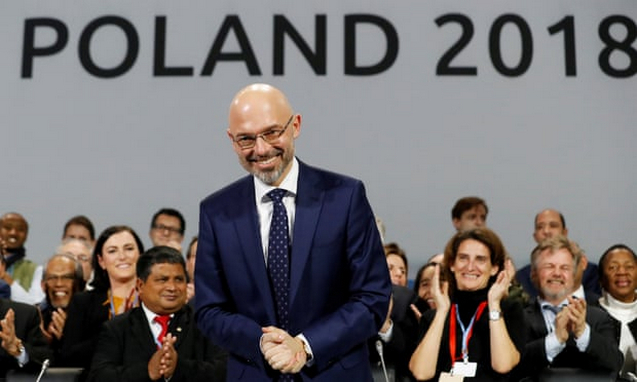
For conference president Michal Kurtyka it was a job well done. "Mission accomplished," he wrote on Twitter. "Our children look back at our legacy and recognise that we took the right decisions at important junctures like the one we face today."

Scratching the surface
For nations already suffering from climate change, the agreement, which did not make clear how pledged funding would be provided, was only just better than nothing. Simon Stiell, Environment Minister of Grenada in the Caribbean, told Reuters it "is barely scratching the surface of what we really require".
Investors said it would take more action at government level to persuade them to pump in the amount of money needed.
"Those countries . . . who push ahead with ambitious, long-term climate policies will be the ones to reap the investment and economic advantages of doing so," said Stephanie Pfeifer, chief executive of Institutional Investors' Group on Climate Change, noting the low-carbon transition was already underway.
Michal Kurtyka: "Our children look back at our legacy and recognise that we took the right decisions at important junctures like the one we face today." PETER KLAUNZER
The United States, set to withdraw from the UN process at the behest of President Donald Trump, staged an event touting the benefits of burning fossil fuels, including coal, more efficiently, while back at home, Trump has termed the Paris deal "ridiculous".
A scientific report requested by the Paris signatories said the share of coal-fuelled power would have to be cut to under 2 per cent by 2050, along with big cuts to other fossil fuels, to stop temperatures rising more than 1.5C and causing devastating floods, storms, heat waves and drought.
The United States, as well as fellow oil producers Saudi Arabia, Russia and Kuwait, refused to "welcome" the report, a term sought by countries seeking to focus minds on its findings.
The final statement merely welcomed its timely completion and invited parties to make use of the information it contained.
Yet the row over the report was far from the only one: China, India, Russia, Australia, Japan, Brazil and the European Union were all drawn into various rifts, although China won some praise for helping to overcome concern, especially from the United States, that it would sidestep any rules.
"I think they have come a long way in recognising they need to provide confidence," Jennifer Morgan, executive director of Greenpeace International, said of the Chinese negotiators.
Describing Washington as "out of touch", Morgan noted the rules agreed in Poland nevertheless bound all countries, including the United States until its planned withdrawal in 2020, an achievement in itself.
"But that doesn´t substitute for the need to build ambition," she said.

Choking coal
Poland, hosting its third UN climate conference, came in for criticism for its commitment to coal, the most polluting of fossil fuels.
The meeting's final statement merely "noted" Warsaw's call for a "just transition" allowing communities dependent on coal more time to adjust.
The appointment of Kurtyka, Poland's deputy environment minister, to preside over the talks appeased some campaigners angered by the government's previous choice, former environment minister, Jan Szyszko.
Szyszko had expressed doubts that global warming is man-made in the past and increased logging in the ancient forest of Bialowieza, declared illegal by the European Union's top court.
However, Kurtyka's job was complicated by Poland's environment minister saying he did not want discussion about raising ambition at the talks and Poland's president vowing not to let anyone "murder coal mining".
A focus on technicalities in the first week was interpreted by campaigners as a pretext to avoid discussions on pledging deeper emissions cuts. Kurtyka got countries to focus on the guidelines near the end of the second week, but there was no collective action to harmonise or improve disparate pledges.
"Each delegation has its own domestic interests," Adam Guibourge-Czetwertynski, Poland's chief negotiator, said in the second week of talks. Our role, as the presidency, is to find balance, which ensures reaching a compromise."
Poland's ruling party, the nationalist-minded Law and Justice (PiS), wants to scale back the share of coal in electricity production from 80 per cent to 60 per cent by 2030.
But the production of hard coal is expected to be stable for decades, although 72 per cent of Poles think it should be gradually phased out to reduce emissions, according to a survey by state-controlled pollster CBOS in November.
Katowice, the heart of Poland's coal region, is among the most polluted cities in Europe, because many people heat their homes by burning low-quality coal, which is the cheapest. Residents say they have no choice.
"No climate decisions, even the best ones, will change the content of our wallets," said Maria Ligeza, an 83-year-old Katowice citizen. "Without help, people will be still burning what they have."

Links

Tuesday, December 18, 2018

UN Climate Talks Set Stage For Humanity’s Two Most Crucial Years

The Guardian - 

COP24 in Poland highlighted the growing threat of fossil fuel interests and the nationalist politicians they fund. Photograph: Koji Sasahara/AP 
The mood was more one of relief than triumph on Sunday when the world’s governments eventually found common ground at the UN climate talks in Katowice, Poland.
This was not just because exhausted delegates were glad to go home after negotiations that dragged on 30 hours beyond the deadline. It also reflected the harder miles and tougher battles to come over the next two years if the planet is to remain habitable.
Scientist after scientist told the conference that the decisions made by 2020 will determine whether global heating can be kept to less than 1.5C above pre-industrial levels, after which the already apparent dangers of climate instability become far worse.
The toughest decisions, however, were pushed into the future, to a special climate summit next September called by the UN secretary general, António Guterres, and the next two COP conferences – in Chile in December 2019, and then to the country chosen to host in 2020.
COP24 delegates applaud the agreement reached in Katowice. Photograph: Marek Zimny/EPA
Katowice showed that the multilateral system of global decision-making is still alive, but under growing threat from fossil fuel interests and the nationalist politicians they fund.
Decision-making at the UN is painstakingly difficult at the best of times, because it requires a consensus among 195 nations. In Poland, 14,000 delegates took two weeks to debate the latest science and proposed policy instruments as they whittled down more than 2,800 areas of disagreement.
The result was a new global rulebook on emissions that requires nations to report every two years on their progress toward Paris agreement commitments to keep temperature rises to between 1.5C and 2C.
Several past obstacles were overcome. China accepted standards on transparency, and richer nations – particularly Germany and Norway – put their hands deeper into their pockets to provide more than $100bn (£80bn) to help poorer nations adapt. A renewed division between the developed and developing world did not materialise as feared.
But more fundamental obstructions also came more sharply into focus. The malign role of fossil fuel interests has often been hidden in bureaucratic language or lost in the distractions of diplomatic spats, but in Katowice there were several moments of blinding clarity. Chief among them was the alignment of the world’s top three oil-producing nations – the US, Russia and Saudi Arabia – to downplay scientific warnings about temperature rises beyond 1.5C. Soon after, an ambassador from Australia – a major coal exporter – joined Trump administration officials in a panel that promoted carbon fuels. Brazil was also accused of holding up talks with a highly contested carbon-accounting proposal that could have reshaped how emissions from the Amazon are calculated. The country’s diplomats denied this but the issue has been kicked forward and it is unlikely the incoming nationalist president Jair Bolsonaro will make life easier for the negotiations.
There was also more clarity as a result of the recent protests in France, which prompted policymakers to think twice about the social implications of higher fuel prices. The leading energy economists Nicholas Stern and Ottmar Edenhofer said carbon taxes were still an important instrument to nudge economies away from fossil fuels, but that the transition has to be fair as well as fast, which means using the extra tax revenue for green infrastructure or redistributing it among poorer members of society who are often hardest hit by fuel tax rises.
Tensions will grow along with the stakes, as will frustration at the widening gap between the science and politics. More protests and lawsuits can be expected from climate litigation groups, financial divestment activists and a growing number of direct action campaigners, including 350.org, Extinction Rebellion and striking students such as Greta Thunberg. They, along with many scientists, say it is not enough to agree on rulebooks. After delaying action for so long, they argue the world now needs leaps rather than steps.
All of which suggests the next two years will be among the most fraught and crucial in the history of humanity. Investment decisions on power stations and infrastructure taken during this period will determine whether carbon emissions can be cut by the 45% needed by 2030 to give the 1.5C target a chance.
It would be fitting if the UK won the right to host the crucial climate summit in 2020. Done well, it would showcase how the world’s first industrialised nation is shifting away from carbon faster than almost any other. Done badly, the UK – by then probably outside the EU – will highlight the folly of shifting away away from multilateralism just when when the world needs to pull together.

Links

We Finally Have The Rulebook For The Paris Agreement, But Global Climate Action Is Still Inadequate

The Conversation - 

Delegates at the closing ceremony of the Katowice climate talks. Marek Zimny/AAP Image
Three years after the Paris Agreement was struck, we now finally know the rules – or most of them, at least – for its implementation.
The Paris Rulebook, agreed at the UN climate summit in Katowice, Poland, gives countries a common framework for reporting and reviewing progress towards their climate targets.
Yet the new rules fall short in one crucial area. While the world will now be able to see how much we are lagging behind on the necessary climate action, the rulebook offers little to compel countries to up their game to the level required.
The national pledges adopted in Paris are still woefully inadequate to meet the 1.5℃ or 2℃ global warming goals of the Paris Agreement. In the run-up to the Katowice talks, the Intergovernmental Panel on Climate Change released a special report detailing the urgent need to accelerate climate policy. Yet the summit ran into trouble in its efforts to formally welcome the report, with delegates eventually agreeing to welcome its “timely completion”.
Rather than directly asking for national climate targets to be increased, the Katowice text simply reiterates the existing request in the Paris Agreement for countries to communicate and update their contributions by 2020.
Much now hinges on the UN General Assembly summit in September 2019, to bring the much-needed political momentum towards a new raft of pledges in 2020 that are actually in line with the scientific reality.

Ratcheting up ambition
A key element of the Paris Agreement is the Global Stocktake - a five-yearly assessment of whether countries are collectively on track to meet the Paris Agreement’s goals to limit global warming.
The new rulebook affirms that this process will consider “equity and best available science”. But it does not elaborate specifically on how these inputs will be used, and how the outcomes of the stocktake will increase ambition.
This raises concerns that the rulebook will ensure we know if we are falling behind on climate action, but will offer no prescription for fixing things. This risks failing to address one of the biggest issues with the Paris Agreement so far: that countries are under no obligation to ensure their climate pledges are in line with the overall goals. A successful, ambitious and prescriptive five-yearly review process will be essential to get the world on track.

Transparency and accounting
One of the aims of the Katowice talks was to develop a common set of formats and schedules for countries to report their climate policy progress.
The new rules allow a degree of flexibility for the most vulnerable countries, who are not compelled to submit quantified climate pledges or regular transparency reports. All other countries will be bound to report on their climate action every two years, starting in 2024.
However, given the “bottom-up” nature of the Paris Agreement, countries are largely able to determine their own accounting rules, with guidelines agreed on what information they should provide. But a future international carbon trading market will obviously require a standardised set of rules. The newly agreed rulebook carries a substantial risk of double-counting where countries could potentially count overseas emissions reductions towards their own target, even if another country has also claimed this reduction for itself.
This issue became a major stumbling block in the negotiations, with Brazil and others refusing to agree to rules that would close this loophole, and so discussions will continue next year. In the meantime, the UN has no official agreement on how to implement international carbon trading.
Accounting rules for action in the land sector have also been difficult to agree. Countries such as Brazil and some African nations sought to avoid an agreement on this issue, while others, such as Australia, New Zealand and the European Union, prefer to continue existing rules that have delivered windfall credits to these countries.

Finance
The new rulebook defines what will constitute “climate finance”, and how it will be reported and reviewed.
Developed countries are now obliged to report every two years on what climate finance they plan to provide, while other countries in a position to provide climate finance are encouraged to follow the same schedule.
But with a plethora of eligible financial instruments – concessional and non-concessional loans, guarantees, equity, and investments from public and private sources – the situation is very complex. In some cases, vulnerable countries could be left worse off, such as if loans have to be repaid with interest, or if financial risk instruments fail.
Countries can voluntarily choose to report the grant equivalent value of these financial instruments. Such reporting will be crucial for understanding the scale of climate finance mobilised.
The Paris Agreement delivered the blueprint for a global response to climate change. Now, the Paris Rulebook lays out a structure for reporting and understanding the climate action of all countries.
But the world is far from on track to achieving the goals of the Paris Agreement. The latest report from the UN Environment Programme suggests existing climate targets would need to be increased “around fivefold” for a chance of limiting warming to 1.5℃. The newly agreed rules don’t offer a way to put us on this trajectory.
Multilateral climate policy has perhaps taken us as far as it can – it is now time for action at the national level. Australia, as a country with very high per-capita emissions, needs to step up to a leadership position and take on our fair share of the global response. This means making a 60% emissions cut by 2030, as outlined by the Climate Change Authority in 2015.
Such an ambitious pledge from Australia and other leading nations would galvanise the international climate talks in 2020. What the world urgently needs is a race to the top, rather than the current jockeying for position.

Links

Climate Negotiators Reach An Overtime Deal To Keep Paris Pact Alive

New York Times - Brad Plumer

Michal Kurtyka, president of the climate talks in Katowice, Poland, leapt over his desk as the final session ended. Credit Janek Skarzynski/Agence France-Presse — Getty Images
KATOWICE, Poland — Diplomats from nearly 200 countries reached a deal on Saturday to keep the Paris climate agreement alive by adopting a detailed set of rules to implement the pact.
The deal, struck after an all-night bargaining session, will ultimately require every country in the world to follow a uniform set of standards for measuring their planet-warming emissions and tracking their climate policies. And it calls on countries to step up their plans to cut emissions ahead of another round of talks in 2020.
It also calls on richer countries to be clearer about the aid they intend to offer to help poorer nations install more clean energy or build resilience against natural disasters. And it builds a process in which countries that are struggling to meet their emissions goals can get help in getting back on track.
The United States agreed to the deal despite President Trump’s vow to abandon the Paris Agreement. Diplomats and climate change activists said they hoped that fact would make it easier for the administration to change its mind and stay in the Paris Agreement, or for a future president to embrace the accord once again. The United States cannot formally withdraw from the agreement until late 2020.
The United States agreed to the deal despite President Trump’s vow to abandon the Paris Agreement. Credit Gabriella Demczuk for The New York Times
Observers said United States negotiators worked constructively behind the scenes with China on transparency rules. The two countries had long been at odds because China had insisted on different reporting rules for developing countries, while the United States favored consistent emissions-accounting rules and wanted all countries to be subject to the same outside scrutiny.
“The U.S. got a clear methodology to make sure that China and India are meeting their targets,” said Jake Schmidt, international policy director at the Natural Resources Defense Council. “That creates the level playing field they have been asking for.”
Many of the attendees at this year’s United Nations climate talks — known as COP24, shorthand for their formal name — expressed disappointment at what they saw as half measures to deal with a mounting climate crisis. Greenhouse gas emissions are still rising around the world, and millions of people are facing increased risks from severe droughts, floods and wildfires.
But supporters of the deal reached Saturday said that they hoped the new rules would help build a virtuous cycle of trust and cooperation among countries, at a time when global politics seems increasingly fractured.
“Particularly given the broader geopolitical context, this is a pretty solid outcome,” said Elliot Diringer, executive vice president of the Center for Climate and Energy Solutions. “It delivers what we need to get the Paris Agreement off the ground.’’
“The fundamentals are in place,” Mr. Diringer added.
Not every country got what it wanted at the meeting, which had been scheduled to end on Friday. Developing nations were hoping for more robust promises on climate aid, but that issue has been postponed for future talks.
The negotiations over the Paris rule book, often dense and technical, were frequently bogged down by sharp political disputes inside the saucer-shaped convention center here in Katowice, at the heart of Poland’s coal country.
Midway through the conference, a huge fight over climate science, with the Trump administration at the center, threatened to derail the negotiations altogether.
Most delegates at the talks had wanted to formally endorse a major report issued in October by the United Nations scientific panel on climate change, which said that fossil-fuel emissions would have to fall roughly in half within 12 years to avoid severe climate disruptions.
But the United States and three other big oil producers — Saudi Arabia, Kuwait and Russia — tried to weaken the statement’s language, enraging delegates from some of the most at-risk nations. By Friday, negotiators had crafted compromise language that expressed “appreciation and gratitude” for the report.
Then, on Friday, Brazil’s delegation held up the talks all through the night because it was fiercely opposed to proposed changes in rules around carbon trading markets. Negotiators eventually agreed to table the issue until next year.
Edson Duarte, the Brazilian environment minister, at the talks in Katowice. Credit Omar Marques/SOPA Images/LightRocket via Getty Images
With a diplomatic framework still alive and rules of the road in place, analysts said it was now up to individual countries to come back before the 2020 talks with concrete pledges to cut emissions more deeply. A few countries, including Chile, Vietnam and Norway, have already said they will start that review process.
When world leaders signed the Paris agreement in 2015, they said they would try to limit the rise in global temperatures to roughly 1.5 degrees Celsius, or 2.7 degrees Fahrenheit, above preindustrial levels to avoid climate-related disasters like widespread food shortages and mass coral die-offs.
But with global fossil-fuel emissions still rising each year, the planet is now quite likely to cross that temperature threshold within 35 years.
“The real test is what happens when countries go home,” said Alden Meyer, director of policy and strategy at the Union of Concerned Scientists. “All the decision text in the world doesn’t cut a molecule of carbon. You need action on the ground.”
In some countries, political obstacles to climate action are mounting.
For instance, at the Poland talks, several European Union officials pledged that the bloc would pursue stronger measures to cut emissions before 2020. But inside the union, discussions over a more ambitious climate target have dragged on, in part because Britain is distracted by Brexit; France is struggling with “Yellow Vests” protests; and Germany is grappling with its own difficulties in phasing out coal.
“We can’t ignore that there are a lot of headwinds,” said Laurence Tubiana, France’s former climate change envoy and a key architect of the Paris agreement.
Some experts at the talks argued that the march of cheaper, cleaner energy technologies would do far more to break the deadlock around climate policy than any complicated treaties could.
“Look at countries like China and India that are going ahead with renewables for their own reasons,” said Saleemul Huq, director of Bangladesh’s International Center for Climate Change and Development. “That’s what we need: for countries to move in that direction because it makes sense to them, not because they signed up for an agreement and they’re supposed to.”
Even some of the exhausted politicians in the thick of this week’s climate negotiations were ready to acknowledge the limits of diplomacy.
“Of course it’s important to have these rules, but a lot of the real action is happening by entrepreneurs; it’s happening by business people; it’s happening by the finance sector; by the money flowing; it’s happening at the city and state level,” said Catherine McKenna, Canada’s environment minister.
“Climate change is a complicated problem,” she said, “and it’s not going to be solved by national governments alone.”

Links

'Missed Opportunity': Australia's 'Difficult' Position In UN Climate Change Talks

Fairfax - Megan Gorrey

Australia's "constructive" role at the United Nations climate change talks in Poland was undermined by its continued support for fossil fuels at home, experts say.
The two week-long summit ended in the city of Katowice on Sunday with an agreement on a so-called rulebook to increase transparency of national emissions-reduction pledges made three years earlier at the Paris Conference of the Parties (COP21).
Delegates to the UN's COP24 climate summit in Katowice, Poland. Credit: AP
But negotiators from nearly 200 countries deferred other decisions, including how to raise aid for developing nations and standard accounting rules for carbon credits, until next year's conference in Chile or possibly later.
The guidelines set out how those countries will report and monitor national emissions pledges. Nations will also be under pressure to lift their goals by 2020 as current targets fall far short of the Paris agreement to keep  global warming to well below 2 degrees.
The Polish climate package, agreed a day over schedule, coincided with Labor's national conference in Adelaide, where protesters urged Opposition Leader Bill Shorten to stop the Adani coal mine in Queensland.
Australia's role at Katowice included leading the so-called Umbrella block of nations although the country copped flak for its presence at a pro-coal event and staying silent on issues such as human rights and debate over a key science report on the impacts of 1.5 degrees of warming.
A protester is dragged off stage by security at Labor's national conference in Adelaide. Credit: Alex Ellinghausen
Economist Frank Jotzo from the Crawford School of Public Policy at ANU, said the outcome of the overall negotiations showed the UN's climate efforts were "holding tight".
"The main goal was to agree on the rules from the Paris agreement, and that has been achieved."
Professor Jotzo said Australia appeared to have played a "constructive" role in negotiations.
He said the revised emissions targets outlined in the rulebook would be "an important point for Australia" going forward, particularly with next year's looming federal election.
"An important political decision will be whether [the government] puts forward a stronger target that 26 to 28 per cent [from 2005 levels by 2030], and if so, how strong and under what conditions.
"If there's a change in government at the next election, a Labor government would need to pay attention to the issue of a revised target fairly soon."
Mr Shorten reiterated on Sunday that an ALP government would lift the reduction target to 45 per cent.
Environment Minister Melissa Price did not respond to requests for comment. Ms Price last week reiterated the Morrison government's confidence Australia will meet its 2030 goal of cutting 2005-levels of carbon pollution by just over a quarter.
But independent MP Kerryn Phelps said Australia had "missed a great opportunity to stamp out a position as a global leader in renewable energy technologies".
"Australia has the technical capacity and the raw materials to be a world leader, but we appear to be aligning ourselves with countries that seem to want to continue their reliance on fossil fuels."
Her criticism was echoed by Simon Bradshaw, who was at the conference as climate change adviser for Oxfam Australia, which is a member of the Climate Action Network.
"Australia’s credibility in the talks has been hampered by our lack of action back home. As ever, there was strong concern over Australia’s rising emissions and the proposed Adani mine.
Dr Bradshaw said the government had further harmed its reputation by lining up next to the Trump administration at a side event promoting fossil fuels, and by continuing to push its coal agenda at home.
"While Australia played a fairly constructive role in some of the more technical aspects of the negotiations, it was squarely among those looking to lower the ambition of the outcome."

Links

The Guardian View On COP24: While Climate Talks Continue, There Is Hope

The Guardian - Editorial

The agreement struck in Poland is not strong enough, but the UN process is all we have 
COP24 President Michal Kurtyka smiles after agreement is reached during the closing session in Poland. Photograph: Kacper Pempel/Reuters
The first thing to say about the compromise struck at climate talks in Poland at the weekend is that it came as a relief. Ever since President Trump’s announcement in 2017 that the US would withdraw from the Paris agreement, the question has been whether the UN process could continue to work. Much like the communique that came out of the recent G20, the agreement on a set of rules to implement promises made in Paris shows that while multilateralism has been damaged, it is not dead. Flawed and inadequate though it is, the process that has developed since the UN Framework Convention on Climate Change was signed in Rio in 1992 is still the best hope we have of staving off the most terrifying impacts of global warming.
The sticking point of carbon credits, with new demands from Brazil regarding the treatment of forests, was pushed back to next year. But the agreement on how governments will measure and report on emissions cuts is important. The dynamic that previously pitted developing against developed countries has significantly shifted.
Minds will now turn to the next deadline: 2020, when countries must demonstrate that they have met old targets and set new, much tougher ones. This round of talks, which the UK aims to host, is even more crucial following recent warnings from the Intergovernmental Panel on Climate Change (IPCC) that current goals are nowhere near ambitious enough. While these set the planet on a course towards a 3C rise in temperatures, scientists believe even 1.5C would bring serious consequences. We have around 12 years in which to bring an unstable situation under control.
Drastic changes to the global economy are the only option, underpinned by a rapid shift to low and zero-carbon energy, along with adaptation and mitigation measures including new mechanisms to manage migration. The US’s refusal, in Poland, to embrace the IPCC’s findings, along with Russia, Saudi Arabia and Kuwait, was wrong-headed and a hint of troubles ahead. Next year UN secretary general António Guterres will attempt to break the logjam when he hosts a climate summit with heads of state.
Once, the UK claimed a global leadership role on the environment, which was at least partly justified by the 2008 Climate Change Act. Political paralysis connected to Brexit is not the only reason why it now sits on the margins, while increasing cooperation between the EU and China is one of the more hopeful recent signs. The UK’s bid to host the 2020 summit should focus minds, not least on the contradictions of an energy policy that combines phasing out coal with the promotion of fracking. While the UN framework is essential, it cannot do the heavy lifting of cutting emissions, which will be done by nation states or not at all.
This month’s pledge by Danish shipping giant Maersk to be carbon neutral by 2050 was important. Businesses too have a responsibility to the societies in which they operate. But governments cannot wait for the private sector, let alone the energy companies on whose riches so much of the global economy rests. They, and the politicians who champion them, are the vested interests against whom the battle for the future must be fought. Some long-term investors are starting to recognise the risks. So are more and more people, as extreme weather linked to warmer temperatures becomes more frequent. Greta Thunberg, the 15-year-old Swedish activist who addressed the UN in Poland, was right to say “the only sensible thing to do is pull the emergency brake”.

Links

Lethal Heating is a citizens' initiative