Legal actions
are based on the principle that governments must meet their obligations
under human rights law and the 2015 Paris Agreement on climate change
Environmental activists gather to urge
world leaders to take action against climate change in Marseille,
France, September 8, 2018. The placard reads No nature no future.
REUTERS/Jean-Paul Pelissier
BARCELONA - Environmentalists in France and Ireland are pushing
forward with legal cases aimed at forcing their governments to step up
action on climate change, motivated by a 2018 flagship ruling that the
Netherlands must cut emissions faster to keep its people safe.
In October, a Dutch appeals court
said the government had "done too little to prevent the dangers of
climate change and is doing too little to catch up", ordering it to
ensure planet-warming emissions are at least 25 percent below 1990
levels by the end of 2020.
Tessa Khan, a lawyer with the Urgenda Foundation which brought the
Dutch case on behalf of nearly 900 citizens, said this and other ongoing
climate legal actions are based on the principle that governments must
meet their obligations under human rights law and the 2015 Paris
Agreement on climate change.
"(These cases) all spring from the same sort of inspiration and the
broad notion that our governments have the duty to protect us from
threats of this scale that they have contributed to knowingly," said
Khan, who is co-director of the Climate Litigation Network.
In France, four non-governmental groups, including Greenpeace and Oxfam, fired the starting gun on Dec. 17.
They sent a "preliminary request for compensation" in a 41-page
letter to the French prime minister and a dozen government ministers,
denouncing the state for failing to take concrete and effective measures
to combat climate change.
The government has two months to respond, and if it fails to give a
satisfactory answer, the groups are preparing to file a full legal
action with the Paris Administrative Court in March.
Armelle Le Comte, climate and energy advocacy manager at Oxfam
France, said the ripple of lawsuits on climate action around the world -
from Europe and North America to Pakistan and Colombia - reflected
growing urgency as the impacts of extreme weather and rising seas become
more visible.
Governments, including France, have talked a lot about tackling climate change, but have not done enough in practice, she noted.
"So I think it is not surprising that more citizens, charities and
NGOs ... decide that legal action is maybe the answer," she said.
Celebs on camera
In the meantime, the NGOs have been raising awareness about the case
and the need for stronger climate action in France through a YouTube
video featuring celebrities such as actress Juliette Binoche, and writer
and film director Cyril Dion.
They also launched an online petition in support of what they are
calling the "Case of the Century" that has garnered nearly 2.1 million
signatures in about a month.
Le Comte said wide public support for the legal action was important in providing a sense of legitimacy to the approach.
The case is particularly poignant in France, which has been rocked in
recent months by "yellow vest" protests over social inequality and the
high cost of living that were initially sparked by planned hikes in fuel
tax.
French President Emmanuel Macron launched a national policy debate
this week that includes how the country could shift to using more clean
energy.
Urgenda's Khan said the court cases were aimed at ensuring emissions targets are met, not telling states how to do it.
"Then it's up to the governments and the public to make sure the
policies that are put in place are ones that ensure a just (energy)
transition and ... the poorest aren't the ones who bear the burden of
that transition," she said.
Oxfam's Le Comte said the "Case of the Century" social media campaign
was meant to provide more information, especially to young people, on
the measures that could be taken.
Irish emissions rise
In Ireland, backers of the climate change case, scheduled to begin in
the High Court on Jan. 22, are organising a children's rally in Dublin
on Saturday to urge leaders that "2019 must be the year of ambitious
climate action".
About 12,600 members of the public have backed "Climate Case Ireland"
with online messages of support. Spokeswoman Sadhbh O Neill said
awareness was growing in the country which has among the highest
emissions per capita in the European Union.
"That helps us show the court that we have standing, that we're not
doing it in a self-interested way and that we are trying to be
representative of concerned citizens," she told the Thomson Reuters
Foundation.
Friends of the Irish Environment, a company set up by environmental
activists, will argue in the case that the government's approval of the
National Mitigation Plan in 2017 violated national legislation on
climate action, as well as its constitution and human rights
obligations.
It will also claim the plan falls far short of the steps required by the Paris Agreement.
O Neill noted that Ireland's emissions had risen since 2014, as its
economy recovered from the 2008 financial crisis, and its dairy industry
expanded. They dropped back slightly in 2017, government figures show.
A spokesman for Ireland's Department of Communications, Climate
Action and Environment said by email that the government would defend
the case, but noted the National Mitigation Plan recognised a detailed
roadmap would be required to decarbonise the economy.
That is now being put in place, he added, and includes a
government-wide climate action plan "intended to make Ireland a leader
in responding to climate disruption".
The verdict in the Irish case, a judicial review, is expected to be
issued in a few months, while the French legal process could last two to
three years, Le Comte said.
In the Netherlands, it took three years for an initial ruling to be
confirmed by the appeals court, and the government said in November it
would request a review of the judgement.
Khan said one key advantage of pursuing states in court was judicial scrutiny of the evidence on climate change.
"Just by putting the facts on the record - that in itself is a really
important communication tool, and helps to mobilise the public around
climate change," she said.
Any halfway decent political opportunist would use this week's images
of dead and dying Murray cod and other fish in the Menindee Lakes to
put the environment and climate change at the forefront of the election
campaign. The fact that the weather has been warmish, even by Goodooga
standards, doesn't do any harm either.
The images have an emotive
energy often lacking in many of the impassioned debates about places we
care about which are fairly far away, and which have become almost
abstractions for the feeling that we ought to be doing something – at
the very least, something more than we have been doing.
Thousands of fish have died at the Menindee Weir Pool.
Straight
off, the dead and stinking fish could symbolise the mismanagement,
maladministration and corruption of water policy in Queensland, NSW and
Victoria. It doesn't take a great deal of extension to work it into an
argument about the National Party's intellectual and moral bankruptcy,
particularly under former leader Barnaby Joyce, and its complete
unfitness to govern. Rural folk increasingly feel that way, wondering
how a party established to represent rural and regional Australians
became instead available for rent to big mining interests, the coal
industry, the fracking industry and large-scale agribusiness,
particularly when these interests threaten their livelihoods.
But
the Nationals are only the obvious culprits. Look, for example, at
Malcolm Turnbull, who had a spell as minister in charge of saving the
Murray and Darling river systems a bit more than a decade ago, and knew
so much about the topic that he and John Howard were able to concoct a
river water policy, costing billions of dollars, on the back of an
envelope over a couple of afternoons, without even feeling the need to
consult the Treasury, which, Turnbull said contemptuously, knew nothing
about the subject.
One
of the many things that Turnbull learned during his period as water
flâneur in chief was the wisdom of successive conservative prime
ministers in keeping water policy out of the hands of Nationals
ministers. Not even Tony Abbott was tempted to hand it over – probably
on the advice of former senator Bill Heffernan, a farmer with some
tolerance for human weakness but never for waste or mismanagement of a
scarce water supply. After Turnbull knifed Abbott, to general applause,
Joyce popped around to remind him that Coalition agreements were between
leaders, not parties, and that continuing the alliance would need to
involve some Liberal concessions. When Turnbull announced his ministry,
water was with Joyce at agriculture, and that department further refined
its habit of looking away and doing nothing when policy became
imperial, and when enforcement of the law, or even implementation of it,
came to be regarded as a matter of discretion.
But one does not
need to dwell long on the dead fish to think also of climate change, and
the Morrison government's inertia on the subject, not least because a
good proportion of the Coalition doesn't actually believe in it or, at
least, in doing anything brave or courageous, or ahead of anybody else,
about it. And also of drought, and extreme weather, neither in the least
bit unusual in the Australian environment, but both seeming to come
more regularly, and with solid evidence of increasing averages. Perhaps
the population is not completely certain about what to do to ward off
the effects of climate change, and how much of whatever it is is
necessary, but opinion polls suggest that most Australians believe we
should do a good deal more, and with a more explicit sense of urgency,
than the present government.
Some of the thousands of dead fish in the Darling River near Menindee. Credit:Nick Moir
One
does not have to segue far off the dead fish, the drought or climate
change theme to think of the Great Barrier Reef, and the threat posed to
it by rising temperatures, caused not least by coal. The government's
response to this crisis appears to involve enabling (if not yet
financing, though it may come to that) a large coal-mining project
nearby, and giving nearly $500 million to a club of rich executives,
chiefly from the mining industry, who think they can commission work,
perhaps with some private sector help, that will tackle some of the
evidences of the effects of climate change, if not actually do anything
about it.
The power of the images is such that they could be
harnessed for messages against the Coalition, or for the Labor Party,
which is saying mostly the right things about climate change, if not
necessarily about water policy or Adani, or for the Greens or
environmental candidates. The fish don't need a detailed inquest: just
by themselves, they show that something has gone very badly wrong.
It
says something about the political ineptness of federal and state
Nationals ministers, including Deputy Prime Minister Michael McCormack,
that he insists that the fish deaths are the effects of drought rather
than policy, or of drought accompanied by abrupt changes in temperature.
No doubt these have played their part in the catastrophe but, as usual
along the Darling system, the problem is much more complicated than
that, and owes much to the overallocation of water to irrigation
farmers, particularly along the Macquarie and Barwon rivers, to the
failures of the Murray-Darling Basin Authority, not least (from the
start) in failing to prioritise the environment ahead of agricultural
needs, and to rorting of the whole system, with the connivance of public
service regulators, particularly in the NSW government. That federal
ministers and some public servants in the primary industry department
see their function as facilitating agriculture and maximising its export
revenue has also led to the corruption of the public stewardship they
were supposed to deliver to the whole community.
One
reason the symbolism of the fish deaths has the power to sound in votes
is that the division of scarce resources inevitably involves rationing,
winners and losers, and people who argue about what should be rationed.
The Four Corners report last year, which showed some big
farmers stealing water, acquired some of its moral force from the fact
that the rorters were dobbed in by neighbours as well as by folk nearby.
They were angry and resentful not only because the rorters were taking
water for free while they paid for it, but because the rorting of the
supply meant a diminished total supply. That's quite apart from the fact
that many farmers are keen fishers, well-versed in their local
environments, and want to live sustainably in them, rather than by
mining its water supplies and raping the soil.
But
that's just in the immediate neighbourhood. In any river system, there
are folk upstream and downstream, particularly downstream, who will
gripe that their allocations have been reduced because too much water
has been taken upstream. They are often right, even within a state. But
there has been a long pattern of farmers within an upstream state taking
more than they should, to the ultimate disadvantage of downstream
states, particularly South Australia. That's a problem aggravated by
physical constraints, including weirs that often prevent water flowing
downstream, by very poor Commonwealth policy and management of
efficiencies to save water, and by evaporation.
Given the original
overallocations of water licences to irrigators, the Commonwealth began
buying allocations (from "willing sellers" on the water market). But
this was unpopular in some areas, with claims (by no means
substantiated) that the sale of irrigation licences was
depopulating communities and reducing their resources. The present
government prefers to spend public money subsidising farmers to increase
the efficiency of their water use, thus liberating some water for the
environment. There are problems with this approach. First, the cost of
the water "liberated" for the environment by such measures is nearly
three times that of water liberated through buying allocations on the
open market, the supposed ideal distributing mechanism. Second, the
economic benefit from the subsidised infrastructure and efficiency
mechanisms goes to the individual farmer, rather than to a district or
the public at large. In a real sense, neighbours can be economically
disadvantaged because they are unable to grow food or cotton at the cost
of the neighbours whose "investment" in better methods was heavily
subsidised.
That
has also brought to light other inequities. Last year in NSW, the
government announced measures to "borrow" water from the environmental
reservation because of the dought's severity. Listening to the blather
coming from the Nationals, one would have understood the announcement as
suggesting that some water was being liberated so farmers and graziers
could get minimal supplies for thirsty sheep, or to round off a crop
almost ready for harvest.
But
the extra water, better characterised as water stolen rather than
borrowed, was not rationed out to the needy. It was auctioned out to the
highest bidder – usually to better-off farmers not suffering as greatly
from the drought and thus in a better position to bid high. Some water,
indeed, went upstream to farmers not actually in drought at all. And
some of the crops "topped off" were not crops planned and planted as
possible from diminishing allocations as drought took hold, but extra
speculative planting, just in case there was late rain.
The
South Australian royal commission into the management of the
Murray-Darling system, being conducted by Bret Walker, SC, should soon
report. Set up in response to anger about its very junior status at the
table, it has had minimal cooperation from the Commonwealth (which
ordered that the basin authority, and its staff and board members, not
give evidence). The commission has had only token cooperation from the
states.
But that has not meant that it has been purely parochial,
or that the evidence before it has been skewed to South Australian
matters or interests. For starters, there are many players, including
irrigators and farming interests from other states, who were keen to
give evidence and to describe their problems. There have been retired
basin workers and regulators, and former CSIRO staff still angry about
how managers caved in to politicians and changed scientific calculations
of water needs to suit political agendas. There has been abundant
evidence showing the authority's setting and subsequent reduction of
sustainable environmental allocations not in response to any scientific
analysis but to calculations of what interest groups might accept. After
the interests complained about the initial determination that a minimum
3000 gigalitres of water a year was needed to meet environmental water
requirements, the authority was told to "pick a number with a '2' in
front of it". It settled for 2750 gigalitres, but despite all of the fad
words about science, accountability and transparency, has been unable,
since its establishment, to show how it arrived at either figure. Expert
advice from scientists is that the minimum environmental allocation
should have been 6900 gigalitres in an average year, that there was
Buckley's of satisfying the environmental needs with an allocation of
3000, let alone 2750.
It
is typical of the mendacity of NSW's participation in the scheme that
it came up with a rort to meet demands for a higher environmental flow.
It wants to close up the Menindee Lakes, leaving only a narrow channel
by which the water can go downstream. After all, it argues, the water in
the lakes (when it is there) only evaporates. Would it be better if,
instead, it was sent to those whingeing crow-eaters, without actually
disturbing the standard of living of NSW agribusiness upstream. Local
farmers, as well as the city of Broken Hill, which draws its water from
the lakes, are furious, some insisting that the evaporation causes local
weather in any event, but also speaking of the lakes' importance as a
wetlands site, a sanctuary for birds, a breeding place for fish (if
there are any left) and as a sieve settling some of the dirty water. The
basin does not appear to be much of a player in the argument involved,
even from its duty as the ultimate protector of the riverine
environment.
But
it seems certain that Bret Walker will hold that the then Commonwealth
solicitor-general was wrong when he advised Tony Burke, when the
authority was set up, that protecting the environment was only one aim
in basin management. Equally important were social and economic
considerations.
Walker,
and the counsel assisting the royal commission, are certain that this
interpretation is wrong. Indeed, they say that every senior
constitutional lawyer consulted shares this view. The authority is first
required to establish the basin's minimum environmental needs. Only
after that can it set allocations for irrigation, or for domestic use in
towns and elsewhere.
Walker plainly thinks the misinterpretation
of the Water Act's clear instructions has led the authority to think it
must perform some political juggling act, by which it ends up with some
solution that causes all of the vested interests least trouble. As such,
the authority has failed miserably, and compounded rather than
alleviated the rivers' problems.
The
counsel assisting, Richard Beasley, SC, has not been kind to the
authority or its board. He quoted senior international scientists who
said it was a fundamental tenet of good governance that scientists
produced facts and that government decided on values and made choices.
They were concerned that scientists in the authority felt pressured "to
trim [the facts] so that the sustainable diversion limit will be one
that is politically acceptable".
Beasley
said that if all the Murray-Darling Basin Authority had done over the
past eight years was to "trim the facts", it would be bad enough.
"But
it's worse than that. The implementation of the basin plan has been
marred by maladministration. By that I mean mismanagement by those in
charge of the task at the basin authority, its executives and its board,
and the consequent mismanagement of huge amounts of public funds. The
responsibility for that ... falls on both past and present executives of
the MDBA and its board."
There are many guilty parties, and few deserve to be spared. Fish rot from the top, it is said.
The record for the highest overnight minimum temperature has been broken twice in one night.
Weather
stations at Noona, west of Dubbo, and Borrona Downs, west of Bourke,
recorded overnight minimum temperatures of 35.9 degrees and 35.6 degrees
respectively.
The record for hottest overnight temperature was broken overnight. Credit: John Veage
The
NSW stations both broke the record set by a remote South Australian
station almost 40 years ago, Bureau of Meteorology forecaster David
Wilke said on Friday.
"The previous record for highest minimum
temperature is 35.5, set on the 24th of January, 1982, at Arkaroola in
South Australia, and that was equalled in 2003 in a place called
Wittenoon in Western Australia on the 21st of January," he said.
Mr Wilke said that, as well as breaking national records, a number of
stations broke their own records for the hottest overnight
temperatures, including Tibooburra Airport, Cobar Airport and
Coonabarabran Airport.
Minimum overnight temperatures would be
slightly cooler over the next couple of nights, with minimums expected
to hit the low 20s on Saturday, Mr Wilke said.
Overnight temperatures are forecast to stay in the low 20s across most of Sydney, making it hard to sleep. Credit: Christopher Pearce
Thanks
to a trough moving across the state, temperatures in Sydney on Saturday
will drop to 29 degrees in the city and 33 degrees in Penrith - a
change of 13 degrees from Friday's forecast high of 45 in the west, he
said.
However, Mr Wilke said the trough was not bringing a strong change, so temperatures would climb again into next week.
"The main problem is we don’t see the humidity really clearing out significantly," he said.
"We’ll
see this relief from the heat in the next couple of days, particularly
for the south-east, but the heat will continue building next week."
Fire ban, severe fire warning issued
The
heat, combined with strong north-easterly winds on Friday have prompted
the bureau to issue a fire weather warning for parts of the state on
Friday.
The Rural Fire Service has also issued total fire bans for 13 areas.
Severe
fire danger was forecast for the Southern Ranges and Southern Slopes
regions, and a very high fire danger for areas around Canberra and the
Illawarra and Shoalhaven areas.
The total fire bans were in places including the Illawarra and Shoalhaven, the greater Hunter area, and areas around Canberra.
The prime minister says Australia's emissions reduction targets will stay the same, despite criticism from Fiji about the need for a rapid shift to clean energy sources.
Prime Minister Scott Morrison and assistant Minister for International
Development and the Pacific Anne Ruston in Suva, Fiji. Source: AAP
Scott Morrison is sticking with Australia's climate change targets
despite strong criticism from Fiji about the urgent need to move to
clean energy.
The prime minister says Australia's emissions
reduction targets will stay the same, but he did commit to spending
money to help Pacific nations tackle the efforts of climate change.
Fijian
Prime Minister Frank Bainimarama said Australia cannot put the
interests of one industry ahead of the lives of Pacific islanders.
Scott Morrison with former rugby league player Petero Civoniceva and
Executive Chair of Fiji National Rugby League Peni Musunanasi in Suva.
"We have sensible, achievable commitments that will continue to
ensure that Australia has a prosperous economy, and Australians will
have the choices that they want in the future," Mr Morrison said in
response on Friday.
"While at the same time respecting the need to
address the real impacts of climate change, both here in the Pacific
and elsewhere around the world."
Mr Morrison said Australia's emissions reduction targets were discussed in a meeting with Mr Bainimarama on Thursday.
"We
are already pursuing those policies in a way that I believe is
consistent with what the prime minister is expecting of Australia," Mr
Morrison said.
Fiji PM tells Scott Morrison 'Australian coal is killing the pacific'
Opposition Leader Bill Shorten said the coalition government has no climate policy.
"It's
a bit embarrassing that he had to go to Fiji to be told that he's doing
nothing on climate change, when in fact millions of Australians could
have told him that in Australia," Mr Shorten told reporters.
Mr
Morrison also announced funding to support a Fijian team in the NSW
rugby league super premiership, and a preseason NRL game in Fiji in
2021.
Mr Morrison will visit Black Rock on Friday, where Australia is funding an expansion of the military training centre.
The centre will be used to train militaries from around the Pacific islands.
The
announcements are part of a "vuvale" partnership - from the Fijian word
for family - that Mr Morrison and Mr Bainimarama agreed to on Thursday.
Mr
Bainimarama said the relationship had been "rocky" after his 2006
military coup, but the return of free elections in 2014 had led to a
thaw with Australia.
Climate change is "no laughing matter" and poses an "enormous" threat to
Fijians and Pacific Islanders, Fiji's Prime Minister Frank Bainimarama
has warned Australia.
In a speech during his counterpart Scott Morrison's Pacific visit, Mr
Bainimarama called on Australia to put the welfare of Pacific peoples
before the interests of any single industry.
"Here in Fiji, climate change is no laughing matter," he said.
"From
where we are sitting, we cannot imagine how the interests of any single
industry can be placed above the welfare of Pacific peoples —
vulnerable people in the world over."
It is the first time a
political leader has publicly confronted Mr Morrison on the question of
climate change during his Pacific tour.
Key points:
In the same speech, Frank Bainimarama lavished praise on Mr Morrison for his "Pacific step-up"
Scott Morrison has promised Australia will not neglect the Pacific
Fiji and Australia have committed to a "family partnership" in a sign of warming ties
In 2015, then-immigration minister Peter Dutton quipped about the fate of the Pacific Islands in the face of climate change, prompting laughter from then-prime minister Tony Abbott.
"Time doesn't mean anything when you're about to be … you know, have water lapping at your door," Mr Dutton said.
Mr Morrison, then the social services minister, pointed out to both men that a microphone was above them.
In his speech on Thursday, Mr Bainimarama said Fiji and Australia should be "good neighbours" and highlighted the searing temperatures dominating Australian cities this week.
"Prime Minister, I urged your predecessor repeatedly to honour his commitment to clean energy future, the only future that guarantees the survival of your neighbours in the Pacific," he said.
Mr Morrison's predecessor, Malcolm Turnbull, abandoned the emissions reduction target in a bid to stave off a leadership challenge last year.A
vocal proponent of climate change policy who led the UN's Climate
Change Conference in 2017, Mr Bainimarama said the issue "cannot be
written off as a difference of opinion".
"Consensus from the scientific community is clear, and existential threat posed to Pacific Island countries, a certainty."
Australia will not neglect the region: PM
But Mr Bainimarama
also lavished praise on Mr Morrison for his so-called "Pacific step-up",
and said he had "transformed" the Australia-Fiji relationship by
visiting Suva.
"While it was a short flight to Suva, your presence has already taken our relationship a very long way indeed," he said.
Mr Morrison's engagement with the Pacific set a "new precedent" and was "absolutely a step in the right direction", he added.
"When
our nation and our people have been left devastated in the aftermath of
ever-worsening cyclones, Australia has always proven to be a friend we
can count on," Mr Bainimarama said.
No Australian
prime minister has come to Fiji since 2006, and Mr Morrison's trip is
aimed at shoring up Australia's influence in the nation, which has been
courting Chinese investment.
Fiji and Australia yesterday agreed to a host of new initiatives and
committed to a "Vuvale Partnership" (or "family partnership") in a sign
of warming ties.
Both countries have agreed to more regular
ministerial meetings, while Australia has promised to send Border Force
officials to Fiji to offer local guards training.
Australia has
also pledged $84 million for a new partnership with Fiji's University of
the South Pacific, and $17 million to provide 1,000 hours of Australian
television content each year to Pacific broadcasters.
Mr Morrison declared that Australia would make sure it did not neglect the region.
"One
of the risks of close relationships is sometimes they can be taken for
granted, and there are periods in our past where that has been the
case," he said.
"Not now. And not in the future if there's anything my government has to do with it."
Some Australian diplomats were anxious that the stoush over Islamic State extremist Neil Prakash would overshadow the visit.
Fijian
officials were angered when Australia stripped Prakash of his
citizenship, arguing he was instead entitled to Fijian citizenship
through his father.
But Fiji insists Prakash and his family were never registered as citizens, and have made it clear Prakash would not be welcome.
When
questioned, Mr Morrison said Mr Bainimarama had not raised the issue at
all in Thursday's talks — indicating the two men had smoothed over the
issue before sitting down in Suva.
The Australian climate has interceded in national politics more than once.
Malcolm Fraser went to the electorate in 1983 at the height of one of the harshest droughts on record.
Tony Burke, federal Labor's environment spokesman, visited the site of the massive fish kill at Menindee.
Credit: Tony Burke
The
previous year's wheat crop had been the worst in decades for much of
the east coast, while many graziers were forced to destroy livestock
left without feed or water.
Just weeks ahead of the 1983 election,
the Ash Wednesday bushfires killed 75 people in Victoria and South
Australia, destroyed more than 3700 buildings and resulted in the death
of an estimated 340,000 sheep.
The
government could not be blamed but there were some within the Liberal
Party that argued Malcolm Fraser had been blamed for everything –
including the drought.
That was, perhaps, brought home when within
a fortnight of Bob Hawke's victory, record-breaking rains fell across
the parched landscape.
In 1991 the NSW government declared a state of emergency after a 1000km blue-green algal bloom erupted down the Darling River.
The
pictures of the bloom, and the public demand for action they elicited,
forced governments across the Murray-Darling basin to take the first
steps towards better management of our water systems.
The 2007
election was not marred by environmental disaster but climate – and the
Howard government's response to climate change – became a hammer blow
used by Kevin Rudd.
Less
than three years later it was Rudd being hammered. The man who declared
climate change the great moral, social and economic challenge was gone
after he failed rise to the challenge he had identified.
Tony
Abbott and Malcolm Turnbull continued the climate change wars, both
succumbing to wounds inflicted by themselves and others. And when Scott
Morrison replaced Turnbull, the new PM's first visit was to
drought-afflicted Queensland before assembling a "drought summit".
Now 14 weeks out from the expected May federal election, the environment has interceded in the political debate again.
The pictures, video and social media posts of the fish kill around Menindee on the Darling River have been visceral.
Images
of old and angry fishermen and farmers, holding up the rotting
carcasses of Murray cod have been beamed into the nation's lounge rooms
or on to our smart phones.
In
the face of criticism from those fishermen, farmers and locals, the
Morrison government has effectively said "let's hope for rain" and "it's
the drought".
The problem with that argument is that it may very
well be exposed by a South Australian royal commission into the
Murray-Darling and its management.
In less than a fortnight, the royal commission started by then SA Premier Jay Weatherill is due to report.
The evidence to it, particularly about the Murray-Darling Basin Authority, has been compelling.
And the findings may be as politically toxic as those rotting fish in the Darling.
In
his final address, senior counsel assisting the commission Richard
Beasley did not hold back in his criticisms of the MDBA and its
political masters who are scattered across the federal, NSW, Queensland,
SA and Victorian spheres.
Describing issues of "maladministration" and "unlawfulness", Beasley sheeted home blame to those in charge.
"The
implementation of the [Murray-Darling] basin plan has been marred by
maladministration. By that I mean mismanagement by those in charge of
the task in the basin authority, its executives and its board, and the
consequent mismanagement of huge amounts of public funds," he said.
"The
responsibility for that maladministration and mismanagement falls on
both past and current executives of the MDBA and its board."
The
commission heard evidence of how problems setting the amount of water
put aside for the environment started under the Rudd government and have
continued ever since. That includes the past six years of oversight by
the Abbott-Turnbull-Morrison government.
The
coalition, particularly the National Party, was always more interested
in modernising the irrigation systems across the Murray-Darling rather
than buying allocations direct from willing sellers.
A draft
report from the Productivity Commission found the government's preferred
process has been extremely expensive – upgrading irrigation pipes and
drains is twice the cost of buying water on the open market.
While
the PC found the upgrade irrigation system process has "lessened" the
socio-economic costs of directing water to the environment, it too was
just as damning as Beasley to the royal commission.
It noted that
the evidence so far was that while the process had provided "a number of
private benefits for irrigators" this had failed to sustain regional
farming communities.
Like those rotting fish, the PC's final
report is just waiting to go off. Delivered to the government last
month, the report has to be made public soon – almost about the same
time as the royal commission reports to the SA government.
Scott Morrison needs almost everything to go right for him to win this year's election.
There
are those things he can control directly, such as government policy;
there are those things he has to target, such as Bill Shorten and
Labor's overall policy agenda; and then there are those issues that come
from left field.
Scientists
have been warning for decades about the problems facing our most
important inland water system, so it's difficult to claim the events
playing out on the Darling are truly a surprise.
But the footage
of men holding aloft dead Murray cod while surrounded by rotting carp,
yellowbelly and bony bream was not expected. Nor the record temperatures
of recent days which has turned parts of NSW, Victoria and South
Australia into fan-forced ovens.
It may be just another sign of
how the natural environment, if ignored for too long, finds a way to
seep into the national political discourse.
Rising temperatures can be charted back to the late 1950s, and the last five years were the five hottest on record
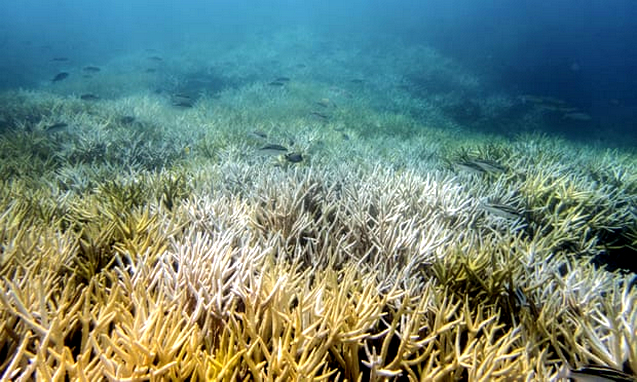
Bleached coral in Guam. The heating of oceans is causing tremendous problems for sea life. Photograph: David Burdick/AP
Last year was the hottest ever measured, continuing an upward trend that is a direct result of manmade greenhouse gas emissions.
The key to the measurements is the oceans. Oceans
absorb more than 90% of the heat that results from greenhouse gases, so
if you want to measure global warming you really have to measure ocean
warming.
There are other ways to measure climate change, but none are as
convincing as the oceans. Air temperatures are most commonly reported in
the media as evidence of global warming, but the problem with these is
they are very erratic. While there is certainly a long-term trend of
higher air temperatures, any given year may be warmer or colder than the
last.
So oceans are key, and they are telling us a clear story. The last
five years were the five hottest on record. The numbers are huge: in
2018 the extra ocean heat compared to a 1981-2010 baseline amounted to
196,700,000,000,000,000,000,000 joules. The current rate of ocean
warming is equivalent to five Hiroshima-size atomic bombs exploding
every second.
The measurements have been published in the journal Advances in Atmospheric Sciences
in an article by Lijing Cheng, the lead author, and his colleagues from
the Institute for Atmospheric Physics in China. His collaborators, of
which I am one, included researchers from around the world. The article
charts ocean heat back to the late 1950s, showing a steady increase.
2018 was the hottest year measured for Earth’s oceans compared with the 1981-2010 average
Guardian graphic. Source: Advances in Atmospheric Sciences. *Change in ocean heat content in zettajoules (1021 joules)
Ocean warming is incontrovertible proof of global warming, and there
are real consequences to a warming ocean. Firstly, warmer water expands,
and this expansion causes sea levels to rise. Approximately a third of
the rise in ocean waters is a result of the heat absorbed by the oceans.
Scientists expect about one metre of sea level rise by the end of the
century, which would be enough to displace 150 million people worldwide.
The warming waters also make storms more powerful. In the US
recently, we have seen hurricanes pass over extremely warm ocean waters,
which has supercharged them and increased the damage they cause. Other
kinds of storms are also being made stronger. Heavier downpours of
rainfall are increasing flooding around the world. Simply put, our
emissions of greenhouse gases have caused loss of life and property. We
are all responsible, but the people who have denied the science and the
solutions own a special responsibility that history will judge harshly.
It isn’t just humans that are suffering and will suffer more in the
future. The heating of oceans is causing tremendous problems for sea
life, particularly coral reefs. If we continue to warm the planet, we
can expect to lose much of these reefs. We can also anticipate
reductions in fish and sea life populations.
We scientists sound like a broken record. Every year we present the
science and plead for action. Not nearly enough is being done. We can
still tackle climate change, but we must act immediately. We have the
means to make a difference, we lack only the will.