29/01/2019

Davos Oils The Wheels Of An Ecological Turnaround

AFR - Ambrose Evans-Pritchard, The Telegraph London

Nowhere in global discourse do Big Oil and Big Ecology come together quite so starkly as in Davos, their two parallel universes briefly intersecting in the capital of cognitive dissonance.
In one room Al Gore gives a masterful tour d'horizon of the predicament we face.
"We are putting 110 million tonnes of man-made, heat-trapping, global-warming pollutants into the very thin shell of the atmosphere as if it were an open sewer, and we do that every single day," he tells a gathering of ministers, princes and billionaires.
Al Gore at Davos, where he gave a masterful tour d'horizon of the predicament we face.  Jason Alden
Mr Gore alerts us to a study this month from the Proceedings of the National Academy of Sciences showing that Greenland's ice is melting four times faster than assumed.
He guides us to the terrifying Hothouse Earth report: we are on track for a temperature rise of 4-5 degrees above pre-industrial levels even under the CO2 targets of the Paris Agreement.
Lethal feedback loops will kick in as permafrost melts across Siberia and methane hydrates are released from the ocean. A cascade of critical thresholds will turn the Amazon to semi-desert. The West Antarctic Ice Sheet will plunge into the water.
As the dominoes fall, sea levels could rise by 60 metres, though that might be the least of our problems. Much of the world would simply be "uninhabitable".
The Davos elites are reduced to tears by Sir David Attenborough's gruesome footage of 100,000 walruses crushed together for survival on a thin strip of the north Russia coast because their ice habitats have vanished.
The mammals are forced on to cliffs, and then slither down to their deaths in a fantastical apocalypse.
Britain's Prince William, left, listens to Sir David Attenborough, who reduced the Davos elites to tears. Markus Schreiber
The audience leap to their feet for a triple ovation. Sir David sweeps the World Economic Forum.
At the same time, Opec leaders are in another room asserting that nothing much is going to change. Fossil dominance is ineluctable.
Amin Nasser, head of Saudi Aramco, says he is not losing any sleep over peak oil or stranded assets. "I don't see it happening in 10 years or even by 2040."
Opec chief Mohammed Barkindo is less defiant, and more alert to the fast-changing mood.
Opec chief Mohammed Barkindo at Davos: "Eighty-two per cent of the world's population has never flown in an aircraft, so there is a huge demand going forward." Simon Dawson
"Our industry is literally under siege and the future of oil is at stake," he said. Yet little is actually changing.
"In our projections, the world oil outlook to 2040, oil will continue to dominate the energy basket," he said.
"The key drivers are trucks, aviation, petrochemicals.
"Eighty-two per cent of the world's population has never flown in an aircraft, so there is a huge demand going forward."
Fatih Birol, the IEA's chief, says the emerging economies of Asia are adding a new coal plant every week.  Aaron M. Sprecher
Opec thinks oil will still be 27 per cent of the global energy mix in 2040, and that fossil fuels will broadly retain the 70 per cent share they hold today. Renewables will still be just 5.4 per cent.
Mr Barkindo notes that the neutral International Energy Agency (IEA) has much the same estimates. He is right.
Oil historian Daniel Yergin from IHS thinks oil demand will peak near 2040 but at a much higher level than today. It will then plateau, held aloft by powerful economic forces.
"I don't think peak means plummet," he said. "We're going to have two billion more people than now."
Rachel Kyte, the UN's special envoy for sustainable energy: "There are still fossil-fuel subsidies in G7 countries. That is ridiculous."  Jessica Hromas
In short, Big Oil and those who know its rhythms are in utter irreconcilable conflict with the planet evangelists. It is natural for anybody with a greenish Weltanschauung to feel a sense of moral outrage.Yet as you drill deeper into the global-warming debate, the moral contours become less clear. This complexity too was in evidence at the policy panels and back rooms of Davos.

The new tobacco companies
Shell, BP, and Total are all at various stages of reinventing themselves as renewable energy companies.
Any non-state oil and gas company that digs in its heels faces a shareholder backlash and the wrath of the disinvestment movement. They are the new tobacco companies.
John Hess, founder of Hess Petroleum, said oil equities are shunned on Wall Street. There is already a fat climate discount on valuations.
"How we get back the hearts and minds of our industry is a real challenge," he said.
Vicki Hollub from Occidental says no major oil and gas company can raise capital or function properly unless it has a climate mitigation plan, and these days it must be more than superficial "greenwashing" or rebranding.
Occidental has teamed up with Net Power in Texas to push for a revolutionary form of carbon capture and storage (CCS).
This puts an oil major once decried as a climate villain on the other side of the ledger.
Net Power was founded by an ex-Goldman Sachs banker who decided to devote the rest of his life and all his money to cracking CCS. His goal was to find a commercially viable way to eliminate the CO2 emissions of coal and gas plants.
The company has built a plant based on the British-designed Allam Cycle with an "oxy-combustion" system using pure oxygen. It uses pressurised Allam Cycle itself to drive a turbine. It is a closed loop with no smokestack.
The hope is that the technology will capture 100 per cent of greenhouse gases and other pollutants at no extra running cost.
Zero-cost CCS would do more to cut emissions than electric vehicles - marvellous though they may be - even if every fossil-fuelled car on the planet were eliminated.
Fatih Birol, the IEA's chief, says the emerging economies of Asia are adding a new coal plant every week. The region has 2000 gigawatts of coal power from facilities with another 40 years of life ahead of them.
The sunk investments cannot be wished away.
"There is a gross disconnect between all the reports and targets and what people say at Davos, and what is happening in real life," he said.
"I am not saying that oil and gas are innocent, but they are not the main problem. There seems to be a blind spot about this in the climate-change debate."
The IEA estimates that coal accounts for 30 per cent of greenhouse gases.
"We have to move to CCS," he said, adding that just 8 per cent of CO2 emissions come from the 1 billion cars on the roads (to be 2 billion in another generation).

The distorting Tesla effect
Even if EVs reached 300 million by 2040 - an ambitious target - this would cut new emissions by just 1 per cent. The Tesla effect has distorted public perception.
"I don't think a lot of policymakers have an understanding of how Herculean the task is," said John Hess.
He invoked the 15 "Princeton Wedges", the combination of measures that would broadly be needed to cut emissions to zero while meeting the surging energy needs of China, India, the developing economies.
The world would have to do the following:
  • triple nuclear power to 1200 gigawatts
  • increase wind power tenfold to 2 million turbines
  • increase solar panels a hundredfold to 15,000 square miles (38,850sq km)
  • replace 1400 coal plants with gas, and fit 800 remaining plants with CCS
  • double vehicle efficiency from 30mp/g to 60mp/g (3.9 litres per 100km), and cut mileage driven by half
  • raise biomass ethanol from one sixth of the world's cropland
  • stop all tropical deforestation
  • adopt conservation tillage across all global agriculture and so forth.
Seen in this light, the vilification of the oil industry alone smacks of scapegoating.
"Climate change is real. You see it in warmer oceans where the water is acidifying, and in melting glaciers," said Mr Hess.
"I don't think anybody disagrees with the 'what'. It's the 'how' that is the real challenge."
The biggest single cause of global warming is farming and loss of forest combined, accelerated by our meat-based eating habits.
As an impassioned World Bank official told a panel, governments spend $US560 billion ($779 billion) a year on farm subsidies. Much of this promotes destructive practices.
The chief culprits are the US, Europe and the rich OECD economies. Part of the money goes into growing animal feed, a subsidy for livestock and cows (methane).

Fossil fuel subsidies 'ridiculous'
Or it goes into the production of sugar and high-fructose corn syrup, aiding and abetting our misnamed obesity "epidemic".
It is not an epidemic. It is a state-promoted and funded addiction syndrome.
A further $US250 billion goes into fossil-fuel subsidies, mostly in poorer countries.
This diverts scarce funds from healthcare and education towards the active encouragement of energy wastage and CO2 emissions.
Rachel Kyte, the UN's special envoy for sustainable energy, said everybody is to blame.
"There are still fossil-fuel subsidies in G7 countries," she said.
"That is ridiculous. We are not being consistent and coherent across our economies."
With the right policy framework the private sector will pick up the baton and run with it.
"The technology exists and it can be done affordably," she said.
If there is an enemy, it is not the oil industry. It is us.

Links

'Terrifying': Scientists Dig Deep For Missing Piece Of Climate Puzzle

Fairfax - Peter Hannam

This weekend, a crucial but barely heralded scientific mission will come to an end in a remote part of Antarctica.
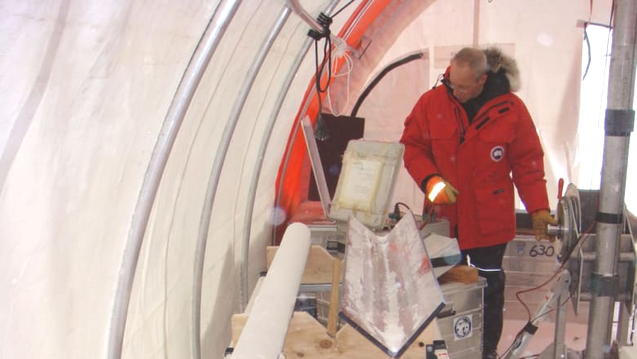
A team of seven Australian and American researchers will conduct the last extraction of ancient air from ice cores drilled as deep as 240 metres.
David Etheridge, CSIRO lead scientist on the Hydroxyl project, at Law Dome laboratory in Antarctica. Credit: CSIRO
They hope to reveal answers to some fundamental questions about how our atmosphere is coping with our soaring emissions of greenhouse gases.
“We’re trying hard not to screw it up," Peter Neff, a glaciologist at the University of Washington, tells the Sun-Herald and Sunday Age from behind the wheel of a tracked snow vehicle at his icy basecamp.
"Every time we handle a sample, it’s terrifying - it only takes one mistake to ruin weeks of work.”
In fact, the findings of the six-year project - led by senior CSIRO atmospheric scientist David Etheridge and Vas Petrenko from the University of Rochester in the US - may carry their own measure of terror, depending on how they turn out.
The role of carbon dioxide, the primary greenhouse gas, has been known for more than a century, including how it is eventually removed from the atmosphere by absorption into the oceans or by terrestrial plants.
But what has actually happened to some 40 other gases, including methane, hydrofluorocarbons and ozone-depleting chemicals, over the decades since industrialisation turns out to be rather less well understood.
"We know pretty well how [these gases] are produced. We need to know how quickly they are removed," Etheridge says from the rather warmer confines of Melbourne this week.
"Without that, we’ve only got part of the puzzle, part of the equation.”
The quandary in question goes something like this.
We know hydroxyl radicals - which bond oxygen and hydrogen - act like atmospheric scrubbers, destroying non-CO2 greenhouse gases such as methane.
The ice core drilling station at Law Dome, 120 kilometres inland from Casey Station. Credit: AAP
Those gases contribute about a third of the extra warming we're inflicting on our planet by trapping additional heat from the sun in our atmosphere.
Hydroxyl is naturally produced in the atmosphere but so reactive that a radical lasts only about a second before destroying a pollutant molecule, and itself.
"Because hydroxyl is so variable, with such a short lifetime and so variable in time and space, it’s actually hard to quantify even in the modern atmosphere,” he says.
More to the point, though, we have little notion of whether this critical cleanser has increased or decreased in abundance since pre-industrial times - with implications for future emissions.
The oxidation process involving hydroxyl is actually crucial at keeping methane “in the supporting role that it’s in, rather than actually becoming the leading troublemaker for warming the atmosphere", Neff says.
The implication - depending how the results play out - could include requiring a recalibration of the major climate models that underpin the Paris climate agreement that almost 200 nations have signed up to.
"All of [the models] are making an assumption about the fundamental reactivity [of hydroxyl in] the atmosphere before the year 1990," Neff says. “This is the first actual check on that part of those models."
Making that check has been no easy feat, and involved more than the odd "touch and go moment", he says.
A savage round of cuts planned by CSIRO management, announced three years ago next week, brought the whole project within days of being axed. Public pressure at home and internationally ended up sparing many scientists from the chop, including possibly this project.
Lately, the challenges have been mostly physical, including coping with the bitter cold - temperatures often drop below minus 20 degrees - and heavy snow drifts that come with working at Law Dome, some 120 kilometres east of Australia's main Antarctic base at Casey.
Etheridge has been involved in decades of atmospheric research and knew Law Dome had special qualities the scientists would need. In particular, the site happens to have some of the heaviest snow falls anywhere.
“Right here, we have about 10 times the average snow in Antarctica - 120 centimetres a year versus five to 10 centimetres," Neff said. “It buries the ice much more quickly than anywhere else. It just piles and piles on top."
Drilling ice cores to analyse the air trapped within the compacted snow has been routine for polar ice scientists for decades. In the case of a hydroxyl hunt, however, such air samples are particularly valuable.
David Etheridge and colleague working in a blizzard at Law Dome.
The researchers won't find the radical compound because hydroxyl is not stored for any length of time in a container, let alone for hundreds of years in ice. Rather, the scientists are after a proxy molecule - the carbon-14 isotope of monoxide - that indirectly will reveal the past abundance of hydroxyl.
Carbon-14 is produced by reaction with cosmic rays from outside the solar system, but the heavy snowfall at Law Dome acts "like a shield in an X-ray".
The snow, then, protects the air in the deeper ice so that carbon-14 is not produced there by cosmic rays which would otherwise alter its level, compared with its original amounts in the atmosphere.
Neff says there are no better places to drill.
“It’s literally the only place on the planet where we can get large amounts of clean air that have not been compromised by this carbon-14 aspect that we are looking for," he says.
Of course, getting to that evidence is hardly a ski in the back country.
Scientists typically sleep in mountaineering tents, tucked in a summer sleeping bag, inside a winter one. Snow drifts are such that staff have increasing difficultly over time fighting the snow drifts, Neff says.
The crew have worked about 77 days straight to complete six drilling operations, extracting about 5 tonnes of ice. The average of the three deepest drills has secured the scientists ice dating from about 1875.
That's early enough to capture the conditions of the air before the biggest surge in greenhouse gases kicked in. Methane emissions, for instance, have risen about 200 per cent since the late 1880s, Neff says.
Inside the drill tent with the ice core. Credit: Joel Pedro
Humans have also released a host of industrial chemicals with various abilities to warm the planet, affect its stratospheric ozone layer, and contribute to local pollution over that time, all of which may have added to hydroxyl's cleaning load.
So delicate are the experiments, though, the drills can't use drill fluids that would otherwise have allowed them to go deeper to, say, 1750 when the industrial era roughly began.
That sensitivity to possible contamination also extends to placing the science tent some 50 metres upwind of the other buildings - basically modified shipping containers - to avoid pollution from the camp's diesel generator.
The work can be intense not least because the ice has to be treated immediately it is extracted to preserve as much as possible the purity of the cores.
“They become like hot potatoes, where all of a sudden they are at the surface and are being bombarded by the full cosmic ray flux,” Neff says.
Rather than ship the ice thousands of kilometres to distant labs, it is melted and the key evidence placed in stainless steel tanks. About 20 of them, weighing about 10 kilograms each, will make the journey to Casey and beyond when the camp packs up in coming days.
Neff, who is also a geologist, says the work has gone better than expected.
“We’ve got absolutely everything we wanted to get done," he says.  The samples "have all been absolutely perfect and cleaner than we thought”.
At least another year of testing awaits, however, including at the ANSTO nuclear facility on Sydney's south-west fringe.
Etheridge, who helped provide the Sun-Herald and Sunday Age with a tour of CSIRO's world-renowned air archive at Aspendale in Melbourne's sandbelt last week, says his "gut-feeling" is that hydroxyl abundance will be shown to be on the skids.
"From my reading of the evidence and the chemistry, I would expect to see a decline over the industrial period of hydroxyl. I would expect it to have decreased," he says, stressing that the results from the current project have not been tested.
“I’m looking forward to being found wrong."
The findings would be strengthened by similar work in the northern hemisphere, such as drilling into Greenland's ice sheets although those cores are likely to be much dirtier than in the Antarctic.
The implications, though, of proof of a reduced ability to destroy methane - which now has a life in the atmosphere of about a decade - would be profound, depending on the scale of any decline.
Apart from raising the warming potential of methane - whether released from coal mines or natural gas fields - the potential for hydrogen to serve as a "clean fuel" could also be placed in doubt. (Labor this week floated a $1 billion plan to create hydrogen export zones in Queensland to be powered by a massive increase in renewable energy.)
"Hydrogen is a very leaky molecule and we’d have to expect that there’d be some leakage in its production," Etheridge says, adding that hydrogen itself has a greenhouse gas effect.
“It may not be of any significance, but we don’t know.”
Neff says that while being away from his family for 100 days is tough, he's proud that his work is going towards answering some of climate science's biggest questions.
"We don’t want to be operating blindly, [about] how much of an impact we have on the entire earth system," he says.
Etheridge likens his team's work to that of space exploration, where scientists pick up information that proves to be useful for something later on that can't yet be anticipated.
He notes that the CSIRO and other science agencies began flagging climate change as a threat in the 1980s well before the warming signal became clear above the background noise of natural variation.
“Now the signals are everywhere," he says.
"Here we are dealing with a $1 trillion question - whether we let the atmosphere go, business as usual and don’t care, or we reel in emissions and try to manage the planet.
“We are trying to manage that question with million-dollar science - it’s not a bad payback.”

Links

Climate Change Creates A New Migration Crisis For Bangladesh

National Geographic - Tim McDonnell

The country, already grappling with the Rohingya crisis, now faces a devastating migration problem as hundreds of thousands face an impossible choice between battered coastlines and urban slums.
A woman in Bangladesh uses bales of straw to try to protect a riverbank that is eroding away from floodwaters. Much of the country is ground zero for a global climate crisis. Photograph by G.M.B. Akash, Panos Pictures/Re​dux
Dhaka, Bangladesh - Golam Mostafa Sarder starts every day before dawn, rising from a thin reed mat in the shed that he shares with fifteen roommates. Each has just enough space to lie flat. He dresses in gym shorts and t-shirt by the light of a single dangling bulb.Outside the shed’s open doorway, in the outskirts of Dhaka, the sprawling megacity capital of Bangladesh, is the brick factory where Golam and his neighbors work for fifteen hours a day, seven days a week, at least six months a year. His home in Gabura, a remote village on the country’s southwestern coast, is more than a day’s journey from the city by bus, rickshaw, and ferry.
Golam’s job is to push wheelbarrows of mud down the production line. Waist-high rows of drying bricks spiral off from a towering kiln that belches smoke over an area the size of a city block. By 6 p.m. his lanky frame is spattered in gray mud. The evening air swims with mosquitoes. He has just enough strength left to clean his bare feet and angular face, inhale a dinner of lentils and rice, and collapse back onto his mat.
A teenage boy works at a brick field in Bhola, Bangladesh. Brick fields in urban areas are a common destination for coastal climate migrants, especially young men. Photograph by Mahmud Hossain Opu
Golam has never heard of global warming. But he says he knows one thing for sure: “If the river didn’t take our land, I wouldn’t need to be here."
Bangladesh, a densely populated, riverine South Asian nation, has always survived its share of tropical storms, flooding, and other natural disasters. But today, climate change is accelerating old forces of destruction, creating new patterns of displacement, and fueling an explosion of rapid, chaotic urbanization. A report last week from the U.S. Government Accountability Office found that the State Department and other foreign aid agencies have not done enough to combat climate change-induced migration in developing countries, and highlighted Bangladesh as particularly vulnerable. And as climate change drives the migration of up to 200 million people worldwide by 2050, Dhaka offers a cautionary tale for refuge cities around the globe.
Interviews with dozens of migrant families, scientists, urban planners, human rights advocates, and government officials across Bangladesh reveal that while the country is keenly aware of its vulnerability to climate change, not enough has been done to match the pace and scale of the resultant displacement and urbanization, toppling any prospect of a humane life for one of the world’s largest populations of climate migrants.
“Right now the government’s vision is to have no vision,” says Tasneem Siddiqui, a political scientist who leads the Refugee and Migratory Movements Research Unit at the University of Dhaka. “It’s just that everything is in Dhaka, and people are all coming to Dhaka. And Dhaka is collapsing.”

Climate-driven displacement
Bangladesh holds 165 million people in an area smaller than Illinois. One-third of them live along the southern coast, a lush honeycomb of island villages, farms, and fish ponds linked by protective embankments. Most of the country’s land area is no higher above sea level than New York City, and during the rainy season more than one-fifth of the country can be flooded at once.
For tens of thousands of years, people living in the vast Ganges Delta accepted a volatile, dangerous landscape of floods and tropical storms as the cost of access to rich agricultural soil and lucrative maritime trade routes.
Forida Khatun stands behind her house in Gabura, Bangladesh, in November. Two of her sons migrated to Dhaka after the family home was destroyed by storms multiple times and agricultural jobs were lost due to salinity intrusion. “Only Allah can save us," she says. "We don’t have any power to save our children.” Photograph by Tim McDonnell
“People have always coped with flooding, and they learned how to cope with death,” Siddiqui says. “But with climate change, many of the damages are permanent. So you have to adapt to a new way of life.” (Learn about Bangladesh’s floating hospital.)
Climate change is disrupting traditional rain patterns—droughts in some areas, unexpected deluges in others—and boosting silt-heavy runoff from glaciers in the Himalaya Mountains upstream, leading to an increase in flooding and riverbank erosion. Every year, an area larger than Manhattan washes away. Meanwhile, sea-level rise is pushing saltwater into coastal agricultural areas and promising to permanently submerge large swaths.
Over the last decade, nearly 700,000 Bangladeshis were displaced on average each year by natural disasters, according to the Internal Displacement Monitoring Centre. That number spikes in years with catastrophic cyclones, like 2009’s Aila, which displaced millions of people and killed more than 200. But even in relatively calm years, there is a rising drumbeat of displacement as sea-level rise, erosion, salinity intrusion, crop failures, and repeat inundation make life along the coast untenable.
Overall, the number of Bangladeshis displaced by the varied impacts of climate change could reach 13.3 million by 2050, making it the country’s number-one driver of internal migration, according to a March 2018 World Bank report.
“On the coast, we can predict with great certainty that many people living there now will simply not be able to continue there, because their livelihoods will be lost,” says Saleemul Huq, director of the Dhaka-based International Centre for Climate Change and Development and one of the country’s leading climate scientists.
As people flee vulnerable coastal areas, most are arriving in urban slums—particularly in Dhaka, one of the world’s fastest-growing and most densely populated megacities. The city is perceived as the country’s bastion of economic opportunity, but it is also fraught with extreme poverty, public health hazards, human trafficking, and other risks, including its own vulnerability to floods. Already, up to 400,000 low-income migrants arrive in Dhaka every year.
“Dhaka is filled with people who fled their village because it was swallowed by the sea or the rivers,” Huq says. “The coming millions will be impossible to absorb.”

How migration happens
Today, city planners, policymakers, scientists, and farmers are reinforcing embankments, innovating home design, rebuilding communities, building shelters, and cultivating salt-tolerant rice seeds, among other actions. But they’re moving too slowly to help many people like Golam, who survived a series of catastrophic storms only to find that migration was the only viable path remaining.
Golam was a child the first time his family’s house was destroyed. He was too young to remember the wind ripping out his father’s fruit trees, floodwaters carrying off tea and rice from the family’s small shop, the mud walls crumbling, him taking shelter with his mother in a neighbor’s house and then, when that too washed away, falling into an empty grave as they ran from the raging riverbank in the dark.
A second storm several years later took their next house. And a third, after that: Cyclone Aila washed away not only the latest house and everything in it, but also the land on which it stood, the family’s last piece of property.
After Aila, Golam’s family was homeless, landless, with almost no possessions, and awash in high-salinity water that would silently sabotage fishing and agriculture for the next decade. For a young man with a third-grade education, the brick factory and its promise of hard cash became the only way to feed his family.
“In my childhood, no one used to come out here for work,” he says. “But now, from my village, nearly every family sends at least one person.”
Golam’s family sent two: A couple years ago, his younger brother joined him. Each earns just shy of $1,500 in six months, his total income for the year.
Their only time off is when it rains. On those days, they take a bus to the international airport and stand outside the perimeter fence to watch planes fly in and out, and imagine where they might be going.
“I hope God will look at me kindly,” Golam says, “and change my luck.” (Learn about Bangladesh’s shipbreakers.)
Young men relax on a flood gate in the booming port town of Mongla, Bangladesh. The city aims to recreate itself as a magnet for climate migrants, with investments in sea walls and other adaptive infrastructure, factories and other job opportunities, as well as public services like affordable housing, schools, and hospitals. Photograph by Mahmud Hossain Opu 
 A city of climate change slums
For climate migrants who arrive in Dhaka, life is seldom easy. Men and boys work in brick factories, drive rickshaws, and build skyscrapers. Women and girls clean houses, stitch Western fashions, and raise families—often fending off sexual violence at multiple steps along the way. Education is a luxury; rent is preposterous. Eviction can come as suddenly as a collapsing riverbank. Home feels very far away.
Sahela Begum, 34, lost her husband to a heart attack in February. She managed to support their four daughters off his life savings for a few months in a town called Naria, on the banks of the Padma River. Then she lost their house. On a sticky evening in August, the riverbank it was on crumbled, sending it downstream along with a dozen of her neighbors’ houses.
“When my house was going in the water, I felt like I was having a stroke and might die,” she says. “When we lost the house, we ran out of options.”
Within a week, she left with her daughters for Dhaka, several hours upstream. They managed to find a room in a slum called Kamrangirchar, near the city center, in a dead-end alleyway behind a cacophonous fabric market built over an old trash dump. She pays around $40 a month, seventy percent of the salary she earns doing domestic work every day, for a darkened, ten-by-ten-foot concrete room under a stairway. Her oldest daughter, 13, also does domestic work, while the 11-year-old stays home to care for the 6- and 9-year-olds. They share three toilets and one four-burner stove with twelve other families living in the alley.
Forty percent of the city’s residents live in slums like this, hundreds of which are spread across the city. According to the International Organization for Migration, up to seventy percent of the slums’ residents moved there due to environmental challenges.
Slums emerge unplanned and unsanctioned in the backyards of glassy skyscrapers, straddling railroad tracks, on stilts above water-logged floodplains, on the fringes of construction sites. Single beds are frequently shared by five or more family members. Sewage runs freely. Structure fires spread easily. Most electricity, when it’s working at all, is tapped illegally from the grid. Insect infestations are inescapable. Skin and gastrointestinal diseases transmitted by dirty water are routine, and the infant mortality rate is twice that of rural areas. Rent money flows into a real estate black market controlled by corrupt local officials and businessmen.
“It’s very hard to get a living here,” Begum says. “But my life is my childrens’ life. If I can make a good future for them, that’s the best thing I can hope for.” (Read about Bangladesh's Rohingya refugee crisis, which also has roots in environmental degradation.)

Cities for climate migrants
When Bangladesh gained independence in 1971, the population was 91 percent rural. But as the country began to pivot from an agricultural economy to one diversified into manufacturing and other urban industries, Dhaka exploded. Today, nearly one-third of the population lives in cities, and Dhaka’s population is nearly triple that of the country’s next three biggest cities combined. The city holds 47,500 people per square kilometer, nearly twice the population density of Manhattan.
Throughout that process of growth, “low-income people were totally left out of the development framework of the city,” says A.Q.M. Mahbub, an urban studies researcher at the University of Dhaka. Affordable housing, and public transit connecting the city center to suburbs as is common in megacities in India and China, were never priorities.
Local officials still tend to view slum dwellers as illegal squatters, rather than residents with a right to basic services. Tariq bin Yousuf, a senior official at the Dhaka City Corporation, a government agency that manages the city’s infrastructure, says that while the city has plans to build more affordable housing, it prefers to leave slum residents reliant on aid from local and international non-governmental organizations.
“If we invest money directly in slum areas, or give them an electricity supply, they will start to think, ‘O.K., we have these facilities, so we have the ownership of this land,’” he says. “Once we give them improved services, they become permanent.”
Many of the country’s leading public policy experts think that attitude—that climate migrants are a regrettable burden—is short-sighted.
Mohammed Kabir Hossain, who drives a rickshaw, is one of many climate migrants who were attracted to Mongla as an alternative to Dhaka. “Because of salinity and flooding, there’s not much opportunity in my village. But here, I can make good money,” he says. Photograph by Mahmud Hossain Opu 
“Climate change and migration you cannot stop,” the University of Dhaka’s Siddiqui says. “But you can turn them into an opportunity for development.”
Mongla, a booming port town on the country’s south-central coast, is testing that theory by embarking on an urban overhaul that aims to turn it into a magnet for climate migrants. It’s one of several emerging “secondary cities,” models of climate-savvy urban planning where investments in sea walls and other adaptive infrastructure are being paired with factories and other blue-collar job opportunities, as well as public services like affordable housing, schools, and hospitals.
“There’s no way to stop people coming to Dhaka unless we can attract them to other places,” Huq says. “The next ten million could go to these secondary towns. The girls and boys of today, the next generation of citizens.”
Mongla has the right ingredients, planners hope. It has a well-established deepwater port, surrounded by a sprawling industrial area with cement factories, diesel fuel mass storage facilities, and two dozen factories with jobs for 4,300 workers producing everything from luggage and electronics to packaged snacks and mannequins. Located in the center of the country’s coastal belt, it’s big enough to offer opportunities but small enough that there’s room to grow.
“We have a master plan for making the city more functional and beautiful,” says Mohammed Alauddin, Mongla’s deputy mayor. “People used to have to leave Mongla to find work. Now they’re coming to work in industry, and staying because of the good living conditions.”
So far, local officials have invested in two flood-control gates; a freshwater treatment and distribution system that Alauddin says has increased the number of houses with running water from one-third of the city’s total to one-half; eleven kilometers of pedestrian-friendly riverside brick pathways; two dozen closed-circuit security cameras; a citywide loudspeaker system that can announce inclement weather and broadcast motivational pop music; and four thousand shade trees. Several new apartment towers are under construction, as well as a watchtower from which tourists can peer into the nearby Sundarban mangrove forest.
The investments appear to be paying off. In the last five years, the population has jumped nearly sixty percent to 110,000, and the price of land has skyrocketed. The industrial area is across a river from the town center, and every evening at rush hour the river is jammed with ferries on which passengers stand shoulder to shoulder. And the town’s reputation is spreading.
“Because of salinity and flooding, there’s not much opportunity in my village. But here, I can make good money,” says Mohammed Kabir Hossain, who drives a rickshaw from the industrial area to the ferry station. He came to Mongla a few years ago from Koyra on the southwestern coast. “A lot of people are coming here from across southern Bangladesh, especially those who are unwilling to go to Dhaka.”

‘Only Allah can save us’
At Golam’s family home in Gabura, two low wooden buildings frame a courtyard that opens onto a constellation of rectangular shrimp ponds stretching to the horizon. Immediately behind it is a crumbling ten-foot embankment, no more than three feet across, paved with the same gray bricks that Golam and men from every family here labor far from home to produce. Behind the embankment, a river divides civilization from the uninhabitable Sundarbans, the world’s largest mangrove forest. The family lives in fear that their house—on a tiny wedge rented from the village—will again wash away.
Forida Khatun, Golam’s mother, shares her son’s angular face. She crouches against the exterior wall of the house wrapped in a purple sari with yellow flowers, her arms shimmering in silvery bracelets, shooing away a nosy chicken. In a high, thin voice she recalls how Golam was an energetic, devious child, always in trouble. He loved boats, and once took a canoe out into the mangroves for so long that he was too exhausted to row himself home. That time, Khatun was able to dispatch a few older boys from the neighborhood to rescue him. Now, she worries that he’s slipped away from her for good.
“If we had the land still, if the salinity was less, our sons could have managed to stay,” she says. “Only Allah can save us. We don’t have any power to save our children.”
Here, land is wealth, and the family has none left. At the same time, salinity has poisoned the job market as much as it has the water and soil: Many wealthier farmers have converted their rice paddies—a reliable opportunity for paid labor—into salt-tolerant shrimp ponds, which essentially care for themselves.
The corrosive effect of salinity on local agricultural economies could displace up to 200,000 people from coastal Bangladesh, a November study from the International Food Policy Research Institute found. That exodus is already well underway in Gabura.
“Because of climate change, the job opportunities are reducing,” says Isharat Jahan Mintu, the chairman of the village government. “And the huge risk of natural disasters makes people want to go to safer areas.”
Mintu estimates that the high tide is rising by one foot per year on average, and that one-third of the village’s farmable acres have been rendered useless by salinity. Farmers are reluctant to bring more than a fraction of their useable acres into cultivation, for fear of seeing their entire nest egg washed away at once and local banks, seeing the same risk, are stingy with loans. As a result, up to two-thirds of the village’s men, including Golam, have left to find work in Dhaka and other cities either temporarily or for good.
As a generation of young people loses faith in what was once one of the most richly productive regions of South Asia, those who remain worry that the village’s social fabric will be irreparably damaged. Families are fragmented, children grow up without fathers, and lifelong neighbors turn against one another over land. Parts of the embankment resemble ghost towns, lined with boarded-up shops. No one wants to leave, but many see no way to stay.
“Migration is very emotional,” Mintu says. “It makes an emptiness in the heart of the village.”

Links

28/01/2019

What Is Global Warming, Explained

National Geographic - Christina Nunez

The planet is heating up—and fast.

Causes and Effects of Climate Change

Glaciers are melting, sea levels are rising, cloud forests are dying, and wildlife is scrambling to keep pace. It has become clear that humans have caused most of the past century's warming by releasing heat-trapping gases as we power our modern lives. Called greenhouse gases, their levels are higher now than at any time in the last 800,000 years.
We often call the result global warming, but it is causing a set of changes to the Earth's climate, or long-term weather patterns, that varies from place to place. While many people think of global warming and climate change as synonyms, scientists use “climate change” when describing the complex shifts now affecting our planet’s weather and climate systems—in part because some areas actually get cooler in the short term.
Climate change encompasses not only rising average temperatures but also extreme weather events, shifting wildlife populations and habitats, rising seas, and a range of other impacts. All of those changes are emerging as humans continue to add heat-trapping greenhouse gases to the atmosphere, changing the rhythms of climate that all living things have come to rely on.
What will we do—what can we do—to slow this human-caused warming? How will we cope with the changes we've already set into motion? While we struggle to figure it all out, the fate of the Earth as we know it—coasts, forests, farms, and snow-capped mountains—hangs in the balance.

Understanding the greenhouse effect
The "greenhouse effect" is the warming that happens when certain gases in Earth's atmosphere trap heat. These gases let in light but keep heat from escaping, like the glass walls of a greenhouse, hence the name.
Sunlight shines onto the Earth's surface, where the energy is absorbed and then radiate back into the atmosphere as heat. In the atmosphere, greenhouse gas molecules trap some of the heat, and the rest escapes into space. The more greenhouse gases concentrate in the atmosphere, the more heat gets locked up in the molecules.
Scientists have known about the greenhouse effect since 1824, when Joseph Fourier calculated that the Earth would be much colder if it had no atmosphere. This natural greenhouse effect is what keeps the Earth's climate livable. Without it, the Earth's surface would be an average of about 60 degrees Fahrenheit (33 degrees Celsius) cooler.
A polar bear stands sentinel on Rudolf Island in Russia’s Franz Josef Land archipelago, where the perennial ice is melting. Photograph by Cory Richards
In 1895, the Swedish chemist Svante Arrhenius discovered that humans could enhance the greenhouse effect by making carbon dioxide, a greenhouse gas. He kicked off 100 years of climate research that has given us a sophisticated understanding of global warming.
Levels of greenhouse gases have gone up and down over the Earth's history, but they had been fairly constant for the past few thousand years. Global average temperatures had also stayed fairly constant over that time—until the past 150 years. Through the burning of fossil fuels and other activities that have emitted large amounts of greenhouse gases, particularly over the past few decades, humans are now enhancing the greenhouse effect and warming Earth significantly, and in ways that promise many effects, scientists warn.

Aren't temperature changes natural?
Human activity isn't the only factor that affects Earth's climate. Volcanic eruptions and variations in solar radiation from sunspots, solar wind, and the Earth's position relative to the sun also play a role. So do large-scale weather patterns such as El Niño.
But climate models that scientists use to monitor Earth’s temperatures take those factors into account. Changes in solar radiation levels as well as minute particles suspended in the atmosphere from volcanic eruptions, for example, have contributed only about two percent to the recent warming effect. The balance comes from greenhouse gases and other human-caused factors, such as land use change.
The short timescale of this recent warming is singular as well. Volcanic eruptions, for example, emit particles that temporarily cool the Earth's surface. But their effect lasts just a few years. Events like El Niño also work on fairly short and predictable cycles. On the other hand, the types of global temperature fluctuations that have contributed to ice ages occur on a cycle of hundreds of thousands of years.
For thousands of years now, emissions of greenhouse gases to the atmosphere have been balanced out by greenhouse gases that are naturally absorbed. As a result, greenhouse gas concentrations and temperatures have been fairly stable, which has allowed human civilization to flourish within a consistent climate.
Greenland is covered with a vast amount of ice—but the ice is melting four times faster than thought, suggesting that Greenland may be approaching a dangerous tipping point, with implications for global sea-level rise. Photograph by Michael Melford, Nat Geo Image Collection
Now, humans have increased the amount of carbon dioxide in the atmosphere by more than a third since the Industrial Revolution. Changes that have historically taken thousands of years are now happening over the course of decades.

Why does this matter?
The rapid rise in greenhouse gases is a problem because it’s changing the climate faster than some living things can adapt to. Also, a new and more unpredictable climate poses unique challenges to all life.
Historically, Earth's climate has regularly shifted between temperatures like those we see today and temperatures cold enough to cover much of North America and Europe with ice. The difference between average global temperatures today and during those ice ages is only about 9 degrees Fahrenheit (5 degrees Celsius), and the swings have tended to happen slowly, over hundreds of thousands of years.
But with concentrations of greenhouse gases rising, Earth's remaining ice sheets such as Greenland and Antarctica are starting to melt too. That extra water could raise sea levels significantly, and quickly. By 2050, sea levels are predicted to rise between one and 2.3 feet as glaciers melt.
As the mercury rises, the climate can change in unexpected ways. In addition to sea levels rising, weather can become more extreme. This means more intense major storms, more rain followed by longer and drier droughts—a challenge for growing crops—changes in the ranges in which plants and animals can live, and loss of water supplies that have historically come from glaciers.

Links

Imagining A Davos For The Many That Was Actually Serious About Climate Change

The Conversation - 

The World Economic Forum: in need of a refresh? Gian Ehrenzeller / EPA
From the moment world leaders claiming to want to fight climate change arrived in private jets, the 2019 World Economic Forum in Davos attracted controversy. With global inequality growing and the threat of environmental destruction looming ever larger, the jets are getting larger and more expensive. The director of one private charter company says surging demand for his planes is partly down to “business rivals not wanting to be seen to be outdone by one another”.
This contradiction between rhetoric and action goes far beyond the use of private aircraft. It reveals the broader problems of allowing billionaires to not only control a disproportionate amount of the world’s wealth but also shape its political and economic agenda. While recognising the need for change, their solutions will almost always lead to a defence of the status quo from which they profit so handsomely.
Davos is just the tip of the iceberg of the more pervasive problem of “charitable billionaires”. On the surface, it would appear that having “the 1%” direct their wealth toward worthy causes is both laudatory and necessary. But such philanthrocapitalism promotes market-friendly policies and devalues the ability of democratic governments to provide social welfare or meet the needs of their citizens. As one critic noted:
the problems capitalist philanthropists claim to be solving are rooted in the same economic system that allows them to generate such enormous wealth in the first place.
An obvious answer may then be to simply dismiss the World Economic Forum and Davos altogether. Stopgap solutions such as seeking to address economic insecurity through employee “mindfulness and well-being” could be mocked, at best.

An alternative and sustainable Davos?
However, the ethos of Davos still has much to offer. It represents an effort to bring together global leaders and influencers to address problems that go beyond national borders. If anything, it would appear that we need more of these trans-national spaces for discussing technological innovation and social transformation.

In orbit: Al Gore talks climate change at Davos. But what about system change? Gian Ehrenzeller / EPA
For Davos to truly be effective though, it must stop serving as a space for elites to defend their status and power. It must no longer be a forum, for instance, for CEOs like Tim Cook of Apple to defend his company and his executive allies from the legitimate “big tech backlash”. Rather, it should be an opportunity to force billionaires to invest in ambitious progressive solutions for solving the very problems they are primarily responsible for causing.
Climate change is a crucial place to start. At the moment, the most that pro-environmental voices such as New Zealand PM Jacinda Ardern can do is plead with elites to “get on the right side of history and embrace ‘guardianship’ of the earth”. Alternatively, Davos could be used to promote a more ambitious green agenda and directly challenge the power of the billionaire class and the politicians who continue to prop them up.
Leading up to Davos, US congresswoman Alexandria Ocasio-Cortez made headlines by calling for a “Green New Deal”. It proposes to have the US become a global leader in “decarbonising” its economy within ten years. Further, it will achieve these aims through massive public investment, a federal jobs guarantee, and a dramatic increase in the taxing of high income. The growing public support for this plan has also been a platform for progressive lawmakers to question the huge US military budget and tax cuts. Why, they ask, are war and wealth being prioritised over the housing, healthcare or the environment?

IMAGE
Link: FINAL Select Committee for a Green New Deal
This is a good beginning. Yet it would benefit from having the support of global movements and the capital of global elites. In an alternative world, Davos could be just such a venue for an international commitment to innovation and progressive change. Rather than just having countries fight to tax their richest citizens and corporations, they could also mandate that they have to invest a percentage of their profits in the ideas and agenda proposed by leading experts and activists around the world every year. In this case, it would be for helping to fund countries and communities to put in place a “green new deal”.
The roots of such an alternative are already growing in events like the “World Social Forum” which is an attempt to bring together community and political leaders with leading thinkers to imagine a different “world” to the corporate-friendly one supported by the World Economic Forum. Critically, it advocates “glocal” solutions, customised to local conditions. Davos, in this regard, could be a yearly corrective where those most affected by elite policies could put forward the specific solutions for them to rectify it.
For this to happen it would mean transforming the very ethos of Davos from one of “idea sharing” to that of democratic accountability and justice. It entails delinking social value and influence from economic wealth and the political influence it buys. Instead, Davos could be an annual opportunity for experts and “the people” to propose the best and most cutting edge ideas for redistributing this wealth to where it is truly needed and can do the most good. Scientists warn that we have only 12 years potentially left to avert a “climate change catastrophe”. It is why we need to create an alternative Davos “for the many, not the few” as soon as possible.

Links

2018 Was The Fourth Warmest Year On Record -- And More Evidence Of A ‘New Normal,’ Scientist Group Reports

Washington Post - Chris Mooney

The year was one in a string that have been a full degree Celsius, or 1.8 degrees Fahrenheit, warmer than temperatures in the late 19th century, the report found.
In this photo taken on November 10, 2018 Flames from the Camp fire burn near a home atop a ridge near Big Bend, California. JOSH EDELSON/AFP/Getty Images (Josh Edelson/AFP/Getty Images)
The year 2018 is likely to have been the fourth warmest year on record, a scientific group pronounced Thursday -- and joins three other extra-hot years since 2015 that suggest a leap upward in warmth that the Earth may never return from in our lifetimes.
The warmest year on record for the Earth’s land and oceans was 2016 -- by a long shot, thanks to a very strong El Nino event. That’s followed by 2017, 2015, and now 2018, said Zeke Hausfather, a research scientist with Berkeley Earth, which released the findings.
“2018 is consistent with the long term warming trend,” Hausfather said. “It’s significantly warmer than any of the years before 2015. There’s still this big bump up after 2014, and 2015, 2016, 2017, and 2018 are all in a class of their own.”
Berkeley Earth. (n/a)
While expert groups have sometimes divided on such annual temperature rankings -- and not all assessments are yet in -- Berkeley Earth’s findings appear unlikely to be disputed.
The Copernicus Climate Change Service, a European Union body, has also proclaimed 2018 the fourth warmest year on record earlier this month.
And Kevin Cowtan, a researcher at the University of York who also keeps an influential temperature dataset, agreed with the ranking, though he noted by email that he is only able to track data through November of last year due to the U.S. government shutdown, leaving his assessment one month short at present.
“Our results to November clearly put 2018 in 4th place, significantly warmer than 2010 in 5th,” said Cowtan. “The 11 hottest years on record have all occurred since 2005.”
Amid the government shutdown the U.S.'s two top keepers of temperature records -- NASA and NOAA -- have not yet released their findings. Last year, both agencies released their assessments for 2017′s temperatures, which NASA called the second warmest and NOAA the third, on January 18.
Hausfather said a coordinated release had been planned for January 17 with his organization and the U.S. government agencies -- before the shutdown, that is. Once that happened, he said, Berkeley Earth decided to go ahead and release its own numbers.
In response to a request for comment, NOAA said that it would look into the state of the 2018 temperature release. Meanwhile, on Thursday NASA’s Gavin Schmidt, who heads the agency office that keeps the temperature record, tweeted that their release has been “indefinitely postponed” due to the shutdown.
But Hausfather said that based on where the other temperature datasets currently stand, with data through November and thus only one month remaining to add, it’s likely there will be no disagreement about the rankings this year by any party.
Indeed, NASA’s Schmidt had tweeted back in October that 2018 would surely be the 4th warmest year.
IMAGE
“At this point, it would be almost impossible for 2018 not to be the fourth warmest in all the records,” Hausfather said.
2018 was yet another year of suspiciously extreme weather events -- such as the devastating California wildfires -- and also extra hot summer temperatures in Europe.
29 countries had their hottest years on record, Berkeley Earth found, including European countries like France and Germany but also Middle Eastern nations like Oman and the United Arab Emirates.
Notably, Antarctica also saw its warmest year on record, the group found.
Berkeley Earth (n/a)
The year yet again featured an odd cold anomaly in the seas to the southeast of Greenland, which some scientists think may represent a slowing down of the “overturning” ocean circulation in the Atlantic. Clearly, this region is bucking the overall warming trend.
From a political and policy perspective, the last several extra warm years are highly significant. That’s because, as the tweet from NASA’s Schmidt above notes, they appear to be at or above a 1 degree Celsius, or 1.8 degree Fahrenheit, increase above so-called “preindustrial” temperatures, or temperatures from the later part of the 19th century.
In Berkeley Earth’s dataset, the last 5 years are all above 1C; in two other datasets the last four years are expected to be above that threshold, according to data provided by Hausfather. In the National Oceanic and Atmospheric Administration dataset, 2018 is trending slightly under it.
Either way, this matters because scientists have outlined increasingly dire consequences as soon as the Earth reaches 1.5 C or 2C, temperature targets that are both flagged in the 2015 Paris climate agreement.
The arrival of 1.5 degrees C -- 2.7 degrees F -- could happen in under 2 decades. In fact, it has in effect already happened for many land areas, since land surfaces are warming quicker than the ocean at this point. But the oceans are warming too -- they may have been the warmest on record in 2018.
Berkeley Earth projects that 2019 may well be warmer than every year so far except for 2016 -- and thus will once again be above 1 C.
“It’s unlikely at this point that we’ll have a situation where temperatures dip back below that, at least for the globally complete datasets,” said Hausfather. He termed the current temperature range -- which has seen more extreme heat events, major coral bleaching and death around the world, and alarming wildfires, among other climate-linked occurrences -- a “new normal.”
Hausfather himself, living in the Bay Area, said he has been personally affected.
“We have a 1 and a half year old baby,” he said. “Earlier this fall after the Camp Fire, when the air quality was worse in San Francisco than it was in Beijing, we had to stay inside, bought an air purifier, had to wear masks outside.”
“We’ve also seen some crazy extreme heat events," he continued. "It reached 100 degrees in San Francisco two weeks after the baby was born….and obviously none of us have air conditioning, it’s San Francisco. So in general we’ve certainly noticed that these extremes appear to have become more common.”

Links

27/01/2019

Pacific Shames PM On Climate Policy

Sydney Morning Herald - Editorial

Prime Minister Scott Morrison, then the treasurer, used a lump of coal to make a point in Parliament in 2017.
(ABC News: Nick Haggarty)
Prime Minister Scott Morrison’s visit to the Pacific last week has buttressed some crucial alliances, amid concerns about China’s economic, military and political expansionism,  in our region.
His three days in Vanuatu and Fiji were long overdue. Mr Morrison has candidly confessed Australia has taken the region for granted. This was the first time an Australian prime minister had visited the region other than for a forum of regional leaders since John Howard.
Mr Morrison's visit, which follows a trip to Papua New Guinea last year where he announced a naval base on Manus Island, reflected a new awareness of the need to counterbalance China's growing influence in the region.
The visit was not only diplomatically and symbolically significant. Mr Morrison and his counterparts announced a range of cooperative projects, overwhelmingly funded by Australia, on infrastructure, migration, border protection, military capacity, sport, economics and more.
But while Mr Morrison's gesture in showing the flag was welcome, his trip was marred by a lack of leadership on the region’s biggest issue, global warming – which poses an existential threat through rising sea levels and the increased frequency of catastrophic weather events.
Fijian Prime Minister Frank Bainimarama said last week: ‘‘We cannot imagine how the interests of any single industry can be placed above the welfare of Pacific peoples and vulnerable people in the world over.’’
Mr Bainimarama is usually on the receiving end of lectures about human rights from Australia. His galling reproach is a sign that Australia's lack of action on climate change is hurting our standing in the region and  allowing China to take the moral high ground, however unfairly.
China has been funding infrastructure in Pacific nations, in what many analysts see as a bid to use debt-entrapment to gain sway, as part of its global One Belt One Road trade and infrastructure program.
Its illegal decision to build a military base on artificial islands in the South China Sea, threatening freedom of navigation in one of the most critical shipping routes, raises questions about its intentions in the Pacific, too.
From an Australian point of view, Mr Morrison’s trip, which follows the establishment of a $2 billion regional development fund by his government, a move supported by Labor, can but be seen in this Chinese context.
Australia should not treat China, its largest trading partner, as an enemy and it can look to partner with China where it can in development programs in the Pacific region. But Australia should ensure that China does not replace us as the crucial  player in the region.
For the Pacific nations whose low lying islands could disappear beneath the waves, Australia is letting the region down through insufficiently robust policies to cut carbon emissions.
Mr Morrison assured Mr Bainimarama he was pursuing "sensible, achievable policies" to meet Australia's commitments under the Paris climate treaty and will, in the meantime, be funding projects to protect the island nations from the effects of global warming.
Yet the Pacific nations understand only too well that Mr Morrison has abandoned any pretence of a national climate policy. His frequent claim that Australia can  hit the emissions reductions required under the Paris treaty "at a canter" is dubious.

Lethal Heating is a citizens' initiative