04/03/2019

Angus Taylor Again Falsely Claims Australia's Greenhouse Emissions Are Falling

The Guardian

The energy minister repeats PM’s line that emissions fell by 1% when the government’s own figures show the opposite
Angus Taylor repeatedly stated emissions had decreased by 1% in an interview on the ABC’s Insiders program. Photograph: Lukas Coch/AAP
The energy minister has again insisted Australia’s emissions are going down, when the government’s official figures show emissions continue to increase, as the government struggles to sell the latest incarnation of its energy policy.
In an interview with the ABC program Insiders, Angus Taylor repeatedly stated emissions had decreased by 1% repeating the line first said by the prime minister, Scott Morrison, that Australia would meet it’s Paris commitments in “a canter”.
“Yes, they’re coming down and the department rightly believes they’re going to continue to go down and the result of this is we will reach, not just our Kyoto targets and still in the Kyoto period, we will reach our Paris targets,” he said.
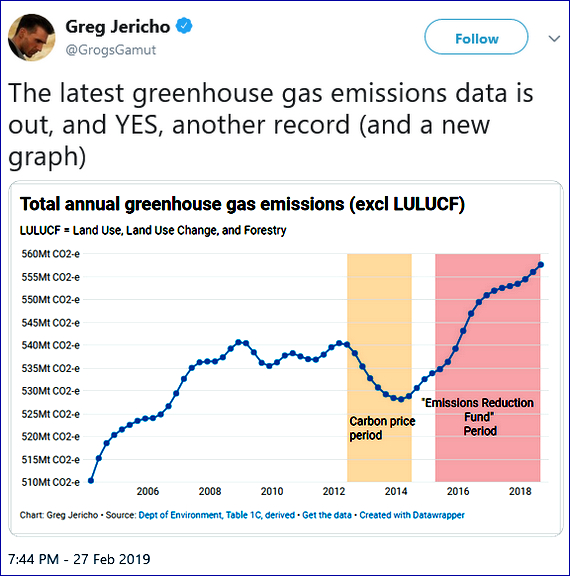
The latest report released by the environment department, looking at emissions between September 2017 and September 2018, showed total emissions in Australia had increased by 0.9%, continuing a pattern of increases over the past five years.


That rise in emissions was largely due to an increase in liquid natural gas exports, but other sectors, including stationary energy, transport and waste sectors also contributed.
Emissions in the electricity sector did continue to decrease, with brown coal supply down by 12.3% while energy generation from renewable sources increased by 14.2%.
The last substantial fall in Australian emissions occurred after the Gillard government put a price on carbon, which was immediately derided as a “carbon tax” by the Abbott opposition, a claim Tony Abbott’s chief advisor, Peta Credlin later admitted was not true and was just “brutal retail politics” which won Abbott the election.
Since then, the Coalition has struggled to settle on an energy policy, with its most serious attempt, the national energy guarantee, leading to the demise of Malcolm Turnbull’s prime ministership.
Under pressure from moderates and the electoral reality the Coalition needs to hold on to its inner city ‘small l Liberal’ seats if it is to have a chance at retaining power, Morrison unveiled a new energy policy late last month, announcing what amounts to a reboot of Tony Abbott’s Direct Action policy.
The emissions reduction fund only amounts to $200m a year. With the election less than three months away, the government has officially signed off on the expansion of the Snowy hydro-project, which began under Turnbull’s leadership, and committed at least $56m to the construction of the Marinus link, the so-called “battery of the nation” project, which would send Tasmania’s renewable power to the mainland.
However a feasibility study into the success of the Tasmanian interconnector project made it clear that its benefits would be realised “when approximately 7,000MW of the national electricity market’s present coal-fired generation capacity retires”, which would mean accelerating the removal of coal from the system.
“The largest single influencing factor in the economic feasibility and timing of Marinus Link is the trajectory of coal-fired generation retirement in the national electricity market,” the feasibility report concluded.
The government has not ruled out underwriting coal-fired generation projects in the future, with resources minister Matt Canavan admitting last week to Sky News the number was “around 10”, after Taylor repeatedly declined to put a figure on it.
But to underwrite coal-generation projects, while supporting the Tasmanian ‘battery of the nation’ project, the success of which relies on the removal of coal from the system, would establish a situation where the government was competing with itself, potentially making one project un-viable.
In his Sunday interview, Taylor still declined to put a figure on how many coal projects the government was considering underwriting, stating “I’m the energy minister, I am not going to commit to a number here and now”, but he said more competition was good, despite the contradiction in projects.
“You put your finger on it – we want more competition,” he said.
“We want more competition, not less. And if what we’re doing with Snowy 2.0 and what we’re doing with battery of the nation and what we’re doing with underwriting results in more competition against ourselves, as you put it, that is a great thing because the result of that is lower prices, keeping the lights on and avoiding the situation we had in Victoria in January – 200,000 houses lost their lights.
“Portland Aluminium smelter had to go off-line. If the battery of the nation had been up and running when that happened, it wouldn’t have happened.
“We got to address this. It is urgent. That’s why we’re doing it a number of ways. It will result in more supply, it will result in more competition as you rightly point out and that will drive down prices.”

Links

The Future Of Farming In The Era Of Climate Change

ABCMicaela Hambrett

Farmers are having to be increasingly vocal about their prospects in the wake of climate change. (Supplied: FCA)
Seemingly relentless climate-related headlines paint a picture of an agricultural industry under siege.
It has sparked concern among people like Nigel Gibson, who like many others have increasingly taken steps in their own suburban lives to prepare for the impacts of climate change.
But recent weather events have left Mr Gibson wondering if enough was being done for agricultural communities on a broader scale.
"Will farmers need to move or can they transition to other opportunities?" he asked ABC Central West NSW's Curious project.
"I feel this is something no-one is talking about."
It is true traditional agriculture is being increasingly tested, and until recently conversations around it evolving were largely taboo.
According to many on the ground, rural and regional Australia are now at a critical point in turning conversations into action.
But this is something farmers, by their adaptive nature, are well placed to do.

A redistribution of agricultural zones
Across Australia, our climate zones are moving. It's something Professor Mark Howden, the director of the ANU Climate Change Institute, has been tracking professionally for more than 27 years.
"What we're seeing is a couple of things; one is the whole of Australia is warming, although at slightly different rates and in different places," he said.
"What used to be conditions that we found further north in temperate terms are now happening further south, so you have your temperature migration happening.
"The other thing that's going on is the rainfall patterns are effectively following that.
"So the cold fronts that used to bring most of the rainfall to Perth across to Canberra now tend to be tracking further south and that rain is falling now over the Southern Ocean."
A side-by-side illustration depicting the southerly migration of Australia's rainfall zones. On the left is Australia's seasonal rainfall based on historical date; on the right, how seasonal rainfall zones have changed according to data from 2000 to 2015. (Supplied: David Stephens, Australian Export Grains Innovation Centre)
The implication for the agricultural industry from these climatic migrations varies from region to region in speed and scale.
Professor Howden cites high-rainfall grazing zones as an example.
"What used to be called the high-rainfall grazing zones — around Goulburn or down towards Melbourne or just inland in WA — those are zones that used to be too wet for cropping.
"But now, because the rainfall has reduced by about 20 per cent, they are actually good for cropping."
Climate migrations are changing what is possible to cultivate and where and therefore changing the land use for certain areas.
But those in both research and farming alliances stress this is not a reason to panic but rather time for an overdue assessment of what is happening in rural and remote Australia and how communities can meet and manage the changes.

The political climate
Conversations around climate change have been held back by controversy and politics, stymieing meaningful policy change for people in farming communities.
It's something Farmers for Climate Action (FCA) chief executive Verity Morgan Schmidt is tackling.
The first agricultural climate alliance in Australia, FCA is advocating for climate solutions both on and off farm — and changing the conversation in a sector that has traditionally been climate conservative.
"We find there's a lot of reluctance at a federal level to actually base policy on science, and that means, as farmers and rural communities, that you are making decisions within a policy framework that isn't actually the best informed, and that's deeply concerning," she said.
Farmers for Climate Action CEO Verity Morgan Schmidt with Rockhampton grazier Mick Alexander. (Supplied: FCA)
As a result, Ms Morgan Schmidt believes agricultural communities have been left at a huge disadvantage.
"It consistently sets you up to fail," she said.
"If you don't take into account the speed at which our climate is changing, if you don't take into account, for example, shifting inflows into the Murry-Darling Basin or rainfall zones shifting south, it's very hard to build a sustainable farm operation because you are operating on a policy framework that is at best outdated.
"But it's also very difficult for you to do sustainable planning at community level."
In August last year, FCA released its Rural Futures report that confronted climate change-related issues facing many regional communities.
"[The report] stared a lot of these issues in the face and went, 'Right, how do we do things differently, how do we kickstart a conversation with these communities so that we are not walking blindly into that cycle of decline?'" Ms Morgan Schmidt said.
"How can we diversify regional economies, particularly some of these economies that have been through a boom-bust cycle of drought, mining and extracted industries?
"How do we recognise that the climate is making it increasingly challenging for us to continue agriculture in many of these regions?"

The ultimate early adapters
Anika Molesworth is a young farmer from Broken Hill in New South Wales who in 2017 was the state's finalist for Young Australian of the Year.
Ms Molesworth's family moved on-farm at the start of the Millennium drought, and growing up in the grip of climate extremes shaped her early understanding of its role in agriculture and galvanised her commitment to change in the industry.
She has emerged as a strong voice in the next generation of farmers, comfortable discussing the realities of climate change and realistic about its limitations.
"I think farmers are an incredibly innovative, adaptive and resilient breed of people," she said.
"They have always been adapting to changes in temperatures and rainfall seasonal variability and they've done a phenomenal job of it.
"But I think the rate and the scale of the environmental changes being driven by climate change mean that we really have to start thinking outside the box.
Riverina farmer Anika Molesworth on her family's property near Broken Hill in New South Wales. (AOTY)
 "Agritourism, insect farming off waste resources, bush tucker foods — there are options out there, but it's not traditional agriculture in that sense.
"We need support structures, new ideas, people helping us transition to these other production industries."
She believes the first step needs to come from the energy sector to buy more time for other industries to develop response strategies.
"The easiest way to put the brakes on what we are experiencing is to transition away from dirty fossil fuel energy to clean, renewable energy; that then takes the pressure off other industries."
When asked what life will look like if action isn't taken, Ms Molesworth is absolute.
"It has to happen, it's a simple as that.
"We are already seeing these terrible outcomes of mismanagement of natural resources impacting huge parts of Australia, our ecosystem, the biodiversity, the communities.
"We really need to be working together on these issues. Not happening is not an option."
Farmers attend a workshop on combating climate change, as part of Associate Professor Lauren Rickards' Critical Breaking Point study. (Supplied: Birchip Cropping Group)
Thinking outside the box
There are instances of agricultural industries moving their operations in response to climate change, most notably the wine industry's migration south to Tasmania.
There are also individual examples of private enterprise packing up and moving in response to climate limitations.
And while some degree of human migration is likely to be necessary eventually due to climate change, overwhelmingly how rural communities should be thinking is what new, sustainable land use their region could migrate to.
"Agricultural zones that have been our primary grazing zones are drying out, but there's advantage there," said Associate Professor Lauren Rickards, co-leader of the Climate Change Resilience research program at RMIT.
But realising it will require a real-time rewiring of traditional thinking about agriculture, policy and incentives.
"We've got to look past the rusted-on, siloed ideas — so, agricultural land might become energy production land, but the opportunity for that town is not going to be realised if agriculturalists keep talking to agriculturalists," she said.
"To get those new, different alternatives in there like wind farms, solar farms, bio fuels or even new wheat crop varieties; it feels like we're not having the big enough conversations about broad enough options.
"I think a lot of creativity is possible if we actually bring together a broader range of people."
Australia's cropping belt appears to be moving south. The blue areas represent increases in cropping farms in the 2000s relative to the 1990s. Red represents decreases. (Supplied: ANU (Neal Hughes)
Need for a bigger picture
David Littleproud, the Minister for Agriculture and Water Resources, says measures are being put in place by the Commonwealth to help rural communities.
"Every year, the Federal Government puts $300 million into research, development and expansion to give our farmers the tools, the cutting-edge science to adapt to a changing climate," he said.
"The Future Drought Fund will also go towards an investment — a $100 million dividend each year to look like climate adaptation."
But Ms Morgan Schmidt believes these measures are reactionary and operating in a policy vacuum.
"The reality is it's always going to be a band-aid solution. We need to stop thinking in short-term approaches to managing this," she said.
"If we look at the drought summit that was heralded when the new PM Scott Morrison came in saying that drought was his top priority — the summit didn't even include climate scientists.
"If we are not actively engaging in a conversation about what the future of our regional areas look like under climate change, then we are going to struggle to ever get drought policy right."

Grains for solar
Peter Mailler says successive governments have failed to see agriculture as socially imperative and climate change has been ignored. (ABC News)
Peter Mailler, a farmer from Boggabilla on the NSW-Queensland border, read the writing on the wall and transitioned part of his grain operation for solar farming in 2015.
He believes the Commonwealth is yet to provide any powerful or realistic market incentive to migrate rural communities away from unsustainable farming practices.
"If you want practice change in agriculture, there has to be a market signal to incentivise it, and at the moment it's not there.
"The transition to solar, for me, is a no-brainer. And in terms of mitigating our economic risk, diversifying out of agriculture is really important at being able to sustain the agricultural enterprise."
But planning and policy roadblocks throughout the set-up meant the Maillers actually had to go back to agriculture to subsidise the project.
Solar panels on Peter Mailler's family's property at Boggabilla in New South Wales. (ABC News)
"At the moment, the lack of policy consistency is slowing it down and hampering [new technology transitions]," Mr Mailler said.
"If the Government want structural change in agriculture, they have got to provide incentives, they have got to make it commercially viable."

A practical solution for a practical problem
Peter Mailler describes a dearth of political leadership addressing the impact of climate change impact on agriculture, just when the problems faced couldn't be more complex to solve.
He believes there need to be a collective, government led response to the threats facing agriculture, rather than the responsibility of solution resting with individuals.
"The problem is beyond my internal business strategy. We've invested in solar and some other things, but unless the country moves with it, we're doomed to fail and it's a really bad situation."
"As a farmer, I can't farm they way I really want to - I'm doing my best. But I know that I'm compromising on any long term strategy just to survive at the moment. And that terrifies me."
Associate Professor Lauren Rickards sees alliances like Lock the Gate as opportunities for new thinking about climate change solutions for rural communities. (ABC News: Dan Cox)
Ms Morgan Schmidt sees this void as an opportunity for rural communities to take their futures into their own hands, especially at a local government level.
"Communities tend to be less bound by the politics of fear and dare to imagine a different future," she said.
"However, we need to ensure they have the information flow so these communities have the courage to ask: 'How do we start diversifying our economies?'"
Farmers like Ms Molesworth believe the industry needs to run towards the problem, not away from it.
"I think we're in for a very bumpy ride in the next few years [and] the next few decades," she said.
"But if we use our wisdom, if we use our technology, if we use our knowledge, we should be able to support farmers who are in the more fragile regions, like I am, and we should be able to support the new farmers coming through too."
A 'climate smart' agriculture workshop in Mackay, part of a push to equip communities directly with climate change skills. (Supplied: FCA)
Who asked the question?
Nigel Gibson grew up in Brisbane, where he still lives and works.
"I have made my career in technology and the last 30 years in supporting science and research in Australia.
"I guess my reason to ask why we are not doing more for climate change and if farmers should move is pure logic as the centre of Australia is like a hot plate in
summer.
"There are challenges, but shouldn't the Australian government be giving us some direction?"
Mr Gibson said the issue is serious and wants to see conversation across the country.

Links

Youth Climate Strikers: 'We Are Going To Change The Fate Of Humanity'

The Guardian

Exclusive: Students issue an open letter ahead of global day of action on 15 March, when young people are expected to strike across 50 nations


Teen climate activist Greta Thunberg speaks at four school strikes in a week.

The students striking from schools around the world to demand action on climate change have issued an uncompromising open letter stating: “We are going to change the fate of humanity, whether you like it or not.”
The letter, published by the Guardian, says: “United we will rise on 15 March and many times after until we see climate justice. We demand the world’s decision makers take responsibility and solve this crisis. You have failed us in the past. [But] the youth of this world has started to move and we will not rest again.”
The Youth Strikes for Climate movement is not centrally organised, so keeping track of the fast growing number of strikes is difficult, but many are registering on FridaysForFuture.org. So far, there are almost 500 events listed to take place on 15 March across 51 countries, making it the biggest strike day so far. Students plan to skip school across Western Europe, from the US to Brazil and Chile, and from Australia to Iran, India and Japan.
At least 500 protests are planned for 15 March
“For people under 18 in most countries, the only democratic right we have is to demonstrate. We don’t have representation,” said Jonas Kampus, a 17 year old student activist, from near Zurich, Switzerland. “To study for a future that will not exist, that does not make sense.”
Young environmental activist Jonas Kampus, from Zurich Switzerland. Photograph: Dominik Waser
The letter says: “We are the voiceless future of humanity ... We will not accept a life in fear and devastation. We have the right to live our dreams and hopes.” Kampus helped initiate the letter, which was created collectively via a global coordination group numbering about 150 students, including the first youth climate striker, Sweden’s Greta Thunberg.
The strikes have attracted some criticism and Kampus said: “We wanted to define for ourselves why we are striking.” Another member of the coordination group, Anna Taylor, 17, from north London, UK, said: “The importance of the letter is it shows this is now an international movement.
Taylor said: “The rapid growth of the movement is showing how important it is and how much young people care. It is vital for our future.” Janine O’Keefe, from FridaysForFuture.org, said: “I’ll be very happy with over 100,000 students striking on 15 March. But I think we might reach even beyond 500,000 students.”
Thunberg, now 16 years old and who began the strikes with a solo protest beginning last August, is currently on holiday from school. She was one of about 3,000 student demonstrators in Antwerp, Belgium on Thursday, and joined protesters in Hamburg on Friday morning.
In recent days, she has sharply rejected criticism of the strikes from educational authorities, telling the Hong Kong Education Bureau: “We fight for our future. It doesn’t help if we have to fight the adults too.” She also told a critical Australian state education education minister his words “belong in a museum”.
The strikes have been supported by Christiana Figueres, the UN’s climate chief when the Paris deal to fight global warming was signed in 2015. She said: “It’s time to heed the deeply moving voice of youth. The Paris Agreement was a step in the right direction, but it’s timely implementation is key.” Michael Liebreich, a clean energy expert, said: “Anyone who thinks [the strikes] will fizzle out any time soon has forgotten what it is to be young.”
In the UK, about Taylor said more than 10,000 students went on strike on 15 February: “I’m anticipating at least double that on 15 March.”

Thousands of UK students strike over climate change

The strikes would not end, Taylor said, until “environmental protection is put as politicians’ top priority, over everything else. Young people are cooperating now, but governments are not cooperating anywhere near as much as they should”. She said students were contacting her from new countries every day, including Estonia, Iceland and Uganda in recent days.
Kampus, who was invited to meet the Swiss environment minister, Simonetta Sommaruga, on Wednesday, said: “The strikes will stop when there is a clear outline from politicians on how to solve this crisis and a pathway to get there. I could be doing so many other things. But I don’t have time as we have to solve this crisis. My dream is to have a life in peace.”

Links

03/03/2019

Climate Action Helps Companies Build Reputations And Attract Investors

The Conversation

Investors are starting to demand businesses take action on climate change. (Shutterstock)
This year, climate change topped off the agenda at the annual meeting of the World Economic Forum in Davos, Switzerland — where every January, global leaders and the heads of the world’s largest companies gather to find ways to improve the state of the world. When surveyed, experts from government, business, academia and non-governmental organizations said the failure to respond to climate change is a key risk.
Companies committed to tackle climate change are addressing their greenhouse gas emissions (GHGs) via science-based targets. These voluntary goals are compatible with the global push towards a low-carbon economy that aims to keep the global temperature increase to less than 2℃.
One program that is gaining traction globally is the Science Based Target Initiative (SBTI), a collaboration between CDP, a not-for-profit charity, the UN Global Compact, the World Resources Institute and the World Wildlife Fund. This program creates a global community where companies can set targets that align with the Paris Agreement.
Joining a global community like SBTI not only provides a formal framework for measurement and tracking goals, it also signals a company’s commitment to climate change action. As of early 2019, 525 companies have signed on, including 169 with approved targets.

Big companies at the forefront
IKEA, Unilever, Tesco, General Mills, L’Oreal, Walmart and McDonald’s are among the large multinational corporations that have signed on to the SBTI.
IKEA Group, for example, has committed to an 80 per cent reduction in GHG emissions in stores and other operations and a 50 per cent reduction in emissions from travel and customer deliveries by 2030, compared to 2016 levels. It will also cut emissions in its value chain by at least 15 per cent, resulting in a 70 per cent reduction in the climate footprint of an average IKEA product.
Large companies can make change within their own operations and along the supply chain. McDonald’s plans to reduce its emissions intensity across its supply chain by 31 per cent by 2030 (baseline 2015) by targeting energy use and packaging waste in restaurants, and streamlining its beef production, which make up more 60 per cent of emissions.
Similarly, General Mills, the packaged food company (Cheerios, Yoplait and Green Giant) set a science-based target to cut its GHG emissions by 28 per cent by 2025 (from a 2010 baseline) across its entire value chain, from farm to table to landfill. It plans to do this by getting its farmers to adopt sustainable practices that reduce emissions and protect at risk water sources, for example.
Companies participate in global sustainability initiatives and set external goals because of their sustainability mindset, strategic gains, external competitive or reputational risk pressures and recognition of an inexorable shift to a low-carbon economy.
While participation in the SBTI is voluntary, the results are reported publicly. Even though there are few tangible sanctions for non-performance, the absence of achievement or reporting can harm a company’s reputation.
Former U.S. Vice-President Al Gore speaks during the ‘Safeguarding the planet’ session at the annual meeting of the World Economic Forum in Davos, Switzerland, in January 2019. (AP Photo/Markus Schreiber)
In Canada, only nine companies have joined the SBTI, and all but one remain at the commitment-setting stage. Canadian National Railway has promised to reduce its emissions intensity by 29 per cent by 2030, based on a 2015 baseline.
There are several reasons for the low participation in SBTI among Canadian companies. The Chartered Professional Accountants of Canada argues that more than 99 per cent of businesses in Canada are small businesses, with fewer resources, employees and pressures.

Key benefits
SBTI and the participating companies, however, see a number of benefits from setting targets. They also provide companies with long-term goals that will be resistant to changes in management and shifts in business priorities.
A major European electric company, EDP, found strategic benefits in laying plans to decarbonize — it builds reputation, improves visibility and helps it benefit from innovation, and had a favourable response from investors, employees and customers.
Walmart says it is part of their sustainability journey to encourage others to look at emissions as a form of waste with financial value or inefficiency in the value chain. In 2017, it launched Project Gigaton to encourage suppliers to eliminate one billion tonnes of GHG emissions from their operations and supply chains by 2030 by targeting one of six pillars: energy, waste, packaging, agriculture, forests or product use. Suppliers achieving goals and communicating performance publicly are recognized as “Giga-Gurus.”
Unilever looks at science-based targets to boost its competitive advantage in the shift towards a low-carbon economy and to hedge against regulator pressures and the costs related to carbon pricing. In 2017, Unilever reduced energy-related emissions by 47 per cent per tonne of production from 2008 levels, and shifted towards renewable energy in manufacturing. The company also identified a nine per cent increase in GHG emissions from its consumer products since 2010, largely due to the consumers’ hot showers when using their products.
The food and beverage sector — considered a significant driver of global climate change and the one with the most at risk from climate change — has been an early adopter of science-based targets. Fifty-nine businesses, including Ben & Jerry’s and PepsiCo, have either set targets or are at the commitment stage.
Other global initiatives to encourage businesses to develop responsible practices and meet climate goals are also on the rise. For example, Principles for Responsible Investment has attracted 2,232 investors who believe in an “economically efficient, sustainable global financial system” and who agree to incorporate environmental, sustainability and governance issues into their investment practice.
Eighty-seven per cent of Canadians believe businesses must make a stronger commitment to climate change action. Youth, in particular, are demanding more commitment, and future consumers such as Greta Thunberg are taking to the world stage and inspiring other students to raise their voices.
It is unlikely that one company or one nation will make a significant impact on reducing emission levels, however, climate change can have significant impact on business.

Links

The Coal, Hard Facts: Australia Could Follow Germany's Phase-Out Model

Fairfax - Frank Jotzo* | Andreas Loeschel*

Coal mining giant Glencore has announced it will cap its coal production and will prioritise investments that are essential to the low-carbon energy transition. It is a powerful illustration of how the corporate world realises that coal will be on the way out, globally.
Coal-fired power's days are numbered, but what number should we put on it? Credit: Michele Mossop


The commission is made up of representatives of utilities, electricity users, local communities, NGOs, academics and state and federal governments.
The coal commission has recommended that Germany phase out the use of coal for electricity by 2038 or perhaps 2035, starting with a rapid reduction in coal power plant capacity of about a third by 2022.  By 2030, almost two-thirds of coal generation should have left the market.
The commission is supported across the political spectrum. It as a high profile and strong legitimacy based on its broad membership. Parties and lobbies disagree over details, but the commission’s central recommendation is almost universally accepted in Germany.
Governments present and future will have leeway in how to translate these goals into policy, but it would be difficult to ditch the overall goals. Such predictability benefits everyone involved. It has been missing in Australia, where the direction of climate and energy policy has largely depended on which party is in government and which prime minister is in office.
Germany’s commission has suggested some approaches that could be popular politically, but that would have economic weaknesses.  One is about who should carry any additional costs. The commission recommends that local communities around power plants should be supported, that the owners of coal plants be compensated, and that electricity prices should not rise either for industry or consumers.
A coal-burning power plant steams behind wind generators in Gelsenkirchen, Germany. Credit:AP
So the taxpayer would be up for the costs. That may be conducive to keeping the stakeholders happy, but it is not ideal economically.
Another consideration is whether to use regulatory or market instruments to facilitate closure of coal plants. The default implementation of phase-out in Germany would be for government to determine which plants should close when, and then pay them out.
The more efficient way would be to let businesses decide which plants shut and when, using a market-based system. The coal commission hinted at this possibility. The costs could then be covered by the electricity industry.
Of course, the economically best way to achieve the efficient exit of coal plants is a price on carbon emissions. In Germany, this would mean implementing a minimum carbon price to bolster the incentive from the EU emissions trading scheme.
Perhaps it is time for an Australian coal commission. It gives a chance of molding lasting consensus, if representation of interest groups is broad.
The coming and inevitable phase-out of coal from the power system warrants a serious attempt to forge a widely shared consensus about how to go about it. That includes not only how to support regional economies and communities, a task that Labor’s proposed Just Transition Authority could tackle. It is about how to achieve an orderly exit, on what trajectory, and with what combination of renewables and energy storage will take coal’s place.
With that might come broad public acceptance and some durability of policies in our ever turbulent politics.
  • Frank Jotzo is a professor at the ANU Crawford School of Public Policy.
  • Andreas Loeschel is a professor at Muenster University and the chair of German government’s independent monitoring commission for the energy transition.
    • Both are directors at the Australian-German Energy Transition Hub.
Links

PBS NewsHour: Why Climate Change Is An ‘All-Encompassing Threat’

PBS NewsHour

Although a candidate just entered the 2020 presidential race with a platform centered on climate change, some experts say Americans aren’t fully aware of the scope and seriousness of global warming. Among them is David Wallace-Wells, who argues in a new book that the severity of the climate crisis has not yet been acknowledged, let alone addressed. He sits down with William Brangham to discuss.


David Wallace-Wells: The Uninhabitable Earth: Life After Warming

Penguin Random House
Transcript
Judy Woodruff:
Climate change continues to grow as a political issue in America.
As we reported, in the latest — the latest Democrat to announce a bid for the White House, Washington state's governor, Jay Inslee, says he will make climate change a central campaign theme.
This comes after Democrats in the House recently put forward their own aggressive plan.
But William Brangham talks with the author of an alarming new book which argues that we're barely acknowledging the severity of this crisis.

William Brangham:
It is worse, much worse, than you think. That's the first sentence of David Wallace-Wells' terrifying new book about climate change. It's called "The Uninhabitable Earth: Life After Warming."
In it, Wallace-Wells marshals the latest scientific research, which he argues points to one unimpeachable fact: that our use of fossil fuels, which admittedly has powered so much prosperity and growth across the world, is now the single greatest threat to our survival, one that he says — quote — "has brought us to the brink of a never-ending climate catastrophe."
David Wallace-Wells is a fellow at the New America Foundation and a columnist and editor at "New York Magazine."
Welcome.
David Wallace-Wells:
Thank you.

William Brangham:
I have to admit, I haven't been alarmed by a book as I was by yours. And I feel like I know a lot of what you're reporting on.
I should tell — we have also posted the first chapter of your book on our Web site. I would encourage people to read it to get a sense of the argument that you're making.
But help us understand what you think people don't quite appreciate about the severity of this problem.
David Wallace-Wells:
There's sort of three big things.
The first is speed. I think we had long thought that climate change was happening very slowly, that it was unfolding, at fastest, at about a decade timescale, more usually like centuries, and we didn't have to worry about it in our own lives, maybe even our children's lives, but it was something to worry about for our grandchildren.
More than half of all the emissions that we have put into the atmosphere in the entire history of humanity, we have done in the last 30 years. And that means that we're doing this damage in real time and in the space of a generation. So the speed is really overwhelming.
And if we lived off the coasts, we often thought that it was a matter of sea level rise, and we'd be safe. We could live inland, that would be OK. In fact, it's an all-encompassing threat that's not compartmentalizable to the coast. It's much bigger than sea level rise.
It impacts the economy, which could be 30 percent lower than it would be without climate change by the end of the century, and it impacts public health, conflict. We could have twice as much war because of climate change at the end of the century. That's the second thing, the scope.
And then the severity. Most scientists talked about two degrees as the sort of threshold of catastrophe.

William Brangham:
Two degrees Celsius.
David Wallace-Wells:
Yes. And that's about twice as much warming as we have had today. They describe that threshold as the threshold of catastrophe. We're on track to get to about 4 or 4.3 degrees Celsius by the end of the century.
And that whole range is really unconscionable in terms of how much climate suffering it would impose. And we have only just begun to see peaks of it, with wildfire and extreme weather. I think, in the coming decades, we're going to see much more of it.

William Brangham:
People hear two degrees, three degrees, four degrees, and those distinctions might seem trivial to people who are not immersed in this.
Three degrees warming, four degrees of warming is potentially calamitous.
David Wallace-Wells:
Yes.
Four degrees of warming, we would have, the U.N. suggests, as many as a billion climate refugees. That's as many people as live in North and South America combined. We would have $600 trillion of climate damages. That's double all the wealth that exists in the world today. Again, we would have twice as much war as we see today.
And the impacts would be everywhere, not just on — you know, not just on the sea level, not just on Arctic melt, not just on heat waves and droughts, but there would be no life on Earth that would be untouched by these forces. That's how all-encompassing the climate system is.

William Brangham:
The natural inclination of a lot of people when they hear you talk like this is to say, that's just hyperbole, that's not going to be so bad, we will find some fix for it.
I mean, it seems like you have to guard against apathy and nihilism and complacency. Your whole book seems to be arguing that none of this would be worth talking about if we didn't have some way to try to fix it.
David Wallace-Wells:
Yes, that's exactly how I feel.
And I think that, when we consider all of the climate horrors that are possible, it's important to remember that those are a mark of just how much power we retain over the climate. The average person can think of some of these really scary scenarios, a global refugee crisis, famine, drought, heat waves that kill people all around the world, and think, oh, my God, it's all over.
But, in fact, if we get to that situation, it will be because of what we do from here on out. Nothing that happened in the past, until a few years ago, is going to affect the climate going forward. The thing that will write that story is the actions that we take moving into the future.
And that means that the climate of the future is always within our control, as a human species. What that means for our politics and how we manage that, obviously very complicated. There are many obstacles ahead. But this is not something that is inevitable at all. In fact, nothing about it is inevitable.
We could avert all of these disasters if we collectively to decided to take action quickly. The question is how quickly we will take action and at what scale.

William Brangham:
You have actually argued that panic can be — that panic is appropriate in response to this, and that panic can be productive. How so?
David Wallace-Wells:
When we think about the campaigns against cigarette smoking, against drunk driving, these were public campaigns that drew very clearly on fear, and were successful as a result.
The U.N. says that, in order to avoid catastrophic levels of warming, we need a global mobilization at the level of World War II. We know, from history, we didn't fight that war out of hope or optimism. It was out of fear and alarm.
Now, I don't think that fear and alarm are the only way to talk about climate. I think that there are reasons for optimism. The policy is — with the Green New Deal, a lot of exciting opportunities there. Public opinion is moving very quickly. The price of solar is falling very rapidly. There are reasons for hope.
But in the big picture, the science itself is terrifying. Every finding that scientists come up with every day makes the world look bleaker. And if we look at those facts and become alarmed, we should allow ourselves to be alarmed and respond in kind.

William Brangham:
When faced with news about how awful climate change could be, there's such a natural reaction of people to say, what can I do individually?
You seem to argue in the book that individual actions, it's well-meaning, but it's really not enough.
David Wallace-Wells:
Yes. And I worry it can be a distraction.
I think people who are moved to live a little more responsibly when it comes to carbon, they should. If they want to eat less meat, if they want to fly less, that's wonderful. I applaud them. It's really noble.
But the contribution that you can make as an individual, adding up all of your lifestyle choices, is completely trivial to the impact that you can have through politics, through voting. I do think so.
The story of global climate change is so large, so all-encompassing, that really the actions of individuals can't make a dent in it. The only thing that can really change course is policy action at the national and international level.
Thankfully, many of us have that leverage in our own hands in voting and the possibility of mobilizing and doing activism around climate, pressuring our leaders to honor their climate commitments.
And I think that's much more important than what you buy or what you eat or what you wear, which I — again, I worry, it's a little bit of a distraction from real political action.

William Brangham:
All right. The book is "The Uninhabitable Earth."
David Wallace-Wells, thank you very much.
David Wallace-Wells:
Thank you.

Links

02/03/2019

Climate, The Crisis That Threatens Our Political Duopoly

Fairfax - John Hewson

When does an issue or policy challenge become more important than political party affiliation? When does a national or global issue outweigh the importance to a voter of their individual struggles?
These are becoming increasingly important questions as support for, and belief in, traditional political parties wanes, and voters are increasingly frustrated and disappointed by their political representatives and the so-called democratic processes of government.
Climate change ... any party that refuses to deal with it forfeits the right to govern. Credit: Bloomberg
In recent days in the United Kingdom we have seen several important resignations (12 at last count) from both the Conservative and Labour parties, over Brexit and other issues, which will test the UK’s ingrained political duopoly. Of course, this is not the first time the duopoly has been challenged – recall the breakaway of the Social Democratic Party in 1981.
However, given the more recent “success” of En Marche in France, and of Ciudadanos in Spain, and what is effectively the existential threat by Brexit to Britain’s political establishment, the exit of nine MPs from Labour and three from the Conservatives (with the real possibility of more to come),  it must be close to a watershed moment.
To be clear, members of this new Independent Group had a variety of motivations for leaving – four because of alleged anti-Semitism in the Labour Party, as well as objections to the party’s left-wing bias, and some also in fear of being de-selected. However, the Conservative defectors, and all but one from Labour, want another “people’s vote” on Brexit. It is instructive that Labour leader Jeremy Corbyn then moved to favour a second referendum, while Theresa May seeks to delay another parliamentary vote, hoping the Europeans will “blink”.
Given that the EU would still clearly prefer that the UK not leave, it is unlikely to offer any significant concessions, so it is hard to see how May can ever win a parliamentary vote on her withdrawal bill. Indeed, she continues to lose procedural votes that work to reduce her negotiating authority. No vote would mean that the UK would still leave on March 29, a “hard Brexit”, which most don’t want. The hope of the UK establishment is that a concensus emerges for a second referendum, or for withdrawing the leave application altogether. Much will depend on whether there are further defections.
It is clear that an issue such as Brexit is not only divisive across the UK community, but also within each of the major parties, important enough to threaten the traditional party duopoly. Many say, or hope, it can’t happen, but it may.
Party unity has been a significant issue in Australia's political history, but disunity has probably been more about individuals than issues, especially since World War II. The most notable exception was the ALP/DLP split of the mid-1950s over communism and communist influence. But Gorton v McMahon, Howard v Peacock, Hawke v Keating, Rudd v Gillard v Rudd, and Abbott v Turnbull were mostly just about personalities, occasionally dressed under a policy cloak.
However, over the post-war period there has been an increasingly significant voter drift against both major parties. In the late 1940s, together, they attracted about 95 per cent of the vote. Now it's in the mid-70s, at best. Most recently, the drift has manifested in support for high-profile independents, a trend that will gather momentum at the May election.
This is also occurring as both leaders have net negative poll ratings, and the electorate is genuinely faced with the choice between two lessers, both parties and individuals.
While there are multiple motivations, a principle reason for the voter drift has been dissatisfaction with the two major parties, which have become increasingly self-absorbed internally while focusing more on point-scoring against, and blame-shifting to, each other, rather than governing, and particularly meeting the bigger policy challenges. Conspicuous disloyalty, interminable scandals, opportunistic, short-term policy thought bubbles, cynicism, and so on, have led voters to disengage, stop listening, or protest where and when they can.
The economic narrative embraced by both sides doesn’t match the lived, and increasingly difficult, experience of voters, while the big issues they realistically expect their representatives to handle are simply denied, ignored, or fiddled with.
In all this, individual members are increasingly under considerable pressure to toe the line, to rabbit on with the party line, as summarised in the dot-points emailed to them each morning, even if they fundamentally disagree. It is a daily farce in the media. It becomes harder and harder to defend the indefensible, especially for those in marginal seats where their feedback is contrary, where their support is waning.
Some members have already broken out of the two-party structure – Cory Bernardi, Clive Palmer. Banks, most noticeably, joining significant independents, Cathy McGowan, Rebekha Sharkey, Andrew Wilkie, Kerryn Phelps and Bob Katter. Independents could certainly hold the “power of the balance” in the Lower House after the next election.
However, could climate policy be our Brexit? Could it threaten our LNP/ALP duopoly? It is a divisive issue within both the LNP and the ALP, against the background of some 70 to 80 per cent of voters consistently wanting decisive government-led action on the essential transition to a low-carbon society, and to renewables.
Advocates for a long-term climate action plan across the two parties are much closer than they are to the deniers, coal advocates and intransigents in their own parties.
We have already lost nearly three decades on this extremely important issue, squandering billions of dollars of investment and probably hundreds of thousands of jobs. We have already kicked the issue to our kids and grand kids. Our two parties and our political system have failed us.
Surely, those unable to rise to the climate challenge forfeit the right to govern?

*John Hewson is a professor at the Crawford School of Public Policy, ANU, and a former Liberal opposition leader.

Links

Lethal Heating is a citizens' initiative