20/06/2019

Australia Quizzed By EU And China On Whether It Can Meet 2030 Paris Climate Target

The Guardian

Countries also raise concerns about rise in Australia’s transport emissions and the use of Kyoto carry-over credits
The Coalition has told China it ‘is supporting low and zero emissions transport options in a number of ways’. Photograph: zetter/Getty Images/iStockphoto
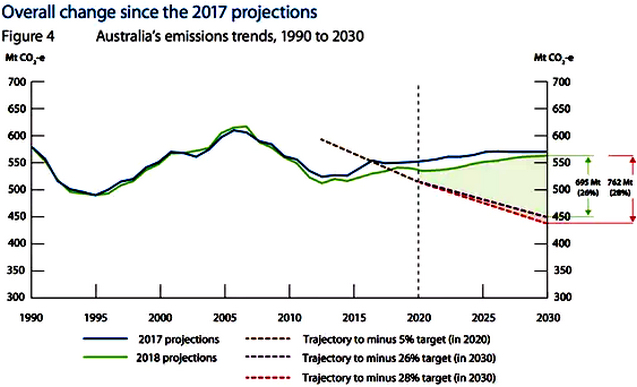
The Morrison government has been challenged by the European Union and by China about whether it can meet its Paris commitments given rising emissions, and about growing pollution from vehicles, ahead of a progress meeting about climate commitments in Bonn next week.
Nineteen countries, including Australia, will gather in Bonn on 24 and 25 June for a multilateral assessment of progress made under international climate commitments, and ahead of that session countries have submitted a range of questions about the performance of signatories in meeting their climate targets.
As well as questions about rising emissions, the EU and Canada have also queried the Morrison government’s decision to use carry-over credits from the Kyoto protocol in its latest carbon budget.
The Coalition is counting a 367 megatonne abatement from carry-over credits (an accounting system that allows countries to count carbon credits from exceeding their targets under the soon-to-be-obsolete Kyoto protocol periods against their Paris commitment for 2030) to help meet Australia’s 2030 target.
The EU in its questions to Australia points out that net emissions will grow during the period 2013 to 2020 and notes “Australia is also increasing coalmining, in particular for export”.
It has asked whether Australia considers its emissions profile, which has seen pollution rise since the repeal of the carbon price, to be “on a structural path of decrease in line with its commitments”. It has also flagged fossil fuel exports and asked whether they are sustainable “in the context of Paris agreement”.
Morrison government officials have addressed the implicit criticism by arguing in a submitted answer that “Australia’s national emissions peaked in 2007” and pointing to a fall in emissions per capita.
It says even without its climate policies, unveiled just before the recent federal election, including the reboot of the Abbott-era emissions reduction fund (ERF), “the decoupling of economic growth from greenhouse gas emissions has been progressing steadily since 1990”.
The government says the mix in electricity generation has changed between 2013 and 2020, and the Renewable Energy Target (RET) will see renewable energy grow to about 23.5% of Australia’s energy mix by 2020.
Australian officials do not, in the answer to the EU, mention the RET winds down from 2020, or that a sectoral target to drive emissions reduction in the electricity sector, proposed by Malcolm Turnbull in the national energy guarantee, was scrapped after he was replaced as prime minister by Scott Morrison.
The EU has also challenged Australia on its 2030 Paris target, pointing out “on the basis of reported projections with existing policies and measures it is not on track to meet this commitment”.
The EU asked Australia whether it would need further policies to meet the Paris commitment, given the current trends. Australian government officials point to the policies outlined before the recent election, including the funding boost for the ERF.
But in defending the status quo, the government has also restated a commitment to “review and refine” domestic policies aligned with the five-yearly review process under the Paris agreement. “This approach will provide for integrated consideration of domestic policy and international targets, and provide guidance for industry about future policy review processes,” officials said.
China, in a question to Australia, notes there will be a significant increase in transportation greenhouse gas emissions, and asks what measures Australia plans to take to reduce transport pollution in the future.
While the Morrison government pilloried Labor in the recent election campaign for proposing a vehicle emissions standard and targets for the uptake of electric vehicles, characterising Labor’s plans as a “war on the weekend”, government officials have told China the Coalition “is supporting low and zero emissions transport options in a number of ways”.
It says it is “developing” a national electric vehicle strategy – a strategy the government has not yet unveiled – which it says will build on support being rolled out through the Australian Renewable Energy Agency and the Clean Energy Finance Corporation.
It also points to the government’s Green Vehicle Guide website, and mandatory fuel consumption and carbon dioxide emission labels, that “help consumers identify and choose more fuel efficient vehicles” as well as “action to bring our fuel quality in line with international standards”.
The government says the safeguard mechanism “puts regulated limits on the emissions of large transport facilities that emit more than 100,000 tonnes C02-equivalent each year (mostly rail freight, domestic aviation and shipping)” and says the ERF “incentivises businesses, households and landowners to proactively reduce their emissions [and] provides incentives to reduce the emissions intensity of land and sea transport activity”.
It also points to the national hydrogen strategy, which is being led by Australia’s chief scientist, Alan Finkel, which is due to be delivered by the end of 2019.

Links

Climate Change, The Problem From Hell

Los Angeles Review of BooksFranz Baumann*


BILL MCKIBBEN, and this is meant as a compliment, is the Don Quixote of the environmental movement, or perhaps its Vivaldi. For over 30 years, he has been tilting at the windmills of ignorance, indifference, and interests — and composed the same concerto a few hundred times. Since his groundbreaking The End of Nature in 1989, he has written 16 more books and countless articles on humanity’s predatory and self-destructive relationship with nature. All are readable, measured, sensible, informative, factual, and incisive, yet short on polemics, hyperbole, and dubious assertions.
Puzzled by the recklessness with which the planetary branch we are sitting on is being sawed off, McKibben in Falter once more explains nature’s workings, asks profound questions, and tells wonderful stories. Unable to do otherwise, McKibben goes after the same windmills yet again — and crafts another lyrical masterpiece.
Falter reads like a book-length article in The New Yorker, which is not surprising since McKibben began his professional life there as a staff writer in the 1980s. This book is the latest installment of a trilogy of environmental disaster chronicles published within the space of a few weeks in the spring of this year. First came David Wallace-Wells’s The Uninhabitable Earth: Life After Warming, then Nathaniel Rich’s Losing Earth: A Recent History, and now Falter. Binge-readers and political activists will benefit from all three.
Falter, organized in four parts and an epilogue, is broadest in scope. It is a humane and wise book, even a beautiful one, if that’s not oxymoronic, given its subject. Amply sourced and referenced for deeper study or for skeptics, it tracks the state of the natural world in exhaustive detail, and identifies the forces imperiling it: the blistering heatwaves in North America and Europe; the droughts in Africa, Asia, and Australia; the typhoons in South-East Asia; the dying old-growth forests attacked by pests and diseases unleashed by climate change; the rising sea levels and unexpectedly speedy warming of the Earth’s oceans as well as their expectedly speedy acidification as well as their overfishing and choking with plastics, “the dead zones at the mouths of all major rivers where fertilizers pour into the sea”; the plummeting corn, rice, sorghum, and wheat crop yields resulting from higher temperatures as well as uncertain rainfall; the biological annihilation of species.
McKibben minces no words on the first page: “Put simply, between ecological destruction and technological hubris, the human experiment is now in question.” To avert catastrophe, no less is required than, in the clinical language of the Intergovernmental Panel on Climate Change (IPCC), “systems transitions” that are technically possible, yet “unprecedented in terms of scale.” The implication is that we are in existential peril and nothing short of a World War II–like mobilization in terms of commitment, focus, resources, and global reach will do. Too much time has been lost in the past decades — squandered actually.
Those who think we have never had it so good, for instance the obnoxiously cheerful author Steven Pinker, are off base because the implied assumption that past performance is indicative of future results. Climate change is so vexing precisely because it is the flip side of the phenomenal accomplishments of the past century or so. Things went right for too long, especially since World War II. Life expectancy, health, calorie intake, disposable income, car ownership, air travel, living space, and other treats rose to historically unprecedented levels. The bill for all this good living is now coming due, quite like the heart attack that strikes down the middle-aged, obese, sedentary, hard-drinking, chain-smoking guy, shattering his self-image of invulnerability. Except that, in the case of global heating, the cost for this generation’s profligacy is passed on to the next, and all generations thereafter. The combination of abundant cheap energy — fossil fuels all, first coal, then oil, and now gas — and scientific as well as technological progress has resulted in historically unparalleled economic growth, wealth, and opportunities.
Humans, on account of numbers and consumption, have become a geological force. “[N]o Roman emperor could change the pH of the oceans, but we’ve managed that trick in short order.” Humans have changed the energy balance of the planet, and thus fundamentally the way the world operates. To wit, the hottest five years on record were the last five years, and 20 of the hottest years happened in the last 22 years.
McKibben has a knack for scare facts, all backed up by documentary evidence. Who knew that humanity’s energy and resource usage during the past 35 years was more than during all of previous history? Or that more than “half of all the greenhouse gases emitted since the start of the Industrial Revolution have spewed from exhaust pipes and smokestacks since 1988”? Or that the carbon dioxide we’re emitting into the atmosphere is the equivalent of “400,000 Hiroshima-sized bombs every day, or four each second”? Or that, “if the billions of years of life on Earth were scaled to a twenty-four-hour day, our settled civilization began about a fifth of a second ago”? Or that a barrel of oil, “currently about sixty dollars, provides energy equivalent to about twenty-three thousand hours of human labor”? It is the scale and speed of humanity’s impact that has nature reeling.
The science is clear, and has been for a long time — for two centuries actually. As any encyclopedia or biology, chemistry, or physics textbook will confirm, the greenhouse effect was mentioned as early as 1824 by the French mathematician and physicist Joseph Fourier. The argument and the evidence were further strengthened by another French scientist, Claude Pouillet, and the Irish physicist John Tyndall. In 1896, the Swedish physicist and eventual Nobel Prize winner (in chemistry) Svante Arrhenius more fully quantified the greenhouse effect. McKibben notes that in November 2017, 15,000 scientists from 184 countries issued a forthright “Warning to Humanity,” which, within months, became the sixth-most-discussed academic paper in history. It has now been signed by well over 20,000 scientists. A similar initiative, Scientists for Future (S4F) of German, Austrian, and Swiss scientists, collected nearly 27,000 signatures in March 2019. Scientific uncertainty is certainly not the issue.
McKibben devotes a chapter to retracing how the fossil fuel companies — the main villains of the book — knew as early as 1959 about the warming effects of carbon dioxide. The initial concerns soon gave way to salivating at the prospect of a warming arctic and thus lower drilling costs there. Ignoring the findings of their in-house scientists, the marketing folks took over, emphasizing the — nonexistent — uncertainty in the scientific community about climate change. Before that happened, Walter Cronkite reported as fact the looming dangers of climate change on the evening news on Thursday, April 3, 1980. Nathaniel Rich reminds us that in 1988 32 climate bills were introduced in Congress, many enjoying not only Democratic but also Republican support. In 2007, the Republican Senator John McCain said:
The science tells us that urgent and significant action is needed. […] If the scientists are right and temperatures continue to rise, we could face environmental, economic, and national security consequences far beyond our ability to imagine. If they are wrong and the Earth finds a way to compensate for the unprecedented levels of greenhouse gases in the atmosphere, what will we have accomplished? Cleaner air, greater energy efficiency, a more diverse and secure energy mix, and U.S. leadership in the technologies of the future. There is no doubt; failure to act is the far greater risk.
What flipped the Republican Party? Was it better data, unforeseen facts, or new revelations? For politicians — given two-, four-, or six-year election cycles, immediate grievances are paramount, such as unemployment, depressed wages, rising inequality, immigration, and whatnot — it is a losing strategy to campaign on a platform of short-term sacrifices for long-term gains, regardless of the smallness of the former and the vastness of the latter. A majority of “voters must support the adoption of substantial restrictions on their excessively consumerist lifestyle, and there is no indication they would be willing to make such sacrifices,” McKibben quotes two analysts as declaring. There is indeed a co-dependency between businesses and consumers, quite like that between drug pushers and drug users. Addicts care only about the daily fix. They cannot envision obvious solutions, let alone adopt them, even if staying the course dooms all. But only tomorrow.
The Earth’s carrying capacity is a secondary concern, as are the costs of delayed mitigation measures. McKibben quotes environmental writer Alex Steffen, who coined the term predatory delay, “the blocking or slowing of needed change, in order to make money off unsustainable, unjust systems in the meantime.” Those with no power today and having contributed nothing to global heating — future generations, the poor in the Global South, and other species — will inherit a scorched Earth and an economic calamity.
Meanwhile, there are those who deny the climate problem altogether, or those who find prohibitive the costs of decisive remedial action, or those who, like McKibben, hope that technological progress will obviate the need for a change in the Western lifestyle. I don’t believe that he actually believes this. But he thinks, correctly, that solar energy is the closest there is to a solution. Not only can it provide unlimited clean power, but it also would reduce the power of a nefarious fossil fuel industry, reduce pollution, and, as a “technology of repair, social as well as environmental,” enhances the autonomy and dignity of people everywhere. He cites studies “that every major nation on earth could be supplying 80 percent of its power from renewables by 2030, at prices far cheaper than paying the damage for climate change.” A just-published German-Finnish analysis claims that
[a] global transition to 100% renewable energy across all sectors — power, heat, transport and desalination before 2050 is feasible. Existing renewable energy potential and technologies, including storage, is capable of generating a secure energy supply at every hour throughout the year.
The problem, though, goes far beyond power generation and requires a radical restructuring of production, consumption, and mobility in Western countries. The imperative is to pull off, in the next few years, a mobilization on the scale of World War II. McKibben evokes how, “[a]fter the attack on Pearl Harbor, the world’s largest industrial plant under a single roof went up in six months, near Ypsilanti, Michigan; […] within months, it was churning out a B-24 liberator bomber every hour.”
Hope being more motivating than despair, the book is a call to arms: “Let’s be, for a while, true optimists, and operate on the assumption that human beings are not grossly defective. Let’s assume we’re capable of acting together to do remarkable things.” It is a lovely sentiment, but also a reminder that it is not only the climate change deniers who are anti-science. So, too, are the technology enthusiasts and renewable-energy optimists who entertain the fantasy that it will be possible for 10 billion people — 40 percent more than today by the end of the century — to live in the style of the American or European middle class.
Population growth is one of the blind spots in Falter; nuclear energy, carbon pricing, carbon capture, and sequestration are others. Sensing, perhaps, that the political traffic cannot bear much, the book’s US-centrism avoids another uncomfortable insight, namely that climate change is a global public policy problem that cannot be solved in one country only, but requires international cooperation, compromise, and cohesion. But these are not notions in sync with “America First.” Possible, too, that McKibben prefers not to complicate matters, get side-tracked, or cause paralyzing gloom, even though he acknowledges that a “writer doesn’t owe a reader hope — the only obligation is honesty.”
Nevertheless, Falter provides ample evidence that we are on the cusp of an avoidable disaster. Weighing future cataclysm against short-term comfort should be a no-brainer because, if the climate breaks down, all bets are off. Don Quixote’s exertions may turn out to be worthwhile after all.

*Franz Baumann is a senior fellow and a member of the board of trustees at the  Hertie School of Governance in Berlin as well as a visiting professor at New York University. Prior to entering academia, he worked for the United Nations for over 30 years in many places and capacities. As an assistant secretary-general, his last assignment was special advisor on the Environment and Peace Operations.

Links

Adani Mine Approval Shows Climate Change Debate Reaches New Level Of Lunacy

Canberra Times - Ebony Bennett*

Australia's debate on the climate crisis reached a new level of lunacy this past week. Almost nowhere else in the world is the climate debate so divorced from reality.
Firstly, Adani's groundwater plan was approved by the Queensland government in a rushed process.
This came after the former commonwealth environment minister rushed Adani's water plan through federally.
The CSIRO's advice to both Commonwealth and Queensland governments was Adani's groundwater model was "not fit for purpose".
Despite this, both have accepted Adani's promise to fix the model later, after it has started mining coal.
Canberra school students earlier this year striked from school against Adani's coal mine and climate change. Picture: Terry Cunningham
As writer and anthropologist Professor Marcia Langton observed on ABC's The Drum: "If we want an economy run like Brazil or PNG, where political pressure and corruption can distort the decision-making process on issues as important as the largest coalmines in the world, then we should continue on the way we are."
This week Energy Minister Angus Taylor dissembled that it was good news that Australia's emissions have risen for the third year in a row (mainly due to LNG), because our LNG is replacing coal overseas, thereby reducing global emissions.
A few years back, then prime minister Malcolm Turnbull tried to tell us exporting coal helped to reduce global emissions because Australia's coal was "cleaner" than other countries' coal.
It was a nonsense argument then and it is now. Basically, Taylor, like Turnbull before him, is trying to persuade us our crap doesn't stink and that Australia happens to be uniquely blessed with the only pollution-reducing fossil fuels on Earth. Think about it. More coal and more gas pushes emissions down? Only in Australia would this pass for legitimate debate.
The very the same people who run this line also argue that stopping new mines and exporting less will make no difference. They can't have it both ways.
For decades Australian governments and fossil fuel companies have tried try to distract Australians from the enormous climate impacts of our fossil fuel exports.
Australia's fossil fuel exports contain more than twice as much CO2 potential as Australia's domestic emissions. Australia is the biggest per capita domestic emitter in the OECD, and our exports do twice as much damage.
Let's be clear, the science hasn't changed - together, coal, gas and oil are the number one cause of the climate crisis engulfing this little planet we all share. More coal and gas exports will fuel more droughts, bushfires, floods and heatwaves. That's a fact. And if we don't have a plan to move beyond coal, gas and oil soon, the climate impacts will only get worse.
This year's Queensland budget talks about needing to "build greater resilience ... in the face of the headwinds, like more frequent natural disasters caused by climate change". The damage bill from Queensland's summer of bushfires and floods will be $1.3 billion - that's from just one summer - entirely paid for by taxpayers. It is a special kind of madness to acknowledge in the budget the cost of climate impacts will grow, while rushing through approval for a new coal mine.
To avoid dangerous climate change and comply with the Paris Agreement, coal use needs to immediately decline and be almost entirely phased out by 2050.
There has never been a worse time in human history to approve or build a coal mine that aims to produce 60 million tonnes of coal per year for 90 years.
The fact Queensland voters swung away from Labor at the federal election doesn't magically solve the climate crisis or change the science; the environment doesn't negotiate. Burning fossil fuels for decades has increased the temperature of the oceans. Half of the Great Barrier Reef is dead and no amount of coal royalties can bring it back to life. We could pass a law prohibiting anyone from talking about it, but it's the dead coral that's driving tourists away from the reef, not the scientists and environmentalists who are sounding the alarm.
Adani's mine, and all the proposed coal mines in the Galilee Basin, are a threat to the tens of thousands of existing jobs that rely on a healthy Great Barrier Reef. Solving regional unemployment in central and north Queensland is important but building the Adani mine will barely shift the needle on greater employment.
Coal mining is one of the least labour-intensive industries in Australia, it just doesn't need many workers. Especially not when the demand for coal is declining.
That's why it was extraordinary when in an interview, the MP for Capricornia Michelle Landry admitted she has never actually asked Adani how many ongoing jobs there will be.
Considering Adani has constantly changed its jobs figures depending on who it is talking to, and publicly stated it plans to automate the mine from pit to port, this seems like an oversight.
Adani's proposed mine is now four times smaller than originally planned yet it is supposed to deliver five times more jobs. Magic or madness?
The Queensland government is still offering Adani free water, a free pass on the mine rehabilitation bill and a special royalty subsidy that's being kept secret.
But I'm an optimist. People thought the one-billion dollar Northern Australia Infrastructure Facility loan was a done deal before the Queensland government vetoed it when Queenslanders made it clear they oppose public subsidies for fossil fuel projects.
The state government pulled out of its previous plans to give Adani a free $100 million road upgrade. Backers of Adani said it would have no trouble finding finance, but more than 50 financial institutions, contractors and insurers have ruled out any involvement and Adani was forced to self-finance the project.
And there's plenty more standing in Adani's way. To name just a few, it requires two more Commonwealth approvals for groundwater plans, which CSIRO says are not up to scratch. Adani has no construction contractor and it's still unclear how they will fund the project. There is a court judgment still to come on the Indigenous Land Use Agreement, which is disputed by the Wangan & Jagalingou traditional owners.
But just as climate action being cheap isn't the reason to take climate action - though it's true - the fact that coal mines face obstacles isn't the reason why we need to stop new coal mines.
Like damming the Franklin River, building an enormous new coal mine is fundamentally a bad idea - economically and environmentally. That's why two thirds of Australians oppose the Adani mine.
A different way is possible. Sometime next year the ACT will become the first Australian jurisdiction to be 100 per cent powered by renewable electricity. Tasmania is set to achieve the same goal by 2022.
But we can't pretend Australia is in any kind of "transition" while we are still approving new coal mines. That way lies madness.

*Ebony Bennett is deputy director of The Australia Institute

Links

19/06/2019

Why Old-School Climate Denial Has Had Its Day

The Conversation

New South Wales, which was 100% drought-declared in August 2018, is already suffering climate impacts. Michael Cleary
The Coalition has been re-elected to government, and after six years in office it has not created any effective policies for reducing greenhouse emissions. Does that mean the Australian climate change debate is stuck in 2013? Not exactly.
While Australia still lacks effective climate change policies, the debate has definitely shifted. It’s particularly noticeable to scientists, like myself, who were very active participants in the Australian climate debate just a few years ago.
The debate has moved away from the basic science, and on to the economic and political ramifications. And if advocates for reducing greenhouse emissions don’t fully recognise this, they risk shooting themselves in the foot.
Australia’s carbon dioxide emissions are not falling. Department of Environment and Energy
The old denials
Old-school climate change denial, be it denial that warming is taking place or that humans are responsible for that warming, featured prominently in Australian politics a decade ago. In 2009 Tony Abbott, then a Liberal frontbencher jockeying for the party leadership, told ABC’s 7.30 Report:
I am, as you know, hugely unconvinced by the so-called settled science on climate change.
The theory and evidence base for human-induced climate change is vast and growing. In contrast, the counterarguments were so sloppy that there were many targets for scientists to shoot at.
Climate “sceptics” have always been very keen on cherrypicking data. They would make a big fuss about some unusually cold days, or alleged discrepancies at a handful of weather stations, while ignoring broader trends. They made claims of data manipulation that, if true, would entail a global conspiracy, despite the availability of code and data.
Incorrect predictions of imminent global cooling were made on the basis of rudimentary analyses rather than sophisticated models. Cycles were invoked, in a manner reminiscent of epicycles and stock market “chartism” – but doodling with spreadsheets cannot defeat carbon dioxide.
That was the state of climate “scepticism” a decade ago, and frankly that’s where it remains in 2019. It’s old, tired, and increasingly irrelevant as the impact of climate change becomes clearer.
Australians just cannot ignore the extended bushfire season, drought, and bleached coral reefs.zzz

Partisans
Climate “scepticism” was always underpinned by politics rather than science, and that’s clearer now than it was a decade ago.
Several Australian climate contrarians describe themselves as libertarians - falling to the right of mainstream Australian politics. David Archibald is a climate sceptic, but is now better known as candidate for the Australian Liberty Alliance, One Nation and (finally) Fraser Anning’s Conservative National Party. The climate change denying Galileo Movement’s claim to be to be non-partisan was always suspect - and now doubly so with its former project leader, Malcolm Roberts, representing One Nation in the Senate.
Given this, it isn’t surprising that relatively few Australians reject the science of climate change. Just 11% of Australians believe recent global warming is natural, and only 4% believe “there’s no such thing as climate change”.
Old-school climate change denial isn’t just unfounded, it’s also unpopular. Before last month’s federal election, Abbott bet a cafe patron in his electorate A$100 that “the climate will not change in ten years”. It reminded me of similar bets made and lost over the past decade. We don’t know whether Abbott will end up paying out on the bet – but we do know he lost his seat.

The shift
So what has changed in the years since Abbott was able to gain traction, rather than opprobrium, by disdaining climate science? The Australian still runs Ian Plimer and Maurice Newman on its opinion pages, and Sky News “after dark” often features climate cranks. But prominent politicians rarely repeat their nonsense any more. When the government spins Australia’s rising emissions, it does it by claiming that investing in natural gas helps cut emissions elsewhere, rather than by pretending CO₂ is merely “plant food”.
As a scientist, I rarely feel the need to debunk the claims of old-school climate cranks. OK, I did recently discuss the weather predictions of a “corporate astrologer” with Media Watch, but that was just bizarre rather than urgent.
Back in the real world, the debate has shifted to costs and jobs.
Modelling by the economist Brian Fisher, who concluded that climate policies would be very expensive, featured prominently in the election campaign. Federal energy minister Angus Taylor, now also responsible for reducing emissions, used the figures to attack the Labor Party, despite expert warnings that the modelling used “absurd cost assumptions”.

Many people still assume the costs of climate change are in the future, despite us increasingly seeing the impacts now. While scientists work to quantify the environmental damage, arguments about the costs and benefits of climate policy are the domain of economists.
Jobs associated with coal mining were a prominent theme of the election campaign, and may have been decisive in Queensland’s huge anti-Labor swing. It is obvious that burning more coal makes more CO₂, but that fact doesn’t stop people wanting jobs. The new green economy is uncharted territory for many workers with skills and experience in mining.
That said, there are economic arguments against new coalmines and new mines may not deliver the number of jobs promised. Australian power companies, unlike government backbenchers and Clive Palmer, have little enthusiasm for new coal-fired power stations. But the fact remains that these economic issues are largely outside the domain of scientists.
Debates about climate policy remain heated, despite the scientific basics being widely accepted. Concerns about economic costs and jobs must be addressed, even if those concerns are built on flawed assumptions and promises that may be not kept. We also cannot forget that climate change is already here, impacting agriculture in particular.
Science should inform and underpin arguments, but economics and politics are now the principal battlegrounds in the Australian climate debate.

Links

In Courtrooms, Climate Change Is No Longer Up For Debate

Undark

Increasingly, global warming science is going unchallenged in lawsuits seeking to curb fossil fuel use and hold companies to account.
Alexander Pohl/NurPhoto via Getty Images
In September 2017, San Francisco experienced its hottest day on record, with temperatures reaching a searing 106 degrees. Weeks later, the city joined Oakland to announce it would sue five major fossil fuel firms — BP, Shell, ExxonMobil, Chevron, and ConocoPhillips — for the costs of building sea walls and other infrastructure to protect residents from global warming.
“I don’t even imagine a case where there is a jury hearing a liability issue that you’d see a vigorous attack on the underlying science.”
When the case reached court the following year, federal district judge William Alsup ordered a tutorial on climate change in which he asked both sides a series of pointed questions, including what caused the planet’s ice ages and what the main sources of CO2 in the atmosphere were. In the news media, the trial was cast as a possible “Scopes” moment for climate change, a reference to the seminal 1925 Tennessee trial in which evolutionary theory was pitted against Biblical teaching.
The cities called on a number of expert witnesses, including Myles Allen, a professor of geosystem science at the University of Oxford. By walking the judge through the century-long history of climate science, punctuated with rapidly ascending line graphs, the witnesses brought global warming to the court’s attention in a way that left no doubt about how credible a threat it was. The fossil-fuel companies, meanwhile, took a different tack. Chevron’s evidence during the tutorial was presented through a lawyer, who acknowledged the role of human activity in climate change but denied the company could have known the future implications of its actions and said a court wasn’t the right place to deal with the issue. Statements submitted by the other defendants were largely in line with Chevron’s presentation.
Filed alongside the case were two amicus briefs — documents produced by someone who is not a direct party in a case, but has an interest in the subject at hand — questioning aspects of climate science. They were written by well-known climate skeptics and promoted by the Heartland Institute, a libertarian organization with links to the fossil fuel industry. Alsup challenged the briefs’ validity and asked who had funded the research behind them, which turned out to include fossil fuel firms such as Peabody and ExxonMobil.
In the end, Allen said, the defense chose not to call on those climate skeptics when presenting its formal evidence in court, a sign of how much progress has been made in climate science and public understanding over the past decade. “Maybe 10 years ago they would have been called, but I think it’s recognized now that it’s become so discredited that it’s not worth putting them up,” said Allen.
Alsup ultimately dismissed the case, ruling that while the evidence of climate change is real and persuasive, the courts are not the proper place to decide issues of such global magnitude, deferring the matter to the legislative and executive branches. Even so, his overall sympathy to the science and the short shrift he gave climate-change denial show how the basic facts of anthropogenic global warming are increasingly being accepted in law. Indeed, other jurisdictions in the United States and abroad now regularly hear about the effects of global warming and the threats it poses. And campaign groups, individuals, and public authorities involved in the burgeoning field of climate litigation are testing out various legal strategies to try to force recalcitrant governments and companies to cut their emissions faster and to get compensation for damages.
“I think the real reason you don’t see the basic science challenged much in these cases is that courts are places of inquiry where the standards of reliability are reason and evidence rather than tweets, falsehoods, and the kind of manipulative discourse that you hear in the political sphere,” said Douglas Kysar, the deputy dean of Yale Law School. “In the U.S., I don’t even imagine a case where there is a jury hearing a liability issue that you’d see a vigorous attack on the underlying science.”
Oakland and San Francisco are now appealing Alsup’s decision, but the judge’s active engagement with the science was nonetheless in stark contrast to a Supreme Court case 12 years earlier, involving the Environmental Protection Agency’s responsibility for regulating greenhouse gases. When Justice Antonin Scalia was corrected for confusing the layers of the atmosphere, he blurted out in frustration: “I’m not a scientist. That’s why I don’t want to have to deal with global warming.”
That would be unlikely to fly today, and Kysar notes that expert testimony in most courtrooms is subject to rigorous admissibility standards. “The courts’ legitimacy and credibility is not based on the power of the purse, having an army, or being elected; it’s based on making pronouncements that seem to be driven by evidence, reason, and principle,” he said. “So when they’re making scientific claims about what actions are causing what effects in the world, they want to be quite sure they’ve got it right.”

KRISTIN CASPER, litigation counsel for Greenpeace’s Global Climate Justice and Liability campaign, said judicial awareness of climate science will continue to grow as public awareness and acceptance increases. “I would expect almost every judiciary will have a climate case before it at some point in the next couple of years,” Casper said. One example: In 2017, an Australian judge was asked to determine whether an open-cut coal mine should be built in Gloucester, New South Wales. The Rocky Hill Coal Project had been denied permission by the state’s planning minister.
“I would expect almost every judiciary will have a climate case before it at some point in the next couple of years.”
In a masterclass of science communication, Will Steffen, emeritus professor at the Australian National University’s Climate Change Institute and a member of Australia’s Climate Council, explained how the world has already vastly overcommitted to spending its carbon budget. He gently led the court to the conclusion that any project which opens up new fossil fuel deposits is incompatible with the Paris Agreement on climate change which most countries signed in 2015. “I wanted to make sure that the chain of logic we used in a scientific approach came through very clearly,” Steffen said. In February 2019, the judge refused to approve the Rocky Hill project in a judgment that extensively referenced Steffen’s testimony.
In other countries — particularly in Europe — public acceptance of climate change science is broader and is often reflected in legal cases. When the Urgenda Foundation, a Dutch organization devoted to promoting use of renewable energy, challenged the Dutch government’s strategy to curb greenhouse-gas emissions in 2015, it deliberately chose not to put forward any climate experts as witnesses. Urgenda’s legal counsel, Dennis van Berkel, said they based their case entirely on official reports from the United Nations Environment Program (UNEP) and the Intergovernmental Panel on Climate Change (IPCC), of which the Netherlands is a member. “We wanted to have a discussion on the law, not the facts,” van Berkel said. “So it was very much our goal to present the facts as they were acknowledged by the state themselves.”
The Dutch government didn’t dispute that climate change is real, but it disagreed that it had to act as quickly as campaigners wanted. It had already set a target to cut emissions by 2020 but was unlikely to meet it. Urgenda responded by presenting evidence from the IPCC and UNEP showing that delays in confronting climate change would exacerbate its risks and costs. Van Berkel said politicians often argue that it’s too expensive to act on climate change. “But that argument came up short in court because there was no way to substantiate it,” he said, “because the reports all read in the other direction.”
In 2015, the judge agreed, ordering the Netherlands to cut its emissions by 25 percent by 2020 compared to 1990 levels. The Dutch government is appealing the decision in the Netherlands’ Supreme Court, where the final argument is likely to revolve around an interpretation of human rights law. But it was the first time a court had forced a government to act on climate change, and it inspired similar cases in Ireland, Switzerland, New Zealand, and Pakistan.

OF COURSE, judges still have to address knotty questions about who is ultimately responsible for putting emissions into the air, who should stop it from happening, and who should pay for the consequences. Answers will only come as more cases go to court, and it seems likely that plaintiffs will be helped by the accumulation of scientific evidence analyzing the extent to which climate change contributes to sea-level rise or extreme weather, and how much can be traced to particular companies.
Plaintiffs will be helped by the accumulation of scientific evidence analyzing the extent to which climate change contributes to sea-level rise or extreme weather.
But even if climate litigation doesn’t succeed, it has helped to shift the tone of public debate, as is clear with one of the most important cases currently going through the courts. In Juliana v. United States, a group of 21 young people claim inaction on climate change violates their fundamental constitutional rights to liberty, life, and property. While the Obama administration initially attempted to dismiss the case, filed by the nonprofit organization Our Children’s Trust in 2016, its lawyers didn’t dispute many of the stated facts about climate change. And even now, Kysar said, despite the current climate-change skepticism guiding the Trump White House, the department’s new political appointees can do little to change its formal response.
“If they tried to file an amended answer which went back on those stipulations,” said Kysar, “they would have looked like a laughing stock.”
The Juliana case has many procedural and institutional hurdles to overcome before it reaches trial. Earlier this month, a panel of judges heard arguments from both sides on whether the case should be allowed to proceed. But if it does, Kysar believes it will be very hard for the government to win.
“What it would have to say is that, although we stipulate to all these facts about the existential threat that we are substantially contributing to through our actions and inactions, we don’t believe that it’s the responsibility of government to preserve the basic conditions for civilized life,” he said. “What lawyer wants to make that argument?”

Links

A Scientist Took Climate Change Deniers To Court And Wrested An Apology From Them

Mother Jones

In the fight against climate disinformation, experts like him are turning to new arenas.
Scientist Michael Mann attends the New York screening of the HBO documentary, "How To Let Go Of The World And All The Things Climate Can't Change" in New York City. Slaven Vlasic/Getty/HBO
In 2011, renowned scientist Michael E. Mann sued a Canadian think tank that published an interview suggesting his work on climate change was fraud.
Eight years later, the Winnipeg-based Frontier Centre for Public Policy—which often promotes climate change denial—apologized Friday and wiped the inflammatory interview from its website.
“(The apology) gives me faith in our legal system that truth can still win out, even in an era of ‘fake news’ and ‘alternative facts,'” Mann said in an email to National Observer.
In the fight against climate disinformation, experts like Mann, an atmospheric scientist at Pennsylvania State University, are turning to new arenas.
Mann is best known as the lead researcher on a landmark 1998 paper on climate change. He and three colleagues reconstructed global temperatures going back about 500 years, producing a now-infamous sideways-hockey-stick-like graph of global temperatures that showed a sharp upswing beginning in the 1900s.
Mann has spent the two decades since the paper’s publication defending it and his reputation against climate change deniers—sometimes in court. He settled with the Frontier Centre on Friday, but a related case in British Columbia and a similar one in the United States are ongoing.
In a message posted to its website, the Frontier Centre apologized for publishing “untrue and disparaging” comments about Mann.
“Although the Frontier Centre for Public Policy still does not see eye to eye with Mr. Mann on the subject of global warming and climate change, we now accept that it was wrong to publish allegations by others that Mr. Mann did not comply with ethical standards…” the think tank wrote in part.
In an email to National Observer, Frontier president and CEO Peter Holle said the group is choosing to address the issue of climate change through its other activities instead of the courts.
“The organization had an opportunity to settle with Mann to avoid further expenditure of time and resources on the matter,” Holle wrote.
Though Mann said the Frontier Centre was smart to retract and apologize, he also pointed out that the case was about untrue allegations of misconduct, not the group’s stance on climate change, making it an outlier.
“Making false and malicious allegations about a scientist is illegal,” Mann said by email. “The law is the appropriate recourse, and often an effective one, as this latest episode demonstrates.”
Climate scientists should be challenging climate disinformation publicly more often, said University of Calgary climatologist Shawn Marshall, “but it is a matter of picking our battles.” Scientists aren’t marketers, Marshall added, but now find themselves in the business of convincing the public their findings are real—an especially difficult task in the polarized realm of social media.
One example played out in real-time Saturday when Milton MP and deputy Conservative party leader Lisa Raitt—who has a master’s degree in environmental biochemical toxicology—tweeted a link to a Financial Post opinion piece that falsely claimed, against scientific consensus and a report released by the federal government in April, that there’s “no solid connection between climate change and the major indicators of extreme weather.” The story was authored by an economist who does not believe in climate change.
Soon after, climate scientist Katharine Hayhoe replied.
“Hi Lisa—I am a climate scientist,” tweeted Hayhoe, a Canadian working at Texas Tech University, linking to YouTube videos explaining the climate crisis. “The article you quote above is incorrect and dangerously misleading. For the sake of our shared country, please have the courage and the integrity to update your understanding.”
Hayhoe shared several more links and invited Raitt to reach out if she had questions. Raitt deleted the original tweet in short order and shared one of Hayhoe’s, saying it was “important to read this as well.”
“Well I’ve learned my lesson in tweeting anything about climate change,” Raitt posted later the same day. “I’m not the one to fight with on this because like most I believe that emissions cause climate change and we should reduce emissions.”
Hayhoe replied with a thank you: “If all our politicians were like this, we would be in a much better place!” she tweeted.
Most people who deny climate change do so because they’ve received information that lines up with their beliefs from a source they trust, Hayhoe told National Observer.
“It’s not a case of people doing this largely for nefarious reasons, for selfish reasons, for greedy reasons, for evil reasons,” she said.
In an interview with National Observer Wednesday, Raitt said the original tweet wasn’t an attempt at a climate change-denying political statement—she was sharing an article she’d read, and wasn’t aware of the author’s background. Once Hayhoe and others pointed out the clash between the article and scientific consensus, she realized she “didn’t want to be a lightning rod on this topic” and deleted it, Raitt said.
“(Hayhoe’s) tweet spoke to me, because it was clearly somebody who was giving me the benefit of the doubt that I wasn’t trying to make a political statement,” Raitt said. The two later had a conversation in private messages and made plans to meet the next time Hayhoe is in Ontario.
The science of attributing extreme weather events to climate change is an emerging one, and Raitt said she’s just learning about it now. However, she said she “fundamentally” believes in climate change and the need to reduce greenhouse gas emissions—something she then took flack over from climate change deniers on Twitter.
“Me being caught in this crossfire between two different streams of thought on whether or not extreme weather is a result of climate change, that’s not an argument I am educated enough to have,” Raitt said. “I wasn’t going to win on either side of this.”
Earlier in his career, Marshall said, he used to engage more with online climate-change denial, something he’s since given up on. “I used to try to respond to it and give proper sources to support the truth and facts, but then they just came back with more rant and often it turned to harassment and bad language.”
Marshall also participated in two public debates with representatives of Friends of Science, a climate change-denying nonprofit, but said he worries it didn’t help—climate change deniers can confuse the facts with false information, while scientists must stick to research that might be difficult for non-scientists to fully understand.
“On the other side there’s no rules,” he said. “It’s hard to win against that.”
Instead of fighting with climate change deniers directly, Marshall said he now prefers to spend time arming his students with the information they need to combat climate myths.
“I’m feeling defeated,” Marshall said. “I feel like we have to fight this in a different way than having arguments with people who don’t want to have a discussion.”
Another climate change-related legal dispute happened in 2009, when scientist Andrew Weaver, who’s now a BC MLA and leader of the province’s Green party, sued the National Post over a series of four articles he said attacked his character. The articles also expressed skepticism about climate change.
In April 2017, a BC judge overturned a previous ruling, which was in Weaver’s favour, and ordered a new trial. Weaver’s lawyer didn’t immediately respond to a request for an update, and Weaver said in a phone interview that he couldn’t comment on the case.
A spokesperson for the Post‘s parent company, Postmedia, declined to comment as the matter is still before the courts. One of the reporters named in the suit, Kevin Libin, was promoted on Monday to become executive politics editor for the entire Postmedia chain, including local dailies like the Edmonton Journal and Ottawa Citizen.
Climate change court cases remain rare—the best way to combat garden-variety denialism is to try to understand where the person is coming from on an individual basis, Weaver told National Observer. That can allow you to make arguments that appeal to the person’s values, rather than making them feel attacked.
“I don’t think it helps to belittle,” Weaver said. “People talk all over each other. Unless you know where someone’s coming from you don’t know how to address their arguments.”
Though public figures rarely, if ever, back down on climate change denial publicly, Hayhoe said she continues to try to have those conversations for the sake of others who are reading along and might be unsure what to believe.
“Every single one of us, what we do in areas that we don’t know too much about is we look to (thought leaders) to form our opinion,” she said.
“I do them more for other people who want to know what is the truth.”

Links

18/06/2019

'Drier Than Millennium Drought': Satellite Shows Toll Of Big Dry

Canberra Times - Mike Foley

A failed Canola crop near Parkes, NSW in August, 2018. Photo by AAP / Dean Lewins.
It was drier in parts of NSW, Queensland, central South Australia, Tasmania and much of Western Australia in December last year than at the height of the Millennium drought.
That's according to scientists from the Australian National University, who developed software to analyse data from water-tracking satellites.
Dr Paul Tregoning headed the team which processed data captured by the Gravity Recovery and Climate Experiment (GRACE) mission.
"Our preliminary results show already the drought last year appeared to be worse across a large area of Australia than late 2009," said Dr Tregoning from the ANU Research School of Earth Sciences," Mr Tregoning said.
"The Millennium drought, which lasted from 2001 until 2009, is considered by some experts to be Australia's worst drought since European settlement, so to see the country in the grip of another bad drought less than a decade later points to more worrying times ahead."
"There was less water in the landscape in northern and northwestern NSW and southwestern Queensland in 2018 compared with 2009, but more water in the southern Murray-Darling Basin region and along the eastern coast."
With good timing, a new study by University of South Australia released on Thursday showed droughts in that state are becoming longer and more severe.
The study, led by Professor Simon Beecham, revealed a pattern of increasing drought that includes major river catchments and urban areas.
"We looked at data from 1960 to 2010 from every high-quality weather station in the state and there is a clear pattern, with drought increasing in the south of the State and over the Murray-Darling Basin, which is the food bowl of Australia," Mr Beecham said.
Significant long-term reductions in rainfall in autumn and winter were a particular concern, Mr Beecham said.
"This is when water systems should be recharging and flows should be building up again. When it is dry during this time, as it was earlier this year, it is a problem for the State's water supplies, as winter rain is soaked up by the dry environment and less ends up in reservoirs."
The GRACE Follow On satellite mission tracks changes in water across the earth by measuring the effect of changes in the gravitational pull of the Earth, caused by changes in groundwater, soil moisture, ocean tides and melting polar ice sheets, on two satellites separated by 200 kilometres.
Two satellites orbit the Earth 200km apart and tiny changes in the distance between the two, caused by changes in the gravitational field, are recorded.
The changes are around 1/10 of the thickness of a human hair, but contain information of movement of water on Earth and can be used to calculate how mass moves around the surface of the earth.
Dr Paul Tregoning and Rebecca McGirr from the ANU Research School of Earth Sciences.
 Water is the dominant mobile mass on Earth and, by analysing the measurements, the ANU scientists calculated the amount of water was present in a given location, at a particular time.
The scientists measured total water storage across Australia, which includes aquifers, soil moisture and surface water, in grids of 200km by 200km. The measurement is accurate to around 2cm water height, which is fine enough to fit with hydrological models.
Two space gravity missions have been deployed. Grace circled the Earth between March 2002 and late 2017. GRACE Follow On launched in May 2018 and on May 22 NASA released the data it had captured to date. It is these data that the ANU researchers have used to estimate changes in water in the Australian landscape.
Satellite data also revealed the extent of ice loss in Antarctica over the past decade.
Dr Tregoning said the ice loss in the Totten Glacier region, east of Australia's Casey station in Antarctica amounted to around 1.4 billion tonnes of water.
"We could be watching the beginning of serious change to the ice sheet. This is very concerning, since a destabilisation of the ice sheet in that region could affect the global sea level by many metres," Mr Tregoning said.

Links

Lethal Heating is a citizens' initiative