25/06/2019

Australia’s Still Building 4 In Every 5 New Houses To No More Than The Minimum Energy Standard

The Conversation |  | 

Most new houses being built in Australia do no better than comply with the minimum energy performance required by regulations. Brendon Esposito/AAP
New housing in Australia must meet minimum energy performance requirements. We wondered how many buildings exceeded the minimum standard. What our analysis found is that four in five new houses are being built to the minimum standard and a negligible proportion to an optimal performance standard.
Before these standards were introduced the average performance of housing was found to be around 1.5 stars. The current minimum across most of Australia is six stars under the Nationwide House Energy Rating Scheme (NatHERS).
This six-star minimum falls short of what is optimal in terms of environmental, economic and social outcomes. It’s also below the minimum set by many other countries.
There have been calls for these minimum standards to be raised. However, many policymakers and building industry stakeholders believe the market will lift performance beyond minimum standards and so there is no need to raise these.

What did the data show?
We wanted to understand what was happening in the market to see if consumers or regulation were driving the energy performance of new housing. To do this we explored the NatHERS data set of building approvals for new Class 1 housing (detached and row houses) in Australia from May 2016 (when all data sets were integrated by CSIRO and Sustainability Victoria) to December 2018.
Our analysis focuses on new housing in Victoria, South Australia, Western Australia, Tasmania and the ACT, all of which apply the minimum six-star NatHERS requirement. The other states have local variations to the standard, while New South Wales uses the BASIX index to determine the environmental impact of housing.
The chart below shows the performance for 187,320 house ratings. Almost 82% just met the minimum standard (6.0-6.4 star). Another 16% performed just above the minimum standard (6.5-6.9 star).
Only 1.5% were designed to perform at the economically optimal 7.5 stars and beyond. By this we mean a balance between the extra upfront building costs and the savings and benefits from lifetime building performance.

NatHERS star ratings across total data set for new housing approvals, May 2016–December 2018. Author provided

 
  The average rating is 6.2 stars across the states. This has not changed since 2016.

Average NatHERS star rating for each state, 2016-18. Author provided
 
The data analysis shows that, while most housing is built to the minimum standard, the cooler temperate regions (Tasmania, ACT) have more houses above 7.0 stars compared with the warm temperate states.

NatHERS data spread by state. Author provided
 
The ACT increased average performance each year from 6.5 stars in 2016 to 6.9 stars in 2018. This was not seen in any other state or territory.
The ACT is the only region with mandatory disclosure of the energy rating on sale or lease of property. The market can thus value the relative energy efficiency of buildings. Providing this otherwise invisible information may have empowered consumers to demand slightly better performance.

We are paying for accepting a lower standard
The evidence suggests consumers are not acting rationally or making decisions to maximise their financial well-being. Rather, they just accept the minimum performance the building sector delivers.
Higher energy efficiency or even environmental sustainability in housing provides not only significant benefits to the individual but also to society. And these improvements can be delivered for little additional cost.
The fact that these improvements aren’t being made suggests there are significant barriers to the market operating efficiently. This is despite increasing awareness among consumers and in the housing industry about the rising cost of energy.
Eight years after the introduction of the six-star NatHERS minimum requirement for new housing in Australia, the results show the market is delivering four out of five houses that just meet this requirement. With only 1.5% designed to 7.5 stars or beyond, regulation rather than the economically optimal energy rating is clearly driving the energy performance of Australian homes.
Increasing the minimum performance standard is the most effective way to improve the energy outcomes.
The next opportunity for increasing the minimum energy requirement will be 2022. Australian housing standards were already about 2.0 NatHERS stars behind comparable developed countries in 2008. If mandatory energy ratings aren’t increased, Australia will fall further behind international best practice.
If we continue to create a legacy of homes with relatively poor energy performance, making the transition to a low-energy and low-carbon economy is likely to get progressively more challenging and expensive. Recent research has calculated that a delay in increasing minimum performance requirements from 2019 to 2022 will result in an estimated A$1.1 billion (to 2050) in avoidable household energy bills. That’s an extra 3 million tonnes of greenhouse gas emissions.
Our research confirms the policy proposition that minimum house energy regulations based on the Nationwide House Energy Rating Scheme are a powerful instrument for delivering better environmental and energy outcomes. While introducing minimum standards has significantly lifted the bottom end of the market, those standards should be reviewed regularly to ensure optimal economic and environmental outcomes.

Links

The Climate Change Lawsuit That Could Stop The U.S. Government From Supporting Fossil Fuels

CBS Sixty Minutes - Steve Kroft

A lawsuit filed on behalf of 21 kids alleges the U.S. government knowingly failed to protect them from climate change. If the plaintiffs win, it could mean massive changes for the use of fossil fuels
The plaintiffs in Juliana v. United States
Of all the cases working their way through the federal court system, none is more interesting or potentially more life changing than Juliana versus the United States.
To quote one federal judge, "This is no ordinary lawsuit." It was filed back in 2015 on behalf of a group of kids who are trying to get the courts to block the U.S. government from continuing the use of fossil fuels.
They say it's causing climate change, endangering their future and violating their constitutional rights to life, liberty and property.
As we first reported earlier this year, when the lawsuit first began hardly anyone took it seriously, including the government's lawyers, who have since watched the supreme court reject two of their motions to delay or dismiss the case.
Four years in, it is still very much alive, in part because the plaintiffs have amassed a body of evidence that will surprise even the skeptics and have forced the government to admit that the crisis is real.
The case was born here in Eugene, Oregon, a tree-hugger's paradise, and one of the cradles of environmental activism in the United States.
The lead plaintiff, University of Oregon student Kelsey Juliana, was only five weeks old when her parents took her to her first rally to protect spotted owls.
Today, her main concern is climate change, drought and the growing threat of wildfires in the surrounding Cascade Mountains.
Kelsey Juliana
Kelsey Juliana: There was a wildfire season that was so intense, we were advised not to go outside. The particulate matter in the smoke was literally off the charts. It was past severe, in terms of danger to health.
Steve Kroft: And you think that's because of climate change.
Kelsey Juliana: That's what scientists tell me.

It's not just scientists. Even the federal government now acknowledges in its response to the lawsuit that the effects of climate change are already happening and likely to get worse, especially for young people who will have to deal with them for the long term.
"The government has known for over 50 years that burning fossil fuels would cause climate change. And they don't dispute that we are in a danger zone on climate change."
Steve Kroft: How important is this case to you?
Kelsey Juliana: This case is everything. This is the climate case. We have everything to lose, if we don't act on climate change right now, my generation and all the generations to come.

She was 19 when the lawsuit was filed and the oldest of 21 plaintiffs. They come from ten different states and all claim to be affected or threatened by the consequences of climate change. The youngest, Levi Draheim, is in sixth grade.

Steve Kroft: You're 11 years old, and you're suing the United States government, that's not what most 11-year-olds do, right?
Levi Draheim: Yeah…

He's lived most of his life on the beaches of a barrier island in Florida that's a mile wide and barely above sea level.

Steve Kroft: What's your biggest fear about this island?
Levi Draheim: I fear that I won't have a home here in the future.
Steve Kroft: That the island will be gone.
Levi Draheim: Yeah. That the island will be underwater because of climate change.
Steve Kroft: So you feel like you've got a stake in this.
Levi Draheim: Yes.

The plaintiffs were recruited from environmental groups across the country by Julia Olson, an oregon lawyer, and the executive director of a non-profit legal organization called "Our Children's Trust." She began constructing the case eight years ago out of this spartan space now dominated by this paper diorama that winds its way through the office.

Steve Kroft: So what is this?
Julia Olson: So this is a timeline that we put together…

It documents what and when past U.S. administrations knew about the connection between fossil fuels and climate change. The timeline goes back 50 years, beginning with the presidency of Lyndon Johnson.

Julia Olson: During President Johnson's administration, they issued a report in 1965 that talked about climate change being a catastrophic threat.

Whether it was a Democrat or a Republican in office, Olson says, there was an awareness of the potential dangers of carbon dioxide emissions.

Julia Olson: Every president knew that burning fossil fuels was causing climate change.

Fifty years of evidence has been amassed by Olson and her team, 36,000 pages in all, to be used in court.

Julia Olson: Our government, at the highest levels, knew and was briefed on it regularly by the national security community, by the scientific community. They have known for a very long time that it was a big threat.
Steve Kroft: Has the government disputed that government officials have known about this for more than 50 years and been told and warned about it for 50 years?
Julia Olson: No. They admit that the government has known for over 50 years that burning fossil fuels would cause climate change. And they don't dispute that we are in a danger zone on climate change. And they don't dispute that climate change is a national security threat and a threat to our economy and a threat to people's lives and safety. They do not dispute any of those facts of the case.

The legal proceedings have required the government to make some startling admissions in court filings. It now acknowledges that human activity - in particular, elevated concentrations of greenhouse gases - is likely to have been the dominant cause of observed warming since the mid-1900s… That global carbon dioxide concentrations reached levels unprecedented for at least 2.6 million years… That climate change is increasing the risk of loss of life and the extinction of many species and is associated with increases in hurricane intensity, the frequency of intense storms, heavy precipitation, the loss of sea ice and rising sea levels.
Julia Olson with correspondent Steve Kroft
Julia Olson: It's really the most compelling evidence I've ever had in any case I've litigated in over 20 years.

The lawsuit claims the executive and legislative branches of government have proven incapable of dealing with climate change. It argues that the government has failed in its obligation to protect the nation's air, water, forests and coast lines. And it petitions the federal courts to intervene and force the government to come up with a plan that would wean the country off fossil fuels by the middle of this century.

Steve Kroft: You're just saying, "Do it. We don't care how."
Julia Olson: Do it well and do it in the timeframe that it needs to be done.
Steve Kroft: You're talking about a case that could change economics in this country.
Julia Olson: For the better.
Steve Kroft: Well, you say it changes the economy for the better, but other people would say it would cause huge disruption.
Julia Olson: If we don't address climate change in this country, economists across the board say that we are in for economic crises that we have never seen before.

The lawsuit was first filed during the final years of the Obama administration in this federal courthouse in Eugene.

Steve Kroft: Did they take this case seriously when you filed it?
Julia Olson: I think in the beginning they thought they could very quickly get the case dismissed.

In November 2016, a federal judge stunned the government by denying its motion to dismiss the case and ruling it could proceed to trial. In what may become a landmark decision, Judge Ann Aiken wrote, "Exercising my reasoned judgment, I have no doubt that the right to a climate system capable of sustaining human life is fundamental to a free and ordered society."

Steve Kroft: A federal judge ever said that before?
Julia Olson: No judge had ever written that before.

The opinion was groundbreaking because the courts have never recognized a constitutional right to a stable climate.
Ann Carlson
Ann Carlson: That's a big stretch for a court.

Ann Carlson is a professor of environmental law at UCLA. Like almost everyone else in the legal community, she was certain the case was doomed.

Ann Carlson: There's no constitutional provision that says the that environment should be protected.
Steve Kroft: Why is the idea that the people of the United States have a right to a stable environment such a radical idea?
Ann Carlson: Well, I think that Judge Aiken actually does a very good job of saying it's not radical to ask the government to protect the health, and the lives and the property of this current generation of kids. Look, If you can't have your life protected by government policies that save the planet, then what's the point of having a Constitution?
Steve Kroft: How significant is this case?
Ann Carlson: Well, if the plaintiffs won, it'd be massive, particularly if they won what they're asking for, which is get the federal government out of the business of in any way subsidizing fossil fuels and get them into the business of dramatically curtailing greenhouse gases in order to protect the children who are the plaintiffs in order to create a safe climate. That would be enormous.

So enormous that the Trump administration, which is now defending the case, has done everything it can to keep the trial from going forward. It's appealed Judge Aiken's decision three times to the ninth circuit court in California and twice to the Supreme Court. Each time it's failed.

Julia Olson: They don't want it to go to trial.
Steve Kroft: Why?
Julia Olson: Because they will lose on the evidence that will be presented at trial.
Steve Kroft: And that's why they don't want one.
Julia Olson: That's why they don't want one. They know that once you enter that courtroom and your witnesses take the oath to tell the truth and nothing but the truth the facts are the facts and alternative facts are perjury. And so, all of these claims and tweets about climate change not being real, that doesn't hold up in a court of law.

The Justice Department declined our request for an interview, but in court hearings, in briefs, it's called the lawsuit misguided, unprecedented and unconstitutional. It argues that energy policy is the legal responsibility of Congress and the White House, not a single judge in Oregon. And while climate change is real it's also a complicated global problem that was not caused and cannot be solved by just the United States government.
In other words, it's not responsible.
“As the district court in a similar suit recently ruled, the plaintiffs in these climate cases would have the courts ‘regulating all statutory, regulatory, budgetary, personnel, and administrative Executive actions that relate to the environment.’ Under our laws, making such important decisions about the Nation’s energy and climate policy is entrusted to elected officials, not the courts. It’s also important to note that this lawsuit was originally filed against and opposed by the Obama Administration because the role of elected officials was being circumvented.”
— Jeffrey Bossert Clark, Assistant Attorney General, U.S. Department of Justice, Environment & Natural Resources Division
Steve Kroft: Why is the federal government responsible for global warming? I mean it doesn't produce any carbon dioxide. How are they causing it?
Julia Olson: They're causing it through their actions of subsidizing the fossil fuel energy system, permitting every aspect of our fossil fuel energy system, and by allowing for extraction of fossil fuels from our federal public lands. We are the largest oil and gas producer in the world now because of decisions our federal government has made.
Steve Kroft: What about the Chinese government? What about the Indian government?
Julia Olson: Clearly, it's not just the United States that has caused climate change but the United States is responsible for 25 percent of the atmospheric carbon dioxide that has accumulated over the many decades.

Julia Olson is confident they're going to prevail in court. Ann Carlson and most of the legal community still think it's a longshot, but she says she's been wrong about this case every step of the way.

Ann Carlson: Courts have asked governments to do bold things. The best example would be Brown versus the Board of Education, when the court ordered schools to desegregate with all deliberate speed. So there have been court decisions that have asked governments to do very dramatic things. This might be the biggest.
Steve Kroft: You've been stunned by how far this case has gotten. Why has it gotten this far?
Ann Carlson: I think there are several reasons this case has actually withstood motions to dismiss. I think the first is that the lawyers have crafted the case in a way that's very compelling. You have a number of kids who are very compelling plaintiffs who are experiencing the harms of climate change now and will experience the harms of climate change much more dramatically as they get older. I think the hard question here is the law.
Jayden Foytlin
The latest oral arguments in Juliana versus the United States were heard earlier this month in portland. But whatever happens next will certainly be appealed. Two-thousand miles away, in the aptly named town of Rayne, Louisiana, the family of one of the plaintiffs, 15-year-old Jayden Foytlin, is still rebuilding from the last disaster in 2016 that dumped 18 inches of rain on Rayne and Southern Louisiana in just 48 hours.

Jayden Foytlin: That's just something that shouldn't happen. You can't really deny that it, climate change has something to do with it. And you can't deny that it's something that we have to pay attention to. I'm not sure if most of Louisiana, of South Louisiana is going to be here, that's just a really big worry of mine.

For the foreseeable future, it's impossible to predict when and how the storms and the lawsuit are likely to end.

Links

24/06/2019

Rising Sea, Erosion To Wreak Havoc In Low-Lying Suburbs: Report

The AgeBenjamin Preiss and Adam Carey

Rising seas are threatening to encroach on low-lying parts of Melbourne within 20 years, causing flooding and erosion in suburbs including St Kilda, Point Cook, Mordialloc, Seaford and Frankston.
Other places at risk include areas around Queenscliff and Barwon Heads on the Bellarine Peninsula; the south-west Victorian towns of Port Fairy and Portland; and Tooradin, Lang Lang and Seaspray in the state's south-east.
Melbourne bayside areas are among those ranked as at risk. Credit: Luis Ascui
A report tabled in Victoria's Parliament last week examines the myriad threats to the state’s fragile coastline, painting an alarming picture of damage to the environment and suburban Melbourne if no action is taken.
The Victorian Environmental Assessment Council report cites a 20-centimetre sea-level rise by 2040 and between 40 centimetres and one metre by century’s end.
“Sea-level rise will lead to more frequent inundation of low-lying areas, loss of coastal habitat, cliff, beach and foreshore erosion,” the report says.
“Climate change will also put pressure on ageing coastal infrastructure and ultimately impact on feasibility of living in or developing some coastal locations.”
Locals Dave Sutton (left) and Phillip Heath on the remaining strip separating the surf beach from the road at Inverloch, where erosion has caused major problems. Credit: Justin McManus
Increasing storm intensity, coupled with rising seas, will cause extensive erosion of the Victorian coastline by 2040, the report says.
“The most extensive area vulnerable to erosion by 2040 is the Gippsland coast,” it says. “Other coasts at risk include west of Portland, beaches in Port Phillip Bay between Mordialloc and Frankston, and the coast between Cape Paterson and Cape Liptrap in South Gippsland.”
Coastal erosion has already had a dramatic impact on the foreshore at Inverloch, which has receded 33 metres since 2012.
Erosion has also caused major problems in Port Fairy, where the local council has stepped up research and planning to tackle the problem.
The report also considers the impact of other coastal threats, including tourism and development. It outlines how a growing population may increase water pollution, with higher levels of treated sewage effluent and industrial wastewater expected to be discharged into the sea.
School students protesting for greater action on climate change. Credit: Justin McManus
The report is intended as a planning tool for the state government, which is developing a policy for coastal protection.
A government spokeswoman said action was being taken to protect the coastline in the face of climate change.
"We’re preparing the Victorian coast for the climate change challenges ahead through research, policy change and on-ground action – investing more than $60 million into marine and coastal projects since 2014," she said.
The spokeswoman said the government was working with communities and councils on a range of projects, including a beach "renourishment program" to mitigate erosion.
It has also spent $10 million on its Port Phillip Bay Fund, which provides grants for community projects that protect and preserve the health of the bay.
Victorian Environmental Assessment Council member Geoff Wescott said the modelling and predictions contained in the report laid out the consequences of failing to take action.
“When you see those maps of St Kilda or the Elwood Canal flooding, that is what happens if nothing is done,” he said.
The government has also commissioned the CSIRO to begin a fresh assessment of the likely coastal hazards that rising seas and bigger storm surges will create along the shores of Port Phillip Bay.
The swollen Elster Creek flooded the Elwood Canal in 2016. Credit: Penny Stephens
That work by Australia’s national science agency is due to be finished by the middle of next year.
Melbourne University senior property lecturer Georgia Warren-Myers said even small sea-level rises coupled with storm surges could have a major impact on some densely populated parts of Melbourne.
A report Dr Warren-Myers co-wrote found that 33 per cent of properties in the City of Port Phillip would be affected by a sea-level rise of half a metre when combined with storm surges.
But she warned property taxes, a key revenue source for state and federal governments, would also be impacted if buyers began rejecting particular areas due to their vulnerability to flooding.
“There are future economic implications that haven’t been really thought out,” she said.
Dr Warren-Myers called for local governments to include more information about sea-level rise and potential flood risk in planning overlays, so they had to be included in Section 32 legal documents that sellers are required to provide to potential buyers.
Port Phillip Baykeeper Neil Blake said erosion and sea-level rises posed huge challenges and may eventually force some Victorians to move from currently populated areas. “There will have to be a major adaptation required to address that,” he said.
Mr Blake said it was beyond time to be discussing climate change in theoretical terms as its consequences were now having a tangible impact on the community and environment.
But he said plastic litter was one of the biggest threats to the health of Victoria’s coastline.
Predicted coastal erosion impact along Victoria’s coastline. VEAC Report
Links

Rising Methane May Thwart Efforts To Avoid Catastrophic Climate Change

Phys.org - Nala Rogers

Credit: CC0 Public Domain
If the world were on track to meet the Paris Agreement goal of less than 2 degrees Celsius of global warming, methane levels in the atmosphere would theoretically be dropping.
Instead, they have been rising since 2007, and shooting up even faster since 2014.
A perspective published in the journal Science discusses the potential causes and consequences of our planet's out-of-control methane.
Methane decays in the atmosphere faster than does, but it is a far more powerful greenhouse gas.
According to the U.S. Environmental Protection Agency, a molecule of methane will cause 28-36 times more warming than a molecule of carbon dioxide over a 100-year period.
Recent data shows that methane concentrations in the atmosphere have risen from about 1,775 parts per billion in 2006 to 1,850 parts per billion in 2017.
The emissions targets in the Paris Agreement were based largely on data from the 1990s and early 2000s, when methane levels were flatter, said Sara Mikaloff Fletcher, a with New Zealand's National Institute of Water and Atmospheric Research in Wellington and first author of the new article.
The only emissions scenario that achieves Paris Agreement goals in assumes that methane levels have been declining since 2010, when in fact they have been rising since 2007, she said.
There may be other ways of keeping climate change under 2 degrees Celsius, but they would involve compensating for rising methane with more drastic cuts to other greenhouse gases.
Scientists aren't sure why methane levels are rising.
A 2017 study attributes about half of the increase to cows and other ruminant livestock, which burp methane as they digest food.
Another contributing factor could be that people are releasing more fossil fuel emissions while burning less wood and other biomass.
In Mikaloff Fletcher's view, the most alarming possibilities are the ones we have little control over.
Rising temperatures could be triggering wetlands to release more methane, and changes in atmospheric chemistry could be slowing the rate at which breaks down. 

Links

This Is The Only Way To Tackle The Climate Emergency

TIMEFarhana Yamin

Farhana Yamin is an international environmental lawyer and activist with the Extinction Rebellion movement. Over the past three decades, she has co-authored a number of international treaties on climate change, including the Paris climate agreement. She is a contributor to This Is Not a Drill: An Extinction Rebellion Handbook.

pic
At this point in human history we have three choices: to die, to survive or to thrive.
From the wildfires in the U.S., coral die-back in the tropics and the deadly hurricanes battering small islands, the signs are crystal clear: climate devastation is already here.
The world’s poorest people and indigenous communities are on the front line. They are also bearing the brunt of the sixth mass extinction, which is under way due to conversion of their forests, wetlands and other wild landscapes into concrete cities, dam reservoirs and fields growing soya.
I joined Extinction Rebellion to fight against the climate and ecological emergency we are now facing – an emergency that threatens the very conditions of all life on Earth.
 I have been an environmental lawyer for thirty years, working to create new treaties, E.U. agreements and national laws aiming to prevent the situation we now find ourselves in. Sadly, I know this emergency cannot be averted by governments signing weak compacts and voluntary agreements with the biggest polluters on Earth. Nor by tweaking carbon markets that have been gutted of climate ambition by fossil-fuel lobbyists. We need to overhaul our political systems to limit access to government by big business. We need citizens’ assemblies to allow ordinary people to decide the scale and pace of transition on the basis of independent scientific advice.
Normal politics has failed us. It has brought the whole planet to the brink of ecological disaster. We cannot invoke and rely on the inadequate legal tools of the past 30 years that have allowed this crisis to happen. We need everyone to unite – from the left, the right, and every shade in between, and especially young people, many of whom are too disillusioned to vote or are excluded because they are only 16. We need everyone to undertake mass civil disobedience to create a new political reality the whole world over.
But we can’t get there if we work in silos and factions. We need a “movement of movements” to model the unity and urgency we need right now. The new movement of movements must be led by our youth and by those who have been resisting “business as usual,” especially communities of color and those at the forefront of oppression.


The new movement must be based on the reality that the legacy of colonialism, combined with current forms of capitalism based on never-ending extractive growth, is literally killing us. The reality is that four environmental defenders a week are being killed in the Global South. We in the Global North need to honor their work and join their struggles by also throwing our own bodies on the line.
We need a socially just transition for everyone on Earth, not just for workers trapped in the toxic industries that need to be phased out, but for everyone at the sharp end of austerity and ecological destruction. Climate and ecological destruction are at heart issues about social and intergenerational justice. We can’t just fixate on the maths and science of climate change and leave people and fairness out of the equation.
These are the facts that justify the unification and intensification of our shared struggles and which will only succeed if we have a worldwide rebellion. Climate-change denialists cannot cover up the fact that the struggle for access to natural resources, especially fresh water and arable land, is intensify- ing, and that large parts of the planet are already becoming uninhabitable due to food and water scarcity.
Farhana Yamin, Extinction Rebellion activist speaks at the Climate emergency protest in Parliament Square outside the Houses of Parliament on May 01, 2019 in London, England. John Keeble—Getty Images
The world’s insect population has fallen by 60 per cent since the 1970s. Large parts of Europe look green but are ‘biodiversity deserts’ – the birds and bees are dying. Current extinction rates are at least tens, and possibly hundreds, of times greater than background rates, destroying entire eco- systems both on land and in the sea. Climate change is warming up the atmosphere, oceans are acidifying and the cryosphere – the parts of the world covered in ice – is literally in meltdown. Abrupt, non- linear, irreversible changes are underway in the Arctic, Antarctica, Greenland and the world’s glaciers, which are crucial to food, water and agricultural production.
The human consequences of these changes – economic instability, large- scale involuntary migration, conflict, famine and the collapse of economic and social systems – are plain to see and reported daily, but these stories are not linked in mainstream political and media coverage to the climate and ecological emergency that is already upon us.
Between 2006 and 2011, 60 per cent of Syria suffered the worst long- term drought and crop failures in the country’s history. Two to three million people became poor and many more were internally displaced. The resulting social instability amplified the political factors that led to war in Syria, with now half its original population of 13 million having migrated or been internally displaced. Something similar is occurring in Yemen, where up to 10 million people face starvation, despite millions trying to move to safer, once fertile areas.
The received political wisdom that people in rich countries can sit tight and buy their way out of catastrophic environmental outcomes, or know that the welfare state will save them, is looking more and more fanciful as we remain in the grip of austerity politics. Anyone with an understanding of how the global food system works, especially how much of the world’s food supply passes through less than a dozen ‘choke point’ ports, will know that our economies are deeply intertwined. Everyone will be affected, joining the millions who already are all over the world. Poor communities, especially people of color, whether in the Global North or the Global South, who have always been on the front lines of environmental injustice, will likely also bear the brunt of the new catastrophes.
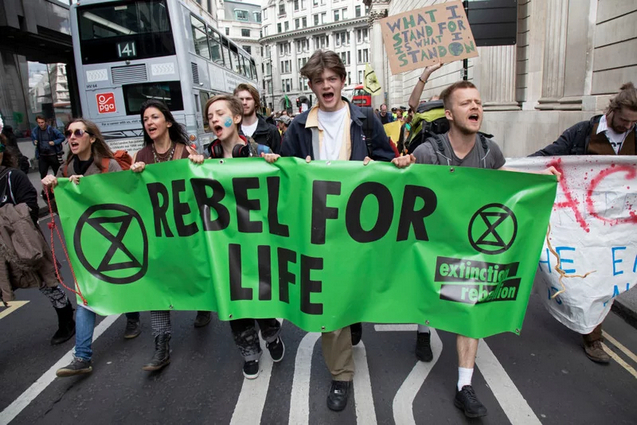
Climate change activists from the Extinction Rebellion group march up to block the street at Bank in the heart of the City of London financial district in protest that the government is not doing enough to avoid catastrophic climate change and to demand the government take radical action to save the planet, on 25th April 2019 in London, England, United Kingdom. Mike Kemp—In Pictures via Getty Images
Are humans destined to become extinct as a species? Will we be slugging it out for what little remains by arming our- selves and building walls to keep out those less fortunate than ourselves? Can we really dismantle the toxic systems that have given rise to these gargantuan problems in the short window we now have?No one knows what will happen, and no one can say for sure whether or not fundamental ecological tipping points have already been breached. The good news is that there are millions of people mobilizing to stop humanity falling off a cliff.
And they also have some sharp new ideas to create kinder, regenerative societies that can start the process of restoring nature and create communities of resistance and resilience to the impacts we cannot avoid. They want to do more than just avoid extinction or merely survive. They are building a movement built on solidarity and well- being so everyone, and every part of everyone, can flourish. Ending domination over nature goes hand in hand with tackling all forms of domination and hierarchy. The struggle for climate justice is also the struggle for racial, gender, sexual and economic equality. We are not alone. Actions are now happening all over the world.
In Ghana, Extinction Rebellion activists recently held an event calling for action on the climate and ecological emergency in Africa. The event was staged in solidarity with those in the Global South and the entire world. ‘The impact of the climate catastrophe is part of our daily life. This is why this event is important,’ says the Ghanaian activist Mawuse Yao Agorkor.
These voices cannot be ignored any longer. This year, Extinction Rebellion has injected a new sense of energy and urgency into the climate movement. Thousands of people have joined, participating in non- violent actions by blocking bridges, blockading roads and shutting down government buildings.
Members of the Extinction Rebellion Youth group locked themselves to the fence of Parliament demanding climate change action on May 3rd 2019 in London, United Kingdom. Kristian Buus—In Pictures via Getty Images
While media headlines have focused on our work in the United Kingdom, Extinction Rebellion has started an International Solidarity Network to support existing resistance in the majority world, working closely with activists in West Papua, Bangladesh, Mongolia and the Caribbean. Extinction Rebellion is also linking with and learning from other movements.
At the U.N. Conference on Climate Change, Extinction Rebellion supported the Alliance of Small Island States and the Climate Vulnerable Forum – together representing over 80 countries with 1 billion people. We helped pull together an international ‘emergency coalition’ to reject weak language that would have condemned them to extinction. While we in the Global North might only just be feeling the effects of climate change, the majority world has long since known the tragedy that the climate crisis brings.
Support is also being provided to the youth-led school strike movement started by Greta Thunberg, and to the newly emerging Birthstrike movement which is taking off in many countries to support people who are choosing not to bring children into this world unless, and until, conditions improve. In the U.S., the Sunrise Movement is building bipartisan support for a ten year mobilization and investment plan called the Green New Deal.
What all these movements have in common is a complete rejection of neoliberal economics and ‘business as usual’ politics. Yes, it is too late to prevent all the negative impacts of climate change. But this cannot destroy our capacity to nurture. It cannot destroy our capacity to love and our sense of justice.We can and now must redesign human societies based on love, justice and planetary boundaries so that no person or society is left to face devastating consequences and we learn to restore nature together.
Faced with toxic systems that are destroying all life on Earth, affirmation of this vision and rebelling against whatever gets in its way becomes a sacred duty for all. We can and must succeed in catalyzing a peaceful revolution to end the era of fossil fuels, nature extraction and capitalism.
Life on Earth depends on it.

Links

Businesses That Ignore Climate Change Could Face 'Kodak Moment', Warns APRA

ABC NewsPeter Ryan

A 'Kodak moment" refers to the film giant that failed to see the rapid rise of the digital world. (Reuters: Stefan Wermuth)
Key points:
  • Senior APRA official Geoff Summerhayes says it is clear that climate change financial risks are now "orthodox economic thinking"
  • Mr Summerhayes says "government spending decisions may need to be reprioritised" to spread the costs of climate change
  • NAB chairman and former Treasury secretary Ken Henry says Australia will move to 100pc renewable electricity by mid-century, even without a carbon price
Climate change pain is inevitable with the only question being "how much and when", a top prudential regulator has warned.
Australian Prudential Regulation Authority executive Geoff Summerhayes said businesses that ignore climate change risks could confront their own "Kodak moment", referring to the film giant that failed to foresee the rapid rise of the digital world and went into bankruptcy protection.
"Companies that delay or avoid adjusting to new economic realities, no matter how famous or successful, can quickly find themselves on the verge of a Kodak moment," Mr Summerhayes warned an insurance conference in Singapore.
Mr Summerhayes said the warnings about foreseeable and potentially catastrophic climate change as a first-order economic risk were no longer limited to fringe groups and environmentalists but now include conservative bodies, such as the Reserve Bank of Australia, APRA and corporate regulator ASIC.
"When a central bank, a prudential regulator and a conduct regulator, with barely a hipster beard or hemp shirt between them, start warning that climate change is a financial risk, it's clear that position is now orthodox economic thinking," he said.
"Debate has largely moved on from whether there is a threat that requires a response to questions about the urgency of threat, who should carry the financial burden of addressing it, and whether the benefits are worth the cost.
"Regardless of their choice, some pain will be felt; the only questions being how much and when."
Mr Summerhayes said while businesses around the world were struggling to find the appropriate balance, data around how to best manage climate change "remains under-developed, making informed debate challenging … and decision-making difficult."

Local electricity sector will be '100pc renewables'
Mr Summerhayes told the International Insurance Society Global Insurance Forum that, while climate change debates exist around the world, they are particularly sensitive in Australia given the nation's exports of iron ore, coal, natural gas and crude petroleum.

Australian bosses have started
caring about climate change

"Government spending decisions may need to be reprioritised, and not every member of society will be able to bear these short-term costs equally comfortably," Mr Summerhayes said.
"The benefit of such an approach is a substantial reduction in the expected catastrophic physical risks of climate change in the long-term."
Earlier this week, outgoing National Australia Bank chairman and former Treasury secretary Ken Henry told The Business that the corporate sector was already moving ahead to confront climate change, rather than waiting for government or regulatory action.
"Australia's energy transition is going to happen anyway," he told the program.
"Almost no matter what the policy framework is, the decisions taken by business leaders today will ensure that by about mid-century Australia's electricity sector will be 100 per cent renewables. It's almost irrespective of what decisions are taken at a policy level."

Extended interview with outgoing National Australia Bank Chairman and former Treasury Secretary Ken Henry. The Business

Mr Summerhayes repeated earlier calls for the finance industry to disclose their climate risks to put themselves in the best position to adjust to "a new economic reality".

Links

23/06/2019

Recent Scorching Temperatures In Kuwait And Pakistan Confirmed As Third And Fourth Hottest On Earth

Washington PostIan Livingston

The 129 degrees (53.9C) in Mitribah, Kuwait, in 2016 was deemed the hottest on record in Asia.
People cool off during a heat wave in Pakistan. (K.M. Chaudhry/AP) (K.M. Chaudary/AP)
Following years of tireless investigation, the World Meteorological Organization has announced two recent temperature readings have been accepted among the hottest recorded on Earth.
One of the scorching marks came from the Middle East, the other from South Asia.
It hit 129 degrees (53.9 Celsius, plus or minus 0.1 degrees uncertainty) in Mitribah, Kuwait, on July 21, 2016, and 128.7 degrees (53.7 Celsius, plus or minus 0.4 degrees uncertainty) in Turbat, Pakistan, on May 28, 2017.
“The Mitribah, Kuwait temperature is now accepted by the WMO as the highest temperature ever recorded for the continental region of Asia,” the organization wrote in a statement. It continued, “The two observations are the third (tied within uncertainty limits) and fourth highest WMO-recognized temperature extremes.”
These are the highest recognized temperatures in 76 years.


Notably, the WMO list of highest global temperatures does not include a 129.2 degree temperature (54.0 Celsius) recorded in Furnace Creek at Death Valley, Calif., on June 30, 2013. But there is a reason.
That location was even hotter in 1913 when it reportedly hit 134 degrees (56.7 Celsius). This temperature is recognized as the hottest recorded on Earth. But some experts question its validity. It was recently described as “essentially not possible from a meteorological perspective” in a detailed analysis.
It is a similar story for the planet’s second-highest recognized temperature, which is 131 degrees (55.0 Celsius) from Kebili, Tunisia, set July 7, 1931, which also is Africa’s hottest temperature. This record has “serious credibility issues,” according to Christopher C. Burt, an expert on extreme weather data.
We asked Randall Cerveny, chief rapporteur of the WMO committee for evaluating climate and weather extremes, why the Death Valley reading in 2013 is not officially considered among the hottest recorded temperatures. Even if you consider the 1913 Death Valley and 1931 Tunisia readings legitimate, the 2013 Death Valley reading should still rank third hottest.
“The WMO does not verify a record through its extreme evaluation process unless it is a new global, hemispheric or continental extreme record,” Cerveny responded in an email. “ . . . the Death Valley 2013 temperature was not proposed to the WMO as an extreme at any of those categories,” given it was not as high as the 1913 record at that same location.
Considering the questions that swirl around two hottest recorded temperatures (Death Valley in 1913 and Tunisia in 1931), the Death Valley (2013) and Kuwait (2016) temperatures could in fact be the highest reliably measured on record. Since it is unclear whether the 2013 Death Valley reading will ever be formally recognized and/or the 1913 reading invalidated, we may never know for sure.

Links

Lethal Heating is a citizens' initiative