14/09/2019

World Losing Area Of Forest The Size Of The UK Each Year, Report Finds

The Guardian - 
A deforested area of the Amazon in Pará state, Brazil. The global rate of tree loss is 26m hectares a year. Photograph: João Laet/AFP/Getty Images


An area of forest the size of the UK is being lost every year around the world, the vast majority of it tropical rainforest, with dire effects on the climate emergency and wildlife.
The rate of loss has reached 26m hectares (64m acres) a year, a report has found, having grown rapidly in the past five years despite pledges made by governments in 2014 to reverse deforestation and restore trees.
Charlotte Streck, a co-founder and the director of Climate Focus, the thinktank behind the report, said: “We need to keep our trees and we need to restore our forests. Deforestation has accelerated, despite the pledges that have been made.”
The New York declaration on forests was signed at the UN in 2014, requiring countries to halve deforestation by 2020 and restore 150m hectares of deforested or degraded forest land.
But the rate of tree cover loss has gone up by 43% since the declaration was adopted, while the most valuable and irreplaceable tropical primary forests have been cut down at a rate of 4.3m hectares a year.
The ultimate goal of the declaration, to halt deforestation by 2030 – potentially saving as much carbon as taking all the world’s cars off the roads – now looks further away than when the commitment was made.
In Latin America, south-east Asia, and Africa – the major tropical forest regions – the annual rate of tree cover loss increased markedly between 2014 and 2018, compared with 2001 to 2013. While the greatest losses by volume were in tropical Latin America, the greatest rate of increase was in Africa, where deforestation rates doubled from less than 2m hectares a year to more than 4m.
Guardian graphic. Source: World Resources Institute analysis based on 2019 data from Global Forest Watch
The report uses data up to 2018 in most cases, so the figures do not include the impact of the most recent burning in the Amazon. The report’s authors note that in June, deforestation rates in the Brazilian Amazon rose by 88% compared with the same month last year.
Streck warned the recent fires were a particular concern because, whereas in previous decades when the humid nature of the rainforest made it hard to burn, with the lush vegetation acting as an effective firebreak, global heating in recent years has dried out parts of the forest and made it easier to combust.
“The fires are coming at the beginning of the dry season, which is when you would have expected the forests to be at their wettest and hardest to burn,” she said. “This shows we could be entering into a feedback loop.”

Tropical deforestation has increased
since the New York declaration on
forests was signed in 2014.
---
Average annual tropical tree
cover loss, million hectares
Guardian graphic | Source: World Resources Institute analysis based on 2019 data from Global Forest Watch. Note: Tree cover loss calculated using a >25% tree cover density threshold. Improvements to methodology starting in 2011 may result in higher estimates of loss in 2011-18 compared with 2001-10

Feedback loops are feared by climate scientists because they amplify the effects of heating. In the case of forests, climate change dries out trees, making them more flammable, and increasing temperatures so they burn more easily, which then contributes more carbon dioxide, which fuels heating.
Keeping existing forests standing, particularly in tropical regions, and restoring wooded areas that have been damaged, has long been recognised as one of the cheapest ways of tackling the climate crisis. The cost of preserving key forests globally has been estimated to be in the tens of billions of dollars a year, compared with the trillions needed to shift to low-carbon infrastructure.
Jo House, a reader in environmental science and policy at the University of Bristol, said: “Deforestation, mostly for agriculture, contributes around a third of anthropogenic CO2 emissions. At the same time, forests naturally take up around a third of anthropogenic CO2 emissions.
“This natural sink provided by forests is at risk from the duel compounding threats of further deforestation and future climate change. The continued loss of primary forests, at ever-increasing rates, despite their incalculable value and irreplaceability, is both shocking and tragic.”
One of the difficulties highlighted by the report is that of gaining private sector support and investment for keeping forests standing. While there are clear economic benefits to cutting down forests, in the form of timber production and expanded agriculture, there are few investments being made in keeping existing forests healthy.

Annual deforestation in Brazil fell below
2m hectares for seven years to 2016
Guardian graphic. Source: For 2001-13, Tyukavina, A., Hansen, M. C., Potapov, P. V., Stehman, S. V., Smith-Rodriguez, K., Okpa, C., & Aguilar, R. (2017). Types and rates of forest disturbance in Brazilian Legal Amazon, 2000–2013, Science Advances, 3(4), e1601047; For 2014-18 data, Hansen, M. C., Potapov, P. V., Moore, R., Hancher, M., Turubanova, S. A., Tyukavina, A. et al. (2013). Tree Cover Loss (Hansen/UMD/Google/USGS/Nasa). Global Forest Watch database.

Another complicating factor is that many governments offer subsidies to agriculture, which provide perverse incentives for deforestation.
The report from a coalition of 25 organisations is being presented in New York before a series of events focusing on the climate crisis in the run-up to the UN secretary general’s summit later this month. At the meeting, world leaders are expected to come up with new proposals for tackling the climate emergency.
But Streck said the failure to meet the pledges made five years ago undercut the value of such promises if they were not backed up with finance, detailed plans and on-the-ground implementation.
“We don’t need more important guys standing up making pledges,” she said. “We need to go beyond declarations. Implementation is complicated, but it’s what we need.”
There have been some bright spots. The rate of loss of primary forest in Indonesia slowed by nearly one-third between 2017 and 2018. Palm oil plantations in the country are a major cause of deforestation, but companies and the government have come under pressure from consumers and aid donors. Wetter weather that reduced forest fires also helped.
While some countries have embarked on tree-planting schemes, notably in Ethiopia, but also in Mexico and El Salvador, these have been far outweighed by the loss of existing forests. Tree planting does not compensate for the loss of standing forests, because established growth yields benefits beyond carbon uptake, through the whole ecosystem.
“It can take centuries for forests to recover their full carbon-absorbing and weather-regulating capabilities,” Streck said.

Links

When Climate Distress Becomes Too Much, The Philosophy Of Eternalism Can Provide Perspective

ABC Radio National - Alice Moldovan

Heidi Edmonds says she's trying to instil a love of nature in her kids while they're young. (Supplied: Heidi Edmonds)
The first time Heidi Edmonds felt this type of anxiety creep up, she became teary and had to go into the bathroom for a cry.
"I was looking at my nieces ... and worrying about their future," she says, "not feeling like everything was going to be OK."
Dr Edmonds — who holds a PhD from Griffith University's Australian Rivers Institute — is a co-founder of Australian Parents for Climate Action, a national volunteer campaign group.
She has two young daughters and like many young parents, manages sleep deprivation and parenting stress with all of her other responsibilities at work and with friends.
Over the last year she's noticed another kind of pressure weighing on her — climate anxiety.
Dr Edmonds takes her role as a climate advocate seriously. (Supplied: Heidi Edmonds)
This week the Australian Medical Association declared climate change a health emergency, referencing a higher incidence of mortality rates from heat stress and more mental ill health.
Ros Knight, the president of the country's peak body for psychologists, the Australian Psychological Society, says many Australians report some level of concern about climate change.
She points to a 2012 study that found 20 per cent of those surveyed felt climate-related distress at times.
"It's hard to be specific about exact numbers for climate anxiety with a capital 'A'," she says. "We would call it climate change distress — we wouldn't necessarily label it one particular response."
Her organisation has an online resource dedicated to coping with this distress and lists fear, anger, guilt, shame, grief, loss and helplessness as associated emotions.
When the tearful episode happened, Dr Edmonds says she still wasn't sure how to talk to her children about climate change.
"You talk to them about nature and caring for nature, and I said to them: 'Mummy's working very, very hard to protect the frogs and the fish and nature.'"
Balancing concern and positivity is part of a long-term strategy for Dr Edmonds, who says that with the support of family and her community, she focuses on solutions.
Another element in her arsenal of hope is the philosophical idea of eternalism.

A salve for a social affliction
Dr Edmonds first came across a passage in a self-help book that incorporated eternalism over a decade ago — and says it has stuck with her since then.
"If we think about time as a tapestry, it allows us to focus on giving our children bright moments now ... so that no matter what the future holds, they'll have had these wonderful moments," she says.
This reference to a tapestry of time resonates with eternalism — a theory that joins the past, present and future in a single block of time.
Kristie Miller, the joint director of the Centre for Time at Sydney University, uses the idea of a Persian rug to explain the concept.
Eternalism compares time to a tapestry, in which the past, present and future are all situated together. (Getty: Dan Kitwood)
When you look down at a rug, she says, "you can see the whole thing".
"None of the rug is any more special than any other bit of the rug. The whole thing creates the entire picture, which is the universe."
So a person's life in 2019 doesn't take precedence over another person's life in 1519 — because there is no objective present moment.

Empowering or disempowering?
Dr Miller explains that eternalism can be a comfort when it comes to grief.
"It's true, of course, that your life comes to an end — in the sense that there will be later times when you don't exist," she says.
But from an eternalist perspective, she says, "all of your life is still out there in space time, so all the things that you did still exist. And some people find that quite consoling."
Dr Miller says eternalism can be either empowering or disempowering for people suffering climate anxiety. (Supplied: Kristie Miller)
The situation becomes more complex in relation to climate change, because this grief is for a future that hasn't happened yet.
On the other hand, eternalism can also exacerbate climate grief — because people can "feel fairly sure that the future that's out there is suboptimal", Dr Miller says.
So does that mean the future is already set and there's no point in taking climate action now?
Not exactly, says Dr Miller, who uses the metaphor of a Rubik's cube to explain cause and effect in eternalism. "When you twist one bit around, other bits automatically twist in response," she says.
If the past, present and future of our world were a single Rubik's cube, and we wiggled certain elements like carbon emissions now, "what you'll do is you'll wiggle the way the future is".
"The later states depend in various ways on the earliest states," Dr Miller says.
This is where optimism comes into the equation.

Change takes time
Dr Edmonds says 90 per cent of the time she feels quite hopeful. "I remain focused on hoping that I can be part of the solution to give [my children] a healthy, happy future."
Psychologists recommend being mindful that changes in attitudes take time, and one person can't do everything. (Getty: picture alliance)
To maintain perspective, she separates the sources of her anxiety, asking which parts are climate anxiety, which are "just general parenting anxiety", and which are caused by a lack of sleep.
Ms Knight says this cognitive strategy is helpful because it prevents catastrophising.
"It's about being aware of what you can and can't contribute. So you can't change everything yourself," she says.
She says maintaining positivity requires long-term thinking and relying on your community to help shoulder the effort of climate change advocacy.
And she recommends "keeping things in measure" and "realising that change does take time. And that, if we look around, we can see that change is slowly escalating."
Dr Edmonds says she's also taking action to get her work-life balance under control.
For her, that's all part of maintaining the pattern in the collective tapestry of time.

Links

John Hewson Urges Liberal Conscience Vote On Climate Emergency

SBS

Former Liberal leader John Hewson has joined calls for the federal parliament to declare a climate emergency for Australia.
Former member for Wentworth John Hewson. Source: AAP
A former Liberal luminary is joining ranks with crossbenchers to urge the coalition to give its MPs a conscience vote on declaring Australia in a state of climate emergency.
John Hewson has added his voice to the push from the Greens and independent MPs.
"Climate was an emergency some 30 years ago," he said on Wednesday.
The group believes if the coalition party room gives its members a conscience vote on the issue, a motion declaring the emergency can pass parliament.
"MPs and senators should have a conscience vote on the emergency declaration so that individual members of parliament can be held personally accountable by their constituents, their children and their grandchildren, indeed by all future generations, for the stance they took on the greatest economic, social, political and moral challenge of this century," Dr Hewson said.
Nearly three million Australians are living in areas where their local councils have declared climate emergencies and pledged greater action to combat climate change, including aiming for 100 per cent renewable energy and zero net emissions.
Countries including Britain, France and Canada have also made the call.
Greens MP Adam Bandt, who is leading the push in federal parliament, says the circumstances of record drought and fearsome bushfires at the start of spring underscore how severe the issue is.
"If the government can declare a budget emergency, it can declare a climate emergency," he said.
Independent Zali Steggall, who won former prime minister Tony Abbott's seat on a platform of strong climate action, cites the lessons of her business background in saying a problem has to be recognised and a plan formed before anything can change.
On Tuesday, she launched the latest Climate of the Nations report, which showed an overwhelming majority of people are concerned about the impacts of climate change and want stronger national action.
"People of all political leanings are concerned with this issue," she told reporters.
"It's something that I want to see more MPs stand up from both sides of the aisle and ask for a conscience vote.
"It should be a question for all MPs to represent their electorate and be true to the campaigns they run when they say they're going to take action on climate change."

Links

13/09/2019

‘You Have No Idea’: Minister’s Stunning Answer On Climate Change

NEWS.com.au - Sam Clench

It was a simple question. But the government minister’s answer was so extraordinary, the interviewer had to clarify it twice, just to make sure.
Water Resources Minister David Littleproud. Picture: Kym Smith Source: News Corp Australia
STOP PRESS
Australia’s minister responsible for drought and natural disasters, David Littleproud, now says he accepts the science on manmade climate change, and “[I] always have”.
Littleproud’s comments to the House of Representatives on Thursday were entirely at odds with a written statement he made to Guardian Australia on Tuesday.
In response to questions, Littleproud said: “I don’t know if climate change is man-made.”
“I’m about practical outcomes, whether that’s about having a cleaner environment or giving farmers and emergency services the right tools to adapt,” the minister said in that statement.
“I am responsible for making sure we have the tools we need to adapt to a changing climate.”
Crossbench politicians are calling on the federal parliament to officially declare a “climate emergency” today.
Greens MP Adam Bandt will move a motion to that effect, and it will be seconded by independent Zali Steggall.
Ms Steggall’s fellow independents Helen Haines and Andrew Wilkie also support the motion, along with Centre Alliance MP Rebekha Sharkie.
They have at least one ally from the Liberal side of politics as well. Former opposition leader John Hewson is in Canberra today to help them push for the declaration.
Ms Steggall went on Sky News this morning to make her case.
“This isn’t about me expressing an opinion. This is about listening to the experts,” she said.
“It’s only a first step, of course. What we really need is a plan to decarbonise.”
Ms Steggall has previously been accused of hypocrisy because she does not drive an electric vehicle. Her critics say that’s an example of her not practising what she preaches.
Asked about that, she said she could not yet afford to buy one.
“I, like every other Australian, have budget pressures, mortgage pressures,” Ms Steggall said.
“I would really welcome the government taking some steps to make EVs more affordable so I could accelerate the process in which I could transfer my car.
“I am committed to, when it comes time to changing my vehicle, that I will change it to an EV.”
You can expect the government to oppose the climate emergency declaration, meaning it will not pass.
Labor, for what it’s worth, is hedging its bets, saying it will “consider any motions brought forward” through its usual processes.
The timing of this is interesting. It comes after government frontbencher David Littleproud’s stunning admission yesterday that he doesn’t know whether climate change is man made.
Zali Steggall. Picture: Kym Smith Source: News Corp Australia
The Minister for Water Resources, whose job includes responsibility for handling natural disasters — bushfires, for example — first revealed that titbit to The Guardian before doubling down in an interview with Sky News political editor David Speers.
“I don’t know if climate change is man made,” Mr Littleproud told The Guardian.
“I’m about practical outcomes, whether that’s about having a cleaner environment or giving farmers and emergency services the right tools to adapt.”
A short while after those comments were reported, he was interviewed by Speers.
“You say the climate is changing, and that is certainly true. The question is, is this man made climate change?” Speers asked.
“I have no idea, but does it really matter?” Mr Littleproud said.
“Sorry, you have no idea whether?” Speers pressed.
“I am not a scientist. I haven’t made an opinion one way or the other, but I don’t think it really matters,” the minister said.
“Sorry, I just want to be really clear on this. You are not sure whether man made climate change is real?” Speers continued.
“I am going to be honest with you, I don’t have an opinion, but I don’t think it really matters. I think these extremes from both sides have taken away the maturity of debate we should have about keeping, simply, a clean environment and making sure we give our people the tools to be able to go out and protect themselves in a changing climate,” Mr Littleproud said.
David Speers does his best ‘Is that your final answer?’ face. Picture: Sky News Source: Supplied


Australia’s Attitude To Climate Change


  • 81 per cent concerned about more droughts and flooding caused by climate change 
  • 77 per cent think climate change is already happening 
  • Two-thirds think Australia should have a national target of net-zero emissions by 2050.
  • Almost two-thirds think humans are responsible for climate change.
  • Most Australians think climate change is causing more extreme weather events and hurting food supply.
  • Most blame electricity companies and their profit margins for rising power bills.
  • Solar power is Australia’s favourite energy source for the fourth year running.
  • Young adults are more concerned about climate change and more supportive of reducing emissions than older generations.
  • About two-thirds want the federal government to stop building new coal mines.
Links

How Actually Dare People Politicise The Bushfires By Claiming 'Scientifically' It's Linked To The Climate Crisis

The Guardian - First Dog On The Moon

I mean there are good scientists on both sides ...
Cartoon by First Dog on the Moon
LARGE IMAGE


Links

12/09/2019

Climate Change Is Bringing A New World Of Bushfires

The Conversation - 

Fires are burning across Queensland and New South Wales. AAP Image/Dan Peled
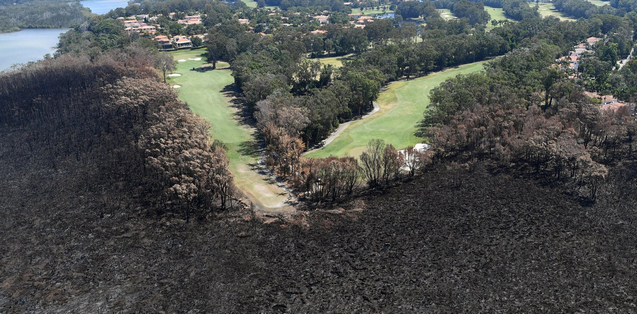
Spring has barely arrived, and bushfires are burning across Australia’s eastern seaboard. More than 50 fires are currently burning in New South Wales, and some 15,000 hectares have burned in Queensland since late last week.
It’s the first time Australia has seen such strong fires this early in the bushfire season. While fire is a normal part of Australia’s yearly cycle and no two years are alike, what we are seeing now is absolutely not business as usual.
And although these bushfires are not directly attributable to climate change, our rapidly warming climate, driven by human activities, is exacerbating every risk factor for more frequent and intense bushfires.
The basics of a bushfire
For some bushfire 101, a bushfire is “an uncontrolled, non-structural fire burning in grass, scrub, bush or forest”. This means the fire is in vegetation, not a building (non-structural), and raging across the landscape – hence, uncontrolled.
For a bushfire to get started, several things need to come together. You need fuel, low humidity (which also often means the fuel itself has a low moisture content and is easier to burn), and oxygen. It also helps to have an unusually high ambient temperature and winds to drive the fire forward.
In Australia, we divide bushfires into two types based on the shape and elevation of the landscape.
First are flat grassland bushfires. These are generally fast-moving, fanned by winds blowing across flattish open landscapes, and burn through an area in 5–10 seconds and may smoulder for a few minutes. They usually have low to medium intensity and can damage to crops, livestock and buildings. These fires are easy to map and fight due to relatively straightforward access.
Second are hilly or mountainous bushfires. These fires are slower-moving but much more intense, with higher temperatures. As they usually occur in forested, mountainous areas, they also have more dead vegetation to burn and are harder to access and fight.
They burn slowly, passing through an area in 2-5 minutes and can smoulder for days. Fires in upper tree canopies move very fast. Mountainous bushfires actually speed up as they burn up a slope (since they heat and dry out the vegetation and atmosphere in front of the fire, causing a runaway process of accelerating fire movement).
About 70 blazes are still burning across Queensland. AAP Image/Dan Peled
Climate change and bushfire risk
To be clear, as previously reported, the current bushfires are not specifically triggered by climate change.
However, as bushfire risk is highest in warm to hot, dry conditions with low humidity, low soil and fuel load moisture (and are usually worse during El Niño situations) – all factors that climate change in Australia affects – climate change is increasing the risk of more frequent and intense bushfires.
Widespread drought conditions, very low humidity, higher than average temperatures in many places, and strong westerly winds driven by a negative Southern Annular Mode (all made worse by human-induced climate change) have collided right now over large areas of the eastern seaboard, triggering extremely unusual bushfire conditions – certainly catching many communities unawares before the start of the official bushfire season.
Different regions of Australia have traditionally experienced peak bushfire weather at different times. This has meant that individual households, communities and the emergency services have had specific periods of the year to prepare. These patterns now seem to be breaking down, and bushfires are happening outside these regular places and times.
Map of bushfire seasons. Bureau of Meteorology
New challenges for the emergency services
While experts recently forecast a worse-than-average coming bushfire season, the current emergency has essentially exploded out of nowhere.
Many Australian communities do know how to prepare but there is always some apathy at the start of bushfire season around getting households and communities bushfire-ready. When it’s still relatively cold and feeling like the last whisps of winter are still affecting us, bushfire preparation seems very far off.
Compounding our worsening bushfire conditions, we are increasingly building in bushfire-prone areas, exposing people and homes to fire. This tips the scales of risk further in favour of catastrophic losses. Sadly too, these risks always disproportionately affect the most vulnerable.
With such extensive fires over wide areas, the current emergency points to an extremely frightening future possibility: that emergency services become more and more stretched, responding to fires, floods, storms, tropic cyclones and a myriad other natural hazards earlier in each hazard season, increasingly overlapping.
Our emergency services do an amazing job but their resources and the energy of their staff and volunteers can only go so far.
Regularly the emergency services of one area or state are deployed to other areas to help respond to emergencies.
But inevitably, we will see large-scale disasters occurring simultaneously in multiple territories, making it impossible to share resources. Our emergency management workforce report they are already stressed and overworked, and losing the capacity to share resources will only exacerbate this.
Immediate challenges will be to continue funding emergency management agencies across the nation, ensuring the workforce has the necessary training and experience to plan and respond to a range of complex emergencies, and making sure local communities are involved in actively planning for emergencies.

Links

World 'Gravely' Unprepared For Effects Of Climate Crisis – Report

The Guardian - 

Trillions of dollars needed to avoid ‘climate apartheid’ but this is less than cost of inaction
Massive wildfires such as those in Bolivia have been mentioned as evidence that the climate crisis is here. Photograph: David Mercado/Reuters
The world’s readiness for the inevitable effects of the climate crisis is “gravely insufficient”, according to a report from global leaders.
This lack of preparedness will result in poverty, water shortages and levels of migration soaring, with an “irrefutable toll on human life”, the report warns.
Trillion-dollar investment is needed to avert “climate apartheid”, where the rich escape the effects and the poor do not, but this investment is far smaller than the eventual cost of doing nothing.
The study says the greatest obstacle is not money but a lack of “political leadership that shakes people out of their collective slumber”. A “revolution” is needed in how the dangers of global heating are understood and planned for, and solutions are funded.
The report has been produced by the Global Commission on Adaptation (GCA), convened by 18 nations including the UK. It has contributions from the former UN secretary general Ban Ki-moon, the Microsoft founder, Bill Gates, environment ministers from China, India and Canada, the heads of the World Bank and the UN climate and environment divisions, and others.
Among the most urgent actions recommended are early-warning systems of impending disasters, developing crops that can withstand droughts and restoring mangrove swamps to protect coastlines, while other measures include painting roofs of homes white to reduce heatwave temperatures.
In the foreword to the report, Ban, Gates and Kristalina Georgieva, the World Bank chief executive, write: “The climate crisis is here, now: massive wildfires ravage fragile habitats, city taps run dry, droughts scorch the land and massive floods destroy people’s homes and livelihoods. So far the response has been gravely insufficient.”
Ban said: “I am really concerned about the lack of vision of political leaders. They are much more interested in getting elected and re-elected, and climate issues are not in their priorities. We are seeing this in the US with President Trump.”
The report says severe effects are now inevitable and estimates that unless precautions are taken, 100 million more people could be driven into poverty by 2030. It says the number of people short of water each year will jump by 1.4 billion to 5 billion, causing unprecedented competition for water, fuelling conflict and migration. On the coasts, rising sea levels and storms will drive hundreds of millions from their homes, with costs of $1tn (£810bn) a year by 2050.
Patrick Verkooijen, the chief executive of the Global Center on Adaptation, said: “What we truly see is the risk of a climate apartheid, where the wealthy pay to escape and the rest are left to suffer. That is a very profound moral injustice.”
But the moral imperative alone will not drive change, he said, and the report also makes an economic case.
“It is a nation’s self-interest to invest in adaptation,” Verkooijen said. The report estimates spending $1.8tn by 2030 in five key areas could yield $7.1tn in net benefits, by avoiding damages and increasing economic growth.
The chair of the UK’s Environment Agency, Emma Howard Boyd, is a member of the GCA. The agency has warned England could run short of water within 25 years and increased coastal and river flooding may force some towns to be abandoned.
Children paddle a raft through waters in Jakarta, Indonesia, where sea levels are rapidly rising. Photograph: Ed Wray/Getty Images 
In July, the UK government’s official advisers said they were shocked at the lack of proper plans to protect people from the effects of the climate crisis.
Bob Ward, the policy director at the Grantham Research Institute on Climate Change and the Environment at the London School of Economics, said: “As one of the governments that commissioned this important GCA report, the UK must heed its conclusions about the large economic benefits from adapting to those impacts of climate change that cannot now be avoided.
“This summer has shown that the UK is not adapted to the changing climate of this century, with heavier rainfall and more frequent and intense heatwaves. Successive environment ministers have failed to give this issue the attention it needs, leading to greater damage to lives and livelihoods.”
Cutting carbon emissions is vital, says the GCA report, but this has received nearly 20 times more funding than adaptation in recent years. Climate effects must be factored into decisions by those who make choices about the future, it says, such as business leaders. Verkooijen said nations should follow France in making it compulsory for large companies to report the climate risks to their businesses.

Coping with the climate storm
The GCA report focuses on several areas of adaptation:
  • Early warning systems: Just 24 hours’ warning of a coming storm or heatwave can cut the ensuing damage by 30%, saving lives and protecting assets worth at least 10 times the cost of the alert system. In Bangladesh, such systems, plus shelters and coastal protection, have already saved hundreds of thousands of lives since the Bhola cyclone in 1970 killed at least 300,000 people.
  • Climate-ready infrastructure: Such measures can add 3% to the upfront costs but save $4 for every $1 spent. Flood protection is key and Shanghai, and other Chinese “sponge cities” are deploying porous pavements, rooftop gardens and trees in parks to soak up water from downpours. Relatively simple measures can also be effective, such as painting roofs with reflective white paint. In the Indian city of Ahmedabad, this has cut temperatures in the rooms below by 5C.
  • Mangrove protection: These coastal forests buffer storms, protecting 18 million people and preventing $80bn a year in flood damage. They also provide nurseries for fish and tourist attractions worth billions. But construction, pollution and global heating have destroyed many mangrove forests, from Australia to Mexico. The GCA says the benefits of mangrove preservation and restoration are up to 10 times the cost.
Links

Lethal Heating is a citizens' initiative