13/10/2019

A Little More Confusion Added To The Climate Policy Debate

Canberra Times - Michelle Grattan

Joel Fitzgibbon was on his mobile at a cafe at the Commonwealth Parliamentary Offices in Sydney on Thursday when he encountered Scott Morrison getting a mid-morning coffee.
"You're making a lot of sense," Morrison said to Labor's resources spokesman, who'd set off a firestorm in his party by suggesting the ALP revise its climate policy to adopt the upper end of the government's target of reducing emissions by 26-28 per cent by 2030.
"Your love won't help me, Prime Minister," Fitzgibbon shot back.
Labor MP Joel Fitzgibbon during question time. Picture: Alex Ellinghausen
He's right there. Fitzgibbon's radical proposal has burst open the conundrum the opposition has in reshaping one of the ALP's centrepiece election pitches.
It's a great deal more complicated than, for example, dealing with the franking credits plan, which Labor can't afford to keep in its present form. That can be restructured, or dumped, without much political angst.
But the climate policy - for a 45 per cent reduction in emissions by 2030 and a target of net zero by 2050 - has become an article of faith within Labor, and among many of its supporters. It's also a policy that in the election split the voters Labor needed, attracting some but driving away others.
Weaken the policy and there will be a reaction from the ALP's inner city constituents, who tend to look toward the Greens out of the corner of their eye. Keep a very high target and lose people once again - to the Coalition or minor parties on the right - from the traditional base, including in regional areas, especially in Queensland where coal mining is a thing.
Fitzgibbon maintains that by adopting the 28 per cent target, Labor would not just be more acceptable to blue collar voters but would put more pressure on the government to act - although this latter point seems a stretch.
Getting to 28 per cent without destroying blue collar jobs or harming the economy would also provide "a great foundation" for prosecuting the case for further action, he claims.
Among the multiple problems Labor has in reviewing its policy is that it will be considering a more pragmatic, less ambitious approach just when the climate debate is once again taking off in public consciousness.
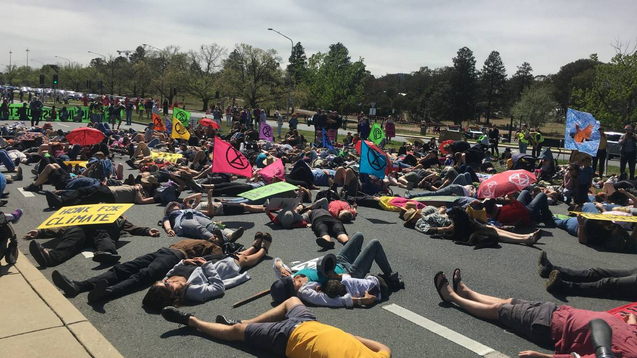
Protesters take over Commonwealth Avenue in a staged "die-in" in protest of climate change inaction. Picture: Peter Brewer
It's hard to assess precisely the extent to which the step-up in activism represents the wider public view. Indeed the civil disobedience demonstrations are infuriating some people because of the disruption. Nevertheless, the period ahead could see the issue biting more, as the ALP is considering easing back.
Given how quickly things change and the relevance of what other countries do, in strict policy terms Labor arguably would be best not to settle a policy until, say, early 2021, for a 2022 election. But the government (and the media) will be able to exploit a Labor vacuum, so that holding out does carry political cost.
Fitzgibbon, who represents the NSW coal seat of Hunter and experienced voter wrath in May, won't get the ambit claim he outlined this week. That would be going too far for the party, and for its climate spokesman Mark Butler who has a lot of reputation at stake. As soon as Fitzgibbon made public his proposal, Butler said it wouldn't be embraced by Labor, declaring it was "fundamentally inconsistent with the Paris Agreement and would lead to global warming of 3 degrees."
Fortunately for the government, Fitzgibbon's intervention reduced the attention on its energy policy, the inadequacy of which was again highlighted this week.
As the Coalition pushes ahead with seeking to get its "big stick" legislation to deal with recalcitrant power companies through parliament, criticisms of its policy came from, among others, the chair of the Energy Security Board Kerry Schott and the Grattan Institute.
Schott, whose board advises federal and state governments, wrote in The Australian Financial Review, ahead of the paper's energy summit, that "government interventions to cap prices and to effectively subsidise certain generation projects will not encourage the considerable new investment and innovation that is needed".
The Grattan Institute, which released a report on Australia's electricity markets, said the government's "fight to avoid the impending closure of the Liddell coal power station in NSW makes it harder for Australia to achieve its emissions reduction targets, and is likely to increase electricity prices and reduce the reliability of supplies".
The AFR summit saw much finger pointing, with Energy Minister Angus Taylor blaming industry for the lack of investment, and industry blaming the government.
Taylor said dismissively: "Time and again we've seen industry participants and commentators swept up in the excitement of complex new programs represented by the latest fashionable acronym that everyone pretends to understand but few ever do." Origin Energy's CEO Frank Calabria said "the mere existence of the big stick is acting as a handbrake on investment, right when we need investment the most".
In theory, Morrison could have tried to use the great authority his unexpected election win gave him to pursue more appropriate energy and emissions reduction policies. Admittedly, it would have been extremely difficult, as it would have contradicted much the government had been saying and doing.
But it was never an option. Morrison is either wilfully blind to what needs to be done (although when treasurer he supported the more rational policy of a National Energy Guarantee), or he is afraid to stir those powerful naysayers in his party.
So where are we left?
With a government stubbornly tied to a set of policies that experts insist won't deliver effective results. And an opposition that's in a funk about where it should position itself in the future.
Meanwhile Australia's overall emissions rise (although electricity emissions are down, as some coal fired power goes out of the system); high electricity prices remain a burden on private and business consumers alike; and there is nervousness about the summer power supply.

Links

The Hot Topic Of Climate Change

The Saturday PaperPaul Bongiorno


The ghosts of leaders past are haunting the political firmament as climate change, the one issue that played a major role in their demise, flares spectacularly. While Malcolm Turnbull, Tony Abbott and Bill Shorten ruminate on their contributions to and prescriptions for the nation, fierce unseasonal bushfires are offering a brutal reality check.
The irony is that a former Liberal prime minister, Malcolm Turnbull, is most in tune with the thousands of Extinction Rebellion protesters disrupting major cities here and around the world. Turnbull does not baulk at laying the blame for Australia’s faltering response on his own party. He told Rupert Murdoch’s flagship newspaper The Australian, “The failure to have a coherent national energy policy is a major problem but it is founded on this rock of climate denialism inside the Liberal Party and inside the media, including by the newspaper you [the interviewer] work for.”
Turnbull defends himself as a “true conservative” against those who dumped him as prime minister on the pretext he was too left-leaning and “not really one of us”. He says, “There is nothing conservative … [in] denying the science of climate change. That’s not a conservative position. That is just, well, that is just denying reality. You might as well deny gravity.”
His successors in government have no compunction about denying anything that doesn’t suit them. Energy Minister Angus Taylor insists Turnbull is wrong to claim the government’s policy is incoherent, because carbon emissions and energy prices are both falling. Except the government’s own figures show this claim to be wrong, or at the very least a giant fudge. Total yearly emissions have been rising every year since Tony Abbott scrapped Labor’s carbon price in 2014.
On energy prices, Taylor says an Australian Competition and Consumer Commission report shows his new regulations forced retailers in South Australia, New South Wales and south-east Queensland to lower their standing offers by $130 to $190 a year. Victoria was the standout, with its retailers decreasing their standing offers by $310 to $430 a year.
Labor’s spokesman for Climate Change and Energy, Mark Butler, rejects Taylor’s argument that electricity bills are shrinking, saying only 10 per cent of households are on standing offers. He quotes analysis by JPMorgan showing wholesale electricity prices rose by 12 per cent from June to August.
On Tuesday, Butler said the latest work from the Grattan Institute reported that under the Coalition the big three private power companies have earned “an extra $1 billion in additional mega-profits … all paid for by Australian households and businesses”. He added that, since the energy crisis sparked by Abbott in 2015, wholesale power prices have risen “by about 158 per cent, and the market expects those prices to continue rising, with forward prices up 29 per cent just in the last 12 months, since Malcolm Turnbull and the national energy guarantee were dumped back in 2018”.
You’d imagine Labor would agree with the Extinction Rebellion protesters … Instead the party is subjecting itself to some very public open-heart surgery on its climate change and energy policy. With interventions like that from the knowledgeable Butler – who’s written a book on the subject – you’d imagine Labor would agree with the Extinction Rebellion protesters, who say there is an urgent need to declare a climate emergency and take greater action to reduce emissions. Instead the party is subjecting itself to some very public open-heart surgery on its climate change and energy policy.
Bill Shorten, in his first major interview since the election, told another Murdoch paper, the Sunday Herald Sun, “It pains me to realise after the election that I’d misread some of the mood in Queensland and Western Australia. There they saw some of our policies as being green-left, not for the worker, not for the working people.” Labor failed to win new seats in the west and saw swings against it of 11 to 12 percentage points in the Queensland coal seats of Dawson and Capricornia. In New South Wales, the  hitherto-safe Labor seat of Hunter had a swing of 9.5 percentage points against the party.
The swing in Hunter has certainly alarmed Joel Fitzgibbon, who managed to hold on by his fingernails. One Labor insider says that, as a result, “Joel has gone rogue.” But Anthony Albanese added Resources to Fitzgibbon’s Agriculture portfolio after the election, and Fitzgibbon has now set about pushing the party to a new climate deal that is closer to the government’s weak ambitions.
Fitzgibbon ventured to reactionary champion Gerard Henderson’s Sydney Institute on Wednesday to run up the white flag. He largely blames the three consecutive election losses on Labor’s more ambitious climate change policies. “How many times are we going to let it kill us?” he asked, adding, “How many leaders do we want to lose to it?” He said it was time “to reach a sensible settlement on climate change”.
His settlement: to match the prime minister’s 26-28 per cent emissions reduction target by 2030. But, unlike Morrison, he wants to achieve the higher target of 28 per cent. “If we could get to 28 per cent by 2030, and also demonstrate that we could do so without destroying blue-collar jobs or damaging the economy, then we would have a great foundation from which to argue the case for being more ambitious on the road to 2050.” The Liberals’ most strident coal spruiker, Craig Kelly, couldn’t have put it better. How it squares with Albanese’s and Butler’s assurances that Labor will always take climate change more seriously than the Liberals is the question. It sets the scene for a mighty brawl at next year’s Labor Party national conference.
The Greens’ Adam Bandt says the public will never forgive Labor if it abandons climate action. He says if Labor walks away from its already weak target of reducing emissions by 45 per cent by 2030, “it walks away from the Paris agreement goal of keeping global warming below 2 degrees”. He accuses Labor of joining the Tories.
It’s a pretty serious accusation on the day Angus Taylor outraged even the energy regulator by announcing he was going to use taxpayers’ money to underwrite coal-fired power stations. Taylor tried to mask his intention by lumping it in with funding for new gas and pumped-hydro plants. He told the Australian Financial Review National Energy Summit there was a need to strengthen the process for retaining coal generators.
The Malcolm Turnbull-appointed chair of the Energy Security Board, Kerry Schott, was unimpressed. She told the same conference, “Government interventions to both cap prices and effectively subsidise certain generation projects will not encourage the considerable new investment and innovation that is needed. The ongoing and costly efforts to keep aged coal plants running for extended periods is also ill advised.”
“Ill advised”, because it also flies in the face of market realities and downgrades the climate change risks that insurers and investors are now factoring into their decisions. And one would think it is ill advised because climate change, according to recent opinion polling, is increasingly seen as Australia’s No. 1 threat.
The yearly Lowy poll published in May found 64 per cent of adults saw the issue as “a critical threat”. It was the first time in the 15-year history of the poll that global warming topped the list of threats. And at the beginning of October, an Essential poll found 70 per cent of Australians thought Morrison was wrong to snub the United Nations Climate Action Summit.
But there is a cynical calculation on the government’s part. Morrison, in the run-up to the May 18 election, pivoted his rhetoric to accepting the science, dressing up his half-baked responses as more serious than they are. This ploy, which he also used in his address to the UN General Assembly, did not survive informed fact-checking. However, at face value it worked at the election. Morrison won. But one veteran Liberal says there were many other factors at play. Bill Shorten’s mea culpa on his tax agenda and having “too many messages” backs this view. You could also throw in Clive Palmer’s $60 million advertising spend, demonising Shorten relentlessly in the final two weeks of the campaign and reinforcing the serious doubts that voters already had about the Labor leader. One senior Labor MP says, “If we’d had $60 million to throw at Morrison, we could have killed him too.”
For the thousands of Extinction Rebellion protesters, all this is fiddling while the planet burns. Former Greens senator Scott Ludlam, who was one of the protesters arrested in Sydney, said calls to shut down the demonstrations were “like turning off the smoke alarm in a burning building”. But that’s not the way Resources Minister Matt Canavan wants anyone to see it. On social media he attacked the Queensland government for sitting “idle for months while it has let a bunch of activists take over the streets of Brisbane”, ignoring the Palaszczuk government’s recent crackdown. He is likely to agree with his colleague Peter Dutton, who believes the protesters should be “named and shamed”, face mandatory jail terms and have their welfare payments stopped.
These “authoritarian populists”, as Turnbull would call them, are desperate for the real message of the protests to be lost in outrage over traffic jams.

Links

Climate Of Angst Laid Bare Within Battered And Bruised Post-Election Labor

Sydney Morning HeraldRob Harris

Labor's internal anxiety over its future policy direction - especially on climate - is set to intensify in the coming weeks as the reality of another three years in opposition sinks in for its caucus members.
Veteran frontbencher Joel Fitzgibbon, who has been in Parliament for 23 years but has served less than two of them as a cabinet minister, laid the angst bare on Wednesday. The MP, who hails from coal country in the NSW Hunter region, argued the opposition had "confused and scared" voters with its policies at the May election during his speech to think tank the Sydney Institute.


While a review is conducted into the policies taken to the last election, Labor isn't saying much when it comes to the issues of climate change and energy.

The speech, which argued for a "sensible settlement" with the Morrison government on emissions targets, was leaked ahead of time and ran on the front page of The Australian, ensuring a full day of debate before it was delivered.
It blindsided Labor leader Anthony Albanese's office, which only received a copy late Wednesday night - not long before the newspaper's printing presses had started firing up. Billed as "Managing Disruption: Australia's Place In A Changing World", the office had assumed the speech was dealing with US President Donald Trump and global affairs.
In all likelihood Fitzgibbon was never going to seek approval for what he planned to say and requesting Albanese's approval would have left the fledgling leader in the awkward position of having to quash the open and honest debate on policy he had promised.
Joel Fitzgibbon advocated for Labor to wind back its 45 per cent carbon emissions reduction target. Credit: Alex Ellinghausen
Ahead of the release next month of a review into the party's shock election loss, Fitzgibbon urged the party to revise its emissions target down to match the upper end of the Coalition's goal of a 26 to 28 per cent reduction. "If we could get to 28 per cent by 2030, and also demonstrate that we could do so without destroying blue-collar jobs or damaging the economy, then we would have a great foundation from which to argue the case for being more ambitious on the road to 2050," he said.
His move infuriated caucus colleagues who said there was no need for a public split on climate targets years before a final policy would have to be decided for the next election.
The party's climate spokesman Mark Butler declared within hours that Labor was "unshakeably committed" to the principles set out in the Paris climate agreement. "The government's targets, announced by Tony Abbott, are fundamentally inconsistent with the principles of the Paris agreement and would lead to global warming of more than 3 degrees," he said. "For that reason, Labor has consistently opposed Tony Abbott's inadequate targets."
But the angst within Labor as to how it takes action on climate change is more widespread than just Fitzgibbon.
At the height of the election campaign, when the party was being smashed on the front pages of newspapers over economic modelling of its climate policies showing damage to the economy ranging from billions to trillions of dollars and its confusing stance on the Adani mine in northern Queensland, Labor MPs would mutter: "We weren't suppose to be talking about this."
Fitzgibbon's frustration comes from a decade-long climate war which has torn both parties to shreds. "How many times are we going to let it kill us? Indeed, how many leaders do we want to lose to it?" he said on Wednesday night.
Amid rowdy public protests across capital cities and warnings from global bodies such as the Intergovernmental Panel on Climate Change and International Monetary Fund about the dangers of inaction, Labor is wrestling with how it can attack the government on climate while keeping itself out of the firing line.
Opposition Leader Anthony Albanese.
Credit: Alex Ellinghausen

Framing the argument around jobs and job security will be critical to that challenge, MPs admit, citing the electoral success of Victorian Premier Daniel Andrews last November.
"Big transitions are always accompanied by big, defining anxieties," Labor's treasury spokesman Jim Chalmers said as he gave the party's annual Light On The Hill Address in Bathurst last week. "This anxiety has many sources but three are key: stagnant wages feeding declining living standards; fears about the future of work; and a sense that our nation is failing to meet its potential."
Chalmers' comments were mirrored by deputy Labor leader Richard Marles on Thursday night, when he said in a speech to the John Curtin Research Centre that traditional Labor voters felt the party "looked down" on blue-collar workers, especially in the coal-mining regions of northern and central Queensland.
Labor frontbencher Tanya Plibersek argued the party should be spending its time shining a light on the government's failings on climate policy and ensuring it kept up a focus on jobs in the booming renewables sector.
For Albanese, as he seeks to impose his authority on a battered and bruised caucus, a Honolulu trip to attend the Australian-American Leadership Dialogue was a blessing. His contribution was a tweet from the Pacific saying he was "proud" that Labor has "consistently supported strong action on climate change", but he will be squeezed from all sides in coming weeks and months as party's shock at losing the federal election in May turns into frustration and anger.
As one Labor MP put it this week: "We are miles off reaching a 'political settlement' ourselves before talking about one with the government.

Links

12/10/2019

Even If Australia Raises A Climate Tax, It Won't Meet Paris Targets: IMF

SBS - Tom Stayner

Australia is in danger of failing to meet its commitments for the Paris agreement, even with a carbon tax to dramatically shift its dependence away from fossil fuels.
Bayswater coal-fired power station in the NSW Hunter Valley region. AAP
Even with the rollout of a steep climate tax Australia would fail to meet its Paris emission reduction commitments, the International Monetary Fund has warned.
The global body is urging ‘urgent policy action’ to guard against the threat posed by climate change but says this action would still see some countries fall short of emissions targets.
The Morrison government has continually defended its response to climate change, saying it is on track to meet its Kyoto and Paris commitments.
But IMF projections comparing the impact of placing a carbon tax ranging from US$25 per ton to US$50 and US$75 on nations around the world have cast doubt on this pledge.
“Whereas a US$25 a ton price would be more than enough for some countries (for example, China, India, and Russia) to meet their Paris Agreement pledges, in other cases (for example, Australia and Canada) even the US$75 a ton carbon tax falls short,” the IMF reported.

The International Monetary Fund has compared nations current Paris pledges and with carbon tax scenarios. International Monetary Fund
The Washington-based fund’s findings suggest that even with direct action to push Australia away from its reliance on coal the nation would fail to meet its commitments.
But Energy Minister Angus Taylor has refuted any idea Australia would adopt such a measure, saying it has already laid out its emissions reduction plan.
"The point of a carbon tax is to raise the price of energy so people consume less," he said.
"Labor’s carbon tax did exactly that, and that’s why we abolished it."
"Our $3.5 billion Climate Solutions Package ... maps out to the last tonne how we will ... reduce emissions to 26 to 28 per cent below 2005 levels by 2030."
The International Monetary Fund is advocating for the carbon taxing measure on a global scale calling it the ‘most powerful and efficient’ means to shift nations away from their reliance on coal.
A carbon tax is designed to push countries towards alternative fuel sources by making fossil fuel generated power less economically appealing.
The IMF said ‘ambitious’ policy action is needed to limit global warming to 2°C or less – the level considered safe by scientists
Prime Minister Scott Morrison has said Australia is "balancing" its global responsibilities with "practical policies" to secure climate action without adverse economic impacts.
Meanwhile, Labor has been caught up in an internal debate over the way forward on emissions with some in the party calling for less ambitious action.
Treasurer Josh Frydenberg said the Coalition was 'confident' it would 'meet' and 'beat' the nation's emissions targets.
“We are track on track to beat out 2020 target and we are confident that we will meet and beat our 2030 target,” he told reporters on Friday.
“You need to have a cost effective transition, and that’s why we’ve put in place a series of measures to do that.”
Australia’s Paris target is to reduce emissions to 26-28 per cent on 2005 levels by 2030.
Labor went to the federal election this year with a 45 per cent emissions reduction target, while the Liberals kept the 26-28 per cent goal.
Liddell power station in Muswellbrook, in the NSW Hunter Valley region. AAP
The International Monetary Fund explained that a climate tax could force the price of coal up by 263 per cent in Australia and see a 75 per cent increase in energy prices.
“The longer that policy action is delayed, the more emissions will accumulate in the atmosphere and the greater the cost of stabilising global temperatures,” the IMF said.
Mr Taylor cited the steep energy price hike linked with a carbon tax as a major concern of the government.
"The report ... states that under a US$75 carbon tax, retail electricity prices would increase by 70-90 per cent in Australia," he said.
"That is not something we are going to do to Australian households and small businesses."
The IMF said nations would need to design the policy response in an ‘equitable and socially and politically acceptable' manner that diverted revenues from the tax to support those vulnerable to ‘higher energy prices’.
A carbon tax implemented by the Labor government was repealed by the Coalition in 2014.
Since then Australia’s greenhouse gas emissions have shown year on year increases.
Australia is responsible for around 1.3 per cent of global carbon emissions and is ranked 15th among the world's biggest emitting nations.
While, on a per capita basis its emissions (16.2 metric tonnes) are ranked only second behind Saudi Arabia (16.3 metric tonnes), and well ahead of the United States (15 metric tonnes) and China (6.4 metric tonnes).

Links

There Are Three Types Of Climate Change Denier, And Most Of Us Are At Least One

The Conversation | 

Greta Thunberg’s fiery oration has prompted outrage, but even if you agree with her you might still be ignoring her message. EPA/Justin Lane
Last week, amid the cacophony of reactions to Greta Thunberg’s appearance before the United Nations Climate Action Summit, a group of self-proclaimed “prominent scientists” sent a registered letter to UN Secretary-General António Guterres. The letter, headed “There is no climate emergency”, urged Guterres to follow:
…a climate policy based on sound science, realistic economics and genuine concern for those harmed by costly but unnecessary attempts at mitigation.
The group, supported by 75 Australian business and industry figures, along with others around the world, obviously rejects the scientific consensus on climate change. But this missive displays remarkably different tactics to those previously used to stymie climate action.
The language of climate change denial and inaction has transformed. Outright science denial has been replaced by efforts to reframe climate change as natural, and climate action as unwarranted.
However, this is just another way of rejecting the facts, and their implications for us. Denial can take many forms.

Shades of denial
The twin phenomena of denial and inaction are related to one another, at least in the context of climate change. They are also complex, both in the general sense of “complicated and intricate”, and in the technical psychological sense of “a group of repressed feelings and anxieties which together result in abnormal behaviour”.
In his book States of Denial, the late psychoanalytic sociologist Stanley Cohen described three forms of denial. Although his framework was developed from analysing genocide and other atrocities, it applies just as well to our individual and collective inaction in the face of the overwhelming scientific evidence of human-induced climate change.
The first form of denial is literal denial. It is the simple, conscious, outright rejection that something happened or is happening – that is, lying. One Nation senators Pauline Hanson and Malcolm Roberts, among others, have at one time or another maintained this position – outright denial that climate change is happening (though Senator Hanson now might accept climate change but denies any human contribution to it).
Interestingly, former Prime Minister Malcolm Turnbull yesterday blamed “climate change deniers” in his own government for blocking any attempt to deal with climate change, resulting paradoxically in higher energy prices today.
It is tempting to attribute outright denial to individual malice or stupidity, and that may occasionally be the case. More worrying and more insidious, though, is the social organisation of literal denial of climate change. There is plenty of evidence of clandestine, orchestrated lying by vested interests in industry. If anyone is looking for a conspiracy in climate change, this is it - not a collusion of thousands of scientists and major science organisations.
The second form of denial is interpretive denial. Here, people do not contest the facts, but interpret them in ways that distort their meaning or importance. For example, one might say climate change is just a natural fluctuation or greenhouse gas accumulation is a consequence, not a cause, of rising temperatures. This is what we saw in last week’s letter to the UN.

The most insidious form of denial
The third and most insidious form is implicatory denial. The facts of climate change are not denied, nor are they interpreted to be something else. What is denied or minimised are the psychological, political, and moral implications of the facts for us. We fail to accept responsibility for responding; we fail to act when the information says we should.
Of course, some are unable to respond, financially or otherwise, but for many, implicatory denial is a kind of dissociation. Ignoring the moral imperative to act is as damning a form of denial as any other, and arguably is much worse.
The treatment of Thunberg, and the vigour with which people push away reminders of that which they would rather not deal with, illustrate implicatory denial. We are almost all guilty, to some extent, of engaging in implicatory denial. In the case of climate change, implicatory denial allows us to use a reusable coffee cup, recycle our plastic or sometimes catch a bus, and thus to pretend to ourselves that we are doing our bit.
Almost none of us individually, or we as a nation, has acted as we ought on the science of climate change. But that does not mean we can’t change how we act in the future. Indeed, there are some recent indications that, as with literal denial, implicatory denial is becoming an increasingly untenable psychological position.
While it is tempting, and even cathartic, to mock the shrill responses to Thunberg from literal and interpretive deniers, we would do well to ponder our own inherent biases and irrational responses to climate change.
For instance, we tend to think we are doing more for the planet than those around us (and we can’t all be right). We also tend to think literal deniers are much more common in our society than they in fact are.
These are just two examples of common strategies we use to deny our own responsibility and culpability. They make us feel better about what little we actually do, or congratulate us for accepting the science. But they are ultimately self-defeating delusions. Instead of congratulating ourselves on agreeing with the basic scientific facts of climate change, we need to push ourselves to action.

Links

One Thing You Can Do: Talk To Your Children About Climate Change

New York TimesJillian Mock


Tyler Varsell
Last month, young people around the world skipped school to join global climate strikes.
Children of all ages marched, chanted and carried signs with slogans like, “You’ll die of old age, I’ll die of climate change.”
Dark messages like that highlighted the worry many young people feel about climate change.
Climate change and related natural disasters can take a toll on mental health, according to a 2017 report by the American Psychological Association.
That can include depression and anxiety.
Children may be one of the hardest-hit groups.
According to a poll by the Washington Post and the Kaiser Family Foundation, more than seven in 10 teenagers and young adults in the United States say climate change will cause harm to their generation.
That includes young people who identify as Democratics and Republicans.In order to lighten that anxiety, experts say, parents should talk to their children.
To address these fears, find a calm moment to ask your child what they’ve seen or heard about climate change and how that makes them feel, said Dr. Lise Van Susteren, a psychiatrist in Washington and a founder of the Climate Psychiatry Alliance.
She said parents should gently correct irrational fears but not downplay anxieties just to make children feel better. That could just make the child feel she can’t trust adults to be honest with them on this topic.
“Talk about the problem, then pivot to the solution,” Dr. Van Susteren said.
Once you’ve discussed your child’s climate fears, talk about people and organizations that are already working on large-scale climate solutions, said Maria Ojala, a psychologist at Orebro University in Sweden who studies young people and climate change.
If possible, talk about solutions in a personal context. Highlight steps you’ve already taken as a family or as individuals to reduce your carbon footprints and brainstorm new ideas together.
Taking action can be an empowering antidote to fear, Dr. Van Susteren said. Encourage your child to take action with her peers as well, like joining a group at school or volunteering with a local organization.
Collective action has mental health benefits, according to Dr. Ojala.
“We are social beings and it’s very good for our well-being to work together with others and be part of a group,” she said.
You probably won’t get rid of your child’s fears altogether, and that’s O.K., Dr. Ojala said. The goal is to help your child cope with her fears in a constructive way to avoid hopelessness.
Finally, think about your own personal choices and lead by example, Dr. Van Susteren said. Your children are probably watching.

Links

11/10/2019

If Each Of Us Planted A Tree, Would It Slow Global Warming?

WiredRhett Allain

Ask a physicist: Just how much carbon could 7.5 billion new trees pull out of the atmosphere?
Photograph: Getty Images
Here are some self-evident truths: Humans need to produce less carbon dioxide—assuming we care a fig about our children’s well-being. But even that’s no longer enough. CO2 levels in the atmosphere have reached 400 parts per million, a huge increase over historical levels of around 300 ppm. The fact is, we also need to figure out how to remove some of the CO2 that’s already out there.
As a short-term solution, intrepid climate activist Greta Thunberg suggests we plant more trees. It’s a lovely idea. Who doesn't like trees? While R&D labs struggle to come up with viable carbon-capture technologies, we already have this “magic machine,” as her video says, that “sucks carbon out of the air, cost very little, and builds itself.” And we don't need to wait for craven politicians to get on board.
I really want to believe in this. What if every person on Earth took it upon themself to plant a tree. One treetop per child. Just how much carbon dioxide could we hope to scrub out of the atmosphere? Would it help reverse climate change? Let’s do the math!

Carbon Content of a Tree
I’m going to walk through a rough estimation. This is a good way to approach policy questions on a first cut; if the results are promising, you can always loop back and do a more sophisticated analysis.
So to start, let’s figure out how much carbon a single tree can hold. Imagine a generic tree. Since I live in Louisiana, I’m picturing a pine (though we have some awesome oak trees here too).
The pine is nice because it has a tractable shape—it's basically just a long skinny cylinder (ignoring the branches). I’ll say it has a diameter (d ) of 1.5 meters and a height (h ) of 15 meters. I can just plug those values into the formula for the volume of a cylinder to get the amount of wood my tree contains.
Illustration: Rhett Allain
This gives me 106 cubic meters of wood. To convert this to mass, I’m going to assume a wood density (ρ) of 500 kilograms per cubic meter, which is half the density of water. The mass of my generic tree would then be:
Illustration: Rhett Allain
That works out to 53,000 kilograms per tree. But how much of that is carbon? Trees are made of many different elements, like hydrogen and nitrogen, but let’s say it’s about half carbon. At least that's an estimate that agrees with Wikipedia. So the mass of carbon would be 0.5 times the mass of the tree, or 26,500 kg. Simple!

Counting Up the Atoms
So far so good. But to talk about atmospheric concentration, what we really need to know is the number of carbon dioxide molecules eliminated. Since each CO2 molecule contains one carbon atom, I need to convert the carbon mass of a tree to numbers. This is where Avogadro's number comes into play, with a value of around 6.022 x 10²³ particles per mole. And one mole of carbon has a mass of about 12 grams. That gives us the number of carbon atoms (n) per tree:
llustration: Rhett Allain
Then, since everybody plants a tree, and assuming they’re all the same, the total amount of captured carbon atoms (N) would just be that number times 7.5 billion, the population of Earth.We're not done yet. We still need to find out how this changes the total concentration of CO2 in the air. For that, we need to estimate the total mass of Earth's atmosphere .... well, that’s kind of daunting. What do physicists do in such situations? We Google it. I get a value of 5 x 10¹⁸ kilograms (from Wikipedia again).So, to find the concentration in ppm, I need the molar mass of air. Air is 99 percent nitrogen and oxygen; a weighted average of their masses gives an air molar mass of 28.97 grams per mole. With that, I can calculate the number of air molecules. This uses the same formula as above for n, so I just built it into my computation code.

The Grand Result
OK, let's crank this sucker out! I’m attaching the code here, so if you want to change my assumptions—perhaps, in keeping with the tropical theme of Earth’s future, you’re envisioning palm trees instead of pine trees— you can click the pencil icon to edit it. Click Play to run the calculation.


Hey, that's not bad! This says that if every one of us took a couple of hours this weekend to plant a tree, it would eventually reduce the carbon dioxide level by around 6 percent from the current level.
Yes, we made a lot of assumptions, and some of them are obviously wrong—but they’re not crazy-wrong. For example, we simplified by saying the trees are all the same. But allowing them to be different wouldn’t change the result if our generic tree is a good middle-of-the-pack average. The real question is whether our model is biased in one direction or the other.
One obvious bias is that we assumed away branches. (I'm trying to picture a poor village smithy standing under a non-spreading chestnut tree …) But that means we probably underestimated the carbon reduction. By how much? That would depend on the species, but I could imagine it increasing the benefit pretty significantly.
How about one more quick estimation. If everyone planted a tree, how much land would that require? Let's say they’re planted in a square grid, 5 meters apart, so that each tree takes up an area of 25 square meters. With 7.5 billion trees, that requires 1.8 x 10¹¹ square meters of land, or 72,000 square miles. That's roughly the size of North Dakota.
I think we could do that. And with all due respect, North Dakota could use some more trees. Oh, for comparison, the Amazon rain forest has an area of 2.1 million square miles. Please don't burn it down.

Links

Lethal Heating is a citizens' initiative