16/10/2019

'Grand Symbolic Gesture': Attempt To Declare A Climate Emergency Fails In Parliament

Sydney Morning HeraldRob Harris | AAP

Federal Parliament has voted down an attempt to declare a "climate emergency", with the Morrison government blocking a "grand symbolic gesture" from the Greens, Labor and the crossbench.
Victorian Greens MP Adam Bandt brought on a vote in the lower house on Tuesday, buoyed Labor's announcement it would back the push.
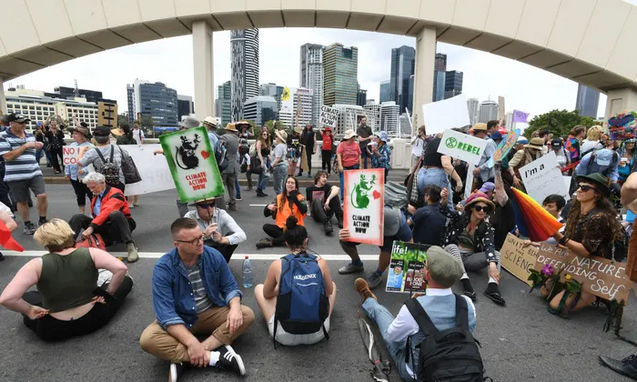
A climate change rally sets up outside Parliament House on Tuesday. Credit: Lukas Coch
Federal Energy and Emissions Reduction Minister Angus Taylor slammed the actions of the opposition, saying it was "symbolism" and not practical.
Opposition's climate spokesman Mark Butler told colleagues during a caucus meeting on Tuesday morning he would lodge a motion for debate in Parliament declaring the climate emergency, as an internal rift over its future policy settings divides the party following its May election loss.
Mr Taylor said the "emotive language" was ignoring the practical needs of every day Australians.
"Labor is making a huge song and dance about declaring a climate emergency, but refuses to commit to a single policy in this area from the last election," he said.
Labor MP Mark Butler and Opposition Leader Anthony Albanese. Credit: Alex Ellinghausen
"Labor's hollow symbolism will not deliver a single tonne of emissions reduction ... by contrast this government is taking meaningful actions."
Following fierce debate late on Monday night at separate factional caucus meetings over comments from frontbencher Joel Fitzgibbon last week, Labor leader Anthony Albanese said the party would decide its targets and policy "in accordance with the science".
Seeking to shift attention to what he said was a failing of the Morrison government to achieve a reduction in emission levels, Mr Albanese said: "Our job, as the opposition, is to hold the government to account and we'll continue to do just that."
"We're not the government. News flash, news flash. We're not the government. They are," Mr Albanese said.
Mr Butler told Parliament the window was closing on "our generation's ability, our unique ability, to meet our responsibility to future generations."
"Today we should try to unite as a parliament about why we should be doing something about climate change and why it is so urgent," he said.
Mr Bandt pointed to the United Nations report saying the world was not on track to limit global warming to less than 1.5 degrees.
"Nothing is more urgent than acting when people's lives and livelihoods are under threat," he said.
"We are experiencing record drought, some of our communities have been told to expect they may run out of water in coming months, parts of Australia have been on fire barely two weeks into winter."
Greens MP Adam Bandt brought on a motions to declare a climate emergency on Tuesday. Credit: Alex Ellinghausen
It is clear we do not have global warming under control."
Labor caucus also agreed on Tuesday to push for amendments to the government's "big stick" legislation which would give it the power to break-up energy companies who engaged in anti-competitive behaviour.
The opposition had previously opposed the legislation but agreed if it could win an amendment on partial privatisation sections of the laws it was willing to waive it through Parliament.
When questioned as to whether it was a "backflip", Mr Albanese said: "No, it's not. This is very different legislation".
"The fact is that the privatisation issue was the major issue that was a sticking point. There were others as well and they've been worked through and there were other amendments that we will insist on in terms of the legislation".

Links

MUNGO MACCALLUM: Albanese And The Inconvenient Climate-Change Deal-Breaker

Independent Australia - Mungo MacCallum

Cartoon by Mark David / @MDavidCartoons
As they sweat on the results of the long drawn out post mortem over Labor’s loss in the unlosable election, the warlords are already staking out their own positions.
The feeling seems to be that since a protracted series of blame games are inevitable, a least they can make a pretence of moving forward, even though they are in fact moving backwards.
And nowhere is the retreat more retrograde and dispiriting than the demand that the party of progress should abandon its long term targets on climate change and succumb, yet again, to the Government’s manifestly inadequate agenda.
Such right-wing luminaries as Member for Hunter Joel Fitzgibbon and Deputy Opposition Leader Richard Marles are now suggesting that capitulation would help things along in Queensland and Western Australia. Their rationale appears to be that the Labor votes were down in both and since the two are traditionally designated as the mining states, forgetting about emissions would bring the punters flocking back to the fold.
The logic is patently absurd. While Labor mishandled the Adani issue and Bob Brown’s quixotic caravan of protest did not help, the real problems in Queensland were Clive Palmer, Pauline Hanson and the monopolised Murdoch media — none of whom would have moved a nanometre if Labor’s target for emissions reduction was 45 per cent, 28 per cent or zero.
But hey, you have to blame something and it sure as hell isn’t going to be us. So the so-called policy relies essentially on self-preservation — a mixture of timidity and perversity.
If it were to be implemented it is not clear how it would play out, but the lessons from history is not promising. And not even ancient history — it is only a little over ten years ago that former PM Kevin Rudd walked away from what he once called the "great moral challenge of our times" and put his own ambitious plans for climate change on the backburner.
Dumping what was seen as a core belief – a principal point of difference between Labor and the Coalition – caused a slump in his Government’s support and the resulting polls, both public and private, provided the excuse the recalcitrant faction bosses needed to replace him, leading to all the instability and vendettas that followed.
The heavies of Sussex Street and beyond were not interested in climate change — their idea of a moral challenge is grabbing the last dim sum from a long lunch in Chinatown. But the rank and file and the swinging voters saw Rudd’s defection from the cause a betrayal, not only because most of them believed in it, but because it showed that when the pressure was put on him, he was just another political opportunist — one who preferred expediency to principle.
And this is precisely the risk Albanese is already accused of — that he stands for nothing, that he is driven by the polls and the focus groups, and thus is not worth supporting. He has got away with caution and moderation to date, but climate change is the big one; and will become more urgent as the extreme weather and the passionate politics become more intense.
If self-preservation is really involved, he needs, this time, to hold firm. It may be a long way to the next election, but tapping the mat on this one could be irreparable.
Links

Speed Bump Jokers

ABC - Media Watch
Kerri-Anne Kennerley not the first to suggest climate protestors be run over.

Media Watch: Speed Bump Jokers
Transcript

PAUL MURRAY: They’re sooks, they’ll keep going on, they’re giant toddlers who think, ‘as long as I keep asking for it eventually daddy will give it to me’. Well I can tell you what the result is, as this parent who has a toddler — go to your room.
- Paul Murray Live, Sky News, 7 October, 2019
Hello, I’m Paul Barry, welcome to Media Watch.
And that was Sky’s Paul Murray doing his own toddler impersonation as he spat the dummy at the Extinction Rebellion protesters who clogged up Australia’s capital cities last week.
And on Nine’s A Current Affair, sympathy for the activists was also in short supply:
SALLY: It’s not fair. It’s not fair at all. 
PROTESTERS: What do we want? Climate justice! When do we want it?
REID BUTLER: It’s chaos in the name of progress.
SALLY: Dad passed away 10 months ago and mum passed away on Sunday at home in that building …
I just want to get to the home so I can start organising all the clean up … 
- A Current Affair, Channel Nine, 7 October, 2019
So never mind the climate. What to do about those protesters? 
Luckily, Studio 10’s Kerri-Anne Kennerley had a couple of ideas: 
KERRI-ANNE KENNERLEY:  Personally, I’d leave them all super-glued to wherever they do it.
 … and you just put little witches’ hats around them or use them as a speed bump.
- Studio 10, Channel Ten, 9 October, 2019
And if running them over was a little extreme, Kerri-Anne had a back up plan:
KERRI-ANNE KENNERLEY: Put ‘em in jail and forget to feed them.
- Studio 10, Channel Ten, 9 October, 2019
So was there outrage at her comments?
Well, enough of a noise for Studio 10’s Sarah Harris to come back to it later to hose it all down:
SARAH HARRIS: … KAK you’re in trouble.
KERRI-ANNE KENNERLEY: What did I do?
SARAH HARRIS: Well, you are leading some of the news websites at the moment. There you are. ‘KAK says use protesters as a speedbump.’
You obviously weren’t inciting violence ...
KERRI-ANNE KENNERLEY: Oh heavens no!
SARAH HARRIS: … you were speaking in hyperbole. It’s a joke.
- Studio 10, Channel Ten, 9 October, 2019
Yes, run them over. What a joke. Except it’s hardly funny. And not the first time she’s made it.
A week before, on Studio 10, she said exactly the same thing, but nobody noticed:  
KERRI-ANNE KENNERLEY: … you know the ones that super-glue themselves to the road or to Canberra? I think they just leave them super-glued there and use them as speed bumps.
SARAH HARRIS: Oh Kerri-Anne! You can’t say that! 
KERRI-ANNE KENNERLEY: No, eventually they’ll get them off. 
- Studio 10, Channel Ten, 1 October, 2019
But Kerri-Anne’s not the only one with a wonderful sense of humour, because back in July viewers on Sky News were cracking up at the same suggestion from 2GB weekend host Paul Kidd:
PAUL B. KIDD: Actually, the first car over them would be bumpy and the next one would be a bit bumpy, but they’d be, they’d be flat after about six cars.
- Credlin, Sky News, 30 July 2019
And he was just re-telling the joke that Sky news host Peta Credlin had made so hilariously the month before:
PETA CREDLIN: Super-glued to the road, holding up all of this traffic. I would have run a car over the top of them. I wouldn’t have gone around them ...
- Credlin, Sky News, 18 June, 2019
And that same day on Sky’s Paul Murray Live, Mark Latham had offered a similar solution, but with a slightly different punchline: 
MARK LATHAM: … do we still have steam rollers?
PAUL MURRAY: Maybe.
MARK LATHAM: I’d like to roll one right down that road …
- Paul Murray Live, Sky News, 18 June, 2019
I think it’s time they got some new material and perhaps stopped making jokes about killing protesters. Because some nutter out there might just take them up on it. 

Links

15/10/2019

Traditional Owners Urge Climate Change Policy Makers To Witness Mangrove Devastation

ABC News - Jane Bardon
Patsy Evans said she was devastated by what she saw when visiting the mangroves of the Gulf of Carpentaria. (ABC News: Jane Bardon)
But during a recent visit to the area for the first time since 2015, when she and her husband alerted the Northern Territory Government to the extent of the damage, she was devastated by the scene.
"This is bad, worse, it's unbelievable, I can't even believe what's happening here," Ms Evans said.
She said she wanted policy makers to see how climate change was affecting the land near her home on the Limmen River, 750 kilometres south of Darwin.
"Go out and see what's happening, be aware and look at it, and don't make decisions where you are," she said.


The Top End is on the front line of Australia's most severe climate challenges (ABC News)

The mangroves were once nurseries for the mud crab, barramundi and prawn fisheries, but now consist mainly of dead trees and dusty earth.
The few live seedlings coming through are exposed, and vulnerable to damage from the fallen dead trees.
"Through the mangroves you get a lot of bush tucker, mud mussels and shells, and they're all just dead. It just makes me feel sad," Ms Evans said.
Scientists from Queensland and Northern Territory universities said one contributing factor was a temporary drop in sea levels, caused by a change in the trade winds, which left the forests unusually high and dry.
But they said another factor in the dieback along 1,000 kilometres of coastline was climate change and a sharp increase in the sea temperature.
Dead shellfish now line the coastline, where mangroves used to thrive. (ABC News: Jane Bardon)

On par with Great Barrier Reef bleaching
"We can't see any other driver of the dieback other than the extreme climatic envelope has shifted," Charles Darwin University professor Lindsay Hutley said.
Dr Hutley said the extent and duration of the dieback was on a par with the severity of Great Barrier Reef bleaching.
"It's the canary on the coastline; it's quite significant, probably globally significant," he said.
Madeline Goddard and Lindsay Hutley are seeing mangroves move inland. (ABC News: Jane Bardon)

Along with colleague Madeline Goddard, Dr Hutley has been researching other impacts of climate change on mangroves.
They've found mangroves have been adapting to climate change and sea level changes by moving inland.
"In parts of the Top End we are experiencing some of the highest sea level rises in the world," Ms Goddard said.
"If we give mangroves space, the whole forest can move landward, until they hit manmade barriers, and then they are at risk of drowning.
"That they are shifting, to this large degree, because of these climate change influences, is a warning to us."
Polar icecap melting underestimated
The CSIRO has mapped the average sea level rise of the Top End at between six and 13 millimetres a year — two to three times the rate off southern Australia and the global average.
Professor Stephen Garnett has said the Top End may have a sea level rise of a metre by the end of the century. (ABC News: Jane Bardon)
"That is partly because north of here we've got the Arafura Sea, which lies on top of the Continental Shelf, and so it's very shallow and so it warms up very quickly," Stephen Garnett from the Charles Darwin University Research Institute for the Environment said.
"So, we're looking at a metre rise by the end of the century, and we've already had a fifth of that," Professor Garnett said.
CSIRO Sea Level and Coastal Extremes senior researcher Kathy McInnes said even if the Global Paris emissions reduction targets were met, that would not be enough to stop this rate of sea level rise.
Dr McInnes said the impacts of polar icecap melting on sea level rise had also been underestimated.
Northern Australia's mangroves could be under threat from rising sea levels. (ABC News: Nick Hose)
She warned that would leave the Top End vulnerable to more impacts like mangrove dieback.
"We can expect greater frequency at which extreme events can occur, and this can lead to cascading impacts on society and ecosystems like the massive dieback of mangroves," she said.
"The compounding effect of that can be felt years down the track because of the flow on effect into our fishing industry, when stocks of both prawns and fish species drop."

Links

If Warming Exceeds 2°C, Antarctica’s Melting Ice Sheets Could Raise Seas 20 Metres In Coming Centuries

The Conversation | 

During the Pliocene, up to one third of Antarctica’s ice sheet melted, causing sea-level rise of 20 metres. www.shutterstock.com, CC BY-ND
We know that our planet has experienced warmer periods in the past, during the Pliocene geological epoch around three million years ago.
Our research, published today, shows that up to one third of Antarctica’s ice sheet melted during this period, causing sea levels to rise by as much as 20 metres above present levels in coming centuries.
We were able to measure past changes in sea level by drilling cores at a site in New Zealand, known as the Whanganui Basin, which contains shallow marine sediments of arguably the highest resolution in the world.
Using a new method we developed to predict the water level from the size of sand particle moved by waves, we constructed a record of global sea-level change with significantly more precision than previously possible.
The Pliocene was the last time atmospheric carbon dioxide concentrations were above 400 parts per million and Earth’s temperature was 2°C warmer than pre-industrial times. We show that warming of more than 2°C could set off widespread melting in Antarctica once again and our planet could be hurtling back to the future, towards a climate that existed three million years ago.

Overshooting the Paris climate target
Last week we saw unprecedented global protests under the banner of Greta Thunberg’s #FridaysForFuture climate strikes, as the urgency of keeping global warming below the Paris Agreement target of 2°C hit home. Thunberg captured collective frustration when she chastised the United Nations for not acting earlier on the scientific evidence. Her plea resonated as she reminded us that:
With today’s emissions levels, that remaining CO₂ budget [1.5°C] will be entirely gone in less than eight and a half years.
At the current rate of global emissions we may be back in the Pliocene by 2030 and we will have exceeded the 2°C Paris target. One of the most critical questions facing humanity is how much and how fast global sea levels will rise.
According to the recent special report on the world’s oceans and cryosphere by the Intergovernmental Panel on Climate Change (IPCC), glaciers and polar ice sheets continue to lose mass at an accelerating rate, but the contribution of polar ice sheets, in particular the Antarctic ice sheet, to future sea level rise remains difficult to constrain.
If we continue to follow our current emissions trajectory, the median (66% probability) global sea level reached by the end of the century will be 1.2 metres higher than now, with two metres a plausible upper limit (5% probability). But of course climate change doesn’t magically stop after the year 2100.

Drilling back to the future
To better predict what we are committing the world’s future coastlines to we need to understand polar ice sheet sensitivity. If we want to know how much the oceans will rise at 400ppm CO₂, the Pliocene epoch is a good comparison.
Back in 2015, we drilled cores of sediment deposited during the Pliocene, preserved beneath the rugged hill country at the Whanganui Basin. One of us (Timothy Naish) has worked in this area for almost 30 years and identified more than 50 fluctuations in global sea level during the last 3.5 million years of Earth’s history. Global sea levels had gone up and down in response to natural climate cycles, known as Milankovitch cycles, which are caused by long-term changes in Earths solar orbit every 20,000, 40,000 and 100,000 years. These changes in turn cause polar ice sheets to grow or melt.
While sea levels were thought to have fluctuated by several tens of metres, up until now efforts to reconstruct the precise amplitude had been thwarted by difficulties due to Earth deformation processes and the incomplete nature of many of the cycles.
Our research used a well-established theoretical relationship between the size of the particles transported by waves on the continental shelf and the depth to the seabed. We then applied this method to 800 metres of drill core and outcrop, representing continuous sediment sequences that span a time period from 2.5 to 3.3 million years ago.
We show that during the Pliocene, global sea levels regularly fluctuated between five to 25 metres. We accounted for local tectonic land movements and regional sea-level changes caused by gravitational and crustal changes to determine the sea-level estimates, known as the PlioSeaNZ sea-level record. This provides an approximation of changes in global mean sea level.

Antarctica’s contribution to sea-level rise
Our study also shows that most of the sea-level rise during the Pliocene came from Antarctica’s ice sheets. During the warm Pliocene, the geography of Earth’s continents and oceans and the size of polar ice sheets were similar to today, with only a small ice sheet on Greenland during the warmest period. The melting of the Greenland ice sheet would have contributed at most five metres to the maximum 25 metres of global sea-level rise recorded at Whanganui Basin.
Of critical concern is that over 90% of the heat from global warming to date has gone into the ocean. Much of it has gone into the Southern Ocean, which bathes the margins of Antarctica’s ice sheet.
Already, we are observing warm circumpolar deep water upwelling and entering ice shelf cavities in several sites around Antarctica today. Along the Amundsen Sea coast of West Antarctica, where the ocean has been heating the most, the ice sheet is thinning and retreating the fastest. One third of Antarctica’s ice sheet — the equivalent to up to 20 metres of sea-level rise — is grounded below sea level and vulnerable to widespread collapse from ocean heating.
Our study has important implications for the stability and sensitivity of the Antarctic ice sheet and its potential to contribute to future sea levels. It supports the concept that a tipping point in the Antarctic ice sheet may be crossed if global temperatures are allowed to rise by more than 2℃. This could result in large parts of the ice sheet being committed to melt-down over the coming centuries, reshaping shorelines around the world.

Links

From Kerri-Anne To The Masked Stinger: How Australia's Media Covered Extinction Rebellion

The Guardian

The Daily Mail promised nudity, the Daily Telegraph tried to generate buzz while the West Australian ran a blank front page
Studio 10’s Kerri-Anne Kennerley suggested Extinction Rebellion protesters be used as speed humps or be locked up in jail and starved. Photograph: Joel Carrett/AAP 
Daily Telegraph reporter Mitchell Van Homrigh got dressed up in a bee costume to go “undercover” with Extinction Rebellion but his stunt wasn’t even the most foolish response to the mass protests we saw this week.
After making all the bee puns he could think of, Van Homrigh admitted he found the protesters “passionate and kind and helpful to this blind little bee”. But he finished by reverting to the Joe Hildebrand school of argument about how little the protest would help their cause.
“Would these people be better off directing their passions towards developing programs and policy that enact their vision?” he wondered as he removed his bee head.
Hildebrand had earlier declared in his weekly news.com.au column that global action for climate change was a waste of time unless the protesters had a solution, as “passion on its own achieves nothing without a practical plan to back it up”.
“Romeo and Juliet were passionate and look what happened to them,” the Studio 10 co-host wrote, before conceding that marching was at least better than doing drugs.
But it was Hildebrand’s occasional co-host on Studio 10, Kerri-Anne Kennerley, who stole the headlines with the most offensive response to the protests.
Kennerley suggested that protesters be used as speed bumps. Or better still locked up in jail and starved: “Put ’em in jail, forget to feed them,” she said.
“Personally, I would leave them all superglued to wherever they do it,” Kennerley said when the panel discussed the disruption to the cities the protesters were causing. “The guy hanging from the Story Bridge. Why send emergency services? Leave him there until he gets himself out. No emergency services should help them, nobody should do anything and you just put little witches’ hats around them or use them as a speed bump.”
Channel 10, which this week narrowly missed censure for an earlier ill-advised comment by Kennerley, later insisted the veteran TV presenter was only joking.
“This morning on Studio 10 Kerri-Anne Kennerley made comments regarding climate protesters that were said in jest,” a spokesman said. “Before the show concluded, Sarah Harris reiterated the tone of her remarks, affirming that Kerri-Anne wasn’t inciting violence.
“Kerri-Anne confirmed that she was indeed speaking in hyperbole and her words were clearly a joke. There was no intent to cause offence. Over the past few days, Studio 10 has extensively addressed a range of opinions on this subject.”
The Australian’s media editor, Leo Shanahan, saw nothing amiss with KAK’s call, describing her rant as “sage advice”.
“Kerri-Anne Kennerley has some sage advice to Extinction Rebellion protesters: just stay on the road”, the Oz said.
It wasn’t just Ten that was all class this week. The media tripped over each other to put the worst light on the protesters who were using civil disobedience to get the attention of governments. Seven breakfast host Samantha Armytage said the protesters were annoying people to get on TV.
“So you deliberately want to annoy people, so you appear on national television,” Armytage said. “What is your message? What are you trying to do?”
Nine’s A Current Affair took the theme of the inconvenienced punter to the extreme, finding a woman stuck in traffic who was on her way to clear out her late mother’s nursing home. Her mother had died on Sunday and now she had been blocked by the protest.
“Fuck the environment,” the distressed daughter said. “People are more important.
“They think [protesting] is so important but what is important is the everyday, good Australian people just trying to go about their everyday lives. It’s not fair.”
The Daily Telegraph blogger Tim Blair kept score of the arrests in each city, as if it were a sporting competition. His best line in National Climate Comp: Sydney Going for Gold was suggesting that the protesters must be on “electric lettuce”, also known as marijuana.
The West Australian editor, Anthony De Ceglie, thought he had an even better gimmick, running a large blank space on his front page.
“The climate change ‘rebellion’ plans to bring its protests to the doors of the West Australian today,” he editorialised. “This is a democracy. And we support free speech and peaceful demonstration. In that spirit, here’s a blank front page for your placards. Use it wisely.”
But the last word should go to the Daily Mail, which got way too excited about the possibility of nudity, with activists planning to “get their gear off”.
“A NAKED parade and traffic stopping rave: how Extinction Rebellion plan to bring Australia to a standstill during week of mayhem over climate change,” the headline said on Tuesday.

Links

14/10/2019

Parliamentarians Deserve Our Wrath For 30 Years Of Inaction, Not Climate Protesters

The Guardian

Supposedly progressive leaders like Annastacia Palaszczuk make you wonder if Gen X is worse on climate than baby boomers
‘Our media discourse this week was flooded with comments by 40- and 50-year-olds wondering who the Extinction Rebellion are trying to convince: “I’m all for action on climate change, but ...” and “Don’t they realise you catch more flies with honey?” ’ Photograph: Dave Hunt/AAP
One of my favourite lines in an article on the climate crisis is by American science journalist Sharon Begley: “If a rich technologically advanced nation won’t put its own house in order, then developing countries have a perfect excuse to do nothing.”
She also wrote in the same article: “For those who fear that the greenhouse will arrive – and no responsible scientist denies that possibility – it seems imperative to take immediate steps to mitigate it.”
Great lines. Written 30 years ago.
Begley wrote them in the same 1989 Newsweek magazine that reported on the fall of the Berlin Wall.
It is astonishing how little has changed.
In the same article she noted that car companies like Ford were strongly opposing any moves to introduce emission cuts that targeted the industry – “it would throw industry into a tailspin and have minimal environmental impact”, one spokesperson suggested. This week the Guardian found that car manufacturers have “been pouring millions of dollars through industry bodies into lobbying efforts to challenge attempts to tackle global heating in the past four years”.
And in the 30 years since the fall of the Berlin Wall that nothing has changed is a damning indictment on our political and media systems.
But it would be wrong to blame only those in power 30 years ago, for what we have seen this week is that blame can be well and truly passed down to the following generation of political leaders.
Gen X is as guilty as the much-maligned baby boomers.
As a member of that most cynical and sarcastic generation, who spent our youth mocking baby boomers who preached revolution and then sold out into the Me Generation as soon as a high-income tax cut and four-bedroom home with a two-car garage was dangled before their eyes, we must acknowledge that the answer to the question of “Are we the baddies?” is yes.
All that cynicism has mostly been translated into complacency.
Our media discourse this week was flooded with comments by 40- and 50-year-olds wondering who the Extinction Rebellion are trying to convince: “I’m all for action on climate change, but ... ” and “Don’t they realise you catch more flies with honey?”
We thought we were Rage Against the Machine but we are really FM Easy Listening.
Thirty years of inaction. Thirty years of waiting. Thirty years of playing nice.
If you think that strategy has worked, then you probably think the Queensland Labor party is a progressive government.
You can understand the reaction to protesters by arch-conservative Gen Xers like the home affairs minister, Peter Dutton, who it appears sees a day without stripping people of their civil liberties as a day wasted. But when you see notionally progressive Gen X leaders like the Queensland premier, Annastacia Palaszczuk, rushing through legislation to prevent these protests you have to wonder not only what is the point of the ALP, but whether my generation is worse on climate change than baby boomers.
Palaszczuk tweeted that “everyone has the right to protest in this state” but then added the caveat: “It’s when extreme protesters using dangerous devices put at risk our emergency services & hinder people going about their daily business that it oversteps the mark.”
Forget that there is zero evidence that anyone in the Extinction Rebellion movement is using dangerous devices, but if hindering people going about their daily business is the new standard, then protest in the state has effectively become something allowed only in cases when it is neither seen nor heard. Which, it seems, would suit Palaszczuk just fine.
It is rather disappointing that she is so eager to embrace laws that Joh Bjelke-Petersen and any number of conservative autocrats would embrace. After all she had to battle oppression and malevolent forces all through her youth to get to the point of *checks notes* taking over the safe parliamentary seat her father held for over a decade.
Still, at least her opposition to climate change protest is not one that will see her alienated in the ALP. This week, federal MP Joel Fitzgibbon suggested Labor should adopt the LNP’s Paris agreement target of a 26%-28% cut in emissions from 2005 levels. That cut in reality is closer to 15% once you take into account carry-over credits and dodgy accounting, and which is massively short of the minimum 45% cut that scientists argue is needed.
It is rather disappointing that Fitzgibbon is so eager to capitulate to the government. After all he had to had to battle oppression and malevolent forces all through his youth to get to the point of *checks notes* taking over the safe parliamentary seat his father held for over a decade.
Look I get it – it is annoying to have you day disrupted. But don’t come at me with arguments that amount to basically doing what has been done for 30 years and expecting anything real to happen.
The problem is it has been easy to ignore climate-change activism and as a result ignore the issue completely. Non-violent resistance is about resisting, not just being non-violent.
And it is about provoking the inevitable overreaction by those in power – the same overreaction that occurred during civil rights and anti-Vietnam war protests. An overreaction that saw the New South Wales and Victorian police demand bail conditions on protests so onerous you would assume they were dreamed up in a Palaszczuk-Dutton group chat.


'The arrests make a point,' say Extinction Rebellion protesters in Australia.

Thankfully those like the ALP’s Mark Butler quickly condemned Fitzgibbon’s suggestion, and others in the party have criticised Palaszczuk’s new laws, so perhaps there remains some hope for it (but, as Richard Marles would suggest, prepare to be disappointed).
This week also came a report from the IMF that suggested even with a $111 carbon price, Australia would be unable to meet its Paris target. When the Gillard government introduced a carbon price seven years ago it was just $23.
That is the price of inaction.
At some point we need to get angry, but if your anger is directed at those protesting rather than at parliamentarians then I suspect you have consigned yourself to expecting nothing to change.
That’s fine, but own it. Realise if you are annoyed by them it’s because you have become more annoyed by protest than a lack of action. Don’t pretend to still be seeking change when your anger is directed at those trying desperately to make up for the past 30 years of wasted cynicism and complacency.

Links

Lethal Heating is a citizens' initiative