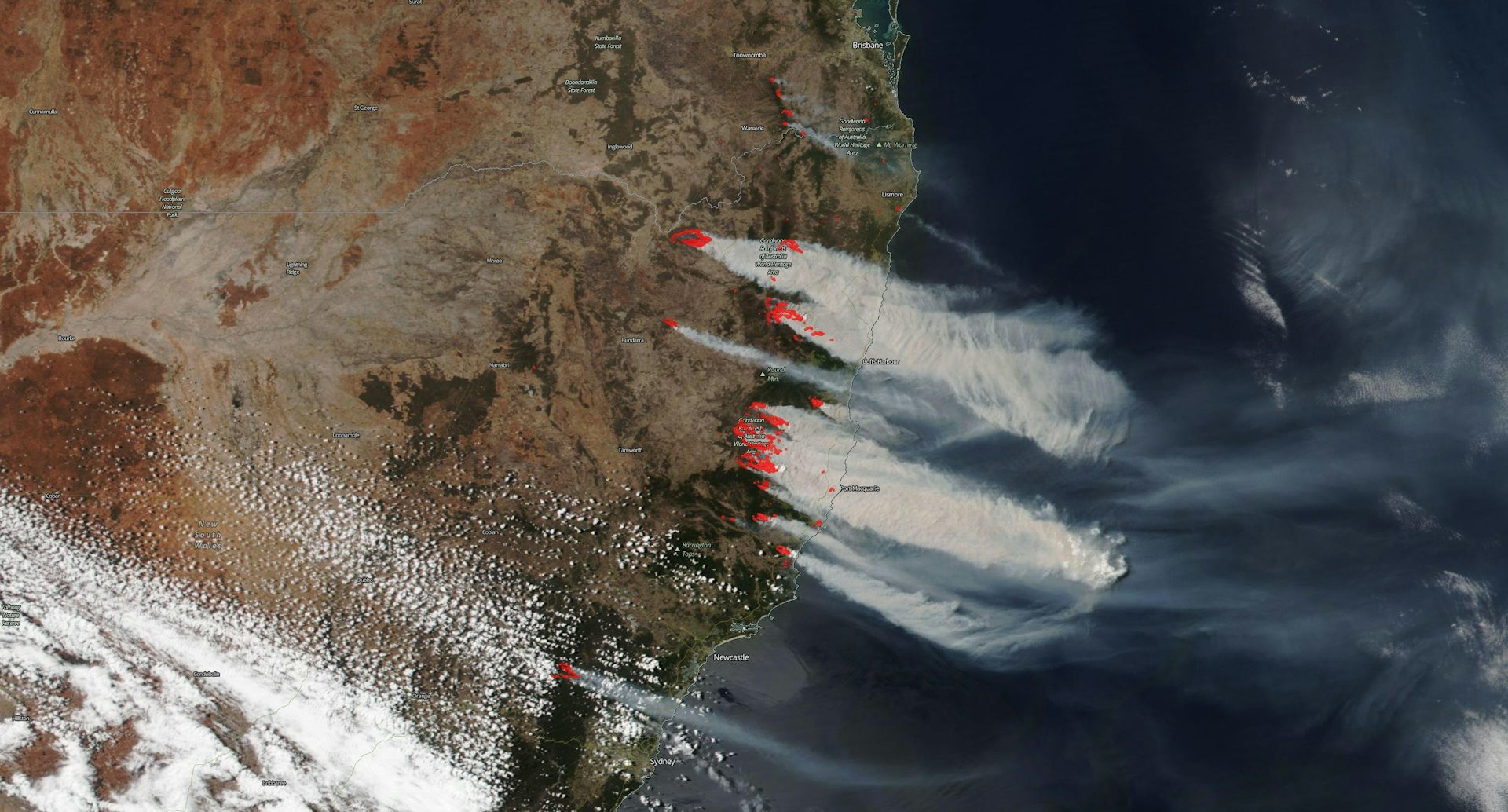
Multiple large, intense fires are stretching from Australia’s coast to the tablelands and parts of the interior. AAP Image/Supplied, JPSS | LARGE IMAGE
Last week saw an unprecedented outbreak of large, intense fires
stretching from the mid-north coast of New South Wales into central
Queensland.
The most tragic losses are concentrated in northern NSW, where
970,000 hectares have been burned, three people have died, and at least
150 homes have been destroyed.
A catastrophic fire warning
for Tuesday has been issued for the Greater Sydney, Greater Hunter,
Shoalhaven and Illawarra areas. It is the first time Sydney has received
a catastrophic rating since the rating system was developed in 2009.
The fire danger tomorrow is now expected to be worse than originally forecast. The Illawarra/Shoalhaven is now forecast to experience a Catastrophic fire danger, as will Greater Sydney and Greater Hunter. More info here: https://t.co/RQyA5UAi8x#nswrfs#nswfirespic.twitter.com/1xlwByvpMz
No relief is in sight from this extremely hot, dry and windy weather,
and the extraordinary magnitude of these fires is likely to increase in
the coming week. Alarmingly, as Australians increasingly seek a
sea-change or tree-change, more people are living in the path of these
destructive fires. Unprecedented state of emergency
Large fires have happened before in northern NSW and southern
Queensland during spring and early summer (for example in 1994, 1997,
2000, 2002, and 2018 in northern NSW). But this latest extraordinary
situation raises many questions.
It is as if many of the major fires in the past are now being rerun concurrently. What is unprecedented is the size and number of fires rather than the seasonal timing.
The potential for large, intense fires is determined by four fundamental ingredients:
a continuous expanse of fuel; extensive and continuous dryness of that
fuel; weather conditions conducive to the rapid spread of fire; and
ignitions, either human or lightning. These act as a set of switches, in
series: all must be “on” for major fires to occur.
The NSW north coast and tablelands, along with much of the southern
coastal regions of Queensland are famous for their diverse range of
eucalypt forest, heathlands and rainforests, which flourish in the warm
temperate to subtropical climate.
These forests and shrublands can rapidly accumulate bushfire fuels
such as leaf litter, twigs and grasses. The unprecedented drought across
much of Australia has created exceptional dryness, including
high-altitude areas and places like gullies, water courses, swamps and
steep south-facing slopes that are normally too wet to burn.
These typically wet parts of the landscape have literally evaporated,
allowing fire to spread unimpeded. The drought has been particularly
acute in northern NSW where record low rainfall has led to widespread defoliation and tree death. It is no coincidence current fires correspond directly with hotspots of record low rainfall and above-average temperatures.
Annual trends in live fuel moisture. The horizontal line represents the threshold for the critical ‘dry’ fuel category, which corresponds to the historical occurrence of most major wildfires in the Bioregion.Estimated from MODIS imagery for the Sydney basin Bioregion
Thus, the North Coast and northern ranges of NSW as well as much of
southern and central Queensland have been primed for major fires. A
continuous swathe of critically dry fuels across these diverse
landscapes existed well before last week, as shown by damaging fires in
September and October.
High temperatures and wind speeds, low humidity, and a wave of new
ignitions on top of pre-existing fires has created an unprecedented
situation of multiple large, intense fires stretching from the coast to
the tablelands and parts of the interior.
More people in harm’s way
Many parts of the NSW north coast, southern Queensland and adjacent
hinterlands have seen population growth around major towns and cities,
as people look for pleasant coastal and rural homes away from the
capital cities.
The extraordinary number and ferocity of these fires, plus the
increased exposure of people and property, have contributed to the
tragic results of the past few days.
Communities flanked by forests along the coast and ranges are highly
vulnerable because of the way fires spread under the influence of strong
westerly winds. Coastal communities wedged between highly flammable
forests and heathlands and the sea, are particularly at risk.
As a full picture of the extent and location of losses and damage
becomes available, we will see the extent to which planning, building
regulations, and fire preparation has mitigated losses and damage.
A firefighter defends a property in Torrington, near Glen Innes, Sunday, November 10, 2019. There are more than 80 fires burning around the state, with about half of those uncontained.AAP Image/Dan Peled
These unprecedented fires are an indication that a much-feared future under climate change may have arrived earlier than predicted. The week ahead will present high-stakes new challenges.
The most heavily populated region of the nation is now at critically
dry levels of fuel moisture, below those at the time of the disastrous
Christmas fires of 2001 and 2013. Climate change has been predicted to strongly increase
the chance of large fires across this region. The conditions for
Tuesday are a real and more extreme manifestation of these longstanding
predictions.
Whatever the successes and failures in this crisis, it is likely that
we will have to rethink the way we plan and prepare for wildfires in a
hotter, drier and more flammable world.
As Sydney braces for its first ever day of catastrophic fire danger, it's worth recapping what scientists think about the links between bushfire risks and a warming world.
Is there a link between climate change and more severe and frequent bushfires?
The aftermath of fire in Rainbow Flat near the Pacific Highway on November 9. Credit: Dean Sewell
How do scientists measure fire danger?
The likelihood of hostile extreme weather can be measured in a range of ways. For bushfires, scientists look at the McArthur Forest Fire Danger Index, developed in the 1960s by CSIRO scientist A.G. McArthur to forecast how weather would affect fire behaviour.
As
the name suggests, the gauge examines the risks to woodlands from fire
using a combination of rainfall or drought conditions along with
predicted wind speeds, temperature and relative humidity.
Typically,
winter and spring see the highest ratings on this fire danger index in
the north and these move southwards as spring makes way for summer.
How bad is catastrophic then?
Fire and emergency authorities started to review response plans in 2008 to adjust to "the growing intensity and severity of recent bushfire experiences across the country".
Then
Black Saturday's bushfires erupted in Victoria on February 7 in 2009,
leaving 173 people dead. That event "brought into sharp focus the
possibility that the current legislation, systems, practices and
processes to support effective community safety outcomes may no longer
match the increasing levels of risk and expectations", a bushfire
warning taskforce report noted.
The
highest fire danger rating was set as "catastrophic" for index readings
of 100 or more. (In Victoria, they are dubbed Code Red.) The basic
message was boiled down to: "For your survival, leaving is the best
option."
The dire assessment is because some fires on such days
are likely to become "uncontrollable, unpredictable and fast moving" and
"there is a very high likelihood that people in the path of the fire
will die or be injured", the taskforce said.
Melbourne reached an
index reading of about 150 on Black Saturday, according to Ross
Bradstock, director of the Centre for Environmental Risk Management of
Bushfires at the University of Wollongong. For Sydney to exceed 100 on
the index could be a first, at least for its Observatory Hill and Sydney
Airport sites, where the weather is measured.
Does climate change play a part?
Yes,
there is a link between climate change and the prevalence and severity
of fires. In fact, the research identifying a link between fires and
climate change is "old hat", says Professor Bradstock. "The research has
all been done. We don’t need to keep doing it."
As the Bureau of Meteorology and CSIRO pointed out in last year's latest State of the Climate report,
the number of the most extreme 10 per cent of fire weather days based
on the fire danger index "has increased in recent decades across many
regions of Australia, especially in southern and eastern Australia".
How fire danger risks are rising in Australia
Source: Bureau of Meteorology, CSIRO
"There
has been an associated increase in the length of the fire weather
season," it said. "Climate change, including increasing temperatures, is
contributing to these changes."
Or, as Hamish Clarke, a former
NSW government scientist and now with the University of Wollongong, puts
it: "Across the country, at a number of high-quality long-term weather
stations, there had either been an increase, or no change [in the fire
danger index]. We didn’t find a significant decrease anywhere."
In
general, one consequence for fire authorities is that the fire season
is getting longer. In eastern Australia, that means fire risks start to
increase earlier in the spring and last longer into the autumn. The
window for hazard-reduction burning is shifting into winter – if it's
not too damp to do it.
How human activity and natural climate
variability factored in bushfire ratings increases from 1973 to 2017 was
the focus of research by Sarah Harris, from the Victoria's Country Fire
Authority, and Chris Lucas in September.
Firefighters north of Forster near the junction of the Pacific Highway on November 8. Credit: Dean Sewell
While
rainfall changes from one year to the next, with phenomena such as El
Ninos in the Pacific and shifting Indian Ocean conditions playing a
role, the researchers' findings were conclusive:
"We
propose that anthropogenic [human-led] climate change is the primary
driver of the [upward trend in the fire danger index], through both
higher mean temperatures and, potentially, through associated shifts in
large-scale rainfall patterns."
How unusual is this year?
Depending
on where you are, very unusual. NSW, for instance, could see a million
hectares burned so far this fire season within days – if it hasn't
already done so. That is about the same as the past three fire seasons
combined – and summer is yet to arrive.
Rainfall deficiencies – or
what most of us call "drought" – are already the worst on record for
northern NSW and parts of southern Queensland. And it has also been hot.
Fires will take off when forests are as dry as this Median live fuel moisture content, Sydney Basin
2013 saw Sydney's last major fires.
Source: R.H.Nolan, M.M. Boer and R.A. Bradstock
According to the Bureau of Meteorology, Australia posted its hottest January-October
in records going back to 1910 for maximum temperatures. It looks like
only a cool spell, which is not on the forecast charts, will stop 2019
being the hottest year on record for daytime readings.
Of particular
concern for this week is how very dry areas are around big population
centres such as Sydney, Newcastle and Wollongong.
Temperatures
are likely to reach the mid- to high 30s on November 12 at a time when
moisture levels in plants – a gauge of how quickly they will burn if
fire breaks out – are tracking below those of the big fire season of 2013 in the Sydney area, and the worst since 2002.
Professor
Bradstock published research in 2009 that predicted how the fire danger
index would track to 2030 and 2050, using CSIRO data from 2007.
"The current predictions [for Sydney on November 12] are beyond what we predicted back in 2007," he says. "That's not good."
The Hillville fire on November 8. Credit: Dean Sewell
Coalition politicians have criticised people for linking deadly bushfires and climate change
Mayors from fire-ravaged NSW have hit back at that, saying climate change is contributing to fires
Glen Innes mayor Carol Sparks says politicians need to believe the scientific evidence on climate change
Mayors from fire-ravaged areas of New South Wales have said there is no doubt in their minds that the devastating blazes tearing through their communities are a result of climate change.
Their
comments are a rebuke to senior leaders within the state and federal
governments, including Prime Minister Scott Morrison and Deputy PM
Michael McCormack, who have criticised people for linking the current
deadly bushfires to climate change.
Three people died in fires
across the state at the weekend, with the State Government declaring a
state of emergency amid predicted catastrophic conditions and
predictions that the coming days will see "the most dangerous bushfire week this nation has ever seen".
"What
people need now is a little bit of sympathy and understanding and real
assistance, they need help, they need shelter," Mr McCormack said on ABC
Radio National this morning.
"They don't need the ravings of some
pure enlightened and woke capital city greenies at this time when they
are trying to save their homes."
Firefighters drive through the middle of the Hillville bushfire near Taree, on the NSW mid-north coast, on Friday.
(ABC News)
Carol Sparks, the Mayor of Glen Innes, where two people died at the
weekend, called on Mr McCormack to refer to scientific evidence before
commenting further.
"I think that Michael McCormack needs to read the science, and that is what I am going by, is the science," she said.
"It is not a political thing - it is a scientific fact that we are going through climate change."
Responding
directly to the comments made by the Deputy PM this morning, Mid Coast
mayor Claire Pontin said she felt "cranky" when she heard Mr McCormack
say that "we've had fires in Australia since time began".
"They need to get out and have a real look at what's happening to this country," Ms Pontin said.
"We've not had situations like that. Fifty years ago, this would never happen."
Ms
Pontin said the issue went beyond politics and said it was essential to
talking about climate change when considering how to respond to the
bushfires,
"We don't have capital city greenies around here, we
have farmers coming to us and saying, "look what's happened to my farm, I
can't afford to feed the cows anymore because I've been buying feed for
the last 18 months." she said.
"It's just ridiculous.
"It's not going to go away if we bury our heads in the sand."
The Bureau of Meteorology has said that "climate change is influencing the frequency and severity of dangerous bushfire conditions in Australia."
Federal
Greens MP Adam Bandt said the weekend fires demonstrated that "the
Government does not have the climate emergency under control".
"Scott
Morrison has done everything in his power to increase the risk of
catastrophic bushfires and sadly we are now witnessing apocalyptic
scenes that none of us — none of us —want to see in Australia,” he said.
But Mr McCormack accused the Greens of exploiting the issue to score a "political point."
"That's
what Adam Bandt, and the Greens, and Richard Di Natale, and all those
other inner-city raving lunatics — and quite frankly, that's how he was
carrying on yesterday — that's what they want, we're not going to go
down that path."
These are the letters sent by former NSW Fires Chief Greg Mullins and 22 other former emergency chiefs to the Prime Minister in April and September predicting a bushfire crisis and requesting a meeting. #nswfires#auspolpic.twitter.com/djhHjHknAe
Mr Mullins and 22 other former emergency chiefs wrote a letter to Mr
Morrison earlier this year predicting a bushfire crisis and calling the
Prime Minister to the table to come with an action plan. The meeting has
not been held.
"The numbers don't lie, and the science is clear," he wrote in an opinion piece in the Sydney Morning Herald.
"Unprecedented
dryness; reductions in long-term rainfall; low humidity; high
temperatures; wind velocities; fire danger indices; fire spread and
ferocity; instances of pyro-convective fires "fire storms - making their
own weather); early starts and late finishes to bushfire season." An
established long-term trend drive by a warming, drying climate," he
wrote.
Mr Mullins cited previous examples when federal politicians
shut down the climate change discussion saying it was inappropriate
while fires are still burning. "But if not now, then when?" he asked.
NSW
Deputy Premier John Barilaro is another politician who has said now is
not the time, lashing out at people for raising the issue of climate
change.
"For any bloody greenie, lefty out there that wants to
talk about climate change when communities are at risk — and over the
next 48 hours we may lose more lives — and if this is the time that
people talk about climate change they are a bloody disgrace," he said.
But Ms Pontin dismissed that.
"It's always the time to be talking about it," she said.
"Every
level of government needs to recognise that there is a big issue and
it's almost too late to act, but we've got to start doing something
now."
An arresting exhibition from activist charity Project Pressure uses conceptual photography to capture the decline of the ice caps
The Lewis Glacier, Mt Kenya by Simon Norfolk. The line of fire shows where the glacier used to extend to. Photograph: Simon Norfolk/Project Pressure
"What is it about those melting glaciers and desperate polar bears that makes
us want to look away?” the activist and author Naomi Klein asked in 2015. In her book This Changes Everything,
she laid the blame on powerful global corporations and acquiescent
governments, which both simultaneously underplay the scale of the
climate emergency and exploit our collective sense of helplessness in
the face of it. Since then, a new urgency has driven climate activism,
most successfully in the disruptive protests of Extinction Rebellion. Can art, though, have a meaningful role in raising awareness of that urgency?
A forthcoming exhibition, Meltdown: Visualising Climate Change,
at the Horniman Museum in London sets out to answer that question in
the affirmative. It focuses on the fate of the world’s glaciers through
the prism of art, photography and film. “We are using art as a kind of
seduction to draw people in, then shock them,” says photographer Simon Norfolk, one of the artists involved.
Why glaciers, though? Norfolk points out that, while severe floods
and forest fires are in some ways more dramatically visual, “they can
leave you open to the charge of not being scientific”. Glaciers, on the
other hand, are one of the key and irrefutable indicators of climate change.
“Through photography and film, you can record over time the ways in
which they are receding, and by how much,” he says. “Plus, they are just
so visual.”
The Lewis Glacier, Mt Kenya, 1963 (A), 2014. The image traces a line where the glacier’s front was in 1963 while showing where it is now. Using scientific maps and GPS, Norfolk marked out the older line using hidden flashlights. ‘I walked along the line dragging my burning stick, joining up the dots of the flashlights. It took about 20 minutes, which was hard work at altitude. The exposure for the mountain and the stars continues for the rest of the hour. I wanted it to be all in camera because climate change is surrounded by loons who will claim I faked it all.’
By way of illustration, his arresting image The Lewis Glacier, Mt Kenya, 1963
shows a line of fire snaking along the rocky slope of a once completely
snow-covered mountain skirting close to some scattered wooden
buildings. It is one of a series of photographs he made using long, slow
exposures on a mounted camera to track him as he ran along a meandering
line on the mountain holding a flaming torch. (You can see him collapse
with altitude exhaustion in a short film documenting the making of the work shot by the Observer photographer Antonio Olmos.)
“I use old maps to trace the exact line where the front edge of the
glacier existed in previous years,” he explains. “My starting point was
1963, the year I was born, and I have made similar images for selected
years ever since. It is a way of photographing the absence of something,
in this instance a few kilometres of ice that have disappeared in the
intervening years.” The series won Norfolk a Sony World Photography award in 2015.
Ice Cave, Vatnajökull, 2014. Richard Mosse used a large-format plate-film camera and infrared film to photograph the ice cave under the Vatnajökull glacier in Iceland. Glacier caves usually form when air enters where water flows underneath the ice, the warm air slowly creates melting and forms a cave from beneath. The dynamic process is becoming more unpredictable as the weather changes and cave access may become impossible in the future.
Meltdown is curated by Project Pressure,
an activist charity that, since 2008, has commissioned artists to work
with climate scientists on often ambitious projects that highlight the
earth’s increasingly unstable environment. Their partners and sponsors
include Nasa, WGMS (World Glacier Monitoring Service), Hasselblad and
the UN Climate Action Summit. “When we began in 2008, climate change was
not high on the activist agenda in the way that it is now, but we
understood the urgency,” says the founder of the project, Danish
photographer Klaus Thymann. “For centuries, landscape has been one of
the classic themes of great art, so it makes sense to use art as another
means to make people aware of the climate emergency and hopefully help
instigate institutional and behavioural changes.”
From
a purely artistic perspective, what is most interesting about the
Meltdown exhibition is that, though it includes the work of a few
documentary photographers, it is a reflection of the broad range of
conceptual strategies being adopted by contemporary activist artists:
from Richard Mosse, winner of last year’s prestigious Prix Pictet, to Noémie Goudal,
a French artist whose photographic installations, a hybrid of the real
and the created, are made in often elemental landscapes.
Glacier 1, 2016, by Noemie Goudal. French conceptual artist Goudal is interested in the meeting of the organic and the manmade. This work was made on the Rhône glacier, where Goudal constructed a large-scale photographic installation printed on biodegradable paper that disintegrates in water. ‘All my work is about the fragility of the landscape,’ she says.
For
Meltdown, Mosse used a large-format plate camera to photograph an eerily
beautiful ice cave underneath the Vatnajökull glacier in Iceland. It
was formed by air entering beneath the ice cap, and, in Mosse’s
blue-tinged prints, resembles a sci-fi landscape, all smooth curves and
jagged icicles, made all the more unreal by his use of infrared film.
Goudal specalises in elaborate interventions with the landscape. For this commission,
she photographed the Rhône glacier in the Swiss Alps, before printing
the results on large sheets of biodegradable paper. She then mounted the
prints, which are 3.5 metres tall, on to plastic canvas using “a
children’s glue that disintegrates on contact with water”. The prints
were then suspended in front of the landscape she had photographed and,
throughout a single day, she shot around a hundred frames of the
disintegrating image.
“I
am primarily interested in the choreography of the landscape and how it
moves and changes continually,” she says. “I want to alter our
perception of it through images that show the organic and the artificial
blending and clashing. In this instance, I kept on shooting until the
scene reverted to the original landscape.”
Mt Baker, 2014, by Peter Funch. Danish artist Funch uses old tourist postcards and historic photos as source material for his series Imperfect Atlas. In this case the images are re-creations of vintage postcards of Mount Baker [in Washington state, US] found on eBay ‘I located the positions from which the original postcard images had been made,’ he says, ‘and re-shot the glaciers from those positions to create comparative juxtapositions of then and now.’
I had assumed that Goudal’s disintegrating prints were a
visual metaphor for the effects of global warming on the glacier, but
she insists that her art “does not really fit into a discourse about
environmental issues” and is more about the ways in which artists and
scientists “observe and interpret” the environment. “Geology and
astronomy are important elements in my work,” she says, “but, apart from
this commission, there is really no big eco-subtext in the rest of my
work.”
Other artists have turned to the past to make sense of our present ecological dilemmas. Peter Funch
uses vintage tourist postcards and historic images of Mount Rainier and
Mount Baker in the North Cascades in Washington as raw material for his
series Imperfect Atlas. Using maps and satellite images, he
pinpointed the exact spot from which the original pictures were taken so
that he could photograph today’s mountain glaciers from the same
position. Funch also employed an old-fashioned technical process called
RGB tricolour separation, in which red, green, and blue filters are used
to create three separate monochrome images, which are then combined to
make a single full-colour image. The process was invented in 1850, a
decade after the first recorded evidence that the mountain glaciers were
receding. As his work makes clear, even the earliest 19th-century
photographs of glaciers were visual documents of their slow decline.
Bone from 4000 BC, Switzerland, 2017: Adam Broomberg and Oliver Chanarin make photographic still lifes of the often perfectly preserved objects revealed by shrinking glaciers, such as this human bone which remained intact in the ice for thousands of years.
“In
the exhibition, we use glaciers as a symbol,” says Thymann. “But some
of the work is about what makes a surprising story. The artists
Broomberg and Chanarin photographed objects that were found inside the
ice of melting glaciers. Simon and myself collaborated on Shroud,
which uses photographs and film to portray the attempt to slow down the
melting of the Rhône glacier by wrapping a vast section of it in a
thermal blanket.”
These images are desperate and deathly, like a Christo
installation gone wrong. It turns out that the owners of a popular
tourist attraction, an ice grotto, have spent 70,000 euros to try and
preserve their site. These kinds of measures are symptomatic of what
Thymann calls a kind of belated “adaptation anxiety” – “What are we
going to do? How can we adapt to this?”
Shroud, 2018, by Simon Norfolk and Klaus Thyman: in an attempt to arrest the melting of the ice at an ice-grotto tourist attraction at the Rhône Glacier, local Swiss entrepreneurs paid for it to be covered up with a thermal blanket. ‘We chose the title,’ says Norfolk, ‘because it looks like they have created a shroud for the glacier’s death.’
That, of course, is a crucial
question at the heart of the exhibition – and our global climate
emergency. As Norfolk points out: “It is the poorest, who caused the
least amount of damage to the environment, that will suffer the most.
The rich will build higher flood walls around the financial district in
Manhattan, but what will happen to people in Bangladesh?”
The point of Project Pressure is to create change though art. “This
is not a time for helplessness or looking away,” says Thymann. “The
mission is to use art to help accelerate change.” Norfolk nods his head
in agreement. “It’s not about making another fancy photobook or
beautiful exhibition, it’s about making trouble, starting arguments.”
A series of leaked emails was leapt on by climate-change deniers to
discredit the data, but their efforts may have only slowed the search
for solutions
Since the first images were taken in 1979, Arctic sea ice coverage has dropped by an average of about 34,000 square miles each year. Photograph: David Goldman/AP
The
email that appeared on Phil Jones’s computer screen in November 2009
was succinct. “Just a quick note to encourage you to shoot yourself in
the head,” it said. “Don’t waste any more time. Do it today. It is truly
the greatest contribution to mankind that you will ever make.”
Nor was it very different from the other emails that were arriving in
Jones’s inbox. Others described the climate scientist as the scum of
the earth. Some authors promised to kill him themselves. Most of the
messages were riddled with obscenities. All made troubling reading.
Professor Phil Jones of the University of East Anglia. Photograph: Chris Bourchier / Rex Features
As to the cause of this outpouring of hatred, that was straightforward. Jones headed the University of East Anglia’s Climate Research Unit,
from which a tranche of emails had just been hacked and made public.
These, it was claimed, showed that he and fellow researchers were faking
the evidence that suggested our planet was heating up dangerously.
The affair was dubbed Climategate by those who deny the existence of
global warming and it remains one of modern society’s most troubling
affairs. Many observers believe it helped delay measures that might have
slowed climate change and given humanity more time to cut atmospheric
carbon dioxide levels, its key cause.
Climategate marks its 10th anniversary this month – an opportune
moment to reflect on just how serious was its impact on society, and to
look at the effect it had on those who were trying to stop Earth from
being ravaged by rising seas, spreading deserts, disappearing coral
reefs and suffocating heat.
At
the time, climate-change deniers were desperate to find ways to
undermine the idea that global warming was real, and as Jones’s unit had provided key data
that supported this notion – by showing how land temperatures on Earth
had been rising sharply in recent decades – his work was considered fair
game. So they responded gleefully by ransacking his hacked emails for
signs he may have been fiddling results and asserted, in blogs, they had
found telltale signs.
These claims were then picked up by media outlets hostile to global warming. “Scientist in climate cover-up told to quit” ran one headline. “Scientists broke law by hiding climate data”, claimed another.
Jones was vilified. “Within a day or two reporters were
outside my house, knocking on my neighbours’ doors, digging for dirt,”
he recalls. “I got hundreds of abusive and threatening emails. I knew
the accusations were nonsense. But as someone used to being in control I
buckled at the loss of it. My health deteriorated. I found it difficult
to sleep and eat. I was under intense, spiralling pressure and felt I
was falling to pieces. Looking back I suppose I was having some kind of a
nervous breakdown.”
So what had Jones said in his emails to trigger these attacks? In one
message Jones says he would be emailing a journal “to tell them I’m
having nothing more to do with it until they rid themselves of this
troublesome editor”. This was interpreted as being a bid to suppress
academic criticism. “We’re choosing the periods to show warming,” he
says in another email that seems to suggest he was fiddling his data.
A dried pond in drought-stricken Fuyang, Anhui province, eastern China in October 2019. Photograph: VCG/via Getty Images
And
then there was his remark that he was going to employ “Mike’s trick” to
use data that would “hide the decline”. In other words, he was going to
cover up data that showed the world was really cooling and was not
warming, it was claimed.
The Mike in question was Michael Mann, professor of atmospheric
science at Penn State University, who had worked with Jones for years.
His “trick” was no more than a simple technique to combine the records
of temperatures measured directly by thermometer with estimates made
from tree rings (which roughly reflect temperature variations).
“In fact, the email was an entirely innocent and appropriate
conversation between scientists,” Mann states in this week’s BBC Four
documentary, Climategate: Science of a Scandal. He and Jones were merely trying to find appropriate ways of illustrating a graph of global temperature changes.
This view was not shared by Sarah Palin: the former US vice-presidential candidate wrote a Washington Post op-ed article that claimed the emails “reveal that leading climate ‘experts’ … manipulated data to hide the decline in global temperatures”.
British climate science was subjected to huge scrutiny by the world’s best journalists and it stood up to the test Fiona Fox, Science Media Centre
Subsequent investigations by journalists showed these claims were unsupportable, however. Guardian writer Fred Pearce studied the leaked emails and produced a book, The Climate Files,
from his research. “Have the Climategate revelations undermined the
case that we are experiencing made-made climate change? Absolutely not,”
says Pearce. “Nothing uncovered in the emails destroys the argument
that humans are warming the planet.”
Pearce was writing for the eco-friendly Guardian, but his views were supported by many others, such as Mike Hanlon, former science editor of the Daily Mail.
“Scratch and sniff as we did, there was no smoking gun, no line that
would show that there had been a conspiracy to fabricate a great
untruth,” he said later. Thus, from the Guardian to the Daily Mail, the notion that Climategate represented “the worst scientific scandal of a generation” – as one UK newspaper had claimed – was found in the end to be unsupportable.
This point is emphasised by Fiona Fox, head of the UK’s Science Media Centre.
“British climate science was subjected to huge scrutiny by the world’s
best journalists and it stood up to the test. If you look at where we
are now in terms of public trust in climate science, it’s hard to
sustain the argument that Climategate was fatally damaging to the field.
“Climategate
also tells us that front page rows about science are an opportunity as
well as a threat and the scientists who stood up in that febrile
environment and soundly defended science also did a great job. We need
to remember that.”
New Yorkers brave the severe thunderstorms that hit the city among tornado warnings in May 2018. Photograph: Peter Foley/EPA
Several official UK reports on the affair also supported Jones. One inquiry – by Sir Muir Russell, a senior civil servant – specifically praised the “rigour and honesty” of Jones and his colleagues while another, chaired by Lord Oxburgh,
found “no evidence of any deliberate scientific malpractice”. The only
real criticism was the suggestion that the researchers had not always
shown a “proper sense of openness” in dealing with data inquires.
Jones and colleagues were also backed by the US Environmental Protection Agency
which heavily criticised American politicians and energy groups who had
tried to use the leaked emails to dismiss the risks facing our
overheating world. These individuals had “routinely misunderstood or
mis-characterised the scientific issues, drawn faulty conclusions,
resorted to hyperbole, impugned the ethics of climate scientists in
general and characterised actions as ‘falsifications’ and ‘manipulation’
with no basis or support,” said the agency.
Other powerful support was provided by physicists at University of
California, Berkeley, who decided to test if deniers had been right to
question Jones’s temperature charts. Led by Professor Richard Muller and
backed by funds that included a $150,000 grant from noted
climate-crisis denial supporters, the Charles Koch Foundation – the team
re-analysed more than 1.6bn land temperature measurements dating back
to the 1800s – and came to exactly the same conclusions as Jones: the
fairly level temperatures that had continued through the past few
centuries began to spike sharply a few decades ago as atmosphere carbon
levels rose.
“Our
biggest surprise was that the new results agreed so closely with
warming values published previously,” said Muller. “This confirms these
studies were done carefully and that potential biases identified by
climate-change sceptics did not seriously affect their conclusions.”
Such powerful endorsements might have been expected to end deniers’
claims about Climategate. However, they have continued since 2009 to
accuse Jones and others of collusion and fraud.
Former Times columnist and climate contrarian Matt Ridley is typical.
The “scandal” showed scientists were “conspiring to ostracise sceptics,
delete emails, game peer review and manipulate the presentation of
data”, he wrote in 2017, ignoring the many reports and studies that in
the interim have shown this was not the case.
Note also that since Climategate we have had eight of the warmest
years on record; carbon dioxide emissions have continued to rise
inexorably; and Arctic sea ice levels in summer have reached record lows
over the past decade. Occurrences of heavy rainfall and heatwaves have
also increased dramatically. The world has continued to heat up
dangerously. Yet humanity has done very little to tackle the crisis.
And that raises a critical question: did Climategate play a role in
this failure to act? Some observers believe it did and, as an
illustration, point to the fate of the Copenhagen climate summit –
organised under the UN framework convention on climate change – which
took place only a few weeks after the leaking of the CRU’s emails.
A sheep farm in New South Wales. The drought across the Murray Darling Basin is now officially Australia’s worst on record. Photograph: David Gray/Getty Images
The Copenhagen summit is widely regarded as a failure.
Instead of agreeing on a legally binding treaty to limit carbon
emissions as hoped, delegates chose merely to “take note of” an accord
drawn up by a core group of heads of state.
So
did the leaking of the Climategate emails have a pernicious influence
there? Bob Ward, policy director at the Grantham Research Institute on
Climate Change and the Environment, doubts it. “Essentially the
conference was badly managed. Climategate had very little impact.”
On the other hand, says Ward, climategate did damage public
policy-making in the UK and in other western countries. “Rightwing
politicians, allied with fossil fuel companies, used their influence to
spread false claims about the emails and to argue against policies to
cut fossil fuel use. That propaganda campaign still continues today.”
The use of illegally hacked emails in Climategate also shows deniers
will resort to all sorts of underhand methods to confuse the public,
Ward added. “I am sure they would do the same again today – so
scientists are going to have to remain vigilant and be ready to fight
back at any time.”
This point is backed by Mann, who has fought vociferously to defend
climate science in the US. Although the past few years have seen a
significant growth in the public’s belief that the world is heating
dangerously, climate-change denial has not gone away.
“Hard denial has evolved into something more pernicious,” he says.
“Attention has been deflected from imposing policy solutions towards
stressing that changes should be made in individual behaviour – people’s
diet, methods of travel and other lifestyle choices. It is a classic
industry manoeuvre: put the onus on individuals to change things and
ignore the need to impose systemic solutions and make policy reforms.
“Of course, individual action needs to be part of the battle, but not
as a substitute for policy reform. It should be as an additional
component. We must also be aware how the forces of denial are exploiting
the lifestyle change movement to get supporters of action against
climate change to argue with each other and engage in behavioural
shaming. So yes, we will be vigilant in future.”
Tree
planting is a popular strategy for reducing carbon in the atmosphere to
help combat global warming. But is it being thought through
sufficiently? I think not.
In recent years, the
neighborly act of planting a tree in the backyard has morphed into major
geoengineering projects marketed as key interventions for managing
global carbon. Important examples are the Bonn Challenge,
started in 2011, which set out to plant 3.5 million square kilometres
(1.4 million square miles) of trees by 2030, and the United Nations’ Billion Tree Campaign.
Africa has been
targeted by the Bonn Challenge as a key area for “forest restoration.”
It has vast areas of grasslands and savannas where the climate could
grow forests. AFR100,
an offshoot of the Bonn Challenge, plans to plant at least 1 million
square kilometers (400,000 square miles) of trees in Africa by 2030.
Already, 28 countries have signed up, each required to pledge its own
target area, with some countries setting aside as much as one-third to
three-quarters of their total land area for trees.
It is surely time to pause and ask questions of tree planting and its consequences.
The assumption underlying all this is that Africa’s grassy ecosystems are degraded and deforested landscapes“that deliver limited benefits to both humans and nature.”
But we know that African savannas are ancient — much older than the
human societies that cut down forests. They support the continent’s
spectacular grass-dependent wildlife along with thousands of other plant
and animal species that prefer sunlight. And they support human
societies.
The tree-planting plans
ignore the fate of the savanna’s current inhabitants. And they bring
the risk of raging megafires as well as adversely altering stream flows.
By fixing set targets by a set period, they are forcing rapid land use
change on a massive scale. It is surely time to pause and ask questions
of tree planting and its consequences.
Climate Benefits
One motivation for global tree-planting plans is to reduce atmospheric carbon
by storing emissions from industrial nations in the ecosystems of the
less industrialized nations. But how effective will it be? Current
emissions are adding an extra 4.7 billion metric tons
(5.2 billion tons) of carbon to the atmosphere every year. How will
planting 3.5 million square kilometers of trees reduce this annual
increase?
Estimates of carbon storage by planting trees are surprisingly divergent and uncertain, with one study giving a maximum of 42 billion metric tons (46 billion tons) if the Bonn Challenge restored 3.5 million square kilometers of natural forest
by 2100 (reforestation) but only 1 billion metric tons (1.1 billion
tons) if tree farming with plantations is used instead (afforestation).
The optimistic scenario would cover less than 10 years of growth in
emissions at current rates. If the AFR100 target is reached, my colleagues and I estimated in a recent study, the annual growth of CO2 would drop by a mere 2.7%.
Why are the estimates
so uncertain? Different tree species grow at different rates, with
natural forest trees growing far more slowly than plantation trees such
as pines and eucalypts. Trees also grow at different rates in different
climates. And carbon accumulation slows to zero net gain as the trees
mature. To continue storing carbon, plantations have to be felled and
replanted, and the wood has to be stored so the accumulated carbon isn’t
lost to the atmosphere.
Not only that, but tree
canopies are usually darker than the grassland they replace. That means
they absorb more sunlight and therefore having a warming effect. This
and other biophysical effects of planting trees to replace grasslands
have yet to be fully evaluated in the tropics and subtropics.
The Costs of Tree Planting
The urgency invoked by
the international agencies promoting tree planting has given little time
for the implementing countries to consider the pros and cons of
long-term land use change.
The
downside is the tying up of land to forestry for the foreseeable
future, with limited options for crop farming, livestock grazing or
conservation of grassy ecosystems.
AFR100 is being financed by
the World Bank (US$1 billion) and other funders, including forestry
companies (nearly half a billion dollars) by 2030. That works out as
US$10–15 per hectare (US$4-6 per acre), a real bargain for what is
effectively a long-term land lease. Nevertheless, the incentive of an
injection of foreign currency is a strong incentive for host countries
to sign up. The short-term gains of wealth for some, jobs for others,
new primary industries and even some reversal of erosion would be
appealing.
The downside is the
tying up of land to forestry for the foreseeable future, with limited
options for crop farming, livestock grazing or conservation of grassy
ecosystems. It could increase the risk of disastrous wildfires, and it’s
reducing water supplies because of reduced streamflow.
Out of the Mess
A major problem with
current afforestation projects is the setting of fixed area targets by
fixed dates. If we really want to restore degraded and deforested areas,
we first need to locate them; identify what is possible given social,
economic and ecological restraints; and plan accordingly.
Restoring forest in
areas that were historically forests, or are currently degraded forests,
makes good sense for carbon storage, biodiversity and restoring some
goods and services. But the global targets were set without reference to
the vast naturally nonforested areas, with their own biota and distinct
land use practices.
Much better methods are being developed
that target tropical forests, not savannas, for tree-planting, and
score areas on the likelihood of restoration success, carbon storage
potential, and likelihood of sustaining forest into the future. Though
only a fraction of the AFR100 target, the restoration of such areas
would make a real contribution to global carbon storage and help
maintain intact tropical forests while respecting the development needs
of the host countries.
Recommendations
Given the limited
benefits of large-scale tree planting and the long-term costs to the
host countries, my colleagues and I believe that the Bonn Challenge and
other major projects based on tree planting need urgent re-evaluation.
In the longer term, restoring the carbon storage function of ecosystems will be essential for reducing CO2.
But tree planting is a slow and minor contributor to reducing
greenhouse gases. The larger, more immediate need is to reduce
emissions, primarily by reducing fossil fuel use and by drastically
reducing land clearing and deforestation.
If you really want to
make a difference to your future, rather than contributing to a
tree-planting program, consider supporting the planting of wind towers,
solar energy and hydropower, or conserving
existing high-carbon ecosystems and help Africa’s transition to a more
urban, industrialized continent less dependent on fossil fuels. You are
sure to have a much larger effect on global warming than tearing up
grasslands to plant trees.