05/01/2020

NYT Q&A: How Climate Change, Other Factors Stoke Australia Fires

New York Times - Seth Borenstein, Associated Press

In this Monday, Dec. 30, 2019, aerial photo, wildfires rage under plumes of smoke in Bairnsdale, Australia. Thousands of tourists fled Australia's wildfire-ravaged eastern coast Thursday ahead of worsening conditions as the military started to evacuate people trapped on the shore further south. (Glen Morey via AP)
Australia’s unprecedented wildfires are supercharged thanks to climate change, the type of trees catching fire and weather, experts say.
And these fires are so extreme that they are triggering their own thunderstorms.
Here are a few questions and answers about the science behind the Australian wildfires that so far have burned about 5 million hectares (12.35 million acres), killing at least 17 people and destroying more than 1,400 homes.
“They are basically just in a horrific convergence of events,” said Stanford University environmental studies director Chris Field, who chaired an international scientific report on climate change and extreme events. He said this is one of the worst, if not the worst, climate change extreme events he’s seen.
“There is something just intrinsically terrifying about these big wildfires. They go on for so long, the sense of hopelessness that they instill,” Field said. “The wildfires are kind of the iconic representation of climate change impacts.”

Q: Is climate change really a factor?
A: Scientists, both those who study fire and those who study climate, say there’s no doubt man-made global warming has been a big part, but not the only part, of the fires.
Last year in Australia was the hottest and driest on record, with the average annual temperature 2.7 degrees Fahrenheit (1.5 degrees Celsius) above the 1960 to 1990 average, according to Australia’s Bureau of Meteorology. Temperatures in Australia last month hit 121.8 F (49.9 C).
“What would have been a bad fire season was made worse by the background drying/warming trend,’’ Andrew Watkins, head of long-range forecasts at Australia’s Bureau of Meteorology, said in an email.
Mike Flannigan, a fire scientist at the University of Alberta in Canada, said Australia’s fires are “an example of climate change.”
A 2019 Australian government brief report on wildfires and climate change said, “Human-caused climate change has resulted in more dangerous weather conditions for bushfires in recent decades for many regions of Australia.”
In this satellite image released by Copernicus Sentinel imagery, 2020 twitter page dated Dec. 31, 2019, shows wildfires burning across Australia. (Copernicus Sentinel Imagery via AP)
Q: How does climate change make these fires worse?
A: The drier the fuel — trees and plants — the easier it is for fires to start and the hotter and nastier they get, Flannigan said.
“It means more fuel is available to burn, which means higher intensity fires, which makes it more difficult — or impossible — to put out,” Flannigan said.
The heat makes the fuel drier, so they combine for something called fire weather. And that determines “fuel moisture,” which is crucial for fire spread. The lower the moisture, the more likely Australian fires start and spread from lightning and human-caused ignition, a 2016 study found.
There’s been a 10% long-term drying trend in Australia’s southeast and 15% long-term drying trend in the country’s southwest, Watkins said. When added to a degree of warming and a generally southward shift of weather systems, that means a generally drier landscape.
Australia’s drought since late 2017 “has been at least the equal of our worst drought in 1902,” Australia’s Watkins said. “It has probably been driven by ocean temperature patterns in the Indian Ocean and the long term drying trend.”

Q: Has Australia's fire season changed?
A: Yes. It’s about two to four months longer, starting earlier especially in the south and east, Watkins said.
“The fires over the last three months are unprecedented in their timing and severity, started earlier in spring and covered a wider area across many parts of Australia,” said David Karoly, leader of climate change hub at Australia's National Environmental science Program. “The normal peak fire season is later in summer and we are yet to have that.”
In this image released Thursday, Jan. 2, 2020, from the Department of Environment, Land, Water and Planning in Gippsland, Australia, smoke rises from wildfires burning in East Gippsland, Victoria. Thousands of tourists are fleeing Australia's wildfire-ravaged eastern coast ahead of worsening conditions as the military started to evacuate people trapped on the shore further south. Cooler weather has aided firefighting and allowed people to replenish supplies. (DELWP Gippsland via AP)
Q: Is weather, not just long-term climate, a factor?
A: Yes. In September, Antarctica’s sudden stratospheric warming — sort of the southern equivalent of the polar vortex — changed weather conditions so that Australia’s normal weather systems are farther north than usual, Watkins said.
That means since mid-October there were persistent strong westerly winds bringing hot dry air from the interior to the coast, making the fire weather even riskier for the coasts.
“With such a dry environment, many fires were started by dry lightning events (storms that brought lightning but limited rainfall),” Watkins said.

Q: Are people starting these fires? is it arson?
A: It’s too early to tell the precise cause of ignition because the fires are so recent and officials are spending time fighting them, Flannigan said.
While people are a big factor in causing fires in Australia, it’s usually accidental, from cars and trucks and power lines, Flannigan said. Usually discarded cigarettes don’t trigger big fires, but when conditions are so dry, they can, he said.

Q: Are these fires triggering thunderstorms?
A: Yes. It’s an explosive storm called pyrocumulonimbus and it can inject particles as high as 10 miles into the air.
During a fire, heat and moisture from the plants are released, even when the fuel is relatively dry. Warm air is less dense than cold air so it rises, releasing the moisture and forming a cloud that lifts and ends up a thunderstorm started by fire. It happens from time to time in Australia and other parts of the world, including Canada, Flannigan said.
“These can be deadly, dangerous, erratic and unpredictable,” he said.

Q: Are the Australian trees prone to burning?
A: Eucalyptus trees are especially flammable, “like gasoline on a tree,” Flannigan said. Chemicals in them make them catch fire easier, spread to the tops of trees and get more intense. Eucalyptus trees were a big factor in 2017 fires in Portugal that killed 66 people, he said.

Q: How can you fight these huge Australia fires?
A: You don’t. They’re just going to burn in many places until they hit the beach, Flannigan said.
“This level of intensity, direct attack is useless,” Flannigan said. “You just have to get out of the way... It really is spitting on a campfire. It’s not doing any good.”

Q: What's the long-term fire future look like for Australia?
A: “The extreme fire season in Australia in 2019 was predicted,” said Australian National University climate scientist Nerilie Abram. “The question that we need to ask is how much worse are we willing to let this get? This is what global warming of just over 1 degree C looks like. Do we really want to see the impacts of 3 degrees or more are like, because that is the trajectory we are on.”

Links

NYT: See Where Australia’s Deadly Wildfires Are Burning

New York TimesNadja Popovich | Denise Lu | 

Days into the New Year, deadly wildfires, fueled by wind and scorching summer heat, continued to rage across Australia’s southeast.
Source: NASA Fire Information for Resource Management System. Data as of January 3.
Thousands of tourists and residents have been forced to evacuate from areas along the southeast coast so far, and tens of thousands more are fleeing to safer ground ahead of the weekend, with forecasters predicting a new round of dangerous fire conditions.
High winds and temperatures reaching close to 100 degrees Fahrenheit, or about 38 Celsius, are expected starting Friday.
Australia’s 2019 fire season started early and has been exceptionally brutal, experts say, even for a country used to regular burning.
Wildfires have scorched millions of acres of land across the country since October, destroying more than a thousand homes and killing at least 19 people, including three volunteer firefighters.
The most-affected state, New South Wales, which includes Sydney, Australia’s largest city, is having its worst fire season in 20 years.
Source: Cumulative sum based on NASA Terra and Aqua satellite data.
This chart was created using data from two NASA satellites, Terra and Aqua, which can detect the infrared radiation emitted by fires.
The last time New South Wales saw a similarly large area burn was in 1974, but those fires were in more remote areas, Ross Bradstock, director of the Centre for Environmental Risk Management of Bushfires at the University of Wollongong, told The Guardian.
A spokeswoman for the New South Wales Rural Fire Service called the scale of the fires “unprecedented” so early in the season.

Source: Maxar Technologies, via Copernicus Sentinel-2 satellite. Note: Map colors are a visualization based on sensor data.
Why Is This Year’s Fire Season So Brutal?
A combination of record-breaking heat, drought and high wind conditions have dramatically amplified the recent fire season in Australia.
This week, government records confirmed that 2019 was the country’s hottest and driest year on record:

Source: Australian Government Bureau of Meteorology
The last month of 2019 saw particularly low rainfall, and the country recorded its hottest day yet.
The combination of extremely dry and extremely hot conditions adds up to more powerful fires, said Crystal A. Kolden, a wildfire researcher at the University of Idaho.
“When the vegetation is just dry, it will burn,” she said. “But when you add this extreme heat, it magnifies the effect allowing it to burn that much more intensely.”

Source: Australian Government Bureau of Meteorology
The Intergovernmental Panel on Climate Change, a group of scientists convened by the United Nations to assess major research on global warming and related climate impacts, found that the number of days with high-risk fire weather are expected to increase across southern Australia as the world warms.
This year’s early and intense fire season is “a harbinger of what is to come,” Dr. Kolden said, and a “strong indicator” that some of the effects of climate change are already here.

Links

(AU) The Pain And Terror Of These Bushfires Cannot Be Held In A Single Human Heart

The Guardian - First Dog On The Moon

Why is our prime minister being so WEIRD about it
Cartoon by First Dog on the Moon
LARGE IMAGE
Links

04/01/2020

The Environment In 2050: Flooded Cities, Forced Migration – And The Amazon Turning To Savannah

The Guardian

Unless we focus on shared solutions, violent storms and devastating blazes could be the least of the world’s troubles. Civilisation itself will be at risk
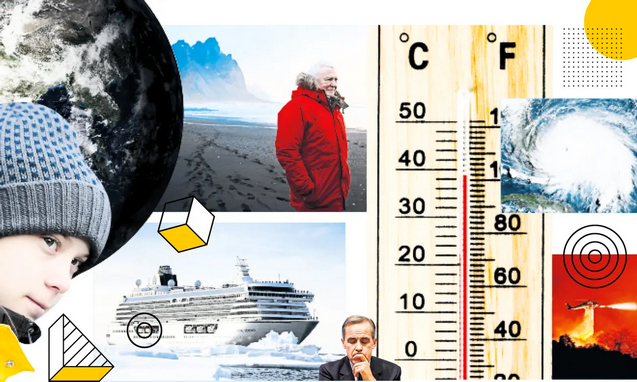
What the world will look like in 2050 if we continue to burn oil, gas, coal and forests at the current rate? Composite: Guardian Design; Filippo Monteforte/AFP; Patra Kongsirimongkolchai/Getty Images/EyeEm; Alex Board/BBC NHU; deepblue4you/Getty Images/iStockphoto; NOAA/AFP/Getty Images; Mike Eliason/Santa Barbara County Fire Depart/AFP; Will Oliver/EPA 
"Good morning. Here is the shipping forecast for midday, 21 June, 2050. Seas will be rough, with violent storms and visibility ranging from poor to very poor for the next 24 hours. The outlook for tomorrow is less fair."
All being well, this could be a weather bulletin released by the Met Office and broadcast by the BBC in the middle of this century. Destructive gales may not sound like good news, but they will be among the least of the world’s problems in the coming era of peak climate turbulence. With social collapse a very real threat in the next 30 years, it will be an achievement in 2050 if there are still institutions to make weather predictions, radio transmitters to share them and seafarers willing to listen to the archaic content.
I write this imaginary forecast with an apology to Tim Radford, the former Guardian science editor, who used the same device in 2004 to open a remarkably prescient prediction on the likely impacts of global warming on the world in 2020.
Journalists generally hate to go on record about the future. We are trained to report on the very recent past, not gaze into crystal balls. On those occasions when we have to venture ahead of the present, most of us play it safe by avoiding dates that could prove us wrong, or quoting others.
Radford allowed himself no such safe distance or equivocation in 2004, which we should remember as a horribly happy year for climate deniers. George W Bush was in the White House, the Kyoto protocol had been recently zombified by the US Congress, the world was distracted by the Iraq war and fossil fuel companies and oil tycoons were pumping millions of dollars into misleading ads and dubious research that aimed to sow doubt about science.
Radford looked forward to a point when global warming was no longer so easy to ignore. Applying his expert knowledge of the best science available at the time, he predicted 2020 would be the year when the planet started to feel the heat as something real and urgent.
“We’re still waiting for the Earth to start simmering,” he wrote back in that climate-comfortable summer of 2004. “But by 2020 the bubbles will be appearing.”
The heat of the climate movement is certainly less latent. In the past year, the world has seen Greta Thunberg’s solo school strikes morph into a global movement of more than six million demonstrators; Extinction Rebellion activists have seized bridges and blocked roads in capital cities; the world has heard ever more alarming warnings from UN scientists, David Attenborough and the UN envoy for climate action, Mark Carney; dozens of national parliaments and city councils have declared climate emergencies; and the issue has risen further to the fore in the current UK general election than any before it. With only weeks to go until 2020, the bubbles of climate anxiety are massing near the surface.
Radford’s most precise predictions relate to the science. Writing after the record-breaking UK heat of 2003, he warned such scorching temperatures would become the norm. “Expect summer 2020 to be every bit as oppressive.” How right he was. Since then, the world has sweltered through the 10 hottest years in history. The UK registered a new high of 38.7C this July, which was the planet’s warmest month since measurements began.
Hostile world: tackling forest fires in China. Photograph: Costfoto/Barcroft Media
He also correctly anticipated how much more hostile this would make the climate – with increasingly ferocious storms (for the first time on record, there have been category 5 hurricanes, such as Dorian and Harvey, for four years in a row), intensifying forest fires (consider the devastating blazes in Siberia and the Amazon this year, or California and Lapland in 2018) and massive bleaching of coral reefs (which is happening with growing frequency across most of the world). All of this has come to pass, as have Radford’s specific predictions of worsening floods in Bangladesh, desperate droughts in southern Africa, food shortages in the Sahel and the opening up of the northwest passage due to shrinking sea ice (the huge cruise liner, Crystal Serenity, is among the many ships that have sailed through the Bering Strait in recent years – a route that was once deemed impossible by even the most intrepid explorers).
A couple of his predictions were slightly premature (the snows on Kilimanjaro and Mt Kenya have not yet disappeared, though a recent study said they will be gone before future generations get a chance to see them), but overall, Radford’s vision of the world in 2020 was remarkably accurate, which is important because it confirms climate science was reliable even in 2004. It is even more precise today, which is good news in terms of anticipating the risks, but deeply alarming when we consider just how nasty scientists expect the climate to become in our lifetime. Unless emissions are slashed over the next decade, a swarm of wicked problems are heading our way.
How wicked? Well, following Radford’s example, let us consider what the world will look like in 2050 if humanity continues to burn oil, gas, coal and forests at the current rate.
The difference will be visible from space. By the middle of the 21st century, the globe has changed markedly from the blue marble that humanity first saw in wondrous colour in 1972. The white northern ice-cap vanishes completely each summer, while the southern pole will shrink beyond recognition. The lush green rainforests of the Amazon, Congo and Papua New Guinea are smaller and quite possibly enveloped in smoke. From the subtropics to the mid-latitudes, a grimy-white band of deserts has formed a thickening ring around the northern hemisphere.
Coastlines are being reshaped by rising sea levels. Just over 30cm at this stage – well short of the 2 metres that could hit in 2100 – but still enough to swamp unprotected stretches of land from Miami and Guangdong to Lincolnshire and Alexandria. High tides and storm surges periodically blur the boundaries between land and sea, making the roads of megacities resemble the canals of Venice with increasing frequency.
On the ground, rising temperatures are changing the world in ways that can no longer be explained only by physics and chemistry. The increasingly hostile weather is straining social relations and disrupting economics, politics and mental health.
Generation Greta is middle aged. Their teenage fears of the complete extinction of the human race have not yet come to pass, but the risk of a breakdown of civilisation is higher than at any previous time in history – and rising steadily. They live with a level of anxiety their grandparents could have barely imagined.
The climate activist Greta Thunberg leads a school strike outside of the Swedish Parliament in 2018. Photograph: Michael Campanella/The Guardian 
The world in 2050 is more hostile and less fertile, more crowded and less diverse. Compared with 2019, there are more trees, but fewer forests, more concrete, but less stability. The rich have retreated into air-conditioned sanctums behind ever higher walls. The poor – and what is left of other species – is left exposed to the ever harsher elements. Everyone is affected by rising prices, conflict, stress and depression.
This is a doorway into peak climate turbulence. Global heating passed the 1.5C mark a couple of years earlier and is now accelerating towards 3C, or possibly even 4C, by the end of the century. It feels as if the dial on a cooker has been turned from nine o’clock to midnight. Los Angeles, Sydney, Madrid, Lisbon and possibly even Paris endure new highs in excess of 50C. London’s climate resembles Barcelona’s 30 years earlier. Across the world, droughts intensify and extreme heat becomes a fact of life for 1.6bn city dwellers, eight times more than in 2019. For a while, marathons, World Cups and Olympics were moved to the winter to avoid the furnace-like heat in many cities. Now they are not held at all. It is impossible to justify the emissions and the world is no longer in the mood for games.
Extreme weather is the overriding concern of all but a tiny elite. It wreaks havoc everywhere, but the greatest misery is felt in poorer countries. Dhaka, Dar es Salaam and other coastal cities are hit almost every year by storm surges and other extreme sea-level incidents that used to occur only once a century. Following the lead set by Jakarta, several capitals have relocated to less-exposed regions. But floods, heatwaves, droughts and fires are increasingly catastrophic. Healthcare systems are struggling to cope. The economic costs cripple poorly prepared financial institutions. Insurance companies refuse to provide cover for natural disasters. Insecurity and desperation sweep through populations. Governments struggle to cope.
“By 2050, if we fail to act, many of the most damaging, extreme weather events we have seen in recent years will become commonplace,” warns Michael Mann, the director of the Earth System Science Center at Pennsylvania State University. “In a world where we see continual weather disasters day after day (which is what we’ll have in the absence of concerted action), our societal infrastructure may well fail … We won’t see the extinction of our species, but we could well see societal collapse.”
Huge waves at Porthcawl, Wales: there will be more extreme storms and longer droughts. Photograph: Ben Birchall/PA 
Adding to the anxiety is the erratic temperature of the planet. Instead of rising smoothly it jolts upwards, because tipping points – once the stuff of scientific nightmares – are reached one after another: methane release from permafrost; a die-off of the tiny marine organisms that sequestered billions of tonnes of carbon; the dessication of tropical forests. People have come to realise how interconnected the world’s natural life-support systems are. As one falls, another is triggered – like dominos or the old board game, Mouse Trap. In some cases, they amplify one another. More heat means more forest fires, which dries out more trees, which burn more easily, which releases more carbon, which pushes global temperatures higher, which melts more ice, which exposes more of the Earth to sunlight, which warms the poles, which lowers the temperature gradient with the equator, which slows ocean currents and weather systems, which results in more extreme storms and longer droughts. It is also now clear that positive climate feedbacks are not limited to physics, but stretch to economics, politics and psychology. The Amazon is turning into a savannah because the loss of forest is weakening rainfall, which makes harvests lower, which gives farmers an economic motivation to clear more land to make up for lost production, which means more fires and less rain.
On our current course, carbon concentrations in the atmosphere will pass 550 parts per million by midcentury, up from around 400ppm today. Katharine Hayhoe, an atmospheric scientist and director of the Climate Science Center at Texas Tech University, explains how this stacks the odds in favour of disaster.
“By 2050, we’d be seeing events that are far more frequent and/or far stronger than we humans have ever experienced before, are occurring both simultaneously and in sequence.”
Her greatest concern is that food production and water supply systems could buckle under the strain, with dire humanitarian consequences in areas that are already vulnerable.
Generation Greta live with a level of anxiety their grandparents could barely have imagined
Hunger will rise, perhaps calamitously. The United Nations’ International Panel on Climate Change expects food production to decline by 2% to 6% in each of the coming decades because of land-degradation, droughts, floods and sea-level rise. The timing could not be worse. By 2050, the global population is projected to rise to 9.7 billion, which is more than two billion more people to feed than today.
When crops fail and starvation threatens, people are forced to fight or flee. Between 50 and 700 million people will be driven from their homes by midcentury as a result of soil degradation alone, the Intergovernmental Science-Policy Platform on Biodiversity and Ecosystem Services (IPBES) estimated last year. Fires, floods and droughts will prompt many others to migrate within and across borders. So will the decline of mountain ice, which is a source of meltwater for a quarter of the world’s population. The poorest will be worst affected, though they have the least responsibility for the climate crisis. For the US author and environmentalist, Bill McKibben, this injustice will make the greatest impact in 2050.
“Forcing people to move from their homes by the hundreds of millions may do the most to disrupt the world. And, of course, it’s a deep tragedy, because these are precisely the people who have done the least to cause the problem,” he says.
In 2050, climate apartheid goes hand-in-hand with increasingly authoritarian politics. Three decades earlier, worried electorates voted in a generation of populist “strongmen” in the hope they could turn back the clock to a more stable world. Instead, their nationalism made a global solution even harder to achieve. They preferred to focus on the immigration consequences of global heating rather than the carbon-capital causes. When voters realised their mistake, it was too late. The thugocracy refused to give up power. They no longer deny the climate crisis; they use it to justify ever-more repressive measures and ever-wilder efforts to find a technological fix. In the past 20 years, nations have tried volcano mimicking, cloud brightening, albedo modification and carbon dioxide removal. Most were expensive and ineffective. Some made weather circulation even less reliable. Powerful countries now threaten rivals not just with nuclear weapons, but with geo-engineering threats to block sunlight or disrupt rainfall patterns.
This is not an inevitable future. Unlike Radford’s prediction for 2020, this vision of 2050 factors in human behaviour, which is more volatile and less predictable than the laws of thermodynamics. Many of the horrors above are already baked into the climate, but our response to them – and each other – is not predetermined. When it comes to the science, the dangers can be substantially reduced if humanity shifts decisively away from business-as-usual behaviour over the next decade. When it comes to the psychology and politics, we can make our situation better immediately if we focus on hope in shared solutions, rather than fears of what we will lose as individuals.
That means putting faith in institutions, warning one another about risks, and treasuring shared eccentricities and traditions – a bit like the shipping forecast.
A storm is certainly brewing. The science is clear on that. The question now is how we face it.

Links

(AU) Dirty Power: An Australian Political Investigation

Greenpeace

The coal industry has infiltrated Australia's federal government through a secretive network of ties, working to influence Australia’s political decisions at the highest level: right up to the office of the Prime Minister, Scott Morrison


 Dirty Power: Big Coal's network of influence over the coalition government

We’ve uncovered the web of connections between the world’s biggest coal giants, industry groups, lobbyists and powerful media organisations that serves to halt action on climate change and stall the transition to clean energy.

Why is this so horrifying?
Coal is the number one cause of climate damage. It causes more frequent and intense natural disasters like bushfires while also polluting our water and air.
By pandering to the interests of the coal industry, the Coalition Government is putting dirty profits ahead of the health and wellbeing of Australians who want our nation to run on clean energy.
From furthering the fossil-fuelled agenda of current Prime Minister Scott Morrison, to helping to bring about the swift downfall of former Prime Minister Malcolm Turnbull: the coal industry has infiltrated the Australian Government at the highest level.
This report is based on interviews with dozens of political operatives, current and former staffers, executives of external lobby firms, and resources sector analysts; previously hidden details about the identity and background of federal ministers’ parliamentary staff; and publicly available information about listed companies and their operatives.
We worked with experienced investigative journalist, Michael West, to expose the web of ties between the coal industry and federal government via industry groups, lobbyists and media.

See the connections between some of australia's
most powerful politicians and the coal industry

Links

(AU) A Vision Of Hell

03/01/2020

(AU) Australia’s Angry Summer: This Is What Climate Change Looks Like

Scientific AmericanNerilie Abram

The catastrophic fires raging across the southern half of the continent are largely the result of rising temperatures
Credit: David Gray Getty Images

Nerilie Abram
Nerilie Abram is an investigator at the ARC Center of Excellence for Climate Extremes and an associate professor at the Research School of Earth Sciences at the Australian National University.
Summer in Australia use to be something we yearned for: long, lazy days spent by the beach or pool, backyard barbecues, and games of cricket with family and friends.
But recent summers have become a time of fear: Schools and workplaces are closed because of catastrophic fire danger, while we shelter in air-conditioned spaces to avoid dangerous heat waves and hazardous levels of smoke in the air. Campgrounds have been closed for the summer, and entire towns have been urged to evacuate ahead of “Code Red” fire weather. Welcome to our new climate.
Of course, unusually hot summers have happened in the past; so have bad bushfire seasons. But the link between the current extremes and anthropogenic climate change is scientifically undisputable.
The fires raging across the southern half of the Australian continent this year have so far burned through more than 5 million hectares. To put that in context, the catastrophic 2018 fire season in California saw nearly 740,000 hectares burned. The Australian fire season began this year in late August (before the end of our winter). Fires have so far claimed nine lives, including two firefighters, and destroyed around 1,000 homes. It is too early to tell what the toll on our wildlife has been, but early estimates suggest that around 500 million animals have died so far, including 30 percent of the koala population in their main habitat. And this is all before we have even reached January and February, when the fire season typically peaks in Australia.
Australia is the most fire prone of all of Earth’s continents. But what has made its latest fire season so extreme? Wildfires need four ingredients: available fuel, dryness of that fuel, weather conditions that aid the rapid spread of fire and an ignition. Climate change is making Australian wildfires larger and more frequent because of its effects on dryness and fire weather.
Australia’s climate has warmed by more than one degree Celsius over the past century, and this change has caused an increase in the frequency and intensity of heat waves. I am 42, and I have lived through only six years with average temperatures below the 1961–1990 climatological average. My children have experienced none, and in all likelihood, they never will.
Increasing temperatures cause increased evaporation that dries the soil and fuel load. More than a decade ago, the Intergovernmental Panel on Climate Change (IPCC) concluded that ongoing anthropogenic climate change was virtually certain to increase in intensity and frequency of fires in Australia. This assessment of the science evidence has been been repeated in countless reports, including the IPCC’s Climate Change and Land report, released in August 2019.
The effects of rising temperature on drying out the environment can be countered by rainfall or by the growth of vegetation that increases humidity locally. But in the southern half of Australia, where rain falls mostly in the winter, there has been a substantial decline in precipitation. In the southwest of the country, rainfall has declined by around 20 percent since the 1970s, and in the southeast, around 11 percent of rainfall has been lost since the 1990s.
One of the factors driving this long-term loss of winter rainfall is the positive trend in the Southern Annular Mode (SAM). This change is causing the westerly winds that circle the Southern Ocean to shift southward toward Antarctica, causing rain-bearing winter cold fronts to pass south of the Australian continent. The role of anthropogenic climate change in driving this trend in the SAM is also clear in the science.


Climate variability acts on top of these long-term trends that are pushing the Australian climate toward a more fire-prone state. And that variability is an important part of the story of why the 2019–2020 summer has been so extreme.
Southeastern Australia has been in drought since 2017. Rainfall here is normally highly variable from year to year, but there have now been three winters in a row where the winter rains failed. This is a situation that has never been seen before in the historical record of Australia’s rainfall, even during infamous decade-long droughts such as the Millennium Drought. The severity of the current drought has caused large swathes of vegetation to die. It has even dried out wet rain forests, allowing fierce fires to take hold in places that would not normally burn.
The current summer has presented the perfect storm for wildfire. Long-term climate warming, combined with years of drought, colliding with a set of climate patterns that deliver severe fire weather.
In the tropical Indian Ocean, one of the most severe positive Indian Ocean Dipole (IOD) events on record played out this year. The unusually cold sea-surface temperatures in the eastern Indian Ocean cut off one of Australia’s critical moisture sources, adding to the ongoing drought in southern parts of the country. Australia’s worst fire seasons typically follow positive IOD events, much more so than the influence of El Niño events in the Pacific. Again, climate change is part of the story, because anthropogenic warming is causing positive IOD events to become stronger and more frequent.


At the same time, this year, a rare sudden stratospheric warming event developed over the Antarctic in late winter. Weakening of the polar vortex over Antarctica in spring increases the forest fire danger index across eastern Australia. This is because a northward shift in the Southern Hemisphere westerlies (i.e., a negative SAM) at this time of year causes very hot and dry westerly winds to be drawn across the continent.
The angry summer playing out in Australia right now was predictable. The scientific evidence is well known for how anthropogenic greenhouse gas emissions are causing long-term climate change and altering climate variability in ways that increase our fire risk. The role of climate change in the unprecedented fires gripping Australia is also well understood by our emergency services. Sadly, though, this summer has occurred against a backdrop in which the Australian government has argued, on the world stage, to scale back our greenhouse-gas-emissions-reduction targets. Our leaders are literally fiddling while the country burns.
In many parts of Australia, there will be no traditional fireworks shows to welcome in the new year. The risk is simply too great, and celebration is not warranted while our communities continue to be under threat from this angry summer.

Links

Lethal Heating is a citizens' initiative