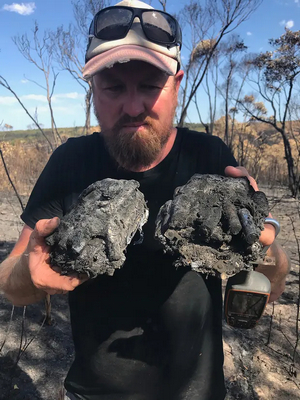
A kangaroo stands on burned land in Lithgow, New South Wales, Australia, on Tuesday. (Brendon Thorne/Bloomberg)
The planet registered its second-hottest year on record in 2019, capping off a five-year period that ranks as the warmest such span in recorded history. In addition, the 2010s will go down in history as the planet’s hottest decade, according to the Copernicus Climate Change Service (C3S), a science initiative of the Europe Union.
The service, which monitors global surface temperatures, determined Earth last year was a full degree warmer (0.6 Celsius) than the 1981-2010 average. This data provides the first comprehensive global look at the state of the climate in 2019, with U.S. agencies such as NASA and the National Oceanic and Atmospheric Administration (NOAA) expected to announce similar results next week.
“2019 has been another exceptionally warm year, in fact the second warmest globally in our data set, with many of the individual months breaking records,” said Carlo Buontempo, head of C3S, in a news release.
The past five years averaged 2 to 2.2 degrees (1.1 to 1.2 Celsius) above preindustrial levels, C3S found. The magnitude of warming puts the planet perilously close to one of the temperature guardrails outlined in the Paris climate agreement, in which policymakers agreed to limit by 2100 global warming to “well below” 3.6 degrees Fahrenheit, or 2 degrees Celsius, above preindustrial levels.
The aspirational goal in the agreement is to hold temperatures to a 2.7-degree increase, or 1.5 Celsius, above preindustrial levels, which is a target favored by the countries considered most vulnerable to climate impacts, such as small island nations.
The rapid warming has occurred as concentrations of carbon dioxide in the atmosphere, a long-lived heat-trapping greenhouse gas, continue to increase. Copernicus cited satellite measurements showing the amount of carbon dioxide in the planet’s atmosphere in 2019 increased by 2.3 parts per million, which was larger than the growth rate in 2018 but below the growth rate of 2.9 ppm in 2015.
Surface air temperature departures from average during 2019. (Copernicus Climate Change Service)
Overall, the amount of carbon dioxide in the atmosphere is now the highest level in human history and probably has not been seen on this planet for 3 million years. However, to meet the Paris targets, the world would need to commit to rapidly slashing carbon emissions at a rate far outside the plans of any of the largest emitters, making the 2.7-degree goal technically possible but politically unlikely.This past year featured numerous climate milestones, most of which indicated human and natural systems are already being buffeted by extensive impacts from relatively low levels of climate change, considering the warming projected to come in the next several decades.
Last year, extreme climate events, such as a searing European heat wave, drove home the urgency of reducing emissions of greenhouse gases. The recent bush fires in Australia charred millions of acres in December, which was that country’s hottest month on record, capping off its hottest and driest year.
Last year was also the warmest summer in the Northern Hemisphere, and Europe had its hottest year on record. Europe also had its hottest December on record as 2019 came to a close.
The year also brought fierce hurricanes that rapidly intensified from weak to monstrous storms — a process in which climate change is thought to play a role. Among them was Hurricane Dorian, which devastated the northwestern Bahamas. In the United States, Alaska experienced record warmth, with an astonishing lack of sea ice in the Bering and Chukchi Seas even during winter.
The year also brought troubling signs that natural systems that serve to store huge quantities of carbon dioxide and methane, the latter being another powerful greenhouse gas, may be faltering as temperatures increase. In December, a federal report indicated the permafrost that rings the Arctic may already be a net source of atmospheric carbon, which would accelerate global warming in what is known as a positive feedback. Raging fires in the Amazon during the year, largely as a result of a pro-development government in Brazil, now threaten to turn the world’s most productive rainforest into a drier, less carbon-rich savanna.
The hot, dry conditions that primed southeastern Australia’s
forest and fields for the bushfires that have been ravaging the country
since September are likely to continue, scientists warn — and climate
change has likely made the situation much worse.
Over the past few months, the bushfires have already scorched millions of acres, killed two dozen people,
and slaughtered an estimated half a billion animals in the country,
where it is currently summer. But scientists say that the risk of
additional fires remains high. Southeastern Australia has been
“abnormally dry” since September, which means that it would need
significant rainfall repeatedly over a period of weeks to become damp
enough to cut down the risk of fires, says Dan Pydynowski, a senior
meteorologist at AccuWeather.
Unfortunately, such prolonged rain does not appear to
be imminent in the next few weeks. Although the region experienced some
rain early this week, Pydynowski warns that it has “not been
impressive” and is not enough to substantially reduce fire risk.
Significant rain from Tropical Storm Blake is also not expected to reach
the area most affected by the fires.
“Everything is so dry right now, it doesn’t take much for a fire to spark and blow up and spread,” Pydynowski says.
A cemetery recently hit by bushfires near Mogo, New South Wales, on Jan. 5. Adam Ferguson for TIME
Climate scientists warn that the scale
and devastation of the wildfires are clear examples of the way climate
change can intensify natural disasters.The Australian bushfires were
exacerbated by two factors that have a “well-established” link to
climate change: heat and dry conditions, says Stefan Rahmstorf, department head at the Potsdam Institute for Climate Impact Research in Germany and a lead author of the United Nations’ Intergovernmental Panel on Climate Change’s Fourth Assessment Report.
In recent years, Australia has experienced long-term dry conditions and exceptionally low rainfall. Scientists say that droughts in the country have gotten worse over recent decades. At the same time, the country has recorded record high temperatures; last summer was the hottest on record for the country.
“Due to enhanced evaporation in warmer temperatures,
the vegetation and the soils dry out more quickly,” says Rahmstorf. “So
even if the rainfall didn’t change, just the warming in itself would
already cause a drying of vegetation and therefore increased fire risk.”
Australian Prime Minister Scott Morrison, who has resisted calls for the country to reduce its carbon emissions,has
been accused of deemphasizing the the link between the bushfires and
climate change, saying during a November interview that there isn’t
“credible scientific evidence” that curbing emissions would diminish the
fires.
However, scientists stress that while many sources may
ignite fires — including arson — climate change is a major reason why
recent the blazes in Australia have been so destructive.
“There are now disingenuous efforts to downplay the
clear role of climate change in worsening the intensity and severity of
the Australian fires, or to blame ‘arson’ as a way to distract from the
growing threat of climate change. These efforts should be called out for
what they are: gross climate denial,” Peter Gleick, a climate scientist
and co-founder of Pacific Institute in California.
Gleick says
that the bushfires are a “very clear example of the links between
climate change and extreme weather.” He points out that these fires are
very similar to recent highly destructive fires in Brazil and California.
“It’s not a question of whether climate change has
caused these fires. Fires start for natural reasons — or for human cause
reasons. What we’re seeing is a worsening of the conditions that make
the fires in Australia unprecedentedly bad,” says Gleick. “All of these
factors — record heat, unprecedented drought, lack of rain — all
contribute to drying out the fuel that makes these fires worse. What we
have are fires that might have occurred anyway, but the extent, the
severity, the intensity of these fires is far worse than it otherwise
would have been without the fingerprints of climate change.”
Rahmstorf also says that climate scientists believe
wildfire conditions are worsening because climate change affects the
water cycle, which in turn “leads to less rainfall in already dry parts
of the world, and more rainfall in the already wet parts of the world.”
Australia is especially vulnerable to climate change because the
continent is already hot and dry; a large swathe of the country is
facing increased risk of drought, says Rahmstorf.
Gleick says that the bushfires can have a ripple
effect both on the local landscape and on the global climate. Fires can
cause “ember storms,” which can lead to additional fires when embers
from smaller fires are picked up by the wind.
Fires also add carbon dioxide — a greenhouse gas
— into the atmosphere, which can in turn amplify climate change, Gleick
says. “Climate change is making these disasters worse, and these
disasters are making climate change worse,” says Gleick. “We’ve only
seen a tiny fraction of the climate change that we’re going to see in
the coming years and the coming decades. If we’re seeing these disasters
with a 1 degree warming of the planet so far, and we know that we’re
headed for a 1.5 or 2 or 3 degree warming, we can only imagine how bad these disasters are going to get.”
From heatwaves and fires to floods and snow, 2019 was a big year of weather.
It wasn't just hot and dry, it smashed the records.
Australia's
average maximum daytime temperatures really sizzled — last year was
2.09 degrees Celsius above the 1961-to-1990 average, smashing the previous record by half a degree.
Dr
Karl Braganza, the Bureau of Meteorology's head of climate monitoring,
said it was the first time an annual anomaly had been two degrees above
average.
Annual mean temperatures were also the highest on record for the country as a whole, at 1.52C above average.
It was also Australia's driest year on record, with only 277.6
millimetres of rain for the country on average, 40 per cent less than
the long-term average.
Dry years are often hot because rain cools
things down, but this is the first time a year has been both the hottest
and driest on record.
The previous driest year was 1902, at the end of the federation drought and before the official temperature record began.
The south-east of the country was even sprinkled with snow at one point, with the AFL's first snow match in Canberra in August.
Doesn't August feel like a lifetime ago?
But yes, the main story of 2019 was the heat and the fires.
January was plagued by heatwaves, making it Australia's hottest month on record.
Fires burned through Tasmania for weeks, resulting in the state's worst fire season since 1967.
There
were also major blazes in Victoria and Western Australia early in the
year, only for that devastation to be eclipsed by the recent horror
fires.
Fires have been raging since September.
On December 17 and then 18, Australia surpassed its hottest day on record — the 19th only missed out on the hat-trick by a whisker.
By the end of December, the BOM's report states more than 5 million hectares have been burnt across Australia since July.
"The
extensive long-lived fires appear to be the largest in scale in the
modern record in New South Wales, while the total area burnt appears to
be the largest in a single recorded fire season for eastern Australia,"
it said.
The main climate drivers this year were the strongest positive Indian Ocean Dipole (IOD) on record, with a strong negative burst of the Southern Annular Mode (SAM) late in the year.
Both
contributed to the hot dry conditions, but this natural variability
happens on the foundation of rising temperatures and increasing fire
danger for Australia, Dr Braganza said.
"We've got very-well-defined and clear trends, underlying the change that we've seen over the past several decades," he said.
"We've seen clear trends in maximum, minimum and average temperatures across Australia.
"We've seen quite clear trends in reducing rainfall across south-west WA and parts of the south-east."
He said the BOM had also seen a clear trend in fire weather, both in terms of longer and more severe fire seasons.
"The fire season has extended by months in some locations, particularly along the south coast and east Gippsland.
"We're getting more fire weather during the season, and the fire weather we're seeing is more severe.
"That's reflected in heatwaves as well in many parts of the continent."
The year that will be
How 2020 will follow is yet to be determined, but that underlying trend is not going away.
The
current outlook is for relatively neutral conditions; the positive IOD
broke down as the monsoon moved into the Australian region.
The #IndianOceanDipole (IOD) has returned to neutral, indicating the end of one of the strongest positive IOD events to impact Australia in recent history—a key driver of the warm & dry conditions during the second half of 2019. Read more in #ENSO Wrap-Up: https://t.co/Eq0Mz3VDnZpic.twitter.com/Q52oaFG5iw
— Bureau of Meteorology, Australia (@BOM_au) January 8, 2020
But that doesn't mean we are out of the woods.
"We're
not seeing an indication of odds favouring a lot of widespread,
above-average rainfall, but we are seeing indications of some rainfall
starting to come in with the northern monsoon," Dr Braganza said.
"The
hope is that they start to cool down parts of the continent over the
central and north-west, which tends to assist in cooling temperatures
down a little.
"But really, it's been very hot and dry already. It's still the start of January, there is a deal of summer to go."
Rain
and cyclones might finally be coming in the north, but the call is to
remain vigilant as the traditionally hottest months of summer are still
to come.
With our south-east coast aflame, our dead uncounted, our holiday
beaches rendered into evacuation zones; with our queues for water, fuel,
food and for simple escape, Australia now has the world’s attention.
In
international eyes, our leaders have been found wanting not only in
planning for such a catastrophe, and not just for the failure of some to
match the tenacious heroism of our volunteers, but for their refusal to
accept the catastrophic reality of climate change and its link with the
burning of coal.
Scott Morrison has been abused by community members on a visit to the bushfire ravaged town of Cobargo.
A headline in The Washington Post
on Friday morning Australian time bluntly captured Scott Morrison’s
humiliation upon visiting Cobargo hours earlier: “Australia’s Prime
Minister visited families devastated by the wildfires. It did not go
well.”
In the same paper, a caption on the video footage of
volunteer firefighters declining to shake the PM’s hand read:
“Australians resist, shun Prime Minister amid deadly wildfires.”
At the very same time, The New York Times
was reporting that “the fires have fueled anger at Australia’s Prime
Minister, Scott Morrison, who has downplayed the role of global warming,
opposed measures to combat climate change and rejected additional
funding for firefighters. After widespread ridicule, last month he cut
short a vacation during the crisis, a trip that critics said showed he
did not take the disaster seriously enough.”
It
quoted the angry Cobargo resident who told him in front of TV cameras
on Thursday, in what will surely be some of the best remembered footage
of Morrison’s prime ministership: “You won’t be getting any votes down
here buddy. You’re out son.”
The
German broadcaster DW noted that locals had called Morrison an “idiot”
and described the criticism he had received for his Christmas holiday to
Hawaii.
In America, CNN carried a report that said: “Experts say
climate change has worsened the scale and impact of the fires, and many
have accused the Morrison administration of doing little to address the
climate crisis. In December, a woman dumped the remnants of her fire-ravaged home in front of the Australian Parliament, accusing Morrison and lawmakers of failing to act.”
When
he saw the footage of Morrison’s reception in Cobargo, English
broadcaster Piers Morgan, normally a reliable friend to populist
conservatives, tweeted “he got what he deserved ... absolutely
unconscionable for a Prime Minister to holiday in Hawaii as his nation
burns”.
By now, NSW Emergency Services Minister David Elliott, at
the time of writing still declining to take calls as he returns from a
European jaunt that began after the deaths of NSW volunteer
firefighters, must feel some relief that he has no international
profile.
Illustration: John Shakespeare
In
truth though, the world began to pay attention to the Australian
conflagrations and its climate change recalcitrance even before the
excruciating footage of Morrison’s visits to firegrounds leaked over the
wires. On New Year’s Eve, New York Magazine published a piece about lamenting the global response to the fires that likened Morrison to Donald Trump and Jair Bolsonaro in embodying climate change denial. Two days later, The Economist noted Morrison’s “lethargic approach to climate change”.
On December 23, Al Jazeera
reported: "Australia's government is resisting growing calls for a more
ambitious response to climate change, even as the country battles
devastating bushfires triggered by record temperatures that have sent
air pollution to critical levels."
It
noted that Australia “releases 1.3 per cent of the world's greenhouse
gases ... its population accounts for 0.3 per cent of the world's
inhabitants”.
In a feature published just after Christmas, The Washington Postcharted the terrible damage already wrought upon Australia’s environment by climate change.
“On land, Australia's rising heat is ‘apocalyptic'. In the ocean it’s
worse,” read the headline. It recounted how flying foxes and possums
were falling dead out of trees in heat waves, how the giant kelp forests
of Tasmania had already been obliterated. “This is happening even
though average atmospheric temperatures in Australia have yet to
increase by 2 degrees Celsius,” it reported.
Australia
also captured global attention during the most recent United Nations
climate change talks in Madrid in early December, known as COP25, which
were widely seen as a dismal failure in the face of existential global
threat.
In this international ring, Australia punched well above
its weight, identified as one of the nations most responsible for
wrecking any chance of securing a meaningful outcome alongside giants
like Brazil and the United States.
In a piece entitled “The winners were the brakemen”, Die Welt explained to German readers how Australia had insisted on double-counting old emissions cuts to meet new commitments.
"Countries
such as Australia, Brazil and the USA have blocked and delayed the UN
climate protection process in Madrid. The growing will in many countries
to stop global warming with decisive action could not prevail here
because of the unanimity principle,” Michael Schafer, head of Climate
and Energy at the environmental organisation WWF Germany, told German
broadcaster Welt. Reimund Schwarze, environmental economist at the
Helmholtz Centre for Environmental Research, spoke of the talks as a
"long tragedy".
Prime Minister Scott Morrison's approach to climate change has been called lethargic. Credit: AAP
“Australia
played its part in this failure with proposals that would have rendered
any agreement practically useless,” wrote James Dyke of the University
of Exeter in The Independent newspaper.
“But its
continual production of coal is more destabilising. It's no surprise
that coal mining corporations want to continue coal mining. But the fact
that certain Australian political parties and sections of the media
strongly promote coal should be a source of immense shame. The greatest
gift they could give to Australians and the rest of the world would be
to radically rethink their ideological attachment to this fossil fuel.”
The
diplomatic cost of Australia’s determination to defend its coal
industry in the face global efforts to cut greenhouse emissions is
significant, broad and so far incalculable, says Herve Lemahieu, the
director of the Lowy Institute's Asian Power and Diplomacy Program, an
ongoing project that measures shifting national power dynamics across
our region.
Speaking from London, he said that as a result of
coverage of Australia’s performance in Madrid and of the bushfires
Australia is now seen in a different, darker light across Europe. Where
once it existed in the popular imagination as a place of almost pristine
natural beauty, it is now viewed as the Western nation most ravaged by
climate change. It’s reputation as a global citizen has been irrevocably
tarnished.
NSW RFS firefighters work through the night. Credit: Kate Geraghty
“The
global media has made a link between Australia’s protection of its coal
industry and its climate policy. The cat is out of the bag,” says
Lemahieu.
The impact of this new understanding of Australia will
not only damage our effectiveness in future climate negotiations, it
will hurt all Australian diplomatic efforts, he says.
“Australia
is currently negotiating a free trade agreement with the EU,” he
explains. “That will have to be ratified by the EU parliament and by
some EU nations. Support for [a free trade agreement with Australia] is
going to face a democratic test among populations that have made that
link.”
Tim
Buckley, the director of Energy Finance Studies at the Institute for
Energy Economics and Financial Analysis, says his frustration at the
government’s intransigent defence of increasingly technologically
obsolete thermal coal (coal burnt for energy rather than steel
manufacturing) at the cost of effective climate change policy and
international reputation is compounded by his view that the industry has
commenced its drawn-out death throes, sustained by political muscle
rather than economic reality.
Coal
power's defenders point to a recent uptick in imports to China and
India and the long-term potential of customers such as Bangladesh,
Pakistan and Vietnam. Buckley concedes China and India will continue to
buy Australian coal in the short term as they seek to maintain economic
growth at up to 6 or 7 per cent annually.
But both have made clear
their intention to first transition to domestic coal as fast as they
can build the necessary infrastructure while concurrently decarbonising
their economies in line with the rest of the world. A Bloomberg analysis published on December 23 predicted “misery” for Australian coal exporters as China cut imports.
He
says the coal-fired power generation of those other nations mentioned
as long-term customers is wholly dependent on subsidies from nations
financing and constructing their coal sectors – mainly China, South
Korea and Japan. Both South Korea and Japan, he says, are already
showing signs that they want to abandon the sector.
Buckley
argues that the thermal coal industry’s tipping point has already
passed, missed by its champions in Morrison’s government but already
factored in by global money markets.
US
coal stocks dropped an average 50 per cent in 2019 while Exxon remained
flat in a US equity market that rose 28 per cent overall, meanwhile the
share price of the world’s largest investor in renewables, the US
utility Nextera Energy, leapt by 42 per cent. Banks and insurers around
the world – among them ANZ, Credit Suisse and Goldman Sachs – are
increasing restrictions on their dealings with thermal coal and
coal-fired power generation operations.
Divestment from fossil
fuel is being turbo-charged by the rise of institutional shareholder
activism. The Institutional Investors Group on Climate Change now has a
combined $24 trillion in assets under management, and is developing “a
practical and useable framework for investors to be able to understand
what it would mean for a pension fund to align with the goals of the
Paris Agreement.” In other words, it is developing a practical guide for
its members to use in dumping coal.
Later
this month, Morrison had planned to India in order to help sell more
coal. That trip might now not go ahead. Buckley reckons he would have
received a polite welcome, not least because India is keen on Australian
LNG. He might have even helped sell more coal for a few more years.
But
it would be delusional, says Buckley, to believe that Australia will
get to choose how and when it transitions from coal. The rest of the
world will make that decision for us, and it could do so suddenly.
Tipping
points can be easy to miss in financial markets, says Buckley. In part,
this is because they are by nature sudden and dramatic. In part, it is
because it is so tempting to keep basing forecasts on historical trends.
“You can get away with that for years,” he says, “until it makes you look like a fool.”
This
summer, Australia has been clobbered by the immediate practical reality
of climate change. A similarly violent collision with economic and
political realities now faces leaders of both parties and their friends
in the coal industry.
Millions of animals have been killed in the bushfires, but the impact on
flora and fauna is more grim even than individual deaths
Habitat of the endangered southern brown bandicoot has been obliterated by fire on Kangaroo Island, one of many Australian species whose survival has been further threatened by this summer’s terrible bushfires. Photograph: Simon Cherriman/WWF Australia
Close to the Western River on Kangaroo Island, ecologist Pat Hodgens
had set up cameras to snap the island’s rare dunnart – a tiny mouse-like
marsupial that exists nowhere else on the planet.
Now, after two fires ripped through the site a few days ago, those
cameras – and likely many of the Kangaroo Island dunnarts – are just
charred hulks.
“It’s gone right through the under storey and that’s where these
species live. The habitat is decimated,” said Hodgens, of Kangaroo
Island Land for Wildlife, a not-for-profit conservation group.
On Friday afternoon, word came through that three other Land for
Wildlife sites protecting dunnarts and other endangered species, such as
the southern brown bandicoot, had also been consumed by fire on the
island off the South Australian coast.Prof Sarah Legge, of the Australian National University, said the
prognosis for the Kangaroo Island dunnart was “not good” and its plight
was symbolic of what was happening all across the east coast of
Australia.
She said “many dozens” of threatened species had been hit hard by the
fires. In some cases “almost their entire distribution has been burnt”.
So far, the current Australian bushfire season has burned through about 5.8m hectares of bush, known across the world for its unique flora and fauna.
Ecologists say the months of intense and unprecedented fires will almost certainly push several species to extinction.
The fires have pushed back conservation efforts by decades, they say,
and as climate heating grips, some species may never recover.
Climate scientists have long warned that rising greenhouse gases will spark a wave of extinctions.
Pat Hodgens with burnt cameras that had been monitoring threatened species on Kangaroo Island. Photograph: KI Land for Wildlife
Now ecologists fear the bushfires represent the catastrophic
beginning of a bleak future for the country’s native flora and fauna.
“It feels like we have hit a turning point that we predicted was
coming as a consequence of climate change. We are now in uncharted
territory,” Legge said. Bushfires
don’t just burn animals to death, but create starvation events. Birds
lose their breeding trees and the fruits and invertebrates they feed on.
Ground-dwelling
mammals that do survive emerge to find an open landscape with nowhere
to hide, which one ecologist said became a “hunting arena” for feral
cats and foxes.
These fires are homogenising the landscape. They benefit no species. John Woinarski
“It’s reasonable to infer that there will be dramatic consequences to
very many species,” said Prof John Woinarski, of Charles Darwin
University.
“The fires are of such scale and extent that high proportions of many
species, including threatened species, will have been killed off
immediately.”
He said footage of kangaroos and flocks of birds fleeing fires was no
evidence of their survival. With fires of such wide extent, they run
out of places to escape.
“We know that the species that can’t fly away – like koalas and greater gliders
– are gone in burnt areas. Wombats may survive as they’re underground,
but even if they do escape the immediate fire front, there’s essentially
no food for them in a burnt landscape.”
A burnt carcass of a kangaroo in Sarsfield, East Gippsland. Photograph: James Ross/EPA
Woinarski said the critically endangered long-footed potoroo was restricted almost entirely to East Gippsland, which has been devastated by this year’s fires.
In southern Queensland, much of the known range of the silver-headed antechinus “has been obliterated by fires”, he said.
He said fires had always been a feature of the Australian landscape,
but in normal circumstances extensive patches of unburnt areas were
left, that helped species survive.
“There are no winners in fires like this,” he said. “These fires are homogenising the landscape. They benefit no species.
“This
is a harbinger of a bleak future for our wildlife. They have set back
conservation in Australia for a very long period, but [the fires] are a
sign of an even more bleak future ahead. Because of climate change, they
will become more frequent and more severe. It’s a sad time for
conservation in Australia.”
He said it was “quite likely” the fires would have caused some extinctions, but “we won’t know until after this summer ends”.
“There’s an obligation now to do immediate reconnaissance for these species.”
Legge offered other examples. The endangered Hastings River mouse, she said, had had about 40% of its known distribution “toasted”.
Fire has covered about one-third of the range of the vulnerable rufous scrub-bird
“Even some species that are not snuffed out completely will struggle
in the coming months. I think this is the end for a number of species,”
she said.
One estimate of the number of animals affected by the fires has come from University of Sydney ecologist Prof Chris Dickman.
Using previous research compiled in 2007 on the impact of land clearing in New South Wales,
Dickman estimated about 480m mammals, birds and reptiles had been
affected – but not necessarily all killed. His estimate did not include
bats, which are susceptible to fires and also critical for moving around
seeds and pollination.
“There
is a suite of small animals that live on the forest floor. If the cover
is removed, then foxes and cats move in and they use the burned areas
as open hunting arenas,” he said.
There is a silent death going on. Richard Kingsford
As the fires moved into Kosciuszko national park, he was now concerned about the endangered mountain pygmy possum.
One important factor, he said, was the ecological role that many affected animals played.
Bandicoots and poteroos help to move fungal spores around after fires
that promote regrowth. If those animals die, that “ecological service”
goes with them.
Prof Brendan Wintle, a conservation ecologist at the University of
Melbourne, said the scale and timing of the fires was “terrifying”.
“If this is what we are seeing now are the beginnings of changes due
to climate change, then what are we looking at 2C or 4C? I don’t think
we can get our heads around what that could be like. This is not the new
normal, but it’s a transition to something we have not experienced
before.
“This is really concerning not just for the impact that this event
will have, but the prospect of this happening on a regular basis is
really quite terrifying, and it will be to the point where forest
ecosystems have changed to have a different character. When they change
you definitely lose species.”
Wintle said species such as the yellow-bellied glider and the greater glider,
already threatened by climate change, would be severely affected.
“These species require large old trees to den and they can’t survive
without at least some large old living trees in their range.”
He said East Gippsland was a stronghold for the two species, but it
appeared that “vast swathes” of its habitat had been burned in recent
days.
A burnt brushtail possum rescued from fires near the Blue Mountains in New South Wales. Photograph: Jill Gralow/Reuters
Much
of the known range of the endangered brush-tailed rock wallaby – a
species already “right on the edge of extinction” – had also been
burned, he said.Three quarters of threatened species in Australia are plants, many of which exist in only small pockets, such as the dark-bract banksia and the blue-top sun orchid.
“You can lose the lot in one big fire,” Wintle said. “If the timing
is wrong, or the fire is too hot, you can also lose the seed bank and
that’s then another species on the extinction list.”
Prof Richard Kingsford, director of the UNSW Centre for Ecosystem
Science, said the fires would rob many bird species of vital old growth
trees they need to breed.
Fire had taken away the invertebrate bugs the birds feed on, and that
food source would not return until there was significant rain.
“There are a whole lot of things that are ecologically off the scale,” he said.
“We won’t really know how much of a tipping point these fires have
been, but the scale in terms of extent and severity I think will be a
serious problem for many, many species. It will set back biodiversity in
our forests for decades.
“You have these incredibly savage blows and these animals have not
evolved to cope with it. These fires are not, in the scheme of things,
natural.
“We don’t see these smaller animals being incinerated. There is a silent death going on.”
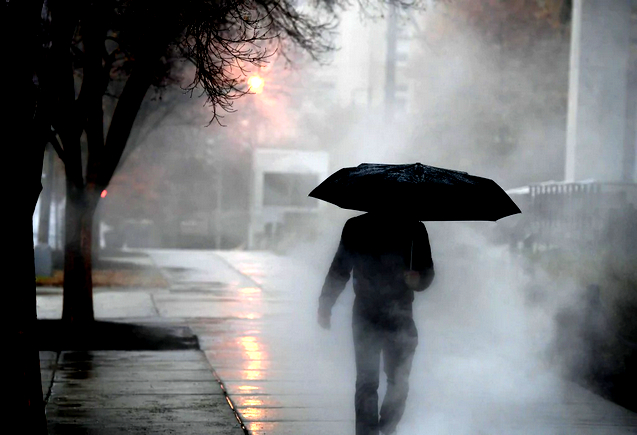
A pedestrian walks in Southwest Washington on a wet and misty December day. (Matt McClain/The Washington Post)
For
the first time, scientists have detected the “fingerprint” of
human-induced climate change on daily weather patterns at the global
scale. If verified by subsequent work, the findings, published Thursday
in Nature Climate Change, would upend the long-established narrative that daily weather is distinct from long-term climate change.
The
study’s results also imply that research aimed at assessing the human
role in contributing to extreme weather events such as heat waves and
floods may be underestimating the contribution.
The new study, which was motivated in part by President Trump’s tweets
about how a cold day in one particular location disproves global
warming, uses statistical techniques and climate model simulations to
evaluate how daily temperatures and humidity vary around the world.
Scientists compared the spatial patterns of these variables with what
physical science shows is expected because of climate change.
The study concludes that the spatial patterns of global temperature and
humidity are, in fact, distinguishable from natural variability, and
have a human component to them. Going further, the study concludes that
the long-term climate trend in global average temperature can be
predicted if you know a single day’s weather information worldwide.
Rural Fire Service firefighters undertake property protection measures Tuesday near the town of Sussex Inlet, Australia. (Sam Mooy/AFP/Getty Images)
Study
co-author Reto Knutti, of ETH Zurich, said the research alters what we
can say about how weather and climate change are connected.
“We’ve
always said when you look at weather, that’s not the same as climate,”
he said. “That’s still true locally; if you are in one particular place
and you only know the weather right now, right here, there isn’t much
you can say.”
However,
on a global scale, that is no longer true, Knutti said. “Global mean
temperature on a single day is already quite a bit shifted. You can see
this human fingerprint in any single moment.
“Weather is climate change if you look over the whole globe,” he added.
The
research uses the techniques applied in other “detection and
attribution” studies that have sought to identify the signal of
human-caused climate change in longer-term changes at the global level,
such as the seasonal temperature cycle of the planet or heating of the oceans.
The
authors, from research institutions in Switzerland and Norway, use
machine learning to estimate how the patterns of temperature and
moisture at daily, monthly and yearly time scales relate to two
important climate change metrics: global average surface temperatures
and the energy imbalance of the planet. Increasing amounts of greenhouse
gases in the atmosphere are causing Earth to hold in more of the sun’s
energy, leading to an energy surplus.
The
researchers then utilized machine learning techniques to detect a
global fingerprint of human-caused climate change from the relationships
between the weather and global warming metrics, and compare it with
historical weather data.
By
doing this, scientists were able to tease out the signal of
human-caused global warming from any single day of global weather
observations since 2012. When looking at annual data, the human-caused
climate signal emerged in 1999, the study found.
In
what one outside expert, Michael Wehner of Lawrence Berkeley National
Laboratory, deemed a “profoundly disturbing” result, the study found
that the global warming fingerprint remained present even when the
signal from the global average temperature trend was removed.
“This
. . . is telling us that anthropogenic climate change has become so
large that it exceeds even daily weather variability at the global
scale,” Wehner said in an email. “This is disturbing as the Earth is on
track for significantly more warming in even the most optimistic future
scenarios.”
Stanford
University climate scientist Noah Diffenbaugh, who was not involved in
the study, said it advances our understanding of climate change’s
effects.
“The
fact that the influence of global warming can now be seen in the daily
weather around the world — which in some ways is the noisiest
manifestation — is another clear sign of how strong the signal of
climate change has become,” he said in an email. “This study provides
important new evidence that climate change is influencing the conditions
that people and ecosystems are experiencing every day, all around the
world.”
The
research may provide a bridge between two approaches to detecting the
human fingerprint on the changing climate. One of these techniques
focuses on long-term trends, while another looks at regionally specific,
shorter-term extreme weather events. Until this new study, there was no
way to integrate these two specialties.
“Because
it’s not possible to disentangle the fingerprint of climate change from
natural internal variability for any particular extreme event, these
studies use model simulations to estimate how the probabilities of such
‘class of events’ may have changed under anthropogenic climate change,”
said study lead author Sebastian Sippel, of the Institute for
Atmospheric and Climate Science at ETH Zurich.
“Our study could be seen also as linking these two sides of the same coin,” he said.
The
study contains uncertainties, particularly when it comes to the
accuracy of computer models in simulating various climate cycles. It
also does not tease out the importance of other factors that influence
the climate, such as land-use change and human-made and volcanic
aerosols.
Knutti
notes that the use of machine learning techniques, which can help tease
out patterns in large data sets, can introduce uncertainties as well,
although he’s confident those were minimized here.
While
the new study does not attribute the climate change trends they found
completely to human activities, Sippel said it’s unlikely there is
another plausible explanation.
“We
know from many other studies that the warming in the last 40 years is
almost entirely human,” he said, adding that this is the subject of
follow-up work.
Piers Morgan blasted the Liberal backbencher on air, telling him to "wake up"
Mr Kelly said the cause of the fires was the "build-up of fuel load and the drought"
Scott Morrison sought to reassure the public his Government accepted the link between climate change and natural disasters
Liberal backbencher Craig Kelly has defended his Government's
handling of the bushfire crisis, during a combative UK television
interview in which he argued the fires were caused by high fuel loads
and not climate change.
Appearing on ITV's Good Morning Britain, Mr
Kelly — who has long questioned whether the climate is indeed changing,
and whether human activity has played a part — was grilled by outspoken
British host Piers Morgan, who introduced him as a "climate change
sceptic".
Mr Kelly nodded along during the introduction.
"You believe this has nothing to do with climate change, explain that," Piers Morgan began.
Mr Kelly replied: "Well Piers, you have to look at science and what our scientists are telling us.
"What causes the fires is the build-up of fuel load and the drought.
"To
try to make out — as some politicians have — to hijack this debate,
exploit this tragedy and push their ideological barrow, that somehow or
another the Australian Government could have done something by reducing
its carbon emissions that would have reduced these bushfires is just
complete nonsense."
The Bureau of Meteorology has said climate
change is influencing the frequency and severity of dangerous bushfire
conditions in Australia and other regions of the world.
Morgan blasted the Liberal backbencher on air, telling him to "wake up".
"Climate
change and global warming are real, and Australia right now is showing
the entire world just how devasting it is," Morgan said.
"For senior politicians in Australia to still pretend there's no connection is absolutely disgraceful."
Some Cobargo residents refused to shake Scott Morrison's hand, others hurled abuse at him.
(ABC News)
Mr Kelly backed his decision to appear on the UK program in an interview with Radio National Breakfast host Tom Tilley.
"I
went on that program to defend the Prime Minister, he was being
attacked for what people were saying was a not-adequate response from
Australia," Mr Kelly said.
Opposition Leader Anthony Albanese said his reaction to Mr Kelly's comments that were aired in the UK was "one of despair".
"Despair,
not just that Craig Kelly has those views and continues to advocate
them — not just here in Australia, but globally, and be seen to be
representing the Australian Government's position — but the knowledge
that he's one of the people who has held back action," he said.
"He's
one of the people who has stopped action on climate change
domestically, which has led us to be in a position whereby we're
actually, as well, arguing for less action internationally, rather than
more."
As fires burn across the country, Prime Minister Scott
Morrison has been under pressure to develop a stronger climate change
policy.
The Australian leader has also made global headlines for
his handling of the bushfire crisis, with international media outlets
watching the fires closely. His confrontational meeting with angry residents
— who heckled the Prime Minister and refused to shake his hand during
the brief visit — in the bushfire-ravaged New South Wales town of
Cobargo was streamed across the world.
The criticism has left Mr
Morrison repeatedly seeking to reassure the public — both domestically
and abroad — his Government accepts the link between climate change and
natural disasters.
"I should stress that there is no dispute in
this country about the issue of climate change globally, and its effect
on global weather patterns, and that includes how that impacts in
Australia," he said on Sunday.
And when asked later in the day
what he would say to those around the world who were watching, he simply
said: "Thank you very much for your support. Thank you."
Mr
Kelly's senior Liberal colleagues are frustrated with the timing of this
intervention, at a time when the Government is eager to highlight its $2 billion commitment to rebuilding towns devastated by the fires.
At
a press conference in Canberra, Emergency Management Minister David
Littleproud said Mr Kelly's views were not representative of the
Government's position.
"Quite frankly, I've got better things to
do than worry about what a backbencher goes and says on national TV," Mr
Littleproud said.
"There's peoples' lives I'm trying to rebuild,
there's 26 Australians who have lost their lives, I couldn't give a rats
what he said, it's irrelevant.
"Let's just focus on those people
who are out there who need our help, that's what we should be focused
on. These tidbits on the sidelines, I couldn't care less about."