03/03/2020

(AU) This Melbourne Council Declared The World's First Climate Emergency - Now 28 Countries Are On Board

SBS - Evan Young

Local and national governments in 28 countries have declared climate emergencies since Melbourne’s Darebin Council in 2016. Many now hope after this summer's bushfires, Australia may declare a national emergency. 
Source: Facebook / Darebin Climate Action Now
On 5 December 2016, Melbourne’s Darebin Council made history.
Councillor Trent McCarthy put forward a motion that the council vote on declaring a state of climate emergency.
Though it would be merely symbolic, it was thought a declaration could still have practical use.
The vote was unanimous and made Darebin Council the first in the world to declare a climate emergency.
“Before the vote, residents were very much telling us climate change mattered more than anything else to them,” Darebin Mayor Susan Rennie told SBS News.
“We had a really mobilised community, desperate for effective action, who were speaking with councillors about how significant it would be if a level of government would acknowledge just how significant the problem is.
“We thought we were a council who could do that.”
Darebin Council Mayor, Susan Rennie SBS News/Patrick Naughtin
More than three years on, the gesture continues to "really unite" councillors, Ms Rennie said.
“In embracing the language of 'climate emergency', we are saying we know business as usual is not okay - business as usual will doom the planet.”
Darebin Council's boundaries largely replicate the federal electorate of Cooper, formerly known as Batman, which has been held by Labor since 1969.

‘Mixed emotions’
Use of the term ‘climate emergency’ has skyrocketed in recent years.
Oxford Dictionaries declared the polarising phrase its 2019 Word of the Year following a 10,796 per cent usage increase and the first-ever National Climate Emergency Summit was held in February in Melbourne.
Ms Rennie said she was proud to help kickstart awareness of the term.
“In 2016, 'climate emergency' was new language that people weren’t using a whole lot,” she said.
“I think it’s fantastic a concept that was new to many people, to see within three years how that has shifted and how people recognise more broadly 'this is a state of emergency and we’re seeing the consequences in our day to day lives' - that’s extraordinary.”
But, Ms Rennie said, declaring the first climate emergency also came with a big sense of responsibility.
“It’s one thing being the first to do something, but if you don’t follow it up with meaningful action then what sort of example are you setting?” she said.
“There’s a sense of sometimes pride, but equally, one of frustration of not being able to do things as quickly as is required."
“So I have many mixed emotions about that.”

What is a climate emergency?
There is no universal definition of what a ‘climate emergency’ is.
"Declarations differ and there are variations in each," said David Holmes, director of Monash University’s Climate Change Communication Research Hub.
Some declarations are about officially accepting that climate change imposes an existential threat, while others are legal acknowledgements of a crisis in order to access money to fight its effects.
But for most local government bodies, such as Darebin Council, it is often about committing to centring climate change when developing policy.
Since 2016, Ms Rennie said Darebin Council has begun work on a number of green initiatives, including programs to subsidise solar panels for residents and businesses, working to make all council operations carbon-neutral, introducing a food waste recycling program and resurfacing roads with recycled material.
Making the declaration in 2016 “set the council on a path” to develop a climate plan, she said.
“Staff in all different parts of the organisation understand that looking at their work through the lens of a climate emergency is critical and it’s a core part of their jobs."
“Our community expects action … so we also invite them to be much more vocal in what responses they want to see.”
Large crowds march during the The Global Strike 4 Climate rally in Melbourne, September 2019. AAP
Dr Holmes said using climate emergency declarations to help enable policy is one thing, but using it as a communication strategy can be “problematic”.
“It’s problematic at national levels in settings where you have a strong division over climate change,” he said.
“If you keep on pushing the language of a ‘climate emergency’ you will start to lose some people and entrench division.
“You find this in Australia and in places where there is a strong denial lobby casting doubt over whether climate change exists.
“Emergency declarations can work at a local government level where constituents are already climate-aware, but at a national level, you've got this problem of semantic fatigue.”

Where have climate emergencies been declared?
Ninety-four Australian jurisdictions have declared a climate emergency, according to Climate Emergency Declaration and Mobilisation in Action (CEDMA).
The ACT parliament declared a climate emergency in May 2019, becoming the first Australian state or territory to do so, while South Australia's Upper House followed suit four months later.
More than 800 million citizens across 28 countries are estimated to live in jurisdictions that have declared climate emergencies, according to CEDMA.
Britain, France, Portugal and Argentina are among the national governments to make climate emergency declarations.
Pope Francis also made a declaration in June 2019, while in November, more than 11,000 scientists around the world signed a scientific paper stating that the planet was facing a climate emergency, “clearly and unequivocally”.

Could Australia declare a national climate emergency?
In October 2019, an e-petition calling on the federal government to declare a national climate emergency reached a record-breaking 404,538 signatures.
It received more than three times the number of signatures on a petition which held the previous record, calling for the removal of GST on menstrual products.
The same month, Greens MP Adam Bandt brought a vote to the House of Representatives on whether to declare a national climate emergency. His motion was defeated 72-65, with Emissions Reduction Minister Angus Taylor labelling it a "grand symbolic gesture".
Emissions Reductions Minster Angus Taylor.
Dr Holmes said a new vote looks unlikely to succeed in the near future.
It could also depend on the public’s response to the bushfire crisis and how much of the devastation is attributed to climate change, he said.
“We're still a way off within the next couple of years of declaring a national climate emergency.”
“I think there's already been a big change in discourse in government ministers, but it’s now a matter of whether they step up and move on from this very destructive debate we've been having.
“Even the fact of framing it as a debate has been destructive. It’s really about moving on from that and having policy that appeals to people.”
Ms Rennie said “it is really important” more local and state governments look at policy creation through a climate lens.
“Ultimately, we know the action we need will take place at a federal government level, but that doesn’t mean local and state government shouldn’t do more,” she said.
“A good place to start is for councils to look at their entire emissions profile and how they reduce that.
“We need to become a zero-emissions society, and we need that to occur quickly.”

Links

02/03/2020

(AU) Why I'm Introducing The People’s Climate Change Bill

Sydney Morning Herald - Zali Steggall*

My dream as a 13-year-old was to get to the top of my sport. As an Australian competing in a sport dominated by northern-hemisphere countries, the odds were against me and there were many who didn’t believe it was possible. But with ambition, a lot of hard work and resilience, it was possible.
Government failure has increased the cost of the transition to clean energy. Credit: Jessica Shapiro
My challenge now is to set Australia on a safer climate future, for my kids and future generations. That is why I will be introducing the people’s Climate Change Bill to the Australian Parliament in March, to end a decade of divisive politics over Australia’s future.
Sadly, the lessons of this summer already seem forgotten as Liberal backbenchers Jason Falinski MP and Tim Wilson MP couldn’t resist playing politics and misrepresenting the bill in an opinion piece in these pages last week.
So I am calling on all MPs to think carefully about the responsibility they owe to their electorates, their children and future generations and support this plan for the future with a conscience vote. Our country is crying out for certainty on climate policy and this is what the bill provides. As I write, more than 60,000 Australians have signed up to the website calling for a Climate Change Bill to be supported by all members of Parliament.
According to the most recent Climate of the Nation report, more than 81 per cent of Australians believe climate change will lead to more droughts and flooding, while 64 per cent believe the country should have a national target for net zero emissions by 2050.
To protect our economy and environment, Australia must have strong national plans to adapt and mitigate the increasing impacts of climate change. The only way we can keep Australia safe is to set our goal to stay below 2 degrees of warming and work our hardest to get there.
The bill’s central purpose is to assist with this. It does this by establishing a sensible framework, endorsed by business including the Australian Industry Group and Business Council of Australia. This type of framework has enjoyed bipartisan support in Britain since 2008 and New Zealand since last year – to name but two.
Part of this framework sets up in law a net zero emissions target by 2050. More than 80 per cent of businesses support this, and all Australian states and territories already have this in law or policy. This bill includes establishing an independent Reserve Bank-style Climate Change Commission, tasked with advising government on the best way to get to net zero, climate risks and the progress towards targets.
Falinski and Wilson argued Australia already has a Climate Change Authority to do this. But they failed to mention that since being completely gutted by the Abbott Coalition government in 2015, the CCA is little used and ineffective.
The new Climate Change Commission will report regularly, independently and publicly without referral, and ensure transparency and accountability for the Australian people.
Coalition members have also raised concerns about potential duplication of efforts with states under this bill. Written very clearly in the text of the legislation is a requirement for efforts by the Climate Change Commission and government to be compatible with the states and territories.
The bill also fills vital gaps in Australia’s policy landscape. It will require regular national risk assessments outlining the effect to Australia from climate impacts such as fires, droughts, seas level rise and extreme weather events, and regional development and employment planning impacted by a transition away from fossil fuels.
Five-yearly adaptation plans are then implemented by the government in response to those risks. After the performance of the government in preparing for and responding to this season’s catastrophic and unprecedented bushfires, the value is clear in having future-focused adaptation and mitigation plans.
There is no issue of constitutional validity of the Bill, as raised in the Falinski and Wilson article. This is only another ‘"fear and smear" attempt by its opponents.
The Australian Constitution gives the right to legislate with respect to "external affairs", thus allowing the Parliament to pass legislation giving effect within Australia to its obligations under international treaties and conventions. This Bill goes to the core objective of meeting our obligations under the Paris Agreement and therefore is consistent with this.
The Bill also does not purport to remove the ultimate decision making from the minister, or any of the executive branch of government, as alleged. The discretion remains with the executive but introduces a level of accountability and transparency.
The challenge ahead is not simple, but it is not something to shrink away from but to face square on, with bipartisan support, with resolution and a plan. The stakes are high. But this is a race we must and can win.

*Zali Steggall MP is the independent member for Warringah in the House of Representatives.

Links

Annals of a Warming Planet: Welcome to The Climate Crisis Newsletter

New Yorker - 

A swarm of locusts north of Nairobi, Kenya, in January. The U.N. described an outbreak of desert locusts as a threat to food security. Photograph by Tony Karumba / AFP / Getty
Bill McKibben 
Bill McKibben is a founder of the grassroots climate campaign 350.org and a contributing writer to The New Yorker.
He writes The Climate Crisis, The New Yorker's newsletter on the environment.
We’re eight weeks into the new decade, and, so far, we’ve had the warmest January ever recorded. (Indeed, researchers at the National Oceanic and Atmospheric Administration said that 2020 is more than ninety-eight per cent likely to be one of the five warmest years ever measured, with a nearly forty-nine-per-cent chance to set a new annual record.) We’ve seen the highest temperature ever measured on the Antarctic continent, and also record swarms of locusts descending on the Horn of Africa, a plague which scientists assure us will “become more frequent and severe under climate change.”

I’m calling this new newsletter—and welcome aboard—The Climate Crisis because this is what a crisis looks like. I’ve been at this beat for so long that when I first started writing for The New Yorker on this topic, in the nineteen-eighties, we called it the “greenhouse effect.” “Global warming,” “climate change”—those are fine, too. But they don’t capture where we are right now: not facing some distant or prospective threat but licked by the flames. Thousands of people huddled on Australian beaches this year, ready to wade into the ocean as their only protection from the firestorms raging on the shore. This is not only a crisis—it is the most thorough and complete crisis our species and our civilizations have ever faced, one there is no guarantee that we will survive intact. Does that sound extreme? Consider the conclusions of a team of economists from the world’s largest bank, in a report to high-end clients which leaked to the British press, last Friday: “Something will have to change at some point if the human race is going to survive.”

But the name of this newsletter is also a nod to W. E. B. Du Bois, and the magazine that he founded a hundred and ten years ago, at the start of the N.A.A.C.P. The Crisis was, and is, a crucial journal in the analysis of the race hatred that mars and shames and undermines our collective life to this day; it linked readers to news from around the world, so that they could examine the currents roiling their lives. I’ll do the same in a section we’re calling Climate School—perhaps, if only by long exposure, I have some sense of how emerging science, economics, and politics fit into the larger picture. I mostly won’t be doing original reporting. (Check out Emily Atkin’s excellent daily newsletter, Heated, for that.) And I won’t shy away from talking about the activism and organizing that many people—myself included—are now engaged in. Du Bois’s The Crisis was an organ of action, constantly suggesting ways that its readers could move forward. “Is a toothache a good thing?” Du Bois asked, in the first issue. “No. Is it therefore useless? No. It is supremely useful, for it tells the body of decay, dyspepsia and death.” A toothache, he declared, “is agitation,” and agitation is necessary “in order that Remedy may be found.” Since I am an agitator as well as a journalist, I’ll include many suggestions about where a push might help us make progress.

My sense is that we’ve reached a place where many people are eager to help. National polling released this month, in a study by researchers at Yale and George Mason Universities, found that one in five Americans said that they would “personally engage in non-violent civil disobedience” against “corporate or government activities that make global warming worse” if a person they liked and respected asked them to. If that’s anywhere close to true, then it’s possible to imagine a movement big enough to make a difference—a movement one can see already emerging with the school climate strikers, the extinction rebels, and the Green New Dealers. I hope to introduce you to many of these people, and to the scientists, entrepreneurs, and policy wonks whose work undergirds their activism—people I’ve met in my years as a journalist and a volunteer at 350.org, the global climate campaign. Most weeks, I’ll include a short interview that lets them address you directly.

I wouldn’t bother doing any of this if I didn’t think that we could still make a real difference in the outcome. But I can’t offer you any guarantee that we’ll win—the short time that science gives us to make sweeping changes is daunting. When an iceberg twice the size of Washington, D.C., crashes into the Southern Ocean, or when the South is experiencing historic winter flooding, it’s a reminder that we’re a long way back in this race. The only guarantee I’ve got is that the fight is under way. Thank you for being a part of it.

Climate School
An as-yet-unpublished study from researchers at Brown University shows that a fourth or more of the climate chatter on Twitter is produced by automated bots, which are more likely to be on the side of climate denial. This is good to know: in real life, as opposed to social-media combat, polling shows that more and more people understand the reality of climate change.

The New Yorker has published luminous climate coverage over the years: few writers match the penetrating authority of Elizabeth Kolbert, and younger writers such as Carolyn Kormann are doing superb reporting. This recent piece, by Robin Wright, is excellent both for its evocation of the Antarctic Peninsula (the place on Earth, I think, that most feels like another planet) and its reminder that this is a war that we can’t afford to lose, because the effects will last essentially forever. And Bernard Avishai’s account of the vanishing solar-tax credit is a reminder of just how much quiet damage the Trump Administration is doing.

A new study in the journal Nature implies that the total methane emissions—the most significant global-warming gas after CO2—from man-made fossil sources (coal, natural gas, and oil) are higher than previous estimates. That means that they underestimated how much comes from oil, gas, and coal—which, in a twisted way, is kind of good news. Because, if we wanted to, we could turn off that source—say, by replacing gas with solar and wind power. The invaluable Hiroko Tabuchi provided a particularly good account in the Times, under the always-useful headline “Oil and Gas May Be a Far Bigger Climate Threat Than We Knew”; a key point for understanding our current energy debate is that natural gas is a bridge fuel to a dramatically hotter planet.

Passing the Mic
Without Christiana Figueres, there would have been no Paris climate accord—the Costa Rican-born former executive secretary of the U.N.’s climate-change convention worked tirelessly to create an opening where the Kyoto and Copenhagen processes had run aground. Her new book, co-written with Tom Rivett-Carnac, is called “The Future We Choose.”

Your book paints two remarkable pictures of where we will go if we don’t act on the climate, and where we can go if we do. Can you give the gist of those two worlds, in a few sentences?
The decade we have just started is the most consequential decade humanity has ever faced. If we are not able to cut our current global greenhouse-gas emissions by fifty per cent over the next ten years, we will be poised to enter into a world of constant destruction of infrastructure, congested and polluted cities, rampant diseases, increasing burning and flooding, mass migrations due to extensive droughts, heat or land loss leading to the abandonment of uninhabitable areas, and political turmoil as people fight for food, water, and land. At the current level of emissions, that is the world that we are heading for. If, on the other hand, we set our minds and determination to the necessary transformation, reducing our global greenhouse gases [by] half over the next ten years, we would have actually co-created a path toward a very different world: a reforested planet with regenerated agriculture, clean and efficient transport, enjoyable cities, clean air, and ubiquitous cheap energy for everyone.

Your endless optimism and hard work midwifed the Paris climate accords. Describe what it felt like the day you heard President Trump withdraw the U.S. from the agreement.
I remember I was travelling. I sat in front of the TV in my hotel with a sheet of paper and a pen in my hand, ready to write down every sentence that was correct. The speech finished and my paper was untouched. Not one sentence had been correct. The whole speech was based on incorrect information and a thorough misunderstanding of the Paris agreement. I was aghast.

You’ve worked especially hard to get governments onboard, but what’s your message for, say, bankers right now?
The financial industry has moved slowly but is picking up speed. The divestment movement has grown to over twelve trillion dollars of capital that is moving from high-carbon to low- or no-carbon assets. The recently launched Net-Zero Asset Owner Alliance, a group of large institutional investors holding a portfolio [valued at nearly four] trillion dollars, is already shifting investment portfolios to net-zero emissions by 2050. Larry Fink, the C.E.O. of BlackRock, which manages [more than] seven trillion dollars in assets, in his latest annual letter announced he is getting out of [thermal] coal and warns all asset managers about the risk of climate-exposed portfolios. We are beginning to see serious engagement of the financial sector. But more needs to happen in order to accelerate the transformation.

Scoreboard
Some major wins to report this week in the battle to keep fossil fuels in the ground:
  • The Teck company pulled its application for a vast new tar-sands mine in Alberta, after sustained campaigning led by, among others, some of Canada’s indigenous groups.
  • The Equinor company announced that it would not proceed with plans for offshore drilling in the Great Australian Bight, after sustained campaigning led by, among others, indigenous groups.
  • Chase Bank announced that it would no longer fund efforts to drill in the Arctic National Wildlife Refuge, after sustained campaigning led by, among others, the Gwich’in tribe in northern Alaska and Canada.
  • In Brazil, a campaign led by indigenous communities convinced courts to end plans for what would have been Latin America’s largest open-pit coal mine.
    (Perhaps you see a theme emerging.)
  • Oh, and the University of Michigan, pressured by students, announced that it would freeze all new investments in fossil fuels while it decides whether to join others in purging its portfolio of fossil-fuel stocks. As Mark Bernstein, a member of the university’s Board of Regents, put it, “We have a responsibility to do everything we can to disrupt the flow of carbon into the atmosphere. This requires disrupting the flow of money to the fossil-fuel industry.”
On the very sad side of the ledger, researchers announced that the bushfires in Australia had burned more than twenty per cent of the continent’s forests, up from less than two per cent in a normal year.

Warming Up
There are mornings when I have a hard time joining the fight, and so sometimes I listen to the bell-clear voice of Kelly Hogan, singing “Sleeper Awake.” Send me your list of motivators—and anything else you think I should know about—at TNYinbox@newyorker.com. I’m glad we’re doing this together.

Links

Rising Sea Levels Put Myanmar's Villages On Frontline Of Climate Change

Reuters - Rozanna Latiff | Zaw Naing Oo

BAGO, Myanmar - Three years ago, the villagers watched as the Sittaung River on Myanmar’s southeast coast crept closer to them, swollen by powerful tidal surges from the Gulf of Mottama that eroded its banks.
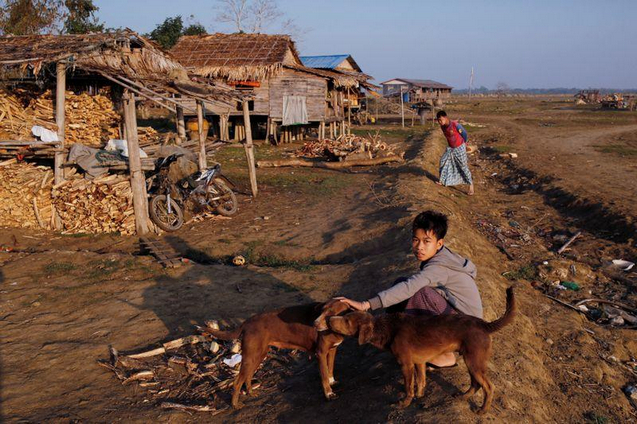
A boy from Ta Dar U village pets a dog after villagers relocated their houses inland in Bago, Myanmar, February 6, 2020. Photo taken on February 6, 2020. REUTERS/Ann Wang

Eventually, the 1,500 residents of Ta Dar U had to accept the inevitable: move or be washed away.
Dismantling their wooden homes, they relocated several kilometers inland, away from the fertile fields they had cultivated for decades.
“Where we now see water, our farming land used to be,” said farmer Tint Khaing. “It was very big, nearly three hours’ walking distance. We all lost our farmland to the sea.”
Ta Dar U is among hundreds of villages at the frontline of Myanmar’s climate crisis, where extreme weather patterns and rising sea levels have amplified and accelerated natural erosion.
Environmentalists consider Myanmar to be particularly vulnerable. It was among the top three countries affected by extreme weather between 1998 and 2018 on the Global Climate Risk Index, published by environmental think tank Germanwatch.
Sea levels are projected to rise about 13 cm (5 inches) by 2020, putting at risk about 2.5 million coastal residents, said Myint Thein, a U.S.-based groundwater consultant and member of Myanmar’s natural water resources committee.
“Flooding will be worst during the rainy season and high tide, dragging salty water up into the land,” he said.
Rapid erosion has already devoured 10 villages in the past four years, said Jos van der Zanden, chief technical adviser to the Gulf of Mottama Project, a Swiss-based organization that provides assistance to displaced villagers.

Fading Future
After their homes fell into the sea, the people of Ta Dar U, mostly rice farmers, scattered across the delta.
Saltwater contaminated their lands and they were forced to take up new occupations, with little success.
Nearly 200 students now travel hours every day to attend school after their own, which once stood near the town center, was reduced to a crumbling pile of rubble on the riverbank.
“If the erosion continues at this rate, the future of the students will fade as well,” said Myo Min Thein, the sole teacher at a makeshift school, who said he is struggling to teach the 26 students, ages 4 to 14, by himself.
The ruins of a monastery are seen after a riverbank collapsed into the water in Ta Dar U village, Bago, Myanmar, February 6, 2020. Photo taken on February 6, 2020. REUTERS/Ann Wang 
Myanmar’s climate change department has drafted plans to address rising waters but is not involved in resettling those displaced, deputy director Thin Thuzar Win told Reuters.
An official from the disaster management department said it did not have specific programs for those displaced by riverbank erosion. Regional government officials did not respond to Reuters’ requests for comment.
Low-lying villages should be moved immediately to areas at least 7 meters (23 feet) above sea level, said Myint Thein.
“It will be costly but it must be done,” he said. “The environment has changed, so the people must learn to adapt.”

Links

01/03/2020

(AU) Political Warfare Over Climate Action

Saturday Paper - Mike Seccombe

While Labor’s commitment to a 2050 emissions target reinvigorated well-practised attacks from the Coalition, the cost of inaction is only becoming clearer.
Opposition Leader Anthony Albanese during question time on Wednesday. Credit: AAP Image / Mick Tsikas
Angus Taylor did not actually say “over my dead body” in parliamentary question time on Monday, but he may as well have.
In the days prior Taylor, Scott Morrison and a coterie of others in the Coalition government had launched fervid attacks on the Labor opposition for declaring a commitment to move Australia to net zero greenhouse gas emissions by 2050.
This was actually a recommitment by Labor, to the policy it took to the 2019 election. Then, for the nine months following the election, it was not Labor policy. Then, on Friday last week, Opposition Leader Anthony Albanese announced it was Labor policy once again.
The government’s response made it double deja vu, as it relaunched its pre-election scare campaign, citing the unquantified cost of the Labor promise, including false claims of a new carbon tax. Morrison even dusted off his “bill you can’t afford” slogan, despite the fact Bill Shorten is no longer the Labor leader.
But on Monday, Zali Steggall, the independent who ran hard on climate change and beat Tony Abbott to take the blue-ribbon Liberal seat of Warringah, turned Morrison’s attack back on him.
“Since you are in government and the climate is on track to 3 degrees of heating on current emission reduction commitments, to ensure sensible economic management … has the government assessed the cost to jobs and to the economy of the outcome of 3 degrees of heating?” Steggall asked. “And what is that cost?”
The prime minister blustered but did not answer.
A few minutes later Labor’s Treasury spokesman, Jim Chalmers, followed Steggall’s lead with a question to Taylor, the minister for Energy and Emissions Reduction. Chalmers asked if the government had modelled “the economic impact of failing to meet its Paris agreement commitment of net zero emissions by 2050”.
Taylor did not answer; he in fact challenged the premise of the question, which was that by signing on to the Paris agreement the government had effectively committed to net zero by 2050.
“That’s not what’s in the Paris agreement,” Taylor said. “Article 4.1 is very clear. It is about a global commitment to meet net zero in the second half of the century.”
Steggall says she was appalled as she listened to Taylor’s “word games” about the deadline for climate action. The second half of the century?
“They really need to be held to account on that,” she says. “Are they suggesting that should be 2070 or 2080? If that’s what they’re saying, there’s no chance of staying under 2 degrees. Absolutely no chance.”
But that was the implication of Taylor’s answer: that he, his leader and his government consider the ultimate goal of the Paris agreement – net zero greenhouse gas emissions – to be something that can be put off for up to 80 years.
He was, however, technically correct in what he said. Article 4.1 of the agreement does indeed refer to “the second half of the century”.
But 73 other nations, every Australian state and territory government (including the Liberal ones), a large and rapidly growing number of business organisations and civil society groups – not to mention the man Morrison supplanted as prime minister, Malcolm Turnbull – do not interpret those words as Taylor does. They read them as meaning net zero by the second half of the century.
They do not read them with a tax-lawyerly eye for loopholes, considering instead the broader context of the agreement, which says that if global heating is to be limited to 1.5 to 2 degrees Celsius, governments must act “as soon as possible”, that developing economies might “take longer” but developed countries “should continue taking the lead”.
“A price on carbon is the most economic, efficient way of reducing greenhouse gas emissions … [but] the politics of it has just soured the entire conversation in this country.” There is little evidence to date that the Morrison government has any intention of taking the lead, or feels any urgency about meeting, or even setting, any emissions reduction target beyond its current one of 26-28 per cent by 2030, relative to 2005 levels.
Steggall has no doubt that the great majority of members of the federal parliament know this is not good enough. She is sure they are aware of the expert inquiries – the Stern report in Britain, the Garnaut report in Australia and numerous others – that conclude the benefits of strong, early action on climate change outweigh the costs. She has no doubt that if MPs were allowed to vote according to their consciences, as they were on the issue of same-sex marriage, the result would be overwhelmingly in support of an ambitious target.
She’s pushing for such a vote on a bill that would set out a road map to net zero. It will not happen, though, because climate is entirely different to same-sex marriage. With marriage, the hard part was settling the moral question; implementing the outcome was easy. With climate, it’s the opposite. Implementation is devilishly complex; setting a target is the easy bit.
Or it should be.
You would think political self-interest alone would dictate bipartisan agreement. Only this week an Essential poll found 75 per cent support among the public for a target of net zero emissions by 2050. Among Coalition supporters, support stood at 68 per cent.
Despite all the evidence arrayed in support of a 2050 net zero target – scientific evidence of a climate crisis, economic evidence of the benefits of acting promptly, all the significant forces mentioned above – even this threshold question remains contentious.
How is it possible that one side of politics abandoned that target for nine months, while the other side still refuses to adopt it? And that both sides appear to have backslidden when it comes to measures to address emissions reduction?
Much credit has to go to the man Zali Steggall defeated: Tony Abbott.
As Richie Merzian, a former climate negotiator for Australia, now climate and energy director with The Australia Institute, would have us all remember, it was not so long ago that Australia was playing a leading role internationally.
Under the prime ministership of Julia Gillard, a price on carbon emissions was implemented in July 2012 – and it worked. Consumer prices did not skyrocket, regions and industries weren’t wiped out, nor did the economy tank, as the naysayers had warned. To the limited extent it had an effect on electricity prices, people were compensated. Gillard also promised that Australia would prosecute the case for carbon pricing at international forums.
“The carbon price, according to our research, reduced national emissions by 2 per cent, even as the economy grew 5 per cent over the two years after its implementation,” Merzian says.
But the Abbott-led opposition, with the support of right-wing media figures, notably radio broadcaster Alan Jones, campaigned relentlessly against what they called a carbon tax. Readers might recall Abbott addressing demonstrators in front of Parliament House, pictured with signs calling Gillard “Juliar” and “Bob Brown’s Bitch”.
After Abbott came to power, he fulfilled his promise to “axe the tax”. It had lasted almost exactly two years. The new government also set about dismantling other parts of the architecture Labor had built around emissions reduction. The measures substituted by the conservatives had emissions tracking upwards again.
The Coalition’s climate policies may not have worked very well, but the scare campaign worked a treat, as we were reminded again this week when Mark Butler, Labor’s climate change spokesman before and after the 2013 election, fronted the media and was reminded of his strong support of a carbon price then. He was challenged to explain his and his party’s position now.
“What is clear is the debate has moved on from the position we found about 10 years ago where, I think, a carbon price was seen as important,” he said.
“… I know the modellers haven’t moved on but I think the rest of the world has moved on.”
Merzian does not agree.
“It is the most economic, efficient way of reducing greenhouse gas emissions, not just in theory, but in practice,” he says.
“New Zealand has an emissions trading scheme. The European Union has an emissions trading scheme. California and numerous other states in the US do. And a number of Canadian provinces. It’s commonplace overseas and has demonstrated its effectiveness.”
Among the major political parties, says Merzian, only the Greens still support a carbon price.
It is not that the world has moved on, he says, but that “the politics of it has just soured the entire conversation in this country”. Labor no longer dares to advocate best-policy practice, for fear of the scare campaign that would inevitably be run against them by the Coalition.
Indeed, the scare campaign has been running this week, even in the absence of any such policy.
Taylor, for example, thundered in parliament about Labor’s secret plan: “They don’t want to tell Australians what their plan is, because we know what it involves. It involves a carbon tax – a tax on fuel, a tax on electricity, a tax on gas and a tax on farmers.”
Such misrepresentations have worked not only against Labor, but also against any moderately progressive policy on the Coalition side.
There have been a couple of attempts to introduce market-based measures that could have been effective in giving business a financial reason to cut emissions. But all have been defeated or neutered by the party’s climate reactionaries.
The power of this cohort is exemplified in what happened to the national energy guarantee (NEG), a policy formulated by Malcolm Turnbull and his then Environment minister, Josh Frydenberg.
It was overwhelmingly approved by the Coalition joint party room. But fewer than a dozen hardliners – about 10 per cent of members – declared they would vote against it. The NEG was dumped.
At the 2019 election, Labor picked up Turnbull’s NEG as an element of its ambitious climate policy package, aimed at cutting emissions by 45 per cent by 2030. And so the Coalition wound up campaigning against a measure that was previously endorsed by 90 per cent of its parliamentary members.
When it comes to the politics of climate change, says Merzian, “the situation is otherworldly”.
Last year’s national vote was widely billed as “the climate election”. And when Labor lost, some people were quick to blame the ambition of its environment and climate policies.
Detailed analyses of the result, including Labor’s internal post-mortem, have since cast doubt on that. As one Labor insider summarises, “They were a net positive for us, so we would have lost bigger without them.”
That is debatable. While they were unquestionably a positive across the nation as a whole, elections are decided in individual seats. And Labor failed in several key seats that depend on coalmining.
The miners, and the communities in which they live, came to fear that the party was going to take away their jobs. It was a perception encouraged by comments from several senior people that a decline in the coal market would be desirable. There was also the revelation from businessman and former Australian Conservation Foundation president Geoff Cousins that Bill Shorten had promised to revoke approval for the giant Adani mine if Labor won the election.
Shorten, in the view of many in the party, tried to walk both sides of the street on the issue of fossil fuel exports. Anthony Albanese has decisively moved to the right, making it clear that his Labor Party will not oppose any project that is viable, just as it will not give taxpayer support to any project that is not.
That much is crystal clear. But when it comes to domestic climate policy, nothing is clear yet, except that Labor aspires to net carbon neutrality by 2050.
The commitment of the last election to a 45 per cent reduction by 2030 is gone, leaving us in the odd situation where one side of politics has a 2050 target but no interim target, while the other has an interim target but no 2050 target.
To say that Labor is playing its cards close to its chest would be an understatement. Even the decision to recommit to net zero stayed secret for weeks.
We now know it was taken on January 29 at a meeting of the full shadow ministry, a large group of people, and yet it did not leak. Nor did Albanese feel the need to reveal it for several weeks.
This suggests several things, first among them unity. If anyone had been seriously pissed off, the public would have known about it. While sources say there was some debate, it was largely about how and when the policy would be fleshed out.
Second, it suggests Albanese decided the public mood was such that a statement of basic principle had to be made, even at the risk of attracting criticism over a lack of detail.
Finally, it points to a calculation that the government’s credibility on climate issues is so shot, in the wake of the bushfires and the internecine warfare between Liberals and Nationals over targets and fossil fuel subsidies, that Labor had little to fear from a fight.
One frontbencher summed up that last point in two words: Gladys Berejiklian.
The Liberal premier of New South Wales came out of the bushfire catastrophe with her reputation hugely enhanced by her perceived competence, her empathy, her present-ness.
The Liberal prime minister of Australia was greatly damaged, seen as incapable of empathising with the traumatised.
Thus, when Morrison and his party initially went after Labor for signing up to an ambitious climate target, the response was to throw back at them the fact that the Berejiklian government has the same target.
The government’s counterargument was that Berejiklian had a plan, while federal Labor didn’t.
It was not very effective, though, for a couple of reasons. It is still early in the electoral cycle and Labor’s reluctance to provide detail is generally accepted as being tactical.
But the Morrison government’s criticism also rings a little hollow, given it has no target and is deeply divided about what its plan might be. Urban Liberal moderates have quite a different view from their Nationals Coalition colleagues.
That could change when Taylor delivers a statement, scheduled for next week, setting out technological fixes for Australia’s climate emergency.
At least some on the Labor side fear that the statement might be a good one, given the developments in renewable generation and batteries, the potential for clean, storable energy from hydrogen and other rapidly evolving technologies.
There have also been hints that the government might come up with a target before the next United Nations Climate Change Conference, to be held in Glasgow in November.
Zali Steggall, in asking her question about the costs of inaction, did not really expect an answer from the prime minister.
In any case, she has her own answer, gleaned from wide research into the economic costs of climate inaction.
“The University of Melbourne came out with a study recently estimating it would be at least 20 times the cost of action,” she says. “It came out with a cost of at least $1.19 trillion by 2050. The breakdown was $611 billion in lost property value, $211 billion in agriculture and labour loss and $368 billion in biodiversity and human health.”
The study’s author, Tom Kompas, professor of environmental economics and biosecurity, says the MP actually low-balled the numbers.
“All up. It’s about $2.7 trillion in potential losses from now until 2050,” he says. “That’s predicated on global temperature increases of 3.6 to 4 degrees.”
Which, of course, is where we could be headed, unless the world’s leaders – of which Australia used to be one – get their act together.

Links

(AU) World’s Top Climate Negotiator Condemns Australian Response To Climate Change

ABC triplejHack


The leader of the Paris Climate Agreement talks says she is "deeply pained" by the attitude of the Australian Government to climate change in the wake of this summer's unprecedented bushfires.
Costa Rican diplomat Christiana Figueres became the United Nations' top climate negotiator in 2010 and was at the helm for the historic Paris Climate Agreement in 2015.
Her task was to bring the leaders of 195 countries together to negotiate a binding agreement to stop the world warming beyond 2 degrees celsius - no easy task after the disastrous failure of the 2009 Copenhagen climate summit.
In an interview with Hack's Avani Dias about her new book, she hit out at the Australian Government's response to the bushfire disaster.
"I am deeply pained by the attitude of the current Australian Government, that still after the worst disaster that has ever hit the planet, the bushfires in Australia, that this government is still denying climate change and denying the fact that there is a lot that Australia can and should be doing," Figueres said.

Australia at the coalface of climate change
A common argument against Australia doing more to reduce emissions and transition away from fossil fuels is that as a country, Australia is only responsible for around 1.3 per cent of global carbon emissions.
Figueres also criticised that defence, saying Australia is at the frontline of climate change.
"I see it the following way: we now know because of the consequences of the bushfires, that Australia is actually one of the most vulnerable countries to unmitigated climate change," she told Hack.
"We also know Australia cannot single-handedly solve the problem."
A supplied image shows smoke billowing from a fire burning at East Gippsland, Victoria on December 2, 2020. Supplied: DELWP Gippsland
Labor has recommitted to its 2019 election policy of zero net emissions by 2050, saying Australia should pull its weight.
"Seventy-three countries, including the UK, Canada, France and Germany, many with conservative governments, have already adopted it as their goal. Australia should too," Opposition Leader Anthony Albanese said on Friday.
Mr Albanese said the Morrison Government had been "complacent" about the risk of climate change, even as bushfires tore through the country.
Emissions Reduction Minister Angus Taylor told RN Breakfast on Monday that the Australian Government would not follow Labor's net zero emissions, as the plan was "uncosted and unfunded".
Mr Taylor was reticent to give an emissions target beyond 2030 ahead of the global climate meetings in Glasgow in November.
"We said by November we'll have a long-term strategy with technology as a centrepiece... That work is going on."
Minister Taylor's office responded to Hack's request for comment by citing a quote from Scott Morrison's National Statement to the United Nations General Assembly: "Australia is doing our bit on climate change and we reject any suggestion to the contrary."
Christiana Figueres called on the Morrison Government to lead by example when it comes to cutting carbon emissions and averting runaway global warming.
"Australia needs all other countries to help in solving what is a global problem, not a national problem. If Australia doesn't put a firm foot forward, it stands in no position to actually ask all other countries to also put their best foot forward."
Australia depends on the best efforts being put forward by all countries, but for that, Australia has to do the same.”
However, Figueres acknowledged every country is falling short of what she regards as necessary to stop the world warming beyond 2 degrees.
"No one is doing enough. Frankly, we should all be moving much faster than we are."

Carryover targets criticised
When it comes to meeting our Paris commitments, the Federal Government has kept open the option of using a "loophole" to reach the 2030 target of reducing emissions by 26-28 per cent on 2005 levels.
It's often referred to as carryover credits - put simply, Australia's record on the previous Kyoto Treaty targets would be used as credit that's deducted from our Paris goal.
Christiana Figueres said that undermined the purpose of the Paris Agreement.
"I think it's very dangerous to act as though this were a game of cards. This is not a game, we cannot play with emissions or emissions reductions of the past," she said.
"It's not about looking back and beginning to get credit where credit is not due, this is about looking into the future."
However, she acknowledged the challenges facing Australia's coal industry as the world transitions away from fossil fuels.
Christiana Figueres, United Nations climate change chief, addresses a news conference after a week long preparatory meeting at the U.N. in Geneva February 13, 2015. Reuters: Denis Balibouse 
"It is definitely a complicated issue, I'm not going to underestimate how you transition those jobs out of coal into the present and the future."
We cannot shy away from a challenge by simply admiring the problem.”
Since leaving as the chief UN climate diplomat, Figueres founded the Global Optimism group, and has co-authored a new book, The Future We Choose, which focuses on what can be achieved if climate change is addressed in the coming decade.
She said there are many reasons to be optimistic about what's in store.
"Yes we are facing the most important challenge that humanity has ever faced, but we have everything that it takes to address climate change! We have the technologies, we have the finance, we know what the policies are, we absolutely have all the tools in our hands."
"Right now we're holding the pen of history in our hands, it's up to us to write what the history or humanity and of this planet will be."

Links

(AU) Scott Morrison's Duty Is To Protect The Australian People. There Is No Greater Threat Than Climate Disruption

The Guardian -  |

Our government continues to focus on the supposedly horrendous cost of climate action without mentioning the benefits
‘The increasing concern from climate researchers that such a world is likely to be climatically unstable and incompatible with the survival of human civilisation as we know it is totally ignored.’ Photograph: Richard Milnes/REX/Shutterstock
The first duty of a government is to protect the people. There is no greater threat than climate disruption as the world heads to 3C or more warming, possibly by mid-century, yet the prime minister is unwilling to explain the implications.
Asked by Zali Steggall in parliament recently about the costs of 3C of warming, Scott Morrison replied that “we do understand there are costs associated with climate change”, but was incapable of saying what they were.
As a diversionary tactic in our climate debate, it invariably works, focusing attention on the supposedly horrendous costs of action, for example building the new zero-carbon energy system; a discussion which skates over the fact that replacing ageing coal-fired generators with renewable energy will be cheaper than rebuilding with coal or gas, as the solar/wind/battery option slips under the fossil-fuel-energy cost curve.
Commentators repeatedly frame debate around the recent 2050 net zero emissions policy adopted by the ALP, and now supported by many others, in terms of its “costs”, without mentioning the benefits: huge damages avoided by reducing the level of global warming by concerted global action.
In fact those damages, at only 3C, may be beyond quantification. Work from the University of Melbourne in 2019 has shown that on current global emissions patterns, a conservative estimate of costs for Australia would be $584.5bn by 2030, $762bn by 2050, and more than $5tn in cumulative damages from now until 2100. On the other hand, the cost of effective emissions reduction is estimated to be $35.5bn up to 2030, or 0.14% of cumulative GDP, a negligible impact.
Such estimates focus on infrastructure damage, agricultural and labour productivity losses, human health impacts and ecosystem losses, but this is the tip of the iceberg. The costs of extreme weather events are not included, and more importantly, neither are the economic damages that Australia will incur as 3C of warming sweeps through Asia and the Pacific, devastating nations, disrupting major trading partners and supply chains, and likely turning the region – the “disaster alley” of global climate disruption – into one of social chaos and breakdown.
Thirteen years ago, senior US national security analysts looked at the consequences of 3C of warming and concluded that it would “give rise to massive nonlinear societal events. In this scenario, nations around the world will be overwhelmed by the scale of change and pernicious challenges … Armed conflict between nations over resources … is likely and nuclear war is possible. The social consequences range from increased religious fervour to outright chaos”.
Australia’s intelligence community, and the prime minister’s office, are well aware of this analysis, and have a duty of care to brief Morrison on its risk assessment. So when he refuses to admit the impacts of a 3C world, ignorance is not an excuse.
Australian government climate denial has played a leading role in ensuring that a 3–4C future has become accepted in global policy making circles as “politically realistic”. The increasing concern from climate researchers that such a world is likely to be climatically unstable and incompatible with the survival of human civilisation as we know it is totally ignored.
A survey of the scientific literature on the likely impacts of 3C paints a frightening picture. We described such an outcome in a recent report, The Third Degree, on the implications for Australia of existential climate-related security risks. In such a world, it is likely that the structures of societies will be severely tested, and some will crash. The poorest nations will suffer first and most deeply from climate change, but, after three decades of inaction, no nation will now escape.
Water availability will decrease sharply in the lower latitude dry tropics and subtropics, and affect almost two billion people worldwide. Agriculture will become nonviable in the dry subtropics. The Sahara will jump the Mediterranean, as Europeans begin a long trek north. Water flows into the great rivers of Asia will be reduced by the loss of more than one half, and perhaps much more, of the Himalayan ice sheet.
Aridification will emerge over more than 30% of the world’s land surface, most severely in southern Africa, the southern Mediterranean, west Asia, the Middle East, rural Australia and across the south-western US.
Most regions in the world will experience a significant drop in food production and increasing numbers of extreme weather events, including heat waves, floods and storms. Food production will be inadequate to feed the global population and food prices will skyrocket, as a consequence of a one fifth decline in crop yields, a decline in the nutritional content of food crops, a catastrophic decline in insect populations, aridification, monsoon failure and chronic water shortages, and conditions too hot for human summer habitation in significant food-growing regions.
The lower reaches of the agriculturally important river deltas such as the Mekong, Ganges and Nile will be inundated, and significant sectors of some of the world’s most populous cities – including Kolkata, Mumbai, Jakarta, Guangzhou, Tianjin, Hong Kong, Ho Chi Minh City, Shanghai, Lagos, Bangkok and Miami – abandoned.
Deadly heat conditions will persist for more than 100 days per year in West Africa, Central America, the Middle East, South-East Asia and parts of Australia, which together with land degradation, aridification, conflicts over land and water, and rising sea levels will contribute to up to a billion people being displaced. Refugee conventions may give way to walls and blockades.
Of this, the Australian government has nothing to say, a total abrogation of its first responsibility to protect the people, and a massive failure of leadership and imagination.

Links

Lethal Heating is a citizens' initiative