02/05/2020

Climate Change Is Pushing Bird Boundaries, Community Scientists Confirm

National Audubon Society

In the first peer-reviewed study of its kind, participants in Audubon’s Climate Watch program helped determine the ongoing impact of climate change to bluebirds and nuthatches.

Eastern Bluebird. Photo: Lewis Barnett/Audubon Photography Awards


Birds In This Story
NEW YORK — Today, the journal Ecological Applications published a final version of a study from National Audubon Society scientists demonstrating that climate change is causing a measurable shift of birds’ ranges during winter and breeding seasons.

Years of bird observations gathered by hundreds of volunteer participants in Audubon’s Climate Watch community science program confirm projections made earlier by Audubon that rising temperatures and changing precipitation patterns will likely result in the colonization of new territories by North American birds.

“Climate change is disrupting hundreds of bird species, and thanks to community scientists all across the country, we can visualize these disruptions in real time and plan conservation efforts accordingly,” said Sarah Saunders, PhD, quantitative ecologist at Audubon and lead author of the study.

The study concludes that climate-vulnerable birds are indeed shifting their distributions at pace with changes in climate suitability due to rising global temperatures.

The most outstanding examples take place during the birds’ wintering season, which is not unexpected given the more pronounced changes in temperature attributable to climate change taking place in winter months.

Notably, the study is also the first to use independently gathered volunteer observations to validate climate suitability projections.

The authors of the study suggest further assessment of the habitat suitability of the newly colonized territories to determine whether these new areas can sustain the avian newcomers.

Climate Watch, an Audubon community science program that invites volunteers to count and identify select species of birds deemed climate vulnerable by Audubon climate science, provides the observation data used in the analysis.

Each year, from January 15 to February 15 and May 15 to June 15, community scientists all across the country look for 12 species: White-breasted Nuthatch, Red-breasted Nuthatch, Brown-headed Nuthatch, Pygmy Nuthatch, Western Bluebird, Mountain Bluebird, Eastern Bluebird, Lesser Goldfinch, American Goldfinch, Eastern Towhee, Spotted Towhee and Painted Buntings.

The dual two-week windows represent wintering and breeding seasons for the chosen species.

The climate-suitable ranges for each of these species are projected to change as their habitats shift, shrink, or expand due to rising global temperatures.

Regularly gathered observations allow researchers to track any shifts in species distributions.

“Climate Watch volunteers have confirmed the accuracy of Audubon’s climate projections, which show that two-thirds of North American birds are at risk of extinction by the end of this century,” said Brooke Bateman, PhD, Audubon’s senior climate scientist and lead author of Survival by Degrees: 389 Bird Species on the Brink, a report published in October 2019.

“Luckily, Audubon science also shows that we can protect three-quarters of these vulnerable bird species by keeping global temperature rise below 1.5 degrees Celsius,” said Bateman.

Audubon’s climate suitability projections for each of these climate-vulnerable bird species allows conservationists to protect not only the places birds need today, but also the places birds will need in a climate-altered future.

For further study, five new species have been added to the list of Climate Watch birds—the towhees, goldfinches and bunting listed above—representing birds found across a broader geographic area and in urban areas, which will allow a more in-depth look at the validity of climate suitability projections and invite even more community scientists to participate in the effort.

Links

01/05/2020

IMF Leader Says Pandemic Stimulus Must Focus On Battling Climate Crisis

ReutersAndrea Shalal

WASHINGTON (Reuters) - Massive fiscal stimulus measures adopted by governments around the world to combat the coronavirus pandemic must be tailored to tackle climate change at the same time, International Monetary Fund Managing Director Kristalina Georgieva said on Wednesday.

IMF Managing Director Kristalina Georgieva speaks during a conference hosted by the Vatican on economic solidarity, at the Vatican, February 5, 2020. REUTERS/Remo Casilli/

Speaking at a virtual summit known as the Petersberg Climate Dialogue, Georgieva joined German Chancellor Angela Merkel and U.N. Secretary Antonio Guterres in calling for focused efforts to promote a “green recovery” from the pandemic crisis.

“Taking measures now to fight the climate crisis is not just a ‘nice-to-have’. It is a ‘must-have’ if we are to leave a better world for our children,’ the IMF leader told the summit.

“What we do now will not only reshape our economies and societies; it will also reshape humanity’s future on this planet,” she said. “A ‘green recovery’ is our bridge to a more resilient future.”

Georgieva said governments had already adopted extraordinary measures to fight the pandemic, which has now infected over 3.11 million people and killed 216,667, but further efforts would be needed to respond to the worst economic downturn since the Great Depression of the 1930s.

To ensure that fiscal stimulus addressed climate change risks, she said governments should make financial lifelines for carbon-intensive companies contingent on commitments to reduce carbon emissions. This was done during the global financial crisis, when some automakers committed to higher fuel efficiency standards.

Georgieva urged governments to focus fiscal spending to promote green technologies, clean transport, sustainable agriculture and climate resilience.

“With oil prices at record-low levels, now is the time to phase out harmful subsidies,” Georgieva said, citing the IMF’s estimate that a low-carbon transition would require $2.3 trillion in investment every year for a decade.

She also urged governments to promote green finance by focusing on green bonds and other forms of sustainable finance, and mandating financial firms to better disclose climate risks in their lending and investment portfolios.

Raising the price of carbon would help generate revenues to increase public revenues in the future, she said.

“A substantially higher carbon price is needed to encourage climate-smart investment and to accelerate the shift to cleaner fuels and more energy efficiency,” Georgieva said.

The IMF estimates that the global carbon price should rise to $75 per ton from $2 per ton currently to keep global warming under 2 degrees Celsius.

Links

Michael Moore’s Planet Of The Humans: A Reheated Mess Of Lazy, Old Myths

RenewEconomyKetan Joshi


The film ‘Planet of the Humans’ opens with the director, Jeff Gibbs, operating a fossil-fuelled combustion engine vehicle, on a road full of combustion engine vehicles, followed up with some footage taken from the International Space Station (fossil fuelled rockets put that in space).

This is not a documentary about the environmental damage that had to occur for Gibbs to go on his drive – it is not mentioned. Nor is it about the harm from fossil fuels.


It is about why renewable energy is bad. I used to work in the renewable energy industry – first, with wind farms and later in research, government agencies and advocacy groups.

So it was hard to resist both watching and reviewing this one, considering it launched on ‘Earth Day’, and it has been widely promoted.

Not only is the documentary bad, it’s old bad. Please join me on this journey back in time. It won’t be fun, but I’m glad you’re here with me.

All of the stuff in this documentary is ancient

It is clear that Gibbs has been trying to make this documentary for a long, long time.

“He is currently working on a film about the state of the planet and the fate of humanity”, read his bio, in 2012. It is clear, digging into these early posts, that he very passionately loathes the burning of trees to generate energy – a wildly controversial and genuinely problematic thing, for sure.

But as early as 2010, Gibbs was posting HuffPost blogs extending that into wind and solar, too.

This one, for instance, repeats a bog-standard list of anti-wind and anti-solar memes that, back in 2010, were fashionable among climate deniers.

The ‘wind and solar are too intermittent’ meme, for instance, is a great hallmark of that era. “How much variable energy can a grid accept? Around ten percent, twenty percent tops it appears”, he wrote back then. I’d include examples of grids with higher percentages operating without a hitch today, but it feels almost cruel.

The extreme oldness of this documentary stands out. In one instance, he tours a solar farm in Lansing, Michigan, in which a bemused official states that a large farm can only power ten homes in a year.

It is the Cedar Street Solar Array, a 150 panel 824 kilowatt (that’s small) farm in downtown Lansing. Guess when that bad boy was built? 2008.

Twelve years ago – an absolute eternity, in solar development years.

As PV Magazine writes, “The film reports on a solar installation in Michigan with PV panels rated at “just under 8 percent” conversion efficiency. It’s difficult to identify the brand of panel in the film (Abound?) — but that efficiency is from another solar era”.

Efficiency gains in solar have been so rapid that by leaving the dates off his footage he is very actively deceiving the audience.

The site generates 64-64 MWh a year, according to the owner – a more recent installation in the same area generates around 436.

The footage really is from another era. It’s like doing a documentary on the uselessness of mobile phones but only examining the Motorola Ultrasleek.

Later, they visit the Solar Energy Generating System (SEGS) solar farm, only to feign sadness and shock when they discover it’s been removed, leaving a dusty field of sand.

In the desert. “Then Ozzie and I discovered that the giant solar arrays had been razed to the ground”, he moans. “It suddenly dawned on me what we were looking at. A solar dead zone”.

Which is a weird one, because the latest 2020 satellite imagery shows a site full of solar arrays, and a total absence of any “dead zones”. The damn thing is generating electricity.


Without knowing when the footage was taken, the only likely explanation for this is the pair of dudes visited the site midway through the point at which one of the fields was being removed and replaced with newer models, something which has happened several times over the past few decades.

In a red flag for any veteran of the wind farm debate, Gibbs then uses footage of a collection of old wind turbines – rusted, gross and horrible – to illustrate the short life and lasting damage of these huge spiky bastards.


If you’re familiar with the network of anti-wind farm groups, you’ll recognise that they’re old machines from South Point on Big Island, Hawaii.

They were removed in 2012, by the owner of the facility. All that is left now are small hexagonal pads on farmland used by the cattle that roam it:


“Why for most of my life, have I fallen for the illusion that green energy would save us?” It sounds like he’s saying this in 2020, but he is saying it well in the past. Gibbs was posting anti-wind memes roughly 23 full epidemics ago.

Nothing in this is new. With regards to its wind and solar parts, it smacks of 2010s era climate change denial, in which renewables were seen by detractors as expensive, wasteful, low-capacity, heavily corporatised and destined to fail.

Things are different in 2020, but the director isn’t. He doesn’t need to be.

Even the ideas are old

Putting aside the sites they visit and the footage they use, there are some ideas in this documentary that are well worn and highly recognisable memes from the 2009 – 2013 climate denial wonder years.

You can tell when someone’s knowledge of this has formed solely from doing a Google search for “solar panels bad don’t like”, and it really shows in this film.

Early on in the documentary, Gibbs has an exchange with an anti-wind farm protester about coal-fired power:

Protester: You need to have a fossil fuel power plant backing it up and idling 100% of the time, because if you cycle up or cycle down as the demand on the wind comes through, you actually generate a bigger carbon footprint if you ran it straight”.

Gibbs: Do you ever go to things where they just go “Oh, that’s not true, it doesn’t matter we’re going to have a smart grid”?.

Protester: Doesn’t make any difference, they still gotta– they’re using it. You gotta have it idling. Because, let’s just say the wind stopped right now. Just stopped for an hour. You’ve got to have that power.

This extremely silly concept – that coal-fired power stations run at 100% capacity all the time regardless of how much power they output – is so old it hurts my brain. In fact, it was big in 2012, when I came across it in Australian media.

It’s wrong. If the power plant generates less electricity, it uses less coal. Gibbs is putting this eight-year-old meme in the microwave and serving it up in for his audience.

Later, he presents the work of a researcher named Richard York, who claims that the addition of renewable energy has no impact on fossil fuel output.

I can’t access the paper, which is from – you guessed it – 2012, but the premise is mind-numbingly silly.

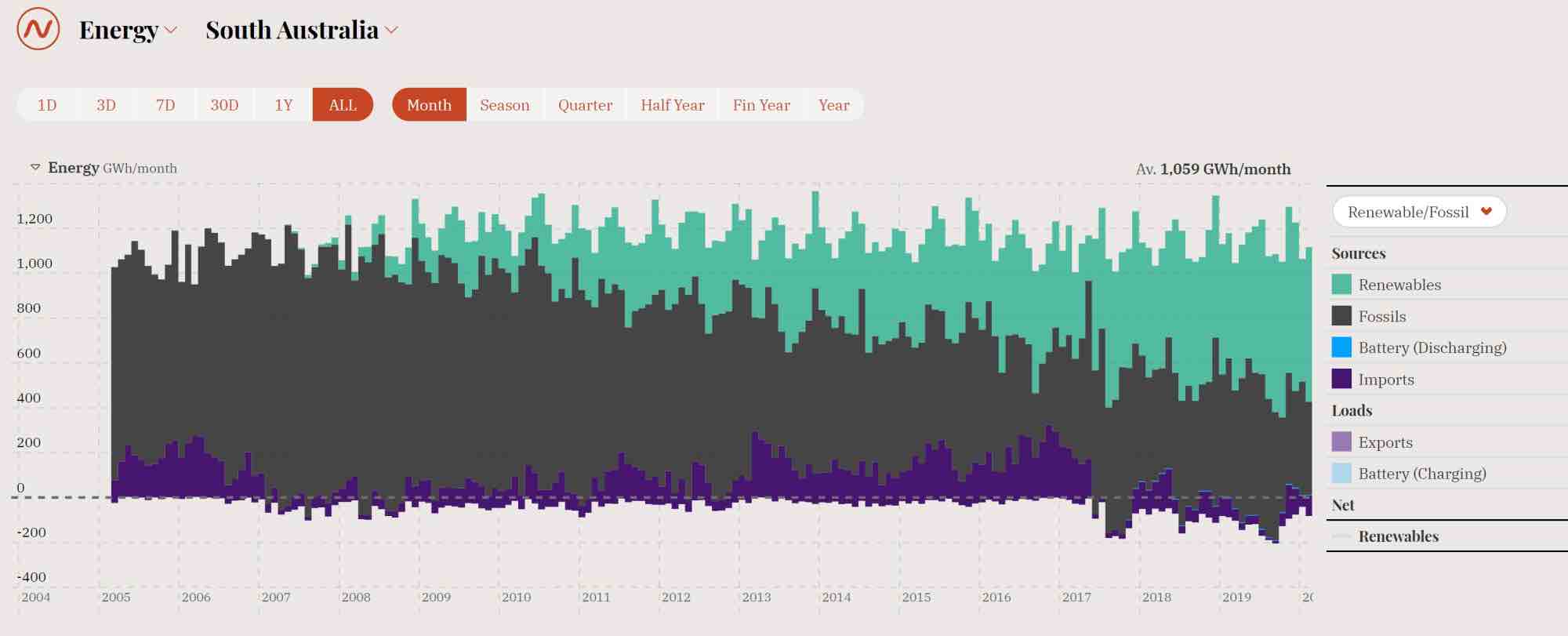
Electric grids match supply and demand at all times. Energy generated from one new source has to replace energy generated from an existing source – the grid would collapse, if it didn’t.

That is why South Australia’s grid looks like this:

And Denmark looks like this:

LARGE IMAGE
Things start to get into proper, outright, anti-vax / climate denier grade misinformation when producer Ozzie Zehner comes in.

“One of the most dangerous things right now is the illusion that alternative technologies like solar and wind are somehow different from fossil fuels”, he tells Gibbs.

“You use more fossil fuels to do this than you’re getting benefit from it. You would have been better off just burning fossil fuels in the first place, instead of playing pretend” .

It is, in fact, possible to scientifically examine the emissions associated with making, transporting and erecting renewable energy, and compare it to the emissions saved by using it.

There are just so many studies on this, but here’s the Breakthrough Institute’s Zeke Hausfather:

IMAGE


It’s important to be really clear about this: Zehner’s remarks in this film are toxic misinformation, on par with the worst climate change deniers. No matter which way you look at it, there is no chance that these projects lead to a net increase in emissions.

Gibbs attends a solar conference – again in some non-specific year – and is told by a bunch of obviously well-meaning and slightly baffled young renewable energy experts (literally the only young, diverse people in the film) that battery storage is a way of managing intermittency.

“When I looked up how much battery storage there is, it was less than one-tenth of one percent of what’s needed”, he says, presenting a pie chart (laugh) of IEA data with a minuscule slice from batteries.

But grid scale of batteries doesn’t need massive capacities to be functionally useful for managing the integration of renewables – so it’s a deeply misleading chart.


In checking the information, I can’t find International Energy Agency data for “51 giga BTU” of battery capacity anywhere on their site. 546,000,000 “Giga BTUs” is 546,000,000,000,000 BTUs. which is 160,032,600,000,000 watt hours, or around 160 terawatt hours.

This is ‘primary energy supply’ – how much energy was generated, but includes the quantity of energy wasted through inefficiency.

If you only look at global annual electricity – the field in which batteries play – it’s around 20 TWh (they use a similar deception for Germany’s biomass share). So it’s an extra dodgy comparison.

Gibbs has created a self-sustaining argument here. If someone builds a battery storage installation, he can visit the site and monotone sadly about its presence.

If someone decides to not build that battery, he can look up the statistics and monotone sadly about the lack of battery capacity.

In an earlier scene, at the launch of the General Motors Chevy Volt (2010, of course), he complains that the cars are being charged by the coal-sodden electric grid of that state – another great example of the infinite loop Gibbs has created for himself, considering his reaction if more wind and solar were built to make that electricity cleaner.

There’s gas, too. They repeatedly claim that shutting down coal plants results in replacement with gas. And in the US, gas has indeed expanded to fill a decent proportion of the gap left by coal:
LARGE IMAGE
The UK has a similar thing too, where both renewables and gas are squeezing out coal. But scroll back up to Denmark, above, where a combination of interconnection with other countries, massive wind build-out and coal and gas shutdown has cleaned up the grid.

Or Germany, where gas output remains unchanged as coal plants shut down.

There is nothing inherent to renewable energy that makes gas compulsory. All that matter is how the transition is managed.

For a long time, gas was sold as a transition fuel, including by organisations like the Breakthrough Institute.

But it is becoming increasingly clear that while it might ease change, it isn’t compulsory, and the urgency of decarbonisation has increased.

This film is a long, slow painful monument to laziness

It feels so weird writing about these things again. I feel like I’ve been transported back in time ten years, back to my early days in the renewable energy industry.

We’d combat these viral memes every single day.

The industry looks different now. Many wind companies have learnt that insensitive, clumsy development leads to backlash that is harmful for everyone, so they’ve started to clean up their act. Solar developers are figuring out more sustainable pathways than the boom and bust of government subsidies.

The human rights issues around mining and materials are becoming more prominent. Renewable companies are taking waste removal seriously.

And then this documentary comes along – a dumb old bull in the china shop that is 2020’s hard-earned climate action environment.

There’s a lot of fragile, hard-fought stuff to wreck in there, and Gibbs goes absolutely wild. He’s bulldozing a lot of hard work.


Gibbs obviously has a long-running gripe with biomass, which has a whole range of serious issues associated with it. Though I don’t know the industry well, I suspect many of his gripes there are valid.

But the outright lies about wind and solar are serious and extremely harmful. Wind and solar aren’t just technological tools with enormous potential for decarbonisation.

They also have massive potential to be owned by communities, deployed at small scales with minimal environmental harm, and removed with far less impact on where they were than large power stations like coal and gas.

They do incredible things to electricity bills, they decentralise power (literally and figuratively), and with more work they can be scaled up to properly replace fossil fuels.

Gibbs isn’t interested in this stuff. No one in 2012 was. He’s armed with a list of dot points from climate denier blog Watts Up With That, and he’s ready to go.

The key harm of this documentary is that it does what so many communicators struggle, but fail to do – it presents ideas from one ideological cluster into the world of another. It is very actively and successfully escaping the ‘bubble’, and selling far-right, climate-denier myths from nearly a decade ago to left-wing environmentalists in the 2020s, and going by much of the comments, it seems to be doing well.

Gibbs is transcending both time and ideological space, held aloft by a system that provides prominence to mediocrity.

It’s tough to look past how popular this has been. The film’s been boosted because many interviews feature the popular and well-known producer Michael Moore, including on Stephen Colbert’s Late Show.

Ludicrously, it received four stars (four. fucking. stars.) in the Guardian, a media outlet normally careful to not boost climate-denier grade misinformation.

All this prominence despite the fact that the film failed to find a distributor, and was dumped onto Youtube instead.

“We’ve talked to sales agents. We believe that there will be a tremendous amount of interest in this film… This is going to get distributed. It will be seen”, Moore insisted last year.

It is clear that Gibbs’ starting point was a loathing of biomass, which then turned into a loathing of every single decarbonisation technology (except nuclear power, which isn’t mentioned in the film).

But he ends up at population control – a cruel, evil and racist ideology that you can see coming right from the start of the film. I wish I had the emotional energy to go into it, but I have spent it all. Earther’s Brian Kahn writes:
“There’s a reason that Breitbart and other conservative voices aligned with climate denial and fossil fuel companies have taken a shine to the film. It’s because it ignores the solution of holding power to account and sounds like a racist dog whistle”
The film features a parade of – solely – white Americans, mostly male, insisting the planet has to reduce its population.

There is no information provided on which people in the world need to stop fucking, but we can take a guess, based on the demographics of the people doing the asking.


This documentary – particularly the parts on energy, renewables and industry- is extremely bad. It is Jeff Gibb’s 2010 Huffington Post blog drawn out in one hour and forty minutes, which feels like like a decade. I knew it would be lazy, but the magnitude of laziness here is incredible.

It it mostly old.

It is obviously re-hashing some specific gripes, like its attacks on the nicest guy in the whole of climate activism, Bill McKibben.

I feel like I’ve barely scratched the surface and I’m like 2,000 words in. I don’t have the energy to glue together every single fragile thing that this bulldozer has destroyed.

It is the ultimate expression of lazy privilege to make something so void of effort, but so widely viewed and promoted. Criticism will be rebuffed as Not Being Able To Handle The Truth, or the classic We Just Wanted To Start A Discussion.

It is still a package of old, dead ideas reheated by someone who knew that he did not need to put any effort into updating his thinking.

There was no chance he would be talking to climate activists, talking to young people, talking to experts, talking to community advocates, talking to people from other countries, or really talking to anyone who wasn’t already mostly in his vicinity.

It should have faded off into the pit of Youtube’s unwatched terabytes, but it didn’t, because mediocrity is celebrated, boosted and broadcast if it comes from someone who looks and sounds the right way.

That is a serious vulnerability.

The hard work of climate and energy advocates, as they grapple with challenges like corporate malfeasance, the impacts of mining and bad development can be shattered by the monotone arrogance of a single person inflicted with the Dunning Kruger effect.

Somber music.

Links

’A Life Too Often Lived Underwater’: How Tidal Flooding Is Wreaking Havoc In Bangladesh

Washington Post - Kenneth Dickerman | Photos - Jashim Salam

Photographer Jashim Salam says his family is among those affected by tidal flooding over the past few years. The family had to raise the ground-level floor of their home in Chaktai, in the heart of the city of Chittagong, Bangladesh, by more than two feet to protect it from floods.


A man wades through floodwaters in Chaktai, Chittagong.

Climate change is affecting everyone everywhere in myriad ways. I recently wrote about how rising sea levels are affecting Miami. Rising sea levels are a problem around the world.

Photographer Jashim Salam has been documenting how this has been affecting him, his family and his neighbors in the southeastern Bangladeshi city of Chittagong.

Salam notes Chittagong often is regarded as the commercial and industrial capital of Bangladesh. As such, it is densely populated, with people from all over the country heading there for work.

Salam estimates the population of Chittagong at 6.5 million. Those people are living with the effects of climate change, particularly with regard to rising sea levels.

Salam, his family and his neighbors are badly affected by tidal surges. He told In Sight his home, in the Chaktai area of Chittagong, gets flooded every year from June to October, sometimes as much as twice a day, because of the rising tidal waters from the Karnaphuli River.

alam says this flooding makes life difficult. It affects everyone’s daily routine. “People have to save their belongings from tidal floods and also throw out water from their homes every time it’s flooded,” he says.

 “The main business areas of Chaktai and Khatungonj also are affected by the tidal floodwater.” Because of the flooding, business is halted and products become waterlogged.

Residents are trying to find ways to cope. They’ve raised their ground-level floors and built barriers and walls to keep the water at bay. Still, the water finds a way in. This is all compounded by the annual monsoon season.

 “This is a recent phenomenon, one many blame on climate change and rising seas coupled with the annual monsoon season,” Salam says. “Residents have had to adapt and adjust to the enormous hardships of a life too often lived underwater.”

Salam’s photos drive home the difficulties people face because of the recurrent tidal flooding. The rising water spares no thing and no one. We see people standing in water driven up to and past their calves, detritus floating through the murky waters and what were once keepsakes streaked, faded and waterlogged.

As Salam told In Sight, “I am portraying a city that I am deeply connected with — and the suffering experienced by its inhabitants.”

Saima, 7, at her flooded home in Chaktai, Chittagong.


A toy gun floats in floodwater in Chittagong. 


Mintoo, 38, at his home.

Samia, 17, stands in front of her home after returning from college.


Joinal and his family members wade through floodwaters.


Jashim Salam's photo negatives were destroyed by tidal floodwaters at his home.


Farzana, 27, at her home.


A man stands in tidal floodwaters.


Abrar, 6, at his submerged home.


A toy floats in floodwaters.


Yousuf, 52, at his home.


Shahin, 45, in front of his home, which is more than 60 years old.

A woman wading in floodwaters.

Photographer Jashim Salam's family photograph was destroyed by floodwaters. 


Links
30/04/2020

Climate Experts Call For 'Dangerous' Michael Moore Film To Be Taken Down

The Guardian

Planet of the Humans, which takes aim at the green movement, is ‘full of misinformation’, says one online library

A still from Planet of the Humans, which has provoked a furious reaction. Photograph: Erik Pedersen/Handout

A new Michael Moore-produced documentary that takes aim at the supposed hypocrisy of the green movement is “dangerous, misleading and destructive” and should be removed from public viewing, according to an assortment of climate scientists and environmental campaigners.

The film, Planet of the Humans, was released on the eve of Earth Day last week by its producer, Michael Moore, the baseball cap-wearing documentarian known for Fahrenheit 9/11 and Bowling for Columbine.

 Describing itself as a “full-frontal assault on our sacred cows”, the film argues that electric cars and solar energy are unreliable and rely upon fossil fuels to function. It also attacks figures including Al Gore for bolstering corporations that push flawed technologies over real solutions to the climate crisis.

Planet of the Humans has provoked a furious reaction from scientists and campaigners, however, who have called for it be taken down.

Films for Action, an online library of videos, temporarily took down the film after describing it as “full of misinformation”, though they later reinstated it, saying they did not want accusations of censorship to give the film “more power and mystique than it deserves”.

A free version on YouTube has been viewed more than 3m times.

A letter written by Josh Fox, who made the documentary Gasland, and signed by various scientists and activists, has urged the removal of “shockingly misleading and absurd” film for making false claims about renewable energy.

Planet of the Humans “trades in debunked fossil fuel industry talking points” that question the affordability and reliability of solar and wind energy, the letter states, pointing out that these alternatives are now cheaper to run than fossil fuels such as coal.

Michael Mann, a climate scientist and signatory to Fox’s letter, said the film includes “various distortions, half-truths and lies” and that the filmmakers “have done a grave disservice to us and the planet by promoting climate change inactivist tropes and talking points.”

The film’s makers did not respond to questions over whether it will be pulled down.

Planet of the Humans has been shown at Moore’s Traverse City film festival, where the producer said it was “perhaps the most urgent film we’ve shown in the 15-year history of our film festival”.

Jeff Gibbs, who wrote and directed the film, has suggested that unrestrained economic and population growth should be the target of environmentalists’ efforts rather than technological fixes.

Climate activist Bill McKibben, one of the targets for the film for allegedly being influenced by corporate money and for supporting the burning of biomass such as wood chips for energy, said the characterisations are untrue.

McKibben has previously changed his views on biomass energy, which he now sees as being detrimental to climate action, and claims he has “never taken a penny in pay” from any environmental group.

“I am used to ceaseless harassment and attack from the fossil fuel industry, and I’ve done my best to ignore a lifetime of death threats from rightwing extremists,” McKibben said. “It does hurt more to be attacked by others who think of themselves as environmentalists.”

Renewable energy has long been portrayed as expensive and unreliably intermittent by oil and gas companies and their lobby groups, which have spent several decades questioning the veracity of climate science and undermining efforts to radically reduce planet-heating emissions.

In fact, the technology used for wind and solar energy has improved markedly in recent years, while the costs have plummeted. While electric cars often require fossil fuel-generated energy to produce them and provide the electricity to fuel them, research has shown they still emit less greenhouse gas and air pollutants over their lifetime than a standard petrol or diesel car.

Generating all power from renewables will take significant upgrades of grid infrastructure and storage but several researchers have declared the goal feasible, most likely with carbon-capture technology for remaining fossil fuel plants.

Scientists say the world must reach net zero emissions by 2050 to head off disastrous global heating, which would likely spur worsening storms, heatwaves, sea level rise and societal unrest.

Links

Parallel Threats Of COVID-19, Climate Change, Require ‘Brave, Visionary And Collaborative Leadership’: UN Chief

UN News

Niger is faced with a food-deficit and low-income levels. WFP/Simon Pierre Diouf


Actions for a
climate-positive recovery

  1. Deliver new jobs and businesses through a green and just transition while accelerating the decarbonization of all aspects of the economy.
  2. Use taxpayers’ money to create green jobs and inclusive growth when rescuing businesses.
  3. Shift economies from grey to green, with using public financing that makes societies more resilient.
  4. Invest public funds in the future, to projects that help the environment and climate.
  5. Consider risks and opportunities for your own economy, as the global financial system works to shape policy and infrastructure.
  6. Work together as an international community to combat COVID-19 and climate change. 
To combat the COVID-19 pandemic and the “looming existential threat of climate disruption”, the only credible response is “brave, visionary and collaborative leadership” anchored in mutilateralism, the UN Secretary General António Guterres, said on Tuesday, during an international discussion focused on climate change.

And against the backdrop of threatened lives, crippled businesses and damaged economies, the UN chief warned the Petersberg Climate Dialogue in Berlin that the Sustainable Development Goals (SDGs) are also under threat.

“The highest cost is the cost of doing nothing”, he spelled out, underscoring the need to urgently “strengthen resilience and cut greenhouse gas emissions to limit global temperature rise to 1.5 degrees” above pre-industrial levels, to mitigate climate change.

Political will required

Heartened by technology and public opinion, especially among the younger generations, he observed that many cities and businesses are taking action.

“But we still lack the necessary political will”, he said, advocating for “significantly more ambition” on mitigation, adaptation and financing.

On mitigation, all countries must commit to carbon neutrality by 2050. And developing countries – least responsible for climate change but most vulnerable to its impacts – need resilience-building support. This requires adequate financing, beginning with a promised $100 billion dollars a year for mitigation and adaptation efforts, added Mr. Guterres.

‘Profound opportunity’

In planning the coronavirus pandemic recovery, there is “a profound opportunity” to steer the world on “a path that tackles climate change, protects the environment, reverses biodiversity loss and ensures the long-term health and security of humankind”, the Secretary-General said.

“By making the transition to low-carbon, climate-resilient growth, we can create a world that is clean, green, safe, just and more prosperous for all”, he emphasized.

As such, he proposed six different climate-related actions that countries can take, to shape the recovery.
Recognizing that like the coronavirus, greenhouse gases respect no boundaries, Mr. Guterres maintained that isolation is a trap in which “no country can succeed alone”.
“We already have a common framework for action – the 2030 Agenda for Sustainable Development and the Paris Agreement on climate change”, he reminded.

Carbon neutrality by 2050

Pointing out that 121 States have already committed to carbon neutrality by 2050, the Secretary-General asked all countries to “prepare enhanced national climate action plans”, or Nationally Determined Contributions (NDCs), “to reach net zero emissions by 2050”.

“I encourage the European Union to continue showing global leadership by presenting, by the end of the year, a Nationally Determined Contribution in line with its commitment to become the first climate neutral continent by 2050”, he said.

“The key to tackling the climate crisis is the big emitters”, upheld Mr. Guterres.

Noting that the world’s 20 leading economies collectively account for more than 80 per cent of global emissions and over 85 per cent of the global economy, he flagged that “all of them must also commit to carbon neutrality by 2050”.

“Without the contribution of the big emitters, all our efforts risk to be doomed”, he conceded.

“Let us use the pandemic recovery to provide a foundation for a safe, healthy, inclusive and more resilient world for all people”.

Links

Insect Numbers Down 25% Since 1990, Global Study Finds

The Guardian - Damian Carrington

Scientists say insects are vital and the losses worrying, with accelerating declines in Europe called ‘shocking’

An adult female western glacier stonefly from the Grinnell glacier in Glacier national park, Montana, US. It is endangered because climate change is melting the glaciers. Photograph: Joe Giersch/AP

The biggest assessment of global insect abundances to date shows a worrying drop of almost 25% in the last 30 years, with accelerating declines in Europe that shocked scientists.

The analysis combined 166 long-term surveys from almost 1,700 sites and found that some species were bucking the overall downward trend. In particular, freshwater insects have been increasing by 11% each decade following action to clean up polluted rivers and lakes. However, this group represent only about 10% of insect species and do not pollinate crops.

Researchers said insects remained critically understudied in many regions, with little or no data from South America, south Asia and Africa. Rapid destruction of wild habitats in these places for farming and urbanisation is likely to be significantly reducing insect populations, they said.

Insects are by far the most varied and abundant animals, outweighing humanity by 17 times, and are essential to the ecosystems humanity depends upon. They pollinate plants, are food for other creatures and recycle nature’s waste.

The previous largest assessment, based on 73 studies, led scientists to warn of “catastrophic consequences for the survival of mankind” if insect losses were not halted. Its estimated rate of decline was more than double that in the new study. Other experts estimate 50% of insects have been lost in the last 50 years.

Recent analyses from some locations have found collapses in insect abundance, such as 75% in Germany and 98% in Puerto Rico. The new, much broader study found a lower rate of losses.

However, Roel van Klink, of the German Centre for Integrative Biodiversity Research in Leipzig, who led the research, said: “This 24% is definitely something to be concerned about. It’s a quarter less than when I was a kid. One thing people should always remember is that we really depend on insects for our food.”

The research, published in the journal Science, also examined how the rate of loss was changing over time. “Europe seems to be getting worse now – that is striking and shocking. But why that is, we don’t know,” said van Klink. In North America, the declines are flattening off, but at a low level.

Elsewhere, data is much more sparse. “But we know from our results that the expansion of cities is bad for insects because every place used to be more natural habitat – it is not rocket science,” said van Klink. “This is happening in east Asia and Africa at a rapid rate. In South America, there is the destruction of the Amazon. There’s absolutely no question this is bad for insects and all the other animals there. But we just don’t have the data.”

Van Klink said the research showed that insects were faring only slightly better in nature reserves than outside protected areas. “We found that very striking and a bit shocking – it means something’s going wrong there.”

Losses of insects are driven by habitat destruction, pesticides and light pollution. The impact of the climate crisis was not clear in the research, despite obvious local examples. Van Klink said changes in heat and rain could harm some species while boosting others, even in the same location.

But he highlighted another study showing that rising carbon dioxide levels are reducing the nutrients in plants and significantly cutting grasshopper abundances on prairies in Kansas, US. ”That is absolutely shocking, because that could be happening all over the world.”

Prof Dave Goulson, of the University of Sussex, who was not involved in the new analysis, said: “People should be as concerned as ever about insects. It is great news that some aquatic insects seem to be increasing, probably from a very low level. But the bulk of insects are terrestrial and this new study confirms what was already clear: they have been declining for many decades.”

Matt Shardlow, the head of the conservation charity Buglife, said: “Many insect species are threatened with extinction and this study shows insect abundance is also declining at an unsustainable rate. While the estimate in this study is lower than some, it is still very steep. Massive abundance declines in flying insects remains a developing ecological disaster."

In a comment article in Science, Maria Dornelas, of the University of St Andrews, and Gergana Daskalova, of the University of Edinburgh, said the new study was the largest and most complete meta-analysis to date. “Embracing nuance allows us to balance accurate reporting of worrying losses with hopeful examples of wins,” they said.

Van Klink said: “We definitely have a lot of reason for concern, but I don’t think it’s too late. The increase in freshwater species makes us at least hopeful that if we put the right legislation in place, we can reverse these trends.”

Links

Lethal Heating is a citizens' initiative