03/05/2020

‘A Bomb In The Center Of The Climate Movement’: Michael Moore Damages Our Most Important Goal

Rolling Stone

It hurts to be personally attacked in a movie. It hurts more to see a movement divided

Jeff Chiu/AP/Shutterstock; Craig Lassig/EPA-EFE/Shutterstock

Bill McKibben is an American environmentalist, author, and journalist who has written extensively on the impact of global warming.
He is the Schumann Distinguished Scholar at Middlebury College and leader of the climate campaign group 350.org.
He has authored a dozen books about the environment, including his first, The End of Nature (1989), about climate change.
If you’re looking for a little distraction from the news of the pandemic — something a little gossipy, but with a point at the end about how change happens in the world — this essay may soak up a few minutes.

I’ll tell the story chronologically, starting a couple of weeks ago on the eve of the 50th Earth Day. I’d already recorded my part for the Earth Day Live webcast, interviewing the great indigenous activists Joye Braum and Tara Houska about their pipeline battles. And then the news arrived that Oxford University — the most prestigious educational institution on planet earth — had decided to divest from fossil fuels. It was one of the great victories in that grinding eight-year campaign, which has become by some measures the biggest anti-corporate fight in history, and I wrote a quick email to Naomi Klein, who helped me cook it up, so that we could gloat together just a bit. I was, it must be said, feeling pleased with myself.

Ah, but pride goeth before a fall. In the next couple of hours came a very different piece of news. People started writing to tell me that the filmmaker Michael Moore had just released a movie called Planet of the Humans on YouTube. That wasn’t entirely out of the blue — I’d been hearing rumors of the film and its attacks on me since the summer before, and I’d taken them seriously. Various colleagues and I had written to point out that they were wrong; Naomi had in fact taken Moore aside in an MSNBC greenroom and laid it all out, repeating the exchange with him while campaigning in Iowa. But none of that had apparently worked; indeed, from what people were now writing to tell me, I was the main foil of the film. I put together a quick response, and I hoped that it would blow over.

But it didn’t. Perhaps because everyone’s at home with not much to do, lots of people watched it — millions by some counts. And I began to hear from them. Here’s an email that arrived first thing Earth Day morning: “Happy Dead Earth Day. Time’s up Bill. You have been outed for fraud. What a MASSIVE disappointment you are. Sell out. Hypocrite beyond imagination. Biomass bullshit seller. Forest destroyer. How is it possible you have led all of us down the same death trap road of false hope? The YOUTH! How dare you! Shame on you!” More followed, to say the least. (If you’re wondering whether it hurts to get this kind of email, the answer is yes. In a time of a pandemic, it’s hard to feel too much self-pity, but that doesn’t mean it’s easy to read someone accusing you of betraying your own life’s work.)

Basically, Moore and his colleagues have made a film attacking renewable energy as a sham and arguing that the environmental movement is just a tool of corporations trying to make money off green energy. “One of the most dangerous things right now is the illusion that alternative technologies, like wind and solar, are somehow different from fossil fuels,” Ozzie Zehner, one of the film’s producers, tells the camera. When visiting a solar facility, he insists: “You use more fossil fuels to do this than you’re getting benefit from it. You would have been better off just burning the fossil fuels.”

That’s not true, not in the least — the time it takes for a solar panel to pay back the energy used to build it is well under four years. Since it lasts three decades, it means 90 percent of the power it produces is pollution-free, compared with zero percent of the power from burning fossil fuels. It turns out that pretty much everything else about the movie was wrong — there have been at least 24 debunkings, many of them painfully rigorous; as one scientist wrote in a particularly scathing takedown, “Planet of the Humans is deeply useless. Watch anything else.” Moore’s fellow filmmaker Josh Fox, in an epic unraveling of the film’s endless lies, got in one of the best shots: “Releasing this on the eve of Earth Day’s 50th anniversary is like Bernie Sanders endorsing Donald Trump while chugging hydroxychloroquine.”

Here’s long-time solar activist (and, oh yeah, the guy who wrote “Heart of Gold“) Neil Young: “The amount of damage this film tries to create (succeeding in the VERY short term) will ultimately bring light to the real facts, which are turning up everywhere in response to Michael Moore’s new erroneous and headline grabbing TV publicity tour of misinformation. A very damaging film to the human struggle for a better way of living, Moore’s film completely destroys whatever reputation he has earned so far.”

But enough about the future of humanity. Let’s talk about me, since I got to be the stand-in for “corporate environmentalism” for much of the film. Cherry-picking a few clips culled from the approximately ten zillion interviews, speeches, and panels I’ve engaged in these past decades, the filmmaker made two basic points. One, that I was a big proponent of biomass energy — that is, burning trees to generate power. Two, that I was a key part of “green capitalism,” trying somehow to profit from selling people on the false promise of solar and wind power.

The first has at least a kernel of — not truth, but history. Almost two decades ago, wonderful students at the rural Vermont college where I teach proposed that the oil-burning heat plant be replaced with one that burned woodchips. I thought it was a good idea, and when it finally came to pass in 2009, I spoke at its inauguration. This was not a weird idea — at the time, most environmentalists thought likewise, because as new trees grow back in place of the ones that have been cut, they will soak up the carbon released in the burning. “At that point I would have done the same,” Bill Moomaw, who is one of the most eminent researchers in the field, put it. “Because we hadn’t done the math yet.” But as scientists did begin to do the math, a different truth emerged: Burning trees put a puff of carbon into air now, which is when the climate system is breaking. That this carbon may be sucked up a generation hence is therefore not much help. And as that science emerged, I changed my mind, becoming an outspoken opponent of biomass. (Something else happened too: the efficiency of solar and wind power soared, meaning there was ever less need to burn anything. The film’s attacks on renewable energy are antique, dating from a decade ago, when a solar panel cost 10 times what it does today; engineers have since done their job, making renewable energy the cheapest way to generate power on our planet.)

As for the second charge, it’s simply a lie — indeed, it’s the kind of breathtaking black-is-white lie that’s come to characterize our public life at least since Vietnam veteran John Kerry was accused by the right wing of committing treason. I have never taken a penny from green energy companies or mutual funds or anyone else with a role in these fights. I’ve never been paid by environmental groups either, not even 350.org, which I founded and which I’ve given all I have to give. I’ve written books and given endless talks challenging the prevailing ideas about economic growth, and I’ve run campaigns designed entirely to cut consumption.
Let me speak as plainly as I know how. When it comes to me, it’s not that Planet of the Humans overstates the case, or gets it partly wrong, or opens an argument worth having: it is a sewer. I’ll finish with just the smallest example: In the credits, it defensively claims that I began opposing biomass only last year, in response to news of this film. In fact, as we wrote the filmmakers on numerous occasions, I’ve been on the record about the topic for years. Here, for instance, is a piece from 2016 with the not very subtle title “Burning Trees for Electricity Is a Bad Idea.” Please read it. When you do, you will see that the filmmakers didn’t just engage in bad journalism (though they surely did), they acted in bad faith. They didn’t just behave dishonestly (though they surely did), they behaved dishonorably. I’m aware that in our current salty era those words may sound mild, but in my lexicon they are the strongest possible epithets.

A reasonable question: Given that the film has been so thoroughly debunked, can it really cause problems?

I’ve spent the past three decades, ever since I wrote The End of Nature at the age of 28, deeply committed to realism: no fantasy, no spin, no wish will help us deal with the basic molecular structure of carbon dioxide. That commitment to reality has to carry over into every part of one’s life. So, realistically, most of the millions of people who watch this film will not read the careful debunkings. Most of them will assume, in the way we all do when we watch something, that there must be something there, it must be half true anyway. (That’s why propaganda is effective). To give one more small example from my email, here’s a note I received the other day:

Stop killing trees you lying murderer.  
Forests are life.  you are killing us all.  
You can change your stance and turn back the tide of destruction you unleashed… or perhaps just go throw yourself in a fire and go down as one of the worst humans to ever exist.  
Straight up evil. 

When I wrote back (and I always write back, as politely as I know how), explaining what I’ve explained in this essay, the writer’s reply was: “I have read your dribble and am glad someone has finally called you out for the puppet you are.”

I don’t think most people are that mean-spirited (or maybe I just hope not) and of course dozens of friends within the climate movement wrote to express their solidarity and love. But I have no doubt that many of the people who’ve seen the film are, at the least, disheartened. Here’s what one hard-working climate activist wrote me from Montana: “The problem is, this movie is all over the place and is already causing divisions and conflicts in climate action groups that I’m involved in — it’s like they detonated a bomb in the center of the climate action movement.” Which I’m sure is true (and I’m sure it’s why the film has been so well-received at Breitbart and every other climate-denier operation on the planet).

Which may well mean that for now — maybe for a long time — my work will be at least somewhat compromised and less effective, because my work is mostly about trying to build that movement, to make it larger and more unified. Yes, there are days (and more of them than I would have expected) when it’s about going to jail, but mostly it’s been a long, long process of reaching out and talking to groups and people — helping them raise consciousness (and sometimes helping them raise money). I’ve spent a very large percentage of my life in high school auditoriums and at Rotary lunches; I’ve traveled to every corner of the world, and in recent years, as the technology improved, I’ve traveled too by low-carbon Skype and Zoom. (Pandemic communications is old-school to me; for some reason I now forget, my invaluable colleague Vanessa Arcara assembled a list of the virtual talks I gave in one stretch of 2015-16, which will give you a sense of what my days are like). But if those visits and talks end up igniting suspicion and controversy, then they’re obviously less useful. I want to help important organizing, not disrupt it.

I’m used to attacks, of course. The oil industry has been after me for decades, and some of their tactics have been far worse than Moore’s — the period when they assigned videographers to literally follow me whenever I set out the door was another low point in my life, but I didn’t complain until it seemed like they were doing the same to my daughter. I’ve gotten used to an endless and creative series of death threats — each one jolts you for a moment, but clearly, since I’m still here, most of them are not serious. And again, I’ve only complained once, when they were bandying about my home address and particular methods of execution on well-trafficked websites. But those kind of attacks don’t confuse and divide environmentalists; if anything, they do the opposite. They’re a punch in the nose, which turns out to be far less damaging than a stab in the back.

And I think this leads to the larger point, about what’s useful for movements and what isn’t.

I’m going to begin by boasting for a moment, if only to make myself feel a little better: Here’s what I’d like people to recall from my work these past years, as opposed to the notion that I am a forest-raping sellout. See if you can figure out what every item on this short list has in common.
  • My role in helping found and build an actual climate movement. I decided at a certain point that we weren’t in an argument over global warming (we’d won that), but that we were in a fight. And the other side — the fossil fuel industry — was so powerful they were going to win unless we built some power of our own. Hence my decision to go beyond writing and to try to learn how to organize. In 2007, with my seven original undergraduate collaborators, we formed Step It Up and found people to organize 1,500 simultaneous demonstrations across the U.S.; two years later, at the start of 350.org, the numbers were 5,200 rallies in 181 countries.
  • My role in helping nationalize the fight over the Keystone XL pipeline, and in the process lay the seedbed for much of the ‘keep it in the ground’ work that has led to challenges of fossil fuel infrastructure around the world.
  • My role in helping launch the divestment fight, with a piece of writing and with the Do the Math campaign around the U.S. and then Europe and the antipodes. (Here’s the movie from that; I think it’s better than Moore’s). We’re currently at $14 trillion in endowments and portfolios that have divested.
  • My role in helping solidify and unify the newer fight against the banks, asset managers, and insurance companies that fund the fossil fuel movement — the StopTheMoneyPipeline.com effort that is fighting pitched battles right now with Chase Bank, Liberty Mutual, and BlackRock.
The thing that unites these four things is the word “helping.” So many others have fought just as hard. If I started listing names I literally would never stop; the pleasure has been in the teamwork and collaboration.

And that’s the point: Movements only really work if they grow, if they build. If they move. And that’s almost always an additive process. The trick, I think, is figuring out how to make it possible for more people to join in. When we started 350.org, we gave out the logo to anyone. It was like a potluck supper; if you organized a little demonstration in your town, you were a part. (One of the early protests we were proudest of involved exactly one woman: an Iranian in a headscarf who worked her way through half a dozen army checkpoints to hold up a sign). The Keystone fight was well underway when we came on board — indigenous groups and Midwest ranchers had been fighting hard — but we helped to create ways to let anyone anywhere join in, framing it as a fight about climate change as well as land. Divestment, similarly: not everyone has a coal mine in their backyard, but everyone’s connected through a school or a church or a pension to a pot of money. Banks may be the best example: Chase has tens of millions of credit cards out there. Or, to take the example of the movie, biomass: Thank heaven for campaigners like Danna Smith and Mary Booth and Rachel Smolker, who built a movement to help explain why this was a bad idea. It worked for me — I changed my mind, which is what you want movements to do.

You can, in other words, change the zeitgeist if you get enough people engaged — if they both see the crisis and feel like they have a way in.

But that’s precisely what’s undercut when people operate as Moore has with his film. The entirely predictable effect is to build cynicism, indeed a kind of nihilism. It’s to drive down turnout — not just in elections, but in citizenship generally. If you tell a bunch of lies about groups and leaders and as a result people don’t trust them, who benefits?

To be clear, I doubt that was Moore’s goal. I think his goal was to build his brand a little more, as an edgy “truth teller” who will take on “establishments.” (That he has, over time, become a millionaire carnival barker who punches down, not up — well, that’s what brand management is for). But the actual effect in the real world is entirely predictable. That’s why Breitbart loves the movie. That’s why the tar-sands guys in Alberta are chortling. “People are going ga-ga over it,” Margareta Dovgal, a researcher with the pro-industry Canadian group Resource Works, told reporters. The message they’re taking from it is “we’re going to need fossil fuels for a long time to come.”

Actually, we won’t. We’ve dropped the price of sun and wind 90 percent in the last decade (since the days when Moore, et al. were apparently collecting their data). As Stanford professor Marc Jacobson has made clear, we could get much of the way there in relatively short and affordable order, by building out panels and turbines, by making our lives more efficient, by consuming less and differently. But that would require breaking the political power of the fossil fuel industry, which in turn would require a big movement, which in turn would require coming together, not splitting apart.

It’s that kind of movement we’ve been trying to build for a long time. I remember its first real gathering in force in the U.S., with tens of thousands of us standing on the Mall in Washington on a bitter February day in 2013 to demand an end to Keystone and other climate action. “All I’ve ever wanted to see was a movement of people to stop climate change,” I told the crowd. “And now I’ve seen it.”

We did an immense amount of work to get to that moment, helping will a movement into being. But from that moment on, for me it’s been mostly gravy — the great pleasure of watching the movement grow and then explode. Watching the kids who had built college divestment campaigns graduate to form the Sunrise Movement and launch the Green New Deal. Watching Extinction Rebellion start to shake whole cities. Watching the emergence of the climate strikers — and getting to know Greta Thunberg and many of the 10,000 others like her across the world. In each case, I’ve tried to help a little, largely just by amplifying their voices and urging others to pay attention.

I remember very well the night that same autumn after an overflow talk in Providence when my daughter, then a sophomore at Brown, said something typically wise to me: “I think you should probably be less famous in the years ahead.” I knew what she meant even as she said it, because of course I’d already sensed a bit of it myself. It wasn’t that she thought I was a bad leader — it was that we needed to build a movement that was less attached to leaders in general (and probably white male ones in particular) if we were going to attain the kind of power we needed.

And so, even then I began consciously backing off, not in my work but in my willingness to dominate the space. I stepped down as board chair at 350.org, and really devoted myself to introducing people to new leaders from dozens of groups. So many of those leaders come from frontline communities, indigenous communities — from the people already paying an enormous price for the warming they did so little to cause. Their voices are breaking through, and thank heaven: If you follow my twitter feed, you’ll see that the most common word, after “heatwave”, is “thanks,” offered to whoever is doing something useful and good. If you get the chance to read the (free) New Yorker climate newsletter I started earlier this year, you’ll see the key feature is called Passing the Mic: So far I’ve interviewed Nicole Poindexter, Jerome Foster II, Mary Heglar, Ellen Dorsey, Thea Sebastian, Virginia Hanusik, Tara Houska, Vann R. Newkirk II, and Christiana Figueres; this week Jane Kleeb; next week Alice Arena, helping lead the fight against a new gas pipeline across Massachusetts.

I think that one thing that defines those movements is their adversaries — in this case the fossil fuel industry above all. And I think the thing that weakens those movements is when they start trying to identify adversaries within their ranks. Much has been made over the years about the way that progressives eat their own, about circular firing squads and the like. I think there’s truth to it: there’s a collection of showmen like Moore who enjoy attracting attention to themselves by endlessly picking fights. They’re generally not people who actually try to organize, to build power, to bring people together. That’s the real, and difficult, work — not purity tests or calling people out, but calling them in. At least, that’s how it seems to me: The battle to slow down global warming in the short time that physics allots us requires ever bigger movements.

It’s been a great privilege to get to help build those movements. And if I worry that my effectiveness has been compromised, it’s not a huge worry, precisely because there are now so many others doing this work — generations and generations of people who have grown up in this fight. I think, more or less, we’re all headed in the right direction, that people are getting the basic message right: conserve energy; replace coal and gas and oil with wind and sun; break the political power of the fossil fuel industry; demand just transitions for workers; build a world that reduces ruinous inequality; and protect natural systems, both because they’re glorious and so they can continue to soak up carbon. I don’t know if we’re going to get this done in time — sometimes I kick myself for taking too long to figure out we needed to start building movements. But I know our chances are much improved if we do it together.

Thanks so much to all who fight for all that matters. On we go.


Links

02/05/2020

India’s Greenhouse Revolution

gestalten - Mark Mann

The non-profit startup aiming to turn India's class of small-scale farmers into 'smart' farmers


Climate change is threatening the viability of millions of small farms in India, but an innovative new greenhouse solution is transforming the lives of vulnerable farmers.

For small independent farmers in dry regions of India, water supply can too easily mean the difference between life and death.

The long droughts, extended heat waves, and unpredictable rainfall brought about by global warming have proven disastrous for many of India’s 146 million small farms, 85 percent of which now lose more money than they make.

Venkatesh Appala grows bell peppers in his Kheyti greenhouse and is using the extra income to save for his daughter’s dowry. (Photo: Sara Hylton, The New Traditional)


In aid of soaring demands, a new kind of greenhouse is making a dramatic difference for some vulnerable farmers.

Hyderabad-based non-profit Kheyti (Hindi for farming) has created an affordable and effective greenhouse system that helps small farms bring stability to their crop production and withstand the worst effects of climate change. The company is calling it the “smart farmer revolution.”

Goats eat tomatoes in an empty farming field in a rural area near Laxmapur village, just north of Hyderabad city. (Photo: Sara Hylton, The New Traditional)

Unlike typical glass greenhouses, Kheyti’s modular Greenhouse-in-a-Box (GIB) is designed to keep light and heat out. Draped across a simple metal frame, the system uses four layers of breathable aluminum-coated nettings to stop pests, partially reflect sunlight (preventing crop damage from excessive heat), and reduce water loss through evaporation.

 The technology allows impoverished farmers to use 90 percent less water, grow seven times more food, and achieve better and more dependable yields, thereby helping to stabilize income. Kheyti’s system costs about half the price of other greenhouses, and the company says that after six years farmers can expect to earn $100 (€90) a month, the equivalent of one year’s revenue under normal conditions.

Kheyti’s greenhouse also employs micro-irrigation, or drip irrigation, a technology that was first commercialized over 80 years ago but has not reached the vast majority of farmers in India until now. Drip irrigation confers much better water efficiency than the reliance on seasonal rainfall.

Coupled with its heat-resistant netting, the Kheyti greenhouse requires just 265 gallons (1,000 liters) per day, which is 20 percent of what farmers would otherwise use in an open farming plan, according to co-founder Shradha Sharma.

Biki Malavath, whose age is unknown, holds her great-granddaughter, nicknamed “Milky,” the youngest member of the village. Laxmapur in Thanda is a village for Lambadi people, considered one of India’s more disadvantaged communities. (Photo: Sara Hylton, The New Traditional)

Launched in 2015, Kheyti offers more than just specialized technology. To help achieve the best results, the social enterprise conducts in-person field training workshops and provides advice via mobile devices (80 percent of India’s farmers own some sort of smartphone).

They even built in a supply chain. The GIB package comes bundled with added seeds and fertilizer, and Kheyti is also set up to connect farmers with produce retailers.

Since most of India’s farmers don’t have the capital to purchase a greenhouse, Kheyti has partnered with the country’s Bank of Baroda to help farmers obtain flexible loans. After an initial down payment of 30,000 rupees, or about $471 (€423), farmers can pay back their loan in installments after each growing season.

Bhavanth and his wife, Bujji, grow tomatoes in their greenhouse, located on the family farm near Laxmapur village in Telangana state. Bhavanth was the first to purchase a greenhouse from Kheyti. (Photo: Sara Hylton, The New Traditional)

One of the best parts of Kheyti’s approach is the culture of sharing and collaboration it creates between participating farmers. When they sign up for a greenhouse, farmers automatically join a collective that meets weekly to compare notes and discuss best practices. Sometimes they pitch in and help with each other’s crops.

These extra supports, both from Kheyti and the collective, enable farmers like Katikala Shyamala, the head woman of a small village called Laxmapur, to operate a greenhouse while still managing other responsibilities and raising children.

The co-founder Sathya Raghu Mokkapati made it his mission to help India’s poor farmers after witnessing a penniless farmer resort to eating mud.

An accountant by training, Mokkapati understood the importance of small farmers to be able to access financing and the difference it could make for their profitability, but he knew he would need more hands-on experience to tackle the problem.

After leaving his corporate job, he and Sharma spent three and a half years farming a 100-acre plot and working with nearly 8,000 farmers to try different methods and crops.

Yadav Bhavanth’s nieces and nephews get ready to take produce to the local market. (Photo: Sara Hylton, The New Traditional)

Along with their third co-founder, Saumya (who doesn’t use a surname), and some help from engineering students at Northwestern University and Stanford University, the entrepreneurs created a design that would mitigate the effects of extreme climate variability.

Once finalized, Kheyti began performing proofs of the concept with 150 farmers in 15 villages in 2018. The trials proved immediately and immensely successful. Early participants found they were able to produce the same yield in their small greenhouses as an entire acre outside, and use the leftover profits to send their children to school.

In the past year, Kheyti has impoverished people, and yet these worked to bring on another 1,000 farmers—all low-income women farmers—in collaboration with the Society for Elimination of Rural Poverty. Kheyti’s ambitions go much further: they aim to reach 100,000 environmental volatility, and market farmer families by 2025.

If all goes well, their greenhouse tech has the simple, innovative greenhouse sole potential to expand internationally. Smallholder farmers make up one of the world’s largest constituencies of impoverished people, and yet these farms are responsible for growing 80 percent of the food on the planet.

Around the world, half a billion small farmers are struggling to survive due to factors like poor yields, environmental volatility, and market fluctuations.

If it scales, Kheyti’s simple, innovative greenhouse solution could have a transformative impact on the lives of millions.

Links

(AU) 'Breakthrough Moment': Woodside Investors Revolt On Climate Change

Sydney Morning HeraldNick Toscano

Woodside Petroleum has been hit with a record-breaking investor push to slash emissions and link executive pay to achieving bold new targets, as Australia's oil and gas industry emerges as the next front for shareholder pressure on climate change.

More than 50 per cent of investors backed motions on Thursday for Woodside to commit to hard targets to reduce its own greenhouse gas emissions and its vastly greater "indirect" emissions – known as Scope 3 emissions – from customers of its products such as power plants around the world.

Australian oil and gas giants Woodside and Santos have come under mounting investor pressure on climate change.

A similar revolt rocked Australia's second-largest oil and gas producer, Santos, last week when 43 per cent of investors voted in support of the same demands.

The climate motions, prepared by ethical investment group the Australasian Centre for Corporate Responsibility (ACCR), called for Woodside to set emissions targets in line with the goals of the Paris climate agreement to limit global warming well below 2 degrees.

It also called for details of how the company's remuneration policy incentivised progress against these targets, and how Woodside's looming investments in dramatically expanding gas output in the coming years were aligned with the Paris goals.

The resolution won the backing of more than half of Woodside's investors, despite the urging of the board. The support is the highest ever in corporate Australia for a shareholder resolution calling for direct and indirect emissions targets.

"This is a breakthrough moment for investor action on climate change in Australia," the ACCR's Dan Gocher said.

"The call for companies to set target on Scope 3 emissions is now supported by more than 50 per cent of shareholders in Australia's largest oil and gas company ... a striking number in the absence of board support.

Woodside would now be in "open conflict" with the majority of its shareholders until it moved to set meaningful targets, Mr Gocher said.

Woodside, which has an ambition for "net zero" emissions for its own operations by 2050, had urged shareholders to vote down the motions, saying it was supportive of the Paris goals while its gas exports were helping to displace higher-emissions fuel sources in Asia such as coal-fired power.

"We produce an energy source, natural gas, that can displace higher emissions fuels and get the
world's energy mix shifting in the right direction," Woodside chairman Richard Goyder said. "Our industry has a big role to play."

While supporters of gas argue it's a vastly less emissions-intensive energy source than coal, critics say it remains a heavy source of emissions and believe its role in keeping global warming well below 2 degrees is limited.

A second resolution on Thursday, for Woodside to review its links to fossil fuel industry groups to determine if their positions were inconsistent with goals to arrest global warming, gained a 42 per cent yes vote.

Both resolutions were not officially put to Thursday's meeting as they depended on the passing of another motion to amend the company's constitution, but results were disclosed in the "interests of transparency"

In recent months, some of the world's top oil and gas giants including BP and Royal Dutch Shell have vowed to set targets for Scope 3 emissions, meaning they will account for the carbon footprint of the energy products they ship and sell to customers around the world. To lower indirect emissions, companies will work with customers to help them decarbonise and seek to diversify into cleaner sources of energy.

BHP is Australia's only resources company to vow to set Scope 3 targets.

Emma Herd of the Investor Group on Climate Change, representing Australian and New Zealand institutional investors with $2 trillion of assets under management, said Australia's oil and gas producers were "now clearly at risk of falling behind" their European counterparts in establishing plans to diversify their businesses and set targets in line with the Paris agreement.

"The sizeable investor votes in favour of climate change resolutions at the Woodside and Santos annual general meetings are a reminder that investors are deeply concerned about the systemic threat global warming poses to sustainable returns fo their beneficiaries," Ms Herd said. "It is incumbent now on Woodside to work constructively with their investors to develop real plans to transition to a net-zero emissions company by 2050."

Mr Goyder said Woodside's response to global warming was a topic the board regularly discussed with investors.

"The fact that global emissions growth is likely to slow this year due to the severe economic downturn is not in anyway an excuse for inaction," he said. "This is still major challenge for the world."

Links

Climate Change Is Pushing Bird Boundaries, Community Scientists Confirm

National Audubon Society

In the first peer-reviewed study of its kind, participants in Audubon’s Climate Watch program helped determine the ongoing impact of climate change to bluebirds and nuthatches.

Eastern Bluebird. Photo: Lewis Barnett/Audubon Photography Awards


Birds In This Story
NEW YORK — Today, the journal Ecological Applications published a final version of a study from National Audubon Society scientists demonstrating that climate change is causing a measurable shift of birds’ ranges during winter and breeding seasons.

Years of bird observations gathered by hundreds of volunteer participants in Audubon’s Climate Watch community science program confirm projections made earlier by Audubon that rising temperatures and changing precipitation patterns will likely result in the colonization of new territories by North American birds.

“Climate change is disrupting hundreds of bird species, and thanks to community scientists all across the country, we can visualize these disruptions in real time and plan conservation efforts accordingly,” said Sarah Saunders, PhD, quantitative ecologist at Audubon and lead author of the study.

The study concludes that climate-vulnerable birds are indeed shifting their distributions at pace with changes in climate suitability due to rising global temperatures.

The most outstanding examples take place during the birds’ wintering season, which is not unexpected given the more pronounced changes in temperature attributable to climate change taking place in winter months.

Notably, the study is also the first to use independently gathered volunteer observations to validate climate suitability projections.

The authors of the study suggest further assessment of the habitat suitability of the newly colonized territories to determine whether these new areas can sustain the avian newcomers.

Climate Watch, an Audubon community science program that invites volunteers to count and identify select species of birds deemed climate vulnerable by Audubon climate science, provides the observation data used in the analysis.

Each year, from January 15 to February 15 and May 15 to June 15, community scientists all across the country look for 12 species: White-breasted Nuthatch, Red-breasted Nuthatch, Brown-headed Nuthatch, Pygmy Nuthatch, Western Bluebird, Mountain Bluebird, Eastern Bluebird, Lesser Goldfinch, American Goldfinch, Eastern Towhee, Spotted Towhee and Painted Buntings.

The dual two-week windows represent wintering and breeding seasons for the chosen species.

The climate-suitable ranges for each of these species are projected to change as their habitats shift, shrink, or expand due to rising global temperatures.

Regularly gathered observations allow researchers to track any shifts in species distributions.

“Climate Watch volunteers have confirmed the accuracy of Audubon’s climate projections, which show that two-thirds of North American birds are at risk of extinction by the end of this century,” said Brooke Bateman, PhD, Audubon’s senior climate scientist and lead author of Survival by Degrees: 389 Bird Species on the Brink, a report published in October 2019.

“Luckily, Audubon science also shows that we can protect three-quarters of these vulnerable bird species by keeping global temperature rise below 1.5 degrees Celsius,” said Bateman.

Audubon’s climate suitability projections for each of these climate-vulnerable bird species allows conservationists to protect not only the places birds need today, but also the places birds will need in a climate-altered future.

For further study, five new species have been added to the list of Climate Watch birds—the towhees, goldfinches and bunting listed above—representing birds found across a broader geographic area and in urban areas, which will allow a more in-depth look at the validity of climate suitability projections and invite even more community scientists to participate in the effort.

Links

01/05/2020

IMF Leader Says Pandemic Stimulus Must Focus On Battling Climate Crisis

ReutersAndrea Shalal

WASHINGTON (Reuters) - Massive fiscal stimulus measures adopted by governments around the world to combat the coronavirus pandemic must be tailored to tackle climate change at the same time, International Monetary Fund Managing Director Kristalina Georgieva said on Wednesday.

IMF Managing Director Kristalina Georgieva speaks during a conference hosted by the Vatican on economic solidarity, at the Vatican, February 5, 2020. REUTERS/Remo Casilli/

Speaking at a virtual summit known as the Petersberg Climate Dialogue, Georgieva joined German Chancellor Angela Merkel and U.N. Secretary Antonio Guterres in calling for focused efforts to promote a “green recovery” from the pandemic crisis.

“Taking measures now to fight the climate crisis is not just a ‘nice-to-have’. It is a ‘must-have’ if we are to leave a better world for our children,’ the IMF leader told the summit.

“What we do now will not only reshape our economies and societies; it will also reshape humanity’s future on this planet,” she said. “A ‘green recovery’ is our bridge to a more resilient future.”

Georgieva said governments had already adopted extraordinary measures to fight the pandemic, which has now infected over 3.11 million people and killed 216,667, but further efforts would be needed to respond to the worst economic downturn since the Great Depression of the 1930s.

To ensure that fiscal stimulus addressed climate change risks, she said governments should make financial lifelines for carbon-intensive companies contingent on commitments to reduce carbon emissions. This was done during the global financial crisis, when some automakers committed to higher fuel efficiency standards.

Georgieva urged governments to focus fiscal spending to promote green technologies, clean transport, sustainable agriculture and climate resilience.

“With oil prices at record-low levels, now is the time to phase out harmful subsidies,” Georgieva said, citing the IMF’s estimate that a low-carbon transition would require $2.3 trillion in investment every year for a decade.

She also urged governments to promote green finance by focusing on green bonds and other forms of sustainable finance, and mandating financial firms to better disclose climate risks in their lending and investment portfolios.

Raising the price of carbon would help generate revenues to increase public revenues in the future, she said.

“A substantially higher carbon price is needed to encourage climate-smart investment and to accelerate the shift to cleaner fuels and more energy efficiency,” Georgieva said.

The IMF estimates that the global carbon price should rise to $75 per ton from $2 per ton currently to keep global warming under 2 degrees Celsius.

Links

Michael Moore’s Planet Of The Humans: A Reheated Mess Of Lazy, Old Myths

RenewEconomyKetan Joshi


The film ‘Planet of the Humans’ opens with the director, Jeff Gibbs, operating a fossil-fuelled combustion engine vehicle, on a road full of combustion engine vehicles, followed up with some footage taken from the International Space Station (fossil fuelled rockets put that in space).

This is not a documentary about the environmental damage that had to occur for Gibbs to go on his drive – it is not mentioned. Nor is it about the harm from fossil fuels.


It is about why renewable energy is bad. I used to work in the renewable energy industry – first, with wind farms and later in research, government agencies and advocacy groups.

So it was hard to resist both watching and reviewing this one, considering it launched on ‘Earth Day’, and it has been widely promoted.

Not only is the documentary bad, it’s old bad. Please join me on this journey back in time. It won’t be fun, but I’m glad you’re here with me.

All of the stuff in this documentary is ancient

It is clear that Gibbs has been trying to make this documentary for a long, long time.

“He is currently working on a film about the state of the planet and the fate of humanity”, read his bio, in 2012. It is clear, digging into these early posts, that he very passionately loathes the burning of trees to generate energy – a wildly controversial and genuinely problematic thing, for sure.

But as early as 2010, Gibbs was posting HuffPost blogs extending that into wind and solar, too.

This one, for instance, repeats a bog-standard list of anti-wind and anti-solar memes that, back in 2010, were fashionable among climate deniers.

The ‘wind and solar are too intermittent’ meme, for instance, is a great hallmark of that era. “How much variable energy can a grid accept? Around ten percent, twenty percent tops it appears”, he wrote back then. I’d include examples of grids with higher percentages operating without a hitch today, but it feels almost cruel.

The extreme oldness of this documentary stands out. In one instance, he tours a solar farm in Lansing, Michigan, in which a bemused official states that a large farm can only power ten homes in a year.

It is the Cedar Street Solar Array, a 150 panel 824 kilowatt (that’s small) farm in downtown Lansing. Guess when that bad boy was built? 2008.

Twelve years ago – an absolute eternity, in solar development years.

As PV Magazine writes, “The film reports on a solar installation in Michigan with PV panels rated at “just under 8 percent” conversion efficiency. It’s difficult to identify the brand of panel in the film (Abound?) — but that efficiency is from another solar era”.

Efficiency gains in solar have been so rapid that by leaving the dates off his footage he is very actively deceiving the audience.

The site generates 64-64 MWh a year, according to the owner – a more recent installation in the same area generates around 436.

The footage really is from another era. It’s like doing a documentary on the uselessness of mobile phones but only examining the Motorola Ultrasleek.

Later, they visit the Solar Energy Generating System (SEGS) solar farm, only to feign sadness and shock when they discover it’s been removed, leaving a dusty field of sand.

In the desert. “Then Ozzie and I discovered that the giant solar arrays had been razed to the ground”, he moans. “It suddenly dawned on me what we were looking at. A solar dead zone”.

Which is a weird one, because the latest 2020 satellite imagery shows a site full of solar arrays, and a total absence of any “dead zones”. The damn thing is generating electricity.


Without knowing when the footage was taken, the only likely explanation for this is the pair of dudes visited the site midway through the point at which one of the fields was being removed and replaced with newer models, something which has happened several times over the past few decades.

In a red flag for any veteran of the wind farm debate, Gibbs then uses footage of a collection of old wind turbines – rusted, gross and horrible – to illustrate the short life and lasting damage of these huge spiky bastards.


If you’re familiar with the network of anti-wind farm groups, you’ll recognise that they’re old machines from South Point on Big Island, Hawaii.

They were removed in 2012, by the owner of the facility. All that is left now are small hexagonal pads on farmland used by the cattle that roam it:


“Why for most of my life, have I fallen for the illusion that green energy would save us?” It sounds like he’s saying this in 2020, but he is saying it well in the past. Gibbs was posting anti-wind memes roughly 23 full epidemics ago.

Nothing in this is new. With regards to its wind and solar parts, it smacks of 2010s era climate change denial, in which renewables were seen by detractors as expensive, wasteful, low-capacity, heavily corporatised and destined to fail.

Things are different in 2020, but the director isn’t. He doesn’t need to be.

Even the ideas are old

Putting aside the sites they visit and the footage they use, there are some ideas in this documentary that are well worn and highly recognisable memes from the 2009 – 2013 climate denial wonder years.

You can tell when someone’s knowledge of this has formed solely from doing a Google search for “solar panels bad don’t like”, and it really shows in this film.

Early on in the documentary, Gibbs has an exchange with an anti-wind farm protester about coal-fired power:

Protester: You need to have a fossil fuel power plant backing it up and idling 100% of the time, because if you cycle up or cycle down as the demand on the wind comes through, you actually generate a bigger carbon footprint if you ran it straight”.

Gibbs: Do you ever go to things where they just go “Oh, that’s not true, it doesn’t matter we’re going to have a smart grid”?.

Protester: Doesn’t make any difference, they still gotta– they’re using it. You gotta have it idling. Because, let’s just say the wind stopped right now. Just stopped for an hour. You’ve got to have that power.

This extremely silly concept – that coal-fired power stations run at 100% capacity all the time regardless of how much power they output – is so old it hurts my brain. In fact, it was big in 2012, when I came across it in Australian media.

It’s wrong. If the power plant generates less electricity, it uses less coal. Gibbs is putting this eight-year-old meme in the microwave and serving it up in for his audience.

Later, he presents the work of a researcher named Richard York, who claims that the addition of renewable energy has no impact on fossil fuel output.

I can’t access the paper, which is from – you guessed it – 2012, but the premise is mind-numbingly silly.

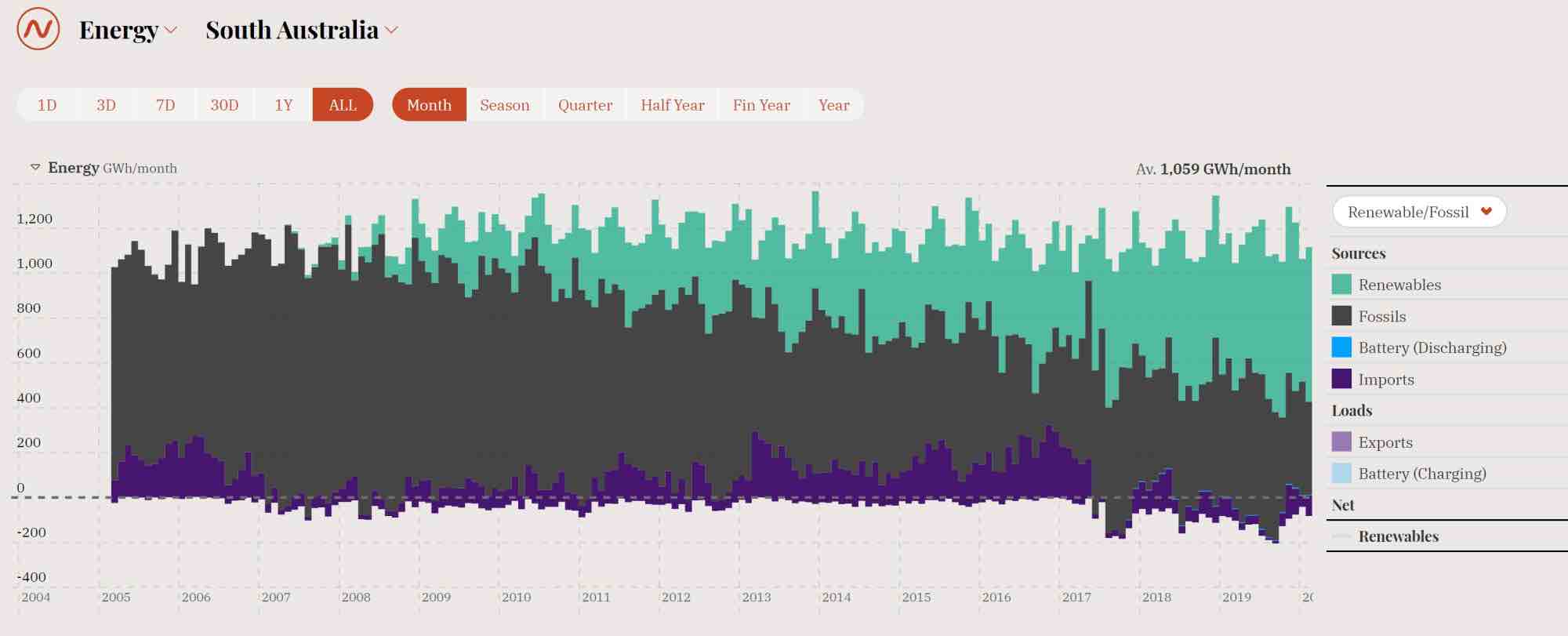
Electric grids match supply and demand at all times. Energy generated from one new source has to replace energy generated from an existing source – the grid would collapse, if it didn’t.

That is why South Australia’s grid looks like this:

And Denmark looks like this:

LARGE IMAGE
Things start to get into proper, outright, anti-vax / climate denier grade misinformation when producer Ozzie Zehner comes in.

“One of the most dangerous things right now is the illusion that alternative technologies like solar and wind are somehow different from fossil fuels”, he tells Gibbs.

“You use more fossil fuels to do this than you’re getting benefit from it. You would have been better off just burning fossil fuels in the first place, instead of playing pretend” .

It is, in fact, possible to scientifically examine the emissions associated with making, transporting and erecting renewable energy, and compare it to the emissions saved by using it.

There are just so many studies on this, but here’s the Breakthrough Institute’s Zeke Hausfather:

IMAGE


It’s important to be really clear about this: Zehner’s remarks in this film are toxic misinformation, on par with the worst climate change deniers. No matter which way you look at it, there is no chance that these projects lead to a net increase in emissions.

Gibbs attends a solar conference – again in some non-specific year – and is told by a bunch of obviously well-meaning and slightly baffled young renewable energy experts (literally the only young, diverse people in the film) that battery storage is a way of managing intermittency.

“When I looked up how much battery storage there is, it was less than one-tenth of one percent of what’s needed”, he says, presenting a pie chart (laugh) of IEA data with a minuscule slice from batteries.

But grid scale of batteries doesn’t need massive capacities to be functionally useful for managing the integration of renewables – so it’s a deeply misleading chart.


In checking the information, I can’t find International Energy Agency data for “51 giga BTU” of battery capacity anywhere on their site. 546,000,000 “Giga BTUs” is 546,000,000,000,000 BTUs. which is 160,032,600,000,000 watt hours, or around 160 terawatt hours.

This is ‘primary energy supply’ – how much energy was generated, but includes the quantity of energy wasted through inefficiency.

If you only look at global annual electricity – the field in which batteries play – it’s around 20 TWh (they use a similar deception for Germany’s biomass share). So it’s an extra dodgy comparison.

Gibbs has created a self-sustaining argument here. If someone builds a battery storage installation, he can visit the site and monotone sadly about its presence.

If someone decides to not build that battery, he can look up the statistics and monotone sadly about the lack of battery capacity.

In an earlier scene, at the launch of the General Motors Chevy Volt (2010, of course), he complains that the cars are being charged by the coal-sodden electric grid of that state – another great example of the infinite loop Gibbs has created for himself, considering his reaction if more wind and solar were built to make that electricity cleaner.

There’s gas, too. They repeatedly claim that shutting down coal plants results in replacement with gas. And in the US, gas has indeed expanded to fill a decent proportion of the gap left by coal:
LARGE IMAGE
The UK has a similar thing too, where both renewables and gas are squeezing out coal. But scroll back up to Denmark, above, where a combination of interconnection with other countries, massive wind build-out and coal and gas shutdown has cleaned up the grid.

Or Germany, where gas output remains unchanged as coal plants shut down.

There is nothing inherent to renewable energy that makes gas compulsory. All that matter is how the transition is managed.

For a long time, gas was sold as a transition fuel, including by organisations like the Breakthrough Institute.

But it is becoming increasingly clear that while it might ease change, it isn’t compulsory, and the urgency of decarbonisation has increased.

This film is a long, slow painful monument to laziness

It feels so weird writing about these things again. I feel like I’ve been transported back in time ten years, back to my early days in the renewable energy industry.

We’d combat these viral memes every single day.

The industry looks different now. Many wind companies have learnt that insensitive, clumsy development leads to backlash that is harmful for everyone, so they’ve started to clean up their act. Solar developers are figuring out more sustainable pathways than the boom and bust of government subsidies.

The human rights issues around mining and materials are becoming more prominent. Renewable companies are taking waste removal seriously.

And then this documentary comes along – a dumb old bull in the china shop that is 2020’s hard-earned climate action environment.

There’s a lot of fragile, hard-fought stuff to wreck in there, and Gibbs goes absolutely wild. He’s bulldozing a lot of hard work.


Gibbs obviously has a long-running gripe with biomass, which has a whole range of serious issues associated with it. Though I don’t know the industry well, I suspect many of his gripes there are valid.

But the outright lies about wind and solar are serious and extremely harmful. Wind and solar aren’t just technological tools with enormous potential for decarbonisation.

They also have massive potential to be owned by communities, deployed at small scales with minimal environmental harm, and removed with far less impact on where they were than large power stations like coal and gas.

They do incredible things to electricity bills, they decentralise power (literally and figuratively), and with more work they can be scaled up to properly replace fossil fuels.

Gibbs isn’t interested in this stuff. No one in 2012 was. He’s armed with a list of dot points from climate denier blog Watts Up With That, and he’s ready to go.

The key harm of this documentary is that it does what so many communicators struggle, but fail to do – it presents ideas from one ideological cluster into the world of another. It is very actively and successfully escaping the ‘bubble’, and selling far-right, climate-denier myths from nearly a decade ago to left-wing environmentalists in the 2020s, and going by much of the comments, it seems to be doing well.

Gibbs is transcending both time and ideological space, held aloft by a system that provides prominence to mediocrity.

It’s tough to look past how popular this has been. The film’s been boosted because many interviews feature the popular and well-known producer Michael Moore, including on Stephen Colbert’s Late Show.

Ludicrously, it received four stars (four. fucking. stars.) in the Guardian, a media outlet normally careful to not boost climate-denier grade misinformation.

All this prominence despite the fact that the film failed to find a distributor, and was dumped onto Youtube instead.

“We’ve talked to sales agents. We believe that there will be a tremendous amount of interest in this film… This is going to get distributed. It will be seen”, Moore insisted last year.

It is clear that Gibbs’ starting point was a loathing of biomass, which then turned into a loathing of every single decarbonisation technology (except nuclear power, which isn’t mentioned in the film).

But he ends up at population control – a cruel, evil and racist ideology that you can see coming right from the start of the film. I wish I had the emotional energy to go into it, but I have spent it all. Earther’s Brian Kahn writes:
“There’s a reason that Breitbart and other conservative voices aligned with climate denial and fossil fuel companies have taken a shine to the film. It’s because it ignores the solution of holding power to account and sounds like a racist dog whistle”
The film features a parade of – solely – white Americans, mostly male, insisting the planet has to reduce its population.

There is no information provided on which people in the world need to stop fucking, but we can take a guess, based on the demographics of the people doing the asking.


This documentary – particularly the parts on energy, renewables and industry- is extremely bad. It is Jeff Gibb’s 2010 Huffington Post blog drawn out in one hour and forty minutes, which feels like like a decade. I knew it would be lazy, but the magnitude of laziness here is incredible.

It it mostly old.

It is obviously re-hashing some specific gripes, like its attacks on the nicest guy in the whole of climate activism, Bill McKibben.

I feel like I’ve barely scratched the surface and I’m like 2,000 words in. I don’t have the energy to glue together every single fragile thing that this bulldozer has destroyed.

It is the ultimate expression of lazy privilege to make something so void of effort, but so widely viewed and promoted. Criticism will be rebuffed as Not Being Able To Handle The Truth, or the classic We Just Wanted To Start A Discussion.

It is still a package of old, dead ideas reheated by someone who knew that he did not need to put any effort into updating his thinking.

There was no chance he would be talking to climate activists, talking to young people, talking to experts, talking to community advocates, talking to people from other countries, or really talking to anyone who wasn’t already mostly in his vicinity.

It should have faded off into the pit of Youtube’s unwatched terabytes, but it didn’t, because mediocrity is celebrated, boosted and broadcast if it comes from someone who looks and sounds the right way.

That is a serious vulnerability.

The hard work of climate and energy advocates, as they grapple with challenges like corporate malfeasance, the impacts of mining and bad development can be shattered by the monotone arrogance of a single person inflicted with the Dunning Kruger effect.

Somber music.

Links

’A Life Too Often Lived Underwater’: How Tidal Flooding Is Wreaking Havoc In Bangladesh

Washington Post - Kenneth Dickerman | Photos - Jashim Salam

Photographer Jashim Salam says his family is among those affected by tidal flooding over the past few years. The family had to raise the ground-level floor of their home in Chaktai, in the heart of the city of Chittagong, Bangladesh, by more than two feet to protect it from floods.


A man wades through floodwaters in Chaktai, Chittagong.

Climate change is affecting everyone everywhere in myriad ways. I recently wrote about how rising sea levels are affecting Miami. Rising sea levels are a problem around the world.

Photographer Jashim Salam has been documenting how this has been affecting him, his family and his neighbors in the southeastern Bangladeshi city of Chittagong.

Salam notes Chittagong often is regarded as the commercial and industrial capital of Bangladesh. As such, it is densely populated, with people from all over the country heading there for work.

Salam estimates the population of Chittagong at 6.5 million. Those people are living with the effects of climate change, particularly with regard to rising sea levels.

Salam, his family and his neighbors are badly affected by tidal surges. He told In Sight his home, in the Chaktai area of Chittagong, gets flooded every year from June to October, sometimes as much as twice a day, because of the rising tidal waters from the Karnaphuli River.

alam says this flooding makes life difficult. It affects everyone’s daily routine. “People have to save their belongings from tidal floods and also throw out water from their homes every time it’s flooded,” he says.

 “The main business areas of Chaktai and Khatungonj also are affected by the tidal floodwater.” Because of the flooding, business is halted and products become waterlogged.

Residents are trying to find ways to cope. They’ve raised their ground-level floors and built barriers and walls to keep the water at bay. Still, the water finds a way in. This is all compounded by the annual monsoon season.

 “This is a recent phenomenon, one many blame on climate change and rising seas coupled with the annual monsoon season,” Salam says. “Residents have had to adapt and adjust to the enormous hardships of a life too often lived underwater.”

Salam’s photos drive home the difficulties people face because of the recurrent tidal flooding. The rising water spares no thing and no one. We see people standing in water driven up to and past their calves, detritus floating through the murky waters and what were once keepsakes streaked, faded and waterlogged.

As Salam told In Sight, “I am portraying a city that I am deeply connected with — and the suffering experienced by its inhabitants.”

Saima, 7, at her flooded home in Chaktai, Chittagong.


A toy gun floats in floodwater in Chittagong. 


Mintoo, 38, at his home.

Samia, 17, stands in front of her home after returning from college.


Joinal and his family members wade through floodwaters.


Jashim Salam's photo negatives were destroyed by tidal floodwaters at his home.


Farzana, 27, at her home.


A man stands in tidal floodwaters.


Abrar, 6, at his submerged home.


A toy floats in floodwaters.


Yousuf, 52, at his home.


Shahin, 45, in front of his home, which is more than 60 years old.

A woman wading in floodwaters.

Photographer Jashim Salam's family photograph was destroyed by floodwaters. 


Links

Lethal Heating is a citizens' initiative