05/05/2020

Inside Clean Energy: 6 Things Michael Moore’s ‘Planet Of The Humans’ Gets Wrong

InsideClimate NewsDan Gearino

The documentary's "facts" are deceptive and misleading, not to mention way out of date

Filmmaker Michael Moore released the documentary "Planet of the Humans" last week, a critique of the movement to renewable energy. Credit: Rich Fury/Getty Images

Dan Gearino covers the U.S. Midwest, part of InsideClimate News' National Environment Reporting Network.
His coverage deals with the business side of the clean-energy transition and he writes ICN's Inside Clean Energy newsletter.
Filmmaker Michael Moore's new documentary purports to expose hypocrisy at the heart of the renewable energy movement.

But the video, released on YouTube last week, is a mess of deceptive and outdated anecdotes, and a succession of ridiculous arguments. It will almost certainly do far more harm than good in the struggle to reduce carbon emissions.

As a reporter who covers renewable energy and has a background in covering the business of energy, watching "Planet of the Humans" was a slog, the equivalent of being cornered at a backyard barbecue by someone who wants to share conspiracy theories.

The writer and director, Jeff Gibbs, and the executive producer, Moore, have put together something that is woefully dated—the kind of commentary that was more common years ago, when renewable energy was more expensive and less efficient and we knew much less about what an energy transition might look like. Today we know more and we know better, but to watch this film you'd think it was about 2010.

I reached out to the producers, but did not get a response. Here are some questions that the film raises, and my answers:

Are EVs Just as Polluting as Gasoline Vehicles?

The time-capsule quality of the film is underscored by a scene filmed in Michigan about a decade ago showing an event tied to the rollout of the Chevrolet Volt, a plug-in hybrid vehicle that began production in 2010. The narrator makes the point that the vehicle was powered by a local utility that runs almost completely on coal, as if to say that the environmental benefits of an EV are illusory.

The film is recycling an old argument: that the use of fossil electricity means electric vehicles have about the same emissions as gasoline vehicles. But researchers have looked closely at this and found that there is a clear emissions benefit of using an EV.

For example, the Union of Concerned Scientists has found that EVs have lower emissions—including emissions from generating electricity—than typical gasoline models, even in the parts of the United States that still rely the most heavily on fossil fuels for electric power.

The environmental benefits of EVs will increase as utilities continue to reduce their emissions and as batteries used in the vehicles become more efficient.

Do Solar Panels Only Last 10 Years?

Planet of the Humans shows an unidentified man at a solar trade show who says, "Some solar panels are built to last only 10 years, so it's not as if you get this magic free energy."

I can only guess that this comment is from years ago, when panels were less durable and efficient than they are today. I know of no solar panel on the market today with such a short life span.

A workman installs solar panels in Colorado. Credit: John Moore/Getty Images

The National Renewable Energy Laboratory has done extensive work to determine how much solar panels degrade over time. Researchers there have found a median degradation rate of 0.5 percent per year, which means a median panel is still producing at 90 percent of its capability after 20 years.

Most solar systems come with warranties of at least 20 years.

How Much Wind and Solar Does Germany Generate?

The narrator of the movie makes the point that Germany's substantial spending on renewable energy has had almost no effect. A graphic appears on screen showing that Germany's solar energy consumption is 1.5 percent and wind energy consumption is 3.1 percent. It doesn't list the year.

As you can see from my story published today about the German energy transition, this is a subject I've followed closely, and I knew something was awry with the film's statistics.

The filmmakers appear to be using percentages that include energy used for home heating and transportation to arrive at such low numbers for wind and solar, without making clear that this is what they're doing. It is, at best, misleading.

German Chancellor Angela Merkel walks past wind turbines while visiting a wind farm in 2010 in Krempin, Germany. Credit: Sean Gallup/Getty Images

Last year, renewable sources generated more than 40 percent of the electricity in Germany, more than double the share in the United States. Onshore wind energy is the country's leading renewable power source, with 17 percent of generation. Solar accounts for 8 percent. The other leading renewable sources are biomass (7 percent), offshore wind (4 percent), and hydroelectric (4 percent).

Germany's success in developing renewable energy and maintaining a reliable grid is a compelling counterpoint to much of what the film is arguing.

Do Solar and Wind Energy Components Have a Carbon Footprint as Large as Fossil Fuels?

This question gets at the issue of "life-cycle emissions" of power plants, which takes into account the carbon emissions of every part of the life of a plant, including obtaining and manufacturing its components.

There is a deep body of research showing that wind, solar and nuclear power have much lower life-cycle emissions than natural gas and coal.

One example is a 2017 paper published in the journal Nature Energy that showed very small carbon footprints for wind, solar and nuclear, while coal and natural gas power plants had much larger carbon footprints, even if they were using carbon capture equipment to store their emissions. Carbon Brief wrote about this research at the time.

An older, but still widely cited, example is a 2013 report from the National Renewable Energy Laboratory that analyzed previous research on the subject to date and used it to produce ranges of findings. It showed a wide gap between life-cycle emissions of fossil fuel power plants compared to wind, solar and nuclear. For instance, the report showed that the median estimate of life-cycle emissions for a coal-fired power plant was about 100 times per unit of electricity than that of a utility-scale wind farm.

Tesla's Factories Generate 100 Percent of Their Own Electricity. So Why Are They Connected to the Grid?

The film shows Tesla officials boasting about how their factories get 100 percent of their electricity from renewable sources. Then the camera pans from a factory to the power lines connecting it to the grid.

Credit: Spencer Platt/Getty Images 

There are many reasons that a building needs to be connected to the grid even if it has access to its own electricity sources. First, the power lines can be used to export any excess electricity. Second, the grid is available as a backup whenever needed.

This doesn't mean that Tesla's claim of 100 percent renewable energy is incorrect. Most of the time, when companies make this claim, they mean that they buy or generate enough megawatt-hours of renewable energy to meet their needs over the course of a year, not that they have gone off-grid.

Do the Environmental Concerns about Biomass Energy Mean that All Renewable Energy is Suspect?

The short answer is an emphatic "No," but there's a longer answer that gets to the heart of one of the film's biggest shortcomings.

The film spends much of its time criticizing energy systems that use biomass, including those that use wood chips to make electricity or corn to make ethanol for motor fuel.

There are some well-documented concerns with using biomass in terms of land use to produce feedstocks, and emissions related to the burning of the fuels. Many environmental advocacy groups do not support the expansion of biomass energy systems, and see a clear difference between biomass and other renewable technologies like wind and solar.

But by lumping together biomass with wind and solar in an argument about renewable energy, the film is oversimplifying. While biomass is clearly a form of renewable energy, the better question is whether it is clean energy. I'm not going to attempt to answer that one today other than to say it is a source of fierce disagreement.

Links

(AU) Decline In 'Successful' Bird Species Like Magpies And Kookaburras Rings Alarm Bells

ABC Central West - Micaela Hambrett

Typically a bird that does well in built-up areas, the decline in magpie numbers across the country has shocked experts. (Supplied: David Flannery)


Key points
  • BirdLife Australia is concerned magpie and kookaburra numbers are declining
  • Theories include the use of second-generation rodenticides, changing agricultural practices, climate change and more frequent droughts
  • One positive, though, is coronavirus shutdowns mean more people may be free to participate in the annual Birds in Backyard survey this year
Sean Dooley describes magpies as being one of the few native bird success stories of European settlement.

So when dwindling observations were recorded across 15 years of Birdlife Australia surveys, alarms bells started ringing.

Mr Dooley, BirdLife Australia's national public affairs manager, said magpies were "open grassland and woodland birds".

"With agricultural and urban areas we've actually created pretty amenable habitat for them in that there's a lot of open space with scattered trees so they can nest in, roost in and survive in the landscape," he said.

But BirdLife Australia data shows that Australian magpies declined by 31 per cent in the East Coast region — including Sydney and Brisbane — between 1998 and 2013.

"They declined by roughly 20 per cent in the South East Mainland Region, which includes Melbourne, Canberra and Adelaide [for the same period]," Mr Dooley said.

The data also reflected a dramatic decline in kookaburras and birds of prey, suggesting carnivores were potentially more vulnerable to these unknown environmental changes.

Kookaburra numbers have declined by up to 40 per cent on the east coast of Australia. (Supplied: David Flannery)

Agriculture, climate change and drought

One possible theory was that the use of second-generation rodenticides was having a bigger toll on birds through secondary poisoning.

"Birds like boobook owls, other birds of prey, and magpies are actually eating rats that have been affected by the poison and it can actually kill them, whereas the earlier rodenticides didn't seem to affect the birds as much." Mr Dooley explained.

Other factors the group was considering included changing agriculture practices, climate change and more frequent droughts.

Although this did not mean magpies or kookaburras were endangered yet, it did indicate food and habitat conditions were under serious pressure.
"It's a huge wake-up call. If these really successful birds are starting to suffer, something's going on in the environment," Mr Dooley said.
With the next report due out next year, he said he expected the downward trend to continue.

"The additional five years [since the last report] have just been more drought conditions. I can't imagine things would be bouncing back," he said.

Largest natural history data set

BirdLife Australia's data is critical to painting a large scale, real-time picture of Australia's bird populations providing insight to researchers and academics.

BirdLife Australia's Sean Dooley hopes unique insights into backyard birds will emerge from the coronavirus lockdown. (Supplied: BirdLife Australia)

The data that made up these reports was nearly all gathered by volunteers.

"We have literally thousands of people sending in tens of thousands of surveys every year. It's probably the biggest citizen science project in Australia and one of the biggest natural history data sets in the country," Mr Dooley said.

Urban and suburban observational data was critical to "filling in the gaps" for common birds that share our spaces, as birdwatchers typically head to more pristine environments seeking rarer species.

Although an entry level survey, Mr Dooley said backyard bird observational data had been able to reflect nuanced trends, such as population decline between regional and metro areas indicating widespread environmental degradation.

Take cover! A young cyclist takes evasive action as a magpie swoops in Casino, New South Wales. (ABC Open contributor Dee Hartin)

This year, the coronavirus lockdown has coincided with the organisation's annual autumn Birds in Backyard survey and it might provide an accidental boon for BirdLife's data sets.

"One bit of positivity is with everybody at home, if we can get them to do their surveys, we're going to get a huge boost in our knowledge of what birds are using urban, suburban and town areas," Mr Dooley said.

Links

04/05/2020

(AU) Want An Economic Tonic, Mr Morrison? Use That Stimulus Money To Turbocharge Renewables

The Conversation |  |  | 

Chris Fithall/Flickr


  • Elizabeth Thurbon, Scientia Fellow and Associate Professor in International Relations / International Political Economy, UNSW
  • , Associate professor, University of Newcastle
  • , Professor Emeritus, Macquarie Business School, Macquarie University
  • , Senior Lecturer in the Department of Modern History, Politics & International Relations, Macquarie University
The chaos of COVID-19 has now hit global energy markets, creating an outcome unheard of in industrial history: negative oil prices.

With the world’s largest economies largely in lockdown, demand for oil has stagnated.

Essentially, the negative prices mean oil producers are willing to pay for the oil to be taken off their hands because soon, they will have nowhere to store it.

Federal energy minister Angus Taylor has proposed a partial solution: Australia will spend A$94 million buying up oil, to bolster domestic supplies and help stabilise global prices.

That strategy is a fool’s path to energy security.

Right now, the best way to shore up Australia’s future energy supplies is to invest economic stimulus money in renewables – essentially to manufacture our own energy security.

Prime Minister Scott Morrison with Angus Taylor, right, who wants Australia to buy surplus oil. Mick Tsikas/AAP


A flawed plan

Australia’s oil reserves have for years languished well below the International Energy Agency’s recommended 90 days. Taylor says his plan would address this, and help stabilise (read: push up) oil prices and restore faith in the global oil market on which Australia depends.

But the plan is undermined by a simple fact: unstable global oil prices have been a recurring problem for decades, largely for political reasons well beyond Australia’s control. We need look only to the price shocks triggered by the Yom-Kippur war of 1973, the Iraq war of 2003, and the Saudi drone attack of 2019 - to name just a few.

Price instability is all but guaranteed to increase in future, as climate change concerns drive insurers and investors away from fossil fuels and towards green energy.

The current chaos actually creates a much better opportunity for Australia: use the massive COVID-19 economic stimulus to manufacture real energy security in the form of renewables.

Buying large volumes of surplus oil will not ensure stable prices. Flickr


Renewables: a win-win

The price and supply of energy from fossil fuels is vulnerable to natural resource depletion, geopolitical tensions and climate change concerns. This is true not just for oil, but coal and gas too.

The only real path to energy security is manufactured energy such as solar panels, wind turbines, electrolysers, batteries and smart grids.

These technologies can turn infinite natural resources into energy, then store and distribute it to ensure stable supply.

Victoria and South Australia now enjoy higher levels of energy security thanks to large-scale stationary batteries that even out electricity peaks and troughs.

For example, a large-scale battery in Victoria stores energy produced by the Gannawarra solar farm. The battery provides energy during peak times when there is no sun.

Manufacturing energy is also important from an economic security perspective, promoting the creation of high-tech, high-wage industries.

These industries can create thousands of skilled jobs and open up massive new export markets – all while helping to mitigate climate change. This reality has been accepted by major East Asian economies, including China to South Korea, for more than a decade.

The Australian government must use its enormous stimulus to help local companies dramatically expand their wind, solar, hydrogen and energy storage investments. This would satisfy domestic energy needs and grow the new green export markets ready and waiting in Asia.

Asia presents huge export potential for Australia’s renewable energy. DAN HIMBRECHTS/AAP


A jobs boon

There is no shortage of projects waiting to be turbocharged. The government could start with Sun Cable, linking Australia’s and Singapore’s clean energy markets via an undersea cable.

It could also kickstart Australia’s clean hydrogen industry. According to the government’s own National Hydrogen Strategy, developing hydrogen would dramatically reduce Australia’s oil import reliance and energy costs and vastly expand its clean energy exports.

By simply following its own strategy, the government could create about 7,600 skilled and semi-skilled jobs and add about A$11 billion each year to Australia’s gross domestic product to 2050.

The cheaper energy prices that follow could help Australia revive its techno-industrial base by making energy-intensive manufacturing a viable proposition once again.

According to leading economist Ross Garnaut, Australia could then bring home its long-lost materials-processing industries and re-emerge as a world-leading exporter of (clean) steel and aluminium.

Geopolitical benefits would also flow from Australia becoming a green hydrogen superpower, such as reducing our worrying export dependence on China.

An investment injection in renewables would be a huge jobs boost. Flickr


Seize the moment

The idea of using the COVID-19 stimulus to turbocharge Australia’s clean energy shift is not pie in the sky. Indeed, doing so is the explicit recommendation of the International Energy Agency, which this week noted:
These huge spending programmes are likely to be once-in-a-generation in scale and will shape countries’ infrastructure for decades to come… Governments can … achieve both short-term economic gains and long-term benefits by making clean energy part of their stimulus plans.
COVID-19 has undoubtedly been disastrous for Australia and the world. But it creates new opportunities in energy, economic security and climate action. To seize these opportunities, the Morrison government must chart a new industrial course for the nation by manufacturing Australia’s energy security.

Links

'This Pandemic Is Nothing Compared To What Climate Change Has In Store'

TheJournal.ie - John Gibbons

John Gibbons lays out the stark climate facts and urges us to take coronavirus as a warning that it’s now time to act, or perish.


Protesters in Paris waiting for the Paris Climate Agreement in 2015. Source: Apaydin Alain

John Gibbons is an environmental writer and commentator who specialises in covering the climate and biodiversity emergency.
He is a contributor to The Irish Times, The Guardian and DeSmog.uk and is a regular guest environmental commentator on broadcast media.
He blogs at Thinkorswim.ie and also runs the website Climatechange.ie.
IMAGINE FOR A moment that our government and others around the world had been given detailed information and warnings about the coronavirus years, even decades before it finally erupted.

Imagine also that experts had shown the path to minimising or even avoiding this global disaster, but our political and business leaders, uneasy about the costs of taking action and possible disruption to commerce, chose to ignore the expert warnings as alarmist and carried on regardless.

In reality, full-blown pandemics are vanishingly rare. Almost no human is alive today who lived in the time of the ‘Spanish Flu’ pandemic of 1918-19.

In the modern era, our collective cultural experience is that of taming, rather than being at the mercy of, nature in general and deadly diseases in particular. Consider smallpox: during the 20th century, it killed an estimated 300 million people worldwide. A global vaccination campaign eventually led to its eradication in 1980. Likewise, polio, another dreaded disease, has been almost completely vanquished by vaccination.

The damage done

Until very recently, premature death had been the norm for most humans. However, in the last five decades, largely freed from the threat of predators, large and small, our numbers on this earth have more than doubled, to over 7.8 billion, while average life expectancy in the same period has increased by well over a decade per person.

That’s the good news. The bad news is that this unprecedented global expansion of the human footprint has brought the biosphere, our living planet, to the brink of collapse. There are many ways of measuring this, such as the precipitous decline in biodiversity, the average annual loss of 15 billion trees, many of them from razed ancient rainforests.

A major report on biodiversity and ecosystems published last May found that the natural world is declining globally ‘at rates unprecedented in human history – and the rate of species extinctions is accelerating, with grave impacts on people around the world now likely’.

The Intergovernmental Science-Policy Platform on Biodiversity and Ecosystem Services (IPBES) report concluded that around one million animal and plant species now face extinction in the coming decades. ‘The essential, interconnected web of life on Earth is getting smaller and increasingly frayed…this loss is a direct result of human activity and constitutes a direct threat to human well-being’, the IPBES report warned.

The unavoidable warming

We face an equally daunting and arguably more intractable challenge from climate change. In October 2018, the Intergovernmental Panel on Climate Change (IPCC) issued a special report on the likely impacts of global warming at and beyond 1.5ºC over pre-industrial temperatures.
Arising from this landmark report, it emerged that in order to keep global temperatures within relatively safe limits, carbon emissions would have to fall by at least 45% by 2030, which is just ten years from now.
This is in line with commitments made by almost all the world’s leaders, including Ireland, when we signed up for the 2015 Paris Agreement, which legally committed us to doing everything possible to avoid extremely dangerous climate change at 2ºC and beyond.

This commitment was underlined in January 2020 by the all-party Oireachtas Committee on Climate Action when it agreed a minimum targeted emissions reduction of 7%+ per annum and this, in turn, has become the Green Party’s key precondition for entering into a coalition government.

virus-outbreak-germany-fridays-for-future
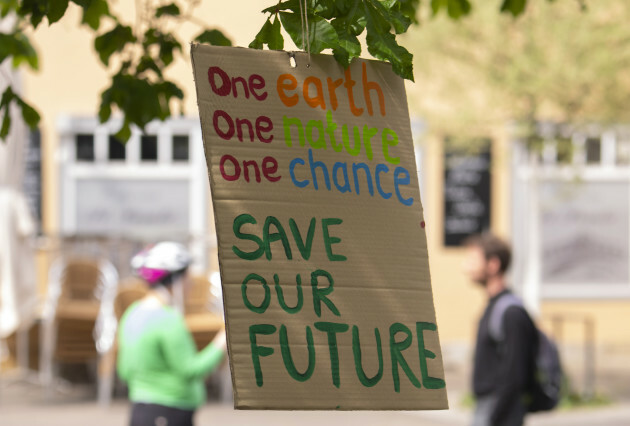
Activists of the fridays for future movement placed a poster at a tree in Erfurt, Germany, April 24, 2020. Source: Jens Meyer

According to the World Meteorological Organisation (WMO), the economic impact of the coronavirus is likely to see global carbon emissions fall by some 6% in 2020.
We need to flatten both the pandemic and climate change curves; we need to show the same determination and unity against climate change as against Covid-19”, according to WMO Secretary-General Petteri Taalas. Action, he added, would be needed “for many generations ahead".
What this underlines is that to achieve a compound 7% annual emissions cut every year from now until 2030 would require the most radical rethink of how we organise our society and economy since the foundation of the state.

Can you see it happening?

Many are deeply sceptical. Former ‘Climate Action’ minister, Denis Naughten dismissed the 7% target as ‘unachievable’, claiming it would equate to banning every private car and slaughtering every (farm) animal in the country.

Naughten is at least being consistent. Back in 2017, he threatened to block implementation of the Paris Agreement at the EU level, claiming it was ‘unaffordable’ for Ireland to implement.

Since 2011, a succession of Fine Gael-led governments has stymied meaningful climate action. As a result, Ireland has now the third-highest per capita emissions in the EU, with the average Irish citizen accounting for more than double the emissions of their high-income Swedish counterparts.

As Sweden shows, ultra-low carbon solutions in transport, energy, home heating, agriculture and industry are indeed possible, but in Ireland, these have been held back by vested interest groups pursuing short-term agendas and TDs engaged in parish pump politics.

climate-change-protest-in-london-uk-14-feb-2020
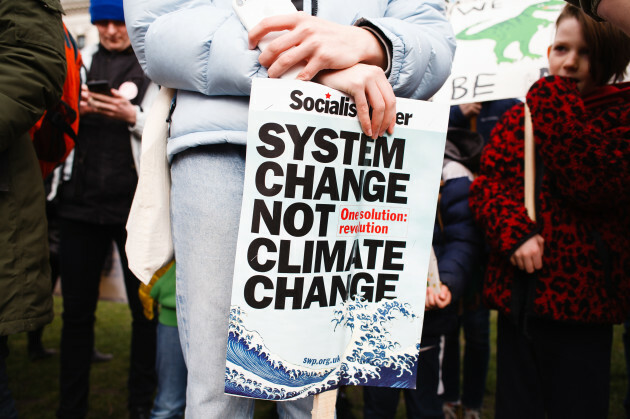
A young environmentalists holds a placard during the protest at Parliament Square in London. Source: SIPA USA/PA Images

Even Taoiseach Leo Varadkar has had to concede he was “not proud of Ireland’s performance on climate…as far as I am concerned, we are a laggard”.

At what cost?

Apart from constant lobbying by commercial and agri-industrial groups, another reason politicians have run scared of climate action is that the issue is consistently framed in the Irish media in terms of the cost of tackling climate change. However, international studies have shown repeatedly that the price of inaction far outweighs the costs of addressing the crisis.

It is estimated that the cost of the coronavirus to the global economy is in the range of $2–$4 trillion this year. A 2018 report calculated that failure to rein in climate change would deliver a devastating $34 trillion hit to the global economy – many times greater than the economic chaos arising from the pandemic.

Other estimates are even less sanguine. An Australian study published in 2019 argues that ‘climate change represents a near to mid-term existential threat to human civilisation’.
Should global temperatures reach 3C over pre-industrial by mid-century, ‘the scale of destruction is beyond our capacity to model, with a high likelihood of human civilisation coming to an end’, the report warns.
So, the next time someone asks if we can ‘afford’ to tackle climate change, a better question might instead be: what price isn’t worth paying to avoid the collapse of civilisation?

Links

How Modelling Articulates The Science Of Climate Change

The Economist


TO IMAGINE EARTH without greenhouse gases in its atmosphere is to turn the familiar blue marble into a barren lump of rock and ice on which the average surface temperature hovers around -18ºC.

Such a planet would not receive less of the sunlight which is the ultimate source of all Earth’s warmth. But when the energy it absorbed from the sunlight was re-emitted as infrared radiation, as the laws of physics require, it would head unimpeded back out into space.

Greenhouse gases block that swift exit. Transparent to incoming sunlight, they absorb outgoing infrared radiation, thus warming the atmosphere and, in so doing, the surface below. The result is an average surface temperature of some 15ºC—warm enough for open seas and oceans and a vibrant biosphere.

In the late 19th century the discovery of the ice ages led scientists to the conclusion that climate could change on a global scale. Svante Arrhenius, a Swedish chemist, wondered if a weakened greenhouse effect might be to blame. Carbon dioxide was known to be a greenhouse gas: Eunice Foote, an American scientist, had found in the 1850s that the rate at which a sealed jar of air warmed up in sunlight depended on the level of carbon dioxide in that air. So Arrhenius—recently divorced, somewhat melancholy and in need of a project—began laboriously to calculate the effects on the climate of halving the atmosphere’s level of carbon dioxide.

Doing so required him to tackle a problem of the sort that most frustrates and most delights scientists who study the Earth system: a feedback loop through which a change in one factor affects another factor which, in turn, affects the first factor more.

Because water evaporates more slowly in cooler climes, the amount of water vapour in the atmosphere falls with the temperature. And water vapour, like carbon dioxide, is a greenhouse gas. Cooling the atmosphere dried the atmosphere which cooled the atmosphere further. Many pencils and thousands of sheets of paper into his exploration of this, Arrhenius concluded that halving the carbon-dioxide level would cool the planet by 5ºC (9ºF).

He also noted that the same relation would hold the other way round: double the carbon dioxide and you would get 5ºC of warming. Industry’s coal burning could thus warm the world—but only, he thought, very slowly indeed. He never imagined that the carbon-dioxide level would increase by a third in just a century.

Around the same time as Arrhenius was pondering the climate, a Norwegian scientist called Vilhelm Bjerknes was working on the physics of how heat drives fluid flow. His students applied these insights to large scale flows in the atmosphere and the oceans, laying the foundations of 20th-century weather forecasting. In 1950 one of those students’ students, Ragnar Fjørtoft, was part of the team which first programmed a computer to forecast the weather by solving such equations.

The computer models central to today’s climate research bring together Arrhenius’s curiosity and Bjerknes’s techniques. Programmes developed from weather-forecasting software calculate how the level of carbon-dioxide and other greenhouse gases is likely to affect the world’s flows of heat, energy and water, and through them the future climate. To do so they use computers that can be some 25trn times faster than the one used in 1950.

These climate models do not treat the atmosphere as a whole. They divide it into millions of “cells”. The conditions in each of these cells depend on the conditions in its neighbours above, below and to the sides as well as on its own history. The idea is to calculate how conditions in each cell change over time.

Unlike a weather forecast, which tries to predict how a specific state of the atmosphere will evolve over a few days, these climate models simulate years, even centuries, of weather in order to discover the averages and probability distributions that define the climate—the envelope which constrains the norms and extremes of future weather.

Dozens of teams at meteorological and research organisations around the world run such models, each using different code to capture the climate’s underlying mechanisms and study everything from future peak rainfall to the tracks of storms to shifts in seasonality. Since 1995 the Coupled Model Intercomparison Project, or CMIP, has brought these teams together by providing standardised tasks for their models and then looking at the range of results.

Thus, for example, the 56 different models considered in the fifth of the CMIP projects, which concluded in 2013, found that doubling the carbon-dioxide level would, in time, bring about a warming of between 1.5ºC and 4.5ºC. The uncertainty in what the models suggest at smaller scales is greater still. Different models can provide very different pictures of the future of regional climates.

Rows and floes of angel hair

The wide range of outcomes is, for the most part, down to the fact that no two models represent the mechanisms of the climate—and particularly its feedbacks—in precisely the same way. Some ways of doing things can be ruled out because the models they produce fail to capture the behaviour of the climate as it is, or as it was in the past (studies of the low-carbon-dioxide ice ages provide useful calibration, which would have pleased Arrhenius).

But among models which reproduce past and current climates reasonably well, there is no clear way to say which one’s representations are most reliable. The differences between the models represent a basic level of uncertainty, given the current state of knowledge.

This endemic uncertainty, though, does not mean the models have nothing useful to say. Given how long modelling has been going on, it is now possible to compare predictions made decades ago with the way things have turned out.

A study published last year systematically assessed what models published between the 1970s and 2007 had said about the way the climate would respond to steady rises in carbon dioxide. It found that for 14 out of 17 models what had happened had been within the model’s error bars; of the other three, two had overshot, one had undershot. Taking the models seriously would have been a good bet.

The most important source of uncertainty in the models lies in the clouds. As greenhouse gases warm the atmosphere its humidity changes, as does the extent to which it cools with altitude. These changes affect how clouds develop; the clouds, in turn, change surface temperature. Most clouds warm the world; some cool it.

The problem is that the processes which control a cloud’s thickness, lifetime and other qualities work on pretty small scales. The models do not. Even if every layer of the atmosphere is represented by hundreds of thousands of grid cells, they still end up being hundreds of kilometres on a side—much too large to capture the processes responsible for individual clouds.

Not all the feedbacks sit squarely within the atmosphere; some extend beneath it. Various feedbacks link the atmosphere to the oceans, which store, move and release heat in ways that do a great deal to shape the climate. In the 1960s modellers began trying to capture these effects by “coupling” models of the ocean to models of the atmosphere, so that what they saw in the atmosphere reflected changes in the oceans and vice versa.

Feedbacks involving the land matter, too. Cold weather brings snow; snowy ground, especially under clear skies, reflects away more sunlight, cooling things further. Biology adds yet more complexity. A tropical forest pumps water vapour into the atmosphere with far greater efficiency than a savannah does.

In warmer oceans it is harder for nutrients to rise to the surface, which reduces the ability of plankton to suck carbon dioxide from the atmosphere. Melting permafrost produces copious microbial methane—a gas which absorbs infrared much more strongly than carbon dioxide does. Over the decades modellers have attempted to build more and more of these interrelationships into their models, adding greatly to their complexity.

Unfortunately increasing complexity does not always reduce uncertainty. A model which ignores, say, the instability of ice sheets—as most did until recently—is clearly missing something important. However, because there are always different ways to incorporate something new, two models updated to capture ice-sheet dynamics may diverge more after this “improvement” than they did when, unrealistically, they simply ignored the issue. In the CMIP6 process, which is currently winding up, preliminary results show a wider range of uncertainties than was seen in CMIP5.

The biggest source of uncertainty, though, lies not inside the models but outside them. Climate change is a problem because human activity is adding carbon dioxide, methane and other greenhouse gases to the atmosphere at a rate that is both prodigious and impossible for the physics, chemistry and biology encoded in the models to predict.

To estimate how changes in policy might affect emissions a different family of models is used—“integrated assessment models” (IAMs) which import simplified results from climate models into models of the economy.

One of the things that CMIP5 asked climate modellers to look at is the way that the climate might evolve if emissions followed four standardised “pathways” developed from four particular IAMs in the 2000s. Three were generated from IAMs trying to simulate various types of climate policy. The fourth, RCP8.5, though often referred to as “business as usual”, was generated from an IAM run featuring high population growth, low technological progress and very large scale use of coal. As a result it shows emissions increasing at a spectacular rate, which makes it scary, but not a helpful baseline.

LARGE IMAGE

The uncertainties in what the models predicted was as striking as ever (see chart). But they all agreed that only the pathway embodying the strongest climate action—much stronger than what is seen and promised today—might allow the world to keep the temperature rise since the 18th century well below 2ºC in the 21st, the target enshrined in the Paris agreement of 2015.

Links

03/05/2020

Satellites Show Melting Ice Sheets In Antarctica And Greenland Have Contributed To 14 mm Sea Level Rise In 16 Years

ABC Science - Zoe Kean

Loss of ice from the margins of Antarctica outweighs the gains in the interior of the continent. (Supplied: British Antarctic Survey)

Key Points
  • NASA satellites help scientists track Greenland and Antarctica’s contribution to sea level rise
  • Melting Antarctic ice shelves lead to glaciers flowing into the sea
  • More research is needed to understand how East Antarctica is responding to climate change
NASA satellites bearing advanced laser technology have recorded the most accurate picture of large scale ice sheet melting in Greenland and Antarctica to date.

Melting ice sheets in Greenland and Antarctica contributed to 14 millimetres of sea level rise between 2003 and 2019, according to a study published today in the journal Science.

"[Into the future] with that 14 millimetres happening every 16 years, it adds up to a pretty significant amount of sea level rise", said lead author Benjamin Smith of the University of Washington.

If all the melt observed in this study was to flood an area the size of Australia, we would all be wading through 66 centimetres of water, Professor Smith calculated.

Two satellites, the ICESat-1 and the more advanced ICESat-2, were equipped with "laser altimeters" that bounced light pulses off the ice sheets to determine their height.

Researchers compared measurements taken in the early 2000s by ICESat-1 with measurements taken in 2018 and 2019 by ICESat-2.

"The two sets of measurements intersect each other at millions of points, it's those intersections that let us map how the ice changed between ICESat-1 and ICESat-2," Professor Smith said.

"This is a much more significant climatic signal than what you might see if you just surveyed for two or three years," Professor Smith said.

Greenland vs Antarctica

Previous satellite data from NASA shows the rate of global mean sea level rise is accelerating by an average of 3.4 millimetres per year.

Melting ice from Greenland and Antarctica contributes to about a third of the sea level rise we're seeing, Professor Smith said.

The latest data showed melting was more extreme in Greenland than in Antarctica.

Greenland's ice cap calving (Gfycat)

Greenland's ice sheet lost an average of 200 gigatons of ice a year, contributing up to two thirds of the sea level rise. The majority of this ice loss was from thinning of coastal glaciers, which have been impacted by warmer summer temperatures melting the ice on the surface, and warmer ocean temperatures eroding the edges of the ice.
"Greenland melts at the surface quite a bit every year whereas the surface of Antarctica does not melt over a significantly large areas of the continent," he said.
The satellite data showed Antarctica lost an average of 118 gigatons of ice in the same time frame.

While there are gains in ice coverage in the interior, due to increased snowfall, these did not outweigh the losses in coastal areas.

"The total amount of thinning vastly outweighs the small amount of thickening in the interior of the ice sheets," Professor Smith said.

Satellite data shows the amount of ice gained (blue) or lost (red and purple) by Antarctica between 2003 and 2019 (Supplied: Smith et al/Science)

The majority of Antarctica's contribution to sea level rise comes from its glaciers flowing into the ocean as warmer water erodes the ice. This process is far more rapid in West Antarctica than in East Antarctica where it is quite patchy, with areas of thickening and thinning.

Measuring ice shelf losses

Glaciologist Matt King said a strength of this research is that it observed both grounded ice such as glaciers and land ice extending onto the sea, whereas previous studies focused on just one or the other.

"We know that ice on land responds to ice extending onto the sea, so looking at the ice sheet as a whole is an advance," said Professor King of the University of Tasmania.

Study co-author Helen Amanda Fricker of the University of California said land-based ice that extends out to sea has previously been excluded because melting ice on land directly contributes to sea level rises, whereas ice that floats on water does not.

But, she said, scientists need to know how ice sheets are changing if we are going to be able to predict how grounded ice might leave the Antarctic continent.

"Knowing this won't slow it down, but it will help us make informed decisions."

The anatomy of an ice shelf. (Supplied: Dr Sue Cook)

"We have discovered that where grounded ice changes most is where the ice shelves are thinning," said Professor Fricker While ice shelves, which float on the ocean, don't contribute to sea level rise, they act like a barrier, anchoring glaciers on the Antarctic landmass.
"Antarctica functions a bit like a giant apple pie, when the crust is removed, the filling leaks out."
Research needed where Australia is based

Professor Fricker is calling for more on-the-ground research in East Antarctica, where Australia's research bases are located.

"Key systems are changing in East Antarctica, it's in Australia's backyard," she said.

Professor King agreed.

"Satellite studies provide a great continental view, but we also need good field measurements to understand what's going on in these vulnerable places," said Professor King.

"We don't really know enough about East Antarctica to understand the changes going on," he said.

"So we are left with a general state of confusion, flying blind from both directions."

Links

(AU) Australia Listened To The Experts On Coronavirus. It's Time We Heard Them On Climate Change

The GuardianLenore Taylor

Economic reconstruction is a chance to speed up decarbonisation, and the pandemic has shown a different kind of politics is possible

‘The energy market operator says Australia could accommodate levels of up to 75% “instant” wind and solar penetration in its main grid by 2025.’ Photograph: Tim Phillips Photos/Getty Images

Lenore Taylor is Guardian Australia's editor. She has won two Walkley awards and has twice won the Paul Lyneham award for excellence in press gallery journalism. Lenore co-authored, Shitstorm, a book on the Rudd government's response to the global economic crisis.
We’re already being swamped with ideas about “reforms” needed to recover from the pandemic crisis.

But the word reform is like gift wrap – a handy cover for any offering, thought-through or otherwise.

Perhaps we should ditch the word entirely, and with it the forest of feelpinions about what governments “must” do to advance an author’s previously-held ideological positioning in the post-corona world.

Imagine if we took just two lessons from the way Australian governments responded to the coronavirus: that good decisions are made when they consider the evidence and the best available expert advice; and that policy-making can accommodate reasonable differences of opinion, without becoming a “war”.

Think, as Laura Tingle did in a piece for the ABC’s 7.30 this week, of the difference it would make if interviewers and commentators allowed room for discussion of complex and competing ideas, before demanding that politicians rule them “in” or “out”, or before finding a backbencher who will say they might cross the floor on a policy that conflicts with their ideological prejudice – even if that policy hasn’t yet been outlined.

Now consider if those principles were applied to climate policy in Australia.

I concede that’s quite a leap given the past decade of mind-numbing debate, during which experts have struggled to get a look in. But in the background, some have been giving it a shot.

For six years now leading business, environmental, investor, union, farming and social welfare groups have been trying, largely in vain, to create a space for a sensible discussion about global heating, and to give Australian politicians a way to retreat from the self-defeating culture war that has scuppered all attempts at policy.

They wouldn’t put it this way, but in effect the environmentalists, desperate for Australia to make some meaningful move towards reducing emissions, and the business groups, desperate for some kind of investment certainty, have been trying to save Australia’s politicians from themselves.

The starting point for the Australian Climate Roundtable’s deliberations is that Australia needs to reach net zero emissions, and that delaying action just increases the cost of reaching that goal. Unremarkable propositions in any fact-based forum, but in some Coalition circles, still close to heresy.

Now the roundtable, including its business members, argues that this post-corona reconstruction is a chance to speed up decarbonising the economy.

The Business Council of Australia chief executive, Jennifer Westacott, argued in an opinion piece that the post-corona discussion should divest itself of “ideological constraints”.

“In resuscitating our economy, we can tackle some of our most vexed problems. Every dollar we invest in energy should be a dollar towards a lower carbon economy and lower energy bills,” she wrote.

And expert evidence about what might be possible has been flooding in by the day.

The Australian Energy Market Operator this week released its long awaited “renewable integration study”, which found Australia could accommodate levels of up to 75% “instant” penetration of wind and solar in its main grid by 2025 – that we have the know-how, but need to update market and regulatory settings.

Think about that next time someone starts burbling on about the impossibility of a renewable-dependent grid coping “when the wind don’t blow and the sun don’t shine”.

Less than a year after an election in which Bill Shorten’s target of 45% renewables by 2030 was attacked for being “unachievable” and “economy wrecking”, the expert market operator says 75% is technically achievable – and in just five years time.

And then there was the advice from the International Energy Agency this week that renewable electricity will be the only energy source resilient to the biggest global energy shock in 70 years, triggered by the pandemic.

The Morrison government is supposed to be working on a “roadmap” towards some kind of long-term emissions reduction policy, understandably delayed while it deals with the pandemic.

It could draw on the work of a bunch of expert groups who have already had a go – the latest Climateworks report released earlier this month found that net zero emissions by 2035 is possible in Australia, using technologies that are mostly already mature and available.

The CSIRO’s roadmap released last year found there was no trade-off between economic growth and transitioning to zero emissions, and in fact strong action could lead to GDP growth, an increase in real wages and net zero emissions by 2050.

But then, apparently pre-empting his own policy, and contradicting his own government’s claim to be “technology neutral”, the energy minister, Angus Taylor, has spent the week calling for a “gas-fired recovery”, variously advocating more gas-peaking plants, more long-term gas supply for manufacturers and more onshore gas production.

The details of what he’s advocating remain opaque, but as the Grattan Institute’s energy expert Tony Wood points out, renewed suggestions of government intervention are only likely to deter investment, presumably the opposite of what Taylor is seeking.

If there’s a coherent policy in there somewhere, it really is time for the government to unwrap it. The experts have been waiting for years, and it turns out that listening to them is a good idea.

Links

Lethal Heating is a citizens' initiative