28/06/2020

Can The Forests Of The World’s Oceans Help Solve The Climate Crisis?

Ensia - Emma Bryce

Researchers are looking to kelp for help storing carbon dioxide far beneath the surface of the sea.

Photo of one of the last patches of giant kelp off the coast of southeastern Tasmania courtesy of Cayne Layton

Sixty years ago, Tasmania’s coastline was cushioned by a velvety forest of kelp so dense it would ensnare local fishers as they headed out in their boats. “We speak especially to the older generation of fishers, and they say, ‘When I was your age, this bay was so thick with kelp, we actually had to cut a channel though it,’” says Cayne Layton, a postdoctoral research fellow at the Institute for Marine and Antarctic Studies at the University of Tasmania. “Now, those bays, which are probably at the scale of 10 or 20 football fields, are completely empty of kelp. There’s not a single plant left.”

Since the 1960s, Tasmania’s once expansive kelp forests have declined by 90% or more. The primary culprit is climate change: These giant algae need to be bathed in cool, nutrient-rich currents in order to thrive, yet regional warming in recent decades has extended the waters of the warmer East Australian Current into Tasmanian seas to devastating effect, wiping out kelp forests one by one. Warming waters have also boosted populations of predatory urchins, which gnaw on kelp roots and compound the loss.

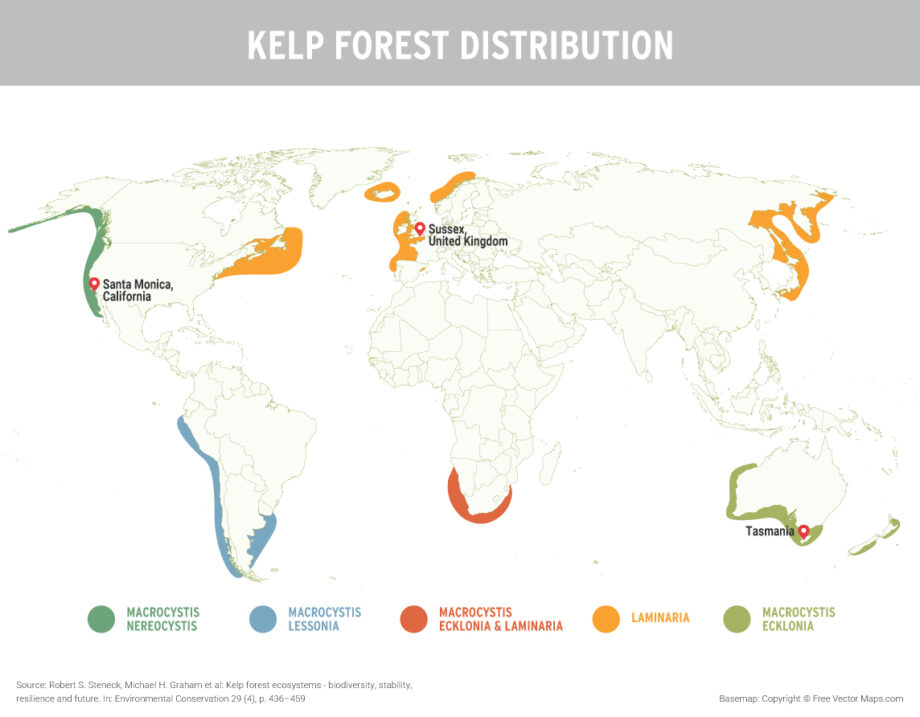
Tasmania isn’t the only site of destruction. Globally, kelp grow in forests along the coastlines of every continent except Antarctica; most of these are threatened by climate change, coastal development, pollution, fishing and invasive predators. All of this matters because these ecosystems provide huge benefits: They cushion coastlines against the effect of storm surges and sea level rise; they cleanse water by absorbing excess nutrients; and they also slurp up carbon dioxide, which can help drive down ocean acidity and engineer a healthy environment for surrounding marine life. These forests — which in the case of the giant kelp species that grows in Tasmania, can reach heights of 40 meters (130 feet) — also provide habitat for hundreds of marine species.

KELP FOREST DISTRIBUTION
Large Image
Kelp thrives in cold-water ecosystems where nutrient-rich water from the deep sea makes it up to the surface, a process known as upwelling. Abundant nutrients allow some types of kelp to grow up to 2 feet (0.6 meters) per day.

Having spent years studying these benefits, Layton is now trying to bring a patch of Tasmania’s struggling kelp forests back to life. Every few weeks, he dives out to inspect three 12-by-12 meter (39-by-39 feet) plots he’s created off the coast, each containing fronds of baby kelp, springing from ropes that are tethered to the ocean floor. These kelp nurseries are part of Layton’s project to determine whether climate-resilient “super-kelp” that has been raised in a laboratory will fare better in Tasmania’s changing seas. But his experiment also brings attention to the extraordinary potential of kelp to absorb carbon and help tackle climate change.

Climate-Forward Kelp

It’s the capacity to draw CO2 from the atmosphere that has added “climate mitigation” to kelp’s list of benefits. When we talk about ways oceans can sequester carbon, the conversation typically revolves around mangroves, salt marshes and seagrass meadows. But “the magnitude of carbon sequestered by algal forests is comparable to that of all those three habitats together,” says Carlos Duarte, a professor of marine science at the King Abdullah University of Science and Technology in Saudi Arabia. “Algal forests should not be left behind. They have been hidden for much too long.”

There’s a lot we still don’t understand about how kelp store CO2. But researchers are starting to build a better picture of this giant seaweed and how we might improve its capacity to help tackle climate change.

The dilemma is that kelp itself is also under siege from warming seas — which is the focus of Layton’s work. Of Tasmania’s original forest, only around 5% remains. Researchers think these plants have survived through natural variation and selection.

“There do seem to be individuals that are adapted and capable of living in the modern conditions in Tasmania that we have created through climate change,” Layton explains.

From this remaining pool of wild giant kelp, he and his colleagues have identified what Layton calls “super kelp” that may be more resilient against the effects of warming seas. From these he has harvested spores, embedding them in twine to be wound around the ropes that are rooted into the sea floor. The hope is that these super kelp spores will develop into saplings that will in turn set their own spores adrift on ocean currents, seeding new mini-forests nearby.

“For giant kelp restoration to work at the scale of the coastline, we’ll need to plant many of these seed patches,” Layton explains. “The idea is that over time, those will self-expand, and eventually coalesce — and there’s your giant kelp forest back.”

Warming waters and the removal of natural predators, like the sea otter, have caused populations of kelp-eating sea urchins to explode in Santa Monica Bay off California. Photo © iStockphoto.com | Michael Zeigler

Other kelp restoration projects around the world are tackling different threats. In Santa Monica Bay, California, conservationists are trying to save local kelp forests from voracious purple urchins, whose population has exploded since a major predator — the sea otter — dramatically declined decades ago. The urchins’ unchecked appetite has contributed to the loss of three-quarters of the bay’s former kelp forest. But fishers are carefully hand-clearing urchins — the draw being that as kelp is restored, fisheries are too. So far they’ve managed to clear 52 acres (21 hectares), which the kelp forest has reclaimed.

“All we had to do is clear the urchins out of the way,” says Tom Ford, executive director of The Bay Foundation, which is leading the effort.

The project’s success has caused others to ponder its carbon sequestration potential, Ford says. The City of Santa Monica recently established a goal of reaching carbon neutrality by 2050, and asked The Bay Foundation how kelp restoration could factor into that. A nonprofit called Sustainable Surf has also launched a program enabling people to invest in the kelp restoration project to offset their own carbon footprints.
“These kelp forests grow so fast and suck in tremendous amounts of carbon.” – Tom Ford
These kelp forests grow so fast and suck in tremendous amounts of carbon,” Ford says. In California there’s a focus on preserving wild lands with carbon credits, he explains. But the uptick in regional wildfires means that land-based forests might no longer seem like the safest bet. “Now, working off the coast is becoming perhaps a more important option.”

Similarly, in the United Kingdom, a plan known as “Help Our Kelp” aims to restore a 180-square-kilometer (70-square-mile) tract of historic kelp forest along the country’s southern Sussex Coast. It has attracted the interest of two local councils and a water company, which are intrigued by its potential to provide a new carbon sink. “All three organizations are interested in carbon, but also interested in the wider benefits [of kelp forests],” explains Sean Ashworth, deputy chief fisheries and conservation officer at the Association of Inshore Fisheries and Conservation Authorities, a partner on the project.

Captured Carbon?

Yet key questions remain about where all the stored carbon ends up. Trees stay in one place, so we can reasonably estimate how much carbon a forest stores. Kelp, on the other hand, can float off to unknown destinations. If it begins to decompose, its stored carbon may be released back into the atmosphere, explains Jordan Hollarsmith, a marine ecologist at Simon Fraser University and the Department of Fisheries and Oceans in Canada. “Truly removing that carbon from the global carbon budget would require that those kelp fronds somehow be buried, or transported to the deep sea,” she says.

In fact, emerging research is beginning to paint a picture of seaweed’s journey through the ocean. A 2016 study estimated that about 11% of global macroalgae is permanently sequestered in the ocean. The bulk of that, about 90%, is deposited in the deep sea, while the rest sinks into coastal marine sediments.

Under good conditions, the giant kelp species that grows in Tasmania can reach 40 meters (130 feet) tall and create a dense and visually impenetrable undersea forest. Photo courtesy of Cayne Layton

“If the algae reaches below the 1,000-meter horizon, it is locked away from exchange with the atmosphere over extended time scales, and can be considered permanently sequestered,” says Dorte Krause-Jensen, a professor of marine ecology at Aarhus University in Denmark and author on the 2016 study along with Duarte. Still, the challenge of tallying this up remains. Compared with mangroves, seagrasses and salt marshes, which deposit carbon directly and reliably into the sediments below, the inherent changeability of a kelp forest makes the sequestration harder to accurately quantify. But this could change, Duarte say, if kelp forests came under strict human management — something that’s already happening with smaller species of seaweed that are being farmed worldwide for food products and fertilizer.

Future Kelp

Could we similarly bring vast kelp forests under human control for the benefit of the planet? Brian Von Herzen, executive director of the nonprofit The Climate Foundation, thinks so. The Climate Foundation is a partner on Cayne Layton’s project for climate-resilient kelp, and Von Herzen is a major player in the field of “marine permaculture,” a type of open-ocean seaweed farming that mimics wild kelp forests to regenerate marine ecosystems, boost food security and sequester carbon.
Von Herzen is currently trying out prototype arrays in the Philippines to help make seaweed farming more resilient to climate change.
Central to Von Herzen’s vision is an array on which kelp would grow, hovering 25 meters (82 feet) below the ocean’s surface. Using solar, wind and wave energy to drive their motion, hoses fixed beneath the structure would siphon up colder, nutrient-rich water from the depths below. This cool water infusion would re-create an ideal micro-environment for the tethered kelp to thrive; the kelp would then oxygenate the water and create new fish habitat — all while capturing carbon, Von Herzen explains.

While these deepwater kelp forests are only hypothetical, Von Herzen is currently trying out prototype arrays in the Philippines to help make seaweed farming more resilient to climate change. Seaweed farmers there have suffered major losses as a result of warm ocean currents that sweep in and decimate their crops. But with the upwelling of cooler water generated by the new arrays, seaweed is starting to flourish again.

This project, and others being developed off the coasts of Europe and the U.S., are laying the groundwork for Von Herzen’s ultimate ambition: To dramatically scale up kelp arrays, eventually spanning great tracts of deep ocean where they could collectively absorb billions of tons of CO2 while also providing food security in the form of shellfish aquaculture and fish habitat and providing what he calls “ecosystem life support.”

Kelp could be buried in the deep sea to sequester carbon or be harvested to produce low-emissions biofuel and fertilizers, he says. “We use the thriving wild kelp forest as the ecosystem model for what we can scale in the oceans,” Von Herzen says.

Current Benefits

On the back of her research, Krause-Jensen is optimistic about the carbon sequestration potential of kelp and the possibility that it could be dramatically enlarged by sustainable farming. But practically speaking, in nations like Australia and the United States, Duarte says, “it’s harder to get a concession for a seaweed farm, than for oil and gas exploration.” And global systems for providing compensation for sequestering carbon are not yet set up to accommodate kelp.

Christophe Jospe, the chief development officer at Nori, a company that is working to make it easier to fund carbon removal initiatives, argues that with such a powerful sequestration tool at our disposal, we should accelerate its acceptance — even if seaweed farmers are only able to guarantee sequestration for, say, 10 years.

“We are throwing ourselves into a heated environmental debate where people say, well, that’s not permanent. But nothing is permanent — and it’s the reservoir of carbon that we need to increase because of the climate crisis that we’re in,” he says. “So actually, it’s a huge environmental value for a program to ensure 10 years of permanence.”

There are signs that things are gradually moving in that direction. Working with Oceans 2050, a global alliance to restore the world’s oceans led by Alexandra Cousteau, Duarte is now helping to develop a carbon credit program that could be applied to seaweed farming. This makes it possible to imagine a world where we might one day invest carbon credits in kelp farms or where wild forest restoration might count as mitigation.

Meanwhile, back in Tasmania, Layton continues to watch over his nurseries of infant kelp, and he urges us to be cognizant of what kelp forests are already doing for us, right now.

“They’re exactly like forests on land. There aren’t many people questioning their value,” he says. “Some people might not be interested in seaweed. But they may be interested in fishing, or their beachfront property not getting washed away, or making sure that their coastal waters are clean. All of those things are intimately tied to kelp forests.”

Links

(US) Minnesota Sues Exxon And Koch Industries For ’30-Year Campaign Of Deception’ On Climate

Rolling Stone - 

The state is the latest on a growing list of local governments hoping to hold the fossil-fuel industry accountable for the climate crisis

Protesters outside of a New York City courthouse for a rally coinciding with the start of a legal case against ExxonMobil, October 2019. Justin Lane/EPA-EFE/Shutterstock

The oil and gas industry was hit with yet another lawsuit when Minnesota Attorney General Keith Ellison announced this week that his office is suing two of the nation’s largest oil companies, and the oil industry’s trade group, for a “30 year campaign of deception” about the impacts of climate change.

At a press conference in Saint Paul, Ellison stated that Koch Industries, ExxonMobil, and the American Petroleum Institute “knowingly directed, conducted and funded a campaign to deceive and defraud Minnesotans and Americans” about the effects of fossil fuels on the environment. The state’s charges include fraud, failure to warn, and false statements in advertising.

Minnesota follows at least 15 progressive cities and states — from San Francisco to Rhode Island — that have filed suits against oil companies in the wake of a 2015 series by Inside Climate News, which uncovered internal Exxon documents that showed the company understood the science of climate change and the severity of its consequences more than 30 years ago, yet spent millions of dollars on a campaign to sow doubt in the science.

Using those documents, local governments have sued industry giants for fraud, and sought compensation for the damages of climate change in their communities. But the cases have yet to show results. The oil and gas industry has responded with a litany of countersuits and subpoenas that have tied up many of the cases for years. And when a case does make it in front of a judge, several have decided that it’s not an issue for the courts to decide.

 In Oakland, San Francisco, and New York City, judges insisted that while the impacts of climate change are real, it was a problem for legislators, not our judicial system, to address. “The problem deserves a solution on a more vast scale than can be supplied by a district judge or jury in a public nuisance case,” wrote U.S. District Court Judge William Alsup in 2018.

The Minnesota lawsuit argues that over the past three decades, climate change and oil and gas development has had a quantifiable impact on the state — itemizing costs like the nearly $614 million spent on asthma treatment in 2014 and the $165 million on flood disaster relief in 2007 — and it seeks to recoup those losses, in part by forcing the defendants to relinquish hundreds of billions in profits they made through what the state is calling unlawful conduct.

But it also demands that the companies undo the misinformation campaign that they’ve run for decades, by funding “a corrective public education campaign in Minnesota relating to the issue of climate change, administered and controlled by an independent third party.”

“Misleading the public about science isn’t a new concept,” said Doug Blanke, director of the Public Health Law Center at Mitchell Hamline School of Law, who was part of the legal team that sued the tobacco industry in the 1990s, in which he won a more than $6 billion settlement for the state of Minnesota. There has yet to be the same kind of victory against the oil and gas industry, but the tobacco settlement seemed near impossible too — until it wasn’t.

The Exxon documents are damning. The complaint filed by Minnesota includes a 1979 document from Exxon Engineering that acknowledges that the CO2 in the atmosphere was increasing, and that according to “the most widely held theory,” that increase was caused by burning fossil fuels, and “the present trend of fossil fuel consumption will cause dramatic environmental effects before the year 2050.”

But Exxon worked to “emphasize the uncertainty in scientific conclusions regarding the potential enhanced Greenhouse effect.” And by 1991, the Information Council for the Environment, a front group created by the coal and electricity industries, had launched a misinformation campaign to “reposition global warming as theory (not fact).” The group released ads with taglines like “Who Told You The Earth Was Warming…Chicken Little?” and “Doomsday is cancelled. Again.”

“Our future generations count on our actions today,” said Winona LaDuke, a Native American land rights activist in Minnesota who’s been on the front lines in the battle against a new oil and gas pipeline in the state. There isn’t any oil in Minnesota, but it’s criss-crossed with pipelines, like those owned by Koch Industries, carrying oil from Canada to ports along the Great Lakes. “I’ve spent most of my life fighting dumb ideas,” said LaDuke. “I’m proud that Minnesota is stepping up.”

The oil and gas industry is in a uniquely imbalanced moment. As shelter-in-place orders drastically changed our energy consumption, a barrel of oil was valued at less than zero earlier this year, and companies are still struggling to break even. More broadly, renewables, while also hindered by the shutdown, continue to take over more of the energy market and the steady drumbeat of the divestment movement chips away at the fossil fuel industry’s financial backing.

Now, Minnesota hopes to pile on a charge for the hundreds of billions of dollars that they say climate change has cost them. “Holding these companies accountable for the climate deception they’ve spread and continue to spread is essential to helping families to afford their lives and live with dignity and respect,” said Ellison. “When corporations and trade associations break the law and hurt Minnesotans, it’s my job and my duty to hold them accountable.”

Links

Affluence is killing the planet, warn scientists

The Conversation -  |  | 

Lifestyles of the rich and harmful. Midnight Runner / wiki, CC BY-SA 

Authors
  • Thomas Wiedmann is Professor of Sustainability Research, UNSW
  • Julia K. Steinberger is Professor in Social Ecology and Ecological Economics, University of Leeds
  • Manfred Lenzen is Professor of Sustainability Research, School of Physics, University of Sydney
Would you like to be rich? Chances are your answer is: “Yes! Who wouldn’t want to be rich?” Clearly, in societies where money can buy almost everything, being rich is generally perceived as something good. It implies more freedom, fewer worries, more happiness, higher social status.

But here is the catch: affluence trashes our planetary life support systems. What’s more, it also obstructs the necessary transformation towards sustainability by driving power relations and consumption norms. To put it bluntly: the rich do more harm than good.

This is what we found in a new study for the journal Nature Communications. Together with co-author Lorenz Keyßer from ETH Zürich, we reviewed recent scientific literature on the links between affluence and environmental impacts, on the systemic mechanisms leading to overconsumption and on possible solutions to the problem. The article is one of a series of Scientists’ Warnings to Humanity.

Technology and consumption

The facts are clear: the wealthiest 0.54%, about 40 million people, are responsible for 14% of lifestyle-related greenhouse gas emissions, while the bottom 50% of income earners, almost 4 billion people, only emit around 10%. The world’s top 10% income earners are responsible for at least 25% and up to 43% of our environmental impact.

Most people living in developed countries would fit into this category, meaning you don’t have to consider yourself rich in order to be globally affluent. Even many poorer people in wealthy countries have a disproportionately large and unsustainable resource footprint compared to the global average.

It is less clear, however, how to address the problems that come with affluence. Progressive mainstream policymakers talk about “greening consumption” or “sustainable growth” to “decouple” affluence from climate breakdown, biodiversity loss and other planetary-scale destruction.

Yet our research confirms that, in reality, there is no evidence that this decoupling is actually happening. While technological improvements have helped to reduce emissions and other environmental impacts, the worldwide growth in affluence has consistently outpaced these gains, driving all the impacts back up.

And it appears highly unlikely that this relationship will change in the future. Even the cleanest technologies have their limitations and still require specific resources to function, while efficiency savings often simply lead to more consumption.

Economic growth hasn’t yet ‘decoupled’ from environmental impact. Oleg Totskyi / shutterstock

If technology alone is not enough, it is therefore imperative to reduce the consumption of the affluent, resulting in sufficiency-oriented lifestyles: “better but less”. This is all easier said than done though, for there is a problem.

The super-affluent

The lockdown has seen a massive drop in consumption. But the resulting unprecedented dive in CO₂ and air pollutant emissions was merely incidental to the lockdown, not a deliberate part of it, and will not last.

So how can we reduce consumption as much as necessary in a socially-sustainable way, while still safeguarding human needs and social security? Here it turns out the main stumbling block is not technological limits or economics itself, but the economic imperative to grow the economy, spurred by overconsumption and the political power of the super-affluent.

Affluent, powerful people and their governments have a vested interest in deliberately promoting high consumption and hampering sufficiency-oriented lifestyles. Since consumption decisions by individuals are strongly influenced by information and by others, this can lock in high-consumption lifestyles.

“Positional consumption” is another key mechanism, where people increasingly consume status goods once their basic needs are satisfied. This creates a growth spiral, driven by the affluent, with everyone striving to be “superior” relative to their peers while the overall consumption level rises. What appears average or normal in a developed country then rapidly becomes a top contribution at the global level.

ustainable lifestyles are situated between an upper limit of permissible use (“Environmental ceiling”) and a lower limit of necessary use of environmental resources (“Social foundation”)

So, how can we get out of this dilemma?

We reviewed a variety of different approaches that may have the solution. They range from reformist to radical ideas, and include post-development, degrowth, eco-feminism, eco-socialism and eco-anarchism. All these approaches have in common that they focus on positive environmental and social outcomes and not on economic growth. Interestingly, there seems to be quite some strategic overlap between them, at least in the short term. Most agree on the necessity to “prefigure” bottom-up as much as possible of the new, less affluent, economy in the old, while still demonstrating sufficiency-oriented lifestyles to be desirable.

Grassroots initiatives such as Transition Initiatives and eco-villages can be examples of this, leading to cultural and consciousness change. Eventually, however, far-reaching policy reforms are needed, including maximum and minimum incomes, eco-taxes, collective firm ownership and more. Examples of policies that start to incorporate some of these mechanisms are the Green New Deals in the US, UK and Europe or the New Zealand Wellbeing Budget 2019.

Social movements will play a crucial role in pushing for these reforms. They can challenge the notion that riches and economic growth are inherently good and bring forward “social tipping points”. Ultimately, the goal is to establish economies and societies that protect the climate and ecosystems and enrich people with more wellbeing, health and happiness instead of more money.

Links

27/06/2020

(US) Retired Easthampton Engineer Builds 30-Foot-Tall ‘Sea Level Rise Ruler,' Plans To Drive It Across The East Coast To Raise Awareness About Climate Change

MassLive Media - 

Easthampton resident Vinny Valetutti’s constructed a 30-foot-tall “Sea Level Rise Ruler” to raise awareness about the dangers of rising sea levels due to climate change and ice caps melting. (Courtesy Olivia Greeley)

Easthampton resident Vinney Valetutti’s monstrous “Sea Level Rise Ruler” is far from 12 inches long.

The construction spans a whopping 30 feet and currently sits on a wooden platform attached to the Western Massachusetts man’s car.

With his structure, the former engineer is seeking to raise awareness about the dangers of rising sea levels due to climate change and ice caps melting.

“I simply hope to make people aware of the reality of sea level rise, as it is a unique part of the global warming discussion,” Valetutti said in a statement. “People tend to not focus on sea level rise because, at first glance, the daily effect is insignificant, but ice melt has a cumulative effect.”

Valetutti, a retired professional engineer who is passionate about energy conservation, stays up to date on the science of climate change. He was inspired in 2019 by Greta Thunberg, a 17-year-old Swedish girl who become internationally recognized for her environmental activism.

Using his background in engineering, Valetutti constructed a traveling flagpole that can hold a 30-foot-tall banner that replicates a ruler, with exact measurements in feet, according to the Easthampton resident.

“I marked the 11- and 22-foot levels in red, because those indicate where our sea level would rise if only 5% or 10% of Antarctica and Greenland were to melt,” he said. “When people stand next to the flagpole and see how high that really is, it shows how legitimate and scary the reality of rising sea levels is.”

The ruler has been sitting in Northampton, but Valetutti is hoping to drive his moveable education tool across the east coast, according to his statement.

“I wanted to take a stance on the side of climate change that is not always talked about - rising sea levels due to global warming,” the statement said.

Valetutti stressed how rapidly sea levels could rise and how little the problem is discussed.

“Sea level rise is real. It is scary, and there is no way to time it,” he said. “Mother Nature can work fast.”

Easthampton resident Vinny Valetutti’s constructed a 30-foot-tall “Sea Level Rise Ruler” to raise awareness about the dangers of rising sea levels due to climate change and ice caps melting. (Courtesy Olivia Greeley)

Links

(AU) The Surprising Way Renewables Can Help Farmers Cope

Sydney Morning Herald - Peter Hannam

It turns out that with solar panels, even the grass is greener during a drought.

That's the experience of Dubbo grazier Tom Warren, who says condensation dripping off the panels arrayed across 55 hectares of his farm provided a moisture source that was the envy of neighbours.

Sheep and solar mix well, Mr Warren said, with condensation from the panel providing extra grass for his flock during the drought. Credit: Janie Barrett

"During the drought, everybody around here was feeding sheep [by hand]," Mr Warren said on Tuesday as sheep grazed among the rows. "We only had to feed these sheep for about three months."

The Berejiklian government is relying on the good word of such landholders to help accelerate the roll-out of large-scale wind and solar, particularly in its three designated renewable energy zones.

Tom Warren, a farmer whose land hosts a solar farm near Dubbo, says more renewables will help revive regional economies. Credit: Janie Barrett

This week, the government said the plan to foster installation of 3000 megawatts of new-generation capacity in the Central West renewable zone had drawn interest from investors for nine times that amount.

So strong was the response, Energy and Environment Minister Matt Kean said, that "there's absolutely room to increase the capacity". The other two zones, in New England and the Riverina, are also likely to attract strong interest.

Some 450 jobs would be created in the first zone based on the 3000MW goal, drawing in new industries, Mr Kean said.

"It will see Dubbo and the Central West become the powerhouse of NSW and the powerhouse of our nation," he predicted. "It's a win for NSW, delivering cheap, clean energy."

Deputy Premier and Nationals leader John Barilaro, who has often advocated coal and gas over renewables, has lately been more supportive of the jobs wind and solar farms can bring to rural communities.

"We need to build diversity in our local economies," Mr Barilaro said at the Dubbo solar farm.

"The ability for a landholder to have a solar farm or have wind turbines ... gives him off-farm income," he said. "It means you can future-proof the regions."

Deputy NSW Premier John Barilaro (left) with Dubbo MP Dugald Saunders and Energy and Environment Minister Matt Kean (right), at the South Keswick solar farm near Dubbo. Credit: Janie Barrett

Mr Kean said "no one would be a bigger beneficiary than the farmers" but consultation would be key.

"We want to work with you," Mr Kean. "We want to get the balance right between our state's energy needs and also to support the agricultural production that we rely so heavily on from this region."

Mr Warren said he would welcome visitors to his farm, run by France-based renewables developer Neoen, if they needed reassurance about the benefits of clean energy.

“It’s tremendous,” Mr Warren said of the potential for renewable energy’s growth. “This can drive the decentralisation of industry — this to me is the future of regional Australia.”

Potential Priority Energy Zones identified by NSW government 


Garth Heron, Neoen's head of development in Australia, said his firm had lodged interest for five projects within the Central West renewable zone. If they proceeded, they would total more than 1GW of solar, wind and batteries and require at least $1 billion to build.

Falling costs of renewables and storage meant they were becoming more competitive against new coal and gas plants and were closing in on existing coal plants. "Average wholesale power prices in Australia are about $70-$90," Mr Heron said. "We'd be looking at two-thirds of that in terms of firmed power [involving both renewables and batteries]."

The company already has 1.3GW of capacity in Australia, making the country Neoen's biggest single market. That tally will pass 2GW within 18 months even before any new Central West projects start.

"It's a great time to be in this sector," Mr Heron said. "This is the tipping point."

Links

(AU) Reserve Bank Warns Of 25% GDP Loss By 2100 Unless Action Taken On Climate Change

The Guardian - 

Australia’s central bank joins 60 others, including the Bank of England, to warn of climate risk to the economy and financial sector

The Reserve Bank of Australia building in Martin Place. The RBA and other central banks have sounded an urgent warning about the risk of climate change to the global economy. Photograph: Bianca de Marchi/AAP

More than 60 central banks, including the Reserve Bank of Australia and the Bank of England, have warned that global GDP could fall by 25% by 2100 if the world does not act to reduce global greenhouse gas emissions.

They suggested if the world acted to limit emissions to net zero by about 2070, giving a 67% chance of limiting global heating to 2C above pre-industrial levels, the impact of the climate crisis on global GDP could be about 4%.

The estimates are included in scenarios published by the Network for Greening the Financial System, a collection of 66 central banks and supervisors and 13 observer institutions. Described as the first of their kind, the scenarios are designed to guide bankers and financial regulators, including Australia’s Prudential Regulation Authority (APRA), in assessing the climate risks to the economy and financial sector.

Their launch follows warnings from financial regulators of the economic threat posed by the climate crisis. Former Bank of England governor Mark Carney last year warned it was possible the transition needed to tackle the climate crisis could result in an abrupt financial collapse, and the risk of collapse would grow the longer action was delayed.

In Australia, APRA board member, Geoff Summerhayes, warned climate change posed a material risk to the entire financial system and urged companies to start adapting.

In a statement released overnight Wednesday, the Network for Greening the Financial System said the changes to the climate were unprecedented. Frank Elderson, the chair of the network and an executive board member of De Nederlandsche in the Netherlands, summarised: “Climate change leads to financial risks and therefore remains a vital issue for central banks and supervisors to address.”

The network said understanding the financial risks and economic costs required it to examine scenarios stretching decades ahead.

It considered three possibilities: under its orderly scenario, climate policies would be introduced soon and gradually tightened, limiting the risk of physical damage – including extreme weather events – and the impact of the transition to low emissions. It would be expected to lead to a “relatively small” economic impact of about 4% of global GDP by 2100.

Under the “disorderly” scenario, climate policies would not be not introduced until 2030, and the emissions reductions needed would be more abrupt than in an orderly world. It was estimated to have a significantly larger economic impact, with nearly a 10% reduction in global GDP.

In the third scenario, described as a “hot house” world, action to deal with the climate crisis would be limited to current policies only. Countries’ international commitments would not be not met and physical risks would be greatly increased as global emissions kept rising until 2080, leading to more than 3C of warming.

The network estimated the physical damage caused under this scenario could wipe out up to a quarter of annual global GDP by the end of the century. But it warned this could be an underestimate as it was not possible to adequately account for all risks, particularly from high impact events such as significant sea-level rise, extreme weather and societal changes that could be triggered by climate-related migration and conflict.

“As a result, damages in this scenario will be larger than models suggest, particularly in regions with lower resilience and capacity for adaptation,” the network said.

Emma Herd, chief executive of the Investor Group on Climate Change, said the scenarios clearly demonstrated that climate change was a systemic economic threat that would undercut prosperity and job security. She said a low-emissions transition was inevitable, and would be cheaper and much less damaging if there was early action.

In Australia, it would require a stable long-term policy framework and a commitment to net-zero emissions by 2050.

“The alternative is sitting on our hands which will continue to expose Australia to decarbonisation efforts across the world while not gaining access to new opportunities that will stem from modernising the economy,” she said.

The scenarios will inform an APRA climate risk variability assessment that was expected to be finished by September before being delayed by the Covid-19 shutdown. Herd said they should lead to companies consistently disclosing their exposure to climate risk, rather than “cherry picking” scenarios that suited their business strategy.

“Governments should also apply these climate scenarios to their own policy decisions, including Covid-19 economic recovery efforts, to ensure taxpayer expenditure is not put at risk by locking in support for carbon-intensive activities,” she said.

On Thursday, the Australian Energy Council – representing all major electricity and gas companies – joined business groups, banks, major miners, the ACTU, institutional investors, all state governments and the federal opposition in calling for the government to adopt a target of net zero emissions by 2050 consistent with the Paris agreement, and for the introduction of stable national policies to set a path to the goal.

It followed the opposition leader, Anthony Albanese, setting out Labor’s hopes for a bipartisan agreement to end more than a decade of political brawling over climate and energy policy. The government rejected both calls.

Links

26/06/2020

COVID-19 Shutdowns Will Give Wildlife Only Short-Term Relief From Climate Change And Other Threats

The Conversation - |  | 

Wildflowers proliferating in overgrown roadsides during the coronavirus pandemic are providing habitat for pollinators. (Shutterstock)

Authors
  • , PhD Student in Conservation Biology, University of Ottawa
  • Jeremy Kerr, Research Chair in Macroecology and Conservation, Professor of Biology, Chair of Department of Biology, University of Ottawa
  • , Senior research fellow, Centre for Biodiversity and Environment, University College London   
There had to be a silver lining to the nearly universal lockdown of the COVID-19 pandemic. One of the small benefits has been a temporarily lighter human footprint in many ecosystems.

Wildlife sightings are increasing, air quality is improving and carbon emissions are dropping. While these glimmers of positivity cannot come close to eclipsing the tragic human cost of the coronavirus, many are now asking what the pandemic will mean for wildlife around the globe.

Global carbon dioxide emissions for 2020 are expected to fall by up to eight per cent due to shutdowns, although the resumption of global activity could increase emissions and offset some of these gains. While this is a significant reduction in our expected emissions, it’s far from enough to turn the tide on climate change’s impacts on biodiversity.

Climate change can’t be stopped by COVID-19. This past April and May were both tied for the warmest on record, and if this trend continues then June will be the 426th month in a row where global average temperatures are above the 20th-century average. This serves as a strong reminder that even if we stop all carbon emissions today, we will still be fighting to reduce emissions and sequester carbon for a long time. The stakes are dangerously high.

Lessons from the bees

We’ve known for a while that bumblebees and many other species have been declining over recent decades. Finding the driver of these declines is especially important for a group of pollinators that performs irreplaceable ecosystem and agriculture services.

Recently, we showed that there is strong evidence that climate change has played a role in the declines of bumblebees across North America and Europe. In this new work, we found a mechanism that links climate change to these pollinator declines: climate chaos.

Bombus ternarius, the tricoloured bumblebee, seen on Manitoulin Island, Ont. (Peter Soroye)

The most common way to describe climate change is as the progressive rise in temperature, observed over decades, following the growth in atmospheric carbon concentrations, mostly due to human activities. Although gradual temperature changes can pose deadly threats, the frequency and intensity of extreme weather events seems to be rising sharply as the greenhouse effect grows. Heatwaves, for example, are both longer and hotter.

As Hamlet noted, “ay, there’s the rub.”

Wildlife can tolerate some degree of warming, either by finding ways to move away from risky weather or evolutionary adaptation. But it’s much more difficult for species to tolerate increasingly chaotic extremes in weather such as prolonged drought and heat waves, or tropical storms.

100 years of bumblebee data

For bumblebee species, we could predict local extinction and colonization of new areas by estimating whether recent climate change had subjected species to temperatures beyond any they are known to have tolerated in the past.

Through a series of tests with a dataset including over 100 years of bumblebee observations, we found that species have disappeared in places where temperature spiked above what they could tolerate. Species across North America and Europe are consistently being pushed to the edges of these limits during the year, much more often than they ever were for most of the 20th century. Increasing intensity of land use — including increased pesticide use — also harms bees, but these effects are distinct from the dangerous signal of climate chaos.

Average annual temperatures (map) and monthly extremes (shown in the right-hand inset with year in red compared to a baseline period in grey) have been increasing across North America and Europe from 1975-2015, resulting in declines for the bumblebees (estimated average annual decline for a species shown in left-hand inset)

While our recent study focused on bees, increasing extremes from climate change should, in principle, affect other species in the same way. If this is the case, then the increasing temperature or precipitation extremes above (or below) the limits of what species can tolerate could rapidly and abruptly begin reshaping ecosystems around the globe by as early as 2030.

Necessary responses

Although we’ll feel the effect of climate change for decades, it’s necessary to address its causes now while we still have reasonable prospects of mitigating its worst impacts. Strategies like maintaining sheltered micro-habitats to provide shade or cover, and keeping a diversity of habitats in a landscape can help reduce exposure of species to extreme weather.

Perhaps, humanity’s lighter touch during the pandemic of 2020 will mean more species can traverse landscapes or make it through another hot year in landscapes that are a little less disturbed. For instance, the profusion of wildflowers in unmaintained roadside verges could create a large amount of nesting and foraging habitat for pollinators if left for the whole year.

The growing number of gardens that are appearing as people spend more time at home could provide a similar benefit. As with reductions in emissions, continuing these practices long after lockdowns end will be the deciding factor in whether they make a difference for pollinators and other wildlife.

In some places, species and ecosystems are bouncing back, although this is not true everywhere: as economies suffer, poachers are killing protected wildlife.

The glimmers of hope will never make the incalculable human toll of a global pandemic worthwhile, nor its economic costs. Yet, hope remains a vital tool to motivate action to address climate change.

Climate change isn’t locked down and it isn’t practising social distancing. It is accelerating the erosion of the planet’s life support systems and the decline of species that humanity would be hard pressed to do without. Concerted global action can make dangerous situations better, whether it’s a pandemic or the climate crisis.

Links

Lethal Heating is a citizens' initiative