16/10/2020

Restoring Farmland Could Drastically Slow Extinctions, Fight Climate Change

New York TimesCatrin Einhorn

Returning strategic parts of the world’s farmlands to nature could help mitigate both climate change and biodiversity loss, a new study found.

A red-fronted brown lemur in the Kirindy forest reserve near Morondava, Madagascar. Scientists said that restoring a portion of agricultural land to a wild state would not only help reduce extinctions but aid in the fight against global warming. Credit...Baz Ratner/Reuters


The twin crises of climate change and biodiversity loss are intertwined: Storms and wildfires are worsening while as many as one million species are at risk of extinction.

The solutions are not small or easy, but they exist, scientists say.

A global road map, published Wednesday in Nature, identifies a path to soaking up almost half of the carbon dioxide that has built up since the Industrial Revolution and averting more than 70 percent of the predicted animal and plant extinctions on land.

The key? Returning a strategic 30 percent of the world’s farmlands to nature.

It could be done, the researchers found, while preserving an abundant food supply for people and while also staying within the time scale to keep global temperatures from rising past 2 degrees Celsius, the upper target of the Paris Agreement.

“It’s one of the most cost effective ways of combating climate change,” said Bernardo B.N. Strassburg, one of the study’s authors and an environmental scientist with Pontifical Catholic University of Rio de Janeiro and the International Institute for Sustainability. “And it’s one of the most important ways of avoiding global extinctions.”

The researchers used a map from the European Space Agency that breaks down the surface of the planet into a grid of parcels classified by ecosystem: forests, wetlands, shrub lands, grasslands and arid regions.

Using an algorithm they developed, the scientists evaluated which swaths, if returned to their natural states, would yield the highest returns for mitigating climate change and biodiversity loss at the lowest cost.

It was not enough simply to lay one result on top of the other. “If you really want to optimize for all three things at the same time,” Dr. Strassburg said, “that leads to a different map.”

A similar and complementary tool, The Global Safety Net, was released last month. It identifies the most strategic 50 percent of the planet to protect, filtering for rare species, high biodiversity, large mammal landscapes, intact wilderness and climate stabilization.

A growing number of campaigns seek to address the world’s environmental emergency by conserving or restoring vast swaths of the planet. The Bonn Challenge aims to restore 350 million hectares by 2030. The Campaign for Nature is pushing leaders to protect 30 percent of the planet by 2030.

Credit...Wahyudi/Agence France-Presse — Getty Images


In the latest study, the scientists found that benefits rise and fall depending on how much land is restored.

Relinquishing 15 percent of strategic farmlands, for example, could spare 60 percent of extinctions and sequester about 30 percent of the built up carbon in the atmosphere.

The authors estimate that at the global level, 55 percent of farmland could be returned to nature while maintaining current levels of food production by using existing agricultural land more effectively and sustainably.

“It’s really impressive,” said J. Leighton Reid, a specialist in ecological restoration at Virginia Tech who was not involved in the study. “The authors do a good job of acknowledging some of the limitations of the work at the same time as they’re proposing this big vision.”

The biggest challenges appear to be political will and finding the money to pay farmers to restore so much land to nature. But the authors point to the hundreds of billions or trillions of dollars per year that subsidize fossil fuels and unsustainable farming practices.

“There’s a lot of money available for investment,” said Robin Chazdon, a longtime biologist with the University of Connecticut and one of the study’s authors. “The world is invested in destruction.”

The study was requested by the United Nations Convention on Biological Diversity, a global treaty that aims to preserve biodiversity. One of the authors, David Cooper, is its deputy executive secretary.

recent report by the convention showed that world leaders had failed to meet their last round of targets. The United States is the only state in the world, with the exception of the Vatican, that has not signed the treaty.

The study will be used to help inform global commitments at the United Nations biodiversity and climate conventions next year. But because the new study highlights nature’s disregard for national borders, it presents a diplomatic challenge.

“This lays out the much higher benefits overall if you ignore the country boundaries and just look at where these priorities are,” said Dr. Chazdon.

The most strategic places are distributed very unevenly; tropical forests and wetlands, for example, hold outsized potential for carbon storage and biodiversity protection.

“Do we say, ‘We’re just going to forego all those benefits and be provincial about this?’” she asked. “Or are there ways to cooperate internationally?”

The authors note that the conservation of existing wilderness remains the most important way to protect biodiversity, and see their proposed restoration as a critical addition.

Other essential steps Dr. Strassburg listed: Stopping the use of fossil fuels; reducing food, energy and plastic waste; and making sustainable choices when buying things like food, cars and clothes.

“Once consumers start changing their patterns,” he said, “companies react really quickly.”

Links

Rewild To Mitigate The Climate Crisis, Urge Leading Scientists

The Guardian

Restoring degraded natural lands highly effective for carbon storage and avoiding species extinctions

Scientists note the importance of appropriate nature restoration to enhance biodiversity and beat climate change. In the Flow Country, Scotland, above, restoration of the blanket bog, a vast natural carbon sink, involves removing forestry plantations. Photograph: Murdo MacLeod/The Guardian


Restoring natural landscapes damaged by human exploitation can be one of the most effective and cheapest ways to combat the climate crisis while also boosting dwindling wildlife populations, a scientific study finds.

If a third of the planet’s most degraded areas were restored, and protection was thrown around areas still in good condition, that would store carbon equating to half of all human caused greenhouse gas emissions since the industrial revolution.

The changes would prevent about 70% of predicted species extinctions, according to the research, which is published in the journal Nature.

Scientists from Brazil, Australia and Europe identified scores of places around the world where such interventions would be most effective, from tropical forests to coastal wetlands and upland peat. Many of them were in developing countries, but there were hotspots on every continent.

“We were surprised by the magnitude of what we found – the huge difference that restoration can make,” said Bernardo Strassburg, of the Pontifical Catholic University of Rio de Janeiro, and the lead author of the study. “Most of the priority areas are concentrated in developing countries, which can be a challenge but also means they are often more cost-effective to restore.”

Only about 1% of the finance devoted to the global climate crisis goes to nature restoration, but the study found that such “nature-based solutions” were among the cheapest ways of absorbing and storing carbon dioxide from the atmosphere, the additional benefits being the protection of wildlife.

Rhinoceros hornbill, an inhabitant of Malaysia’s biologically rich 130m-year-old Belum Temengor forest – which benefits from protection but is also subject to human interference, such as lake creation. Photograph: Fazry Ismail/EPA

Restoring nature did not have to be at the expense of agriculture and food production, Strassburg said. “If restoration is not properly planned it could lead to a risk to agriculture and the food sector, but if done properly it can increase agricultural productivity. We can produce enough food for the world and restore 55% of our current farmland, with sustainable intensification of farming.”

The study also says that planting trees, the “nature-based solution” that has received most support to date, is not always an appropriate way of preserving biodiversity and storing carbon. Peatlands, wetlands and savannahs also provide habitats for a wealth of unique species, and can store vast amounts of carbon when well looked after.

Strassburg said: “If you plant trees in areas where forests did not previously exist it will mitigate climate change but at the expense of biodiversity.”

Nathalie Pettorelli, a senior research fellow at the Zoological Society of London, who was not involved in the research, said: “This paper provides further scientific evidence that ecological restoration is a sensible and financially viable solution to address the global climate and biodiversity crises. How ecosystems will be restored is however as important as where and how much will be restored. Ensuring that the best science is used to make decisions about how to restore each local ecosystem will be key.”

Three-quarters of all vegetated land on the planet now bears a human imprint. But some scientists have a target of restoring 15% of ecosytems around the world.

Alexander Lees, senior lecturer in biodiversity at Manchester Metropolitan University, who was also not involved with the study, said: “[This] analysis indicates that we can take massive strides towards mitigating the loss of species and increasing atmospheric carbon dioxide by restoring just 15% of converted lands. The global community needs to commit to this pact to give back to nature post-haste – it’s the deal of the century, and like most good deals available for a limited time only.”

The study focused on land, but the oceans also offer vast benefits linked to biodiversity and opportunities for absorbing carbon dioxide and mitigating climate change, said Richard Unsworth, senior lecturer in marine biology at Swansea University, and director of Project Seagrass, which restores vital marine habitats.

Unsworth said: “Marine habitat restoration is also vital for our planet and arguably more urgent given the rapid degradation and loss of marine ecosystems. We need restored ocean habitats such as seagrass and oysters to help promote biodiversity but also to help secure future food supply through fisheries, and lock up carbon from our atmosphere.”

Links

(AU) 'There Is No Time To Lose': Great Barrier Reef Has Lost Half Its Corals

Sydney Morning HeraldMiki Perkins

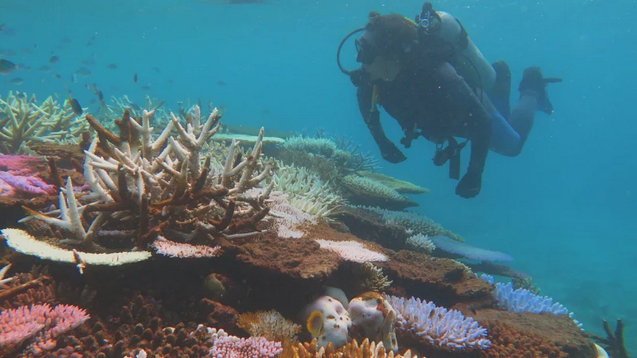
The Great Barrier Reef has lost half its corals, with a decline in the number of shallow and deep water corals across almost all species in the past two decades.

The decrease was most marked in branching and table-shaped corals, which were the worst affected by record-breaking temperatures that triggered mass bleaching in 2016 and 2017. The study was completed before another mass coral bleaching event this year, which has probably exacerbated the decline.

The number of small, medium and large corals dropped more than 50 per cent between 1996 and 2017, researchers from the Townsville-based ARC Centre of Excellence for Coral Reef Studies, who assessed coral communities and their colony size, have said.

Half of the Great Barrier Reef's corals have been lost. Credit: Tony Chase


These surveys also showed fewer baby coral and large breeding corals, lead researcher Dr Andy Dietzel and co-author Professor Terry Hughes said in a study published in Proceedings of the Royal Society on Wednesday.
There is no time to lose - we must sharply decrease greenhouse gas emissions ASAP
Study authors
“The loss of big corals is important because they make all the babies - they’re responsible for a huge proportion of the breeding that’s done every year by adult corals,” Professor Hughes said.

The climate crisis has driven marine heatwaves, with the research recording steeper deterioration of coral colonies in the northern and central Great Barrier Reef after mass coral bleaching in 2016 and 2017.

Dead coral at the Great Barrier Reef. Credit: Tony Chase

The southern part of the reef was also exposed to record-breaking temperatures and extensive bleaching in early 2020 (this data was not included in the study).

Corals rely on algae known as zooxanthellae to provide the bulk of their energy and much of their vibrant colour. When exposed to sustained abnormal heat - measured in so-called degree-heating days - corals begin to expel the algae, leading to mass bleaching.

Branching and table-shaped corals provide shelter and habitat for reef inhabitants such as fish, and their loss reduces fish abundance and the productivity of coral reef fisheries.

Bleaching on the Great Barrier Reef corals near Cooktown in March 2020. Credit: Via Terry Hughes

“These types of corals are three-dimensional - they make the nooks and crannies that are essential for the biodiversity of the coral reef,” Professor Hughes said.

Better data on the demographic trends of corals is needed to understand how their populations are changing, the researchers found.

“We used to think the Great Barrier Reef is protected by its sheer size—but our results show that even the world’s largest and relatively well-protected reef system is increasingly compromised and in decline,” Professor Hughes said.

The authors are concerned about the shrinking gap between bleaching events because there is little opportunity for corals to rebound.

“There is no time to lose - we must sharply decrease greenhouse gas emissions ASAP,” the research paper states.

Global temperature increases would need to stabilise between 1.5 and two degrees for the reef to remain, even if it was quite different to what exists now, Professor Hughes said. “If it’s three or four degrees then forget about it.”

This year, February had the highest monthly sea surface temperatures ever recorded on the Great Barrier Reef since the Bureau of Meteorology’s records began in 1900.

The warming ocean is affecting reefs worldwide, including off the coast of Brazil, in parts of Melanesia and Indonesia.

Links

15/10/2020

Greta Thunberg: ‘Only People Like Me Dare Ask Tough Questions On Climate’

The Guardian

The activist discusses a new film that follows her life and the role autism played in her journey from troubled child to eco champion

Greta Thunberg outside the Swedish parliament building in Stockholm. Photograph: Anders Hellberg

For a teenager who first became famous for skipping school, Greta Thunberg has come a long way.

The 17-year-old from Stockholm is today a global champion of the environment movement and the uncompromising scourge of climate crisis deniers.

In the process, she has earned the disdain of Donald Trump and the plaudits of figures including the pope and David Attenborough. For good measure, Time made her the magazine’s Person of the Year for 2019.

It is an astonishing journey that will be brought to our screens this week with the release of I am Greta, a 97-minute documentary that follows the activist, who has autism, on trips round the world as she raises the banners of green concern among young campaigners.


At the United Nations, we see her warning its secretary general, António Guterres, that “political leaders have failed us – but now change is coming”.

At the Vatican, we see her greeted by a huge crowd chanting “Go Greta, save the planet!” and, later, flotillas of boats sailing out to meet her when the zero-carbon yacht that had carried her across the Atlantic to attend a UN climate meeting arrives in New York.

As I am Greta makes clear, the world has reacted in a remarkable way to this slight, determined figure. 

Even more astonishing is the nature of the figure at the centre of these events, for Thunberg is adamant that her condition – she freely acknowledges she is autistic – has played a critical role in helping her get her message across in a clear and simple manner.

Thunberg addressing the UN Climate Summit in New York. Photograph: Jason DeCrow/AP

“To get out of this climate crisis, we need a different mindset from the one that got us into it,” she said in an interview with the Observer last week.

“People like me – who have Asperger’s syndrome and autism, who don’t follow social codes – we are not stuck in this social game of avoiding important issues.

“We dare to ask difficult questions. It helps us see through the static while everyone else seems to be content to role-play.”

Thunberg believes her condition helps her look at the world and see what others cannot, or will not, see. She dislikes small talk and socialising, preferring to stick to routines and stay “laser-focused”.

And her ability to concentrate fiercely is acknowledged by her father, Svante Thunberg. “She can read a book and remember everything in it,” he says ruefully.

But while she argues that her disorder has given her a unique vision of the looming crisis being unleashed by rising carbon dioxide emissions, we see that it has also brought her considerable unhappiness.

Her early childhood was marked by several painful episodes, and at the age of 11 she simply withdrew from life. “She stopped laughing,” says her mother, Malena Ernman. “She stopped talking. And she stopped eating.”

As Thunberg puts it: “I almost starved to death.”

The youngster stayed away from school for a year. “She only spoke to me, her mother and her little sister,” says her father in the documentary.

Thunberg is equally forthcoming in the film about the unhappiness she experienced.

“For many years, people – especially children – were very mean to me. I was never invited to parties or celebrations. I was always left out. I spent most of my time socialising with my family – and my dogs.” (The latter, black labrador Roxy and golden retriever Moses, play major roles in her life, as the film makes clear.)

Thunberg managed to pull back from the brink, however, and for most of the documentary we see a fairly happy individual: cooking with her mother and laughing with her father. Nevertheless, hers is an unusual background for a person who has become a global star.

Thunberg with Belgian campaigners on a school climate strike in Brussels in 2019.

The process began with her school strike – against Swedish politicians’ failures to take meaningful action on the climate crisis. “Why have an education when there is no future,” she demanded.

The strike was a social media sensation and almost overnight Thunberg became a star of the green movement.

She has since spoken to the UN nations in New York, appeared at the COP24 climate conference in Katowice, in Poland and visited the European Parliament.

At the EU she broke down in tears during a speech in which she outlined the extent of the extinctions, triggered by climate change, that were occurring across the planet.

And at the 2019 UN climate summit in New York, an infuriated Thunberg told delegates: “People are dying. Entire ecosystems are collapsing. We are in the beginning of a mass extinction, and all you can talk about is money and fairytales about eternal economic growth. How dare you!”

Intriguingly, Thunberg insists her performance at the general assembly was an unusual one for her. “I’m never angry. I’m not even angry at home. That was the only time I’ve been angry. Before that speech, I thought, this is a once-in-a-lifetime opportunity. I need to make sure something comes out of it. So I let my emotions take over.”
"We are stuck in a loop where everyone just blames each other, and if we keep on doing that, we won’t achieve anything"
Greta Thunberg
Her words are pretty uncompromising in general, however, and her speeches have earned her the approbation of fans who range from Arnie Schwarzenegger to Jon Bercow to Emmanuel Macron and also attracted the scorn of Brazil’s populist president Jair Bolsonaro, Russia’s Vladimir Putin, and others.

Thunberg has also received death threats, we learn. So are they still being sent, I ask her? Thunberg looks unfazed. “I don’t know. I don’t spend that much time checking.”

She is equally unperturbed by the political derision she has provoked. “When these people attack individuals – in some cases, children like me – that shows that they really have nowhere left to go,” she tells me.

“They have no arguments left. This is a crisis completely based on scientific consensus, but they try to focus on something else. It’s as if there was a fire and the alarm starts and they try to argue about the fire alarm instead of the actual fire.”

The pattern needs to be disrupted, she insists. “We are stuck in a loop where everyone just blames each other, and as long as we keep on doing that we won’t be able to achieve anything.”

The extent of humanity’s vulnerability is starkly demonstrated by the impact of Covid-19, adds Thunberg. “If one virus can completely destroy economies, then that is a sign that we need to rethink things and start to live sustainably.”

If nothing else, Covid emphasises again that we need to listen to the science, she insists.

Thunberg is now studying for her school exams and is planning a career in the social sciences.

“All this attention isn’t going to last for very long,” she believes. “The interest in me will soon fade away. And, really, it’s not healthy at such a young age. So I need to see past it – although all the travelling was good fun.”

As to the documentary, Thunberg says she is happy with it, although the title makes her uncomfortable as it suggests she takes herself very seriously. “And I don’t,” she insists.

Links

(AU) 5 Australian Women Who Are Solving The Biggest Problems Of Climate Change.

MamamiaGemma Bath

L'Oreal-UNESCO Women in Science program


In a world preoccupied by the coronavirus pandemic (and for good reason), another global emergency is being somewhat forgotten.

Climate change. 

Thankfully for us, there are still plenty of remarkable minds working away behind the scenes on future-proofing our planet for the decades to come.

While a pandemic responsible for killing one million people around the world (and rising) should never be celebrated, there have been some flow-on effects that are benefiting our fight for the planet.

We're living through the biggest carbon crash we have ever recorded, with a number of different analyses showing we will be using between two and three billion tonnes less warming gas in 2020. 

But air travel won't stay grounded forever, and road transport will eventually return to normal levels sending our CO2 levels climbing once again.

So while our governments, virus scientists and policy-makers remain largely preoccupied by coronavirus, climate scientists and experts are busy working on solutions.

Here are just five women (four Aussies and one New Zealander) who are making serious scientific progress when it comes to addressing climate change. All were recently awarded $25,000 Fellowships for their work, as part of the 2020 L'Oréal-UNESCO For Women in Science program.

Dr Kate Nguyen - chemical and civil engineer
Dr Kate Nguyen Image: L'Oreal-UNESCO

Dr Kate Nguyen from RMIT University is currently working on a sustainable coating that could literally save thousands of homes from bushfires.

Last year our bushfire season was unprecedented, killing 34 people, nearly three billion animals and destroying at least 3,500 homes in thousands of fires. We've been warned more seasons like the devastation of 2019/2020 are in our future as our planet continues to warm.

Dr Nguyen's ceramic-like coating is made from industrial waste that would ordinarily end up in landfill, turned into an environmentally friendly coating that will provide a protective envelope over a building.

Speaking to Mamamia, Dr Nguyen says she was inspired by naturally fire resistant native trees in Australia, and as a mother of two young girls she is very interested in helping "the sustainable development of our cities for future generations."

Thanks to funding support from the L'Oréal-UNESCO For Women in Science program, Dr Nguyen has been able to start work on the project immediately in 2020, and while the coating won't be ready for the bushfire season that's already upon us, she's hopeful to have some pilot applications up and running for the 2021/2022 season.

"Like millions of Australians I watched with horror the bushfires that ravaged part of the country earlier this year. I hope my research can protect many homes in fire-stricken areas," said Dr Nguyen.


Dr Emma Camp - coral biologist and marine bio-geochemist
Dr Emma Camp Image: L'Oreal-UNESCO

Thanks to our warming planet, we are at a real risk of losing Queensland's incredible Great Barrier Reef within our lifetime.

The reefs aren't just beautiful, they're essential for our marine life - taking up just one per cent of the ocean floor, but housing 20 per cent of our marine life.

University of Technology Sydney's Dr Emma Camp is focusing her expertise on finding resistant corals that have the ability to survive in increasingly hostile ocean conditions.

Dr Camp hopes to understand the genetic traits of these corals and seed a stock of them which they can then transplant into areas devastated by mass coral death, to hopefully bide us some time as we take action, as a global community, while we reduce our carbon emissions.

Speaking to Mamamia Dr Camp says 2020 has given us a new perspective.

"The global disruption to our normal way of life due to COVID-19 presents a unique opportunity to create a new norm, one where we are not separate from nature and we focus on addressing the loss of biodiversity and climate change," she said.

"If we lose coral reefs we lose not only an immensely beautiful, intricate and fascinating ecosystem, we lose the biodiversity it maintains and a whole suite of ecosystem services they provide," Dr Camp told Mamamia.

"My research is looking to aid corals by 'buying them time,' but we fundamentally need to address the causes of climate change... the continued barrier of inaction or slow action is frustrating and heartbreaking as I am witnessing the impacts it is having on our amazing reef systems," she warned.


Dr Marzi Barghamadi - experimental scientist
Dr Marzi Barghamadi Image: L'Oreal-UNESCO

CSIRO's Dr Marzi Barghamadi is working on lithium metal battery technology, to create longer lasting and higher power batteries so that we can all one day zip around in powerful electric cars.

There are several critical changes that must be addressed for these kinds of batteries to meet requirements, and Dr Barghamadi's research aims to solve one of the biggest challenges - the mechanism behind metal degradation that results in batteries with a low cycle life and low safety.

"We all want electric cars that will allow us to drive longer distances with one charge," she explained.

"Lithium batteries have a much lower environmental impact than fossil fuels. So, the aim is to replace more fossil fuels with these batteries," she added.

Realistically, Dr Barghamadi doesn't see electric cars being rolled out en masse in the "early future," but tells Mamamia, "we can speed this transition."

"Governments, especially in developed countries, could look at investing more in green energy sources and supporting climate change initiatives," she said.

In 2019, electric vehicles made up roughly about 0.5 per cent of all vehicles on the road, but Dr Barghamadi is confident that "they could be, and will be our future reality if we as a society take considered steps towards this transition."


Dr Adele Morrison - climate and fluid physicist
Dr Adele Morrison Image: L'Oreal-UNESCO

Australian National University scientist Adele Morrison spends her days researching oceanic movements around Antarctica's ice sheet to determine when coastal cities will be at risk of rising sea levels. 

It's pretty grim stuff, but as Dr Morrison tells Mamamia: "The response needed to limit global warming is simple. The first step is to reduce CO2 emissions to zero as soon as possible and the technology to do this already exists."

Dr Morrison is talking about things like renewable electricity, pumped hydropower, electric vehicles, electric heating and hydrogen powered aircraft.

"It's just the willpower that's lacking," she said, pointing to the Australian government's approach as one that's "clearly not working."

With 85 per cent of the Australian population currently living within coastal regions, rising sea levels are of a major concern, and Dr Morrison's research is crucial for the future planning of our country. 

But for someone who literally spends her days mapping when cities will likely be underwater, Dr Morrison is confident we can turn things around.

"The bold and science led response to COVID-19 by both state and federal governments has been one of the most successful responses in the world. It shows Australia is capable of swiftly tackling an emergency situation," she told Mamamia

"We need a similar ambitious science-led approach to reduce the risk of climate change."


Dr Shari Gallop - marine environmental scientist
Dr Shari Gallop Image: L'Oreal-UNESCO

Dr Shari Gallop, from the University of Waikato in New Zealand, is looking into the restoration of estuaries, which are present on coasts all around the world and are hugely important for the preservation of the ecosystems that prop up many of our communities. 

Many of the world's largest cities, including Sydney, New York, Tokyo and London, are built around estuaries, and right now they're under increasing pressure.

"Now we know better that estuaries are really important, [but] in the past they have sometimes been considered as 'low value' which means they often haven't been taken care of as they should," Dr Gallop told Mamamia.

Dr Gallop is focusing on 'working with nature' approaches to restore these highly vulnerable interfaces between the land and sea, and is trying to get a better understanding of what makes these restoration projects succeed or fail, so we can continue to future proof them. 

"Without these answers, we could be designing estuarine restoration projects and putting huge amounts of resources into making them happen, perhaps without a full consideration and appropriate tools to account for the impacts of climate change," she told Mamamia. 


Links

(AU) ANU's Adele Morrison Receives $25,000 L'Oréal-UNESCO For Women In Science Grant For Climate Change Research

Canberra Times - Amy Martin

Adele Morrison secured a fellowship and grant from the L'Oréal-UNESCO For Women in Science program. Picture: Sitthixay Ditthavong

If all of Antarctica was to melt, it would increase the sea level by nearly 60 metres and would see cities such as Sydney disappear.

It's not a pleasant thing to think about but for Australian National University scientist Adele Morrison, it's something that she considers on a daily basis.

The climate and fluid physicist researches oceanic movements around Antarctica's ice sheet to determine when coastal cities will be at risk of rising sea levels. It is this work which on Monday saw her awarded a fellowship and a $25,000 grant from the L'Oréal-UNESCO For Women in Science program.

The L'Oréal-UNESCO For Women in Science program aims to address the under-representation of women in science.

According to United Nations Educational, Scientific and Cultural Organization (UNESCO) data, less than 30 per cent of the world's researchers are female.

It's for this reason that Dr Morrison says the benefit of receiving the grant is not just what the money will do for her research but that it also draws attention to the under-representation of women in science.

"It depends on what level of science you're looking at. The numbers at a PhD level and early career stage - which is where I am - are actually pretty equal," she says.

"The problem occurs higher up at the leadership stage. In Australia, 17 per cent of senior Australian researchers working in science are female. It just drops off dramatically at about this stage because that's when women start having kids and it becomes hard to keep working at the top level.

"Universities in Australia are fantastic - at least at ANU it is - and they've put in a lot of great policies for helping women and trying to increase the representation at higher levels.

"But this culture is only just really starting to change, and internationally it's pretty dire."

Dr Morrison is undertaking advanced computer modelling to study and map the ocean activity relevant to the melting of the Antarctic sheet so that it can be determined how long it will be until cities are underwater.

With 40 per cent of the global population and 85 per cent of the Australian population currently living within coastal regions, the rising of sea levels in coming years caused from the melting of Antarctica's ice sheets is of major concern.

"The impact of the sea level will mostly be felt from extreme sea-level events, so it's not so much just the slow inundation from rising sea level, it's when you get extreme events," Dr Morrison says.

"These currently occur when you get like a king high tide combined with a storm event. You might remember back in 2016 there was one of these events on the northern beaches in Sydney and there were photos of swimming pools and backyards falling into the ocean.

"These extreme sea-level events do happen naturally but they used to happen infrequently and the frequency of these events is now increasing.

"The projections are that by 2050, most of the coastlines around Australia will experience what used to be a once-in-a-century ocean flooding event every single year." 

Links

14/10/2020

(AU) Australia's Summer Forecast – Intense Heatwaves And More Cyclones

 - Josh Dutton

NSW and Victorian residents are going to have to brace for sweltering summer weather with more intense heat waves forecast.

The Bureau of Meteorology released its severe weather outlook for the rest of October until April on Monday.

The bureau last month said Australia will experience La Niña in the coming months. BOM manager of Climate Operations Dr Andrew Watkins said it means we’ve got warmer ocean water near Australia with cooler water off the south.


Much of Australia is in with a good chance of exceeding the median minimum temperature in December. Source: BOM

It tends to favour rainfall and cloudiness, he said. And while there will be fewer days of extreme heat in southern states, they will be more intense this summer.

The severe weather outlook forecasts longer heat waves for South Australia, Victoria and NSW.

Meteorologist Diana Eadie said Australia “is warming”.

“Extreme heat days are more likely than compared to the past due to the impacts of climate change,” she said.

“This summer, rain and increased humidity, thanks to La Niña, means we face a reduced number of extreme heat days compared to recent years.

“But while heatwaves may not be as severe in southern areas, they may last longer and be more humid both of which can increase the risk to human health.”

Victoria could see longer heatwaves over the next few months. Source: BOM

Hot temperatures for late October

By BoM’s definition, a heatwave occurs when maximum and or minimum temperatures “are unusually hot over a three-day period” in a specific location.

According to BoM’s climate outlook maps, most of Australia, if temperatures do exceed the average, most of the searing heat will occur between December and February.

However, the two weeks from October 19 through to November 1 promise to be hot too with southern NSW, South East Queensland, Darwin, Canberra, Melbourne and Perth all a 60-80 per cent chance of exceeding the median minimum temperature.

For Darwin and Hobart, it’s at 70-80 per cent.

A man paddle-boards at Glebe's Blackwattle Bay in Sydney last summer as smoke haze fills the air. Source: AAP


Cyclones and flooding await

The La Niña event also brings more cyclones. In fact, in 2011 when Australia experienced La Niña South East Queensland was pummelled by flooding.
BoM believes eastern Australia and parts of the north will experience more rain over the coming months. It could lead to more mosquitoes too.
Climatologist Greg Browning said past years have seen less cyclones but the upcoming weeks and months will buck that trend.

"On average Australia sees nine to 11 tropical cyclones each year, with four crossing the coast. With La Niña this year we are expecting to see slightly more tropical cyclones than average, and the first one may arrive earlier than normal," Mr Browning said.

"Every northern wet season has had at least one tropical cyclone cross the Australian coast, so we can never be complacent. We know that cyclones can develop at any time throughout the tropical cyclone season, which runs from November to April.

"This means that communities right across northern Australia need to be prepared now, and stay informed from the very start of the tropical cyclone season in October, right through until April."

Residents look on after the Balonne river floods in St George in Queensland's southwest in February. Source: AAP

The Northern Territory could be hit with an earlier onset of monsoons while Queensland could see more cyclones bringing widespread flooding.

While spring through to summer is normally a dry period for South Australia it’s also likely to see more rain than usual while Tasmania, NSW, northern WA and the ACT could also see widespread flooding.

North Queensland might see an earlier start to the wet season too.

November through to January looks to be the wettest period though with parts of NSW’s north across the Queensland border to the Sunshine Coast, according to BOM’s climate outlook.

A man soaks up the heat at Sydney's Coogee Beach. Source: Getty Images


October 19 through to November 1 has parts of northern NSW, South East Queensland and Darwin at about 65-70 per cent chance of surpassing median rainfall.

November could be a wet month for Sydney, Melbourne, Canberra and Adelaide too with a 65-75 per cent chance of exceeding median rainfall.

Links

Lethal Heating is a citizens' initiative