President Trump announcing the US pull out from Paris in June 2017.
Getty Images
After a three-year delay, the US has become the first nation in the
world to formally withdraw from the Paris climate agreement.
President Trump announced the move in June 2017, but UN regulations meant
that his decision only takes effect today, the day after the US election.
The US could re-join it in future, should a president choose to do so.
The Paris deal was drafted in 2015 to strengthen the global response to
the threat of climate change.
It aims to keep the global temperature rise this century well below 2C
above pre-industrial levels and to pursue efforts to limit the temperature
increase even further to 1.5C.
Why has this taken so long?
The delay is down to the complex rules that were built into the Paris
agreement to cope with the possibility that a future US president might
decide to withdraw the country from the deal.
Protestors objecting to President Trump's climate policies
project their message onto one of his hotels.
Getty Images
Previous attempts to put together a global pact on climate change had
foundered because of internal US politics.
The Clinton administration was unable to secure Senate backing for the
Kyoto Protocol, agreed in 1997.
So in the run up to the Paris climate talks, President Obama's negotiators
wanted to ensure that it would take time for the US to get out if there
was a change in leadership.
Even though the agreement was signed in December 2015, the
treaty only came into force on 4 November 2016, 30 days after at least 55 countries representing 55% of global
emissions had ratified it.
No country could give notice to leave the agreement until three years had
passed from the date of ratification.
Even then, a member state still had to serve a 12-month notice period on
the UN.
Trump: The world won't laugh any more at US
So, despite President Trump's
White House announcement in June 2017, the US was only able to formally give notice to the UN in November
last year. The time has elapsed and the US is now out.
What will the withdrawal mean in practice?
While the US now represents around 15% of global greenhouse gas
emissions, it remains the world's biggest and most powerful economy.
So when it becomes the only country to withdraw from a global solution
to a global problem it raises questions of trust.
Former Secretary of State John Kerry holds his
granddaughter as he signs the Paris agreement at the UN.
Getty Images
"Being out formally obviously hurts the US reputation," said Andrew
Light, a former senior climate change official in the Obama
administration.
"This will be the second time that the United States has been the
primary force behind negotiating a new climate deal - with the Kyoto
Protocol we never ratified it, in the case of the Paris Agreement, we
left it."
"So, I think it's obviously a problem."
How is the US pull out being viewed?
Although this has been a long time coming, there is still a palpable
sense of disappointment for many Americans who believe that climate
change is the biggest global challenge and the US should be leading
the fight against it.
"The decision to leave the Paris agreement was wrong when it was
announced and it is still wrong today," said Helen Mountford from the
World Resources Institute.
"Simply put the US should stay with the other 189 parties to the
agreement, not go out alone."
The formal withdrawal has also re-opened old wounds for climate
diplomats.
Getty Images
"It's definitely a big blow to the Paris agreement," said Carlos
Fuller, from Belize, the lead negotiator for the
Alliance of Small Island States
in the UN talks.
"We actually worked very hard to ensure that every country in the
world could accede to this new agreement. And so, by losing one, we
feel that basically we have failed."
Others say that the US pull-out is partly due to the failure of the
Obama administration to have the Paris agreement ratified by the US
Senate.
"What Obama did at the end of his second term was fundamentally
undemocratic, to sign up to a Paris agreement without going to the
Senate and the Congress and instead doing it via executive order,"
said former UN climate chief, Yvo De Boer.
"And then, in a way, you're setting yourself up for what has happened
now."
Could the US re-join the agreement?
Yes, it could.
In fact, while on the campaign trail, Joe Biden said he would seek to
re-join as soon as possible - if he was elected President.
Under the rules, all that is required is a month's notice and the US
should be back in the fold.
However, even if the US chose to re-enter the agreement, there would
be consequences for being out - even for a few months.
"We know that the UK and the EU and the UN Secretary General are
planning an event on 12 December, on the fifth anniversary of the
conclusion of negotiations for the Paris agreement, where they're
going to try to drive more ambition," said Andrew Light.
"Under the Paris rules, the US will not be able to participate in
that."
Not everyone in the US is upset to leave the Paris agreement?
President Trump made leaving Paris a key part of his election platform
in 2016, tying it into his vision of a revitalised US with booming
energy production, especially coal and oil.
His perspective on the Paris agreement was that it was unfair to the
US, leaving countries like India and China free to use fossil fuels
while the US had to curb their carbon.
"I'm not sure what Paris actually accomplishes," said Katie Tubb, a
senior policy analyst at the
Heritage Foundation, a conservative US think tank.
"In terms of getting to the end of the century, if the goal is to
reduce global temperatures, it just can't be done on the backs of the
industrialised world."
"No matter what you think about global warming, and the nature of it,
the pace of it, you have to take these growing economies seriously,
and help them and I just didn't see Paris getting to that end, in any
efficient or constructive manner."
How have US opponents of the pull-out reacted over the past three
years?
In the wake of the President's announcement back in 2017, a number of
states and businesses have pledged to continue cutting carbon and to
try and make up for the Federal government's decision to walk away
from the US commitment under Paris.
Among them are
America's Pledge, put together by former California governor Jerry Brown and the
former mayor of New York, Michael Bloomberg.
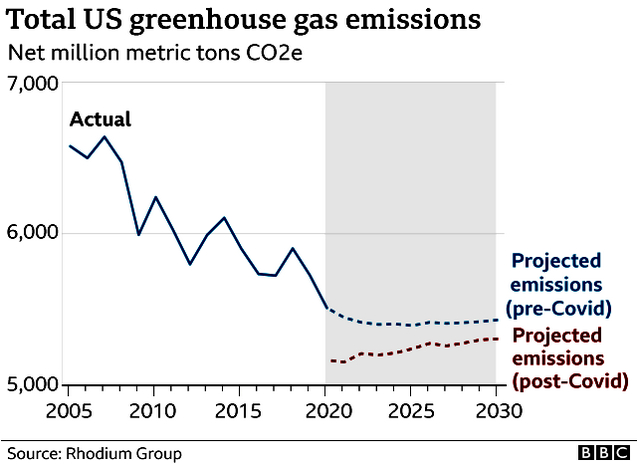
They say that states and cities will help cut US emissions by 19%
compared to 2025 from what they were in 2005 - that's not enough to
make up for the US promise under Paris but it keeps those targets
"within reach".
At UN climate talks, groups representing states and cities
that want to remain in the Paris pact have made their
presence felt. Getty Images
"The public understands that fighting climate change goes hand in hand
with protecting our health and growing our economy," said Michael
Bloomberg in a statement.
"So despite the White House's best efforts to drag our country
backward, it hasn't stopped our climate progress over the past four
years."
On the business front, there has been growing pressure from
shareholders of large fossil fuel-based industries to face up to the
climate challenge.
A proposal filed by BNP Paribas Asset Management won a 53% majority
vote at Chevron - it called on the oil giant to ensure that its
climate lobbying was in line with the goals of the Paris agreement.
Will other countries now leave the agreement?
"I don't think anyone will follow Mr Trump out of Paris," said Peter
Betts, a former lead negotiator for the UK and the EU in the global
climate negotiations, and now an associate fellow at
Chatham House.
"Nobody has in the last four years and I don't think they will in the
future."
Some are worried that the US withdrawal will see other countries adopt
a go-slow attitude, at a time when scientists are saying that efforts
should be speeded up.
China's President Xi speaking to the UN on climate change,
seen on an outdoor screen in Beijing.
Getty Images
"They are biding their time, they are saying that if the US is not in
then we don't need to rush to do anything at this time'," said Carlos
Fuller, lead negotiator from the Alliance of Small Island States.
"I think they are hedging their bets to see what kind of a better deal
they can get out of it, and not actually withdraw."
Others are hopeful that the US withdrawal will drive a sense of unity
among others, and see new leadership emerge.
"The EU green deal and
carbon neutrality commitments from China, Japan and South Korea point to the inevitability of our collective
transition off fossil fuels," said Laurence Tubiana, one of the
architects of the Paris agreement and now chief executive of the
European Climate Foundation.
"There were always going to be speed bumps as the global economy
shifted off oil, gas and coal - but the overall direction of travel is
clear. As governments prepare stimulus packages to rescue their
economies from covid-19 it's vital they invest in technologies of the
future, not the past."
Republican climate denial is even scarier than Trumpism.
Credit...Pavel Lvov/Sputnik, via Associated Press
Author
Paul Krugman has been an Opinion columnist since 2000 and is also a Distinguished Professor at the City University of New York Graduate Center. He won the 2008 Nobel Memorial Prize in Economic Sciences for his work on international trade and economic geography.
The most terrifying aspect of the U.S. political drama isn’t the revelation
that the president has abused his power for personal gain. If you didn’t see
that coming from the day Donald Trump was elected, you weren’t paying
attention.
No, the real revelation has been the utter depravity of the Republican
Party. Essentially every elected or appointed official in that party has
chosen to defend Trump by buying into crazy, debunked conspiracy
theories. That is, one of America’s two major parties is beyond
redemption; given that, it’s hard to see how democracy can long endure,
even if Trump is defeated.
However, the scariest reporting I’ve seen recently has been about
science, not politics. A
new federal report
finds that climate change in the Arctic is accelerating, matching what
used to be considered
worst-case scenarios. And there are indications that Arctic warming may be turning into a
self-reinforcing spiral, as the thawing tundra itself
releases
vast quantities of greenhouse gases.
Catastrophic
sea-level rise, heat waves that make major population centers
uninhabitable, and more are now looking more likely than not, and sooner rather than
later.
But the terrifying political news and the terrifying climate news are
closely related.
Why, after all, has the world failed to take action on climate, and why
is it still failing to act even as the danger gets ever more obvious?
There are, of course, many culprits; action was never going to be easy.
But one factor stands out above all others: the fanatical opposition of
America’s Republicans, who are the world’s only major climate-denialist
party. Because of this opposition, the United States hasn’t just failed
to provide the kind of leadership that would have been essential to
global action, it has become a force against action.
And Republican climate denial is rooted in the same kind of depravity
that we’re seeing with regard to Trump.
As I’ve written in the past, climate denial was in many ways the
crucible for Trumpism. Long before the cries of “fake news,” Republicans were refusing to
accept science that contradicted their prejudices. Long before
Republicans began attributing every negative development to the
machinations of the “deep state,” they were insisting that global
warming was a gigantic hoax perpetrated by a vast global cabal of
corrupt scientists.
And long before Trump began weaponizing the power of the presidency for
political gain, Republicans were using their political power to harass
climate scientists and, where possible, criminalize the practice of
science itself.
Perhaps not surprisingly, some of those responsible for these abuses are
now ensconced in the Trump administration. Notably, Ken Cuccinelli, who
as attorney general of Virginia engaged in a long
witch-hunt
against the climate scientist Michael Mann, is now at the Department of
Homeland Security, where he pushes anti-immigrant policies with, as The
Times
reports, “little concern for legal restraints.”
But why have Republicans become the party of climate doom? Money is an
important part of the answer: In the current cycle Republicans have
received 97 percent of political contributions from the
coal industry, 88 percent from
oil and gas. And this doesn’t even count the wing nut welfare offered by
institutions supported by the Koch brothers and other fossil-fuel moguls.
However, I don’t believe that it’s just about the money. My sense is
that right-wingers believe, probably correctly, that there’s a sort of
halo effect surrounding any form of public action. Once you accept that
we need policies to protect the environment, you’re more likely to
accept the idea that we should have policies to ensure access to health
care, child care, and more. So the government must be prevented from
doing anything good, lest it legitimize a broader progressive agenda.
Still, whatever the short-term political incentives, it takes a special
kind of depravity to respond to those incentives by denying facts,
embracing insane conspiracy theories and putting the very future of
civilization at risk.
Unfortunately, that kind of depravity isn’t just present in the modern
Republican Party, it has effectively taken over the whole institution.
There used to be at least some Republicans with principles; as recently
as 2008 Senator John McCain co-sponsored serious climate-change
legislation. But those people have either experienced total moral
collapse (hello, Senator Graham) or left the party.
The truth is that even now I don’t fully understand how things got this
bad. But the reality is clear: Modern Republicans are irredeemable,
devoid of principle or shame. And there is, as I said, no reason to
believe that this will change even if Trump is defeated next year.
The only way that either American democracy or a livable planet can
survive is if the Republican Party as it now exists is effectively
dismantled and replaced with something better — maybe with a party that
has the same name, but completely different values. This may sound like
an impossible dream. But it’s the only hope we have.
Tim Flannery has been speaking about climate change for decades – but
he’s finding it harder and harder to be the bearer of bad news
‘As the news darkens, I’m having difficulty talking to young people
about it’: Prof Tim Flannery.
Photograph: Carly Earl/The Guardian
Author
Tim Flannery
is a scientist, an explorer, a conservationist and a leading writer on
climate change. He has held various academic positions including
visiting Professor in Evolutionary and Organismic Biology at Harvard
University, Director of the South Australian Museum, Principal
Research Scientist at the Australian Museum, Professorial Fellow at
the Melbourne Sustainable Society Institute, University of Melbourne,
and Panasonic Professor of Environmental Sustainability, Macquarie
University.
Being a bearer of bad news is never easy. I’ve been writing and talking about
climate change for decades now.
Constant exposure hardens one to even the most horrific reality, and I’ve
coped by acting like a jolly hangman – or at least not giving in publicly to
the helplessness I sometimes feel as I relate the latest findings.
But as the news darkens, I’m having difficulty talking to young people about
it. I can tell an optimistic story about developing technologies and the
role they can play in helping avert the worst of the crisis.
But we have now left action so late that some very severe climate impacts
seem unavoidable. When I try to imagine how I, as a young person, would
react to such news, I find it hard to continue my work.
I was recently asked to speak to a group of around 40 emerging leaders, all
in their 30s and 40s. The meeting was conducted early in the morning, via
Zoom. I began with an overview of the impacts of climate change as it’s
emerging, as outlined in the Intergovernmental Panel on Climate Change’s
sixth assessment report.
Tim Flannery’s The Climate Cure. ‘We have now left action so late that some very severe climate
impacts seem unavoidable,’ he says. Photograph: Text Publishing
The report, which is still being drafted, is filled with terrifying news of
melting ice caps, burning forests and climate tipping points being closer
than we previously thought. Because I deal with such matters every day, I’m
somewhat numbed to them. But I could see that they were having a profound
effect on my audience.
The group of emerging leaders I spoke to included a young executive from the
fossil fuel industry. During the discussion that followed, he commented that
most of the younger people in his industry, himself included, felt as I did
about the emerging climate crisis.
But while some have left to establish renewable energy companies, many more
have stayed on, regardless of their personal feelings. Changing one’s
career, especially if you’ve been successful, is not easy. Perhaps those who
remain fear that they will plunge their families into poverty if they try to
re-skill and seek work elsewhere.
The young executive then told us what it’s like to drive with his family
in his branded work vehicle. Abuse is frequently hurled at him by those
who despise what his company is doing, and that experience is shared by
his children. I watched the faces of the Zoom participants as the distress
of the executive grew. As parents we could all picture the scenario: the
children locked into place for a journey they can’t escape from, as
tension between adults explodes.
I know exactly how he felt. When I was climate commissioner, my older two
children were teenagers. On several occasions when I was enjoying a weekend
in the city with them, people shouted at me, “F– off Mr Carbon Tax”, and
other abusive things.
I could say nothing to the abusers, who were itching for a fight. And the
embarrassment and hurt on the faces of my kids still haunts me. As they grew
older, they came to understand that those who screamed at me were ignorant
and scared. But I didn’t do a very good job, at the time, of talking with
them about the reasons for the abuse.
The reaction of very young children to the climate crisis is of even greater
concern. What I didn’t realise, on the morning of that Zoom call, was that
my youngest child, aged seven, had not been asleep as I thought, but had
been listening to the entire presentation.
That realisation brought me up sharp. My son is a bright boy, interested in
science and space, so I’m pretty sure he understood what I said. And I’m
sure that the emotionally fraught discussion he witnessed had an impact on
him. But how, now, am I to talk to him about our future?
Our children carry the lessons learned in childhood far into the future. Uli
Edel’s 2009 film
The Baader Meinhoff Complex
documents the bombings, bank robberies and killings that were carried out by
radical gangs in Germany in the 1970s and 80s.
Based on detailed evidence, it makes the case that radicalised youth was a
response to the unacknowledged Nazi past of their parents’ generation. The
Baader Meinhoff gang grew up in a world where prominent Nazis remained in
positions of high authority. They acted as they did because they felt there
had been no justice – no reckoning for the horrific acts their parents had
been part of.
I strongly believe we need to speak with our children about the growing
climate threat: about responsibility, impacts and forgiveness. Yet as I look
at my young son playing with his Lego or reading his children’s books, my
courage fails me. I keep putting the discussion off, as I suspect many
workers in the fossil fuels industry do when it comes to speaking to their
children.
Yet if we fail to explain the state of the world we have created, and our
role in helping create it, I greatly fear that some in the next generation
will grow into very angry young people indeed.
Martin Wolf is chief economics commentator at the Financial Times, London. He was awarded the CBE (Commander of the British Empire) in 2000 “for services to financial journalism”.
A renewed presidency for Donald Trump is likely to be nowhere more
consequential than for climate change. The coming decades will determine
whether the threat of damaging and irreversible change is averted, or not.
Without active US engagement, success seems inconceivable. Even with it, it
would be unlikely. But, crucially, it would be conceivable. We know what to do
and we know, too, that it is affordable. What is unaffordable is not to do
what we need to do. But will we? That is the question.
It is indicative of the shift in the perspective of the global policy
establishment that a chapter of the IMF’s October
World Economic Outlook
focuses on “mitigating climate change” — that is, preventing it — via
“growth-and-distribution-friendly strategies”. In brief, the IMF insists that
humanity can have its cake and eat it: both higher incomes and a safe climate.
As a result of rising concentrations of greenhouse gases in the
atmosphere, global average temperatures are already about 1C above
pre-industrial levels. On present trends, this could reach around 1.5C in a
decade and 2C half a decade later. At that point, warn climate scientists,
dangerous and irreversible tipping points in the climate are likely to be
passed. Most governments do at least pretend to agree. Thus,
in the Paris accords of December 2015, they committed themselves to keeping temperatures below these levels, even
if their promises fell short of what was needed to achieve this.
As the IMF notes: “Sizeable and rapid reductions in carbon emissions are
needed for this goal to be met; specifically, net carbon emissions need to
decline to zero by mid-century.” If this is to happen, emissions need to fall
sharply this decade and keep on falling thereafter. That would represent a
huge turnround from previous trends.
What sort of programme might deliver this outcome? The answer, suggests the
fund, is a combination of front-loaded green investments, aggressive funding
of research and development, and a credible long-term commitment to rising
carbon prices. This is in line with other studies, notably
Making Mission Possible: Delivering a Net-Zero Economy, a September 2020 report from the global Energy Transitions Commission. The
latter also emphasises complementary regulation, to accelerate changes in
behaviour. Compensation of poorer losers against the higher fuel prices will
be needed as well.
Is a move towards zero net emissions by 2050 affordable? The
answer is: surprisingly so, particularly given the economically depressed
post-Covid starting point. The IMF estimates that achieving this aim might
lower world output by 1 per cent, relative to its “baseline” under unchanged
policies, once one adds in the benefits of damages avoided. Even so, this must
be put in the context of expected cumulative global growth of 120 per cent
over the next 30 years. It also ignores the benefits of far lower local
pollution.
Some estimates suggest that temperature increases of as
much as 5C by 2100, in the absence of mitigation, might lower global output by
25 per cent. This does not take account of the massive non-economic
disruptions to humanity, indeed all life, to be expected from such an
unprecedentedly rapid upheaval in the climate.
Given these estimates of the modest short-term cost of mitigation against the
far greater long-term costs of failure to do so, the argument for action is
overwhelming. It becomes more so when one allows for the scale of the
uncertainty created by unmitigated climate change, as well as its
irreversibility.
Taking action might make sense even if the costs were many times as large as
now expected. So why is it not happening? One explanation is that it involves
changes in lifestyles, which we dislike. Another is that it requires thinking
in decades, which is unnatural. But the most important explanation is that it
requires long-term co-operation, which we usually find impossible.
Co-operation among five players — China, the US, the EU, India and Japan —
would deliver a huge part of what is needed. Unfortunately, this hardly looks
likely right now. A shift in the
US presidency
towards someone sane would be a big help. Without that, sanctions against the
US might be necessary. But a more aggressive shift by
China than planned
will also be essential.
If needed policy shifts are to happen soon
enough, it will take statesmanship of a high order indeed. Domestically,
programmes must compensate the most vulnerable losers, which is a good reason
for using a carbon tax. Internationally, leaders must co-operate far more
effectively than they did even on the Paris accord. If they are to do what is
needed, leaders must overcome two other obstacles to wise action: the
fossil-fuels-forever resisters; and the ecological fanatics, who argue in
favour of a revolutionary overthrow of capitalism and the end of growth — by
tomorrow, please.
The only realistic hope is technocratic problem-solving and co-operative
policies. These must be guided by moral purpose, but not infused by fantasies
of revolutionary transformations. Cries of “repent, for the end of the world
is nigh” will not solve this emergency. Humanity is at its best when it uses
its head. Climate is at bottom a crisis of technology and behaviour; it can be
tackled only by changing incentives throughout the system.
As I have argued before, this is now extremely urgent. If we want to prevent a dangerous shift in
the planet’s climate, we need to act far more decisively than hitherto. We are
drinking fossil fuels in the earth’s last-chance saloon. The time has come for
humanity to sober up.
The big question for Scott Morrison and his colleagues is whether they want
to be a backward-looking or forward-looking government.
Do they want to enshrine Australia as the last giant of the disappearing
world of fossil fuels, and pay the price of declining relevance to the
changing needs of our trading partners, with all the loss of jobs and
growth that would entail?
Illustration: Simon Letch
Or do they have the courage to seize this opportunity to transform Australia
into a giant in the production and export of renewable energy and
energy-intensive manufactures, with all the new jobs and growth that would
bring?
In recent weeks, the main customers for our energy exports – China, Japan
and South Korea – have done something we’ve so far refused to do: set a
date for their achievement of "carbon neutrality". Zero net emissions of
greenhouse gases.
Faced with this, and the free advice from fellow conservative Boris
Johnson that he should get with the program, Morrison has defiantly
declared that Australia would make its own "sovereign decisions".
This is infantile behaviour from someone wanting to be a leader, like
the wilful child who shouts, "You’re not the boss of me!"
It goes without saying that Australia will make its own decisions in its
own interests. No other country has the ability or desire to force its
will on us. But nor can we force our will on them. They will go the way
they consider to be in their best interests, and it's clear most are
deciding to get out of using fossil fuels.
We remain free to change our export offering to meet our trading
partners’ changing needs, or to tell them all to get stuffed because
producing coal and gas is what we’ve always done and intend to keep on
doing. Our sovereignty is not under threat. No one can stop us making
ourselves poorer.
Australia can be a global source of secure and reliable
renewable power. Credit: Photo: Reuters
A report issued on Monday by Pradeep Philip, head of Deloitte Access
Economics, called A New Choice attempts to put figures on the
choices we face in responding – or failing to respond – to global
warming. I’m not a great believer in modelling results, but the report
does much to illuminate our possible futures.
In last year’s election, Morrison made much of Bill Shorten’s failure to
produce modelling of the cost to the economy of his plan to reduce
emissions in 2030 by much more than the Coalition promised to do in the
Paris Agreement.
Had he been sufficiently dishonest, Shorten could easily have paid some
economic consultancy to fudge up modelling purporting to show the cost
would be minor, but for some reason he didn’t. However, Morrison didn’t
resist the temptation to quote the results of someone who, over decades
of modelling the cost of taking action to reduce emissions, had never
failed to find they would be huge.
Our sovereignty is not under threat. No one can stop us making
ourselves poorer.
It’s true that the decline of our fossil fuel industries will involve
much expensive disruption to those businesses and the lives of their
workers, as they seek out new industries in which to invest their
capital and find employment. But what’s a lot more obvious today than it
was even last year is that this cost will be incurred whether it happens
as a result of government policy or because the decline in other
countries’ demand for our fossil fuel exports leaves us with what
financiers call "stranded assets" – mines and other facilities that used
to turn a profit, but now don’t.
Prime Minister Scott Morrison and Energy Minister Angus
Taylor. Credit: Alex Ellinghausen
Last year it was possible for the cynical and selfish to ask why we
should get serious about climate change when no one else was. Today the
question is reversed: how can we fail to act when everyone else is?
One of Morrison’s great skills as a politician is his ability to draw
our attention away from some elephant he doesn’t want us to notice. In
the election he got us to focus on the cost of acting to reduce our
emissions. The bigger question we should have been asking is, what’s the
cost to the economy if we and the others don’t act to stop
future global warming?
Whatever number some modeller puts on that cost, our "black summer"
should have left us needing little convincing that climate change is
already happening and already imposing great destruction, pain and cost
on us. Nor is it hard to believe the costs won’t be limited to drought,
heatwaves and bushfires, and will get a lot worse unless we stop adding
to the greenhouse gas already in the atmosphere.
On a more positive note, Deloitte adds its support to those experts –
including Professor Ross Garnaut and the Grattan Institute’s Tony Wood –
finding that "in a global economy where emissions-intensive energy is
replaced by energy from renewables, Australia can be a global source of
secure and reliable renewable power. Countries such as Japan, South
Korea and Germany have already come to Australia asking for us to export
renewable hydrogen for their own domestic energy consumption."
We have a "once-in-a-lifetime opportunity to simultaneously boost
economic growth, create sustainable jobs [and] build more resilient and
cleaner energy systems".
The bushfires and the plague are symptoms of something momentous
unfolding on Earth – an acceleration of our impact on nature
‘For the beleaguered Coalition government, Covid seemed to
provide the escape it wanted from climate politics.’
Photograph: Adwo/Alamy
Author
Tom Griffiths
is a Professor of History in the Research School of Social Sciences at
the Australian National University, Canberra, and Director of the
Centre for Environmental History at the ANU. This essay is part
of an anthology, Fire, Flood and Plague, edited by Sophie Cunningham to be published by Penguin Random House
in December.
What has been the most shocking event of 2020? Was it awakening on New Year’s
Day to more news of terror in Australia’s southern forests, to the realisation
that the future was suddenly here, that this spring and summer of relentless
bushfire was a planetary event? Was it the silent transmission of Covid-19,
already on the loose and soon to overwhelm the world and change the very fabric
of daily life everywhere at once? Or was it the surging race riots and protests,
especially across America, where police brutality triggered grief, anger and
outrage about the inequality and injustice still faced by black people? Could we
even distinguish them from each other, this overlapping sequence of horrors?
Fire, plague and racism are always with us, percolating away, periodically
erupting, sometimes converging. They came together in the colonisation of
Australia when the conquering British brought smallpox, scorned Indigenous
rights and fought Aboriginal fire with gunfire. Systemic racism
is the virus, declared Black Lives Matterprotesters.
In mid-June the historian Geoffrey Blainey,
writing in the Australianin defence of colonial statues, looked back on the first day of the year. His opening gambit was this
sentence: “On New Year’s Day, no major economist, no famous medical scientist
and no political leader had predicted that this would be a tumultuous year.”
Only a defiant climate sceptic could have been so uncurious about the events
unfolding that day and so dismissive of expertise.
For on
New Year’s Eve, the savage summer had pulsed into frightening ferocity on the
New South Wales south coast and in East Gippsland. Eight people died that day
in the fires. Sleepless tourists and residents faced the dawn of the new year
without power, fuel or mobile-phone reception, and some without homes. The day
brought evacuations, road closures, panic buying, collective fear and a surge
of dire predictions. For months, experts and bush residents had been preparing
for a tumultuous fire season and here on the first day of 2020 was a
frightening climax.
Throughout 2019, fire experts
had pleaded with the federal government
to hold a bushfire summit to prepare for the dreaded summer, but the prime
minister had refused. The crisis could not be acknowledged in case it gave
credence to the need for climate action.
As if neglect and omission in the face of the fire threat were not
enough,
Coalition
politicians and their apologists then hastily encouraged lies about the causes
of the fires, declaring that they were started by arsonists and that greenies
had prevented hazard-reduction burns. Yet these fires were overwhelmingly
started by dry lightning in remote terrain, and hazard-reduction burning is
constrained by a warming climate. The effort to stymie sensible policy reform
after the fires was as pernicious as the failure to plan in advance of them.
Scott Morrison attends a state memorial honouring victims of
the Australian bushfires in Sydney.Photograph: Loren Elliott/Reuters
There was barely a moment to breathe between bushfires and Covid.
Australians had been in lockdown for months even before the year began,
fighting fires that had started at the end of winter, cowering indoors from
smoke, heat and ash, and wearing masks on their brief forays outside. People
spoke courageously of “the new normal” but did not yet understand that
“normal” was gone. Just as they finally stepped outside to sniff the clearer
autumn air, it was declared dangerous again. Their masks were still in their
pockets.
Despite the connections between these crises, politicians were keen to
separate them, as if one blessedly cancelled out the other, not least because
the pandemic gave the prime minister a chance to reset after his disastrous
summer. Instead of
forcing handshakes
he was forced to withhold them. For the beleaguered Coalition government,
Covid seemed to provide the escape it wanted from climate politics.
Australians were forbidden from talking about the obvious
relationship between bushfires and climate, so how will we manage to
interrogate the common origins of climate change and the pandemic? The fires
and the plague are both symptoms of something momentous that is unfolding on
Earth: a concentration and acceleration of the impact of humans on nature. As
the environmental scientists Inger Andersen and Johan Rockström
argued in June: “Covid-19 is more than an illness. It is a symptom of the ailing health of
our planet.”
Or, as the US science writer David Quammen
succinctly put it: “We made the coronavirus epidemic.” Not in a laboratory but in the scary,
runaway experiment humans are conducting with Earth. Historians and scientists
predicted the unpleasant surprises. Like most infectious diseases in the
history of humanity, Covid-19 spilled over from wild animals to humans and
became a pandemic because of ecosystem destruction, biodiversity loss, climate
change, pollution, the illegal wildlife trade and increased human mobility.
“So when you’re done worrying about this outbreak,” Quammen warns, “worry
about the next one. Or do something about the current circumstances.”
Doing something about it means more than finding a vaccine; it means urgently
addressing the causes of the climate emergency and the biodiversity crisis. It
means understanding how dire the current rupture is in the long-term
relationship between humans and nature.
Could people be alive down there?
In November 2019, as forest fires worked their way down the eastern seaboard,
I walked for a week in the Australian Alps, my annual pilgrimage to the high
country. The wild granite tors, the delicate beauty of the snow gums and the
exhilarating freedom of the alpine herb fields have always lifted my spirits.
In late spring and early summer this landscape still carries the memory of
snow, of a magic, ethereal otherworld I came to know on skis as a child.
Slicks of ice remained tucked under crags. It is a place apart, of subtle
colours and sharp air, where ranges of cerulean blue cascade in receding waves
to the horizon. But this time the mountains had all gone, swallowed by an
apocalypse.
The entrance to Kosciuszko national park after it was closed
during January’s bushfirees.Photograph: Mike Bowers/The Guardian
From high in the Kosciuszko national park, I felt like a refugee from
the suffering world of the plains, finding solace in the snowgrass and minty
alpine forests. I could see nothing of the world below. In every direction I
looked down upon a strange, suffocating orange blanket. This was no mystic
lake of fog that would evaporate in the morning sunshine; it was something
sinister and malevolent, infusing every scarp and canyon with its sickness.
There below me, Australia was burning. Could people still be alive down
there, in such dense, acrid smoke? Could they breathe? In the mornings, a
temperature inversion kept the ugly blanket below me, but each afternoon my
eyes started smarting as smoke infiltrated the alpine valleys, turning the
sun red. That smoke killed 10 times more people than the flames. It was
coming for me and I couldn’t go any higher.
This experience of looking down on a burning world brought home to me, perhaps
more forcibly than facing the flames below, what the future might hold. One
way to make sense of this critical tipping point is the idea that we are now
living in the Anthropocene, having left behind the relatively stable Holocene
epoch, the period since the last ice age. The Anthropocene – the age of humans
– places us on par with other geophysical forces such as orbital variations,
glaciers, volcanoes and asteroid strikes, and recognises our power to change
the planet’s atmosphere, oceans, climate, biodiversity, even its stratigraphy.
Earth was first jolted into the Anthropocene by the industrial revolution in
the late 18th century, when people began digging up and burning fossil fuels.
Australian National University historian Tom Griffiths.
Photograph: Black Inc Books
But as I gazed down on the smoke, I remembered an alternative name for this
era that has been proposed by the historian Stephen Pyne. It is the Pyrocene:
a fire age, comparable to past ice ages. The Pyrocene puts fire at the centre
of the human ecological story and contrasts it with ice. Fire is alive and ice
is dead. Fire is at the heart of human civilisation, for we are a fire
species. Yet we are also, paradoxically, creatures of the ice. We were born in
the Pleistocene, a geological epoch that began 2.5m years ago and introduced a
series of rhythmic ice ages – or, to be precise, one long ice age punctuated
by regular brief interludes of interglacial warmth. The repetitive glaciations
of the Pleistocene, which demanded innovation and versatility, promoted the
emergence of humanity on Earth.
The Pyrocene is a more radical category than the Anthropocene. The
Anthropocene declares the end of the latest interglacial period. The Pyrocene
goes further, by declaring the end of the much longer and older Pleistocene,
the whole epoch of ice ages. It announces the end of the age of ice, the
beginning of the age of fire, and the end of what was truly the age of humans.
Not the beginning of the age of humans, as is suggested by the smugly named
Anthropocene, but the end. And Australia is on the frontline of the Pyrocene.
This is what I pondered as I watched the acrid orange blanket snake up the
alpine gullies towards me. Are we witnessing the beginning of the end? Is this
what the Pyrocene looks like? Nowhere to go but up, and no up to go to?
The Anthropocene is primarily a geological signature, whereas the Pyrocene is
biological; they are both acts of historical imagination that rupture the
conventional periods within which we imagine our existence. They ask us to see
human history not as something defined by documents or brought into being by
the invention of writing, but as a diverse cultural odyssey that is also a
biological story – even a geological one. If humans have become so powerful
that they can change the condition of the planet’s oceans and atmosphere, then
we urgently need to think in deeper time, on a scale where we might better
understand the environmental rhythms we are so profoundly disturbing.
Before and after: the 46,000-year-old Juukan Gorge site that
was destroyed by Rio Tinto in May.Photograph: PKKP Aboriginal Corporation
And yet, at the beginning of Reconciliation Week in Australia, amid
the climate and Covid emergencies and as race riots escalated in the US, the
corporate mining giant Rio Tinto
detonated 46,000 years of human history
at Juukan Gorge in the Pilbara. It was an act of sacrilege committed even as
George Floyd’s death unleashed avowals around the world that Black Lives
Matter. In the age of Covid, people rallying against black deaths in custody
donned masks and carried banners inscribed with Floyd’s final words:
“I can’t breathe.”
Several years before Juukan Gorge was destroyed, archaeologists found a
4,000-year-old belt made of plaited hair in one of its rock shelters. Its DNA
was associated with today’s Puutu Kunti Kurrama and Pinikura traditional
owners. Chris Salisbury, Rio Tinto’s chief executive of iron ore,
apologised for “the distress”
caused by the destruction of the site but not for the act itself, which he
defended. Here is staggering evidence of Australia’s continuing inability to
empathise or identify with the peoples who discovered this continent and who
today are still fighting for recognition, justice, respect and equality before
the law.
It is confirmation that in the 21st century our country remains a colony,
still unable to accept (as the Uluru statement puts it) that “this ancient
sovereignty can shine through as a fuller expression of Australia’s
nationhood”. The deep environmental and cultural inheritance of this
continent, with all the wisdom and perspective it might offer about living in
this place, about survival, species and cultural burning, about fires, plagues
and rising seas, is not yet important enough to Australians. When will it be,
if not now? The insidious smoke is coming.
A group of more than 700 Australian doctors has written to Prime Minister Scott
Morrison to accuse Energy and Emissions Reductions Minister Angus Taylor of
failing in his duties by not acting to protect Australians from the impacts of
climate change.
“We are health professionals and organisations bearing witness to the harm Mr
Taylor’s failure to reduce emissions is causing to the health of Australians,”
says the letter, whose signatories include Professor Nick Talley, the editor-in-chief of the
Medical Journal of Australia, Dr Clare Skinner, who is the
incoming president of the Australasian College of Emergency Medicine and
Professor Peter Sainsbury of the University of Sydney’s School of Public
Health.
Angus Taylor and Scott Morrison are taking a bet on hydrogen in the
government's imminent energy technology road map.
Credit:Adam McLean
“We are also united by our concern about the climate crisis and the impact it
is having on the safety and wellbeing of Australians and our neighbours.
Public health is inextricably linked to climate health. Climate damage is here
now – and it is killing people.”
The doctors accuse Mr Taylor of failing in his ministerial duties by directing
public money to fossil fuel projects, failing to adequately reduce Australia’s
emissions obligations and by not committing Australia to a 2050 net zero
emissions target.
A spokesman for Mr Taylor said in response, “The Morrison Government is
delivering record levels of investment in renewables, cutting emissions, and
reducing energy prices for Australian households. Facts that Labor, the Climate
and Health Alliance and other activist groups choose to ignore.”
“As a result, Australians are already seeing higher rates of respiratory
illness, diarrhoea and morbidity requiring hospital admission during hot days,
and higher rates of suicide in rural areas during drought years.
In
the letter the doctors said there is already a noticeable health impact from
increased frequency and intensity of bushfires, floods, dust storms, drought and
extreme heat in Australia.
“The burning of fossil fuels such as coal and gas that drives global warming
is also a major contributor to air pollution – this silent killer is linked to
the premature deaths of 3000 Australians each year.
Higher levels
of air pollution are also associated with increasing illness and death related
to ischaemic heart disease, chronic obstructive airways disease, lung cancer
and asthma.”
They wrote that the annual cost to Australia from air pollution mortality
alone is estimated to be $11.1-$24.3 billion.
The letter was co-ordinated by the Australian Conservation Foundation.




 Credit...Pavel Lvov/Sputnik, via Associated Press


