21/04/2021

(AU SMH) Military Leaders, Security Chiefs Demand Action On Climate Threat

Sydney Morning Herald - Nick O'Malley

The two existential threats that keep former chief of defence Admiral Chris Barrie awake at night are nuclear war, which he says the Australian government can’t do much about, and climate change, which he says the Australian government is not doing enough about.

Former Chief of Defence Admiral Chris Barrie is calling for urgent action on climate change. Credit: Andrew Taylor

Barrie is one of more than 30 current and former defence personnel and security sector staff to join the newly formed Australian Security Leaders Climate Group, which is calling on the Australian government to undertake a whole-of-nation assessment of the security risks posed by climate change.

“As ex-service members and experienced practitioners of national and international security who have witnessed up close the devastation of war and crisis, we recognise that climate change is a fundamental threat to the security and prosperity of all Australians,” he said.

“Yet Australia is ill prepared for climate impacts, with climate security risks not being fully assessed or understood in Australia.

Climate change a security threat in Australia, says intelligence expert
“We are being left behind, with some of our closest allies already taking action. In the US, the Biden Administration has elevated climate change to a high-level national security issue, with significant stature within national security decision-making.”

A spokesman for Energy and Emissions Reductions Minister Angus Taylor said that Australia was responding to climate change by reducing its emissions faster than many of its peers.

“Between 2005 and 2018, Australia’s emissions fell faster than Canada, New Zealand, Japan, Korea or the United States. Over that same period, half of G20 members actually increased their emissions,” he said.

Admiral Barrie said he had seen scenarios which outlined the potential impact of Bangladesh’s coastal areas becoming inundated in the foreseeable future, prompting mass forced migration and resulting in tens of thousands of climate refugees attempting to reach Australia by boat.

“These are the kinds of prospects that we need some leadership over. It involves the whole nation, it involves every one of us. We all have to pull this boat. And that includes the federal government,” he said.

“The problem is we don’t have an action plan, so we are wandering around in circles trying to figure out what to do.”

Admiral Barrie said he believed United Nations climate talks in Glasgow in November will be the last chance the world has to properly address the threat.

“What we want is an action plan, so that we can get on at all throughout our community, all through our local governments, our state and federal governments and start pulling together in one direction.”

He said the climate summit hosted by United States President Joe Biden at the end of this week was a crucial opportunity for world governments to voice their support for immediate action.

“It is a leadership issue, and I think it is a pity that a group like ours has to get together and say that.”

Founding members of the group include former deputy chief of the Royal Australian Air Force Air Vice-Marshal John Blackburn, AO, and former Defence Department director of preparedness and mobilisation Adjunct Associate Professor Cheryl Durrant.

“The first duty of the Australian government must be the safety and security of its citizens. Today, the government is failing to address the growing impacts of climate change and therefore failing to protect its own people. Unlike the pandemic, we cannot quarantine ourselves from climate change and there is no vaccine.”

Associate Professor Durrant said a review of the threat was critical to filling in a “major strategic gap” in Australian security planning.

Links

(AU ABC) Scott Morrison Reveals $1bn Energy Deal With South Australian Government

ABC News

Prime Minister Scott Morrison and South Australian Premier Steven Marshall announced the deal on Sunday. (ABC News)

A bilateral energy and emissions agreement worth more than $1 billion has been struck between the federal and South Australian governments, the Prime Minister says.

Scott Morrison announced the $1.08 billion State Energy and Emissions Reduction Deal at a press conference in the Clare Valley, north of Adelaide, on Sunday morning.

The deal will aim to deliver more affordable and reliable power to South Australians, unlock gas supplies, and kick-start work on a new interconnector between SA and New South Wales.

Mr Morrison said it would also provide funding for emissions-reduction projects, including hydrogen.

The agreement involves a $660 million contribution from the Commonwealth and $422 million from South Australia.

"We're doing everything we can to ensure South Australians get lower cost, more affordable, more reliable energy, but importantly also lower emissions for the future — both here in South Australia and more broadly by backing in the incredible technology that Australia is and will continue to lead the world in," Mr Morrison said.

"This is a smart state. Lower cost, affordable, reliable energy with lower emissions — that is what is necessary to drive this state forward and Australia forwards."

South Australian Premier Steven Marshall said the deal would provide more jobs in SA's energy sector.

"This new agreement for energy and emissions reductions is going to take us to the next level," Mr Marshall said.
"It is all about lower cost energy, it's about lower emissions and, importantly, it's about creating jobs in the renewable sector here in our state."
Government's 'gas-fired' plan under fire

Mr Morrison said the deal, which follows similar ones made with the New South Wales and Tasmanian governments, would be a "key driver" of the country's economic recovery from COVID-19.

Amid international pressure to reduce the use of fossil fuels, the federal government has come under attack for pushing ahead with its plan to increase the amount of gas in Australia's energy system.

The Greens last year rejected Mr Morrison's statements when he revealed his government's agreement with NSW, and argued the plan's reliance on "toxic methane gas" put the country's "weak climate targets on a certain path to failure".

At the time, Greens MP Adam Bandt said the government's agreement with NSW amounted "to little more than climate criminality".

Energy Minister Angus Taylor rejects claims he pressured a top bureaucrat to change report conclusions on gas pricing. (AAP: Lukas Coch)
Four Corners last week revealed the government had been accused of pressuring experts who questioned its gas-fired plan — something Energy Minister Angus Taylor denied.

The South Australian agreement includes a gas target of an additional 50 petajoules a year by the end of 2023, plus a stretch target of 80 petajoules a year by 2030.

Mr Taylor said the increased targets would lead to benefits for both South Australia and the national electricity market.
"The focus on gas will help South Australia meet its own gas needs and assist efforts to prevent forecast shortfalls in the broader east coast gas market from 2023, as part of our gas-fired recovery," he said.
The deal also includes $400 million for what the government labelled "investment priority areas", including carbon capture and storage, electric vehicles, hydrogen and other emissions reduction projects in SA.

South Australia's Minister for Energy and Mining, Dan van Holst Pellekaan, said the "historic" commitment would contribute to the state achieving net 100 per cent renewables by 2030.

"The joint commitment to develop hydrogen hubs in South Australia is a strong sign to our global partners in Asia and Europe that South Australia can lead the nation in this new industry," he said.

Links

(AU SBS) Net Zero Emissions Won't Be Achieved In 'Cafes And Wine Bars', Scott Morrison Says

SBS - AAP | SBS

Scott Morrison has admitted Australia's energy mix has to change over the next 30 years, while highlighting a preference for a 2050 net zero emissions target.

Prime Minister Scott Morrison said factories in regional Australia and scientific research will drive the country's plan to move to net zero emissions. Source: AAP

Just days away from a global climate summit where Australia will join other major emitters, Scott Morrison has pledged to protect industry on the road to net zero, "preferably by 2050".

But the prime minister has admitted Australia's energy mix will have to change over the next 30 years to achieve net zero carbon emissions.

"We are going to meet our ambitions with the smartest minds, the best technology and the animal spirits of our business community," he told the Business Council on Monday night, spruiking gas and hydrogen.

"We're not going to achieve net zero in the cafes, dinner parties and wine bars of our inner cities.

"It will be won in places like the Pilbara, the Hunter, Gladstone, Portland, Whyalla, Bell Bay, the Riverina. In the factories of our regional towns and outer suburbs."

But critics warn him against flirting with net zero targets and letting Australia lag behind on climate action.

"The federal government has been increasingly isolated on the world stage and this sort of net-zero lip service while propping up the gas industry will not cut it," Greenpeace spokeswoman Nelli Stevenson said on Tuesday.

Later this week, Mr Morrison will speak at a virtual climate summit hosted by US President Joe Biden.

America and China - the world's two biggest carbon polluters - have agreed to co-operate to curb climate change, leaving Australia increasingly isolated.

On the digital fringes, three days of global climate action will feature a summit with youth climate activists including Greta Thunberg, along with other events to demand more ambition.


19 March: Underwater climate protest held in Saya de Malha

Meanwhile, Anthony Albanese is targeting the Morrison government's ability to handle a renewable energy technology rollout, pointing to the national broadband network.

The opposition leader says Australia cannot have the same "technological misadventure" with renewable energy.

"We need to be at the front of the pack, not well behind the pace," he will tell a virtual summit on Tuesday

Mr Albanese says low-cost electricity from renewables will help businesses grow so they can hire more Australians.

"With the right policy settings, falling power prices will act as a catalyst for a revival of the Australian manufacturing industry," he said.


20 February: United States officially rejoins the Paris climate agreement

The Morrison government is using the same argument but in a bid to justify expanding the gas industry.

Rather than setting out a plan for the phase-out of export resources like coal, Mr Albanese says its future will be based on global demand.

"Labor respects existing resource export industries for the jobs they provide to Australians," he will say.

"Decisions about the long-term future of those industries will be made in the boardrooms of Tokyo, Beijing, Seoul and New Delhi."

But he says renewables represent the future.

"We must use cheap, clean energy to maintain existing energy-intensive industries, like aluminium and steel, and also to develop new opportunities that have not previously been viable."

Labor's climate and energy policies include money for a national reconstruction fund, an upgrade for Australia's power lines, $200 million for community batteries and tax reforms to lower the cost of electric vehicles.

Links

20/04/2021

(AU ABC) For These Torres Strait Islanders, Climate Change Is Already Here — And They're Urging The Government To Do More

ABC 7.30 - Andy Park | Alex McDonald | Jenny Ky

Kabay Tamu says he is terrified of being forced to leave his island home in the Torres Strait. (ABC News)

For generations, Indigenous Australians have thrived on the islands in the Torres Strait – but rising sea levels, more extreme weather and coastal erosion are devouring some of the 17 inhabited islands in the region and threatening their way of life. 

Scientific modelling suggests that some of the low-lying islands could become uninhabitable within decades if global temperatures keep rising at the current rate.

"If this happens, we'll be climate change refugees in our own country," Torres Strait Islander Kabay Tamu told 7.30.

"It's going to be so traumatising.
"Our ancestors, our forefathers were buried here. Just thinking about it just sometimes brings tears to my eyes.
"It's really scary to think about that."

In the east of the Torres Strait, Yessie Mosby says climate change has made his island home an increasingly desolate place.

Yessie Mosby has seen the effects of climate change on his island home. (ABC News: Alex McDonald)

Fresh water from a well that once sustained generations of Torres Strait Islanders has now turned to salt water and parts of the reef around the island that were once abundant with shellfish are now filled with sand.

"The reef outside, it looks like a desert," Mr Mosby said.

Masig Island, situated in the eastern area of the central island group in the Torres Strait. (ABC News)

"Our ancestors survived off drinking fresh water along the wells they dug out through this island.

"Most of the wells are near the shorelines now — they used to be inland.

"All the water [has] now become brackish. It used to be drinkable — [it's] not drinkable anymore."

'Our human rights are being violated'

Boigu Island priest Stanley Marama is one of eight Torres Strait Islanders who accuse the Australian Government of failing to address the climate impacts that threaten their homes and culture.

They've taken their case to the UN Human Rights Committee in Geneva.

Stanley Marama says the Australian government should be doing more to help the Torres Strait deal with the impacts of climate change. (ABC News: Alex McDonald)

"[The] Government should help us right now — not tomorrow, not next year," Mr Marama told 7.30.
"We believe that our human rights are being violated because of the impacts and the effects of climate change," Kabay Tamu said. 
In a statement to 7.30, Minister for Indigenous Australians Ken Wyatt said the Morrison Government is "confident its climate change policies are consistent with international human rights obligations" and are "committed to providing infrastructure supports to Torres Strait Islander and Aboriginal people in the Torres Strait."
"Geographic circumstances heighten the Torres Strait region's vulnerability to several climate change threats … the government is aware of the risks and is helping Aboriginal and Torres Strait Islander communities build their resilience and prepare for the impacts of climate change."
What the scientific modelling shows

How much the world warms in coming decades could determine whether the cultural traditions of the Torres Strait survive.

The average global temperature has already increased by 1.1 degrees and will exceed 1.5 degrees Celsius within the next 20 years if it continues on the current trajectory.

For the residents in the Torres Strait, time is running out.

Scientific modelling suggests the sea level there could rise about 80 centimetres by the end of this century, which would mean the kinds of devastating weather events that normally occur once every 100 years could hit low-lying islands like Boigu every few days.

"Probably in the last 10 years, I've seen about 20 metres of land being washed away," Mr Tamu told 7.30.

How much the world warms in coming decades could determine whether the cultural traditions of the Torres Strait survive. (ABC News: Alex McDonald)

In 2019, this group of Torres Strait Islanders asked Prime Minister Scott Morrison to come and see the impacts of climate change on the Torres Strait for himself — but the PM declined the invitation.

"It's pretty hard to see weather patterns change in Canberra," he said.

Communities located on low-lying islands are particularly vulnerable to increasingly intense storm tides caused by more extreme weather. (ABC News: ABC News)

Heather Zichal was a Climate Adviser during the Obama administration and she says meaningful action on the climate crisis needs to begin now.

"We have so much work to do," Ms Zichal said.
"Every single day that we aren't moving in the right direction, it's just going to make the problems and the challenges that much harder [to solve] down the road."
Locals determined to stay put

Masig Island resident Hilda Mosby hopes that building higher seawalls will protect the island — at least in the short term.

As they wait for construction to start on Masig Island, locals struggle to keep the rising sea from inundating the community.

A new seawall is currently being built on Boigu Island. (ABC News: Alex McDonald)

"We're doing everything we can to stay where we are," she said.

But London-based environmental lawyer Sophie Marjanac, who is working on the United Nations case, says Australian authorities need to plan for the worst — which means preparing to relocate some low-lying island communities.

"Our clients' islands are between three and 10 metres above sea level, so they're particularly vulnerable to the impacts of sea level rise," she told 7.30.

Environmental lawyer Sophie Marjanac is working on the United Nations case. (ABC News)

"Unfortunately, the science tells us that in the coming decades, some of these island communities will become uninhabitable.

"Planning for that really needs to begin now."

Climate Council CEO Amanda McKenzie said further climate impacts were now unavoidable in the Torres Strait.

"But we can help those communities prepare as best as possible," she said.

Warraber Islet in the Torres Strait. (ABC News)

The scientific consensus suggests the world has about a decade to prevent some of the worst impacts of climate change from occurring — and many of the island communities in the Torres Strait hope their homes will be spared.

"I want us to live here for as long as we can," Mr Tamu said.
"I want my children, my grandchildren to live here and to experience the life that we experienced growing up."
Links

(AU SMH) Climate Change A Security Threat In Australia, Says Intelligence Expert

Sydney Morning Herald - Nick O'Malley

Australia should address climate change as a national security threat at the Earth Day climate summit hosted by US President Joe Biden, according to a former director of the Australian Department of Defence.

Cheryl Durrant, a specialist in intelligence analysis and scenario planning during her military career who is now an academic and councillor with the Climate Council, said Mr Biden had raised the significance of climate change as a security threat in his invitation to world leaders.

A man tries to access his house in a flooded neighbourhood of Jakarta in January, when 17 people were killed. Credit: Getty

She said Australia was falling behind other nations in integrating climate policy with national security. The two major security threats facing the world at present were global war and climate change, said Professor Durrant.

“The unfortunate double-whammy with climate change is that it makes global war more likely, so it is a bit of a no-brainer that it is the most pressing problem to tackle,” the former director of preparedness and mobilisation at the Defence Department said.

China's power game puts the pressure on Australian coal
Professor Durrant said climate change presented difficulties to defence planners because it was unlike other threats they have prepared for.

“The whole defence apparatus is set up around bad guys and good guys, it really hasn’t advanced much beyond who has the bigger club … and that kind of thinking does not solve a problem like climate change,” she said.

“You can’t bomb climate change, you can’t fight it. If you were to declare war on the worst per capita emitter you would be declaring war on Australia. If you were to declare war on the biggest historical emitter you would be fighting America. If you’re fighting the biggest current emitter you’d be declaring war on China.”

She said many of Australia’s allies were now considering climate change from a policy perspective that integrated defence and security, as well as agriculture.

A spokesman for Energy and Emissions Reduction Minister Angus Taylor said achieving Paris goals would require co-ordinated global action, “including from the top three largest emitters: China, the US and the European Union, which collectively account for more than half of global emissions”.

In his executive order announcing the April 22-23 summit, Mr Biden instructed his administration to produce integrated reports on climate impacts in foreign policy, national security, economics and defence, Professor Durrant noted.

He also announced the creation of a climate taskforce to include 13 cabinet members and a range of department heads.

By contrast, last year’s Australian Defence strategic update was developed in isolation from other agencies and mentioned climate change once.

Call for pantomime of coal politics to end in Upper Hunter
The potential security threats presented by climate change in Australia’s region were particularly significant, Professor Durrant said.

Recent reports have highlighted the prospect of mass migration due to sea level rise and intense heat, as well as water and food insecurity.

She said Australia had to have an “honest conversation” about whether it wanted to make a big investment in new defence technologies – such as missiles – in a destabilised region, or a big investment in renewable energy technologies that could help stabilise the region.

The concerns echo those raised in a new report by Dr Robert Glasser, director of the Australian Strategic Policy Institute’s Climate and Security Policy Centre.

According to that report, sea level rise in this region is happening four times faster than the global average, and it has the largest coastal population in the world affected by it.

In Indonesia alone, 60 per cent of the population lives in coastal areas.

Dr Glasser said as the report was published that the risk of multiple climate-driven crises happening simultaneously in the region was growing and suggested we were “on the cusp of an overlooked, unprecedented and rapidly advancing regional crisis”.

Links

(AU The Australian) Labor Drops Hostility To Coal

The Australian - 

Madeleine King says Labor is ‘absolutely not supportive one bit’ of a push by Malcolm Turnbull for a moratorium on new coalmines. Picture: Sean Davey

Opposition resources spokeswoman Madeleine King has said Labor will not stand in the way of new mines and believes Australia will export coal beyond 2050, as the party moves to recast itself as a middle-ground option in the climate change wars.

Ms King, a West Australian MP who took over the resources portfolio in January, said she is up for the challenge of taking on the perception in Western Australia and Queensland that federal Labor is not supportive of the resources industry.

When asked whether Labor supported the coal sector, Ms King said “you bet it does,” and stressed her belief that Australia would continue to export the ­resource past 2050.

“It is a major export. It is in our top three in any given time at the moment,” Ms King told The Australian.

“For so long as international markets want to buy Australian coal, which is high quality, then they will be able to.”

Ms King said Labor was “absolutely not supportive one bit” of a push by Malcolm Turnbull for a moratorium on new coalmines, while adding there would also be “huge opportunities” for mining companies as the growth of low-emissions technologies increased demand for lithium, copper and nickel.

She called for a more “mat­ure” discussion on climate change from both sides of the debate in which green activists recognised that coal and gas would be part of the nation’s economy for many years to come.

“It is about having a more ­mature conversation and explaining exactly what this will involve,” she said.

“We all want a renewable ­energy future but it will not, cannot, happen overnight.

“We need to explain that … (and) junk these climate wars.

“Some arguments have been turned into a sort of a zero-sum game and it all has to be action immediately.

“And action is urgent. I think that it’s right to say we must act, but you cannot shut down ­people’s lives either and shut down industries overnight. And we shouldn’t want to do it.”

Ms King, who supports ­Anthony Albanese’s commitment of net-zero emissions by 2050, said she believed Australia would be exporting both thermal and metallurgical coal in the second half of the century.

“I think we go beyond the ­middle of the century, I really do,” Ms King said.

“I aspire to net-zero emissions by 2050 but not every country is going to make it.”

Leader of the Opposition Anthony Albanese and Shadow Resources Minister Madeleine King.

She said the coal exports were “still growing” and any declines in the sector were a “fair way off”.

“The demand will remain for some time and we will continue to supply that demand,” Ms King said. “As an export trading nation, we are subject to the vagaries of the international market that decides when that decline happens.

“I think (reduction in coal demand) is a fair way off yet. And I think it will be a slow gradual decline in demand as each (nation) that is committed to net-zero emissions figures out how it is going to make its energy mix work to get to that point.”

Ms King’s vocal support of the resources sector comes as the ­Opposition Leader moves to recast Labor as a centre-ground ­option that will take strong action on ­climate change but also support traditional industries.

At the ALP’s national conference last month, Labor made commitments to give tax breaks to electric cars but also inserted supportive references to the coal and gas sectors in its policy platform.

Former resources spokesman Joel Fitzgibbon has led the charge for the party to be more forthright in its support of the sector after the Adani and climate change ­issues savaged Bill Shorten’s support at the last election in Queensland, the NSW Hunter Valley and Western Australia.

While Labor has been successful at a state level in WA and Queensland in the past decade, its primary vote in the resource states has barely lifted above 30 per cent since Julia Gillard contested the 2010 election.

Links

19/04/2021

(AU The Guardian) Big Weather: Indigenous Artists Reflect On Climate Crisis – In Pictures

The Guardian

Aboriginal and Torres Strait Islander peoples’ cultural knowledge and sophisticated understanding of weather systems is the cornerstone for Big Weather, an exhibition currently showing at NGV Australia’s Ian Potter Centre.

Climate crisis is never far from the surface, with works from artists like Karla Dickens, Clinton Naina, Treahna Hamm and Nici Cumpston addressing the changing weather patterns and the ongoing effects of colonisation on the land and its processes.

Big Weather will be showing at the Ian Potter Centre: NGV Australia, Melbourne, until 21 October


    Nookamka – Lake Bonney (2007) by Nici Cumpston

    Nici Cumpston is a Barkandji artist from the Barka, or Darling River in far west NSW, and is compelled to make work that testifies to the ongoing plight of the people and the waterways of the Murray-Darling basin. In this series of works the artist has spent time walking and documenting the backwaters of this incredible river system with the aim to raise awareness of the fragility of this vital resource and the vulnerability of the people, animals and plants that rely upon it.


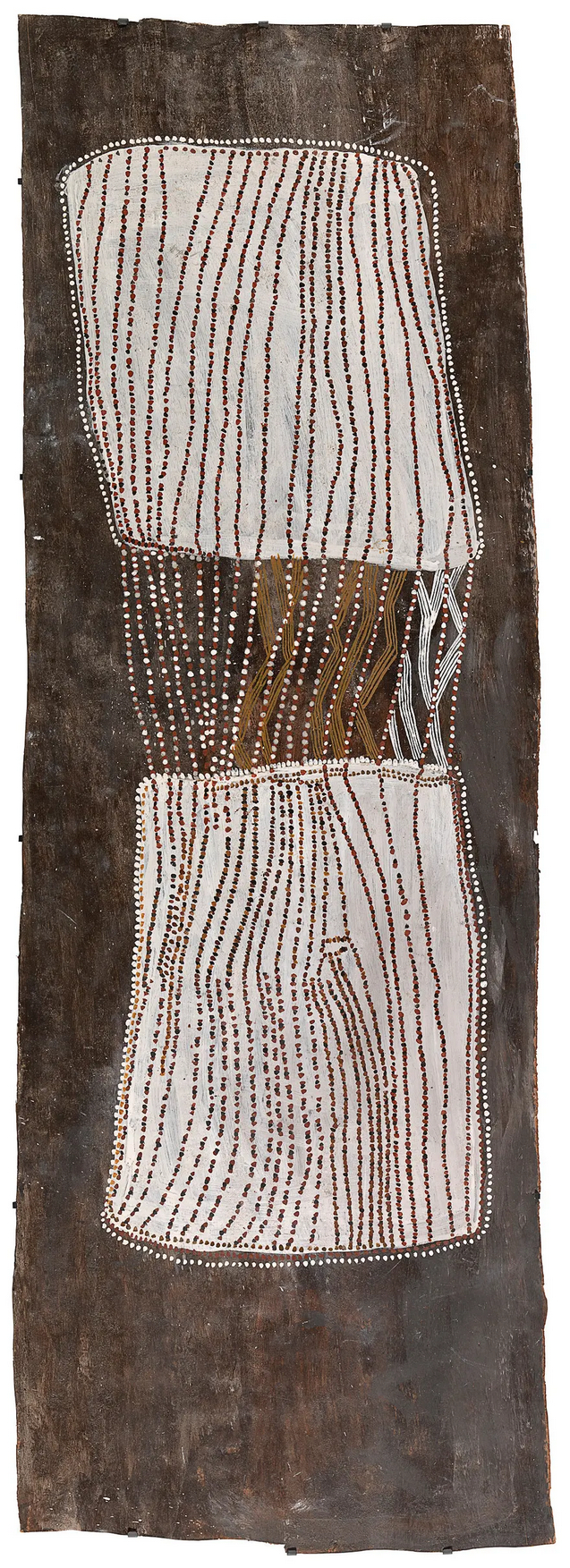
    Lightning in the rock (2015) by Noŋgirrŋa Marawilli

    ‘NoÅ‹girrÅ‹a Marawili is a senior Madarrpa artist working at Buku-Larrnggay Mulka at Yirrkala in the Northern Territory. This work represents Baratjula, the Madarrpa clan estate adjacent to Cape Shield where Mundukul, the Lightning Snake lives deep beneath the sea. The artist shows the sacred rock set in deep water between the electric ‘curse’ that the snake spits into the sky in the form of lightning, and the spray of the sea trying to shift the immovable rock foundation of the Madarrpa people.’ – Hannah Presley, curator of Indigenous art, NGV (Photograph: National Gallery of Victoria)


    We are on fire (Not in a sexy way) (2020) by Karla Dickens

    ‘This is one of a number of works I created acknowledging the Black Summer fires. The work comments on the effect Australia’s mining industry has on climate change, revealed through the vintage fire hose covered in stickers from mining companies, rows of crosses and dollar signs symbolising death. The title of the work painted large on a chipped red surface and the word “empty” painted on the hose.’ – Karla Dickens


    Stolen climate (2020) by Clinton Naina

    ‘Stolen climate is made from cotton and bleach, representing the capitalist industry of cotton that was born from slavery and theft, which helped create the foundation of what is known today as climate change. White King bleach is used in this work as a metaphor of western imperialism and colonisation that has also played a major role in the creation of the circumstances that we face together globally as people.’ – Clinton Naina


    Methexical Countryscape Paakantyi #2 (2013) by Brian Martin

    ‘This drawing is a presentation of Country and in this case, Wurundjeri Country. The drawing reiterates the importance of Country hence is titled ‘Countryscape’ instead of landscape. There is a different configuration of Country as opposed to land, as Country has subjectivity. Country is important to all of us especially in terms of climate and sustainability as we need to deeply listen and relate to the non-human: Country.’– Brian Martin


    Eye of the storm (2020) by Treahna Hamm

    ‘Central to First Nations identity are totems that represent who we are as a people. Through practices of settlement, laws and regulations of the land, our cultural landscape has been made more fragile and therefore prone to bushfires ... Beneath the possum skin cloak’s symbols of what came to be in Australia 2019-2020 is an optimism that what was once wrong will become a balance, and stability through worldwide First Nations consciousness [will] prevail.’ – Treahna Hamm


    Dark Emu spiritual cultural connections to Homelands (2020) by Treahna Hamm

    ‘Painting spirituality on a subconscious level can take on many depths and levels of symbology especially on cultural ancestral objects such as possum skin cloaks. Elders’ teachings and those gained in the spiritual realm can bring forth many individual meanings to self and to others. This includes aspects of weather within culture and how connection is made by First Nations knowledge and connection to country.’ – Treahna Hamm


    Fish scoop (2010) by Yvonne Koolmatrie

    ‘Senior Ngarrindjeri weaver Yvonne Koolmatrie has woven a fish scoop out of sedge, using the Ngarrindjeri coiling technique. Women customarily used scoops to collect fish caught in nets and to entrap fish, yabbies and crayfish in the shallows. By making such cultural objects, Koolmatrie connects with the river, her Country and her ancestors.’ – Hannah Presley


    Flooded Gum, Katarapko Creek, Murray River National Park (2007) by Nici Cumpston

    This piece was created during a major drought following a decision to pump water back in to this precious river red gum forest, enabling the saplings to grow.


    Tree stumps, western shoreline – Nookamka (2007) by Nici Cumpston

    All of the works in this series show the direct impact of changing weather patterns and human control of water flow. This one shows the shoreline of this inland lake. In this case, the flow of fresh water in to the lake was stopped so the water could be kept in the River Murray. This had catastrophic effects on the fish and bird life as well as the livelihoods of those living alongside it. The stagnant water became incredibly saline and sulphuric acid rose to the surface, which reeked of rotten egg gas.


    Rockholes and country near Kata Tjuta (2007) by Bill Whiskey Tjapaltjarri

    ‘[Tjapaltjarri] tells the story of the cockatoo who was attacked by the cheeky crow while preparing to lay her eggs ... The result of the clash lies in the formations of white stones scattered across the landscape, and an overlooking hill that is the embodiment of the eagle spirit.’ – Hannah Presley


    Mount Giles from sandhills near Gilbert Springs (c. 1937) by Albert Namatjira

    ‘Albert Namatjira was a remarkable Western Arrernte artist who painted his ancestral Country. Master of a western painting style, his watercolours are infused with a deep personal connection to the rocky escarpments, native grasses and majestic ghost gums. By presenting his works alongside contemporary Western Arrernte artists in Big Weather, we can see changes in the landscape and highlight the importance of the inter-generational transfer of knowledge.’ – Hannah Presley (Photograph: NGV)

    Links

    Lethal Heating is a citizens' initiative