Solar and wind potential is far higher than that of fossil fuels and can meet
global energy demand many times over, unlocking huge benefits for society.
With current technology and in a subset of available locations we can capture at
least 6,700 PWh p.a. from solar and wind, which is more than 100 times global
energy demand.
Opportunities unlocked
The collapse in renewable costs in the last three years means that half of this
solar and wind technical potential now has economic potential, and by the end of
the decade it will be over 90%.
The land required for solar panels alone to provide all global energy is 450,000
km2, 0.3% of the global land area of 149 million km2. This differs by country as
highlighted below.
Humans specialise in extracting cheap energy, and fast, as witnessed by the
rapid development of shale gas. Now the opportunity has been unlocked, expect
continued exponential growth of solar and wind deployment.
The technical and economic barriers have been crossed and the only impediment to
change is political. Sector by sector and country by country the fossil fuel
incumbency is being swamped by the rapidly rising tide of new energy
technologies. Even countries where the technical potential is below 10 times
energy demand, as shown below, have devised innovative approaches to energy
generation.
The fossil fuel age is over…
The fossil fuel industry cannot compete with the technology learning curves of
renewables, so demand will inevitably fall as wind and solar continue to grow.
At the current 15-20% growth rates of solar and wind, fossil fuels will be
pushed out of the electricity sector by the mid-2030s and out of total energy
supply by 2050.
… and we begin a new era
The unlocking of energy reserves 100 times our current demand creates new
possibilities for cheaper energy and more local jobs in a more equitable world
with far less environmental stress.
Poor countries are the greatest beneficiaries. They have the largest ratio of
solar and wind potential to energy demand and stand to unlock huge domestic
benefits.
What you need to know about the week that saw the US commit to nearly
doubling its emissions reduction target and the world focus anew on the
greatest threat to our planet.
As he campaigned for the White House Joe Biden told the world that he would
make climate change central to his presidency and in the months since his
victory, his energy and determination startled even the most optimistic US
climate campaigners.
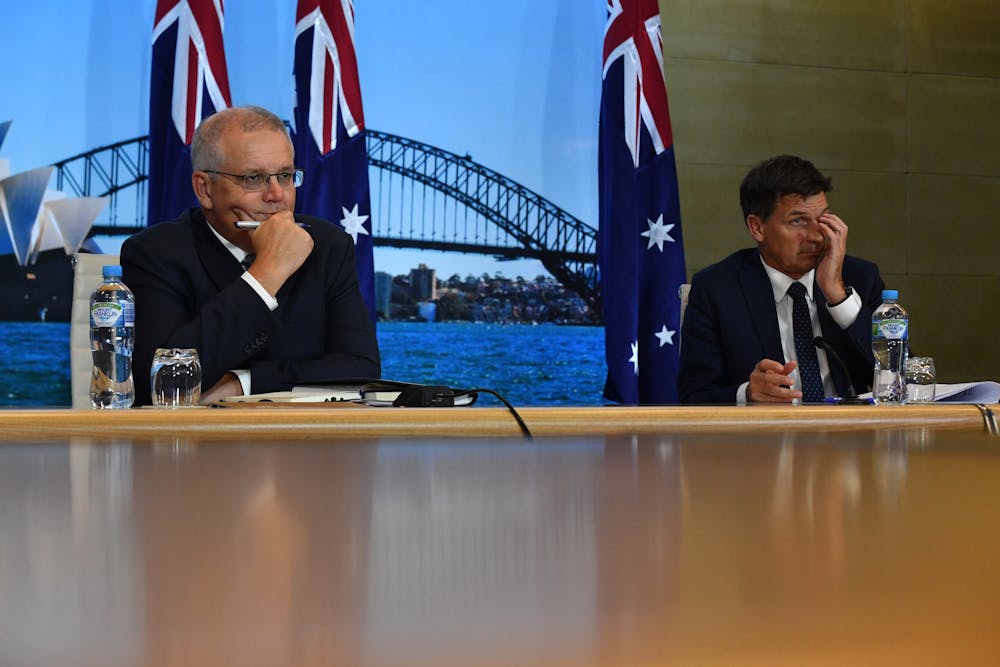
Last Friday, Biden returned the United States to the world stage on climate,
convening a meeting of 40 world leaders, including Prime Minister Scott
Morrison.
Biden’s goal was to reassert American leadership and encourage the world to
focus on the climate crisis in the lead-up to the
United Nations climate talks
in Glasgow in November.
The Age and the Sydney MorningHerald’s climate and
environment team covered the conference from Sydney, Canberra and Melbourne
and worked closely with North America Correspondent Matthew Knott.
Our coverage began in the weeks before the leaders convened, with analysis of
grim new reports about the state of the climate from Australian and
international scientific bodies.
At the start of April, we reported that the Australian Academy of Science
believes that because we have delayed action for so long it is now “virtually
impossible” to keep global warming under the more ambitious Paris Agreement
goal of 1.5 degrees and that as a result, the
Great Barrier Reef is all but doomed.
Soon afterwards the Climate Council released
their own report with similar findings, emphasising that it was possible for the world to “overshoot” the mark but
still pull temperatures back with real effort and new technologies.
Pressure mounted on Australia
to increase our own ambitions. As the talks approached the team began to
explore what the impact might be on Australia if it did not.
Australian security chiefs and even former Chief of the Defence Force, Admiral
Chris Barrie, told The Age and the Herald about their concerns
that Australia was
not prepared for the security threat
presented by climate change.
We secured an
interview with Australia’s US Ambassador, Arthur Sinodinis, who explained that
he had spoken with Biden’s climate envoy, John Kerry, and that Australia
planned to work with the world to tackle the threat.
As leaders prepared to speak, Prime Minister Scott Morrison again said
that Australia’s “preference” was to get to net zero emissions by 2050,
and that it would
use technology to get there.
By then though the world had moved on, with key players
focussed on 2030.
Late on Friday night Australian time, Morrison was invited to speak and told
the summit that Australia is on a pathway to achieve net zero emissions.
He outlined the significant funding his government was
committing to research and development of renewable energy, carbon capture and
storage and carbon sequestration methods.
As expected the US committed to nearly doubling its reduction target to 50
percent by 2030, and China reaffirmed its 2060 goal and its plans to see its
coal use peak in five years.
The former Kiribati president Anote Tong observed that though he was glad
Scott Morrison had referred to the “Pacific family” in his speech, family
members should care for one another’s welfare.
Gabi Mocatta is Lecturer in Communication, Deakin University, and Research Fellow
in Climate Change Communication, Climate Futures Program, University of
Tasmania
Rebecca Harris is Senior Lecturer in Climatology, Director, Climate Futures Program, University of Tasmania
It’s unusual for researchers who study our catastrophically changing climate
to use the words “optimism” and “climate change” in the same sentence.
As an Intergovernmental Panel on Climate Change (IPCC) lead author and a
climate communication researcher, we well understand how grave the climate
situation is.
Our planet’s biodiversity and oceans are in peril. And if we reach
climate tipping points, we’ll have little ability to mitigate runaway climate change.
But what if we were to come to a tipping point for climate action?
At Biden’s climate summit last week,
the US committed
to a 50-52% cut in greenhouse gas emissions reduction on 2005 levels by 2030.
The UK promised a 78% emissions reduction by 2035, while the EU pledged to cut
emissions 55% by 2030 on 1990 levels. And Japan committed to a 46% cut by 2030
on 2013 emissions.
Australia, however, brought nothing new to the table in terms of emissions,
offering no further cuts to its planned 26-28% reduction on 2005 emissions by
2030.
Australia’s lack of ambition aside, the summit is not the only sign
transformation in the global climate effort is underway. Recently, more
reasons for optimism have emerged than we’ve seen for decades.
A groundswell of change
The science on climate change is now more detailed than ever. Although much of it is devastating, it’s also resoundingly clear.
The IPCC’s AR6 reports — the latest
assessment of the science and social responses to climate change — will be
released in time for the next major climate summit, COP26, in Glasgow in
November. This means policy makers will have a stronger directive than ever on
the urgency to act.
Greta Thunberg called on Congress to enact more concrete measures on climate change when she appeared virtually before a House subcommittee on Thursday. “We are the ones who get to decide how you will be remembered,” the teenage climate activist warned lawmakers. “Choose wisely.” pic.twitter.com/5Xi6Mzm6gQ
It’s now also unequivocal that people want action. The largest ever global
opinion survey on climate change,
The Peoples’ Climate Vote, found in late 2020 that 64% of people consider the climate crisis a “global
emergency”.
This poll also showed strong support for wide-ranging policy action. Support
for climate action was above 80% in all countries among people with
post-secondary education, underscoring the importance of education in
advancing support for climate-friendly policy.
Policy makers at last seem to be taking both science and public will for
action seriously. Some 120 countries have committed to achieving net zero
emissions by 2050. Even the current largest emitter, China,
has committed to
carbon neutrality by 2060, or sooner.
Company directors who fail to consider and disclose climate-related
risks
could now be held liable
under Australia’s Corporations Act.
Biden’s Earth Day summit saw many nations increase their climate
change commitments.Kyodo via AP Images
International finance and
insurers, are also progressively
abandoning coal. And investment in climate solutions is
garnering increasing interest. There is much opportunity in this domain: the OECD estimated in 2017 that
investment of
US$6.9 trillion a year over 15 years
in clean energy infrastructure would be needed to keep global temperature rise
under 2℃.
Carbon border taxes are also
now being mooted, so countries will pay for their high-emissions supply chains in taxes on
their exports.
Australia is particularly exposed
in this regard, given it’s slower to decarbonise than many of its trading
partners.
Better social understanding of climate
The unprecedented student climate strikes in 2019
brought climate change repeatedly onto media agendas and into conversations
around dinner tables. The student strikers can no doubt be credited with
setting off the first domino in a tipping point for action that seems to be
beginning now.
In the past two years, we have seen greater visibility and increased social
understanding of climate change.
Globally, films like David Attenborough’s
climate testament, A Life on Our Planet, have made the climate and
biodiversity crisis unflinchingly clear for audiences around the world.
In
Australia, popular media outputs — such as the film 2040, ABC’s Fight for
Planet A and Big Weather — have enhanced Australians’ climate literacy.
Films like David Attenborough’s A Life on Our Planet increase social
understanding of climate change.
Though research on social understanding of climate has long shown climate
change
makes people feel powerless, we now have tools giving us agency to act by meaningfully reducing our own
emissions, such as
carbon accounting apps that help
us track and minimise household emissions.
And such change from below is significant:
some research shows
household emissions account for 72% of the global total. So with the right
incentives (we’ll need both carrots and sticks) behavioural change could
contribute significantly to emissions reductions.
The damage to the Flinders Chase National Park after bushfires
swept through on Kangaroo Island in January 2020. 82% of
Australians think climate change will lead to more bushfire.AAP Image/David Mariuz
Actions for the decisive decade
For the first time, then, political will and global public opinion seem
focused on profound action across many domains. This could mean we’re not
bound to the current heating trajectory. But to elude a catastrophic temperature rise of 3-4℃ by 2100, we must make political ambitions, collective change and personal
contributions concrete.
Actions for this decisive decade include putting the international commitments
to deep emissions cuts into action, with clear pathways to net zero. Ambitions
on cuts will have to be continually ratcheted up, this decade, with developed
countries making the greatest reductions.
Australia brought nothing new to the table in terms of emissions
at Biden’s summit.AAP Image/Mick Tsikas
Coal will have to be phased out quickly, carbon pollution taxed and investment
in climate solutions incentivised.
People in developed countries will need to
accept fundamental lifestyle changes and decision makers must construct
policies to guide such change. Governments must make policy based on science —
which the coronavirus pandemic
has shown we can do.
It seems we’re heading for an “overshoot” scenario, where the global temperature rise will exceed 1.5℃, before we
pull the temperature back down over decades with negative emissions.
Investment in such technology initiatives as direct
air carbon dioxide capture, must be massively scaled up.
Nature-based solutions such as reafforestation
and restoration of carbon sequestering ecosystems, on land and in the water,
will also be crucial.
Above all, we need to act fast.
The 2020s really are our final chance: our “Earthshot” moment to start to repair the planet after decades of
inaction.
The Australia Institute's report said the fossil fuel
industry received more in subsidies than Australia spent on
the Army or Air Force.
(ABC News: John Gunn)
Key Points
The Australia Institute
says fossil fuel subsidies cost more than Army
capabilities in the budget
There are big
disagreements over the figures and what is a "subsidy" and
what is not
Queensland Senator
Matt Canavan says a net-zero emissions target makes no
sense amid China tensions
Fossil fuel subsidies have cost state, territory and federal budgets
roughly $10.3 billion over the past financial year, or $19,686 a minute,
according to a new report from The Australia Institute.
The
progressive think tank says the $7.84 billion allocated for the fuel tax
credit scheme in the Federal Budget alone exceeds the $7.82 billion
spent on Army capabilities or the $7.55 billion on Air Force
capabilities.
It also has calculated state governments have
contributed some $1.2 billion to coal, oil and gas companies by helping
reduce the costs of exploration, improving ports, railways and power
stations, while also funding research aimed at reducing emissions caused
by burning fossil fuels.
In the past, mining industry lobby groups and pro-mining politicians have
rejected The Australia Institute's figures, saying the assumptions
underpinning them are "flawed" and do not take into account the industry's
broader contribution to the economy.
"We really now need to be talking about phasing these incentives out,
particularly given the US under Joe Biden is looking at removing tax
perks," Australia Institute research director Rod Campbell said.
"It's not just important for Australia to take action on climate change
but some of this money could be going to schools, or hospitals or issues
voters are really worried about."
The report also states:
The
Northern Territory is the biggest backer of the gas
industry over the longer term with almost $4 billion committed to an
offshore gas project and $1 billion for pipelines.
Queensland provided
industry assistance measures worth at least $744 million last year.
Western Australia is spending hundreds of millions
on power stations.
New South Wales is
allocating $100 million towards "coal innovation".
The ACT is the only
jurisdiction with no fossil fuels subsidies, though it notes
Tasmania's budget also has no clear industry
assistance.
Australia Institute 2020-21 fossil fuel subsidies by
State, Territory and Federal governments
Source: Budget papers, annual reports and tax expenditure
documents
The true cost of fossil fuel subsidies is hard to calculate
The total cost of fossil fuel subsidies has been a contentious
issue over the past decade.
An International Monetary Fund report in 2019 said Australia was
spending some US$29 billion ($37.4 billion) in subsidies, though that
paper included the estimated cost of things like the environmental and
social price of pollution and greenhouse gas emissions.
Other organisations, like the Productivity Commission as well as think
tanks have estimated the annual cost actually ranges from several hundred
million a year to as much as $12 billion annually.
"The real question is, what's the most appropriate number?" Mr Campbell
said.
"We haven't included damage to the environment or to human health (in our
report), because estimating those numbers is difficult and estimating
those numbers is controversial.
"What we've done to try and eliminate any controversy, is we've just added
up what is in the books, state and federal budgets, and reports from
government-owned corporations."
Canavan says net-zero target makes no sense amid China tensions
Former resources minister and outspoken Queensland backbencher Matt
Canavan said many of the assumptions in The Australia Institute's report
are flawed.
He said some assistance to fossil fuel industries can be good for the
country and economy, and asserts that mining is the least subsidised
industry.
Former resources minister Matt Canavan has been vocal in his
support of the fossil fuel industry.
(ABC News: Sean Davey)
"Fossil fuels are our nation's biggest export. I think government should
be helping encourage that," Senator Canavan, a big supporter of new coal
projects, said.
"If a government builds a rail line or a port to support mining, companies
have to pay to use it … but it also then is permanent infrastructure that
allows other industries to benefit and piggyback on."
"This has an impact far beyond their own sector."
He doesn't believe infrastructure spending or the federal fuel tax credit
scheme should be seen as fossil fuel subsidies.
"I fundamentally disagree with the assumptions. The absence of a tax is
not a subsidy and the mining industry builds its own roads, they don't use
public ones," Senator Canavan said, even though he conceded the fuel
excise tax is not directly linked to spending on roads.
"This scheme is also available to other industries, like agriculture."
It is a target that would be a lot less ambitious than the UK, the US and
Canada, which are all vowing substantial emissions reductions by 2030 or
2035.
But Senator Canavan, who has been a vocal opponent of a 2050 goal, claims
regional security concerns in coming decades should make Australia think
twice before committing to anything.
"I agree completely with Defence Minister Peter Dutton; we can't discount
the possibility of war with China. While that is a distinct possibility
why would we be hamstringing our own industries?" he said.
"Cutting our carbon emissions while China increases output is not
going to change the environment, it's just going make that country
stronger and more able to bully us and other peace-loving countries
in the region."
Instead of set targets, over the past week the Morrison government has
pledged more than $1.1 billion dollars towards what it calls "clean" and
"low emissions" technologies and projects.
Some of the money will go to carbon, capture and storage research – a
technology many climate scientists say is an expensive failure aimed at
extending the life of fossil fuel power generation projects.
Another chunk of the funding will go towards boosting hydrogen production,
some of which will be manufactured using gas.
On Monday night Scott Morrison again voiced the government’s
intention to create a net-zero economy “as quickly as possible and
preferably by 2050” in a speech widely interpreted as an effort to
delicately shift Australia’s climate position another pace closer to
that of its international peers.
That may have been the case, but the speech also highlighted how
isolated Australia has become in a world that has largely banked its
2050 targets and is now concerned with 2030 plans.
US President Joe Biden is expected to ramp up pressure on Australia to act on climate change. Credit: AP
Indeed, the focus by the US and the UK at this week’s talks on 2030
targets will be “intense”, says Alden Meyer, until recently the
co-director of the Washington DC, office of the Union of Concerned
Scientists and now a member of the leading European climate think tank
E3G.
This is because over the past year or so about two thirds of the world’s
economy has either formally adopted or accepted 2050 net zero targets.
On this point China is now aligned with the US, the UK, the EU, Japan
and South Korea, among others.
The reasons for the unanimity of focus on near-term goals are threefold.
Firstly the Paris process functions like a ratchet – negotiators secured
global agreement to a distant, politically viable goal, and then began
raising the bar.
The second reason is scientific. Carbon dioxide lingers in the
atmosphere for between 300 and 1000 years, so any greenhouse gas we emit
today joins the “stock” already there. If our emissions remain high
today but we suddenly reach net zero in, say 2049, we are still
compounding climate damage day by day until then.
As a result, the authors of the agreement always envisioned a steady
emissions decline.
The Intergovernmental Panel on Climate Change - the body through which
Paris was negotiated - says a 45 per cent reduction by 2030 is necessary
to meet net zero 2050.
As a wealthy industrialised nation the pressure is on Australia to do
more than that to allow developing nations to secure some of the
industrial and economic benefits we have already enjoyed.
The third reason is technical. Whatever the value of newly developed
technologies - such as the hydrogen linked to carbon capture and storage
that has attracted funding from the Morrison government - there is no
time left. To reach a net zero 2050 goal massive reductions need to
begin today using today’s technology.
If Morrison was to announce 2050 net zero target and did so without a
credible 2030 target, “It’s not gonna be taken seriously, it’ll be seen
as rhetorical posturing,” Meyer told the Herald and the
Age.
Meyer, who has close ties with members of Biden’s climate team, believes
the costs of posturing rather than acting will soon become concrete.
“Australians are going to be hearing about this in every meeting they
go to.”
The European Union has made it clear that it intends to introduce a
border tariff on emissions intensive imports from countries that do not
price carbon.
Last week the new US Trade Representative, Katherine Tai, gave a speech
signalling the US is considering similar measures.
“The science indicates that the window of opportunity to prevent a
catastrophic environmental chain reaction on our planet is closing fast,
and the United States must be a leader in the collective effort to work
toward a global solution,” she said.
“For too long, the traditional
trade community has resisted the view that trade policy is a legitimate
tool in helping to solve the climate crisis.”
Campaigning for the White House, Biden said that climate change would be
a central focus of his presidency and that he would seek to encourage
global action to tackle it using the full machinery of America’s
government and diplomatic corps.
Since his election the energy with which he has pursued the issue has
startled even some of the most optimistic climate change advocates. This
week he is expected to announce the doubling of America’s 2030 target to
50 per cent reductions.
Morrison has so far indicated that he has no plans to increase
Australia’s goal of 26-28 per cent reductions by 2030.
According to Meyer, Biden’s focus on 2030 targets this week - and this
year - will be both intense and relentless.
“It’s not only going to be an issue when Scott Morrison has bilateral
conversations with President Biden or when John Kerry comes to
Canberra,” Meyer told a webinar hosted by the Australia Institute on
Wednesday.
“Australians are going to be hearing about this in every meeting they go
to. So when they go to the Clean Energy Ministerial Mission Innovation
Summit in Chile at the end of May, they’re going to hear about this from
the Secretary of Energy.
When they go to the G20 finance ministers
meeting, they’re going to hear from Treasury Secretary Janet Yellen
about the importance of addressing the climate issue and getting rid of
fossil fuel subsidies.
“This is going to be unrelenting pressure on every front where Australia
has to deal with the United States and I think increasingly with other
countries as well.”
In this light, edging towards 2050 rather than charging towards 2030 is
unlikely to satisfy global expectations.
Some CEOs are optimistic about their ability to become net-zero,
but less sure about how to achieve it. Image: Freepik
Author
Nicole Systrom
is founder of the Sutro Energy Group, which partners with
philanthropists, investors and entrepreneurs to accelerate
high-impact climate and clean technology solutions.
Article Overview
Urgency to mitigate climate change by 2030 requires public-private
collaboration.
Many CEOs are taking action but huge challenges remain to achieve
ambitious climate targets.
We outline three keys ways companies can use their influence and
acumen to get to net-zero.
Note
The views expressed in this article are those of the author alone and
not the World Economic Forum.
A growing number of CEOs get it: they have an obligation to address climate
change.
Advocates and environmentalists everywhere are cheering
commitments by big companies that demonstrate the various ways they are taking
on climate change, from asset manager
BlackRock’s
push for portfolio companies to disclose net-zero plans to
IBM’s commitment
to hit net-zero greenhouse gas emissions by 2030.
As the US rejoins the Paris Climate Agreement and we approach the UN Climate
Change Conference (COP26) in Glasgow this November, we’ll likely see a steady
drumbeat of announcements in the months to come. But can companies really get
there?
While many leaders I’ve spoken to are optimistic about their ability
to use cleaner sources of energy, reduce buildings emissions and improve energy
efficiency, making commitments is one thing; meeting them is quite another.
As one energy utility CEO told me, he thought 80% of getting to net-zero was
achievable.
The hard part was the remaining 20%, because of
everything from the intermittency of renewable technology to the high cost of
energy storage to the challenge of upgrading our grid infrastructure, “The last
mile” as this CEO called it.
So even though we’re just starting the race, it’s that last mile that we need to
keep in mind. Here’s three key things companies can do to make it to the finish
line:
1. Support early-stage entrepreneurs and scale solutions
Large corporations generally have the infrastructure, networks and the resources
to scale technologies that startups don’t. But we can’t expect a successful
company to abandon a corporate culture developed over decades to suddenly launch
a quixotic quest for blue-sky innovation.
Fortunately, corporations are showing a greater interest in supporting climate
entrepreneurship – and government is playing a part as well. The Department of
Energy offers
Lab-Embedded Entrepreneurship Programs, in which top scientists and engineers are assigned to US national
laboratories where they perform early-stage research and development and train
to be entrepreneurs.
Providing scientists with entrepreneurial acumen
and skills gives them a better chance to succeed in the innovation ecosystem and
seize commercial and investment opportunities. Using balance sheets or corporate
philanthropy, the private sector can and should partner with government and the
NGO community to support promising new developments.
And it’s not just about championing the little guy. Microsoft, for example,
has committed
to being carbon negative by 2030 and water positive with net-zero waste.
At the same time, its
Climate Innovation Fund
focuses on investing in developed climate solutions that require capital to
scale in the market. The company prioritizes technologies that are relevant to
its core business and help suppliers and customers reduce their carbon
footprints.
Big companies have no problem making their voice heard in policy debates – even
those outside their areas of expertise or narrow self-interest, as we saw last
spring when
CEOs endorsed police reform
during racial justice protests.
At the same time, early-stage
entrepreneurs lack the capacity and expertise to engage with policymakers, which
has led to a fundamental misunderstanding of how early-stage innovation works in
many parts of government.
One way to bridge that gap would be for
corporates to lend their lobbying expertise to climate innovators to ensure the
trillions of dollars President Biden promises to invest, as part of his
Build Back Better
plan, are effective in incentivizing entrepreneurs and scientists.
At a mini, corporations should swear off lobbying against climate
change regulation, which often undermines them.
What's the World Economic Forum
doingabout the transition to clean energy?
Moving to clean energy is key to combating climate change, yet in the
past five years, the energy transition has stagnated.
Energy consumption and production contribute to two-thirds of global
emissions, and 81% of the global energy system is still based on
fossil fuels, the same percentage as 30 years ago.
Plus,
improvements in the energy intensity of the global economy (the amount
of energy used per unit of economic activity) are slowing. In 2018
energy intensity improved by 1.2%, the slowest rate since 2010.
Effective policies, private-sector action and public-private
cooperation are needed to create a more inclusive, sustainable,
affordable and secure global energy system.
Benchmarking progress is essential to a successful transition.
The World Economic Forum’s Energy Transition Index, which ranks 115 economies on how well they balance energy security
and access with environmental sustainability and affordability, shows
that the biggest challenge facing energy transition is the lack of
readiness among the world’s largest emitters, including US, China,
India and Russia.
The 10 countries that score the highest
in terms of readiness account for only 2.6% of global annual
emissions.
Additionally, the Mission Possible Platform (MPP) is working to assemble public and private partners to
further the industry transition to set heavy industry and mobility
sectors on the pathway towards net-zero emissions.
MPP is
an initiative created by the World Economic Forum and the Energy
Tansitions Commission.
3. Make net-zero part of a business strategy
A goal of net-zero carbon emissions by 2050 is a laudable one. But achieving it
will require a full-scale review of a company’s business strategy, including
products, operations, vendors and supply chains. The good news is that while 60%
of the 100 CEOs at large companies
surveyed
recently said they have already taken that important step, four in 10 of these
companies haven’t. The more companies with a net-zero strategy, the clearer the
demand for “last mile” innovation will be.
Regarding climate, Jesper Brodin, the CEO of Ingka Group, which owns IKEA,
put it simply: “We have definitely shifted the dialogue from the ‘why’ and are now focused
fully on the ‘how.’” We need more leaders who are ready to ask: how does my
company reach net-zero? If current technology doesn't get us there, how can we
support the research and startups that could?
Getting there won’t be easy. But after developing lifesaving vaccines faster
than ever, there’s no reason we can’t apply the same urgency and commitment to
problem-solving to addressing climate change. And we have to start now.