05/06/2021

(AU The Conversation) ‘Flash Droughts’ Can Dry Out Soil In Weeks. New Research Shows What They Look Like In Australia

The Conversation | 

Dan Peled / AAP

Authors
  •  is a Research Fellow, Monash University
  •  is Senior Lecturer, School of Earth, Atmosphere and Environment, Monash University
At the tail end of winter in 2015, the ground in the Wimmera in northwestern Victoria had been a little dry but conditions weren’t too bad for farmers. The crop season was going well.

The start of September looked promising. It was cool, and there were decent rains. One Wimmera lentil grower said, “As long as it doesn’t get too hot, we should actually be OK.”

A few weeks later, summer weather had arrived early. At the start of October, the soils were baked dry. Lentils and other pulse crops were devastated.

This kind of event, where drier-than-normal conditions transform into severe or extreme drought in the space of weeks, is called a “flash drought”.

While flash droughts are still not well understood, our research studies how they occur in Australia - which may help move us toward being able to warn of flash drought in advance.

The different kinds of drought

Scientists typically talk about drought as a lack or deficit of available moisture to meet various needs, such as in agriculture or for water resources. We often classify different types of drought depending on where there is a lack of water, or what its effects are:
  • meteorological drought is a deficit of rain or other precipitation
  • agricultural drought is a deficit of moisture in the soil and evaporating or transpiring into the air
  • hydrological drought is a deficit of water in runoff and surface storage such as dams
  • socioeconomic drought is a lack of water that affects the supply and demand of economic goods and services.
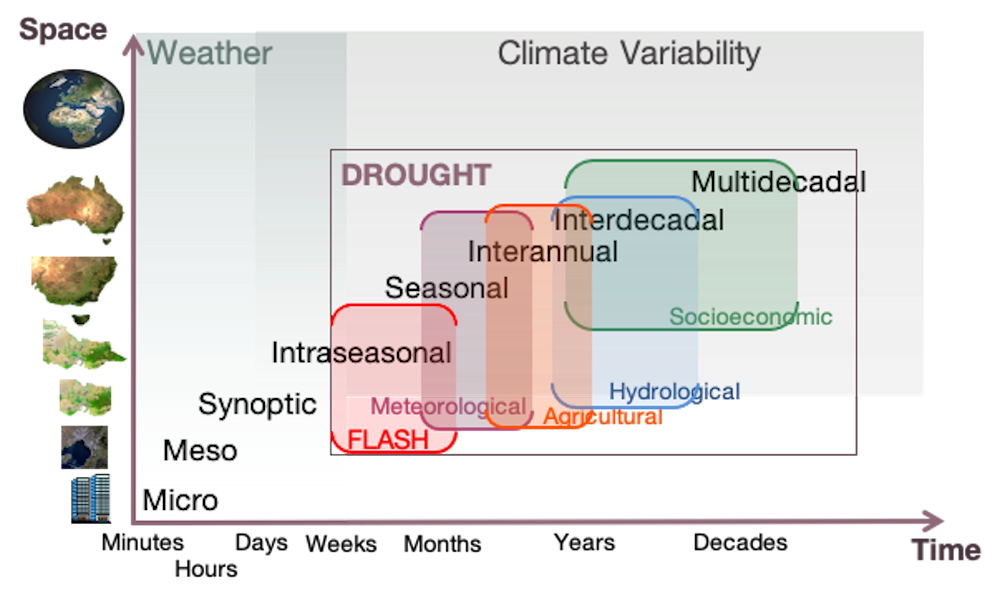
Different types of drought can occur at the same time, or a drought may evolve from one type to another. Droughts can last from months to decades, and can cover areas from a local region to most of the continent.

The different types of drought, showing how long they last and the size of the area they affect. Ailie GallantAuthor provided

Recently, a new characterisation of drought has been added to the drought spectrum: “flash” drought.

What causes flash droughts?

Flash droughts are droughts that begin suddenly and then rapidly become more intense. Droughts only occur when there is insufficient rainfall, but flash droughts intensify rapidly over timescales of weeks to months because of other factors such as high temperatures, low humidity, strong winds and clear skies.

These conditions make the air “thirsty”, which meteorologists call “increased evaporative demand”. This means more water evaporates from the surface and transpires from plants, and moisture in the soil is rapidly depleted.

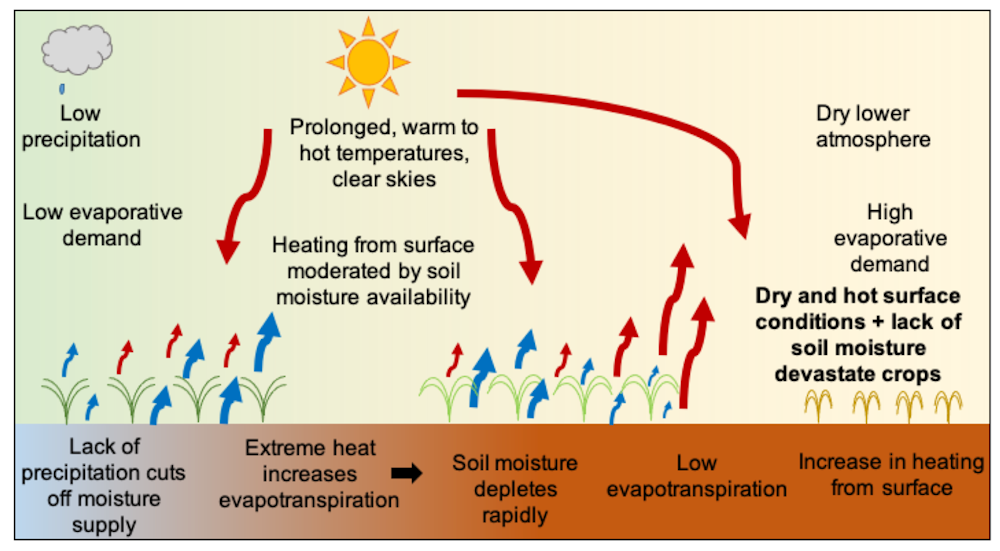
Under these conditions, evaporation and transpiration increase for as long as moisture is available at the surface. When this moisture is depleted and there is no rain to replenish it, the lack of water limits evaporation and transpiration – and vegetation becomes stressed as drought emerges.

When there is a lack of rain accompanied by high temperature, low humidity, strong wind and clear skies, conditions are right for flash drought. Tess ParkerAuthor provided

Why haven’t we heard about flash drought before?

Flash droughts have always existed, and were first described in 2002. However, some particularly devastating flash droughts over the past decade have led to a surge of interest among researchers.

One such drought happened in the US Midwest. In May 2012, 30% of the continental United States was experiencing abnormally dry conditions. By August, that had extended to more than 60%. Although other rapidly developing droughts had been seen before, the widespread impacts of this event caught the attention of the US public and government.

Flash droughts are also increasingly a focus of attention in China and Australia. One of the few studies of flash drought in Australia examined an event when conditions in the country’s east suddenly changed from wet in December 2017, to dry in January 2018.

Anecdotal reports from farmers in the northern Murray–Darling Basin indicated removal of livestock from properties, and sheep numbers at record lows. By June 2018, there were reports of trees dying and a desert-like landscape, with little grass cover.

What happened in the Wimmera?

Our recent study of flash drought in Australia used several different measurements to capture a range of conditions related to drought.
  • precipitation describes the supply of moisture from the atmosphere to the surface
  • evaporative demand is the atmospheric demand for moisture from the surface
  • evaporative stress is the supply of moisture from the surface relative to the demand from the atmosphere
  • soil moisture is the wetness or dryness of the land surface.
The index we used to determine the atmospheric demand shows that the speed of development and the intensity of flash drought are driven by high temperatures, low humidity, strong winds and clear skies. All of these increase the demand for moisture from the surface.

After a drier than normal winter, southeast Australia experienced a cool and wet start to September 2015, with some rain in the first week of the month. Humidity and surface air pressure were roughly average, and surface sunshine below average, suggesting normal evaporative demand.

A warm spell began in mid-September, and intensified into a severe heatwave by early October, with temperatures over 35℃ persisting for several days in some areas. Throughout this period the overlying air became very dry. A persistent high-pressure system brought clear skies and increased sunshine.

By the end of October, the Wimmera was in severe or extreme drought conditions, devastating pulse and grain crops. Analysts estimated wheat production fell by 23%, with a loss of A$500 million in potential yields.

Flash drought in Australia

Flash droughts in Australia occur in all seasons. In the Wimmera, flash droughts are most frequent in summer and autumn. They can end as rapidly as they start, but in some cases may last many months.

In several instances, flash droughts in the Wimmera have started in summer or autumn, and the region has remained in drought through the following winter, and sometimes into spring. In this way, flash drought can be the catalyst for the common droughts lasting 6-12 months typical of southeast Australia.

But there is some potential good news. We have long known that seasonal-scale droughts in Australia are strongly related to the El Niño-Southern Oscillation (ENSO), which gives us some ability to predict them.

ENSO strongly affects rainfall, which means it can also be linked to flash droughts in winter and spring.

Further, sub-seasonal forecasting, which predicts the climatic conditions weeks to a month in advance, has improved considerably in recent years. Given flash droughts occur on these timescales, we can be optimistic that prediction of flash droughts may be possible

Links

(USA New Yorker) Automakers Start To Figure Out The Climate Future

The New Yorker

Bankers, not so much.

Last month, Ford released an electric version of its F-150, the most popular motor vehicle of all time. Photograph courtesy Ford

Author
Bill McKibben is a founder of the grassroots climate campaign 350.org and a contributing writer to The New Yorker. He writes The Climate Crisis, The New Yorker’s newsletter on the environment.
If you want to meet an expert who understands where the world is heading, may I introduce a bushy-bearded Australian coal miner who features anonymously in a video that was shared by the Sydney Morning Herald last week.

He is sitting behind the wheel of a borrowed Tesla when a man in the back seat urges him to “just plant it. Hard as you can.”

The man punches the accelerator, is immediately pushed back in his seat, and breaks into a grinning cackle. “Fucking got some go, eh?” the man says. “It’s just instant. Like, fuck,” the driver replies, beaming. (Watch it; you’ll feel happier afterward).

Many of the changes needed to get us on the right climate path are going to meet with resistance, but it’s beginning to look as if getting people to accept electric vehicles may not be one of them. Elon Musk has done pioneering work, but the Tesla has mainly been a niche product—the niche being early adopters of cool things who live along the coasts. (Life in Muskworld is getting a little silly: last month, he started touting a model with ten rocket thrusters that will go from zero to sixty in 1.1 seconds, which sounds like a very bad idea.)

Things got very real, though, with last month’s announcement of an electric version of the Ford F-150 pickup, America’s best-selling vehicle every year since the Reagan Administration, and the most popular motor vehicle of all time. Within seven days, the company had reported seventy thousand preorders—and the stock had jumped eight per cent.

Having spent most of my life in rural America, where the F-150 is ubiquitous, I can tell you why this is going to succeed. It’s not the acceleration; it’s the plugs. The electric version will basically be a battery on wheels. The “power frunk” (where the engine used to be) has several outlets, useful for all the power tools you might need if you’re not near another electrical source—if you’re building a home, say—and replacing the noisy, smelly, dangerous gas generators that no one likes.

You say that most pickup drivers are not, in fact, home builders? It’s true—most Americans have no need of a pickup at all. But watch any truck commercial and see who it stars. Once blue-collar America endorses the electric approach, suburbia will follow. We need far more than electric cars, of course: buses and bikes, not to mention paths for those bikes, are crucial. But since, right now, public transit accounts for about one per cent of passenger miles travelled, the new pickup paradigm seems critical.

And, in any event, the car companies seem all in. Last week, Ford announced that it was putting down thirty billion dollars in new spending on E.V.s; General Motors has already said that it will be nothing but electric by 2035. By contrast, the banking sector seems determined to have it both ways, trying to make money off both fossil fuels and a renewable future.

Late last month, President Biden issued an executive order on climate financial risk that begins by noting that “the failure of financial institutions to appropriately and adequately account for and measure these physical and transition risks threatens the competitiveness of U.S. companies and markets, the life savings and pensions of U.S. workers and families, and the ability of U.S. financial institutions to serve communities.”

That failure was visible on many fronts in recent days. Deutsche Bank put forward a detailed plan to cut its carbon emissions by, say, reducing “fuel consumption for its company car fleet in Germany (roughly 5,400 cars) by 30 percent by 2025.”

That sounds fine, but, as the campaigners at the German environmental and human-rights organization Urgewald have pointed out, such proposals “are also an embarrassing testament to the fact that the bank’s understanding of sustainability is stuck in the 90s.

The measures are easy to integrate and don’t harm anyone. However, they won’t have a significant impact either”—not, say, like the bank’s plan to coördinate the initial public offering for the oil-and-gas group Wintershall, which plans to boost its fossil-fuel output by thirty per cent by 2023.

Closer to home, the world’s biggest fossil-fuel financier, JPMorgan Chase, has announced plans to cut not the amount of carbon that its loans liberate from the ground but, rather, the “carbon intensity” of its portfolio.

This would permit it to keep making loans to companies that want to continue producing the same amount of oil and also allow it to vastly increase the amount of natural gas that they pump; gas is somewhat less carbon-intensive than oil, so this increase would slide right through this loophole.

At a House Committee on Financial Services hearing last week, Representative Alexandria Ocasio-Cortez did her best to cut through this blatant greenwashing, and Jamie Dimon, the Chase C.E.O., seemed to say that the bank was working to cut absolute emissions in its portfolio as well—but for the moment the plans are secret.

If you’re wondering how much this matters: a new report shows that the carbon produced by the loans from British bankers alone would make them, if they were a country, the ninth-biggest emitter on earth.

It’s good news of a sort that so much is suddenly up in the air: the fallout from the various court rulings and shareholder votes of late May is less a blueprint for the future than a simple acknowledgment that something must change. Sticks are being stuck in hornets’ nests, and there’s some shrieking from the industry and its friends. (Check out the fifteen G.O.P. state treasurers threatening to withdraw state funds from banks that don’t lend to the oil industry.)

But, at least for the moment, the delighted laughter of a miner behind the wheel of an E.V. drowns out the noise.

Links

(The Guardian) Climate Crisis Is Suffocating The World’s Lakes, Study Finds

The Guardian -  

Falling oxygen levels harming already struggling wildlife and drinking water supplies, say scientists

Lake Ammersee near Munich, Bavaria, Germany. Oxygen levels in lakes have fallen three to nine times faster in the past 40 years. Photograph: Lukas Barth-Tuttas/EPA

The climate crisis is causing a widespread fall in oxygen levels in lakes across the world, suffocating wildlife and threatening drinking water supplies.

Falling levels of oxygen in oceans had already been identified, but new research shows that the decline in lakes has been between three and nine times faster in the past 40 years. Scientists found oxygen levels had fallen by 19% in deep waters and 5% at the surface.

Rising temperatures driven by global heating is the main cause, because warmer water cannot hold as much oxygen. Furthermore, rising summer heat leaves the top layer of lakes hotter and less dense than the waters below, meaning mixing is reduced and oxygen supply to the depths falls.

Oxygen levels have increased at the surface of some lakes. But this is most likely due to higher temperatures driving algal blooms, which can also produce dangerous toxins.

Cutting emissions to tackle the climate crisis is vital, the scientists said, as well as cutting the use of farm fertiliser and urban sewage pollution that also damages lakes.

“All complex life depends on oxygen and so, when oxygen levels drop, you really decrease the habitat for many different species.” said Prof Kevin Rose, of the Rensselaer Polytechnic Institute (RPI) in the US, who was part of the research team.

“This study proves that the problem is even more severe in fresh waters [than in oceans], threatening our drinking water supplies and the delicate balance that enables complex freshwater ecosystems to thrive,” said Curt Breneman, RPI’s dean of science.

Freshwater habitats are rich in fish, insects, birds and animals, and are important for food and recreation for humans. But they have already suffered great damage, with average wildlife populations having fallen by 84% since 1970. In addition to global heating and pollution, the causes include overuse of water for farming.

The study, published in the journal Nature, analysed 45,000 dissolved oxygen and temperature profiles collected from nearly 400 lakes worldwide. Most records started in about 1980, though one went back to 1941.

Most of the lakes were in temperate zones, particularly in Europe and the US, but there were a few records from higher latitudes, nearer the poles, and for tropical lakes in Africa. In both cases, oxygen was falling as in the other lakes.

In lakes where oxygen levels have fallen to almost zero, phosphorus can be drawn out of sediments, providing an essential nutrient for bacteria. These can proliferate and produce the powerful greenhouse gas methane, driving further heating.

Oxygen levels in surface waters were increasing in about a fifth of the lakes studied, almost all of which were prone to pollution. This is an indicator of widespread increases in algal blooms, said Rose. “Without taxonomic data, we can’t say that definitively, but nothing else we’re aware of can explain this pattern.”

Global temperatures are still rising, pushing lake oxygen levels ever lower, so just keeping the status quo requires action to clean up freshwater bodies.

Rose said a positive example was Oneida Lake in New York state, where a clean-up led to better water clarity, which in turn allowed more photosynthesis from oxygen-producing algae.

60% of fish species could be unable to survive in current areas by 2100 – study. Read more
“The new study provides a much-needed global overview of what happens in the limited freshwater stores of the planet – their health is a prime concern,” said Prof Hans-Otto Poertner, of the Alfred-Wegener-Institute in Bremerhaven, Germany, who was not part of the team.

Lakes are isolated and small compared with oceans, in which global currents can still provide oxygen to deeper waters, he said.

“Climate change, together with [agricultural pollution], threatens vulnerable freshwater systems, adding to the urgency to strongly cut emissions,” Poertner said.

Links

04/06/2021

(AU SMH) The Sleeper Election Issue That Could Bite Morrison And Albanese

Sydney Morning HeraldJohn Hewson

Author
Dr John Hewson AM is an honorary professor at the Crawford School of Public Policy, Australian National University, and is a former leader of the Liberal party.
Scott Morrison has rightly followed the science and medical advice in responding to COVID-19. If his government hadn’t closed our borders, and the states hadn’t enforced lockdowns and social distancing, imagine the catastrophe.

The Prime Minister quantified it recently when he said Australia had avoided 30,000 COVID deaths. That compares with the 910 deaths caused by the pandemic to date. “I’m not going to take risks with Australian lives,” Morrison said.

Australia’s Black Summer is cited as a warning on the costs of inaction on climate change. Credit: Nick Moir

His government is not treating the hard climate science with the same urgency, although it has been developed over many more decades than the more rudimentary medical science it relied upon in responding to the pandemic.

Last month, the International Energy Agency, a long-time mouthpiece for fossil fuels, called for a global halt to new coal and gas ventures. At the same time, the Morrison government committed to spending $600 million of taxpayers’ money on a new gas-fired power plant in NSW’s Hunter Valley.

Inaction on climate change presents us with real costs – in lives, livelihoods and the lost economic growth that would come with sustainable industries and jobs.

Economist Nicki Hutley has summarised some of the likely consequences of inaction: “The cost of extreme weather disasters in Australia has doubled since the ’70s, reaching $35 billion over the decade to 2018-19. Economic damages per person are around seven times the global average.”

Paris Agreement
NAB chief ‘taking into account’ landmark climate report in oil and gas policy
The recent Black Summer fires are estimated to have cost about $100 billion – 14 times the economic and social costs of the 2009 Black Saturday fires.

Health costs are just starting to be recognised and counted. Hutley reports that the 2011 heatwave “saw a 14 per cent rise in ambulance call-outs and a 13 per cent increase in excess deaths”.

Particulate emissions from dirty petrol have been reported to kill multiples of the road toll each year.

Research from the Australian National University and the University of Melbourne suggests economic losses from climate change in a few decades could be like a COVID-sized economic shock every year. A similar prognosis has been suggested by modelling for the NSW government.

Australia also runs the genuine risk that, as a global climate laggard, significant trading partners will levy carbon border taxes on our exports, costing billions in lost revenue and thousands of lost jobs.

Paris Agreement
Politicians have duty of care to protect children from climate harm, court finds
The benefits of an effective and just transition, meanwhile, are supported by Deloitte, Beyond Zero, the Climate Council and many more in Australia, and by strategies adopted globally, including in the United States, Canada, Britain and Europe.

While Joe Biden and Boris Johnson push for greater emissions reductions, investor pressure mounts on fossil fuel companies.

Shell was ordered by a Dutch court to slash its emissions; 61 per cent of Chevron shareholders backed a resolution to force an emissions reduction; and an activist hedge fund won two seats on the ExxonMobil board.

Australia’s Federal Court found, in assessing a new coal mine, that our Environment Minister had a “duty of care” to younger people to avoid causing them personal injury from climate change. Expect more class actions against governments on climate.

Disturbingly, Australia’s two major political parties are engrossed in a race to the bottom on climate change, seeing who can be less specific about targets and commitments.

Paris Agreement
Mathias Cormann calls for ‘ambitious’ plan to reach net zero emissions
With the prospect of an early federal election this year, there is growing interest in running independents in key seats, focusing heavily on climate issues.

In an online independents’ convention in March, 80 electorates were represented. In 38 electorates there are community-based groups under the banner of Voices, and movements such as “Vote Angus Taylor Out”.

Clearly, independents will not be elected in all these seats, but they may well claim enough seats to swing the balance of power.

As the philosopher Karl Popper said, the party system robs individual politicians of responsibility, “makes [them] a voting machine rather than a thinking feeling person … what we need in politics are individuals who can judge on their own and who are prepared to carry personal responsibility”.

Scott Morrison will no doubt attempt to keep the election focus on his handling of the pandemic and the economy, capitalising on his poll superiority to Labor leader Anthony Albanese.

The sleeper election issue of climate may have to be carried by the independents.

The Prime Minister would be wise to remember the Wentworth byelection.

Links

(UK BBC) Major Project Aims To Clear Clean Energy Hurdle

 BBCRoger Harrabin

image copyright Reuters

A major project aims to overcome a barrier to electricity grids that are entirely supplied by renewable energy.

Output from wind turbines varies because wind speeds fluctuate; output from solar cells changes according to cloud cover and other factors.

This is called variability, and overcoming it is crucial for increasing the share of renewables on the grid.

A group of leading nations will invest $248m over the next decade to solve the issue by 2030.

The effort has emerged from a clean-tech research programme called Mission Innovation (MI).

Environmentalists say the sum’s a fraction of the many trillions of dollars of damages that climate change is projected to wreak on society, unless it’s curbed.

But the 23 member governments involved in the programme are spending US$5.8bn per year more than in 2015 – and they say they’ll commit more public funds to clean tech if they can afford it.

Solutions to the variability problem will include energy storage; for example, smart power systems which respond to changes in demand; advanced controls and artificial intelligence.

Those behind MI say that half of the global emissions reductions required to achieve climate targets by 2050 depend on technologies that exist today, but are only at demonstration or prototype phase.

These include hydrogen power, advanced battery storage and zero-emission fuels.

Solar power and wind power are already widely affordable, but the statement says nations need to develop whole energy systems to match.

The other main areas of the group’s research will be hydrogen power, shipping, long-distance transportation, and carbon dioxide removal from the air.

Members of the partnership include the US, UK, the EU and China.

Each member has agreed to open three “hydrogen valleys” - clusters of industries powered by clean hydrogen fuel.

image copyright EPA

A few of the partners want to produce some of this hydrogen by splitting it from natural gas, and seizing the CO2 emissions by carbon capture technology.

Environmentalists say this fossil fuel hydrogen is an inefficient technology being promoted by the oil and gas industry. They want to derive all hydrogen from renewable electricity.

The project also says it will help develop ships capable of running on zero-emission fuels such as green hydrogen, green ammonia, green methanol, and advanced biofuels.

Tom Burke from the climate think tank E3G told BBC News: “John Kerry, Bill Gates, et al. are wrong about the importance of R&D [research and development]. Deployment of what we already have is what matters and for which we need big bucks.”

Jennie Dodson, head of secretariat at MI, told BBC News: “There’s recognition that more investment is still needed – but all the countries in MI are committing to maintain and seek to increase wherever possible."

She said R&D investment levels were always smaller than infrastructure spending, but act as a catalyst for investment.

She gave two examples. One is a $5m prize for cooling buildings which produced technologies delivering cooling that's five times more efficient.

The other is the announcement, in 2016, that the Swedish government would work with industries to pilot fossil fuel-free steel manufacturing.

“They've provided around 50 million euros for pilot scale plants, with additional funding from industry", she said. "The Swedish government’s support has provided political backing and financial de-risking of the initial demonstration phases of these projects.

“This is now leading to billions of dollars investment by the industry - and influencing other steel manufacturers and companies to develop fossil-free steel manufacturing.

Mission Innovation was first launched in parallel with the 2015 Paris agreement on climate.

A recent analysis from the development charity Tearfund, the International Institute for Sustainable Development and the Overseas Development Institute showed that G7 nations were still channelling more cash to fossil fuel firms than to renewables.

This included Covid-19 grants to the aviation and car industries, which received $115bn from the G7 countries. Of that, 80% was given with no attempt to force the sectors to cut their emissions in return for the support.

Links

      (AU The Guardian) Western Australia Gas Project ‘Would Create More Emissions Than Adani And Damage Indigenous Rock Art’

      The Guardian

      Woodside’s proposed Scarborough development is equivalent of 15 coal-fired power plants, environment experts say

      Part of the LNG projects in the north of Western Australia. Woodside’s Scarborough to Pluto LNG development is on the cusp of being approved without a full environmental impact assessment from state or federal authorities, according to a new report. Photograph: Graeme Robertson/The Guardian

      A proposed gas export development in northern Western Australia could result in more than 1.6bn tonnes of greenhouse gas emissions across its lifetime and damage Indigenous rock art, environment and climate campaigners say.

      A report by two groups – the Conservation Council of Western Australia and the Australia Institute – said the Scarborough to Pluto liquified natural gas (LNG) development appeared on the cusp of being approved without a full environmental impact assessment from state or federal authorities.

      Released on Thursday, the report suggested the development could lead to lifetime emissions equivalent to that released by 15 coal-fired power plants. The project includes the development of a new gas field more than 400km off the coast, piping infrastructure and an expanded processing facility in the Pilbara.

      Greenpeace says its use of AGL logo was a parody designed to make company look ‘toxic’ Read more
      In annual terms, it found the project would release about 4.4m tonnes within Australia – adding the equivalent of nearly 1% to national emissions. The vast bulk of the emissions would occur in the countries that bought and burned the gas.

      It would increase WA’s annual emissions by about 5% as the McGowan Labor government says it plans to help transition the state economy to reach net zero emissions by 2050. WA is the only state to have increased its emissions since 2005, largely due to the booming LNG industry.

      Piers Verstegen, the conservation council’s director, said if fully realised the Scarborough project would be responsible for more emissions than the Adani coalmine in Queensland.

      “It is an international outrage that any government would support a project which would result in over a billion tonnes of carbon pollution and cause irreversible impacts on Aboriginal heritage,” he said.

      The project’s major proponent, Woodside, said there had been many opportunities for interested parties to comment on the proposal over the past two-and-a-half years. Through a spokesperson, the company said the development had been referred separately to state and commonwealth authorities as required.

      The federal Department of Agriculture, Water and the Environment found in August 2019 the pipeline works did not have to be assessed under national conservation laws, and the National Offshore Petroleum Safety and Environment Management Authority had approved the development of the gasfield in April 2020.

      At a state level, the Environment Protection Authority (EPA) last year approved the pipeline construction in WA waters near the shore and found the expansion of the processing facility was only a minor change to previous approval decisions and did not require a full assessment.

      Australian court finds government has duty to protect young people from climate crisis Read more
      The spokesperson said Woodside was awaiting final approval from the WA environment and climate action minister, Amber-Jade Sanderson. If approved, a final investment decision on the $11bn development is expected later this year.

      Woodside announced on Wednesday that the former WA Labor treasurer, Ben Wyatt, who retired from politics at the March state election, had been appointed a non-executive director of the company.

      Verstegen said the piecemeal nature of the assessment meant there had been no consideration of whether the project was consistent with the latest climate science and the Paris agreement, or to properly consider the potential damage to Murujuga rock art on the Burrup Peninsula. He said the EPA should be asked to carry out a full independent assessment of the entire project.

      He said not to do so would be “reckless in the extreme”, citing a recent major report by the International Energy Agency that found all fossil fuel expansion should end now if the planet is to meet the goals agreed in Paris.

      The conservation council’s president, former Labor premier Carmen Lawrence, said many of the circumstances that led to Rio Tinto destroying an Aboriginal heritage site at Juukan Gorge applied to the Scarborough development.

      “It is now clear that pollution from gas processing on the Burrup is having a significant effect on the Murujuga rock art,” she said. “Allowing further expansion of gas processing on this site will increase both the duration and severity of these impacts and this must be assessed carefully before any further decisions are made, not as an afterthought.

      Australia urged to drop coal and gas plans after global energy agency’s warning Read more
      The conservation council has launched a supreme court challenge to the processing of gas from Scarborough at an expanded Pluto processing facility, and appealed the approval of the nearshore pipe development.

      On the former, the EPA supported a Woodside submission that this could be approved through a change in wording to a previous approval decision in 2007. The council has argued it should receive a full, new assessment on the grounds the ramifications of the change were significant.

      A state government spokesperson said the EPA’s recommendations were based “on the best available evidence and scientific advice”. “There are a range of processes under the act to ensure good environmental outcomes. The minister for environment makes decisions on these matters after considering the advice and recommendations of the EPA,” they said.

      Mark Ogge from the Australia Institute said the Scarborough project and Pluto expansion were “completely contrary” to global efforts to limit global heating to 1.5C. LNG developments in WA have driven an increase in national industrial emissions since mid last decade. “This is throwing fuel on the fire,” Ogge said.

      The Woodside spokesperson said Scarborough contained less CO2 than other oil and gas reservoirs, and would deliver “one of the lowest carbon LNG sources in Australia”.

      They said the company was aiming to be “net zero in our direct emissions by 2050 or sooner”. It has not set a target for its “scope 3” emissions – those from its products after they are sold.

      BHP, a partner in the project, referred a request for comment to Woodside.

      Links

      03/06/2021

      (AU AFR) ASIC Targets Fossil Fuel Companies Over Climate Change

       AFRMichael Roddan

      A $700 million oil and gas exploration group chaired by Future Fund guardian John Poynton and National COVID-19 Commission boss Nev Power was one of five fossil fuel firms warned by the corporate regulator they risked breaking the law because of non-disclosure of climate change risks.

      The intervention by the Australian Securities and Investments Commission in mid-2020 was among the regulator’s first forays into the market as it ramps up its regulation of climate-related disclosures for shareholders.

      National COVID-19 Commission chairman Nev Power is the deputy chairman of Strike Energy.  Alex Ellinghausen

      Letters sent to companies, obtained under Freedom of Information laws, reveal ASIC fired off the missives to Strike Energy and its auditor Deloitte, the $400 million Carnarvon Petroleum and EY, Africa-focused Pancontinental Oil & Gas, Perth-based Whitebark Energy and KPMG, and the $200 million Leigh Creek Energy and auditor Grant Thornton.

      The warnings were all triggered by complaints received by ASIC that alleged the companies’ operating reviews and directors’ reports failed to disclose risks posed to the businesses by climate change. While auditors do not audit directors’ reports in the annual reports, they are required to ensure any information in a director’s report is consistent with the audited operating and financial review.

      Top lawyers say company directors could be liable for failing to understand and disclose climate risks, could be sued for failing to act on those risks once known, and may be liable for “misleading or deceptive conduct” for selectively disclosing exposures to climate change or declaring green goals while lacking credible plans to achieve them.

      The arguments have gained the backing of the Reserve Bank of Australia, ASIC, the Australian Prudential Regulation Authority, the ASX corporate governance committee and the Australian Accounting Standards Board. The Taskforce on Climate-related Financial Disclosures (TCFD) is now seen as the global standard for informing shareholders of the climate-related risks faced by companies.

      ASIC issued lengthy a guidance for companies in 2018 and considers it potentially misleading conduct to discuss a company’s prospects without also referring to potential downside risks.

      In his letters, ASIC senior manager Ben Phillips warned Strike Energy, Carnarvon Petroleum, Pancontinental, Whitebark and Leigh Creek that the companies’ 2019 annual reports were “inconsistent and out of step” with other energy companies “without any clearly discernible explanation as to why this might be the case”.

      The Taskforce on Climate-related Financial Disclosures is now seen as the global standard for notifying shareholders of the climate-related risks faced by companies. AP

      Mr Phillips said that while ASIC had not conducted a “detailed review” of the non-disclosures in question, it nonetheless reminded the directors and auditors of the requirements under section 299A of the Corporations Act, which requires full disclosure, and warned it would be monitoring disclosures in 2020 annual reports.

      Mr Poynton’s 2019 annual report for Strike made no mention of climate change or the risk posed by fossil fuel transitions, but his chairman’s letter noted that: “Strike sees the role of gas in the energy system increasing in importance as an immediate and effective way of reducing Australia’s carbon intensity.”

      After ASIC’s intervention, Strike’s 2020 disclosures noted the “potential risks and opportunities posed to our business, and the broader sector, as a result of climate change and the anticipated global transition towards a lower carbon economy”, and disclosed the board was considering using the TCFD disclosure template in future periods.

      Strike managing director Stuart Nicholls told The Australian Financial Review the company would recommend to a new ESG (environmental, social and governance)-related board sub-committee, chaired by Mary Hackett and including Mr Power, that TCFD be adopted for this year’s annual report.

      An oil rig owned by Carnarvon Petroleum. Supplied
      The company in May announced a commitment to reach net zero emissions by 2030, while planning to fully offset its Scope 3 emissions (from its energy customers) with a development of a geothermal project that could supply low-cost, zero-carbon energy into WA for more than 50 years.

      “These things are being taken very seriously at Strike,” Mr Nicholls said.

      Mr Nicholls said ASIC was doing its job ensuring good governance and disclosure, and that in the absence of a market mechanism or policy framework from the federal government for carbon pricing, capital markets and corporations were now adopting more rigorous standards. “There is value in adapting,” he said.

      In a speech in February this year, ASIC commissioner Cathie Armour noted that the regulator had written to “several companies that had come to our attention as potential ‘laggards’ in this area to remind them of their statutory obligations”.

      Carnarvon Petroleum, which did not mention climate change in its 2019 annual report apart from noting the company was “cognisant of the need to achieve an appropriate balance, over time, in relation to ... the environment, social licence and corporate governance”, produced its first sustainability report in October 2020 after receiving the ASIC correspondence.

      A spokesman for Carnarvon said the company had also aligned its climate change-related disclosures with the TCFD model. “We have also made a deliberate move to create a new stream of reporting on our commercial and operational risk register, enhancing the focus on ‘climate risk’ in mid-2020,” the company said.

      Carnarvon’s 2020 annual report noted climate change might affect oil and gas markets, more extreme weather events could affect its operations, while government policy may have an “adverse impact” on the business.

      Pancontinental Oil & Gas, which did not mention climate change in its 2019 annual report, did not respond to questions, but its subsequent annual report noted “the developing interest of our stakeholders in climate change and the potential risks that may arise”, and disclosed it would use the TCFD model in the future.

      “Going forward it will be important for climate change risk to be considered in all business decisions particularly during the due diligence stages of new ventures,” Pancontinental’s latest annual report said.

      Whitebark Energy, which omitted any reference to climate change in its 2019 annual report, warned investors in its subsequent report that climate change risks included the “transition to a low carbon economy” and policy changes that “may result in increasing regulation and costs which could have a material impact on the company’s operations”.

      Leigh Creek Energy also did not mention climate change in its 2019 report, but in its 2020 annual report told investors it would “act to reduce our emissions in all areas of our operations”, pursue new technologies to minimise its impact on the climate and “work towards our objective of becoming carbon neutral by 2030″.

      Links

      Lethal Heating is a citizens' initiative