21/07/2021

(USA VICE) MIT Predicted In 1972 That Society Will Collapse This Century. New Research Shows We’re On Schedule.

VICENafeez Ahmed

A 1972 Massachusetts Institute of Technology (MIT) study predicted that rapid economic growth would lead to societal collapse in the mid 21st century. A new paper shows we’re unfortunately right on schedule.

Image: Getty

A remarkable new study by a director at one of the largest accounting firms in the world has found that a famous, decades-old warning from Massachusetts Institute of Technology (MIT) about the risk of industrial civilization collapsing appears to be accurate based on new empirical data. 

As the world looks forward to a rebound in economic growth following the devastation wrought by the pandemic, the research raises urgent questions about the risks of attempting to simply return to the pre-pandemic ‘normal.’

In 1972, a team of MIT scientists got together to study the risks of civilizational collapse. Their system dynamics model published by the Club of Rome identified impending ‘limits to growth’ (LtG) that meant industrial civilization was on track to collapse sometime within the 21st century, due to overexploitation of planetary resources.

The controversial MIT analysis generated heated debate, and was widely derided at the time by pundits who misrepresented its findings and methods. But the analysis has now received stunning vindication from a study written by a senior director at professional services giant KPMG, one of the 'Big Four' accounting firms as measured by global revenue.

Limits to growth

The study was published in the Yale Journal of Industrial Ecology in November 2020 and is available on the KPMG website. It concludes that the current business-as-usual trajectory of global civilization is heading toward the terminal decline of economic growth within the coming decade—and at worst, could trigger societal collapse by around 2040.

The study represents the first time a top analyst working within a mainstream global corporate entity has taken the ‘limits to growth’ model seriously. Its author, Gaya Herrington, is Sustainability and Dynamic System Analysis Lead at KPMG in the United States. However, she decided to undertake the research as a personal project to understand how well the MIT model stood the test of time. 

New Report Suggests ‘High Likelihood of Human Civilization Coming to an End’ Starting in 2050
The study itself is not affiliated or conducted on behalf of KPMG, and does not necessarily reflect the views of KPMG.

Herrington performed the research as an extension of her Masters thesis at Harvard University in her capacity as an advisor to the Club of Rome.

However, she is quoted explaining her project on the KPMG website as follows: 

“Given the unappealing prospect of collapse, I was curious to see which scenarios were aligning most closely with empirical data today. After all, the book that featured this world model was a bestseller in the 70s, and by now we’d have several decades of empirical data which would make a comparison meaningful. But to my surprise I could not find recent attempts for this. So I decided to do it myself.”

Titled ‘Update to limits to growth: Comparing the World3 model with empirical data’, the study attempts to assess how MIT’s ‘World3’ model stacks up against new empirical data.

Previous studies that attempted to do this found that the model’s worst-case scenarios accurately reflected real-world developments. However, the last study of this nature was completed in 2014. 

The risk of collapse

Herrington’s new analysis examines data across 10 key variables, namely population, fertility rates, mortality rates, industrial output, food production, services, non-renewable resources, persistent pollution, human welfare, and ecological footprint.

She found that the latest data most closely aligns with two particular scenarios, ‘BAU2’ (business-as-usual) and ‘CT’ (comprehensive technology). 

“BAU2 and CT scenarios show a halt in growth within a decade or so from now,” the study concludes.

“Both scenarios thus indicate that continuing business as usual, that is, pursuing continuous growth, is not possible. Even when paired with unprecedented technological development and adoption, business as usual as modelled by LtG would inevitably lead to declines in industrial capital, agricultural output, and welfare levels within this century.”

Study author Gaya Herrington told Motherboard that in the MIT World3 models, collapse “does not mean that humanity will cease to exist,” but rather that “economic and industrial growth will stop, and then decline, which will hurt food production and standards of living… In terms of timing, the BAU2 scenario shows a steep decline to set in around 2040.”


The ‘Business-as-Usual’ scenario (Source: Herrington, 2021)

The end of growth?

In the comprehensive technology (CT) scenario, economic decline still sets in around this date with a range of possible negative consequences, but this does not lead to societal collapse.
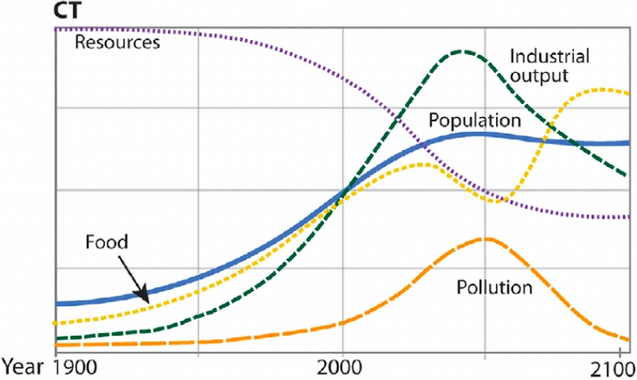

The ‘Comprehensive Technology’ scenario (Source: Herrington, 2021)

Unfortunately, the scenario which was the least closest fit to the latest empirical data happens to be the most optimistic pathway known as ‘SW’ (stabilized world), in which civilization follows a sustainable path and experiences the smallest declines in economic growth—based on a combination of technological innovation and widespread investment in public health and education.


The ‘Stabilized World’ Scenario (Source: Herrington, 2021)

Although both the business-as-usual and comprehensive technology scenarios point to the coming end of economic growth in around 10 years, only the BAU2 scenario “shows a clear collapse pattern, whereas CT suggests the possibility of future declines being relatively soft landings, at least for humanity in general.” 

Both scenarios currently “seem to align quite closely not just with observed data,” Herrington concludes in her study, indicating that the future is open.   

A window of opportunity

While focusing on the pursuit of continued economic growth for its own sake will be futile, the study finds that technological progress and increased investments in public services could not just avoid the risk of collapse, but lead to a new stable and prosperous civilization operating safely within planetary boundaries. But we really have only the next decade to change course. 

“At this point therefore, the data most aligns with the CT and BAU2 scenarios which indicate a slowdown and eventual halt in growth within the next decade or so, but World3 leaves open whether the subsequent decline will constitute a collapse,” the study concludes.

Although the ‘stabilized world’ scenario “tracks least closely, a deliberate trajectory change brought about by society turning toward another goal than growth is still possible. The LtG work implies that this window of opportunity is closing fast.” 

In a presentation at the World Economic Forum in 2020 delivered in her capacity as a KPMG director, Herrington argued for ‘agrowth’—an agnostic approach to growth which focuses on other economic goals and priorities.  

“Changing our societal priorities hardly needs to be a capitulation to grim necessity,” she said. “Human activity can be regenerative and our productive capacities can be transformed. In fact, we are seeing examples of that happening right now. Expanding those efforts now creates a world full of opportunity that is also sustainable.” 

She noted how the rapid development and deployment of vaccines at unprecedented rates in response to the COVID-19 pandemic demonstrates that we are capable of responding rapidly and constructively to global challenges if we choose to act. We need exactly such a determined approach to the environmental crisis.

“The necessary changes will not be easy and pose transition challenges but a sustainable and inclusive future is still possible,” said Herrington. 

The best available data suggests that what we decide over the next 10 years will determine the long-term fate of human civilization.

Although the odds are on a knife-edge, Herrington pointed to a “rapid rise” in environmental, social and good governance priorities as a basis for optimism, signalling the change in thinking taking place in both governments and businesses.

She told me that perhaps the most important implication of her research is that it’s not too late to create a truly sustainable civilization that works for all.

Links

(AU ABC) Great Barrier Reef In 'Recovery' But Experts Say Progress Will Be Threatened By Climate-Related Disturbances

ABC North Qld - Chloe Chomicki

AIMS researchers surveyed 127 coral reefs in 2021 to assess the health of the reef. (Supplied: Australian Institute of Marine Science)

Key Points
  • Coral cover is rising across the Great Barrier Reef
  • The "recovery window" is due to a break in climate-related disturbances
  • Experts believe the progress could be short lived
The Great Barrier Reef is experiencing a rare window of recovery due to a break in weather and bleaching events according to the latest observations from marine scientists.

According to the Australian Institute of Marine Science's Annual Summary Report on Coral Reef Condition, which was released today, conditions have been relatively good for coral recovery during 2020-21. 

Researchers surveyed 127 reefs and found that at least 69 had seen an increase in hard coral cover since they were last surveyed.

"This indicates that recovery is well underway, after a particularly intense decade of disturbances prior to this," monitoring team leader Mike Emslie said.

"We've had very few acute disturbances this year," Dr Emslie said.

"There were no sustained heatwaves leading to coral bleaching, there were no large tropical cyclones.
"Essentially the Great Barrier Reef has had a bit of a breather."
AIMS researchers are towed over the Great Barrier Reef to conduct surveys. (Supplied: Australian Institute of Marine Science)

The improvements come after the Great Barrier Reef experienced its most widespread bleaching event on record early last year.

Dr Emslie said the majority of the coral cover growth was driven by common, fast-growing table and branching corals.

However, he said these corals were the most vulnerable.

"Their fast growth comes at a bit of a cost, their skeletons aren't as dense as other corals," Dr Emslie said.

AIMS has warned that the recovery the Great Barrier Reef is currently experiencing is likely to be short-lived with the "increasing prominence" of climate-related disturbances.

"The biggest risk to the reef going forward is climate change," AIMS chief executive Paul Hardisty said.
"We must reduce emissions if the Great Barrier Reef and frankly other reefs around the world are going to continue to exist in the state in which we recognise them today," Dr Hardisty said.
Dr Paul Hardisty delivered an update on the reef's condition in Townsville. (ABC North Qld: Chloe Chomicki)

The World Heritage Committee, which sits under UNESCO, made a draft recommendation to list the Great Barrier Reef as "in danger" in June.

The decision is expected to be finalised at a meeting in China in the coming days.

AIMS declined to comment on the World Heritage Committee recommendation.

However, research program leader Britta Schaffelke said the latest observations of the Great Barrier Reef did not change a grim outlook which was delivered by the institute in 2019.

"The outlook report assessed the future outlook for the reef to be very poor," Dr Schaffelke said.

"The reef outlook into the future is still very poor because of the dangers of climate change and other factors."

'Incredibly rare moment'

The World Wildlife Fund's  Richard Leck said the report told a story of hope and one of a warning. 

"It's great to see the reef still has resilience and we have seen some significant bounce back in coral species," he said.

"But this is an incredibly rare moment in time where we haven't had extreme heat events or crown of thorns outbreaks.

"Those events are more likely to continue into the future."

Mr Leck said the report strengthened arguments to list the Great Barrier Reef as "in danger".

"This report reinforces the importance of the decision faced by the World Heritage Committee this week," he said.

Links

(The Guardian) Politicians From Across World Call For ‘Global Green Deal’ To Tackle Climate Crisis

The Guardian 

New alliance urges governments to work together to deliver a just transition to a green economy

Flood damage in Schuld, Germany on Sunday. Ilhan Omar, a US congresswoman for Minnesota, said the recent extreme weather around the world should serve as a warning. Photograph: Anadolu Agency/Getty Images

People around the world need a “global green deal” that would tackle the climate crisis and restore the natural world as we recover from the Covid-19 pandemic, a group of politicians from the UK, Europe and developing countries has said.

The Global Alliance for a Green New Deal is inviting politicians from legislatures in all countries to work together on policies that would deliver a just transition to a green economy ahead of Cop26 UN climate talks in Glasgow this November.

The alliance includes Caroline Lucas, the Green party’s only MP, and Labour’s Clive Lewis, as well as MEPs, representatives in Brazil, Argentina, Indonesia, Malaysia and the US among other countries.

Ilhan Omar, a US congresswoman for Minnesota, said the recent extreme weather in the US and around the world should serve as a warning:

“Climate change is here and it is an existential threat to humanity. We have already seen the horrifying repercussions of failing to act – wildfires raging across the west coast [of the US], extreme hurricanes, heatwaves in Australia, massive flooding around the world. Natural disasters like these will only get worse unless we act as a global community to counteract this devastation.”

How data could save Earth from climate change Read more
The alliance wants governments to put measures in place that would boost the green economy as well as collaborating on global vaccine access for Covid and debt restructuring for the world’s poorest nations.

They will seek to share knowledge around the world of successful initiatives, such as the decarbonisation plan recently put forward in Costa Rica.

Many government leaders have promised to “build back better” from the pandemic but few countries are investing in the new infrastructure needed.

Recent research by Vivid Economics found that only about a tenth of the $17tn being spent globally on rescuing stricken economies was going on projects that would reduce greenhouse gas emissions or restore nature.

However, more than $3tn was being poured into measures and industries that actively harmed the environment, such as coal and other fossil fuels.

Manon Aubry, a French MEP, said governments must focus on social justice and the climate:

“As the consequences of the climate crisis become more and more alarming, inequalities are growing and the poorest are hit hardest by the impacts of a changing climate. If we want fair, systematic and effective climate policies, we need a radical shift away from free trade and free-market ideology.”

The alliance currently has 21 members from 19 countries. Joenia Wapichana, the first indigenous woman ever to be elected federal representative in Brazil, said: “I understand how important it is that we all take responsibility for a green new deal.

"That’s why I am joining this alliance – to join forces so my work in parliament can contribute to the strengthening of the legislative process in defence of collective rights, the environment and in defence of indigenous peoples.”

Paola Vega, Costa Rican congresswoman and president of the special permanent commission for the environment of the legislative assembly of the Republic of Costa Rica, said a green deal would require a transformation of the way governments treat ecological problems, and in the way people live.

“Unless our countries, and the diverse alliances and range of powers that govern them, create enough pressure for collective action that changes the rules of the game, we will fall short of the urgent measures that we need to be able to address the massive challenges that we face today,” she said.

“It’s important that we are clear that this means an absolute change of paradigm: a change in the way we live, the way we consume and produce.”

Links

20/07/2021

(AU SMH) Northern Hemisphere’s Awful Summer Demands Climate Action

Sydney Morning Herald - Editorial

The floods in Germany and heatwaves in North America show the dangers but the federal government makes only lazy excuses.

Erftstadt, southwest of Cologne. (AP)


The lockdowns are grabbing a lot of the headlines here in Australia but the disastrous floods, droughts and bushfires in the northern hemisphere summer should be a reminder that climate change poses an even more serious threat than COVID-19.

In Germany and Belgium, flooding from an unprecedented weather event has killed at least 170 people and devastated ancient towns that have stood untouched for centuries. Meanwhile, last month, the town of Lytton in Canada’s snow forest recorded a freakishly high temperature of 49.6 degrees shortly before wildfires burnt it to the ground. Along the west coast of the United States, wildfires of extraordinary extent and ferocity are still raging out of control. Californians have been asked to cut water use by 15 per cent because of a historic drought.

Of course in the developing world, the disasters are just as severe if less widely reported here.

Development
Why a killer US heatwave points to a stifling future for our cities
These tragedies are all consistent with decades of scientific predictions of the likely impacts of human-induced climate change. It is actually happening. Global temperatures are already 1.2 degrees higher on average than a century ago and they are set to rise 5 degrees this century on the current trajectory.

Yet in the same week that our televisions are full of this compelling evidence of the urgency for strong action to fight climate change, the federal government continues to avoid making strong commitments and to abrogate what many view as our responsibilities as global citizens.

It remains Prime Minister Scott Morrison’s “preference” that Australia adopts a target of reaching net zero emissions by 2050, a goal that climate scientists say is still likely to be slower than required to hold the global temperature rise below an average of 2 degrees.

Yet he faces renewed opposition within his own government. Returned National Party leader Barnaby Joyce told The Australian Financial Review that he would lose his leadership if he even contemplated agreeing to such a target.

In an interview on ABC TV on Sunday, he added that he would not accept the target until he knows “what is involved”. This is a lazy excuse. As NSW Environment Minister Matt Kean said on Twitter, Mr Joyce “is as well placed as anyone to see ‘what’s involved’ and come up with a plan.”

Paris Agreement
Liberal MPs call for net zero by 2050 but Steggall’s climate bill rejected by committee
This week, the government also appeared to threaten to fight the next stage of the European Union’s climate policies, which include a so-called carbon border adjustment tax.

From 2026, the EU will impose a tariff on carbon-intensive imports such as steel and aluminium from countries that are not matching its climate policies, such as a carbon tax.

Even before reading the EU’s plan, Trade Minister Dan Tehan attacked the measure as “protectionist”, joining with Vladimir Putin’s Russia in opposing it. Yet his opposition will be seen as ideological, since very few Australian exports will be affected directly.

The Herald agrees with the Australian Industry Group, a business lobby group, which says the new tax is an opportunity rather than a threat for Australia.

It says the tariff has been designed to “create a level playing field by ensuring exporters to the EU are paying the same carbon price that European producers have to under the EU emissions trading scheme”. It has said that measures seem fair at first glance and has called on the federal government to talk to the EU.

The latest climate change-driven disasters in the northern hemisphere will only increase the pressure on Australia to drop the obfuscation and announce serious action ahead of the important United Nations Climate Conference, due to take place in Glasgow in November.

Australia must start taking action itself and embrace the opportunities presented on the international stage. Fighting the inevitable transition away from fossil fuels will only do further harm to our reputation at home and abroad – let alone that done to the environment.

Links

(AU New Daily) Alan Kohler: The Climate Change Panic Button Is Coming

New DailyAlan Kohler

Governments need to hit the panic button on climate change, writes Alan Kohler. Photo: TND/Getty

Author
Alan Kohler writes twice a week for The New Daily. He is also editor in chief of Eureka Report and finance presenter on ABC news.
This week it’s floods in Germany, 170 dead and terrible devastation.

A few weeks ago people were dying from the heat in Canada, which reached about 49 degrees Celsius in Lytton, British Columbia.

Wildfires are now breaking out across North America.

This is from the global warming that has already occurred, which is about 1.2 degrees above the pre-industrial age.

The world is now trying to stop it going above 1.5 degrees by getting emissions down to net zero by 2050.

Even if we succeed in that, which is far from guaranteed, the extreme weather events will be significantly worse and more frequent than they are now.

But at what point will governments hit the real panic button?

Because net zero by 2050 is not it.

Weighing up risk

The reason many are still negotiating, prevaricating and putting it off is that governments and businesses are not looking at global warming in terms of risk, but are using scenario analysis instead.

For example, the Australian Prudential Regulatory Authority issued a draft prudential practice guide on climate change in April, which included 4 degrees of warming as one of its two “scenarios” for banks to use in their future planning.

A 4 degree rise in the average global temperature would make large parts of the planet uninhabitable and lead to the total collapse of the banking system. No need for any planning.

The other APRA scenario was for 2 degrees of warming or less, consistent with the Paris Agreement, which should happen if all countries meet their Paris pledges, which so far they’re not.

And even under that scenario, the banking system barely survives.

There was nothing especially wrong with APRA’s guidance note – it was just a typical example of the arse-covering required by bureaucrats and corporate executives to cover their environmental, social and governance (ESG) obligations, with a paper trail to prove they did it.

But it highlights the problem with using scenarios instead of risk analysis.

The recent floods in Germany were the latest example of devastating climate change. Photo: AAP

Since most countries are now committed to net-zero emissions by 2050, even though the policies to achieve that have not been implemented, everyone can assume that the scenario of 1.5 degrees is locked in – a likelihood of 100 per cent. But that’s not correct. Even then there would still be a two-thirds risk of it being 2 degrees instead of 1.5, because of feedback loops caused by more carbon dioxide being released by the warming that has occurred.

Current policies, unchanged, would result in 2.4 degrees of warming, which would be terrible, but there would be a high risk (about 67 per cent) of 3 degrees, which would be catastrophic.

Lessons from AstraZeneca

Precise risk analysis of global warming is difficult because feedback loop tipping points are unknown and unpredictable.

It’s known that with 1.5 to 2 degrees of warming, the combination of permafrost melt in Siberia, wildfires in the world’s forests and warming of the ocean will release more carbon dioxide into the atmosphere, which means a feedback loop could take the temperature to 2.5 degrees above pre-industrial temperatures – and perhaps beyond – no matter what we do.

I was reminded of the power of risk analysis by the recent reaction to the risk of blood clots and death from the AstraZeneca vaccine.

It appears to be something like one in 88,000, or 0.0011 per cent to get a clot.

If that happens, the chance of then dying is 4 per cent, which boils down to a 0.00044 per cent chance of dying from having the AstraZeneca vaccine.

On the strength of that risk, the UK discontinued AstraZeneca for under-40s and the Australian medical authorities have warned against it, and people are shunning it in droves and waiting for Pfizer.

The risk of catastrophe and even extinction as a result of global warming is a lot higher than 0.00044 per cent and yet most of us are still driving petrol cars and eating steaks and hamburgers, and governments are still talking about targets 30 years away (or not, in Australia’s case).

Climate panic button

Whatever the temperature gets to – whether it be 1.5, 2, 3 or 4 degrees of warming – it would be a global average, uneven across the planet.

Anything much more than 1.5 degrees and heatwaves in some parts of the world would make them too hot to survive for some of the year, so humans couldn’t live there at all.

Daily life everywhere else would be an unbearable succession of extreme weather events, as we are seeing in Germany at the moment.

Sea level would rise by 1.5 to 2 metres, making many coastal and low-lying areas uninhabitable.

As a result, millions, possibly billions, of people would be displaced making a mess of global borders.

Banking and insurance would become impossible. The financial system would collapse.

What’s the risk of that? 10 per cent? 1 per cent?

Even if it was 1 per cent, that would be like two or three planes a day crashing after take-off in Australia – which would lead to zero take-offs until it was fixed.

At some point well before 2050, governments will be forced to switch to risk analysis for climate change, and to publish the result.

Unless scientists say the risk is zero – which they won’t – then whatever they come up with, political leaders will be forced to hit the panic button by alarmed voters.

What does the panic button look like?

I’m not sure, but here are some thoughts: Fossil fuels would be suddenly and totally banned, or made prohibitively expensive, and oil, gas and coal would instantly go bust; physical tourism would be banned and air travel confined to essentials and rich elites so the airline industry would collapse; the lithium battery and hydrogen would suddenly boom.

And so on.

Life would change more completely than it has during the pandemic.

In short, it would look like war.

Links

(ICIR) Climate Change Threatens Our Survival, Women Farmers In Niger Cry Out

International Centre for Investigative Reporting - Daniel Atori

FEMALE  farmers in Niger State have raised  alarm that Nigeria might experience a severe food crisis beginning from this year because of the adverse effects of climate change, insecurity, and other challenges.


THE late rains have left several small-scale holder farmers in Niger State vulnerable. Therefore, they have been told to use improved seedlings to boost production, but this advice has not allayed their fears.

“We used the improved seedlings and planted early but the rain which did not come has adverse effects on our farms. We are helpless and survival is critical at this time,” a woman farmer said

In the 2020 Global Hunger Index (GHI), Nigeria ranks 98th out of the 107 countries and with a score of 29.2 per cent, an indication that the country faces a serious case of hunger.

Nigerian rural female farmers account for nearly 70 per cent of agricultural workers and 80 per cent of food producers but they are at the receiving end of the negative impacts of climate change and insecurity.

SWOFON members in Magama LGA

A tour of five local government areas – Edati, Lapai, Lavun, Magama and Shiroro – in the three senatorial zones of Niger State exposed the need for urgent intervention from the government and other stakeholders.

Mairo Abdulmumini, Coordinator, Small-scale Women Farmers Organisation of Nigeria, (SWOFON), and 24 other women including, Dina Daniel, manage farmland at Tawale-Gwada in Shiroro Local Government Area, where they plant crops such as cassava, yam, and groundnuts.

When our reporter visited their farms, the women farmers had planted yam but they are afraid that if it does not rain on time, the yam will dry up, and eventually, they will lose their crops. 

” You know now even if we do the ridges, cassava and yam require water, if you don’t have water, you can’t work on cassava and yam.

And when it finally rained, it resulted in heavy flooding that swept away our cassava farm.”

The women, therefore, appealed to the government to create more awareness and sensitisation for those of them in the rural areas so that they can have full knowledge of climate change for better and improved farming.

Michael E. Mann, one of the world’s most influential climate scientists, has noted that the world has “finally reached the point where it is not credible to deny climate change because people can see it playing out in real-time in front of their eyes”.

Mairo Abdulmumuni, Coordinator Shiroro LGA

The rising incident of security is another challenge. Many farmers can no longer go to farm.

“The bandits usually attack, steal our produce, destroy our farms and produce and even our stores,” Abdulmumini said. 

According to Eunice Adeditan, SWOFON Coordinator in Lapai, most women farmers feel vulnerable and are afraid of going to their farms because of fear of attack by herders or bandits.

“Most of our women will not come out except we get men and security agents to follow us. The Fulani herdsmen used to bring their cows into our farms and eat everything and if you talk, it becomes a problem.”

The state Coordinator, Disa, said Niger State has security problems, even the SWOFON national headquarters knows about it, especially in places such as Kuta, Shiroro and Minna.

Eunice Adeditan, Coordinator Lapai LGA

SWOFON also complained about the difficulty of accessing funds in terms of the agriculture budget at the state ministry of agriculture.

“I met with the director handling Planning, Agriculture Services, he told me the state ministry of agriculture under the Mechanised Section, has something for us, but they will not give us funds directly, but use the money to buy gender-friendly machines for us.

“But till now, nothing has been given to us. We are planning to meet him soon because I told him we are coming.”

The Coordinator of SWOFON in Magama Local Government Area, Dorcas Jagaban, warned that the challenges faced by many women farmers will cause prices of food to go even higher than it already is.

But there are ways through which the government can assist the women.

Head, Women in Agriculture (WIA) under the Niger State Agriculture and Mechanisation Development Authority (NAMDA), Ministry of Agriculture and Rural Development, Mrs. Rose Saba, said the government intervention through the Central Bank of Nigeria (CBN) could be helpful.

She also said that more training should be given to farmers so that they can learn how to boost their farming during the dry and rainy seasons.

Links

19/07/2021

(AU SMH) Why A Killer US Heatwave Points To A Stifling Future For Our Cities

Sydney Morning Herald - Nick O'Malley | Miki Perkins

It was the hellish evening temperatures that finally caused the authorities to start busing the homeless into heat shelters where they had access to fans, air-conditioning and water.

Three hours from sundown last Saturday the temperature in Las Vegas peaked at 47.2 degrees, equalling a record set in 2017. By dawn, the temperature had bottomed out at a stifling 34 degrees and begun to rise again.

Firefighters monitor the Sugar Fire, part of the Beckwourth Complex Fire, in Doyle, California last week. Credit: AP

One person was treated for burns after walking on a pavement and the homeless were bussed from an outdoor shelter to indoor cooling centres in response.

West of the city at Furnace Creek in Death Valley a temperature of 54.4 degrees was recorded. Experts are still checking the reading and debating over whether this was the hottest temperature ever recorded on earth.

In the town of Lytton in British Columbia, a Canadian heat record was set at the end of last month when the temperature hit 49.6 degrees and lingered up there over three days. Authorities attributed hundreds of deaths across the region to the heat, even before wildfire arrived and burnt most of the village to the ground, killing two more.

Before the flames approached one local, Lorna Fandrich, told the New York Times that she’d noticed green leaves dropping off the trees, apparently unable to tolerate the heat. On the coast to the west, millions of mussels and oysters cooked and died in superheated shallow waters.

From his home outside Sacramento Ken Pimlott, the recently retired head of Cal Fire, the agency responsible for fighting wildfires across the state of California, watched on with dread. The height of the northern fire season, he noted, has not even arrived yet.

These temperatures, Pimlott told The Sydney Morning Herald and The Age, are no longer outliers, but spikes in a new normal in a world not prepared to manage them.

The temperatures have already extended the North American fire season, causing exhaustion among crews who can’t get enough rest from the fire lines and difficulties in keeping up with maintenance demands on equipment. Aircraft once shared with nations like Australia were under greater demand as fire seasons overlapped, he said.

Professor Sebastian Pfautsch is an expert in urban heat. Credit: Wayne Harley


Pimlott’s dread was shared in Australia.

Dr Sebastian Pfautsch, a specialist on urban heat at Western Sydney University, says though Australian attention has drifted from the terrible summer of 2019 and 2020, he fears for the future of residents of some suburbs in Sydney and Melbourne.

The heat is coming, he says, and we are not prepared for it.

Stephen Livesley is an associate professor in forest sciences at the University of Melbourne, and an expert on the benefits of urban forests. “It’s possible we’re going to end up with large neighbourhoods which people in 20 or 30 years’ time will simply avoid,” he says.

This concern is not misjudged, says Professor Christian Jakob, a Monash University atmospheric scientist.

His analysis of the heatwave that struck North America shows that it originated with an unremarkable rainshower on the other side of the Pacific Ocean, not far from Japan.

The shower caused an atmospheric disturbance that in turn created what scientists call a Rossby wave, which was guided towards North America by the jet stream, amplifying as it travelled before breaking upon the shores of the Pacific Northwest.

There the wave caused a high-pressure system. As Jakob explains, air heats under pressure. On the ground, temperatures soared. What caused the temperatures to reach such extremes, though, and what made the system linger long enough to cause such misery and destruction beneath it, cannot yet be explained by science says Jakob.

Until better computer models are created all we can know is that as the climate heats due to global warming such heatwaves will in some areas increase in intensity and duration.

Areas particularly prone to the phenomenon include northern Europe, North America and south-eastern Australia, he says.

Caddens in Sydney’s west is being transformed by new developments. Credit: Wolter Peeters

On the day that Penrith became for a time the hottest place on earth, with temperatures hitting 48.9 degrees on January 4 last year, Keith Heggart’s air conditioner conked out by midday.

The manual said it sometimes did that in extreme heat and recommended hosing it down, but due to bushfires water use was banned. Heggart and his young family closed windows against the smoke and the blinds against the sun and sheltered in the living room where a fan pushed around the hot air.

Watching the news from America these past few weeks, Heggart has fretted about the summers to come. His street in Penrith is older than others and there is some shade, some gaps between the houses, but when he looks at the new developments nearby, he despairs.

“There are no trees, there is no shade,” he says. “You could reach out your window and touch the house next door.

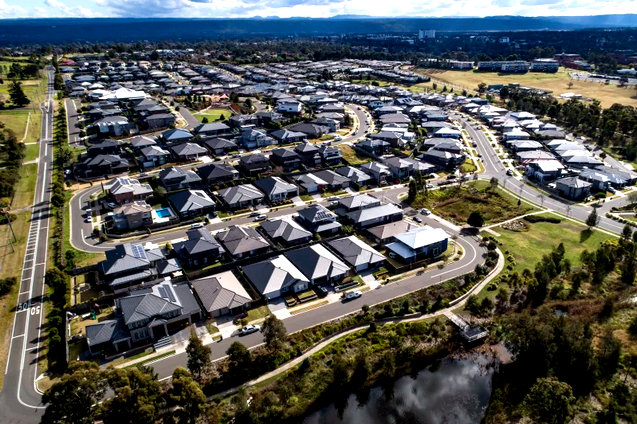
When he looks at new developments on the fringes of Australian cities, Pfautsch says residents have been abandoned to wholly predictable heat extremes caused by global warming but exacerbated by poor planning regulation.

Infrared images show the high temperatures generated by dark roofs in density housing.
Council areas such as Blacktown, Penrith and Campbelltown in Sydney and suburbs like Wollert, Mernda and Mickleham in Melbourne are compelled to absorb growing populations by state governments, but are failing to impose proper planning regulations. Strapped for cash, they have allowed property developers to shape the built environment, he says.

NSW Planning Minister Rob Stokes says combatting urban heat is a major focus, particularly in Sydney’s western suburbs.

“We are undertaking the biggest urban reforestation program in NSW history,” he says. “Since 2019 we have planted almost 600,000 more trees across Sydney as part of the NSW government’s plan to reach 1 million trees by 2022. We are also investing unprecedented funds in new parks and public spaces, with $250 million being invested with local government to provide more parks across NSW.”

Penrith Council did not respond to a request for comment.

It is not just that large houses on small blocks leave no room for trees, Pfautsch says. The little space left between them provides no room for recreation and serve to increase heat, with side-passages often home to air-conditioning systems that spew heated air across dividing fences.

But Pfautsch sees other wilful mistakes. Unshaded black roads absorb heat during the day only to radiate it at night, extending the heat of day into the evening. This contributes to the urban heat island effect.

Roofs, exterior walls and even driveways created by developers in currently fashionable dark shades serve to exacerbate the impact, he says.

But, according to Pfautsch, the problems begin even before the new suburbs are laid out, when developers clear new sites of all existing trees, ponds and watercourses to maximise space and save on construction costs.

What greenspace remains is often not connected to homes by shaded foot or bike paths.

“It is inhumane to expect people to live like this in the temperatures we anticipate,” he says. “I can’t say it more strongly than that.”

New developments in Sydney’s west are particularly vulnerable to extreme heat. Credit: Wolter Peeters

In May, the Victorian state government announced it would plant 500,000 trees in Melbourne’s west, in areas like Maribyrnong, Wyndham, Melton and Hobsons Bay.

Residents had been calling for help to green these suburbs as their populations took off without enough trees being planted to provide amenity or reduce the heat.

Trees are recognised globally as a weapon against the urban heat island effect.

Overall, Melbourne lost 0.3 per cent of its canopy between 2014 and 2018. Almost 2000 hectares of trees were cut from the east and south-east, mostly at residential properties.

Bushfires
Storms, tornadoes and explosions: How bushfires are getting stranger
And the distribution is patchy. The western region of Melbourne had about 5 per cent canopy cover in 2018, compared to 17 per cent in the inner south-east and 25 per cent in the east. Before it was earmarked for development, the city’s west was a basalt plain covered in critically-endangered native grasslands, not an area of thick bushland.

Even these remnant grasslands are dwindling: the Auditor General found Victoria had failed to protect its critically-endangered grasslands despite an agreement with the Commonwealth that was supposed to ensure their survival.

Now, much of these grasslands are gone and new homes in growth-area housing estates are often built almost to the edge of the plot, without room for a garden.

A spokesperson from the Victorian government said that in 2017 it mandated that a minimum garden area must be kept, as a percentage of a housing lot or subdivision, to protect the character and green space within Melbourne’s suburbs. The Victorian Planning Authority’s draft guidelines for new precinct plans propose a 30 percent tree canopy target for Melbourne’s new growth areas. These are expected to be released by the end of the year.

The outer parts of Australian cities are submitting to urban sprawl.

Stephen Livesley says the heat island effect is a challenge that will only get worse as the climate becomes warmer and dryer.

Livesley often takes his students on field trips to the Melbourne outer suburbs of Tarneit and Point Cook to show them what poor urban planning in the field, like public parks where developers have done initial plantings but not continued to water them, meaning that after a year or two the trees are stunted or die, and weeds take over.

“We’re ending up with dark-roofed, back-to-back, nose-to-front, housing suburbs on the outskirts of Melbourne. And if you add dark, asphalt and concrete surfaces you’re going to get really hot suburbs,” he says. “When you have high-temperature events intersecting with urban heat islands, you have really, really high temperatures.”

According to Pfautsch, even a concerted effort to increase tree coverage in the suburbs most prone to the heat-island effect will only have limited impact in the years to come.
We are pushing some of the most vulnerable people in our society into these low-tree, low-services environments.
Stephen Livesley
But more significantly, he notes that while photosynthesis in trees causes a cooling effect when temperatures are in the 20s and low 30s, in extreme cases, many species simply shut down, some even dump their leaves to preserve what moisture they have retained.

In the heat spikes to come, he says, trees will only be able to help us so much.

All this raises thorny questions of environmental and climate justice, Livesley says, as the suburbs most affected are often the most affordable.

“We are pushing some of the most vulnerable people in our society into these low tree, low services environments, with poor public transport infrastructure.”

Climate policy
The new dread of Australia's once-loved long, hot summer
He agrees with Pfautsch that planning regulations and incentives need to be changed. One simple fix would be to encourage lighter-coloured roofs to reflect solar radiation.

And using recycled water to ensure public parks and nature strips are kept moist would add a green buffer during heatwaves: “They may only cool the surrounds by a degree but that could be the difference between someone going to hospital or dying”.

In Mildura, a town near the border in north-west Victoria, temperatures have increased in line with worldwide heating trends. Between 1998-99 and 2018-19 the number of days each year where the temperature went above 35 degrees increased by about 20 days, and the number of heatwaves rose from six to nine.

For residents living in public housing – who faced huge bureaucratic hurdles to having air conditioners installed – recent summers have been a nightmare, prompting local service provider Mallee Family Care to lobby the state government.

With the University of Sydney School of Public health, the service undertook research to find out what the effects of extreme heat were on these public housing tenants.

All residents agreed there was little respite, with nowhere to escape from the heat even at night, when many were forced to drag their mattresses outside.

It was hotter inside non-air-conditioned houses than outside, but many felt compelled to stay indoors to reduce the risk of sunburn. Some recorded temperatures inside their homes in the 40s and 50s.

They reported headaches, sweating, heat exhaustion and heatstroke. One pregnant resident told researchers: “I thought I was going to die. Honestly, I wanted to die because it was just so hot. I didn’t want to leave the house, I just isolated myself, lying in the hallway.”

Mental health conditions were exacerbated and some worried about the future, with one woman saying: “I’m 65 now, what happens in my 70s? I think about 70 without an air conditioner. Life might be very hard.”

Mallee Family Care chief executive Teresa Jayet says there was evidence substance abuse and family violence worsened. School students were exhausted and unable to undertake their school work. Some were sent to the sick bay to catch up on sleep.

In November, the state government announced $122 million in funding to seal windows and doors, upgrade heating, cooling, and hot water in 35,000 social housing properties.

Ms Jayet welcomed the funding but said the work needed to happen quickly. “If we don’t invest now, the trajectory will be too late for people, it will be too hard to come back to try and rectify this issue,” Ms Jayet says.

Global warming
What will happen to our cities (and beaches) at 3 degrees of warming?

As the heatwave caused havoc in America, Pfautsch thought of the central Australian desert, he says. There each summer the air is superheated above the red dirt and fed to the east and south.

“There is nothing we can do about that, there is nothing we can put between us and hundreds of cubic kilometres of hot air,” he says.

“Planting trees is not enough.”

Instead, he says, not only should we be tackling climate change, we should be totally re-imagining how we build our suburbs.

Links

Lethal Heating is a citizens' initiative