24/07/2021

(ABC) No Scientific Consensus Yet On Whether Warming Arctic May Lead To More Extreme Weather

 ABC Weather - Ben Deacon

Predicting the impact of global warming on the jet stream is at the frontier of climate science. (Supplied: NASA)

Key Points
  • Climate change is leading to an increase in the frequency and intensity of extreme weather events
  • The warming Arctic may be leading to a slowing of the jet stream in the Northern Hemisphere, causing more extreme weather
  • The slowing jet stream theory is an area of ongoing research
In the past month alone, Germany, Belgium and the Netherlands have suffered horrific flooding, Siberia caught fire, and the Arctic Sea suffered near-record melting

 Meanwhile, in North America, after record-high temperatures, formerly rare fire thunderstorms have become near-daily events.

There is one big theory connecting climate change to the weather patterns behind events as disparate as fire and floods, heatwaves and melting ice, across three different continents. 

It is elegant, reasonably easy to understand and has profound implications — but because it is at the frontier of climate science, not all researchers are yet convinced.

Warmer world, hotter heatwaves

 In one respect, the influence of climate change on heatwaves is relatively straightforward, according to Andrew King from the ARC Centre of Excellence for Climate Extremes at The University of Melbourne.

Smoke from Oregon's Bootleg fire rises behind the town of Bonanza. (AP: Bootleg Fire Incident Command)

"We've warmed the planet by about 1.2 degrees Celsius and the land has warmed faster than the ocean," Dr King said.
"So, this allows heatwaves to be that bit hotter than they would be otherwise."
Lytton, in Canada's British Columbia, recorded a record high temperature of 49.6C on June 29. (Supplied: Andybremner2012 CC BY-SA 4.0)

 Dr King said a warmer atmosphere could also hold about 7 per cent more moisture for every degree Celsius of warming.
"That means storms that occur on very short timescales can rain out more than they would be able to in a world without global warming," he said.
Heavy rainfall in central China's Henan province caused deadly flooding this week. (Supplied: AP)

Climate change and weather patterns

Instances of extreme weather can be driven by distinct weather patterns that allow rain or heat to build up over time because weather systems stall in one place instead of moving on.

If climate change is causing weather systems to stall for longer, they may build to more intense levels.

This visualisation of high-altitude winds over North America on the day it reached 49.6 degrees Celsius in Canada shows the meandering jet stream. (Supplied: Earth.nullschool.net)

Late last month in Canada, a horseshoe-shaped high-pressure system called an Omega Block saw heat build up for days, leading to off-the-chart temperatures. In Europe last week, a cut-off low pressure system stalled over Germany, dumping a month's worth of rain in a day.
Limit of science

The impact of climate change on how such individual weather patterns move is at the very limit of science.

"It's kind of like having a jigsaw but most of the pieces are missing," Dr King said.
"We have really incomplete observations in many parts of the world and they don't go back long enough in time to really track the climate for long enough."
A lack of weather observations from remote regions like the Arctic makes it difficult to predict the precise behaviour of weather systems. (Supplied: Polar Bears International)

That missing data — often from remote places like the Arctic — is needed to build computer models of unprecedented detail that can better predict weather patterns. 

"We really need high-resolution simulations," Dr King said. 

"We have a few studies with regional, high-resolution simulations that point to a climate change-caused intensification of short-duration extreme rainfall, including in Europe.

"That's quite a powerful line of evidence to suggest that climate change is [enhancing] — or has likely enhanced — the recent extreme rainfall we saw in Germany, the Netherlands and elsewhere.
"But we just don't have enough data to really make conclusive statements."
The missing data is crucial to answering one of the biggest questions in climate science: Are weather systems sticking around for longer in the Northern Hemisphere because of climate change?

The answer — which would connect heat, floods and fire — has everything to do with the jet stream.

The jetstream circling the North Pole, reaching down into North America.

Wavy jet stream theory

Dr King says there is a belt of high-altitude winds that encircle the Northern Hemisphere, called the jet stream, and weather systems often follow that track.

Those winds are related to temperature differences between the cold polar regions and the warm tropics. 

"In a warming world, we're seeing a bit more warming over higher latitudes in the polar regions than we see over the equator," Dr King said.

"And that reduces the temperature difference between the equator and the poles.
"The idea is that, if you reduce that temperature difference between the equator and the poles, both near the surface and higher up in the atmosphere, you might reduce the strength of the jet stream. And you might make it wavier or slower," he said.
A slower, wavier jet stream may allow storms to stick around longer, leading to more extreme weather. 

But there is no conclusive evidence that the jet stream is slowing due to climate change.

"There are a variety of studies looking into this, some of which find evidence to suggest this is happening, particularly from the model-based studies, [and[ others, which suggest this isn't really happening,"  Dr King said. 

How the warming Arctic affects weather patterns in the Northern Hemisphere is an active area of research. (Supplied: Alfred-Wegener-Institut/Mario Hoppmann)

One recent study used detailed computer modelling to show a warmer world would lead not only to more intense rain in Europe but also to slower storm movement. 

However, its lead author — Abdullah Kahraman from Newcastle University in the United Kingdom — was at pains to qualify the limits of the study, saying it related to one very detailed computer simulation.

"This study does not really tell you that this will definitely be happening like that, because this is one scenario," Dr Kahraman said.
"However, when it comes to the jet stream issue, this is not the only simulation that is projecting some kind of decreasing of wind speed in the higher atmosphere."
Other scientists have recently shown there may only be a modest decrease in high altitude winds due to a warming Arctic. 

"It's basically an area of very active research, there are quite a few people around the world looking into this. And there is a diversity of views among scientists," Dr King said.
"At the very least, I think we can say that we don't have a great deal of confidence that this is a clear effect of climate change.
"But there is some indication that there might be more persistence of weather systems, as the jet stream may be allowing them to remain in place for longer.

"This could be contributing to some extreme weather events."

Links

23/07/2021

(USA TODAY) Scientists Discover More Than 30 Viruses Frozen In Ice, Most Never Seen Before

USA TODAYJordan Mendoza

Ancient, 15,000-year-old viruses identified from melting glaciers

What will happen when these ancient, ice-bound viruses thaw out? Buzz60

A group of scientists discovered ancient viruses frozen in two ice samples taken from the Tibetan Plateau in China, and most of them are unlike anything ever seen before.

The findings, published Wednesday in the journal Microbiome, came from ice cores taken in 2015 that scientists believe began to freeze at least 14,400 years ago.

“These glaciers were formed gradually, and along with dust and gases, many, many viruses were also deposited in that ice," lead author and researcher at The Ohio State University Byrd Polar and Climate Research Center Zhi-Ping Zhong said in a statement.

"The glaciers in western China are not well-studied, and our goal is to use this information to reflect past environments. And viruses are a part of those environments."

When researchers analyzed the ice, they found genetic codes for 33 viruses.

Of the 33 found, genetic codes for four of them showed they are part of virus families that typically infect bacteria. However, up to 28 of the viruses were novel, meaning they had never before been identified.

However, the group doesn't believe the viruses originated from animals or humans, but came from the soil or plants. The scientists also believe roughly half of them survived because of the ice.

"These are viruses that would have thrived in extreme environments,” said Matthew Sullivan, co-author of the study and director of Ohio State’s Center of Microbiome Science.

“These viruses have signatures of genes that help them infect cells in cold environments – just surreal genetic signatures for how a virus is able to survive in extreme conditions."

Sullivan added the technology used to study microbes and viruses inside the ice would eventually lead to looking for similar genetic sequences in other extreme ice environments, possibly on Mars.

Senior author of the study Lonnie Thompson said the discovery of the viruses in glaciers of ice will also help researchers understand how they respond to climate change.

“We know very little about viruses and microbes in these extreme environments, and what is actually there,” Thompson said. “The documentation and understanding of that is extremely important."

Links

(UK UNILAD) Earth Temperature Could Reach ‘Tipping Point’ Within Five Years, Study Warns

UNILADEmily Brown


A study by the World Meteorological Organization (WMO) suggests Earth’s temperature could reach its ‘tipping point’ within the next five years. 

Last year marked one of the three warmest years on record, with the global average temperature being 1.2°C above pre-industrial levels, but the WMO has warned the worst could be yet to come as the chances of the temperature reaching 1.5°C are increasing with time.

The UN Intergovernmental Panel on Climate Change (IPCC) has established 1.5°C as a key tipping point for the Earth’s temperature, beyond which the risks of disasters such as extreme drought, fires, floods and food shortages will increase dramatically. Earlier this year, the WMO, which is the world’s leading weather and climate organisation, warned that there is a 40% chance the annual average global temperature will reach the threshold in at least one of the next five years.

In a statement cited by CNN, Petteri Taalas, the WMO’s secretary-general, stressed the findings are ‘more than just statistics’.

He continued: ‘Increasing temperatures mean more melting ice, higher sea levels, more heatwaves and other extreme weather, and greater impacts on food security, health, the environment and sustainable development.’ Even if the threshold is not reached in the coming years, the WMO has said there is a 90% chance that at least one year between 2021 and 2025 will become the warmest on record, surpassing the current hottest record established in 2016.

The Paris Agreement aims to keep the global temperature increase below 1.5°C, but the world is already two-thirds of the way to the tipping point, with the annual average temperature likely to be at least 1°C warmer than pre-industrial levels in each of the coming five years, according to the WMO.

Taalas described the study as ‘yet another wake-up call’, commenting: ‘We are getting measurably and inexorably closer to the lower target of the Paris Agreement on Climate Change. The world needs to fast-track commitments to slash greenhouse gas emissions and achieve carbon neutrality.’ Gavin Schmidt, director of NASA’s Goddard Institute for Space Studies in New York City, said that while there is a ‘little bit of up and down in the annual temperatures’, the long-term trends are ‘unrelenting’.

Per Reuters, he added: ‘It seems inevitable that we’re going to cross these boundaries, and that’s because there are delays in the system, there is inertia in the system, and we haven’t really made a big cut to global emissions as yet.’

In order to reach the goal set out in the Paris Agreement, the IPCC reported that global greenhouse gas emissions must reach net zero by 2050.

Links

(USA The Conversation) The Next Big Financial Crisis Could Be Triggered By Climate Change – But Central Banks Can Prevent It

The Conversation |  | 

Both climate change and policies to prevent it can rattle the economy. Citizen of the Planet/Education Images/Universal Images Group via Getty Images

Authors
  •  is Associate Professor of Economics, Georgia State University
  •  is Assistant Professor of Economics, Georgia State University
  •  is Assistant Professor in Economics, Georgia State University     
In 2008, as big banks began failing across Wall Street and the housing and stock markets crashed, the nation saw how crucial financial regulation is for economic stability – and how quickly the consequences can cascade through the economy when regulators are asleep at the wheel.

Today, there’s another looming economic risk: climate change. Once again, how much it harms economies will depend a lot on how financial regulators and central banks react.

Climate change’s impact on economies isn’t always obvious. Mark Carney, the former governor of the Bank of England, identified a series of climate change-related risks in 2015 that could shake the financial system. The rising costs of extreme weather, lawsuits against companies that have contributed to climate change and the falling value of fossil fuel assets could all have an impact.

Nobel Prize-winning U.S. economist Joseph Stiglitz agrees. In a recent interview, he argued that the impact of a sharp rise in carbon prices – which governments charge companies for emitting climate-warming greenhouse gases – could trigger another financial crisis, this time starting with the fossil fuel industry, its suppliers and the banks that finance them, which could spill over into the broader economy.

Our research as environmental economists and macroeconomists confirms that both the effects of climate change and some of the policies necessary to stop it could have important implications for financial stability, if preemptive measures are not undertaken. Public policies addressing, after years of delay, the fossil fuel emissions that are driving climate change could devalue energy companies and cause investments held by banks and pension funds to tank, as would abrupt changes in consumer habits.

The good news is that regulators have the ability to address these risks and clear the way to safely implement ambitious climate policy.

Climate-stress-testing banks

First, regulators can require banks to publicly disclose their risks from climate change and stress-test their ability to manage change.

The Biden administration recently introduced an executive order on climate-related financial risk, with the goal of encouraging U.S. companies to evaluate and publicly disclose their exposure to climate change and to future climate policies.

In the United Kingdom, large companies already have to disclose their carbon footprints, and the U.K. is pushing to have all major economies follow its lead.

The European Commission also proposed new rules for companies to report on climate and sustainability in their investment decisions across a broad swath of industries in its new Sustainable Finance Strategy released on July 6, 2021. This strategy builds on a previous plan for sustainable growth from 2018.

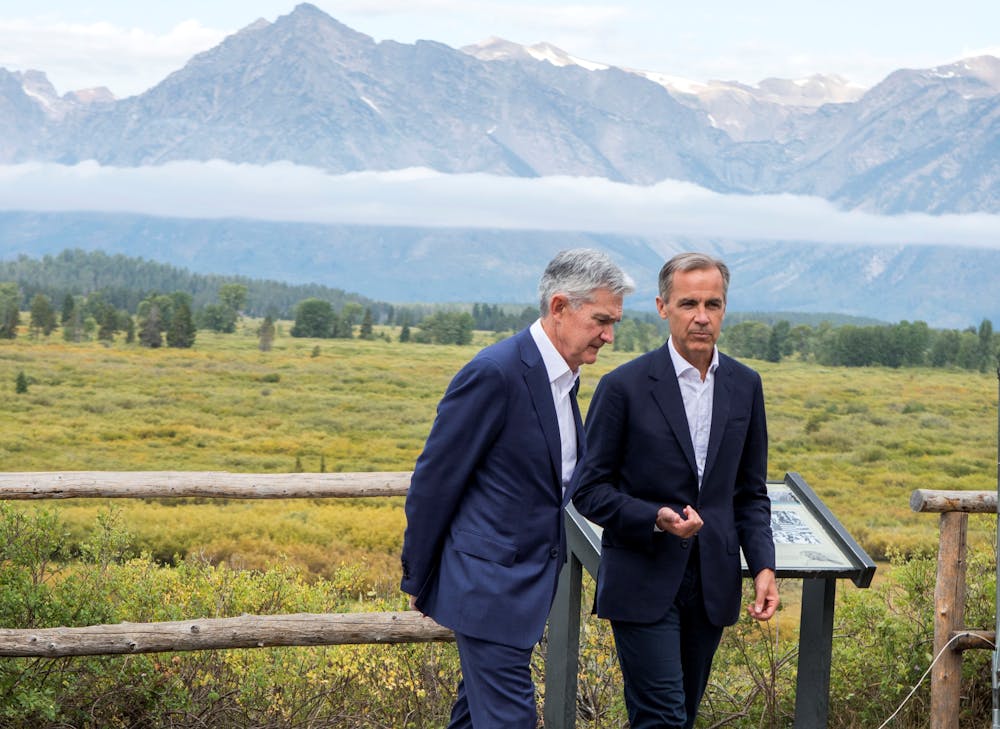
Mark Carney (right), former head of the Bank of England, has been warning about the economic risks of climate change for several years. The U.S. Federal Reserve, chaired by Jerome Powell (left), has recently begun discussing it as well. AP Photo/Amber Baesler

Carbon disclosure represents a crucial ingredient for “climate stress tests,” evaluations that gauge how well-prepared banks are for potential shocks from climate change or from climate policy. For example, a recent study by the Bank of England determined that banks were unprepared for a carbon price of US$150 per ton, which it determined would be necessary by the end of the decade to meet the international Paris climate agreement’s goals.

The European Central Bank is conducting stress tests to assess the resilience of its economy to climate risks. In the United States, the Federal Reserve recently established the Financial Stability Climate Committee with similar objectives in mind.

Monetary and financial policy solutions

Central banks and academics have also proposed several ways to address climate change through monetary policy and financial regulation.

One of these methods is “green quantitative easing,” which, like quantitative easing used during the recovery from the 2008 recession, involves the central bank buying financial assets to inject money into the economy. In this case, it would buy only assets that are “green,” or environmentally responsible. Green quantitative easing could potentially encourage investment in climate-friendly projects and technologies such as renewable energy, though researchers have suggested that the effects might be short-lived.

A second policy proposal is to modify existing regulations to recognize the risks that climate change poses to banks. Banks are usually subject to minimum capital requirements to ensure banking sector stability and mitigate the risk of financial crises. This means that banks must hold some minimum amount of liquid capital in order to lend.

Incorporating environmental factors in these requirements could improve banks’ resilience to climate-related financial risks. For instance, a “brown-penalizing factor” would require higher capital requirements on loans extended to carbon-intensive industries, discouraging banks from lending to such industries.

Reducing fossil fuel use to slow climate change will affect oil industry assets, like refineries, pipelines and shipping, as well as the industry’s suppliers. Joe Raedle/Getty Images


Broadly, these existing proposals have in common the goal of reducing economy-wide carbon emissions and simultaneously reducing the financial system’s exposure to carbon-intensive sectors. The Bank of Japan announced a new climate strategy on July 16, 2021, that includes offering no-interest loans to banks lending to environmentally friendly projects, supporting green bonds and encouraging banks to disclosure their climate risk.

The Federal Reserve has begun to study these policies, and it has created a panel focused on developing a climate stress test.

Lessons from economists

Often, policymaking trails scientific and economic debates and advancements. With financial regulation of climate risks, however, it is arguably the other way around. Central banks and governments are proposing new policy tools that have not been studied for very long.

A few research papers released within the last year provide a number of important insights that can help guide central banks and regulators.

They do not all reach the same conclusions, but a general consensus seems to be that financial regulation can help address large-scale economic risks that abruptly introducing a climate policy might create. One paper found that if the climate policy is implemented gradually, the economic risks can be small and financial regulation can manage them.

Financial regulation can also help accelerate the transition to a cleaner economy, research shows. One example is subsidizing lending to climate-friendly industries while taxing lending to polluting industries. But financial regulation alone will not be enough to effectively address climate change.

Central banks will have roles to play as countries try to manage climate change going forward. In particular, prudent financial regulation can help prevent barriers to the kind of aggressive policies that will be necessary to slow climate change and protect the environments our economies were built for.

Links

22/07/2021

(AU AFR) Australia Faces Carbon Tariffs Without Big Ambitions: Mark Carney

 AFRMichael Roddan

Former Bank of England governor Mark Carney believes Australia must show high ambitions to tackle climate change and reduce emissions to avoid carbon tariffs being whacked on the country.

Former governor of the Bank of England Mark Carney. Bloomberg
The UN’s November Climate Change Conference of the Parties (COP26) in Glasgow would pressure countries to develop solid policies for reducing emissions, said Mr Carney, the current UN Special Envoy on Climate Action and Finance.

“The more high ambition is shown by all countries – Australia included – the less likely there is to be border adjustment mechanisms and, and that’s, that’s what we’re going for,” Mr Carney told the Australian Council of Superannuation Investors conference on Wednesday.

COP26 was trying to recognise that different counties were going to have different policies, such as carbon taxes or regulation or subsidies, but the world was trending towards enforcing climate action through trade policy, Mr Carney said.

“There is a push, we see it in Europe, most prominently, but also the United States, talking about carbon border adjustment mechanisms (CBAMs). Canada as well,” he said.

“A number of countries as they up their ambitions, are saying: ’Well, wait a minute, what about these high intensity and high emission industries - aren’t I putting myself at a competitive disadvantage if others aren’t moving as fast as rapidly, and therefore do I put these so-called CBAMs in place.”

“There’s no question that momentum is there. We’re trying to arrest it, as Australia’s a free-trading nation, so is the UK as is Canada, and the world is better off if we can keep the trade system open. But there is a risk, without question.”

Prime Minister Scott Morrison has been averse to carbon pricing and taxing schemes, but there is growing pressure on Australia as international groups push for the introduction of CBAMs, a tariff Trade Minister Dan Tehan has attacked as a potentially protectionist measure.

President Joe Biden has said the US will introduce a carbon price, and will look at carbon border taxes on imports if necessary. China is also examining a broad-based domestic carbon price, although has evinced less support for carbon border taxes.

A combined US-EU carbon tariff would raise the prospect that some Australian exporters could face significant new costs even if Mr Morrison does not introduce a carbon price domestically.

Also speaking at the ACSI conference was Dr Graham Sinden, head of climate risk at the Australian Prudential Regulation Authority, who said the regulator’s work on comparing the country’s top bank’s preparedness for climate change was racing ahead.

The work, which is organising big lenders to analyse the exposure to climate-related risks of their balance sheets, was put on hold last year after the plan was announced on the same day Australia enacted emergency measures in relation to the then-growing coronavirus scare.

APRA was working with the five big banks and the Australian Banking Association to design the probe, and had “just recently handed that project over to the execution phase with the banks to commence working through understanding what the risks are to their balance sheets”, Mr Sinden said.

“We expect the outcomes of that, both from a quantitative perspective – understanding what risk looks like – and the potential influence of different climate pathways on risk after 2050, we expect that to be quite informative,” he said.

Links

(AU The Guardian) Coalition Believes It Has Numbers To Stop Great Barrier Reef Being Listed As ‘In Danger’

The Guardian

Exclusive: Diplomatic email suggests whirlwind lobbying trip by Sussan Ley has won over at least nine of 21 members on World Heritage Committee

Federal environment minister Sussan Ley spent eight days flying around Europe to lobby ambassadors from 18 countries for support against UNESCO Great Barrier Reef ‘in danger’ listing. Photograph: Nature Picture Library/Alamy Stock Photo

Australia’s global lobbying offensive to keep the Great Barrier Reef off the world heritage “in danger” list has secured support from at least nine of the 21-member committee that will make the decision, according to a diplomatic email seen by Guardian Australia.

 Australia’s Paris-based ambassador to UNESCO, Megan Anderson, said in the email she believed the government had won enough support to delay the decision on the “in danger” listing until at least 2023.


UNESCO says ‘in danger’ listing would be ‘call to action’ on Great Barrier Reef. Read more

It was sent on Saturday, shortly after the start of a two-week World Heritage Committee meeting in China that will decide whether to change the reef’s world heritage status. A decision on the reef is expected on Friday.

The federal environment minister, Sussan Ley, was due to return to Australia overnight from an eight-day lobbying trip that included flights to Hungary, France, Spain, Bosnia and Herzegovina, Oman and the Maldives.

The minister’s office said she had met ambassadors from 18 countries either face-to-face or virtually.

The trip was to lobby against a recommendation by the UN’s science and culture organisation, UNESCO, that the reef be listed as “world heritage in danger” due to the impact of three mass coral bleaching events in five years, and slow progress to cut pollution from farms and properties.

Sussan Ley returned home after an eight-day lobbying trip that
included flights to Hungary, France, Spain and the Maldives
MAP

If the committee agrees, it would be the first time a world heritage site has been placed on the list due to damage from climate change. The committee is chaired this year by China.

In the email, Anderson said Bahrain, Saint Kitts and Nevis, Ethiopia, Hungary, Mali, Nigeria, Saudi Arabia, Oman, and Bosnia and Herzegovina, had indicated “they would like to co-author/co-sponsor” an amendment supporting Australia’s position.

In a document tabled to the committee early Wednesday those countries, as well as Russia and Spain, are listed as backing Australia.

Anderson said Australia believed the level of support would “send a good message about consensus and that the committee would not need to spend a lot of time discussing [the reef]”.

The amendment, which was submitted by Bahrain, would require a UNESCO monitoring mission to the reef and allow Australia to report back to the committee by December 2022. Any consideration for placing the reef on the danger list would be pushed back until at least 2023.

Last week, the Guardian revealed Australia had won the support of oil-rich Saudi Arabia and Bahrain to co-sponsor “amendments” to be put to the committee that would see a decision delayed until the 2023 meeting of the committee.

Australia has argued UNESCO did not follow the normal process because it did not carry out a monitoring mission before making its recommendation. Australia also argued the decision had been politicised.

Environment groups, prominent Australians and a lineup of international figures from the worlds of entertainment, science and conservation have all backed UNESCO’s call.

Senior UNESCO officials have repeatedly rejected claims due process had not been followed and said an “in danger” listing was a chance to rally the world to the reef’s plight. Since the World Heritage Committee last considered the reef in 2015, corals across the world’s biggest reef system have been hit by mass bleaching in 2016, 2017 and 2020.

In the email, sent to ambassadors from more than 20 countries, Anderson supplied a scientific summary from the Australian Institute of Marine Science (Aims) which, she said, had found “widespread recovery of coral at key sites across the property”.

Record-breaking ocean temperatures over the Queensland reef in February 2020 led to the most widespread bleaching event on record. But since then, conditions have been benign, the Aims report said.

But the report said rising coral coverage was thanks to fast-growing species that were susceptible to storms and coral-eating starfish – and would probably be hit in the next bleaching event.

The minister has been flying in one of the RAAF’s three new Dassault Falcon 7X planes. Charges for previous ministerial flights on the same aircraft suggest the trips cost in the region of $4,200 an hour.

Joanna Lumley and Jason Momoa join prominent group backing Great Barrier Reef ‘in danger’ listing Read more
Last Thursday, the government hosted ambassadors from 13 countries and the EU for a day of snorkelling on Agincourt Reef, off Port Douglas, with reef envoy Warren Entsch.

Ley was accompanied on the Europe trip by the chief executive of the Great Barrier Reef Marine Park Authority, Josh Thomas.

Publicly available flight logs showed the RAAF plane crisscrossed Europe for meetings with members of the 21-country world heritage committee.

The plane landed in Budapest last Monday and then flew to Paris. On Wednesday, the plane flew to Madrid and back. On Friday, there was a return trip to Sarajevo.

The jet then flew to the Indian Ocean nation of the Maldives, via Oman, on Monday, where Ley met with the country’s environment minister and the country’s special climate change envoy.

A spokesperson for the minister said there was “strong appreciation of the minister’s concerns in regard to the absence of process from UNESCO”.

“The meetings included constructive and cordial conversations, including two with the ambassador of the People’s Republic of China to UNESCO,” they said.

Australia had a strong relationship with all countries in the world heritage system, the spokesperson said, “as we work together to protect the world’s cultural and natural heritage”.

Imogen Zethoven, a consultant on world heritage for the Australian Marine Conservation Society who has also been briefing countries on the reef, said: “The trip by minister Ley is all about politics ahead of conservation.”

“The government wants to defer any decision about the Great Barrier Reef until after the next election. I hope committee members can see through this,” she said.

Richard Leck, head of oceans at WWF-Australia, said the recommendation from UNESCO to the committee was “based on the best available science”.

‘“It contains recommendations that are urgently needed to give the reef a fighting a chance.

“We urge the committee to assess whether to implement this draft decision based on the integrity of the science, not based on the lobbying efforts of the Australian government.”

Links

(Legal) Climate Change Cases Doubled Past Six Years

Environmental + Energy Leader 

(Credit: Insurance Journal)

The number of climate change-related cases worldwide more than doubled in the past six years, according to recent data from the Grantham Research Institute on Climate Change and the Environment at the London School of Economics.

More than 1,000 cases globally have been brought in the last six years, since the Paris Agreement in 2015 — with 191 new climate change cases being filed between May 2020 and May 2021. This compares to about 800 cases filed from 1986 to 2014.

While the majority of claims since 1986 have been in the U.S. — with the EU and Australia being other jurisdictions with the highest volume of cases — in the past year, cases were filed for the first time in Guyana, Taiwan, the East African Court of Human Rights and the European Court of Human Rights.

While claims against corporations have historically been dominated by cases against fossil fuel companies, claims are now being filed against a wider range of private sector organizations.

For example, in 2020, an action was brought against dairy company Fonterra claiming a duty of care to reduce emissions, and cases were also filed against companies with a more indirect role such as those in the financial services sector.

Non-governmental organizations (NGOs) and individuals are responsible for an increasing number of claims. And, ‘strategic’ cases, which aim to bring about some broader societal shift such as advancing climate policies, creating public awareness, or changing the behavior of government, are also dramatically on the rise.

A report from the UN Environment Program (UNEP) released earlier this year corroborates these findings. Key trends trends in climate litigation, according to the UNEP, include:
  • Violations of ‘climate rights’, i.e. fundamental human rights including the right to life, health, food, and water.
  • Failures of governments to enforce their commitments on climate change mitigation and adaptation.
  • ‘Greenwashing’ and non-disclosures, when corporate messaging contains false or misleading information about climate change impacts.
The Grantham Institute researchers predict that climate change litigation will continue to grow and diversify.

Growth areas include supply and value chain litigation; cases challenging government support to the fossil fuel industry; and so-called ‘just transition’ cases, in which claimants oppose climate change adaptation or mitigation projects due to their impacts on the environment and communities.

Corporations should also be wary of potential actions that can occur outside of the courtroom, explain Mark Clarke and Clare Connellan, partners at international law firm White & Case.

The rising sense of urgency to mitigate the effects of climate change has prompted shareholders to utilize traditional business mechanisms, such as voting on environmental resolutions at annual meetings to decrease the company’s carbon footprint.

In the last year, shareholders at a number of financial and energy companies have proposed and voted in favor of setting climate targets in line with the Paris Agreement, though not all have passed.

Some companies are also being asked by their shareholders to disclose how their business models will be compatible with a net zero economy.

Links

Lethal Heating is a citizens' initiative