30/07/2021

(AU SMH) Superannuation Giant Abandons Coal, Backs New Tech And Renewables

Sydney Morning Herald - Nick O'Malley

Australia’s second largest superannuation fund has completely divested from thermal coal and ploughed $1 billion into renewable and low-emission technology in the year since it declared it would reshape its business in line with climate targets.

Aware is aiming to reduce emissions across its entire portfolio by 45 per cent by 2030. Credit: Quinn Rooney

According to its progress report, Aware Super, formally First State, has reduced emissions in its listed equities portfolio by 45 per cent and by 63 per cent across its socially responsible investment options.

Chief executive Deanne Stewart said more needed to be done to achieve Aware’s goal to reduce emissions across its entire portfolio by 45 per cent by 2030 in line with the Paris Agreement targets, on the way to net zero by 2050.

She said Aware started moving towards a divestment from carbon intensive investment as far back as 2015 when it became clear not only that climate change presented a direct risk to the retirement savings of fund members, but that there were significant opportunities for growth in emerging and growing renewable and low-carbon technologies.

She said momentum was growing across the sector as the impact of climate change became more real and immediate to the broader community.

Group of 20 nations fails to agree on phasing out coal by 2025
“It’s not something that’s in the distant future, something that may or may not occur.

"Whether it’s here in Australia with record floods and bushfires, whether it’s in China, whether it’s floods in Northern Europe, the fires in the US, [climate change] is unavoidable, inescapable … you can see it, it is a present danger.”

Aware is a member of the Investor Group on Climate Change, a collaboration of Australian and New Zealand institutional investors focused on the impact of climate change on investments.

The group this week issued a report calling for an orderly transition from a carbon-intensive economy as global action on climate change intensified.

It said while institutional investors had a significant role to play in ensuring communities were supported through transition, government action was needed to ensure mining, oil and gas communities such as those in the Hunter Valley, Bowen-Surat, Pilbara and Gippsland basins, were not disproportionately hit by abrupt economic changes.

Ms Stewart said state governments were setting policy to assist a transition, but that the federal government could help do more with climate targets and energy policy that ensured certainty for business and investment.

Links >

(USA Quanta) A Soil-Science Revolution Upends Plans To Fight Climate Change

Quanta - Gabriel Popkin

A centuries-old concept in soil science has recently been thrown out. Yet it remains a key ingredient in everything from climate models to advanced carbon-capture projects.

One teaspoon of healthy soil contains more bacteria, fungi and other microbes than there are humans on Earth. Those hungry organisms can make soil a difficult place to store carbon over long periods of time. Catherine Ulitsky

The hope was that the soil might save us. With civilization continuing to pump ever-increasing amounts of carbon dioxide into the atmosphere, perhaps plants — nature’s carbon scrubbers — might be able to package up some of that excess carbon and bury it underground for centuries or longer.

That hope has fueled increasingly ambitious climate change–mitigation plans. Researchers at the Salk Institute, for example, hope to bioengineer plants whose roots will churn out huge amounts of a carbon-rich, cork-like substance called suberin. Even after the plant dies, the thinking goes, the carbon in the suberin should stay buried for centuries.

This Harnessing Plants Initiative is perhaps the brightest star in a crowded firmament of climate change solutions based on the brown stuff beneath our feet.

Such plans depend critically on the existence of large, stable, carbon-rich molecules that can last hundreds or thousands of years underground. Such molecules, collectively called humus, have long been a keystone of soil science; major agricultural practices and sophisticated climate models are built on them.

But over the past 10 years or so, soil science has undergone a quiet revolution, akin to what would happen if, in physics, relativity or quantum mechanics were overthrown. Except in this case, almost nobody has heard about it — including many who hope soils can rescue the climate.

“There are a lot of people who are interested in sequestration who haven’t caught up yet,” said Margaret Torn, a soil scientist at Lawrence Berkeley National Laboratory.

A new generation of soil studies powered by modern microscopes and imaging technologies has revealed that whatever humus is, it is not the long-lasting substance scientists believed it to be.

Soil researchers have concluded that even the largest, most complex molecules can be quickly devoured by soil’s abundant and voracious microbes. The magic molecule you can just stick in the soil and expect to stay there may not exist.

Artificially colored scanning electron micrograph images of soils from the island of Hawai’i. Thiago Inagaki, in collaboration with Lena Kourkoutis, Angela Possinger and Johannes Lehmann

“I have The Nature and Properties of Soils in front of me — the standard textbook,” said Gregg Sanford, a soil researcher at the University of Wisconsin, Madison. “The theory of soil organic carbon accumulation that’s in that textbook has been proven mostly false … and we’re still teaching it.”

The consequences go far beyond carbon sequestration strategies. Major climate models such as those produced by the Intergovernmental Panel on Climate Change are based on this outdated understanding of soil.

Several recent studies indicate that those models are underestimating the total amount of carbon that will be released from soil in a warming climate.

In addition, computer models that predict the greenhouse gas impacts of farming practices — predictions that are being used in carbon markets — are probably overly optimistic about soil’s ability to trap and hold on to carbon.

It may still be possible to store carbon underground long term.  Indeed, radioactive dating measurements suggest that some amount of carbon can stay in the soil for centuries. But until soil scientists build a new paradigm to replace the old — a process now underway — no one will fully understand why.

The Death of Humus

 Soil doesn’t give up its secrets easily. Its constituents are tiny, varied and outrageously numerous. At a bare minimum, it consists of minerals, decaying organic matter, air, water, and enormously complex ecosystems of microorganisms.

One teaspoon of healthy soil contains more bacteria, fungi and other microbes than there are humans on Earth.

The fine hairs surrounding roots are covered in hungry bacteria; soils slightly further away from the roots may have an order of magnitude fewer microbes. Courtesy of Jennifer Pett-Ridge and Erin Nuccio
The German biologist Franz Karl Achard was an early pioneer in making sense of the chaos. In a seminal 1786 study, he used alkalis to extract molecules made of long carbon chains from peat soils.

Over the centuries, scientists came to believe that such long chains, collectively called humus, constituted a large pool of soil carbon that resists decomposition and pretty much just sits there.

A smaller fraction consisting of shorter molecules was thought to feed microbes, which respired carbon dioxide to the atmosphere.

This view was occasionally challenged, but by the mid-20th century, the humus paradigm was “the only game in town,” said Johannes Lehmann, a soil scientist at Cornell University.

Farmers were instructed to adopt practices that were supposed to build humus. Indeed, the existence of humus is probably one of the few soil science facts that many non-scientists could recite.

What helped break humus’s hold on soil science was physics. In the second half of the 20th century, powerful new microscopes and techniques such as nuclear magnetic resonance and X-ray spectroscopy allowed soil scientists for the first time to peer directly into soil and see what was there, rather than pull things out and then look at them.

What they found — or, more specifically, what they didn’t find — was shocking: there were few or no long “recalcitrant” carbon molecules — the kind that don’t break down. Almost everything seemed to be small and, in principle, digestible.

“We don’t see any molecules in soil that are so recalcitrant that they can’t be broken down,” said Jennifer Pett-Ridge, a soil scientist at Lawrence Livermore National Laboratory. “Microbes will learn to break anything down — even really nasty chemicals.”

Lehmann, whose studies using advanced microscopy and spectroscopy were among the first to reveal the absence of humus, has become the concept’s debunker-in-chief. A 2015 Nature paper he co-authored states that “the available evidence does not support the formation of large-molecular-size and persistent ‘humic substances’ in soils.”

In 2019, he gave a talk with a slide containing a mock death announcement for “our friend, the concept of Humus.”

Over the past decade or so, most soil scientists have come to accept this view. Yes, soil is enormously varied. And it contains a lot of carbon. But there’s no carbon in soil that can’t, in principle, be broken down by microorganisms and released into the atmosphere.

The latest edition of The Nature and Properties of Soils, published in 2016, cites Lehmann’s 2015 paper and acknowledges that “our understanding of the nature and genesis of soil humus has advanced greatly since the turn of the century, requiring that some long-accepted concepts be revised or abandoned.”

Old ideas, however, can be very recalcitrant. Few outside the field of soil science have heard of humus’s demise.

Buried Promises

At the same time that soil scientists were rediscovering what exactly soil is, climate researchers were revealing that increasing amounts of carbon dioxide in the atmosphere were rapidly warming the climate, with potentially catastrophic consequences.

Thoughts soon turned to using soil as a giant carbon sink. Soils contain enormous amounts of carbon — more carbon than in Earth’s atmosphere and all its vegetation combined.

And while certain practices such as plowing can stir up that carbon — farming, over human history, has released an estimated 133 billion metric tons of carbon into the atmosphere — soils can also take up carbon, as plants die and their roots decompose.

Farming practices such as plowing can reduce the amount of carbon stored in soil. Helena

Scientists began to suggest that we might be able to coax large volumes of atmospheric carbon back into the soil to dampen or even reverse the damage of climate change.

In practice, this has proved difficult. An early idea to increase carbon stores — planting crops without tilling the soil — has mostly fallen flat. When farmers skipped the tilling and instead drilled seeds into the ground, carbon stores grew in upper soil layers, but they disappeared from lower layers.

Most experts now believe that the practice redistributes carbon within the soil rather than increases it, though it can improve other factors such as water quality and soil health.

Efforts like the Harnessing Plants Initiative represent something like soil carbon sequestration 2.0: a more direct intervention to essentially jam a bunch of carbon into the ground.

The initiative emerged when two plant geneticists at the Salk Institute, Joanne Chory and Wolfgang Busch, came up with an idea: Create plants whose roots produce an excess of carbon-rich molecules. By their calculations, if grown widely, such plants might sequester up to 20% of the excess carbon dioxide that humans add to the atmosphere every year.

The researchers zeroed in on a complex, cork-like molecule called suberin, which is produced by many plant roots. Studies from the 1990s and 2000s had hinted that suberin and similar molecules could resist decomposition in soil.


A scanning electron micrograph of suberized cork cells. JosĂ© Graça


With flashy marketing, the Harnessing Plants Initiative gained attention. An initial round of fundraising in 2019 brought in over $35 million.

Last year, the multibillionaire Jeff Bezos contributed $30 million from his “Earth Fund.”

But as the project gained momentum, it attracted doubters. One group of researchers noted in 2016 that no one had actually observed the suberin decomposition process.

When those authors did the relevant experiment, they found that much of the suberin decayed quickly.

In 2019, Chory described the project at a TED conference. Asmeret Asefaw Berhe, a soil scientist at the University of California, Merced, who spoke at the same conference, pointed out to Chory that according to modern soil science, suberin, like any carbon-containing compound, should break down in soil. (Berhe, who has been nominated to lead the U.S. Department of Energy’s Office of Science, declined an interview request.)

Around the same time, Hanna Poffenbarger, a soil researcher at the University of Kentucky, made a similar comment after hearing Busch speak at a workshop. “You should really get some soil scientists on board, because the assumption that we can breed for more recalcitrant roots — that may not be valid,” Poffenbarger recalls telling Busch.

Questions about the project surfaced publicly earlier this year, when Jonathan Sanderman, a soil scientist at the Woodwell Climate Research Center in Woods Hole, Massachusetts, tweeted, “I thought the soil biogeochem community had moved on from the idea that there is a magical recalcitrant plant compound. Am I missing some important new literature on suberin?”

Another soil scientist responded, “Nope, the literature suggests that suberin will be broken down just like every other organic plant component. I’ve never understood why the @salkinstitute has based their Harnessing Plant Initiative on this premise.”

Busch, in an interview, acknowledged that “there is no unbreakable biomolecule.” But, citing published papers on suberin’s resistance to decomposition, he said, “We are still very optimistic when it comes to suberin.”

“The theory of soil organic carbon accumulation that’s in that textbook has been proven mostly false … and we’re still teaching it.”
Gregg Sanford


He also noted a second initiative Salk researchers are pursuing in parallel to enhancing suberin. They are trying to design plants with longer roots that could deposit carbon deeper in soil. Independent experts such as Sanderman agree that carbon tends to stick around longer in deeper soil layers, putting that solution on potentially firmer conceptual ground.

Chory and Busch have also launched collaborations with Berhe and Poffenbarger, respectively. Poffenbarger, for example, will analyze how soil samples containing suberin-rich plant roots change under different environmental conditions.

But even those studies won’t answer questions about how long suberin sticks around, Poffenbarger said — important if the goal is to keep carbon out of the atmosphere long enough to make a dent in global warming.

Beyond the Salk project, momentum and money are flowing toward other climate projects that would rely on long-term carbon sequestration and storage in soils. In an April speech to Congress, for example, President Biden suggested paying farmers to plant cover crops, which are grown not for harvest but to nurture the soil in between plantings of cash crops.

Evidence suggests that when cover crop roots break down, some of their carbon stays in the soil — although as with suberin, how long it lasts is an open question.

Not Enough Bugs in the Code
               
Recalcitrant carbon may also be warping climate prediction.

In the 1960s, scientists began writing large, complex computer programs to predict the global climate’s future. Because soil both takes up and releases carbon dioxide, climate models attempted to take into account soil’s interactions with the atmosphere. But the global climate is fantastically complex, and to enable the programs to run on the machines of the time, simplifications were necessary.

For soil, scientists made a big one: They ignored microbes in the soil entirely. Instead, they basically divided soil carbon into short-term and long-term pools, in accordance with the humus paradigm.

More recent generations of models, including ones that the Intergovernmental Panel on Climate Change uses for its widely read reports, are essentially palimpsests built on earlier ones, said Torn. They still assume soil carbon exists in long-term and short-term pools.

As a consequence, these models may be overestimating how much carbon will stick around in soils and underestimating how much carbon dioxide they will emit.

Last summer, a study published in Nature examined how much carbon dioxide was released when researchers artificially warmed the soil in a Panamanian rainforest to mimic the long-term effects of climate change.

They found that the warmed soil released 55% more carbon than nearby unwarmed areas — a much larger release than predicted by most climate models. The researchers think that microbes in the soil grow more active at the warmer temperatures, leading to the increase.

microbes
Below Our Feet, a World of Hidden Life

The study was especially disheartening because most of the world’s soil carbon is in the tropics and the northern boreal zone.

Despite this, leading soil models are calibrated to results of soil studies in temperate countries such as the U.S. and Europe, where most studies have historically been done.

“We’re doing pretty bad in high latitudes and the tropics,” said Lehmann.

Even temperate climate models need improvement. Torn and colleagues reported earlier this year that, contrary to predictions, deep soil layers in a California forest released roughly a third of their carbon when warmed for five years.

Ultimately, Torn said, models need to represent soil as something closer to what it actually is: a complex, three-dimensional environment governed by a hyper-diverse community of carbon-gobbling bacteria, fungi and other microscopic beings. But even smaller steps would be welcome. Just adding microbes as a single class would be major progress for most models, she said.

Fertile Ground 

If the humus paradigm is coming to an end, the question becomes: What will replace it?

One important and long-overlooked factor appears to be the three-dimensional structure of the soil environment. Scientists describe soil as a world unto itself, with the equivalent of continents, oceans and mountain ranges.

This complex microgeography determines where microbes such as bacteria and fungi can go and where they can’t; what food they can gain access to and what is off limits.

A soil bacterium “may be only 10 microns away from a big chunk of organic matter that I’m sure they would love to degrade, but it’s on the other side of a cluster of minerals,” said Pett-Ridge. “It’s literally as if it’s on the other side of the planet.”
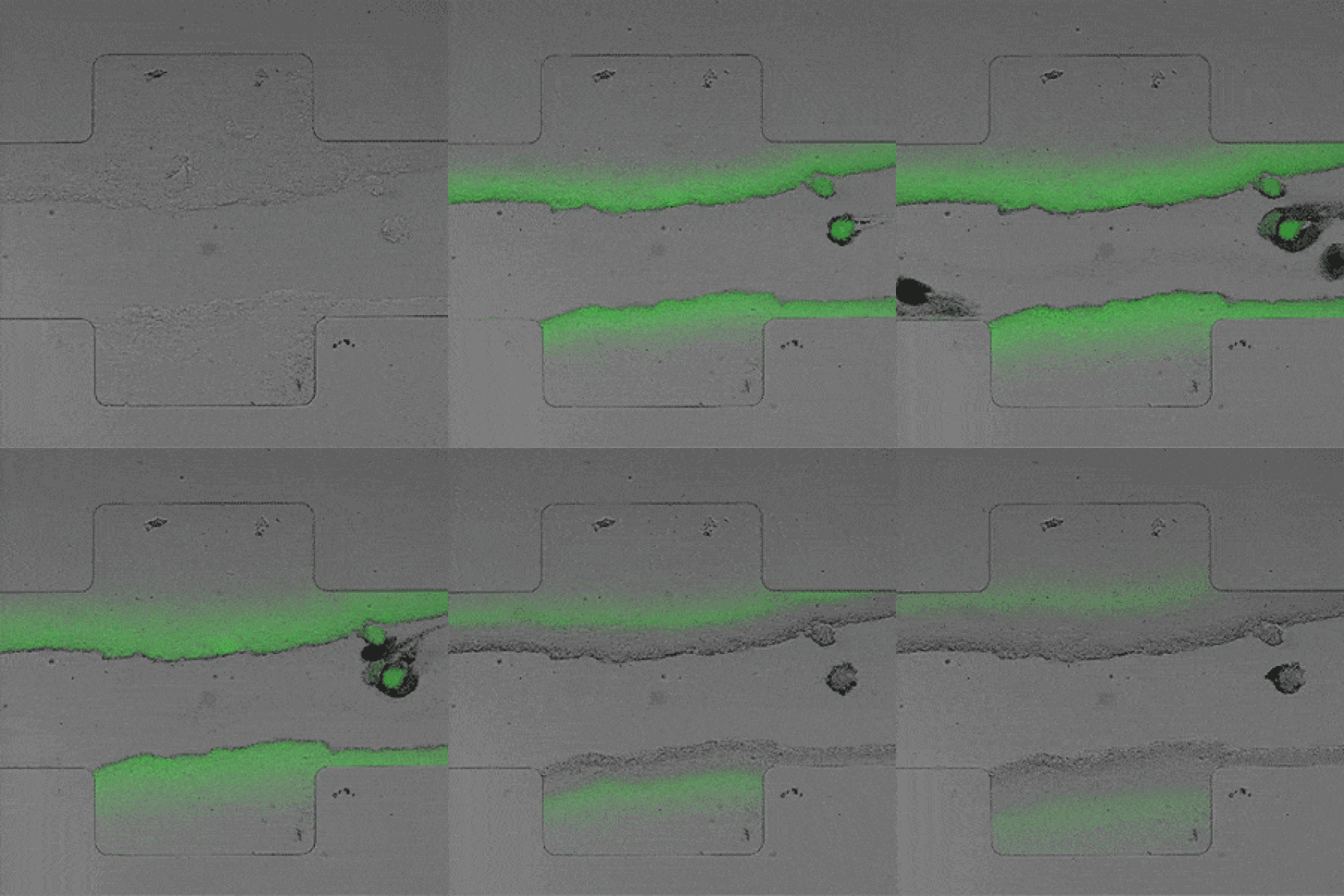
A microfluidics experiment shows organic matter, in green, attaching itself to clay. Halfway through the experiment, an enzyme is injected. The enzyme allows bacteria to consume the carbon. Judy Q. Yang
Another related, and poorly understood, ingredient in a new soil paradigm is the fate of carbon within the soil. Researchers now believe that almost all organic material that enters soil will get digested by microbes.

“Now it’s really clear that soil organic matter is just this loose assemblage of plant matter in varying degrees of degradation,” said Sanderman. Some will then be respired into the atmosphere as carbon dioxide.

What remains could be eaten by another microbe — and a third, and so on. Or it could bind to a bit of clay or get trapped inside a soil aggregate: a porous clump of particles that, from a microbe’s point of view, could be as large as a city and as impenetrable as a fortress.

Studies of carbon isotopes have shown that a lot of carbon can stick around in soil for centuries or even longer. If humus isn’t doing the stabilizing, perhaps minerals and aggregates are.

Before soil science settles on a new theory, there will doubtless be more surprises. One may have been delivered recently by a group of researchers at Princeton University who constructed a simplified artificial soil using microfluidic devices — essentially, tiny plastic channels for moving around bits of fluid and cells.

The researchers found that carbon they put inside an aggregate made of bits of clay was protected from bacteria. But when they added a digestive enzyme, the carbon was freed from the aggregate and quickly gobbled up.

“To our surprise, no one had drawn this connection between enzymes, bacteria and trapped carbon,” said Howard Stone, an engineer who led the study.

Lehmann is pushing to replace the old dichotomy of stable and unstable carbon with a “soil continuum model” of carbon in progressive stages of decomposition. But this model and others like it are far from complete, and at this point, more conceptual than mathematically predictive.

Researchers agree that soil science is in the midst of a classic paradigm shift. What nobody knows is exactly where the field will land — what will be written in the next edition of the textbook.

“We’re going through a conceptual revolution,” said Mark Bradford, a soil scientist at Yale University. “We haven’t really got a new cathedral yet. We have a whole bunch of churches that have popped up.”

Links

29/07/2021

(AU ABC) Climate Emergency Not Slowed By COVID-19 Pandemic And Planet's 'Vital Signs' Worsening, Scientists Say

ABC Science - Jo Khan

Fires raging across the US west have scientists concerned the climate emergency is not going anywhere. (AP: Noah Berger)

Key Points
  • Scientists have declared Earth's "vital signs" are worsening, despite a change in habits because of COVID-19
  • Emissions have reached an all-time high even though air traffic has declined
  • Australia is an outlier in both setting targets and strategies to reduce emissions 
Chances are in the past 18 months you've heard someone exclaim that air travel is at an all-time low, and how good that must be for the climate.
 
But scientists have confirmed that despite many industries and human activities slowing during the COVID-19 pandemic, the Earth's "vital signs" have actually worsened over the past two years.

And with catastrophic floods in Europe and India, unprecedented heatwaves in British Columbia and dozens of wildfires raging across the US west, it's frighteningly obvious that the climate emergency is not going anywhere.

Pandemic disrupts Earth's 'vital signs'

The research, published today in the scientific journal BioScience, is not peer reviewed, but is a continuation of the 2019 climate emergency declaration, which was endorsed by over 11,000 scientists.

That number now sits at over 14,000 scientists from 158 countries.

The scientists involved chose 31 indicators that correspond to the effects of human activities on the climate, environment, and society, in an attempt to broaden discussions of climate change beyond global surface temperatures.

These indicators, which they call Earth's "vital signs", include things like human population, meat production, tree cover loss, carbon dioxide emissions, national declarations of climate emergency, and sea-level change.

The COVID-19 pandemic disrupted many of these "vital signs", but also provided insights into how a major shift in human activity can impact climate change, according to report author Thomas Newsome from the University of Sydney.

"Even with that decline in air transport and the general slowdown in human movement, it generally didn't have an overall impact on greenhouse gas emissions," Dr Newsome said.
"Carbon dioxide, methane and nitrous oxide emissions have reached all-time highs over the last two years, so they continued to rise in step with surface temperatures."
The decline in air transport had little overall impact on greenhouse gas emissions. (Unsplash: Suhyeon Choi)

Temporary declines in air transport, world GDP, energy consumption and carbon dioxide emissions, have all started to return to pre-pandemic levels, Dr Newsome said.

"It suggests that much more fundamental changes to the way we produce energy are needed than a slight shift in one particular sector," he said.

The pandemic has also had little impact on the rate of forest-cover loss in the Amazon, which increased to a 12-year high in 2020.

And the number of ruminant livestock worldwide has not been slowed down by the pandemic either — it now reaches over 4 billion.

That means the total mass of ruminant livestock on the planet is now more than that of all humans and wild mammals combined, which contributes significantly to the production of methane and is also a driver of deforestation.

The rate of forest cover loss in the Amazon hit a 12-year high in 2020. (Center for International Forestry Research/flickr.com/CC BY-NC-ND 2.0)

Fossil fuel subsidies holding back progress

A shift in both fossil fuels divestment and subsidies over the past two years does signal some movement in the right direction, Dr Newsome said.

Around $8.8 trillion (US$6.5 trillion) was divested from fossil fuels between 2018 and 2020, with most of that being from faith-based groups, philanthropic foundations, education, government, and pension funds.

And fossil fuel consumption subsidies — relating to prices consumers pay for energy — fell to a record low of $245 billion (US$181 billion) in 2020, which was 42 per cent lower than 2019 levels.

"It demonstrates that there are economic signals here that we're heading in the right direction," Dr Newsome said.
"Divesting in fossil fuels suggests that it's coming to an end, the world is moving towards renewables."
Dr Thomas Newsome was one of over 11,000 scientists who declared a climate emergency in 2019. (Supplied: Fiona Roughley, University of Sydney.)

But despite an overall global decrease, two recent reports suggest fossil fuel subsidies are still holding back progress on emissions reductions.

One report by the International Institute for Sustainable Development found that the reform of fossil fuel consumption subsidies in 32 countries could reduce greenhouse gas emissions by 5.5 billion tonnes by 2030. 

A separate report from BloombergNEF found that the level of support for all types of fossil fuel subsidies within G20 countries is incompatible with the Paris Agreement goals.

And while we're responsible for a smaller slice of the subsidy pie, Australia had the largest percentage increase in fossil fuel subsidies from 2015-2019 of 48 per cent, according to the report. 

Dr Newsome thinks Australia is becoming increasingly isolated from the rest of the world when it comes to emissions.

"Australia is an outlier in many respects, with both setting a clear target to reach net zero emissions and in terms of actually putting in place effective strategies to reduce our greenhouse gas emissions," he said.
"But equally, while the rest of the world is moving, we're not seeing the shifts yet in the data that suggests that anything to date has been effective in actually tackling the issue of climate change."
The report's researchers said the phasing out and eventual ban of fossil fuels is just one of the solutions required to find a way out of the climate emergency.

An effective carbon price and environment reserves to restore natural carbon sinks are the other two key solutions proposed.

Foreshadowing long-awaited IPCC report

While the "vital signs" are striking, the message is unsurprising, said lecturer in climate science and science communication at the University of Melbourne Linden Ashcroft, who was not involved in the research.

"It is a really effective way of showing people what's been going on, and echoes research that's going on in all different fields of science," Dr Ashcroft said.

"While we have dramatically changed the way we've lived in the last 18 months, it's going to require much more long-term, dramatic change to stop or even slow the worst impacts of climate change."

The five hottest years on record have all occurred since 2015. (Supplied: NASA)

Dr Ashcroft said the sheer volume of the "vital signs" considered in the report meant some detail and nuance was lost.

"I'm going to be paying much more attention to the Intergovernmental Panel on Climate Change report that comes out next month, because that's been through years and years of revisions and peer review," she said.

The next IPCC report, due to be released on August 9, will be the most comprehensive assessment on the state of global heating since 2013.

Dr Ashcroft said the paper would give an overview of a huge range of scientific fields and how they relate to climate change.

"I do think there is a place for this very impassioned scientific argument, but I also think there is a place for the IPCC-style report which brings together all of the climate research that's done all around the world to get an absolute, comprehensive picture of what's going on," Dr Ashcroft said.

Links

(UK The Guardian) Hitting Global Climate Target Could Create 8m Energy Jobs, Study Says

The Guardian

Researchers suggest net increase would mostly occur in renewables sector, with decline in fossil fuels

A worker inspects solar panels at a manufacturing plant in Singapore. Photograph: Edgar Su/Reuters

If some politicians are to be believed, taking sweeping action to meet the goals of the Paris climate agreement would be calamitous for jobs in the energy sector.

But a study suggests that honouring the global climate target would, in fact, increase net jobs by about 8 million by 2050.


The study – in which researchers created a global dataset of the footprint of energy jobs in 50 countries including major fossil fuel-producing economies – found that currently an estimated 18 million people work in the energy industries, which is likely to increase to 26 million if climate targets are met.

Previous research suggests that pro-climate polices could increase net energy jobs by 20 million or more, but that work relied only on empirical data from the Organisation for Economic Co-operation and Development (OECD) countries and generalised the results for the rest of the world using a multiplier.

But the data varies dramatically across regions, driven by differences in technology and rates of unionisation, among other factors. For instance, extracting 1m tonnes of coal in India takes 725 workers, versus 73 in the US.

The latest analysis, published in the journal One Earth, combined such employment factors across a global dataset (including key fossil fuel, non-OECD economies such as Russia, India and China) with an integrated assessment model, which combines climate and economic estimates to predict the costs of climate change.

“This dataset makes the analysis more grounded in … reality, rather than using a multiplier,” said one of the study’s authors, Dr Sandeep Pai, who led the analysis as part of his PhD at the institute for resources, environment and sustainability at the University of British Columbia in Canada.

Under the target scenario of global temperatures being held well below 2C of pre-industrial levels, of the total jobs in the energy sector in 2050, 84% would be in the renewables sector, 11% in fossil fuels, and 5% in nuclear, the analysis found.

Although fossil-fuel extraction jobs – which constitute the lion’s share (80%) of current fossil fuel jobs – will decline steeply, those losses should be offset by gains in solar and wind manufacturing jobs that countries could compete for, the researchers estimated.

However, while most countries will experience a net job increase, China and fossil fuel-exporting countries such as Canada, Australia and Mexico could have net losses.

Undoubtedly, there will be winners and losers. The winners will be people who take these jobs in the renewable sector, and there are the health benefits of fresh air and cleaner cities – but there will also be people, companies and governments who lose out, said Pai.

“That’s why … we want to work towards a ‘just’ transition, make sure nobody’s left behind,” he said. “The point is that unless politics and social context of different countries align, I think this technological transition will not happen soon.”

Johannes Emmerling, an environmental economist at the RFF-CMCC European Institute on Economics and the Environment in Italy, another author of the study, acknowledged that the analysis did not account for the gaps in skills.

People working in the fossil fuel industry do not necessarily have the expertise or the experience to carry out jobs in the renewable sector, but given that there are few estimates of jobs as the world aims to forge a greener future, the focus was on firming up estimates, he said, adding that skills were the next avenue of research.

Links

(USA Axios) Study: Get Ready For Many More Record-Shattering Heatwaves

AxiosAndrew Freedman

NASA computer model image of temperature departures from average on June 27 during the Pacific Northwest heat wave. (NASA Earth Observatory)

The recent deadly heat wave in the Pacific Northwest, during which all-time temperature records were shattered by several degrees, is a prologue to what is coming across much of the U.S., Europe and Asia, a new study finds.

Why it matters: The study shows that the rate of climate change is an under-appreciated driver of extreme heat, and that today's quickening pace of warming virtually guarantees more extreme temperature records in coming decades.
  • The study, published Monday in Nature Climate Change, also finds that looking to past extreme temperatures when making infrastructure decisions offers a poor guide to the future given how quickly human-caused greenhouse gas emissions are transforming the likelihood of unprecedented heat extremes.
Details: The study shows that the rate of warming, rather than the absolute amount of warming compared to preindustrial levels, is an important determining factor in how likely it is that heat waves will greatly exceed temperatures previously observed in a particular location.

What they did: Using computer models and records of past weather events, Erich Fischer and his colleagues at ETH Zurich examined how the chances for record-shattering heat waves have been shifting and will continue to change as global warming continues.
  • They focused on the occurrence of week-long, record-shattering heat waves, such as the one that recently occurred in the Pacific Northwest and Canada, and examined how these probabilities would change depending on the rate and amount of greenhouse gas emissions.
By the numbers: During the Pacific Northwest's deadly heat wave, Seattle hit an all-time high of 108°F, while Portland shattered its old record to reach 116°F. The previous record in Portland was just 107°F, whereas Seattle had only seen the mercury rise to 103°F prior to this event.
  • Typically, all-time temperature records are exceeded by fractions of a degree.
  • The study found that under a high emissions scenario, record-shattering heat extremes (at least three standard deviations from average) are two to seven times more likely during the 2021–2050 period, and three to 21 times more likely during the 2051–2080 period.
  • The greatest frequency of these heat extremes would occur during periods of faster warming immediately following years of relatively flat temperature growth.
  • The planet is currently warming at a rate of about 0.18°C, or 0.32°F per decade, according to NOAA. This is considerably faster than the warming rate during the previous 40 years, which puts us at greater risk of unprecedented heat.
What they're saying: "The main message is that we need to prepare for more record heat events in the coming decades that shatter previous record temperatures by large margins," Fischer told Axios via email.
  • "Because the probability of record-shattering events is directly related to the speed of warming, this is yet another piece of the puzzle that demonstrates that in order to reduce the risk of such record-shattering heat, greenhouse gas emissions need to be reduced very rapidly," Fischer said.
Outside experts who were not part of the new study told Axios the research helps explain what's being seen in the real world.
  • "All I can say is, wow, what a remarkably prescient paper," said Daniel Swain, a climate scientist at UCLA, noting that it was completed and submitted for publication prior to the heat waves this summer.
  • "The notion that events we assumed were vanishingly rare or impossible, due to our relatively limited historical record, are probably not nearly so rare in the real world," Swain added, noting that in the case of the Pacific Northwest heat event, unusual but not unheard of weather patterns were able to produce astonishing temperature records.
  • "We don't need to invoke some kind of exotic new mechanism for so-called 'black swan' heat waves," he said. "All it takes is to get unlucky with a confluence of the same ingredients that produced lesser historical heat waves."
  • Friederike Otto, who helps lead the global effort to analyze climate change's role in producing extreme weather events, said the paper shows that even very rare events like the Pacific Northwest heat wave are "increasing rapidly in likelihood with still increasing warming rates."
  • On the other hand, Michael Mann of Penn State University told Axios that model shortcomings regarding the physics of extreme events and atmospheric circulation means that the new study's projections are quite uncertain.
What's next: Even if world leaders decide to slash greenhouse gas emissions in the near term to avoid potentially devastating amounts of global warming, unprecedented heat extremes will still grow more common and damaging during the next several decades due to the lag time that the planet's climate has built into it.

Links

28/07/2021

(AU ABC) Human Rights Issue Or 'Green Lawfare'? Citizens Take To The Courts To Fight Climate Change

ABC Radio National - Antony Funnell, Future Tense

More than 17,000 co-plaintiffs successfully brought a case against oil producer Shell in the Netherlands. (Getty: Peter Boer/Bloomberg)

They don't fit the activist stereotype — some are farmers, some are from the suburbs, some are retired, and some are still going to school.

Melbourne University's Jacqueline Peel calls them "next generation" litigants, ordinary citizens tired of political promises and eager to hold governments and companies to account.

Many see climate change as a human rights issue and they're being assisted in their legal ambitions by a coterie of academics, lawyers and even judges.

But there are also critics, who warn of "green lawfare" judicial activism and a threat to the democratic ideal of the separation of powers: that governments, not the courts, should determine national policy.

Climate change impacts everyone Environmental law expert, Jacqueline McGlade, says the judicial landscape around climate change is changing rapidly.

"In the last two or three years we've doubled the number of cases that have been brought forward."

And those cases are being heard in court rooms across the globe from the United States to Pakistan to Australia, focused not just on current environmental threats, but on the risks to future generations, she says.

"Everybody knows that climate is going to impact everyone .... [it will] impact our fundamental human rights to life, to water, to food and so on, and that's how it is connected."

As an example, Professor McGlade nominates a case brought before Brazil's highest court in September 2020.


Amazon deforestation rises
to 12-year record


"The government was failing to properly administer the Amazon Fund, the mechanism that was set up to combat deforestation.

"The Supreme Court accepted that lawsuit last year and directed the government to actually provide information on why it wasn't managing the fund properly."

Then in March, the Federal Court of Australia ordered that Environment Minister, Sussan Ley, had a duty of care to protect young people from "emissions of carbon dioxide into Earth's environment".

The case was brought against the minister by eight students and a nun and involved plans to expand a Northern NSW coal mine.

The group who bought a case against the Environment Minister say they were motivated by their passion for climate justice. (ABC News: Brendan Esposito)

A multinational in the dock The most internationally significant judicial decision of recent times occurred in a District Court in the Netherlands in May. It involved the giant multinational gas and oil producer Shell on the one side, and more than 17,000 co-plaintiffs on the other.

"It was about Shell's accountability for the emissions it releases into the atmosphere and making sure that it was making appropriate reductions in those emissions over time," says Professor Peel, who believes the decision could set a global precedent.

"We've seen these kinds of actions against governments to hold them accountable for their emissions reduction targets [but] this was the first case in the world where you are seeing this kind of action being brought against a company."

The case has pricked the attention of industry across the world, she says.

"It's often said in relation to litigation that you probably only need one successful case to change the atmosphere in a boardroom.

"It puts companies on notice that they could be sued on similar grounds and could be held liable for the damages associated with the climate harms caused by their emissions."

A 'redistribution of power' Australian lawyer David Morris, from the non-profit legal service the Environmental Defenders Office, is also seeing the rapid growth in climate change-related lawsuits, but he says many litigants struggle to understand and navigate judicial processes.

He works directly with individuals and communities to help them frame and prosecute their cases. He describes it as a "redistribution of power".


 "It really goes to the integrity of our system, the idea that a small community group can stand up against the might of a major mining company or a government department and then win in court.

"It really ensures the integrity of our processes too. It ensures that when ministers are making important decisions which might have consequences over many decades, indeed well into the future, that they follow proper process."

Mr Morris says connection with country is increasingly being used as a litigation tool.

"Local community groups are often motivated by a deep love of place and a desire not to see that place destroyed.

"We see it increasingly in the work we do with traditional owners, with Aboriginal and Torres Strait Islander people in Australia, the deep connections that those people have to country and the impacts that they see from particular projects but also that they see from the growing impacts of climate change."

Push back Yet official antipathy toward climate-related litigation is also on the rise.

Ms Ley has appealed the recent Federal Court ruling made against her, arguing that she doesn't have a duty of care to protect Australian children from climate harm.


Suing for change on climate

She and others in the Morrison government have repeatedly accused environmental organisations of waging "lawfare" against fossil fuel companies.

"We've often seen quite adverse reactions from politicians to a lot of the climate litigation," says Professor Peel, "partly because it does reflect badly on the progress that politicians are making or not making in dealing with the challenge."

She says some in the judiciary are also cautious about hearing climate-related cases.

"There is a long-running debate in the legal sphere about what the role of judges should be, whether they should have a strong role in developing the law and taking it forward to address new circumstances and challenges. Or whether those functions should be best left with policymakers and parliaments."

But she says the framing of many "next generation" cases can be persuasive.

"You're seeing judges more willing often to go into that space because they think of it as an issue of justice where the law has a particular role to play.

David Estrin from the International Bar Association rejects any notion of "judicial activism".

While governments have a primary role in determining a nation's environmental laws, he argues, courts play an essential role in holding them to account when their actions fail to remain within the limits of the law.

"This mandate to the courts to offer legal protection, even against the government, is an essential component of a democratic state under the rule of law," he says, quoting a 2019 ruling by the Netherlands Supreme Court.

Professor Peel argues a further increase in litigation is inevitable as long as there remains a perception that governments and companies aren't moving fast enough on climate change or aren't adhering to their own commitments.

And David Morris predicts the next decade will see a significant shift in thinking.

"You will start to see an evolution of the jurisprudence in these spaces, so an evolution of the judges' thinking," he says, "or of the court's findings in respect of some of these cases, which to date have been novel." 

"And what you'll see is a growing body of knowledge, a growing body of reasoning that starts to place very real pressure on companies and governments who fail to act swiftly."

Links 

Lethal Heating is a citizens' initiative