15/08/2021

(AU The Guardian) Industry And Energy Groups Remain In The Dark When It Comes To Australia’s Emissions Reduction Strategy

The Guardian

The Coalition promised to release a long-term plan before the Glasgow climate talks – and that’s just 80 days away

The minister for energy and emissions reduction, Angus Taylor. His office is yet to state when it will release a long-term strategy on emissions reduction. Photograph: Mike Bowers/The Guardian

Leading Australian industry groups have warned that the government has failed to consult them on a promised long-term emissions reduction strategy, despite it planning to present it at pivotal climate talks in Glasgow in just 80 days.

The government has been saying for more than 18 months that the strategy is in development and has promised to release it publicly and to the UN before the Glasgow talks in November.

The prime minister, Scott Morrison, has faced increased pressure over his stance this week after the UN’s climate panel released a major report showing “unequivocal” human influence on the atmosphere, ocean and land.

The Intergovernmental Panel on Climate Change said Australia would experience worsening heat extremes, bushfires, marine and land heatwaves and rising sea levels. The report has intensified calls for the government to introduce policies to drive deeper emissions cuts before 2030.

Morrison continued to resist calls to commit Australia to a 2050 net zero emissions target and to improve the government’s six-year-old target to cut emissions by 26% to 28% by 2030 based on 2005 levels – a goal a senior US government climate official this described as insufficient.

The government has remained tight-lipped over details of its long term strategy or the timing of its release.

The Australian Industry Group, the country’s largest employer group, told Guardian Australia it had not been consulted on the strategy. It said it should include the 2050 net zero goal.

Tennant Reed, Ai Group’s climate, energy and environment policy adviser, said it was unusual there had not been consultation with interest groups about the strategy given there had been with climate policy, including the government’s technology investment roadmap, and the target it took to the 2015 Paris climate summit.

Senior US climate official says Australia’s climate targets are ‘not sufficient’  Read more

He said broad consultation was “much more likely to identify the key issues and best solutions, and build consensus around them”.

Reed said the long term strategy should include a medium-term emissions goal and a “clear long-term national goal of net zero emissions by 2050 to guide government policy and private investment”.

It should assess the economic and social impacts of both climate change and measures taken to lessen its effects, as well as international trends, he said.

“That is a tall order, but within the capabilities of the Australian government,” he said.

Reed said he expected the government’s technology roadmap – which sets so-called “stretch goals” for reducing the cost of carbon capture and storage, soil carbon and low-carbon steel and hydrogen – would form part of the strategy.

Kane Thornton, chief executive of the Clean Energy Council, said the council was yet to be consulted on the strategy, but would welcome being approached.

He said council research had found investment in large-scale clean energy projects had fallen to a five-year low, and the country needed a plan to turn that around.

“Without a clear plan for emissions reduction, Australia risks not being able to attract the levels of investment seen in many other countries who are experiencing surging investment, particularly in solar and wind,” he said.

The primary oil and gas lobby group, the Australian Petroleum Production and Exploration Association (Appea), also said while it was regularly consulted on climate policy it had not been asked for input into the strategy.

Large-scale solar and windfarm investment in Australia records major drop this year. Read more


Damian Dwyer, Appea’s deputy chief executive, said its position was that gas had fewer emissions than coal when burned for electricity and was used in manufacturing for jobs that “renewables simply cannot do”.

He said “the strategy should recognise that “demand for gas is growing and that our product can help Australia and the world reduce emissions”.

The International Energy Agency has said there is no room for any new fossil fuel projects, including new gas fields, if the world wants to reach net zero emissions by 2050.

Australia’s biggest electricity consumer, the Tomago aluminium smelter in New South Wales, said earlier this week it would be powered almost entirely by renewables by 2029.

The government has been saying for more than a year that it is developing the strategy. In February last year, the energy and emissions reduction minister, Angus Taylor, said the government would take it to the international Cop26 climate talks in Glasgow which at that time were scheduled for November that year.

In late December, the government reiterated its 2015 target as part of a resubmission to the UN of what is known as a Nationally Determined Contribution (NDC) – the pledge each signatory to the climate convention was expected to make under the Paris agreement, and is being asked to improve before Glasgow.

Analysis of Australia’s NDC has founds its targets are consistent with global warming of more than 2C.

Guardian Australia asked Taylor’s office when it planned to release the long-term strategy, if it would include new targets and who had been consulted during its development.

A spokeswoman referred to the transcript of a press conference from this week, and to the Hansard record of Question Time proceedings in parliament.

None of those contained details of the strategy or when it would be released. At the press conference, Morrison said commitments to reduce emissions “are backed up by plans, and we don’t make them lightly.”

He said Australians “deserve to know the implications and the costs and what the plans are”, that he had done that before the last election and “I will do that again as we go into the commitments later this year.”

Links

(AU SMH) Carbon Dreaming: How To Fix The Climate Crisis

Sydney Morning Herald - Nick O'Malley | Peter Hannam

This week a blockbuster United Nations report delivered terrible but not unexpected news to the world about how people are rapidly heating its climate.

It told us that dire previous predictions of the impact of global warming were if anything too conservative and that warming of 1.5 degrees is all but certain by the middle of the century, locked in by the carbon dioxide that has accumulated in the atmosphere since the industrial age began.

Solution seeker: engineer and physicist Saul Griffith says the government should be pursuing populist climate policy that helps all Australians not only have solar on their roofs but electric vehicles in their garages. Credit: James Brickwood

(Carbon dioxide, it turns out, lingers in the atmosphere for hundreds or even thousands of years, so our grandparents’ mistakes are haunting us, just as our carelessness will be visited upon our grandchildren.)

The impact of the warming, the Sixth Assessment report by the UN’s Intergovernmental Panel on Climate Change shows, is certainly dire and potentially catastrophic.

The report, which is actually just the first part of an update of the 2014 Fifth Assessment, also includes the possible but so-far unlikely consequences of so-called tipping points being passed that would see the climate spiral out of control.


But it notes that as yet the relationship between warming and emissions remains linear.

It is in this last point that you can find some hope in the report, says one of its lead authors, the CSIRO’s chief climate research scientist, Pep Canadell.

“It shows that there is no geophysical reason we cannot stabilise the climate and see it start to cool by the end of the century,” he explains.

Climate policy
Seven top takeaways from the IPCC’s latest climate science assessment
When you dive into the report to see this notion illustrated you find a chart explaining the point about 100 pages into the nearly 4000-page long document.

Throughout the report the authors use a series of illustrative scenarios showing the likely amount of warming we can expect depending on how much more carbon we pump into the atmosphere.

It shows that even given the warming locked in, it is still possible to keep the climate within the 1.5 degree target range, physically if not politically.

The report even says how it must be done.

How the models are tracking the heating
Source: IPCC

First, carbon emissions must be brought to zero quickly, says Dr Canadell. If we hope to keep within the 1.5 degree range – the more aspirational target in the Paris Agreement – this must be done by 2050.

Secondly, what new emissions we still allow into the atmosphere must be done within a carefully measured carbon budget, one that will likely be allocated to each country by negotiation.

Thirdly, we must then begin the job of withdrawing billions of tonnes of that accumulated carbon dioxide from the atmosphere and burying it back underground where it came from.

Can it be done?

Emissions reductions

One person worth asking is engineer and physicist Saul Griffith, who lives in a rambling suburban home backing onto the rainforest of the Illawarra escarpment at Austinmer south of Sydney.

Before he fled a locked down Los Angeles to return to Australia, Griffith, a graduate of the University of Sydney and MIT, completed the most detailed inventory of how American households use power.

He and a team at one of the non-profit organisations he co-founded, Rewiring America, worked out how much power and gas American homes and small businesses used for transport, heating, cooling and lighting and household appliances.
Energy
‘Call to honesty’: NSW committee calls for coordinated exit from coal

They established how much carbon dioxide - and money - they would save if all these processes were electrified and supplied by a clean grid.

They even calculated how many jobs in trades would be created as the nation went about replacing gas-hungry kitchens, hot-water systems and space heaters.

Over the years Griffith has led US government funded research projects for agencies including NASA, Defense Advanced Research Projects Agency (DARPA), Advanced Research Projects Agency–Energy (ARPA-e), the National Science Foundation and the US military’s Special Operations Command.

Rewiring America is today working with several US senators and the White House on elements of energy policy.

NSW Energy and Environment Minister Matt Kean says Griffith, who he uses as a “sounding board” on similar issues, is “basically a genius”.

So can Australia decarbonise at the speed the IPCC says is necessary?

“Oh yeah,” says Griffith. “We could shit it in.”

Griffith’s mantra for Australia is the same as it is for America - electrify everything. Indeed he is establishing a Rewiring Australia organisation to advocate for such policies.

By his calculations Australia can reduce emissions by more than 50 per cent by the end of the decade by replacing gas and coal-fired power with renewables and helping households, small business and light-manufacturing deploy solar and battery technology to replace internal combustion vehicles as well as gas-burning water and space heating appliances.

Most light manufacturing could now electrify with existing technology, Griffith says.

Given the speed at which this technology is improving, the immediate result of this would be cleaner air and cost savings as well as emissions reductions, he says.

“The government should be pursuing populist climate policy that helps all Australians not only have solar on their roofs but electric vehicles in their garages and electric appliances inside the house,” he argues.

“The people who spend their lives watching where the technology is going know that in the next three years we’ll come to the crossover point where doing the right thing environmentally will be doing the right thing economically.”

A further benefit of a large electric vehicle fleet would be that the batteries in parked cars would serve as a vast and interconnected back-up to the grid.

As these policies were being pursued, says Griffith, Australia should be funding research into the harder problem of decarbonising heavy industry, particularly the production of steel and metals.

Griffith believes the government’s support of nascent hydrogen technology is misplaced. Using electricity to create hydrogen to serve as a fuel, he argues, is inherently inefficient.

In a decarbonising world Griffith would focus on massively ramping up our renewable energy capacity and developing green steel. He would abandon Australia’s high-volume but low-margin export of coal, iron ore and bauxite and instead become the world’s foundry – making the clean metals the rest of the world will need as it replaces its old fossil-dependent systems.

A firefighter works to contain a wildfire near Athens during a heatwave in Greece. Meanwhile, Sicily may have set a modern record for the hottest day ever in Europe on Friday, with a recorded temperature of 48.8 degrees. Credit: Bloomberg

“Half of the price of steel is the energy price of manufacturing it,” he says.

“We will make the cheapest electricity in the world, we use that to make steel here, it’s going to be much cheaper than steel made in Japan with our hydrogen that we have shipped over there.”

Green Australian steel and aluminium exports, says Griffith, would be the most efficient way to export renewable energy.

Griffith is the first to admit that such a project of mass, rapid electrification would not be easy. If all the equipment he refers to in his charts and arguments was replaced at the end of its natural life we would still be on a path to warming of 1.8 degrees. And the world does not yet have the manufacturing capacity for such a project even if it had the will.

Rapid electrification would take an effort similar to the strategy the allies adopted to revolutionise their economies as World War II broke out.

“Where and once upon a time it was bullets and airplanes and jeeps, it’s now batteries, and wind turbines and electric vehicles,” says Griffith.

The carbon budget

Should emissions begin to rapidly fall, those that are still allowed into the atmosphere in the short-term must be carefully managed within the framework of a carbon budget.

The IPCC report lays the foundation for how much greenhouse gases humans can emit through burning fossil fuels, farming and other activities, and still hope to prevent catastrophic warming.

This so-called carbon budget is actually a range of probabilities about how much cumulative emissions we have left to curb warming to a given temperature.

The third tranche of the Sixth Assessment Report will go into more details about the most effective ways to avoid blowing the budget but that is not due out until March, well after November’s global climate summit in Glasgow.

The IPCC calculates anthropogenic emissions for the 170 years since the Industrial Revolution kicked off as 2.39 trillion tonnes of CO2, give or take about one-tenth of that. (1 trillion tonnes has been burnt since the IPCC reports began in 1990.)

What’s left to burn before we tick past 1.5, 2 degrees or more actually starts from January 2020, so we have already exhausted almost 20 months of that budget.

Renewables
‘Energy chaos’: Wind and solar industry facing roadblocks in Australia
As Alan Pears, an RMIT researcher who has advised governments on energy and climate policy for decades, says what budget you aim for “depends on how confident you want to be, and the target you’re aiming at”.

For instance, he highlights a 50-50 per cent chance of keeping global emissions to 500 billion tonnes of C02 to keep warming to 1.5 degrees, the ambitious end of the Paris agreement.

At current rates of about 42 billion tonnes, the world has about 12 years’ to go until we reach carbon neutrality (net-zero emissions) with whatever pollution going up required to be captured in some form.

But as Pears notes, “if you hopped on an airplane and had only a 50 per cent chance of getting off alive, would you catch that plane?”

At an 83 per cent chance of keeping to 1.5 degrees, the allowable budget shrinks to 300 billion tonnes of CO2, or a bit more than seven years’ worth of current-level emissions. (Non-CO2 greenhouse gases, such as methane, are excluded.)

What should Australia’s fair share of any carbon budget be? As Australia is a beneficiary of past unconstrained fossil fuel and land-clearing, one could argue the case that Australians have had our go already even if we were blissfully ignorant of the consequences until about 1990.

Pears says two other approaches would be to estimate what the budget would look like if we maintained our roughly 1.3 per cent share of global emissions in any reduction, or, more fairly calculated emissions based on our population of 25 million in a global tally of almost 8 billion.

If we were the most risk-adverse, taking the 83 per cent probability of hitting our temperature targets, then Australia has about 3.9 billion tonnes of CO2 left to burn, or about a decade’s worth, if we kept our current share. A fairer per capita share, though, leaves just 940 million tonnes in the kitty, or about two years’ worth of burning, Pears says.

And if we were willing to punt on merely a 17 per cent, or about one-sixth, chance of success? On that per capita gauge, Australia will still only be able to pollute for six years at existing rates before hitting net-zero if the 1.5-degree warming was our ceiling.

Negative emissions tech

With emissions rapidly declining in accordance with a carbon budget the report says, the best chance of stabilising the climate at or just over 1.5 degrees after mid-Century and hopefully see it begin to cool, demands we deploy technology that removes carbon dioxide from the sky.

Paris Agreement
Beyond emissions: The call to pull carbon out of the atmosphere

So-called negative emissions technologies are like a break-glass-in-case-of-emergency last chance that crept into IPCC modelling as scientists worked on their last climate assessment, published in 2014.

It wasn’t that anyone was drawn to the option, just that they could find no other way to keep the worst impacts of climate change out of their models.

The primary technology referred to in the report is known as Bioenergy with Carbon Capture and Storage (BECCS).

Yet to be proven at scale, BECCS envisages that plant matter is burnt for fuel and the resultant emissions captured and stored. This way the carbon absorbed by plants can be captured and sequestered.

It is far from an ideal solution. For it to work massive amounts of the world’s surface area - more than twice the size of Australia according to some models - would have to be turned over to growing plant matter destined for incinerators linked to carbon capture machines.

Other technology being considered is known as direct air capture – machines designed solely to suck carbon dioxide out of the sky. Research published in Nature Communications in 2019 found it possible that by 2100 a quarter of all energy generated may be dedicated to industrial-scale efforts like this.

Australian environmentalist Tim Flannery - who remains a climate optimist by sheer force of will - has written about negative emissions in his books Atmosphere of Hope and The Climate Cure.

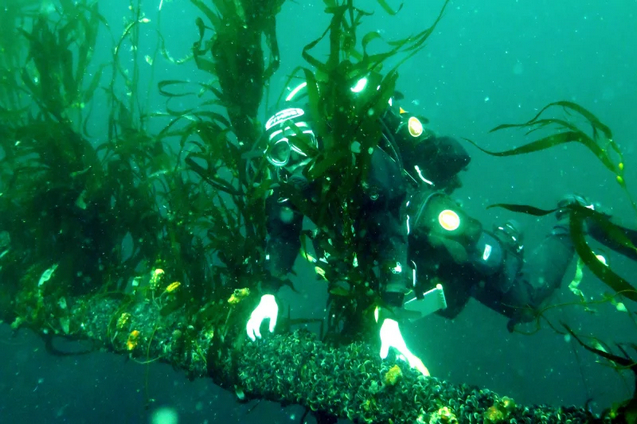
He sees possibilities in harnessing the properties of kelp, some species of which absorb carbon dioxide as it grows from oceans before sinking to the deep ocean floor.

One of the last patches of giant kelp in Fortescue Bay on the east coast of Tasmania. Giant kelp is one of the fastest growing organisms on the planet, giving it unique potential to rapidly take up carbon during photosynthesis. Credit: Cayne Layton

Other possible drawdown technologies include grinding up and distributing silicate rocks, to which carbon dioxide from the atmosphere binds.

This effort, Flannery notes, would be energy intensive in its own right.

Pinching a phrase from Al Gore, Flannery says that there is no single “silver bullet” solution to drawdown, rather there is “silver buckshot”.

Many solutions will need to be harnessed and deployed. The scale at which this range of technologies will need to be deployed is “mind-blowing”.

Extreme weather
‘How lucky do you feel?’: The awful risks buried in the IPCC report
The gap that negative carbon technologies will need to fill for us is around 10 billion tonnes of carbon dioxide per year until the end of the century if we are to stabilise and cool.

If it can be done, he says, we still don’t know what the world will look like.

“No one has ever run the [global warming] experiment in reverse.”

We know enough to try it though, he says. We know that if we get it right the world will be cooler. We know that the skies over cities will be clear. We know that the acid build-up caused by carbon dioxide in the seas could rapidly reverse, easing stress on species of crustaceans and corals.

Going over the figures and the extraordinary co-operative efforts and economic costs they suggest this week Flannery conceded that there is a “kind of madness” to the conversation.

“We know at the moment it costs about $250 a tonne to remove it,” he says.

“In a saner world it would cost more to dump the stuff in the atmosphere than suck it out.”

Links

14/08/2021

(AU EDO) Landmark Bushfire Survivors’ Climate Case Is Heard

Environmental Defenders Office

Bushfires ravage the NSW Mid-North Coast in 2019. By Ash Hogan via CC Licence.

Survivors of devastating bushfires have taken the NSW Environment Protection Authority to court, in a landmark climate case this week.

For the first time, an Australian court has allowed evidence on climate change to be heard in a case involving an alleged failure by a government agency to perform a statutory duty.

On Monday, former chief scientist Professor Penny Sackett gave evidence in Bushfire Survivors for Climate Action case against the New South Wales EPA, telling the court that:

“We know we’re in a dangerous situation now.  I personally don’t want it to be any more dangerous.

“1.5 (degrees warming) is not a magical temperature … however, the thing that does distinguish it is that … this is still a target that we can meet. When I say we, I mean globally, the world.”

On Tuesday, the court heard that EDO’s clients would like to tender further evidence from Professor Sackett in light of the IPCC’s dire 6th report on climate change, released on Monday evening.

Richard Beasley SC told the court, “We already know that the NSW environment is suffering under the impacts of climate change right now. We know that the impacts are likely to get much greater without extraordinary measures being taken.

“There could hardly be more significant pollutants now for the environment than greenhouse gas emissions. And so we say that the duty imposed on the EPA is one that must respond to the level of threat that the NSW environment faces.

“The threat is of significant damage to the environment, not just to NSW, but the globe, if there is temperature rise of 1.5 degrees or more. The science is just clear on that, and frankly, it’s been clear for a while.”

The three-day hearing before Chief Judge Preston in the NSW Land and Environment Court has now concluded.

The Landmark Case Begins

Bushfire Survivors for Climate Change Action at Parliament House in Canberra.

Environmental Defenders Office (EDO) is representing Bushfire Survivors for Climate Action (BSCA) in the case against the independent authority over its alleged lack of greenhouse gas emissions policy.

The group’s members are people who lost their homes, communities, loved ones and peace of mind in bushfires; people who’ve fought fires as RFS or other volunteers, community leaders concerned about the impact and growing risks of bushfires and primary producers who’ve watched stock and wildlife impacted by bushfires and their after-effects.

The group’s president Jo Dodds has lived through three bushfires, including Black Saturday in 2009, the Tathra bushfires in 2018 and the megafires of 2019/20.

BSCA filed the case in April 2020, following the Black Summer bushfires that ripped through large swathes of New South Wales.

The group is seeking to encourage and, if necessary, compel the NSW EPA to develop policies to measure and regulate greenhouse gases in the state.

BSCA argues that the EPA is not only explicitly empowered by its legislation to take strong action on climate by controlling the emission of greenhouse gases, it is also required to do this under its own laws.

Win over climate evidence

Bushfire Survivors for Climate Action President Jo Dodds.


In November 2020, the Land and Environment Court ruled that BSCA would be allowed to prepare expert scientific evidence on climate change for the hearing.

It was the first time an Australian court has ruled on whether evidence on climate change can be put forward in a case involving an alleged failure by an authority to perform a statutory duty.

The November ruling also permitted evidence to be prepared on whether the emissions trajectories for New South Wales, Australia, and the world, are in line with the Paris Agreement goals to limit global warming to 1.5 degrees Celsius, and to examine the link between climate change and bushfire risk.

NOTE: Elaine Johnson is the Solicitor on Record for BSCA and Matt Floro is the Senior Solicitor with carriage of this matter. EDO would like to thank Richard Beasley SC and David Hume of Counsel for their generous assistance.

Links

(AU The Conversation) Communicating Climate Change Has Never Been So Important, And This IPCC Report Pulls No Punches

The Conversation |  | 

AAP Image/James Ross

Authors
  •  is Honorary Fellow, School of Earth Sciences, The University of Melbourne
  •  is Senior Knowledge Broker, Monash University
  •  is Lecturer in climate science and science communication, The University of Melbourne
On Monday, the Intergovernmental Panel on Climate Change (IPCC) released the first instalment of their sixth assessment report. As expected, the report makes for bleak reading.

It found all regions of the world are already experiencing the impacts of climate change, and its warming projections range from scary to unimaginable.

But the report also makes for dry reading. Even the Summary for Policymakers, at 42 pages, is not a document you can quickly skim.

Local governments, national and international policymakers, insurance companies, community groups, new home buyers, you and me: everyone needs to know some aspects of the IPCC’s findings to understand what the future might look like and what we can do about it.

With climate action more crucial than ever, the IPCC needs to communicate clearly and strongly to as many people as possible. So how is it going so far?

The most assertive report in 30 years

The gruelling IPCC process and an extensive author list of 234 scientists make IPCC reports the world’s most authoritative source of climate change information. Every sentence is powerful because each one has been read and approved by scientists and government officials from 195 countries.

So when the report states “it is unequivocal that human influence has warmed the atmosphere, ocean and land”, there is absolutely no denying it. In fact, the IPCC has become progressively more assertive in the 30 years it has been assessing and summarising climate science.

In 1990, it noted global warming “could be largely due to natural variability”. Five years later, there was “a discernible human influence on global climate”. By 2001, “most of the observed warming […] is likely to have been due to the increase in greenhouse gas concentrations”.

This week’s reference to “unequivocal” human influence pulls no punches.

The IPCC needs to communicate clearly and strongly to as many people as possible. EPA/ALESSANDRO DELLA VALLE

Why has this language changed? Partly because the science has progressed: we know more about the complexities of the Earth’s climate than ever before.

But it’s also because the report’s authors understand the urgency of communicating the message effectively. As this week’s report makes clear, limiting warming to the most ambitious 1.5℃ goal of the Paris Agreement may be (at least temporarily) out of reach within decades, and the goal of keeping warming below 2℃ is also at risk.

As the IPCC’s scientific assessment reports are only published every seven years or so, this may be the authors’ last chance to warn people.

Climate change communication isn’t easy

Communicating any science is hard, but climate science has particular challenges. These include the complexities of the science and language of climate change, people’s misunderstanding of risk management, and the barrage of deliberate misinformation.

The IPCC has standardised the language they use to communicate confidence: “likely”, for example, always means at least a 2-in-3 chance. Unfortunately, research has shown this language conveys levels of imprecision that are too high and leads to readers’ judgements being different from the IPCC’s.

The gruelling report approval process also means IPCC statements can be conservative to the point of confusion. In fact, a 2016 study showed IPCC reports are getting harder to read. In particular, despite the IPCC’s efforts, the Summaries for Policymakers have had low readability over the years, with dense paragraphs and too much jargon for the average punter.

Condensing the IPCC report to its highlights, such as in this graphic, is an effective way to engage time-poor readers. Monash Climate Change Communication Research Hub/IPCC

There has also been a rise in communication barriers since the final part of the IPCC’s Fifth Assessment Report was released in 2014, including more fake news, and climate news fatigue.

The IPCC’s complex results can appear controversial and hotly debated, because of politicisation and a well-funded disinformation campaign from fossil fuel giants. And with news so often passed through social media, it’s easy for people to turn to someone they trust, even if that person’s information is wrong.

While there has been an increase in communication imperatives, including the urgency for action and the increase in science information, these are all taking place during a headline-stealing global pandemic.

Also, people are exhausted. Eighteen months of living with a pandemic has probably shrivelled everybody’s ability to take on more big problems.

On the other hand, hunger for COVID-19 information has raised familiarity with exponential curves, model projections, risk-benefit calculations, and urgent action based on scientific evidence to combat a global threat.

Remaining hopeful

To address the challenges of communicating the science, climate communicators should aim for consistent messages, draw on credible information, focus on what is known rather than the uncertainties, offer tangible action, use clear language that avoids despair, connect locally, and tell a story.

To a large extent, Australian contributors to the IPCC release this week have done just that, chiselling relevant facts from the IPCC’s brick of a report into blogs and bites. To its credit, the IPCC has also provided a plethora of communication resources in different formats. This includes videos, fact sheets, posters and, for the first time, an interactive atlas enabling you to explore past and possible future climate changes in any region.

However, there’s (so far) less focus on information for different audiences, such as students, young people, managers and planners rather than just politicians and scientists.

And the atlas, while a great tool, still requires users to have some climate science literacy. For example, average users looking for future climate information may not understand that CMIP6 and CMIP5 are the next, and previous, generations of climate models used by the IPCC. While mainly focusing on the report’s terrifying findings and commitment to global warming, media coverage this week also emphasised the importance of immediate action, and sources of hope.

This is a positive approach because feeling that humanity cannot, or will not, respond adequately can lead to a lack of engagement and action, and eco-anxiety.

As Al Gore pointed out 15 years ago in An Inconvenient Truth:
there are a lot of people who go straight from denial to despair without pausing on the intermediate step of actually doing something about the problem.
Early next year, the IPCC will release two volumes about ways to adapt to, and reduce, climate change. After the confronting results of this first volume, the next two must provide messages of hope if we’re to keep fighting for our planet.

Links

(AU EDO) $21 Million In Beetaloo Gas Grants To Face Federal Court Challenge

Environmental Defenders Office


The Environmental Defenders Office (EDO) has filed urgent proceedings on behalf of the Environment Centre Northern Territory (ECNT), challenging the lawfulness of a Federal Government decision to grant up to $21 million to gas company Imperial Oil and Gas.

The decision by the Commonwealth Minister for Resources and Water was announced earlier this month under the Beetaloo Cooperative Drilling Program, a program set up to provide funding for gas exploration activities in the Northern Territory’s Beetaloo sub-basin.

The legal action – a judicial review in the Federal Court – questions the lawfulness of the Beetaloo Cooperative Drilling Program and the decision of the Minister to grant these funds. The solicitor with carriage of this matter is Anna Gudkov, working with Ruby Hamilton, both under the supervision of Sean Ryan.

Grants under this program are subject to the Public Governance, Performance and Accountability Act 2013 (Cth) which requires that the Minister not approve the expenditure unless he “is satisfied, after making reasonable inquiries, that the expenditure would be a proper use of…money”.

A “proper” use of money is defined by section 8 of the Public Governance, Performance and Accountability Act as one that is “efficient, effective, economical and ethical”.

The Federal Court proceeding filed by ECNT alleges that before deciding to give Imperial Oil and Gas up to $21 million to support their gas exploration activities, the Minister failed to make reasonable inquiries in respect of the increased risks of climate change if the Beetaloo Basin is exploited for gas development.

In addition, the filing argues the Minister failed to make reasonable inquiries into the economic risks of expenditure on these projects in the context of a world which is moving rapidly away from fossil fuel use.

The proceeding argues that an assessment of these risks is necessary under the Public Governance, Performance and Accountability Act and the Minister made an error of law by not making reasonable inquiries into these risks prior to making a decision on this expenditure.

On behalf of ECNT, EDO has also sought an undertaking from the Minister that he will not execute a grant agreement with Imperial Oil and Gas, and/or transfer public funds to Imperial until the legality of his decision to make the grant is clarified by the Court.

“This case is about whether the proper process has been followed in respect of the Federal Government’s decision to grant $21 million to Imperial Oil and Gas for exploration activities in the Beetaloo sub-basin in the Northern Territory,” said EDO CEO David Morris.

“Our client will argue that before making a decision to grant these funds, the relevant Minister needed to make reasonable inquiries into a range of risks, including climate and economic risks, that may arise from the expenditure.”

“We will argue on behalf of our client that the Federal Government did not make these reasonable inquiries, and thus the Minister’s decision is invalid.”

Co-Director of ECNT, Dr Kirsty Howey stated, “We want to see taxpayers money used wisely and with all the consequences being fully considered. Granting $21 million to a private fossil fuel company should only be done after all care is taken to examine the impacts on climate change, the environment and the community.”

“The law requires the Minister to be satisfied that the expenditure is a proper use of money having made reasonable inquiries. We say that means inquiries into the risks of a heating climate if the heart of the Northern Territory was opened up to fracking.”

The Court documents argue that Minister Pitt didn’t make reasonable inquiries about climate change risks, transition risks to a zero carbon economy, and risks associated with failing to meet the targets of the Paris Agreement.

“It’s not apparent from the available public documents that the Minister made any inquiries about the climate change risks of gas developments in the Beetaloo”, added Dr Howey.

Links

13/08/2021

(BBC) Climate Change: Low-Income Countries 'Can't Keep Up' With Impacts

BBC - Navin Singh Khadka

Caribbean island countries say their adaptation plans are not effective because hurricanes have become more powerful. Getty Images

Low-income countries are struggling to protect themselves against climate change, officials and experts have told the BBC.

Organisations representing 90 countries say that their plans to prevent damage have already been outpaced by climate-induced disasters, which are intensifying and happening more regularly.

The UN says the number of developing countries with climate adaptation plans has increased. But it stresses that there's limited evidence these plans have reduced any risks.

"We need to adapt our plans to the worsening climate crisis. Our existing plans are not enough to protect our people," says Sonam Wangdi, chair of the UN's Least Developed Countries (LDC) Group on climate change.

Their call for action comes as the UN's climate science body prepares to publish its latest assessment on Monday about the state of global warming.

The report, compiled by the Intergovernmental Panel on Climate Change, will provide a scientific assessment of current and future climate change, and be a key reference for policymakers at the UN climate summit in Glasgow this November.

The world has already warmed by about 1.2C since the industrial era began, and temperatures will keep rising unless governments around the world make steep cuts to emissions.

Chaos in the Caribbean

Climate experts say houses in the Caribbean countries are unable to stand against category five hurricanes. Getty Images

Last year, the Caribbean had a record-breaking 30 tropical storms - including six major hurricanes.

The World Meteorological Organisation says the region is still recovering.

On islands like Antigua and Barbuda, experts say that many buildings have been unable to withstand the intense winds these storms have brought.

"We used to see category four hurricanes, so that's what we have prepared for with our adaptation plans, but now we are being hit by category five hurricanes," says Diann Black Layner, chief climate negotiator for the Alliance of Small Island States.

"Category five hurricanes bring winds as strong as 180 miles per hour which the roofs cannot withstand because it creates stronger pressure inside our houses," she said.

Falling seawalls in Pacific islands

Pacific island countries say their defences against rising seas and cyclones are proving to be increasingly weak. Getty Images

Several Pacific Island countries were hit by three cyclones between the middle of 2020 and January 2021.

"After those three cyclones, communities in the northern part of our country have seen the sea walls built as part of their adaptation plans crumbling," says Vani Catanasiga, head of the Fiji Council of Social Services - a group representing Fijian NGOs in the country's Disaster Management Council.

"The water and the wind repeatedly battering the settlements even displaced some locals."

Although it's rare to see so many storms in such a short space of time, experts say sea storms have been growing in strength.

Studies suggest tropical cyclones have become more intense in the past 40 years, but an increase in the overall number of cyclones has not been established.

Uganda's mountain menace

Some African countries say intensified landslides and floods have rendered their adaptation efforts useless. Getty Images

In Uganda, communities in the Rwenzori region have been trying to protect themselves from landslides and floods by digging trenches and planting trees, helping to prevent soil erosion.

But it has not always been a success.

"The rains have become so intense that we have seen huge, sudden floods sweeping away these defences," said Jackson Muhindo, a local climate change and resilience coordinator for Oxfam.

"As a result, there have been multiple landslides on mountain slopes which have buried settlements and farms," he adds. "Adaptation works based on soil conservation are proving to be increasingly useless in the wake of these extreme weather events."

Adaptation low on the agenda

The UN Framework Convention on Climate Change says more than 80% of developing countries have begun formulating and implementing their national adaptation plans.

But a study by the International Institute for Environment and Development (IIED), published last month, suggests that the 46 of the world's least-developed countries don't have the financial means to "climate proof" themselves.

The IIED says these countries need at least $40bn (£28.8bn; €33.8bn) a year for their adaptation plans. But between 2014-18, just $5.9 billion of adaptation finance was received.

Developing countries say adaptation has not been a priority issue among their wealthier counterparts. Getty Images

Under the UN climate convention, the EU and 23 developed countries have pledged to make $100bn available every year to fund climate-related projects in developing nations - like schemes to cut emissions, and adaptations to mitigate damage caused by weather-induced disasters.

From 2020, this money will be passed on through the Green Climate Fund, Global Environment Facility and other such agencies. But developing countries argue that promise has largely been unkept.

A report by the Organisation for Economic Cooperation and Development (OECD) showed developed countries had made nearly $80bn available in 2018 as total climate finance. But it found that only 21% of that money was provided for adapting to climate impacts, while most went towards cutting carbon emissions.

Developing countries have criticised climate finance figures provided by developed world, pointing out they also include money from regular aid payments.

Some experts say adaptation plans have been hampered by politics.

"When you have other issues like [bad] governance, poverty and now Covid, it becomes very difficult for the plans to work. They simply aren't a government's priority," according to Carlos Aguilar, a climate adaptation expert with Oxfam.

Links

Lethal Heating is a citizens' initiative