09/11/2021

(AU The Guardian) Australia’s Emissions From Land Clearing Likely Far Higher Than Claimed, Analysis Indicates

The Guardian | 

High-profile experts cast doubt over the bulk of the country’s touted reductions in greenhouse pollution

Land clearing in northern New South Wales. Expert analysis of satellite imagery has called into question the Australian government’s claims of a reduction in carbon emissions. Photograph: Mike Bowers/The Guardian

Australia is likely to be releasing more emissions from deforestation than reported to the United Nations, new analysis indicates, stoking calls for an independent review of the sector that has delivered the bulk of the country’s claimed reductions in greenhouse gas pollution in recent decades.

An assessment of satellite imagery of more than 50 properties in Queensland by Martin Taylor, an adjunct senior lecturer at the University of Queensland, has identified significant discrepancies between what is treated as cleared land by Australia’s National Carbon Accounting System (NCAS) and the Statewide Landcover and Trees Study (Slats) used by the state government.

“It flummoxes me – what’s going on in their models when they are missing such obvious land clearing,” Taylor said. “How can you possibly say that’s still forest … it’s so glaringly obvious something is wrong.”

How countries have treated emissions from the land sector – clumsily known as Land Use, Land Use Change and Forestry (LuluCF) – has been contentious for decades, partly because of the challenges of accurately measuring and monitoring what can be subtle changes in vegetation even between seasons and periods of drought and wet spells.

The Australian government has relied on its reporting of falls in land-clearing rates for almost all the reductions that allow it to claim the country’s emissions have fallen by about one-fifth since 2005, and that Australia has “over-achieved” on its pledged cuts under the Kyoto protocol.

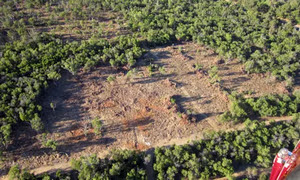
Martin Taylor compared how the federal government and the Queensland government assessed vegetation changes of more than 50 properties of at least 100 hectares in size. NCAS (left) says there was forest 2017-20 but Slats (right) shows what was cleared by the winter of 2018.

An accurate estimate of changing vegetation cover also underpins the veracity of carbon offsets, with the majority of claimed cuts paid for through the federal government’s emissions reduction fund going to the land sector. Its new long-term emission reduction plan to reach net zero by 2050 also relies heavily on it.

“Emissions from [LuluCF] have fallen by 114m tonnes of carbon dioxide-equivalent since 2005, and in 2019 the sector represented a 25 Mt CO₂-e sink for Australia,” the government’s net zero plan report states. Australia reports annual emissions of about 500m tonnes.

Martin Taylor says he is ‘flummoxed’ that models are missing obvious vegetation change.
Deforestation has featured at Cop26 the climate summit in Glasgow, with Australia among the 105 nations to sign a pledge to reduce forest loss by 2030.

Accounting rules agreed to under the UN framework convention on climate change help countries minimise loss of their forests. Under those rules, tree crown cover needs to amount for only 10% to 30% of an area of less than one hectare for it to be treated as a forest. Australia takes the mid-point of the range at 20%.

Before and after images of land clearing north of Injune, Queensland, in 2017 and 2018. NCAS (left) claims there is forest from 2017-20 but Slats (right) picks up the clearing by winter 2018.

Taylor said the 20% estimate was “a fundamental issue” that meant NCAS “just completely misses” land clearing.

“Where forest tree cover gets reduced down from 100% to 30% or 20%, to them it’s still a forest and nothing’s changed,” he said. “That’s huge.”

Taylor and other researchers said even 20% coverage could be understating actual clearing because the models used are less accurate than the Slats detection used by Queensland and other states, including NSW.

Before and after images of land clearing north-east of St George, Queensland, in 2017 and 2018. NCAS (left) shows the area as still forested 2017-20 but Slats (right) picks up land clearing by the winter of 2018.


It isn’t clear what land-clearing is

Questions over the reliability of Australia’s land sector emissions accounting are not new.

As far back as 2007, Andrew Macintosh of the Australian National University law school called for an independent review of NCAS, without which the “federal government’s claims about Australia’s performance against its Kyoto target should be treated with scepticism”.

Glenn Walker, then with the Wilderness Society, also compiled a report highlighting how Queensland’s land clearing rates rocketed after the LNP under Campbell Newman came to power in 2012, yet Australia’s emissions continued to fall during that period.

Excluding the years from 2007 to 2012, the National Carbon Accounting System has underestimated land clearing in Queensland compared with the Statewide Landcover and Trees Study (Slats) compiled by the state government.

Excluding land use, national emissions had risen by more than 5% since 2005 – the base year picked by the Abbott government for Australia’s Paris climate goal – before Covid-19 lockdowns began. Carbon pollution in other rich economies fell in that timeframe.

When land use emissions are removed, Australia’s carbon pollution path shows a rise, unlike many other major developed economies.

Researchers say there are “millions of anecdotes” to illustrate areas where land-clearing has been picked up by Slats, but not by NCAS. One case involved NCAS identifying a dam as a forest because of its dark colour.

Don Butler, an ecologist formerly at the Queensland Herbarium and now a professor at ANU, worked with the Slats program for years. He said NCAS used Landsat imagery at 25m to detect vegetation and alterations, while Slats used 10m pixels.

“Just that change alone will change the estimate of the area cleared,” he said.

Stuart Phinn, a professor at the University of Queensland specialising in the use of remote sensing to measure environmental changes, said Newman’s policies “did have a large impact on clearing” that were picked up by Slats.

Reports at the time estimated Queensland landholders were clearing 10 sq km a day in 2015-16. The environment minister, Steven Miles, estimated carbon emissions at 45m tonnes over that year.

Slats doesn’t itself calculate emissions. As with NCAS, the emissions are inferred by the vegetation change identified in satellite images that is assessed using complex algorithms. The next Slats report for 2018-19 will be released on November 30.

Despite the revival of land clearing in Queensland after 2012 and a rise in NSW in recent years, Australia has continued to book falls in emissions from the land sector since 2007. From the June quarter of 2015, the sector has been negative, implying more sequestration than emissions.

Butler said: “The reason Slats is more accurate is that a human looks at every bit of clearing that’s reported and decides that it is clearing, and that’s not something that NCAS is resourced to do.”

Phinn, Butler and other researchers do not suggest there is any intent by NCAS to mislead on emissions, but stress the need for more transparency.

“It would be good to go more public with their modelling validation,” Phinn said. “I don’t think it’s open enough.”

The emissions reduction minister, Angus Taylor, passed a request for comment to the energy department, which said any suggestion that the Australian government had underestimated land clearing was “misplaced”.

“The Australian government prepares the national greenhouse accounts in accordance with Intergovernmental Panel on Climate Change guidelines,” a department spokesperson said, citing the approach detailed in the national inventory report.

“The methods and data are reviewed every year by teams of international experts assembled by the UNFCCC secretariat in Bonn. The international architecture that governs the National Greenhouse Accounts is designed to give confidence that the data are accurate, comparable and time-series consistent.”

‘It’s hard to understand and it’s hard to explain’

Martine Maron, professor of environmental management at the University of Queensland, said the complexity of the processes was one reason emissions from land clearing had not drawn as much public scrutiny.
“It’s a huge issue in Australia,” Maron said. “It’s been a problem for a long time. It’s really, really hard to understand and it’s hard to explain.”

“Essentially [NCAS and Slats] are using the same input data but they’re classifying change in different way,” she added. “I’ve spent years trying to get my head around it.”

Why Australia is accused of cheating during climate talks 4min 24sec

Butler said there were reasons to question the accounting even after recent revisions, including the increasing area assessed to be regrowth on previously cleared land.

“It’s now worth about 10-12m tonnes [of CO2] of sequestration a year,” he said. “That’s the bit … I have the least faith in I suppose, and it is a significant part of the story.”

Head of consulting at Ndevr Environmental, Matt Drum, and also formerly with the federal department of climate change, said land use changes were not reliably calculated, so his firm focused on tracking carbon emissions by the rest of the economy.

“It’s not a bit of a black box, it’s a massive black box,” Drum says. “It’s at the point where you report without LuluCF – it’s much more reliable.”
The Greens leader, Adam Bandt, said Scott Morrison “boasts of meeting and beating terrible targets, but his claimed 20% emissions cuts [since 2005] rely on accounting changes that the experts now question”.

“Take out the land sector and it’s unstable greenhouse accounting and the Liberals haven’t reduced emissions since 2005 at all,” Bandt said.

Phinn and Butler said space-based remote sensing was rapidly advancing and systems would soon be available that more precisely detected height and density of vegetation, so that regrowth of grass, for instance, was not treated as if it were more woody plants. Whether governments use the technology to adjust and even reinterpret past data is another matter.

With the land sector also accounting for more than 60% of Australian carbon credits and more than three-quarters of contracted abatement under the ERF, potentially billions of dollars of offsets and sequestration claims are riding on good data.

Will Steffen, a researcher at ANU, helped advise the Labor government under Julia Gillard on how to nudge companies to reduce their emissions rather than rely on offsets to do their work.

“[We wanted] to make sure that there wasn’t a get out of jail free card by using land offsets in place of actually reducing fossil fuel emissions,” Steffen said. “The land sector screamed up and down that that wasn’t fair because then as now there are companies in those industries who make money off offsets.”

Steffen said: “I think we need a really thorough review of the entire land clearing process. That’s not just accounting, but how we use land carbon vis-a-vis fossil fuel emissions.”

Links

(AU New Daily) Alan Kohler: Politicians Must Stop Lying About The Cost Of Climate Change

New DailyAlan Kohler

World leaders must be honest about the cost of climate change, writes Alan Kohler. Photo: TND/AAP

Author
Alan Kohler writes twice a week for The New Daily. He is also editor in chief of Eureka Report and finance presenter on ABC news.
The name of the climate change conference in Glasgow betrays its failure: COP26.

It’s the 26th of them.

The United Nations Framework Convention on Climate Change (UNFCCC) has been plugging away since 1995, and the only declines in greenhouse gas emissions over that time have been during recessions, oil shocks and the collapse of the Soviet Union – nothing to do with the COP(out)s.

Maybe No.26 will be the one, but you’d have to be an incurable optimist or a politician, or have not paid close attention to what’s been going on in Glasgow, to think that.

The International Energy Agency’s executive director, Fatih Birol, says the pledges made over the past week will bring global warming to below 2 degrees for the first time, which seems to be an achievement.


But apart from the sheer inadequacy of it, Dr Birol is confused about the meaning of “pledge”, as is everybody else at the meeting.

The dictionary describes a pledge as a binding promise, but these promises are not binding, and we have learnt over 26 years that they barely qualify as promises at all.

“Best efforts”, or “let’s see how we go” would be a better description.

Since 1995, there have been five American presidents, six British prime ministers, seven Indian PMs and eight Australian PMs.

It simply isn’t possible for them to make a binding long-term promise, or rather they only make long-term promises that are likely to win them short-term votes.

And making the sort of binding promise necessary to achieve 1.5 degrees of warming would be guaranteed to lose any election.

According to a study by the Peterson Institute for International Economics, the global cost of carbon must rise from roughly $10 a tonne globally now to $60 a tonne immediately, and $75 a tonne by 2030 in order to hit the Paris Agreement targets (or 2 degrees and “preferably” 1.5).

PIIE goes on: “The impact of such a shock is familiar because it resembles the oil shocks of the 1970s, when a previously under-priced resource was suddenly revalued.”

“If priced at $75 a tonne, the aggregate value of the 36.4 gigatonnes of carbon emissions in 2019 would amount to 3.1 percentage points of 2019 world GDP,” the study says.

“[T]he 1974 oil shock resulted in the repricing of 19.7 billion barrels of oil from $3.3 to $11.6/barrel; the corresponding shock amounted to 3.6 percentage points of the 1973 global GDP.”

Can we imagine any national leader saying: “Right, everyone, what we need now is another oil shock”?

The IMF wrote in June that carbon pricing is needed and would have to be supported by measures to enhance its effectiveness and acceptability, including public investment in clean technology networks (like grid upgrades to accommodate renewables) and measures to assist vulnerable households, workers, and regions.

It says these things would be equivalent to a carbon price of $US75 a tonne.

And finally, the Bank of England has published what it called a “2021 Climate Biennial Exploratory Scenario”, in which it went much further, and much scarier.

“In the Early Action scenario, carbon prices increase from roughly $US30 per tonne of carbon dioxide-equivalent today, to just under $US900 by 2050 in the UK and EU (abstracting from general inflation over the time period).

“In the Late Action scenario, carbon prices remain at $US30 until 2030, and then rise steeply to over $US1000 in 2050.”

Even in today’s money, that sort of carbon price would make the oil shocks of the 1970s seem like a picnic.

So the capitalists, not the politicians, will have to save the planet, and that is starting to happen.

Private sector leading the way

Last Wednesday a press release was issued in Glasgow with this first paragraph: “Today, through the Glasgow Financial Alliance for Net Zero (GFANZ) over $US130 trillion of private capital is committed to transforming the economy for net zero. These commitments, from over 450 firms across 45 countries, can deliver the estimated $100 trillion of finance needed for net zero over the next three decades.”

But that is not money sitting in a fund ready to invest in clean energy.

It refers to the total assets managed by members of the Glasgow Financial Alliance for Net Zero, which is a group of concerned banks and financial institutions.

Banks account for roughly half the $US130 trillion ($174 trillion).

Their assets are mostly loans to people and businesses, which can’t be used by the banks to invest in renewable energy. They can decide not to lend money for new coal mines, which they have already done, but they can’t tell their customers what to do.

Also, banks count single assets several times through chains of loans, which are deposited and lent again.

Investment management also involves double-counting by subcontracting other managers to look after some of the money, and both are counted.

So the double-counting means it’s actually less than $US130 trillion ($174 trillion).

That press release was just another piece of COP26 puffery. But it is fair to say that the investment and business world are trying to pick up leadership of the fight against global warming.

That’s because investors have a longer-term focus than politicians, and are genuinely worried about what happens in 2050. Most CEOs are like politicians, of course, but their shareholders are calling the shots.

But can investors and businesses do this on their own? Absolutely not.

There has to be a global price on carbon if 1.5 degrees is to be achieved.

There is a very active voluntary carbon market of companies and investors trying to do the right thing, which pushed the spot price of Australian Carbon Credit Units to a record high of $36.75 on Friday and has lifted other carbon prices around the world, but it’s not enough.

If it stays voluntary with just a few emissions trading schemes dotted around the world, then the companies and households choosing not to cut or offset their emissions will be able to freeload, and the cost of the climate change project would not be equally shared.

That’s why it has always broken down – if everyone is not sharing the burden, it can’t work.

So the only way global warming will be defeated is if political leaders are prepared to come clean on the cost of it and oppositions don’t use that as a platform to lie their way into office.

Like the Coalition did in Australia.

Links

Green Hydrogen: How Half The Water Flushing A Toilet Could Power Your Home For Days

Euronews - Doloresz Katanich


Winner of the Earthshot Prize for Fix the climate   -   Copyright  Earthshot

Emission-free hydrogen could, one day, entirely replace fossil fuels - and a start up in Germany believes it has the key ingredient to make it accessible to all.

Born in a climate-change affected South Pacific Island, Vaitea Cowan believes deeply in green hydrogen technology. She co-founded Enapter more than three years ago.

"I wanted to replace all the diesel generators in New Caledonia and all the remote areas that didn't need to rely on dirty diesel, " she says.

"But then realising the potential for green hydrogen to replace fossil fuels, I wanted to be part of this change."
Green solutions will only be adopted if they are the most economically attractive. And that's our mission at Enapter to make green hydrogen cost-competitive with fossil fuels.
Vaitea Cowan Co-founder, Enapter
With headquarters in Germany, the company has deployed its ion exchange membrane electrolysers in over 100 projects across 33 countries. The technology turns renewable electricity into emission-free hydrogen gas.

Developed more quickly and cheaply than once thought possible, the AEM electrolyser already fuels cars and planes, powers industry and heats homes.

Enapter's hydrogen generators have recently won Prince William’s Earthshot Prize in the 'Fix Our Climate' category.

What is green hydrogen?

Much of the planet's hydrogen is locked up in water. So-called 'green' hydrogen is an emission-free way of extracting it. This extraction relies on renewable energy, which is used to power electrolysis. Electrolysis is the chemical process needed to separate the hydrogen and oxygen atoms in the water.

Extracting hydrogen this way has been facing criticism, because of its low efficiency and high cost. Enapter says, however, that their AEM Electrolyser solves these problems and provides a quick and easy way to produce green energy, even at home.

Half of the water used to flush a toilet can power a home for days

Enapter says its electrolyser uses about 2.4 litres of water to generate enough hydrogen for a couple's home for several days.

However, the exact number of days depends on the power storage capacity. This amount of water is equal to half of the water used for flushing a toilet once (5 litres), and eight times less than the water consumption of a dishwasher (20 litres).

The Earthshot Prize will help Enapter to start mass production.

"The production site, we started to build six weeks ago, will go into mass production at the beginning of 2023", says Vaitea.

By 2050, Enapter’s hopes to produce 10% of the world’s hydrogen.

Links

08/11/2021

(AU SMH) ‘Indigenous People Feel The Climate Crisis. Our Land Is A Part Of Us’

Sydney Morning Herald - Tishiko King

Author
Tishiko King is the campaigns director at Seed Mob and community organiser for Our Islands Our Home.
While world leaders met behind closed doors at COP26, it’s been the relentless leadership of First Nations people that gives me strength and ignites a fire in my belly.

This global climate conference, labelled the one to save humanity, has been frustrating to say the least. Yet again, we’ve seen political power holders together with their fossil fuel donors, turn a blind eye to the consequences of their poor leadership and decision-making.

Protestors dressed as US President Joe Biden and British Prime Minister Boris Johnson who were among the world leaders to attend the summit. Credit: Getty Images

But as the oceans are rising, so too are First Nations people. We are the first scientists, the first innovators, and we have cared for our lands and waters for thousands of generations.

It was the words of India Logan-Riley, a young Māori activist, who said what many of us have been thinking, “in the face of mediocre leadership Indigenous people shine through … This COP, learn our histories, listen to our stories, honour our knowledge and get in line, or get out of the way.”

What many people don’t realise is that Indigenous people have been paving the way since before world leaders started these global gatherings to address the climate crisis.

It was Eriel Deranger, Dënesųłiné woman and the Executive Director at Indigenous Climate Action Canada, who reminded the conference again of the leading role Indigenous leadership has played in making space for civil society contributions at COP negotiations, which at its core, is a forum designed for state leaders.

Indigenous leaders from the Global Alliance of Territorial Communities meet the Prince of Wales at the Glasgow summit. Credit: Getty Images

Deranger shared how world leaders came together in 1992 to talk about the climate crisis, but preceding this was a gathering of Indigenous peoples who wrote the Kari-Oca Declaration, a submission to the United Nations demanding that civil society and Indigenous leaders had a say in these spaces.

It was Indigenous peoples that demanded a place, lobbied, and brought perspectives from the world to the official negotiations.

Across the world, Indigenous people make up less than 5 per cent of the world’s population, yet we protect 80 per cent of global biodiversity. We have looked after our land sustainably for over 60,000 years.

As a proud Torres Strait Islander woman, already in my lifetime I have seen the impacts of climate change on our islands.

I travelled to COP26 in Glasgow for my people and to stand up for First Nations people, as a representative of both Seed Indigenous Youth Climate Network and Our Islands Our Home, a campaign calling on the Australian Government to do more to protect the Torres Strait Islands.

A fisherman, whose livelihood relies on his catch, casts his net from a boat off Hammond Island in the Torres Strait. Credit: Kate Geraghty

As Indigenous people, we don’t just see the climate crisis, we feel it. Our land is a part of who we are, a part of our identity. This connection to our land and one another stems far and wide, across the oceans and seas.

It’s these connections and knowledge of our homelands that is absolutely critical in the collective fight for climate justice.

But while world leaders sit on their hands, going round and round in circles, making empty and misleading commitments, it was a young Samoan woman, Brianna Fruean of the Pacific Climate Warriors, who issued a caution of the power of the words, noting there is no place for pity in the fight against climate change.

Glasgow summit
Thunberg calls COP26 a ‘failure’ as summit chief warns of a long week ahead
Brianna pointed out, “...how climate action can be vastly different to climate justice, how two degrees could mean the end, and 1.5 could mean a fighting chance.”

She shared a chilling message with world leaders that, “in your words, you wield the weapons that can save us or sell us out.”

When I return to Australia, I return with a message I have delivered many times, but now I’m further fuelled by the many First Nations communities I know are fighting with me.

What I say to Australia is this: get behind First Nations communities. Stand alongside us in our fight for climate justice, for land rights, and for self-determination. These are critical pieces in our fight against the climate crisis. Because colonialism and capitalism have caused the climate crisis, but Indigenous leadership can solve it.

For now, the state leaders have left Glasgow, but we will stay and fight. There is an Indigenous people’s action planned over the weekend, and make no mistake, we are rising.

Links

(ABC) Big Crowds Rally In Rainy Glasgow For Cop26 Climate Action

ABC - Reuters

 A final pact will be announced after further COP26 negotiations next week. (AP: Andrew Milligan/PA)

Tens of thousands of protesters have marched through rainy downtown Glasgow, and in many other cities around the world, to demand bolder action at the UN climate conference.

Students, activists and climate-concerned citizens linked arms as they moved slowly through the streets of the Scottish city, host of the COP26 meeting that began on Monday.

Some pushed children in strollers, some danced to stay warm. Police watched the procession from the flanks.

"It's good to have your voice heard," said Kim Travers of Edinburgh.

"Even with the rain, I think it makes it a bit more dramatic."

Some countries, not including Australia, have agreed to phase out coal. (Reuters: Yves Herman)

Just a few blocks from the procession, back-room negotiations continued at the COP26 meeting. On stage, speakers sounded the alarm over the threat of global warming to food security.

Since the climate talks began, national delegations have been working to agree on technical details for the final pact, to be announced at the end of the conference after more negotiations this week.

The first week also saw countries make a slew of promises to phase out coal, slash emissions of the potent greenhouse gas methane and reduce deforestation.

Business leaders and financiers, meanwhile, pledged to invest more in climate solutions.


The bushfire survivor at COP26

But activists have demanded that the meeting make more progress.Ros Cadoux, a grandmother from Edinburgh, said she came to march for future generations.

"If you've got kids and grandkids, my God, what else could you do?"

Colourful banners bore slogans ranging from earnest calls for "Climate Justice Now", to the more comical: "No planet = no beer".One group bounced along to the sound of a drum and chanted: "Get up, get down, keep that carbon in the ground."

"The climate crisis is about the survival of humanity as we know it," said Philipp Chmel, who traveled from Germany for the march.

"It's up to the youth and the workers, the working class, to bring about the change that is necessary."

Tens of thousands braved Glasgow rain to send a message on climate change. (AP: Andrew Milligan/PA)

One group of young people — some with bullhorns — blamed companies for the climate crisis and chanted calls in favour of socialism while punching their fists in the air.

Around midday, the rain cleared for a few hours, and an enormous rainbow streaked across the sky.

"If ever there was a time for activism, and if ever there was a time for the people to come out onto the streets, then it is today," said University of Glasgow student Theo Lockett, 20.

Protesters 'want more' from Morrison government

Climate activists held rallies in many other cities, including Seoul, Copenhagen and London.

Blinky, the smoking, screaming four-metre high koala puppet, is seen with Extinction Rebellion activists in Melbourne.(Reuters: Extinction Rebellion)


More than 1,000 people demonstrated on Saturday in Sydney and Melbourne to protest against the government's climate policies and the strategies it offered at COP26.

Morrison returns from Glasgow a significantly reduced figure on the domestic and international stage
Why aren't the disturbing aspects of both the climate change and strategic positions of the government under more intense pressure? Read more
Sydney's first legal protest after a months-long COVID-19 lockdown saw about 1,000 people march in support of global action day for climate justice, a worldwide movement mobilised during the COP26 meeting.

"We're all out here to show that we want more from our government," said protester Georgia, who gave only her first name.

"The COP 26 agreements were happening and it's not turning out the best for Australia at the moment."

Marchers carried signs reading, "We need human change, not climate change" and "Code Red for Humanity".

Australia has rejected a global pledge to slash emissions of the potent greenhouse gas methane. Campaigners and pressure groups have not been impressed by the commitments of other world leaders.

Rallies were held around Australia. (Reuters: Extinction Rebellion)

Melbourne's protest was smaller than Sydney's, with just a few hundred people turning out for a rally that featured a giant koala bear emitting plumes of smoke, and protesters dressed as skeletons on bikes.

Several smaller events were held elsewhere in Australia.

'Not a secret that COP26 is a failure': Greta Thunberg attacks world leaders' inaction

'Obituary of our planet'


During a panel of speeches on Saturday (local time), Democratic US senator Sheldon Whitehouse urged companies to rein in groups lobbying politicians to block climate action.

Are we burning carbon price credits?
Australian farmers are busy generating carbon credits. They're valuable, but could be worth more. Read more

"Corporate members who made big promises here at this COP have got to get their trade associations under control so they're not undercutting our work in Congress," said Mr Whitehouse, who was at COP26 with a bipartisan group of Congress members.

He also told journalists that it was crucial to resolve a carbon price for carbon markets — one of the key sticking points in the negotiations.

As with the COVID-19 pandemic, "it won't be long before the entire population of the world is affected, directly or indirectly" by climate change, said former prime minister Julia Gillard, now head of UK health charity the Wellcome Trust.

Earlier at the conference, actor Idris Elba acknowledged that he had few credentials to speak on climate change, but said he was at COP26 to amplify the climate threat to global food security.

COP26 has seen high-profile speakers including Idris Elba. (AP: Alastair Grant)

Sitting on the same panel, climate justice campaigner Vanessa Nakate of Uganda implored the world to stop burning fossil fuels, the main cause of rising global temperatures.

"We are watching farms collapse and livelihoods lost due to floods, droughts and swarms of locusts," she said — all of which scientists say are being exacerbated by climate change.
"The climate crisis means hunger and death for many people in my country and across Africa."
Civil society leaders and representatives from companies like Unilever and PepsiCo spoke about corporate responsibility in making trade and commerce less of a burden on nature.

Speaking about using satellite technology to monitor global landscapes, the director and founder of Google Earth Outreach urged better stewardship of the world's forests.

"We don't want to be writing the obituary of our planet in high resolution," Rebecca Moore said.

Dozens of countries commit to phasing out coal, except Australia

Links

(Grist) Report: Climate Misinformation On Facebook Viewed 1.4 Million Times Daily

Grist

AP Photo / Jeff Chiu

Facebook may be changing its corporate name, but it’s still peddling climate misinformation.

According to a new report from the advocacy organization Stop Funding Heat and the ad hoc group of activists called the Real Facebook Oversight Board, the platform’s existing mechanisms don’t go nearly far enough to rein in false or misleading content about climate change. 

The groups analyzed 48,700 posts published between January and August 2021, covering 196 Facebook groups and pages that are known to publish false climate claims.

They identified 38,925 instances of climate misinformation — only 3.6 percent of which had been evaluated by Facebook’s third-party fact-checkers. Eighty-five percent of the content bore no link to the platform’s Climate Science Center, a tool the company launched ostensibly to provide Facebook users with “factual resources from the world’s leading climate organizations.”

“The extent of climate misinformation on Facebook’s platform is a lot more than they are giving away,” said Sean Buchan, Stop Funding Heat’s research and partnerships manager and a lead author of the report.

According to the report, this mostly unfiltered climate misinformation was viewed up to 1.36 million times daily over the past eight months — nearly 14 times the alleged daily user traffic to Facebook’s climate science information hub.

These findings build on the scientific community’s growing antipathy toward the social network and its role in proliferating misinformation. Thanks, in part, to Facebook’s recommendation algorithms, conspiracy theories have reverberated rapidly throughout the platform — whether it’s QAnon nonsense or baseless claims about the efficacy of COVID-19 vaccines

Facebook’s parent company, now called Meta, has taken some steps to address their misinformation problem, including the launch of a third-party fact-checking program in 2016, as well as creating topical information centers meant to connect users with reputable news and information sources. There’s one for COVID-19, for example, and another for voting and election information

Demonstrators in London protest climate misinformation on Facebook, Google, and YouTube. Ollie Millington / Getty Images

However, critics say that these efforts still don’t go far enough.

Reflecting on the shortcomings of the company’s Climate Science Center — launched in September 2020 — Buchan did not mince words. “Either they don’t care or they don’t know how to fix it,” he said in a statement tied to the new report.

Granted, climate misinformation is not coming from Meta/Facebook itself. The report by Stop Funding Heat and the Real Facebook Oversight Board found that one-fifth of the groups and pages they analyzed could be classified as “full-time” or “dedicated” misinformers which regularly posted overtly false content. Not even one-tenth of these groups’ posts had a fact-checking label applied, and only 10.6 percent had a link to the Climate Science Center.

The report also identified “subtler” forms of climate information that were able to bypass Facebook’s fact checks. This content, which accounted for the vast majority of misinformation in the analysis, included posts containing links to far-right news sites like Breitbart, or flawed reasoning from media personalities. 

For example: “Better start saving up for your electric car,” read one post from the conservative commentator Glenn Beck, linking to an article claiming that U.S. efforts to slash emissions would be economically burdensome. (In reality, failure to act on climate change is projected to cost the global economy up to $23 trillion annually by 2050.)

Another post from Australian senator Malcolm Roberts incorrectly suggested that snowy weather disproved global warming. (Weather is not the same as climate; even though it still snows, global average temperatures have already risen by 2.2 degrees Fahrenheit since 1880.) 

Facebook did not flag either post for a third-party fact check. As Stop Funding Heat discussed in a previous report in May 2021, this may be due to loopholes in Facebook’s fact-checking policies, which until August shielded content that was deemed to be “opinion.” (The same set of rules continues to exempt politicians from ever being fact-checked.)

In response to the study, Meta expressed concerns about the authors’ approach, saying that the report used “made up numbers and a flawed methodology to suggest content on Facebook is misinformation when it’s really just posts these groups disagree with politically.”

Over the past year, Meta has repeatedly stated its commitment to climate action. It reached net-zero carbon emissions in 2020 and recently announced it was operating on 100 percent renewable energy.

Mark Zuckerberg, chair and CEO of Meta, Facebook’s parent company. AP Photo / Esteban Felix

Jake Carbone, a senior data analyst at the nonprofit think tank InfluenceMap who was uninvolved with the new report, said that these efforts are incommensurate with the scale of change needed to address the urgent problem of climate misinformation.

“When stories look back on the impact that Facebook has had, they’re not going to talk about the emissions that came from its servers,” he said. “It’s really important to look at the impact that its information ecosystem is having.” The report identified a number of measures, mostly involving greater transparency, that could help Meta address Facebook’s misinformation problem.

The authors called for the company to make its definition of climate misinformation public  and share internal research about how misinformation spreads on its platform. They also suggested implementing a total ban on climate misinformation in paid advertising — a method by which millions of viewers are exposed to anti-climate action messaging. 

“This content causes harm,” Buchan said, adding that without much stronger efforts and transparency from Facebook’s parent company, government regulators may need to step in. In the lead-up to the major climate conference known as COP26, he said, other big tech companies have put out new efforts to combat climate misinformation.

Last month, Google announced a pledge to demonetize climate denial content from its video platform, YouTube. And this week, Twitter announced a new policy of “pre-bunking” climate disinformation in an attempt to get ahead of false content before users see it.

Meta, however, seems determined to double down on familiar Facebook tactics. In September the company announced a $1 million investment in a new fact-checking grant program; earlier this week (timed with the start of COP26) it pledged a series of initiatives to drive more Facebook users to the Climate Science Center and suggest ways for Messenger and Instagram users to shrink their carbon footprint.

But critics say these programs are unlikely to change the underlying misinformation problems highlighted in Stop Funding Heat and the Real Facebook Oversight Board’s report.

“It’s a distinct lack of humility during this time,” Buchan said. “We’re hoping that Facebook can take leadership on this issue before it gets a lot worse.”

Links

07/11/2021

(SMH) Thunberg Calls COP26 A ‘Failure’ As Summit Chief Warns Of A Long Week Ahead

Sydney Morning HeraldNick O'Malley

Glasgow: On what was billed as youth day at COP26, some of the old men of the movement took to centre stage inside the United Nations “blue zone” to consider the week that had passed and call for more action and haste in the climate effort.

Most notable was the former US vice-president Al Gore, who quoted Winston Churchill, saying: “The era of procrastination, of half measures, of soothing and baffling expedients, of delays, is coming to a close.

“In its place, we are now entering a period of consequences.”

Mr Gore said a political tipping point had been reached, and that a green revolution larger in scale than the industrial revolution and in pace with the digital revolution was now under way.

Greta Thunberg addresses protesters outside the climate summit in Glasgow on Friday, local time. Credit: PA

Outside the wire, Greta Thunberg dismissed the rhetoric of older generations at COP as she addressed thousands of young people who rallied in central Glasgow.

“It is not a secret that COP26 is a failure,” she said. “It should be obvious that we cannot solve a crisis with the same methods that got us into it in the first place.

“We need immediate drastic annual emission cuts unlike anything the world has ever seen.

“The people in power can continue to live in their bubble filled with their fantasies, like eternal growth on a finite planet and technological solutions that will suddenly appear seemingly out of nowhere and will erase all of these crises just like that.

“All this while the world is literally burning, on fire, and while the people living on the front lines are still bearing the brunt of the climate crisis.” 

Al Gore told the conference the world was entering a “period of consequences”. Credit: Getty Images

Back in the blue zone, the success – or failure – of the first week of COP is still a matter of live debate.

Another old man of the movement, US climate envoy John Kerry, told reporters he detected a great sense of urgency at the meeting compared to previous UN climate talks, but warned that the “the job is not done yet”.

Climate demonstrators gather in Glasgow during COP26 on Friday. Credit: AP


The COP’s organisers have been relieved that outside analysts have projected that, if all the commitments so far made as part of the UN negotiations and in the so-called “Glasgow package” of side-deals that the UK has been pursuing for months in the lead-up to this meeting are kept, warming will peak at less than 2 degrees this century.

Before the COP, that figure was 2.7 degrees, and before the Paris talks it was 6 degrees, COP president Alok Sharma reminded a press conference.

A brief history of climate science and global climate negotiations. By Tom Compagnoni.

But echoing the message of the protesters outside the wire, Mr Sharma said he did not believe “populations would accept it” if leaders returned from the meeting at the end of next week and their pledges and agreements did not bring those projections down to 1.5 degrees, and demonstrate how such new ambitions might be met.

Delegates and negotiators have focused on hammering out the fine print of what is hoped will become a document some are already calling the “Glasgow pact”.

Though Mr Sharma would not say what the sticking points were in tens of different negotiating tracks, there is no secret that some states, like China, do not want 1.5 degrees locked in as the target.

Others are resisting calls from blocs of nations such as the so-called High Ambition Coalition – a caucus of both small island states and powerhouses such as the United States – to make the reporting of new reductions targets annual rather than a five-yearly responsibility for signatories of the Paris Agreement.

The arduous work of negotiating so-called article 6 – the rules governing a future global carbon market – grinds on, as it has now for six years.

Glasgow summit
How the world ran out of time
Without proper transparency, the positive projections celebrated this week could retreat into fantasy.

In the coming days, ministers will begin to return to the blue zone to check on the progress of their negotiators.

Mr Sharma is already demanding more from them, issuing a statement to the teams saying he expected work to start early and move quickly on Monday, and that he did not want COP to bleed on into its second weekend as it has in the past.

Glasgow Climate Summit
Explore
Links

Lethal Heating is a citizens' initiative