12/01/2022

(Reuters) Natural Disasters Cost Insurers $120 Billion In 2021, Munich Re Says

Reuters - Tom Sims | Alexander Hübner


Summary
  • Second-most costly year
  • Tally is higher than Swiss Re estimate in December
  • U.S. accounts for high portion of losses
  • Climate change to result in more extreme weather
FRANKFURT - Marked by devastating hurricanes and cold snaps in the United States, 2021 proved the second-most costly year on record for the world's insurers, Munich Re said on Monday, warning that extreme weather was more likely with climate change.

Insured losses from natural catastrophes totalled around $120 billion last year, second only to the $146 billion in damages during the hurricane-ridden year of 2017.

The annual tally by Munich Re , the world's largest resinsurer, is higher than an estimate of $105 billion that competitor Swiss Re published last month.

The U.S. - ravaged by dozens of tornadoes in December, and by Hurricane Ida and freezes in Texas earlier in the year - accounted for an unusually large portion of the losses, Munich Re said.

"The images of natural disasters in 2021 are disturbing. Climate research increasingly confirms that extreme weather has become more likely," said Torsten Jeworrek, a member of Munich Re's board.

Nearly 10,000 people died from natural catastrophes, in line with previous years. Total losses, including those not covered by insurance, were $280 billion, the fourth-highest on record.

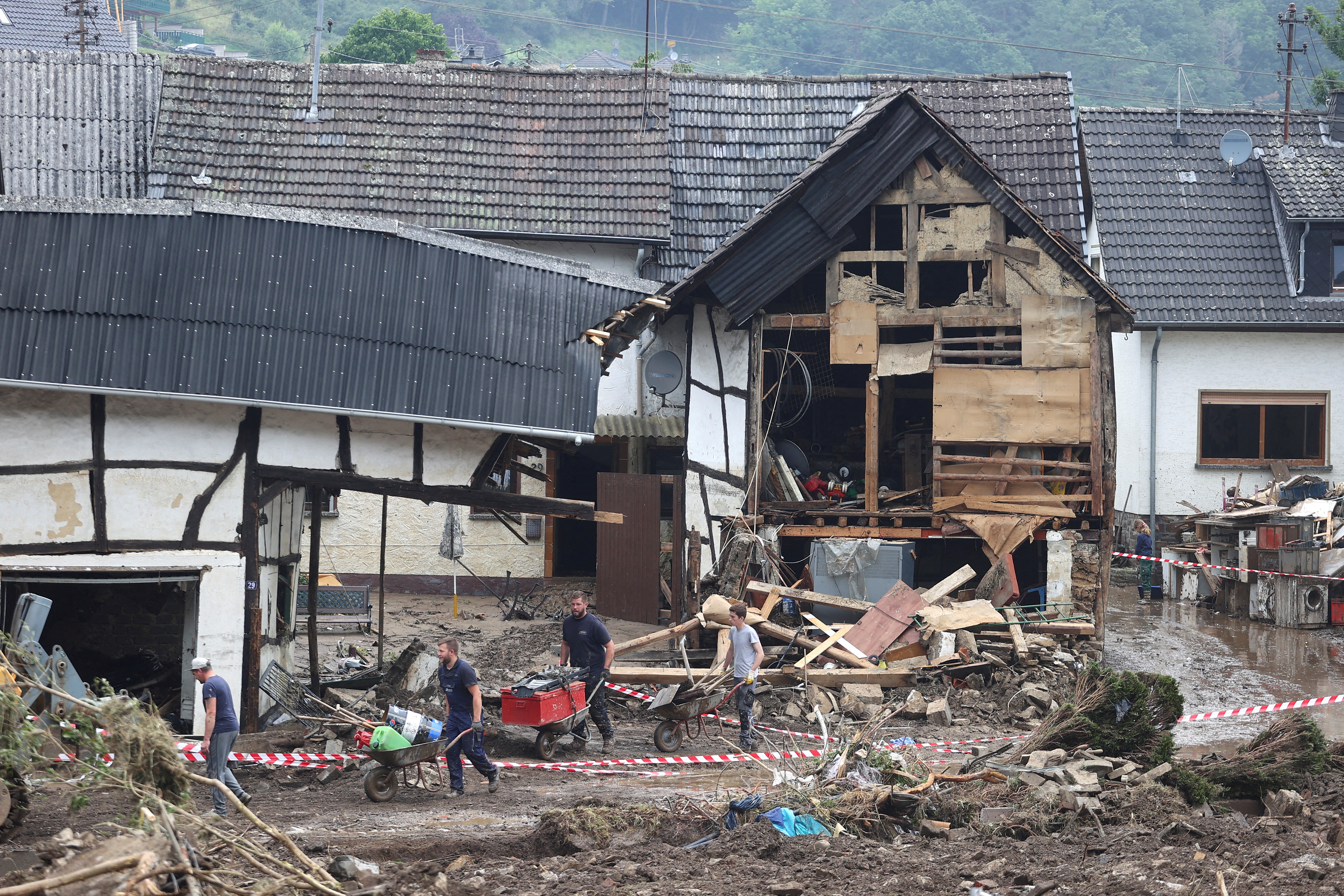
Residents remove rubble among the debris left over by the July 2021 extreme weather and lethal floods of the nearby Ahr river, in Schuld, Germany, July 17, 2021.REUTERS/Wolfgang Rattay
Residents remove rubble among the debris left over by the July 2021 extreme weather and lethal floods of the nearby Ahr river, in Schuld, Germany, July 17, 2021. REUTERS/Wolfgang Rattay

Hurricane Ida, damage from which stretched from New Orleans to New York, resulted in $36 billion in insured losses. The winter storm that primarily hit Texas resulted in around $15 billion in losses. Floods in Germany cost billions too.

"The 2021 disaster statistics are striking because some of the extreme weather events are of the kind that are likely to become more frequent or more severe as a result of climate change," said Ernst Rauch, Chief Climate and Geo Scientist at Munich Re.

Many scientists agree that events in 2021 were exacerbated by climate change and that there is more – and worse – to come as the Earth's atmosphere continues to warm through the next decade and beyond.

The costliest year on record was 2017, with hurricanes Harvey, Irma and Maria. Other severe years were 2011, when big earthquakes hit Japan and New Zealand, and 2005, when Hurricane Katrina ravaged New Orleans.

Insurers have in some cases been raising the rates they charge as a result of the increasing likelihood of disasters, and in some places have stopped providing coverage.

As insurers warn about climate change and the costs associated with it, they themselves are under pressure from activists to stop insuring dirty industries.

Links

(AU The Conversation) Scientists Call For A Moratorium On Climate Change Research Until Governments Take Real Action

The Conversation |  | 

Mario Tama/Getty Images

Authors
  •  
    Professor, Massey University
  •  
    Professor of Environmental Planning, University of Waikato
  •  
    Professor and ARC Future Fellow, University of the Sunshine Coast     
Decades of scientific evidence demonstrate unequivocally that human activities jeopardise life on Earth. Dangerous anthropogenic interference with the climate system compounds many other drivers of global change.

Governments concur: the science is settled. But governments have failed to act at the scale and pace required. What should climate change scientists do?

There is an unwritten social contract between science and society. Public investment in science is intended to improve understanding about our world and support beneficial societal outcomes. However, for climate change, the science-society contract is now broken.

The failure to act decisively is an indictment on governments and political leaders across the board, but climate change scientists cannot be absolved of responsibility.

As we write in an article about this conundrum, the tragedy is the compulsion to provide ever more evidence when the phenomena are well understood and the science widely accepted. The tragedy is being gaslighted into thinking the impasse is somehow our fault, and we need to do science differently: crafting new scientific institutions, strategies, collaborations and methodologies.

Yet, global carbon dioxide emissions are 60% higher today than they were in 1990, when the Intergovernmental Panel on Climate Change (IPCC) published its first assessment. At some point we need to recognise the problem is political and that further climate change science may even divert attention away from where the problem truly lies.

Governments agree that the science is settled but scientists are compelled to do more research despite inadequate government action and worsening climate change. Author providedCC BY-ND

Was COP26 too little, too late?

The outcome of COP26, summarised in the draft Glasgow Climate Pact, includes some progress, including an agreement to begin reducing coal-fired power, removing subsidies on other fossil fuels, and a commitment to double adaptation finance to improve climate resilience for countries with the lowest incomes.

But many of the world’s leading scientists argue that this is too little, too late. They note the failure of COP26 to translate the 2015 Paris Agreement into practical reality to keep global warming below 1.5℃ above pre-industrial levels.

Even if COP26 commitments are fulfilled, there is a strong likelihood that humanity and life on Earth face a precarious future.

What are climate change scientists to do in the face of this evidence? We see three possible options — two that are untenable, one that is unpalatable.

Where to from here for climate change scientists?

The first option is to collect more evidence and hope for action. Continue the IPCC process that stays politically neutral and abstains from policy prescriptions. A recent editorial in Nature called on scientists to do just that: stay engaged to support future climate COPs.

However, this choice not only ignores the complex relationship between science and policy, it runs counter to the logic of our scientific training to reflect and act on the evidence. We know why global warming is happening and what to do. We have known for a long time.

Governments just haven’t taken the necessary action. In a recent Nature survey, six in ten of the IPCC scientists who responded expect 3℃ warming above pre-industrial levels by 2100. Persisting with this first option is therefore untenable.

The second option is more intensive social science research and climate change advocacy. As Harvard historian Naomi Oreskes recently observed, the work of the IPCC’s Working Group I (WGI, on the physical science basis of climate change) is complete and should be closed down. Attention needs to focus on translating this understanding into action, which is the realm of WGII (on impacts, adaptation and vulnerability) and WGIII (on mitigation of greenhouse gas emissions).

In parallel, growing numbers of scientists are getting involved in diverse forms of advocacy, including non-violent civil disobedience. However, albeit more promising than option one, there is little evidence of impact thus far and it is doubtful this pathway will lead to the urgent transformative actions required. This option is also not tenable.

Halt on IPCC work until governments do their part

The third option is much more radical, but unpalatable. We call for a moratorium on climate change research that does little more than document global warming and maladaptation.

Attention needs to focus on exposing and re-negotiating the broken science-society contract. Given the rupture to the contract outlined here, we call for a halt on all further IPCC assessments until governments are willing to fulfil their responsibilities in good faith and mobilise action to secure a safe level of global warming. This option is the only way to overcome the tragedy of climate change science.

Readers might agree with our framing of this tragedy but disagree with our assessment of options. Some may want greater detail on what a moratorium could encompass or worry it may damage the credibility and objectivity of the scientific community.

However, we question whether it is our “duty” to use public funds to continue to refine the state of climate change knowledge (which is unlikely to lead to the actions required), or whether a more radical approach will serve society better.

We have reached a critical juncture for humanity and the planet. Given the unfolding tragedy, a moratorium on climate change research is the only responsible option for revealing and then restoring the broken science-society contract. The other two options are seductive but offer false hope. 

Links

(BBC) Past Seven Years Hottest On Record - EU Satellite Data

BBC News - Georgina Rannard

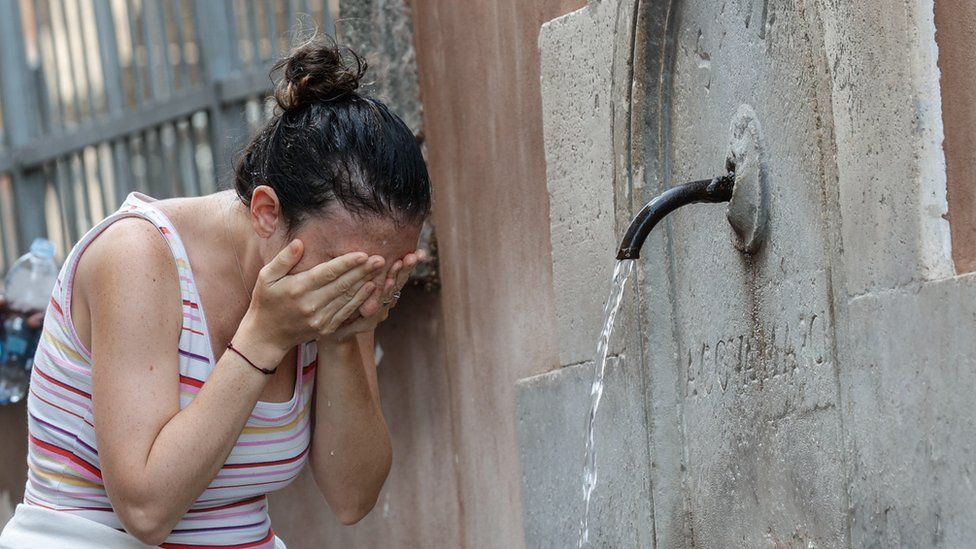
A woman cools off at a fountain in Italy
Image source, EPA

The past seven years have been the hottest on record, according to new data from the EU's satellite system.

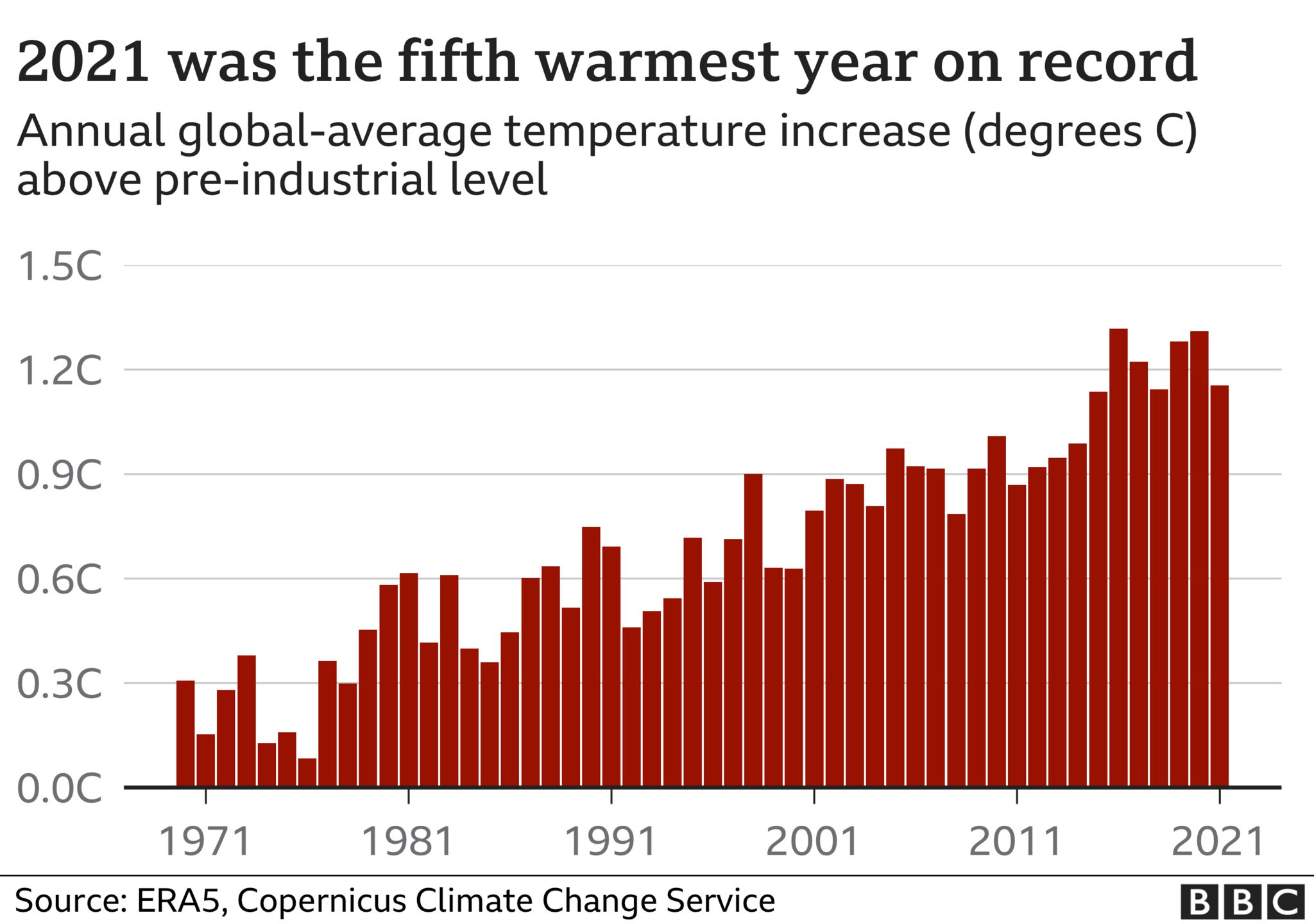
The Copernicus Climate Change Service said 2021 was the fifth-warmest year, with record-breaking heat in some regions.

And the amount of warming gases in our atmosphere continued to increase.

Governments are committed to limiting global temperature rise to 1.5C to curb climate change. But scientists warn that time is fast running out.

The environmental, human and economic costs of hotter temperatures are already being seen globally.

Europe lived through its warmest summer, and temperature records in western US and Canada were broken by several degrees. Extreme wildfires in July and August burnt almost entire towns to the ground and killed hundreds.

"These events are a stark reminder of the need to change our ways, take decisive and effective steps toward a sustainable society and work towards reducing net carbon emissions," Carlo Buontempo, director of the Copernicus Climate Change Service, explains.

The Copernicus data comes from a constellation of Sentinel satellites that monitor the Earth from orbit, as well as measurements taken at ground level.

Fifth-warmest year

Copernicus data showed that 2021 was the fifth-hottest on record, marginally warmer than 2015 and 2018. Taken together, the past seven years were the hottest seven years on record by a clear margin, the agency explained.

The 2021 average temperature was 1.1-1.2C above the pre-industrial level around 150 years ago.


Analysis - Justin Rowlatt, climate editor


It would be easy to dismiss the latest global temperature figure as a non-event. Who celebrates fifth place in anything?

If we were in a film, these annual temperature updates would be the ominous drum beat signalling the plot is darkening.

They measure out the pace of change in our world. The increments may be tiny - a fraction of a degree - but the direction of travel is inescapable.

And make no mistake, the rhythm they mark out increasingly sets the pace for all our lives. Think of the fires and floods that affected so many people in 2021.

And now look again at what the data is telling us: the seven hottest years ever recorded have been the last seven years.

We can't say we weren't warned.


The agency said that the start of the year saw relatively low temperatures compared to recent years, but that by June monthly temperatures were at least among the warmest four recorded.

Places with above average temperatures included the west coast of US and Canada, north-east Canada and Greenland, large parts of north and central Africa, and the Middle East.

Infographic 1px transparent line The weather phenomenon known as La Niña - when surface sea temperatures are cooler - contributed to below-average temperatures in western and eastern Siberia, Alaska, and the central and eastern Pacific during the start and end of 2021.

Europe's warmest summer

Overall Europe's annual temperature was outside the ten warmest years on record but the summer was the hottest.

A heatwave swept through Mediterranean in July and August, particularly affecting Greece, Spain and Italy.

    In Sicily, 48.8C degrees was reported, breaking Europe's record for highest temperature by 0.8C.

    The hot temperatures in the eastern and central Mediterranean was followed by intense wildfires particular in Turkey but also in Greece, Italy, Tunisia and Algeria.

    And Europe also saw extreme wet weather, with huge floods devastating parts of Germany, Belgium and the Netherlands.

    These events were part of the same picture of weather systems disrupted by climate change.

    Warming gases increased


    The concentration in the earth's atmosphere of two gases that significantly contribute to climate change rose in 2021, said Copernicus.

    Carbon dioxide concentrations reached 414.3 parts per million last year, growing at a similar rate to 2020.

    Climate change is causing once-mighty rivers to dry up and temperatures to rise to deadly levels in Mexico

    But scientists remarked that methane levels in the atmosphere increased to reach an unprecedented approximately 1,876 parts per billion. The growth rate of methane was also higher than in 2020 - Copernicus said both rates were very high compared to the past two decades of satellite data.

    Scientist say it is important to reduce methane levels because it is more potent than CO2, however it lasts much less time in the Earth's atmosphere.

    The increasing concentrations of these gases showed no signs of slowing down, concluded Vincent-Henri Peuch, Director of the Copernicus Atmosphere Monitoring Service.

    More data about 2021's temperatures will be released in the coming days from other agencies including from Nasa and the UK's Met Office.

    Links

    11/01/2022

    (AU ABC) Should You Build Your Home Stronger To Withstand The Possible Impacts Of Climate Change?

    ABC News

    A prototype image of a house standing through strong winds
    In the face of increasing extreme weather events, James Cook University, Suncorp Insurance, CSIRO and Room 11 architecture collaborated to build a home resilient to fire, flood, storm and cyclone. (Supplied: Suncorp)

    Key Points
    • Some people are building their home above code to protect from extreme weather
    • Experts say houses will be more exposed under climate change
    • The government is encouraging 'resilience' measures
    As the footprint of climate change becomes clearer, the ability of homes to withstand the accelerating impacts of climate change and extreme weather is turning into a significant challenge.

    Working as an engineer for the Tropical Cyclone Testing Station, Geoff Boughton has seen hundreds of homes wrecked and ravaged, with families left without anywhere to live.

    He most recently witnessed it in Kalbarri and Northampton, an area where houses were not built to withstand the continuous cyclonic wind gusts caused by Seroja.
    "They have to start again, and I really don't want that to happen for myself or my family,” he said.
    Geoff Boughton outside is home
    Geoff Boughton's Perth home is built to withstand a weak cyclone, and intense thunderstorms. (ABC: Tyne Logan)

    When building his own home in Perth, well outside of the cyclone-rated region of WA, this was something he considered.

    Cyclones are uncommon near Perth, but they're not unheard of.

    "When you think of a 1 in 500 year event, if a house lasts for 50 years that makes it a 1 in 10 chance it happening within the lifetime of my house," he said.

    “The other thing is, with climate change, we really don’t know what the climate is going to be in 50 years time."

    tradie drills nails into roof
    During construction, a series of reinforcements were added to Geoff Boughton's roof. (Supplied: Geoff Boughton)

    From the outside, his house looks like a typical Perth home, but its structure is far stronger.

    It's able to withstand a weak cyclone blowing constant gusts of up to 160kph and is waterproofed for extreme thunderstorm events.

    And it didn't cost much.

    He said this was achieved through several features, including strengthening a series of structural elements on his roof to prevent it from lifting even if a window was broken.

    Geoff Boughton reaches at window
    Mr Boughton has higher windows, strengthened roof connections and sealing around his roof. (ABC: Hugh Sando)

    The windows are a slightly higher specification to keep water out better, and his roof edge is sealed to prevent water from coming in.

    All up, he said the additional features cost him about $4000 from a new build for his timber home.

    The fire-proof home

    Meanwhile, 100 kilometres south in Waroona, nestled amongst an old forest so thick you can barely see the house, lives Kingsley Dixon.

    His house is considered to be in a bushfire-prone area.

    Kingsley Dixon has built infrastructure to protect his home from bushfires 1min 41sec

    But having lived through bushfires, including the devastating Waroona-Yarloop blaze, he and his husband have gone well beyond basic code in their build.

    They have invested tens of thousand of dollars adding a reliable, long-term water supply, superficial sprinklers across the roofing system and fire-resilient landscaping around the house.

    "I think we need to move beyond minimum compliance, and ensure what we produce imagines the worst-case fire," he said.
    "What if we get the 1 in 1000 year fire, which we haven't experienced?"
    Kingsley Dixon outside leafy garden
    Kingsley Dixon has spent tends of thousands of dollards safeguarding his home from fire. (ABC: Glyn Jones)

    Like Mr Boughton, climate change and the heightened risk of bushfires in his region has reinforced his decision.

    Aren't building codes enough?

    Both Mr Dixon and Mr Boughton are part of a growing cohort of people building what is know as 'resilience' into their homes.

    A resilient house is one that is able to be lived in with relatively little work after a big event.

    Building standards are constantly under review to include the changing climate, with their primary focus to protect public health, safety and general welfare.

    But University of WA Environmental Engineer Anas Ghadouani said they are often "slow" to incorporate changes, and don't always protect your home from extreme weather events.

    A head and shoulders shot of UWA water expert Anas Ghadouani smiling and standing in front of the Swan River.
    Professor Anas Ghadouani said building codes did not always protect your home from extreme weather events. (ABC News: Charlotte Hamlyn)

    He said the codes juggle a fine balance of risk to impact.

    "The regulator can only look at the minimum standard that will resolve in the minimum damage to a neighbourhood with that building code," he said.

    He said the current risk analysis provided by building codes often meant a house would not withstand 'freak storms', which are getting more likely with climate change.

    "So the building codes are protecting you from a 1 in 100 year event," he said.

    "But the problem is some of those events are occurring more frequently than they're statistically supposed to be."

    Is it worth the cost?

    Building extra strength into your home is being encouraged by government and industry.

    Following Tropical Cyclone Seroja, the WA Department of Fire and Emergency Services offered grants of up to $20,000 to build additional protection into their homes.

    Melissa Pexton, State Recovery Controller from TC Seroja, said it was about minimising future destruction.

    "With an increase in those more devastating events, we really want to try build in resilience at every opportunity," she said.


    Youtube One House to Save Many Documentary 22min 47sec

     Earlier this year, the James Cook University, Suncorp Insurance, CSIRO and architecture firm Room 11 collaborated to build what they called the "one house to save many", a home resilient to fire, flood, storm and cyclone.

    The directors of Room 11 architects said the final design showed, with thoughtful planning, it could be achieved at a comparable cost to a standard architecturally designed home.
    "Things like running the fire in the ceiling and down the walls, and keeping the power-points a meter off the floor costs exactly the same, but your wiring stays dry," associate director Kate Phillips said.
    The costs of building resilience into your home can vary significantly, as demonstrated by the costs of Mr Boughton's features compared with Mr Dixon's.

    But it's most affordable when building from scratch.

    Mr Ghadouni said it ultimately came down to personal choice and the need to weigh up the risk with the cost to build.

    "Probably not enough people are acting on it in my view, but people are actually not sure what to do," he said.

    He said there was enough climate science on a regional level for the home-owner to be able to make a decision on their risks.

    Links

    (BBC) Lithium Batteries' Big Unanswered Question

    BBC Future Planet - Allison Hirschlag

    As the world looks to electrify vehicles and store renewable power, one giant challenge looms: what will happen to all the old lithium batteries?

    (Image credit: Getty Images)

    As the quiet whirr of electric vehicles gradually replaces the revs and noxious fumes of internal combustion engines, a number of changes are set to filter through our familiar world.

    The overpowering smell of gas stations will fade away into odourless charge stations where cars can re-juice their batteries as needed. Meanwhile, gas-powered generator sites that dot the horizon may be retrofitted to house massive batteries that could one day power entire cities with renewable energy.

    This electrified future is much closer than you might think. General Motors announced earlier this year that it plans to stop selling gas-powered vehicles by 2035. Audi's goal is to stop producing them by 2033, and many other major auto companies are following suit.

    In fact, according to BloombergNEF, two-thirds of the world's passenger vehicle sales will be electric by 2040. And grid-scale systems the world over are growing rapidly thanks to advancing battery storage technology.

    While this may sound like the ideal path to sustainable power and road travel, there's one big problem. Currently, lithium (Li) ion batteries are those typically used in EVs and the megabatteries used to store energy from renewables, and Li batteries are hard to recycle.
    As demand for EVs escalates, as it's projected to, the impetus to recycle more of them is set to barrel through the battery and motor vehicle industry
    One reason is that the most widely used methods of recycling more traditional batteries, like lead-acid batteries, don't work well with Li batteries. The latter are typically larger, heavier, much more complex and even dangerous if taken apart wrong.

    In your average battery recycling plant, battery parts are shredded down into a powder, and then that powder is either melted (pyrometallurgy) or dissolved in acid (hydrometallurgy). But Li batteries are made up of lots of different parts that could explode if they're not disassembled carefully. And even when Li batteries are broken down this way, the products aren't easy to reuse.

    "The current method of simply shredding everything and trying to purify a complex mixture results in expensive processes with low value products," says Andrew Abbott, a physical chemist at the University of Leicester.

    As a result, it costs more to recycle them than to mine more lithium to make new ones. Also, since large scale, cheap ways to recycle Li batteries are lagging behind, only about 5% of Li batteries are recycled globally, meaning the majority are simply going to waste.

    But as demand for EVs escalates, as it's projected to, the impetus to recycle more of them is set to barrel through the battery and motor vehicle industry.

    Extracting and processing lithium requires huge amounts of water and energy, and has been linked to environmental problems near lithium facilities (Credit: Alamy)

    The current shortcomings in Li battery recycling isn't the only reason they are an environmental strain. Mining the various metals needed for Li batteries requires vast resources. It takes 500,000 gallons (2,273,000 litres) of water to mine one tonne of lithium.

    In Chile's Atacama Salt Flats, lithium mining has been linked to declining vegetation, hotter daytime temperatures and increasing drought conditions in national reserve areas. So even though EVs may help reduce carbon dioxide (CO2) emissions over their lifetime, the battery that powers them starts its life laden with a large environmental footprint.
    We can no longer treat the batteries as disposable
    – Shirley Meng
    If the millions upon millions of Li batteries that will give out after around 10 years or so of use   are recycled more efficiently, however, it will help neutralise all that energy expenditure. Several labs have been working on refining more efficient recycling methods so that, eventually, a standardised, eco-friendly way to recycle Li batteries will be ready to meet skyrocketing demand.

    "We have to find ways to make it enter what we call a circular lifecycle, because the lithium and the cobalt and nickel take a lot of electricity and a lot of effort to be mined and refined and made into the batteries. We can no longer treat the batteries as disposable," says Shirley Meng, professor in energy technologies at the University of California, San Diego.

    How to recycle Li batteries

    A Li battery cell has a metal cathode, or positive electrode that collects electrons during the electrochemical reaction, made of lithium and some mix of elements that typically include cobalt, nickel, manganese and iron. It also has an anode, or the electrode that releases electrons to the external circuit, made of graphite, a separator and an electrolyte of some kind, which is the medium that transports the electrons between cathode and anode.

    The lithium ions travelling from the anode to the cathode form an electric current. The metals in the cathode are the most valuable parts of the battery, and these are what chemists focus on preserving and refurbishing when they dismantle an Li battery.

    Meng says to think of an Li battery like a bookshelf with many layers, and the lithium ions rapidly move across each shelf, cycling back each time to the top shelf – a process called intercalation. After years and years, the bookshelf naturally starts to break down and collapse. So when chemists like Meng dismantle an Li battery, that's the sort of degradation they see in the structure and materials.

    "We can actually find the mechanisms, [and] either using heat or some kind of chemical treatment method, we can put the bookshelf back [together]," says Meng. "So we can let those recycled and refurbished materials go back to the assembly line to the [Li battery] factories to be made into new batteries."

    Lithium batteries are more internally complex than lead-acid batteries, composed of many carefully assembled parts (Credit: Getty Images)

    Improving Li battery recycling and ultimately making their parts reusable will reinfuse value into the Li batteries already out there. This is why scientists are advocating for the direct recycling process Meng describes – because it can give the most precious parts of Li batteries, like the cathode and anode, a second life. This could significantly offset the energy, waste and costs associated with manufacturing them.

    But disassembling Li batteries is currently being done predominantly by hand in lab settings, which will need to change if direct recycling is to compete with more traditional recycling methods. "In the future, there will need to be more technology in disassembly," says Abbott. "If a battery is assembled using robots, it is logical that it needs to be disassembled in the same way."

    Carbon Count
    The emissions from travel it took to report this story were 0kg CO2. The digital emissions from this story are an estimated 1.2g to 3.6g CO2 per page view. Find out more about how we calculated this figure here.
    Abbott's team at the Faraday Institution in the UK is investigating the robotic disassembly of Li batteries as part of the ReLib Project, which specialises in the recycling and reuse of Li batteries.

    The team has also found a way to achieve direct recycling of the anode and cathode using an ultrasonic probe, "like what the dentist uses to clean your teeth," he explains. "It focuses ultrasound on a surface which creates tiny bubbles that implode and blast the coating off the surface."

    This process avoids having to shred the battery parts, which can make recovering them exceedingly difficult.

    According to Abbott's team's research, this ultrasonic recycling method can process 100 times more material over the same period than the more traditional hydrometallurgy method. He says it can also be done for less than half the cost of creating a new battery from virgin material.

    Abbott believes the process can easily be applied to scale, and used on larger grid-based batteries, because they typically have the same battery cell structure, they just contain more cells. However, the team is currently only applying it to production scrap, from which parts are easier to separate, because they're already free of their casings.

     The team's robotic dismantling tests are ramping up though. "We have a demonstrator unit that currently works on whole electrodes and we hope in the next 18 months to be able to showcase an automated process working in a production facility," says Abbott.

    Degradable batteries

    Some scientists are advocating for a move away from Li batteries in favour of ones that can be produced and broken down in more eco-friendly ways. Jodie Lutkenhaus, a professor of chemical engineering at Texas A&M University, has been working on a battery that is made of organic substances that can degrade on command.

    "Many batteries today are not recycled because of the associated energy and labour cost," says Lutkenhaus. "Batteries that degrade on command may simplify or lower the barrier to recycling. Eventually, these degradation products could be reconstituted back into a fresh new battery, closing the materials life-cycle loop."

    It's a fair argument considering that, even when a Li battery is dismantled and its parts are refurbished, there will still be some parts that can't be saved and become waste. A degradable battery like the one Lutkenhaus' team is working on could be a more sustainable power source.

    Organic Radical Batteries (ORBs) have been around since the 2000s, and function with the help of organic materials that are synthesised to store and release electrons. "An Organic Radical Battery has two of these [materials], both acting as electrodes, that work in concert to store and release electrons, or energy, together," explains Lutkenhaus.

    The team uses an acid to break their ORBs down into amino acids and other byproducts, however, conditions need to be just right for the parts to degrade properly. "Eventually we found that acid at elevated heat worked," says Lutkenhaus.

    There are a number of challenges ahead for this degradable battery though. The materials needed to create it are expensive, and it has yet to provide the amount of power required for high-demand applications like EVs and power grids. But perhaps the greatest challenge degradable batteries like Lutkenhaus's face is competing with the already well-established Li battery.

    As demand for electric vehicles surges in the coming decades, the need for a way to recycle their batteries will grow too (Credit: Getty Images)

    The next step for scientists pushing direct recycling of Li batteries forward is working with battery manufacturers and recycling plants to streamline the process from build to breakdown.

    "We are really encouraging all the battery cell manufacturers to barcode all the batteries so with robotic AI techniques we can easily sort out the batteries," says Meng. "It takes the entire field to cooperate with each other in order to make that happen."

    Li batteries are used to power many different devices, from laptops to cars to power grids, and the chemical makeup differs depending on the purpose, sometimes significantly. This should be reflected in the way they're recycled. Scientists say battery recycling plants must separate the various Li batteries into separate streams, similar to how different types of plastic are sorted when recycled, in order for the process to be most efficient. 

    And even though they face an uphill battle, more sustainable batteries are slowly but surely coming onto the scene. "We can already see designs entering the market which make assembly and disassembly easier, and it is probable that this will be an important topic in future battery development," says Abbott.

    On the production side, battery and car manufacturers are working on cutting down on the materials needed to build Li batteries to help reduce energy expenditure during mining and the waste each battery creates at the end of its life.

    Electric car manufacturers have also begun to reuse and repurpose their own batteries in a number of different ways. For example, Nissan is refurbishing old Leaf car batteries and putting them in automated guided vehicles that bring parts to its factories.

    Speed bumps ahead

    The steadily increasing market demand for EVs already has companies across the automobile industry spending billions of dollars on increasing the sustainability of Li batteries. However, China is currently the largest producer of Li batteries by far, and subsequently ahead when it comes to recycling them.

    So far, China produces the most lithium batteries, and it also has more capability to recycle them than other producers (Credit: Getty Images)

    Widely adopting standardised methods for recycling Li batteries that include sorting streams for the different types will get them a big step closer. Meanwhile, using AI technology to refurbish the most useful parts, such as the cathode, could help countries with small supplies of Li battery components to not have to rely so much on China.

    Developing new batteries that might rival the Li battery will also likely shake up the industry by creating some healthy competition. "I do think it does the world better if we diversify the portfolio for battery storage, particularly for grid storage," says Meng.

    The advent of a less complex, safer battery that is cheaper to make and easier to separate at the end of its life is the ultimate answer to the current sustainability problem with EVs. But until such a battery makes an appearance, standardising Li battery recycling is a significant move in the right direction.

    And in about 2025, when millions of EV batteries reach the end of their initial life cycles, a streamlined recycling process will look much more appealing to economies the world over. So perhaps, by the time EVs become the predominant form of transport, there will be a good chance their batteries will be gearing up for a second life.

    Links

    (AU AAP) Aussie Birds Disappearing Due To Warming

    AAP - John Kidman

    Eleven bird species are endemic to the Australian Wet Tropics including the golden bowerbird. Image by ADAM MCKEOWN

    It’s called “the escalator to extinction”: as mountain habitats are warmed by climate change, resident plants and animals are continually forced upslope until they simply run out of room.

    Scientists the world over have long feared the impact of such events but now concede it’s actually happening across one of the planet’s most spectacular rainforest regions, in far north Queensland.

    Researchers Stephen Williams and Alejandro de la Fuente have just completed an assessment of bird populations in the Australian Wet Tropics World Heritage Area, stretching 650 kilometres from Townsville to Cooktown.

    Examining the abundance and distribution of 42 species, they found compelling evidence that as temperatures rise, lowland birds are moving uphill and displacing other species.

    Birds that live at high altitudes along the rugged coastline – most of them rare upland species – have been pushed out of the lower levels of their ranges, with their numbers declining by almost half.

    Meanwhile lowland bird populations in the same areas have increased 190 per cent.

    With data collected over 16 years from 114 sites between sea level and 1500 metres, the James Cook University pair say their findings suggest a bleak outcome.

    “The outstanding universal value of the Australian Wet Tropics World Heritage Area, one of the most irreplaceable biodiversity hotspots on earth, is rapidly degrading,” they say.

    “These observed impacts are likely to be similar in many tropical montane ecosystems globally.”

    Worldwide estimates of extinctions over the remainder of the century as a result of climate change suggest potential losses of between 15 and 35 per cent of all species.

    The projected impact is expected to be especially severe in mountain ecosystems with more than 80 per cent of species facing high extinction risk.

    The global significance of montane ecosystems is heightened in the tropics, with approximately half the world’s species of plants and vertebrates believed to be endemic to 34 identified global biodiversity hotspots.

    Professor Williams and Mr de la Fuente say bird species will especially continue to experience upslope shifts.

    “Left with nowhere else to go, montane species are predicted to become increasingly susceptible to stochastic extinctions or declining populations,” they say.

    “This so-called escalator to extinction has been predicted, and now observed, in a number of places and taxa around the world.”

    Australian Wet Tropics rainforests were World Heritage listed in 1988 and are described as the planet’s sixth-most irreplaceable protected area.

    They are home to 370 bird species, 11 of them – including the endangered southern cassowary – found nowhere else.

    Nine of the endemic species are confined to upland rainforests.

    They include the tooth-billed bowerbird, golden bowerbird, bridled honeyeater, fernwren, Atherton scrubwren, mountain thornbill, grey-headed robin, northern logrunner and Bower’s shrikethrush.

    Links

    10/01/2022

    (AU The Guardian) After Adani: Whatever Happened To Queensland’s Galilee Basin Coal Boom?

    The Guardian -

    Only the controversial Carmichael mine has opened, while a dozen other projects are shelved, lapsed or discontinued

    File photo of the Alpha Coal project in the Galilee basin. The project was sold by Gina Rinehart to conglomerate GVK and is understood to be dormant. Photograph: Andrew Quilty/Greenpeace

    Queensland’s huge untapped Galilee coal basin was touted as a jobs and revenue bonanza by its supporters, with the potential to liberate hundreds of millions of tonnes of harmful greenhouse gases.

    The Galilee’s potential as a “carbon bomb” was wrapped up in a dozen or more coalmining projects and estimates of billions of dollars of investment.

    So far, just one project has made it through the starting gate – Adani’s controversial Carmichael mine, which sent its first coal to port late last year. The mine was supposed to be the first of many.

    Yet there is little sign of more coal to come, with many projects shelved, lapsed or discontinued, and uncertain futures for those that remain.

    Adani is poised to ship its first coal – is this failure for Australia’s defining climate campaign? Read more
    “There was genuine hope, and house and land prices skyrocketed,” says Sean Dillon, the mayor of Barcaldine regional council, which covers several small towns including Alpha, Barcaldine, Aramac and Jericho in the basin.

    Dillon says communities have become jaded by the promises of jobs and income.

    “Everything was on the cusp and then it just got mothballed. It’s left a few communities scratching their heads,” he says.

    Dillon’s own cattle station property north of Alpha sits over one of the proposed mines, known as Kevin’s Corner. That tenement, along with two others, was sold in 2011 by Gina Rinehart’s Hancock Prospecting for a reported $1.2bn to the Indian conglomerate GVK.

    Dillon says his understanding is that project is now “completely dormant”.

    The broader failure of many of the mines to materialise is down to “geography and workforce”. All the mines are greenfield sites – largely undeveloped land still covered in scrub or fields – with high costs to develop the infrastructure needed.

    He says most people in the region are not opposed to new coalmines, but there’s a desire for diversification of an economy that’s dominated by agriculture.

    A state government-backed plan for a renewable energy precinct in the region has “got people excited”, he says.

    “These non-traditional jobs … people are not against them, but they are just more familiar with resource extraction jobs. But they are keen to see some alternative options.”

    Approved but not progressed

    The one project that has got off the ground, Adani’s Carmichael mine, still retains approvals to mine up to 60m tonnes of coal a year for export to power stations. But the company has said the project is currently downscaled to a 10m-tonne-a-year operation.

    In the early 2010s, the Queensland government passed environmental approvals for six mines in the Galilee – including Carmichael – with more than 15,000 operational jobs claimed across the projects.

    By 2014, a government-backed assessment of the basin’s coal identified four mines that had gained initial approval, two more going through environmental approvals and a further seven considered at much earlier stages of development.

    The Galilee basin in central Queensland. Photograph: Andrew Quilty/Greenpeace

    Earlier reports from environment groups and others identified nine of those projects as “megamines” which, if they gained approvals and were at full production, would produce 330m tonnes of coal a year.

    When burned, all that coal would emit 857m tonnes of CO2 a year, according to a report from Climate Analytics.

    But slowly the projects – and the jobs claims – have fallen away.

    The Degulla mine had an estimated 35m tonnes of coal a year waiting to be dug. But in 2013 its Brazil-based owner Vale, one of the world’s biggest miners, put the project on the market.

    Vale announced last year it was getting out of coal altogether and told the Guardian this week it still has “exploration tenements in the [Galilee] region that are in [the] process of divestment”.

    The Chinese-owned Macmines Austasia abandoned its bid for a mining lease for its $6.7bn China Stone mine in 2019.

    A state environmental assessment for another mine, the South Galilee Coal project, lapsed in late 2019. The project’s part-owner had already gone into administration and there’s little sign of action from the mine’s American investor.

    Hancock Prospecting has interests in two mines and Clive Palmer’s Waratah Coal also has two mine projects identified.

    Market analysts S&P Global said in a bulletin in December there was “yet to be any commitment registered for these projects”.

    Palmer’s Galilee Coal project – once known as the China First mine – is linked to his company’s plans to build a power station in the Barcaldine region. Those plans, submitted to the Barcaldine regional council, were called in by the state government in December.

    Hancock Prospecting and Waratah Coal did not respond to a request for response. The Queensland Resources Council said no one was available to speak before deadline.

    Tim Buckley, an energy market analyst at the pro-renewables Institute for Energy Economics and Financial Analysis, says when the Galilee projects were proposed, they threatened to become “a climate bomb that was unparalleled”.

    “All but one didn’t even get out of the starting blocks and I think none will,” he says.

    Buckley says the entire economic rationale for coal has changed since the projects were announced.

    “A decade ago it was about catering for a growth in demand in energy across Asia,” he says. “But now it is about decarbonisation. It is accepted now that coal is on a slow but terminal decline. The world is completely different now.”

    Anti-coal protesters outside Waratah Coal headquarters in 2021. Photograph: Russell Freeman/AAP

    A December report from the Office of the Chief Economist noted 37 coal projects in Australia at the feasibility stage, but many were delayed.

    There was a growing preference for expansions of brownfield sites – previously utilised land – over greenfield investments, the report said, with “an expanding list of lenders/investors who have withdrawn from financing new thermal coal projects”.

    Buckley says: “Everyone today that still loves coal sees it as cheaper to buy stranded assets that exist rather than go for greenfield projects.”

    The Queensland government is working on a development plan for the resources industry. A draft says that the global market for thermal coal “is likely to decline as countries choose their own path to reduced emissions” but there could still be pockets of growth.

    “Queensland’s high-quality thermal coal deposits mean that we are well placed to respond to these opportunities, while continuing to support the coal industry to decarbonise and remain competitive for longer,” the draft says.

    In a statement, the Queensland resources minister, Scott Stewart, said the “development of any specific project is a matter for the relevant company”.

    He said the government had “long held the position that we support resources projects which stack up financially, environmentally and socially”.

    Stewart said the plan would look at “taking advantage of the worldwide demand for new economy minerals which are critical as part of clean energy technology like batteries and renewables”.

    Links

    Lethal Heating is a citizens' initiative