26/04/2025

The Heat Is On: How Climate Change Is Stealing Australia’s Endangered Wildlife - Lethal Heating Editor BDA


A koala clings to a charred gum tree. Smoke lingers in the air. Below, the forest floor is blackened and bare.

It’s not a memory — it’s the new normal.

🔥 Climate Change Is No Longer a Future Threat

Australia’s unique wildlife is under siege. Climate change is no longer a distant danger. It’s the top threat facing our endangered species today.

From koalas to coral reefs, animals across the country are battling extreme heat, rising seas, megafires, and shifting seasons. Many are losing.

More than 1,800 Australian species are officially listed as threatened. According to the State of the Environment Report 2021, climate change now impacts every ecosystem.

🐨 Koalas Are Burning

Once considered safe, koalas are now endangered in Queensland, New South Wales, and the ACT.

Their forests are drying out. Bushfires are becoming more intense. Food trees are dying from drought or heat stress. And koalas, slow to adapt or move, are being left behind.

“Climate change amplifies every existing threat,” says Dr. Sarah Bekessy of RMIT University. “It’s the firestarter, the floodgate, the heatwave.”

🪸 The Great Barrier Reef Is Dying Fast

In the oceans, rising temperatures are wreaking havoc.

Marine heatwaves have killed off half the Great Barrier Reef’s corals since the mid-1990s. Mass bleaching events in 2016, 2017, and 2020 turned huge sections ghost white.

Corals rely on algae for nutrients and colour. When waters heat up, corals expel this algae — and often die within weeks.

“The reef is the rainforest of the sea,” says Professor Terry Hughes of James Cook University. “When it dies, everything suffers.”

Thousands of marine species depend on reefs. From clownfish to sea turtles, extinction risk ripples outward.

🐸 Frogs, Birds, and Wetlands on the Edge

It’s not just iconic animals in trouble. Entire ecosystems are fraying.

The critically endangered northern corroboree frog, native to the alpine bogs of southeastern Australia, needs cold, wet winters to breed. But snow is melting earlier. Bogs are drying. Eggs are dying.

The eastern curlew, a migratory shorebird, is losing its feeding grounds. Rising sea levels and coastal development are wiping out its wetlands.

In the Kakadu wetlands, saltwater intrusion is killing freshwater plants. Saltwater crocodiles are thriving — but fish, birds, and turtles are disappearing.

⏳ Science Is Clear — And the Clock Is Ticking

A 2020 study in Nature Climate Change found that one in six species could vanish worldwide if global temperatures rise beyond 2°C.

Australia is especially vulnerable. Our ecosystems are isolated and often fragile. Even small shifts in temperature or rainfall can cause population collapse.

💸 Action Is Possible — But Underfunded

Despite the urgency, funding remains patchy.

The Australian Conservation Foundation revealed that recovery funding for threatened species fell by 39% between 2013 and 2018.

Only 39 of Australia’s top 100 endangered species have fully funded recovery plans.

“You can’t save species without tackling climate change,” says Darren Grover of WWF Australia. “We need emissions cuts and on-the-ground recovery — fast.”

🌿 Hope Is Not Lost

There are signs of progress.

  • Bushfire recovery grants have helped restore habitats.

  • Wildlife corridors are reconnecting fragmented forests.

  • Indigenous land management is reintroducing traditional burning and conservation methods.

  • Grassroots communities are planting native trees and cleaning up coasts.

The federal government has even pledged “zero extinctions” in national parks — a bold goal, if backed by action.

🌏 We Have the Knowledge. We Need the Will.

Climate change is not tomorrow’s threat. It’s today’s reality.

Every delay costs more species. More forests. More reef. More future.

If we act now — and act boldly — we can still protect what makes Australia wild and wonderful.

But the window is closing. Fast.

Links

25/04/2025

What would change your mind about climate change? We asked 5,000 Australians – here’s what they told us

LOOKSLIKEPHOTO/Shutterstock

The Conversation - Kelly Kirkland  Abby Robinson  Amy S G Lee  Samantha Stanley  Zoe Leviston

AUTHORS
• Kelly Kirkland
  Research Fellow in Psychology
  The University of Queensland
• Abby Robinson
  PhD candidate in Social Psychology
  The University of Melbourne
• Amy S G Lee
  PhD Candidate in Social Psychology
  The University of Melbourne
• Samantha Stanley
  Research Fellow in Social Psychology
  UNSW Sydney
• Zoe Leviston
  Research Fellow in Social Psychology
  Australian National University
Australia just sweltered through one of its hottest summers on record, and heat has pushed well into autumn. 
 
Once-in-a-generation floods are now striking with alarming regularity. 

As disasters escalate, insurers are warning some properties may soon be uninsurable. Yet, despite these escalating disasters — and a federal election looming — conversation around climate change remains deeply polarising.

But are people’s minds really made up? Or are they still open to change?

In research out today, we asked more than 5,000 Australians a simple question: what would change your mind about climate change? Their answers reveal both a warning and an opportunity.

Recent floods in western Queensland devastated graziers and remote towns such as Thargomindah. Bulloo Shire Council/AAP
On climate, Australians fall into six groups

Almost two thirds (64%) of Australians are concerned about the impact of climate change, according to a recent survey.

But drill deeper, and we quickly find Australians hold quite different views on climate. In fact, research in 2022 showed Australians can be sorted into six distinct groups based on how concerned and engaged they are with the issue.

At one end was the Alarmed group – highly concerned people who are convinced of the science, and already taking action (25% of Australians). At the other end was the Dismissive group (7%) – strongly sceptical people who often view climate change as exaggerated or even a hoax. In between were the Concerned, Cautious, Disengaged and Doubtful – groups who varied in belief, awareness and willingness to engage.

In our nationally representative survey, we asked every participant what might change their opinion about climate change? We then looked at how the answers differed between the six groups.

For those already convinced climate change is real and human-caused, we wanted to know what might make them doubt it. For sceptical participants, we wanted to know what might persuade them otherwise. In short, we weren’t testing who was “right” or “wrong” – we were mapping how flexible their opinions were.

Our views aren’t set in stone

People at both extremes – Alarmed and Dismissive – were the most likely to say “nothing” would change their minds. Nearly half the Dismissive respondents flat-out rejected the premise. But these two groups together make up just one in three Australians.

What about everyone in the middle ground? The rest – the Concerned (28%), Cautious (23%), Disengaged (3%) and Doubtful (14%) – showed much more openness. They matter most, because they’re the majority — and they’re still listening.

People with dismissive views of climate science are a small minority. jon lyall/Shutterstock
What information would change minds?

What would it take for people to be convinced? We identified four major themes: evidence and information, trusted sources, action being undertaken, and nothing.

The most common response was a desire for better evidence and information. But not just any facts would do. Participants said they wanted clear, plain-English explanations rather than jargon. They wanted statistics they could trust, and science that didn’t feel politicised or agenda-driven. Some said they’d be more convinced if they saw the impacts with their own eyes.

Crucially, many in the Doubtful and Cautious groups didn’t outright reject climate change – they just didn’t feel confident enough to judge the evidence.

The trust gap

Many respondents didn’t know who to believe on climate change. Scientists and independent experts were the most commonly mentioned trusted sources – but trust in these sources wasn’t universal.

Some Australians, especially in the more sceptical segments, expressed deep distrust toward the media, governments and the scientific community. Others said they’d be more receptive if information came from unbiased or apolitical sources. For some respondents, family, friends and everyday people were seen as more credible than institutions.

In an age of widespread misinformation, this matters. If we want to build support for climate action, we need the right messengers as much as the right message.

What about action?

Many respondents said their views could shift if they saw real, meaningful action – especially from governments and big business. Some wanted proof that Australia is taking climate change seriously. Others said action would offer hope or reduce their anxiety.

Even some sceptical respondents said coordinated, global action might persuade them – though they were often cynical about Australia’s impact compared to larger emitters. Others called for a more respectful, depoliticised conversation around climate.

In other words, for many Australians, it’s not just what evidence and information is presented about climate change. It’s also how it’s said, who says it, and why it’s being said.

Of course, the responses we gathered reflect what people say would change their minds. That’s not necessarily what would actually change their minds.

What does concrete evidence of climate action look like? Piyaset/Shutterstock
Why does this matter?

As climate change intensifies, so does misinformation — especially online, where artificial intelligence and social media accelerate its spread.

Misinformation has a corrosive effect. Spreading doubt, lies and uncertainty can erode public support for climate action.

If we don’t understand what Australians actually need to hear about climate change – and who they need to hear it from – we risk losing ground to confusion and doubt.

After years of growth from 2012 to 2019, Australian backing for climate action is fluctuating and even dropping, according to Lowy Institute polling.

Climate change may not be the headline issue in this federal election campaign. But it’s on the ballot nonetheless, embedded in debates over how to power Australia, jobs and the cost of living. If we want public support for meaningful climate action, we can’t just shout louder. We have to speak smarter.

Links

24/04/2025

GLOBAL: Climate Change April Review - Lethal Heating Editor BDA

2025-04-23_1

Escalating Climate Impacts

• India-Pakistan Heatwave: An unprecedented early-season heatwave has gripped the Indian subcontinent, with temperatures soaring to 46.4°C in Barmer, Rajasthan.
The extreme heat has led to power outages, agricultural disruptions, and at least 19 fatalities due to associated storms.
Experts warn that such events may become more frequent and severe due to climate change. ​Link

• Intensifying Rainstorms in New Orleans: Recent data indicate that rainstorms in New Orleans are becoming more intense, exemplified by a recent event dumping over six inches of rain in parts of the metro area.
This trend is attributed to human-driven climate change, which leads to warmer air capable of holding more moisture, resulting in heavier precipitation events. ​Link ​

Climate Innovation & Controversy

• UK Geoengineering Trials: UK scientists, backed by £50 million from the government-funded Advanced Research and Invention Agency (Aria), are initiating small-scale outdoor geoengineering experiments.
These trials aim to test solar radiation management technologies, such as cloud brightening, to temporarily cool the planet.
While controversial, proponents argue that such research is essential given the urgency of climate tipping points. ​Link

• Air Source Heat Pump Viability: A recent study at Energy House 2.0, a climate simulation lab at the University of Salford, tested whether air source heat pumps can provide sufficient hot water for a typical family, even on cold days.
The findings suggest that, with proper installation, these systems can effectively replace gas boilers without sacrificing comfort. ​Link

Public Sentiment & Accountability

• Global Support for Climate Action: A global study involving 130,000 people across 125 countries reveals that 89% of the world's population wants stronger governmental action to combat climate change.
However, many individuals incorrectly believe they are in the minority, creating a "spiral of silence" that hinders collective mobilisation. ​Link

• Law Firms' Fossil Fuel Involvement: Major law firms in London, including the prestigious Magic Circle members, have come under fire for their involvement in fossil fuel transactions despite promoting climate sustainability.
Critics argue that this dual approach is hypocritical and has substantial environmental consequences. ​Link

Key Climate Events in 2025

• COP30 in Brazil: The 30th United Nations Climate Change Conference (COP30) is scheduled to take place from November 10-21 in Belém, Brazil.
The conference will focus on climate finance, mitigation, nature protection, climate justice, and plastic pollution. ​Link

• GLF Forests 2025: Scheduled for April 24-25 in Bonn, Germany, and online, this event aims to define the next decade of action for forest conservation and climate resilience. ​Link

Australia: Climate Litigation & Extreme Weather

• Australia's Climate Challenges: Australia continues to experience extreme heat, with Townsville Airport recording its wettest year on record.
Additionally, the country has emerged as a global hotspot for climate change litigation, reflecting growing public demand for accountability and action. ​Link

More Reading

23/04/2025

Fire tornadoes becoming routine due to climate change, analysts say

ABC Ballarat - Laura Mayers

John King captured this footage 50 metres from his back door during the Grampians bushfire. Supplied: John King

SUMMARY

Fire analysts say once-theoretical fire behaviour is now becoming routine, including fire tornadoes.

John King captured a 100-metre-tall fire column only 50 metres from his back door during the Grampians bushfire in December.

Unusual fire behaviour was also seen in the Los Angeles fires in January.
John King was ready for the 2024 bushfire season.

Living on the fringes of western Victoria's Gariwerd/Grampians National Park, the CFA volunteer knew the importance of having a fire plan in place, as well as hoses and water tanks.

But Mr King was not prepared for a fire column spearing 100 metres in the air, only 50m from his back door.

"We had these willy willies [whirlwinds] going four or five times the height of some of the trees," he said.

Mr King began filming the awesome sight as it spiralled through the hot air, picking up speed, the heat of the blaze gathering a swirling column before dissolving into smoke.

He described it as "magnificent, in a strange way".
"It wasn't coming towards us, so to be honest, at the time I just felt a bit awe-inspired by it," Mr King said.
"It was an incredible sight."

John King captured the flame tornado only 50 metres from his back door. ABC Ballarat: Laura Mayers

The unusual natural phenomenon was captured during the height of bushfires sparked by dry lightning in December 2024 that raged for months and burnt through more than 136,000 hectares of bushland.

Once a myth, now reality

Fire analysts say unusual fire behaviours like tornadoes were once considered a myth, but may start to become more commonplace. 

Mr King says he was lucky he didn't lose any structures after the fast-moving bushfire went through his property. Supplied: John King


University of Tasmania professor of pyrogeography and fire science David Bowman said fire tornadoes were the flame equivalent of a water spout or dust devil.

"There are examples ... where you can actually see fire trucks being thrown around in these intense systems," Professor Bowman said.

"In really humungous fires you can get true tornadoes where they even have an eye and extraordinarily powerful winds."

The bushfire claimed parts of Mr King's fenceline on the boundaries of his property. Supplied: John King


A fire tornado, sometimes called a fire whirl, is created during strong wildfires energised by powerful winds, dry fuel and intense heat.

In the Los Angeles fire in January, which claimed the lives of 30 people and destroyed more than 150 square kilometres of homes and bushland, the "perfect" conditions led to the unusual fire behaviour.

The fires tore through the Grampians National Park and Mount William and Redman Bluff after being sparked by dry lightning. Supplied: John King


Professor Bowman said higher temperatures and climate change were fuelling droughts that were in turn leading to incredibly fast-moving fires that released large amounts of energy.

Fire tornadoes were seen along the fire front at Bullsbrook in Perth's north in 2020. ABC News

"We're seeing now worldwide things that were sort of almost theoretical or all very unlikely to happen are now becoming more routine," he said.

"Not only are they happening more often, they're happening in places you would never expect them to happen, like the Arctic Circle.

"They're also happening in the middle of the night.

"That is telling us that, because of this atmospheric acidity, [landscapes are] much drier, and so when you have dry landscapes they are poised to express extremely volatile behaviour."

How to prepare for bushfires | Emergency Tips

Links

22/04/2025

Exposure to perceptible temperature rise increases concern about climate change, higher education adds to understanding

The Conversation - 

Higher education can train students to carefully consider the evidence around them.
Adam Crowley/Tetra Images/Getty images


AUTHOR
Professor of Anthropology
University of Tennessee
Years ago, after taking an Earth science class, I found myself looking at the world differently. It was the 1990s, and lakes in Wisconsin where I lived at the time were beginning to freeze later in winter and thaw earlier in spring, and flowers seemed to bloom a bit earlier.

That geology class helped me understand the gradual warming that was underway, warming that has accelerated since then.

People are more likely to believe an explanation when they see direct evidence of it. In the U.S., the percentage of people who recognize that global warming is happening is higher in counties that experienced record high temperatures in the previous decade. 

But understanding what’s happening and why also matters. That’s because people’s existing knowledge shapes how they interpret the evidence they see.

Education level and political affiliation are both known to be strong global predictors of concern about climate change.

But does higher education actually create climate concern? 

As an anthropologist and a researcher in computational social science, I and my colleague Ben Horne set up a study to try to answer that question.

Education leverages experience into concern

In our study, we used Census Bureau data on the percentage of the population with at least a bachelor’s degree in 3,048 U.S. counties, NOAA data on recent warming by state, and Yale climate opinion survey data. 

We wanted to find out whether climate concern increases as a product of education and recent warming.

We found that in many southern states − such as Alabama, Mississippi and Texas − the correlation between the percentage of bachelor’s degrees at the county level and climate concern was weak. 

Higher education levels didn’t seem to make much of a difference in how concerned people were about climate change.

However, in northern states − such as Maine, Vermont and Michigan − the education effect was stronger. 

We believe this difference is in part because climate change is more perceptible in colder states. 

A 1-degree temperature rise in Florida may not feel significant, whereas in Maine or Wisconsin, it would be more noticeable as winters became shorter and signs of spring came earlier.

We believe the results suggest that higher education helps people who are exposed to perceptible warming shifts better understand the changes they are experiencing; it’s the pairing of both that makes the difference.

We wondered whether political ideology might be driving the trends we were finding. Southern states also tend to be more politically conservative.

When we controlled for political leanings, however, our analysis found that the education effect appeared to be mostly influenced by whether people had experienced perceptible warming in recent years.

There were two outliers: Despite being cold states that have experienced the effects of climate change, North and South Dakota had low education effects when it came to climate concern. 

One possible explanation is that fossil fuels are central to their economies, shaping local attitudes toward climate change.

Nationally, our study suggests that higher education leverages people’s experience with climate change to increase their climate concern. 

It isn’t just having a college education alone, as the different results from warmer and colder parts of the country show. It is experiencing rising temperatures that makes the difference. The more perceptible the warming, the greater the effect.

Young people are growing up with climate change

A generation ago, climate change seemed to be more theoretical prediction than common experience for most people in the U.S.

This may be part of the reason why a sense of urgency has been slow to develop, even though three-quarters of Americans recognize that global warming is happening. 

 Generations that grew up in the mid-20th century, when seasons and climate seemed constant, had little reason to expect change.

Today, as climate change accelerates, people are experiencing increasingly dangerous summer heat waves and extreme weather. 

Surveys show climate concern has increased in U.S. counties that have recently experienced warmer winters or extreme temperatures, and climate-driven disasters have increased public concern.

Younger generations may see the world differently. For them, climate change has been a reality in their developing years. 

Given their personal experiences and interest in science, we believe higher education will have a powerful effect.

Links

21/04/2025

The Silent Suffering: Climate Change’s Global Toll on Animals - Lethal Heating Editor BDA


• Shifting Habitats and Vanishing Homes

Across the globe, animals are being forced to flee their native habitats as climate change reshapes ecosystems.

Rising temperatures, melting ice caps, and shifting rainfall patterns are driving species from the poles to the equator and from the sea to higher ground. 

Polar bears, once rulers of the Arctic, are now struggling to find stable ice platforms to hunt. 

In mountainous regions, animals like the snow leopard are being pushed further uphill, with nowhere left to go. 

As habitats shrink or disappear entirely, so too does the delicate balance that supports entire ecosystems.

• Oceans in Crisis

Marine life is also under siege. 

Oceans, which absorb 90% of the Earth’s excess heat, are becoming warmer and more acidic. 

Coral reefs — often described as underwater rainforests — are bleaching at unprecedented rates. 

These reefs are home to a quarter of all marine species; when they die, a vast network of life collapses.

Fish are migrating to cooler waters, displacing predators and prey, while species such as sea turtles are experiencing skewed birth ratios because of warmer sands affecting egg incubation. 

The oceans are changing faster than marine animals can adapt.

• Extreme Weather, Extreme Consequences

Increased frequency and severity of extreme weather events are wreaking havoc on animal populations. 

Wildfires in Australia, California, and the Amazon have destroyed millions of acres of habitat, killing billions of animals. 

Hurricanes, floods, and droughts are displacing countless species, often leaving them without food, shelter, or breeding grounds. 

For migratory species like birds and butterflies, changing weather patterns can result in mistimed migrations — arriving too early or too late for food sources to be available, leading to starvation and population decline.

• Broken Food Chains

Climate change is disrupting the food web from the ground up. 

Insect populations, vital to both plant pollination and as a food source, are declining in many parts of the world due to rising temperatures and pesticide use. 

This has cascading effects on birds, reptiles, and mammals that rely on them. 

In the Arctic, changes in sea ice are affecting the timing of plankton blooms, which impacts fish populations and the animals that feed on them — including humans. 

The interconnectivity of species means that a disturbance to one can ripple across entire ecosystems.

• A Narrowing Window for Action

Without immediate and meaningful action, many species face extinction within decades. 

Conservation efforts, while essential, are only a part of the solution. 

Reducing global greenhouse gas emissions, protecting and restoring natural habitats, and establishing wildlife corridors can help species adapt to a warming world. 

International cooperation, stronger environmental policies, and increased public awareness are critical.

The future of Earth’s animals depends not only on their resilience but on our willingness to act.

Unless we confront climate change head-on, the silent suffering of the animal kingdom may soon become a permanent silence.

Links

20/04/2025

Climate change is not just a problem of physics but a crisis of justice

The Guardian -

In an exclusive extract from Friederike Otto’s new book, she says climate disasters result from inequality as well as fossil fuel

Friederike Otto, associate director of the Environmental Change Institute, University of Oxford, and an associate professor in the Global Climate Science Programme. Photograph: Alamy

My research as a climate scientist is in attribution science. Together with my team, I analyse extreme weather events and answer the questions of whether, and to what extent, human-induced climate change has altered their frequency, intensity and duration.

When I first began my research, most scientists claimed that these questions couldn’t be answered. There were technical reasons for this: for a long time, researchers had no weather models capable of mapping all climate-related processes in sufficient detail. But there were other reasons that had less to do with the research itself.

Let’s imagine extreme flooding in Munich, Rome or London and heavy rainfall in the slums of Durban on the South African coast. How the people in these various places experience this extreme weather depends on the local economic and social conditions and, fundamentally, on their political situation.

Researching weather – and thus, the role of climate change – in the way I do is always political, and this makes it an uncomfortable topic for many scientists. I believe it is important to show that both obstacles – the technical and the political – can be overcome; our climate models have become better and better, and we are coming to realise that research cannot take place at a remove from the real world.

A burning area of Amazon rainforest in 2020. Photograph: Carl de Souza/AFP/Getty Images

For example, to know exactly how big the risk of a drought is – where and for whom – we need a whole lot of information. Three main factors come into play: the natural hazard, our exposure to the hazard, and the vulnerability with which we approach it.

In west Africa in 2022, entire regions suffered from dramatic flooding during the rainy season. These floods were caused in part by above-average rainfall that, as my team and I discovered, was significantly more intense than it would have been without climate change. The rainfall was considered a “natural hazard,” but exacerbated so significantly by human-caused climate change that it was anything but natural.

To a large extent, these floods – particularly in Nigeria – were caused by the release of a dam in neighbouring Cameroon, which flooded large parts of the densely populated Niger delta, home to more than 30 million people. The risk from rainfall is particularly high, both for the people and for local ecosystems and infrastructure such as buildings, bridges, roads and water supply lines.

This region is uniquely exposed to weather and natural hazards. A dam was supposed to have been built in the Nigerian part of the delta to hold back the water, but it was never built. Given the poor infrastructure and high rates of poverty, people in this area are particularly vulnerable, affected much more adversely than those in other areas.

The community of Imburu, north east Nigeria, is almost completely submerged in September 2022. Photograph: Radeno Haniel/AFP/Getty Images


So how does weather become a disaster?

We can’t say exactly how the effects of climate change vary by location and type of weather, but what is absolutely clear is that the more people are in harm’s way and the more vulnerable they are, the greater their risk.

We’ve learned a lot more in recent years about all aspects of risk. For example, it’s now clear that climate change alters heatwaves far more than other weather phenomena. With every study that my team and I perform, we seek to answer the question of what these alterations actually mean for a small section of the global population. In these studies – known as “attribution studies” among experts – we analyse not just historical and current weather data but also information on population density, socioeconomic structures and basically everything we can find about the event itself to gain the most accurate picture of what happened and to whom.

Only after all those steps do we ask whether climate change played a role. To do this, we work with various datasets that take into account a vast range of factors – land use, volcanic activity, natural weather variability, greenhouse gas levels, other pollutants, and much more.

Broadly speaking, we use climate models to simulate two different worlds: one world with human-caused climate change and one without. We then use various statistical methods to calculate how likely or intense heatwaves are in specific places, both with and without human-caused global warming.

But it is vulnerability and exposure that determine if weather becomes a disaster. The effects of extreme events always depend on the context – who can protect themselves from the weather (and how) is always a major factor. This is why the term “natural disaster” is entirely misplaced.

For example, one of our studies from 2021 showed that the food insecurity linked to the drought in southern Madagascar was caused mainly by poverty, a lack of social structures, and heavy dependence on rainfall, but not by human-induced climate change. Nevertheless, just as with the Nigerian floods, international reports talked only of the weather and climate. The international media barely mentioned that, in fact, the local infrastructure, which had remained unfinished for decades, played a decisive role in the disastrous drought.
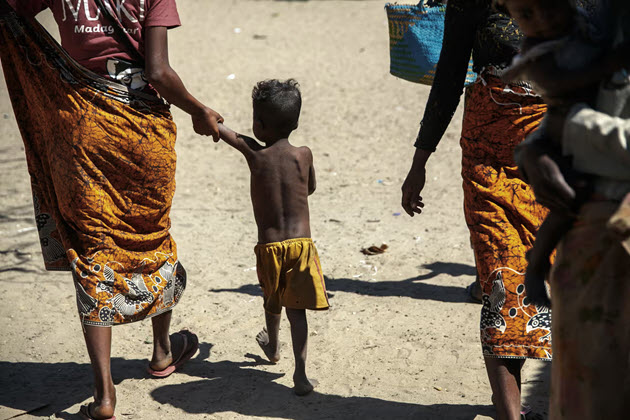
People going to a Médecins Sans Frontières (MSF) mobile clinic in Befeno, Madagascar, set up to treat the most serious cases of moderate and severe malnutrition after the 2021 drought. Photograph: RIJASOLO/AFP/Getty Images

How extreme events are reported – where the media focus their attention – doesn’t just influence the responsive measures we think possible. It also influences who we see as responsible for implementing the next necessary steps. Describing extreme weather as a singular moment that tells us something about climate change, and nothing more, conceals the factors that have just as much (if not more) impact on the weather’s effects, and provides politicians with a handy discussion framework as they try to divert attention from poor local decision-making and planning.

There are two main reasons infrastructure in both Madagascar and Nigeria is so lacking and often nonexistent: the sustained destruction of local social structures under European colonial rule and extreme inequality within the population – inequality between the genders, between rich and poor, between different ethnic groups. It is because of factors like these that climate change becomes such a life-threatening problem.

The main thing I have learned from extreme weather events is that the climate crisis is shaped largely by inequality and the still-undisputed dominance of patriarchal and colonial structures, which also prevent the serious pursuit of climate protection. By contrast, physical changes such as heavier rainfall and drier soil have only an indirect effect. In short, climate change is a symptom of this global crisis of inequality and injustice, not its cause.

Weather-related disasters are largely a matter of unfairness and injustice, not misfortune or fate. This applies at a local level, for example when patriarchal structures insist that pregnant women living in traditional societies have to work outdoors in extreme heat because working in the fields for personal consumption is “women’s work”. Or when financial aid is paid to the male head of the family and never reaches those responsible for putting food on the table.

But injustice is also apparent on a global scale. Climate science is a field dominated by white men, most with backgrounds in the natural sciences, who mainly conduct and lead studies focused on the physical aspects of the climate while disregarding numerous other issues. This is why far too few studies deal with the global interactions between social and physical changes in an evolving climate.

It’s no wonder that we lack credible research findings that could inform us about the issues of loss and damage in global climate policy on a scientific basis. This makes it even more difficult to show how centuries of colonial practices by the global north against the countries of the global south continue to influence the way we live, think and act.

It’s hardly news that climate change is mainly a problem because it damages people’s dignity and fundamental human rights. In fact, it’s the whole reason we talk about it on an international level.

The United Nations climate change conferences have never been about polar bears or the downfall of the human race. They have always been about human lives and countless livelihoods – and, of course, about economic issues. This is demonstrated by the debate on the target of limiting heating to 2C above preindustrial levels.

While this includes economic cost-benefit considerations, it is above all a political goal that doesn’t take science into account at all: not a single scientific assessment has ever defended or recommended a specific target – and with good reason, because setting such targets is ultimately an ethical issue. It can be expressed as a simple political question: how many more human lives, how many more coral reefs, how many more insects will we allow ourselves to lose to the short-term continued use of comparatively cheap fossil fuels in the global north?

Heatwaves in North America and west Africa, droughts in South Africa and Madagascar, forest fires in Australia and Brazil, floods in Germany and Pakistan: these fundamentally different events hit societies that are battling very different problems, and they all demonstrate the role of climate change in different ways.

A swimming pool surrounded by flood waters in Essen, western Germany on 26 December 2023. Photograph: Ina Fassbender/AFP/Getty Images
But it always proves true that the people who die are those with little money who can’t readily obtain all the help and information they need. And that doesn’t have to be the case, no matter where they are.

In my opinion, the fact this keeps on happening is due to one particular, and persistent, social narrative. The basic premise is that burning fossil fuels is essential to maintaining what we call prosperity, and that “freedom” isn’t possible if we’re imposing a speed limit.

If we compared modern society with the society of 300 years ago, we would unquestioningly attribute many of the achievements of recent centuries – like access to clean drinking water – to the burning of fossil energies. Historically, we associate coal, oil, and gas with democracy and western values, identifying a causal link between charcoal briquettes and the welfare state: the one affects the other. But even when this is actually true, we always forget to point out that the reverse conclusion – one perishes, and the other goes with it – is as fatal as it is false.

The global north and global south both continue to argue that, for reasons of fairness, the countries in the global south must initially have very high greenhouse gas emissions too, to ensure the growth of their economies. This completely ignores the fact that in the global north (as well as elsewhere), the poor pay for the lifestyles of a small number of wealthy people, be it the workers who toil in the mines for metals or the city dwellers subjected to greater air pollution due to the use of private vehicles. Who says that what happens in the global north is naturally better and must be imposed on the world?

Climate change would still have existed if Europe hadn’t conquered any colonies but humans had still burned fossil energy sources – but things would have looked very different without the west’s ongoing colonial mindset. In essence, colonial-fossil climate change is therefore not a climate crisis but a crisis of justice.

Climate change is a problem that has less to do with a collapsing climate or other physical conditions than we might think, and the consequences of this are wider-reaching than we have been willing to admit. It clearly shows us that the main way in which we currently research and fight climate change – as a physics problem – falls far too short. Obviously, we need to transform the way in which we obtain energy. Above all, however, we need to transform participation in social life and the application of political and economic power – who makes decisions and how.

This is an edited extract from Climate Injustice by Friederike Otto,
which will be published by Greystone Books on 24 April (£22)
 
     Climate Change Books

Lethal Heating is a citizens' initiative