13/09/2015

This Artificial "Leaf" Can Produce Fuels From Carbon Dioxide And Sunlight

IFLScience

photo credit: Stock image via Mopic/Shutterstock.
Researchers say they have developed an artificial "leaf” that can produce fuels such as methane and gasoline from carbon dioxide. The team claimed it is a major step towards using fuels made renewably from sunlight for everything from heating our homes to running cars, without emitting any greenhouse gases.
The breakthrough, published in the Proceedings of the National Academy of Sciences, was led by Peidong Yang and his team at the Kavli Energy NanoSciences Institute at the University of California, Berkeley. It builds on the natural process of photosynthesis, where water and carbon dioxide are turned into sugar – organic fuel – by plants. By tweaking the process, via synthetic photosynthesis, it could be possible to create a whole host of different products.
To demonstrate this is possible, the team were able to make their system produce methane, rather than sugar, from carbon dioxide. Their equipment used a combination of semiconducting nanowires and bacteria to work. Using inorganic catalysts, water was split into hydrogen, which was then used by living cells to convert carbon dioxide into chemical products – in this case, methane.
"We're good at generating electrons from light efficiently, but chemical synthesis always limited our systems in the past,” said Yang in a discussion on the breakthrough. “One purpose of this experiment was to show we could integrate bacterial catalysts with semiconductor technology. This lets us understand and optimize a truly synthetic photosynthesis system.”
A similar system devised by Yang and his team earlier this year produced butanol, a component of gasoline, and various biochemical building blocks. Next, they will attempt to make an entirely synthetic system, without the need for bacteria, that builds on designs in nature to replicate the process of photosynthesis, and ultimately produce liquid fuels that can last months or years.
"This is not about mimicking nature directly or literally," said Ted Sargent, the vice-dean of research for the Faculty of Applied Science and Engineering at the University of Toronto, in the discussion. "Instead, it is about learning nature's guidelines, its rules on how to make a compellingly efficient and selective catalyst, and then using these insights to create better-engineered solutions."
So, you won’t be using artificial leaves to power your home or car just yet. But this could be a significant step in that direction.

12/09/2015

Pacific Leaders Respond To Australian Minister's Sea Level Remarks

The Guardian

Scott Morrison, Tony Abbott and Peter Dutton’s conversation is picked up by a nearby microphone.

Pacific leaders have hit out at the insensitivity of an Australian minister’s apparent joke at the expense of low-lying nations struggling against rising sea levels.
Immigration minister, Peter Dutton, was caught on a microphone chatting with Australian prime minister, Tony Abbott, and social services minister, Scott Morrison, while waiting for a community roundtable to begin on Friday in Canberra.

Dutton implied that meetings at the recent Pacific Islands Forum in Papua New Guinea had also begun late because: “Time doesn’t mean anything when you’re about to be, you know, have water lapping at your door.”

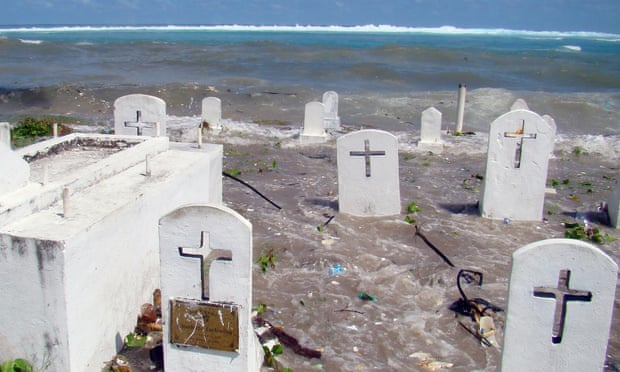
A photo taken in December 2008 shows a cemetery on the shoreline in Majuro Atoll being flooded from high tides and ocean surges in the low-lying Marshall Islands. Photograph: Giff Johnson/AFP/Getty Images
Abbott laughed at the comment, until Morrison pointed out that there was a live microphone hovering above their heads.
Marshall Islands foreign minister, Tony de Brum, who has been a high profile advocate for stronger action on climate change in the UN climate process, expressed his offence on Twitter:
Anote Tong, the president of Kiribati, described the joke as vulgar. “What kind of a person is he?” he asked the ABC. “As long as there is this kind of attitude, this kind of arrogance in any position of leadership, we will continue to have a lot of tension.”
Gary Juffa, the governer of the Papua New Guinea province of Oro, focused on the Australian prime minister’s reaction:


Over the past decade, climate change and rising sea levels have begun to strangle life in low-lying Pacific island countries. In De Brum and Tong’s atoll nations people are already struggling with regular inundations, more severe droughts and displaced people.

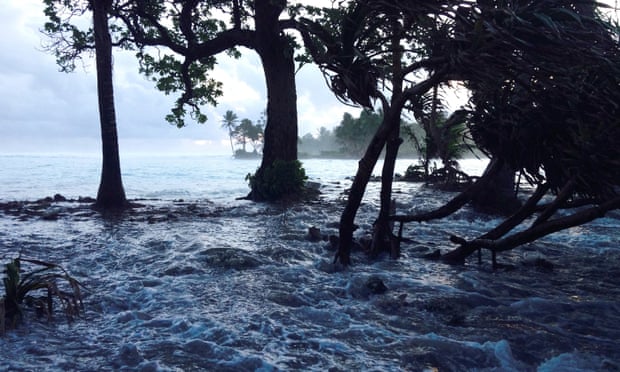
Storm surges washing across Ejit Island in Majuro Atoll, Marshall Islands, in early 2014. Photograph: Giff Johnson/AFP/Getty Images

De Brum has consistently said that even if the upcoming Paris climate talks keep the atmosphere within the (increasingly unlikely) target of a 2C temperature rise on pre-industrial levels, that his islands may become uninhabitable. He and other island leaders have said climate science gives them little chance in a world that warms more than 1.5C.


The furore broke out just hours after the Australian prime minister rejected a plea from Pacific countries to ramp up its carbon reduction targets, which observers called “pathetically inadequate” when they were released in August.
Earlier, Tong told the ABC that Australia’s refusal to consider scaling up its ambitions was disappointing.
“I would really have loved to go back and say yes, we had support, solid support from all of the Pacific neighbours including our developed neighbours. How does it feel? I’ve learned to live with the disappointments,” he said.
It is not the first time De Brum has used strong language to attack Australia. Earlier in the year he said the country had “jerked around” the Marshall Islands by cutting its foreign aid budget.
A traditional owner on Cape York, Gerhardt Pearson, also responded angrily to the comments, calling his views “soft bigotry” and saying they hark back to mission days of the last century.
“We are constantly burdened with the view espoused by the likes of Dutton: it’s one of soft bigotry and low expectations, and it continues to dominate policy responses,” Pearson said.

Pacific Island Leaders Fail To Agree On Climate Change Target

Sydney Morning Herald

Rising sea levels are a significant threat to places such as Kiribati. Photo: Justin McManus

Pacific leaders have failed to come to a common position on climate change after nine hours of tense talks at the Pacific Island Forum.
A final communique has accepted that Australia and New Zealand will not back the push by smaller island states for the rise in global temperatures to be limited to 1.5 degrees.
Kiribati President Anote Tong said the communique recognised that those "on the front line" of global warming were facing a serious problem and were in a "very different" position to Australia and New Zealand.

Tony Abbott, pictured with other leaders at the forum. Photo: Andrew Meares

"It's not the best outcome that we would have liked, but we have to respect that," Mr Tong said.
In a concession to the smaller island states, the forum agreed they could approach the Paris climate summit in December with their own proposal to limit the increase in average global temperatures.
New Zealand PM John Key said his country and Australia stood by the 2-degree target agreed at Lima but added: "There is an agreement that we as Pacific countries accept that, for low-lying states, they are particularly vulnerable and they would seek an even more ambitious target in Paris."
Australian Prime Minister Tony Abbott stressed after the meeting that neither his country nor New Zealand had made any new commitments on climate change.
"As you know, Australia and New Zealand have already announced very ambitious targets for emissions reduction to take to the Paris conference," Mr Abbott said. "I was very pleased to explain to the forum today what Australia is doing, just how ambitious we are being."
Mr Abbott entered the talks confident he could reassure those who say their survival is threatened without a stronger commitment to reduce carbon emissions.
"I think I have got a very good story to tell on climate change, to tell the Pacific Islands Forum," the Prime Minister said before entering a day-long meeting with 15 Pacific island leaders.
Led by Mr Tong, several of the leaders warned that anything short of a commitment to limit the average global temperature rise to 1.5 per cent would represent a betrayal of their people.
"We expect them as bigger brothers, not bad brothers, to support us on this one because our future depends on it," Mr Tong said earlier this week of Australia and New Zealand.
He raised the prospect of smaller states leaving the forum or Australia and New Zealand being asked to do so, though Papua New Guinea Prime Minister Peter O'Neill played down this prospect.
After the talks, Mr Tong expressed satisfaction that the smaller island states would be able to argue their case in Paris.
"I I am very happy that we will be able to come away with a position that we are not totally disagreeing."
Fijian Prime Minister Frank Bainimarama boycotted the forum, citing "the refusal of Australia and New Zealand to step back and allow the Pacific island nations to determine their own futures free from outside interference".
"We have significant differences with Australia over its policies on climate change, in particular, that are clearly not in the interests of the Pacific Small Island Developing States," he said in a letter to Mr O'Neill.
Fairfax Media has seen successive drafts of the leader's declaration where a reference to a 1.5 degree commitment is removed. The final draft will be released after the leaders' retreat.
"There is an internationally agreed target, the Lima target [of 2 degrees], and Australia supports that," Mr Abbott said.
Australia has pledged to reduce emissions by 26-28 per cent by 2030, which Mr Abbott says will be, on a per capita basis, the largest reduction in the world.
"Unlike some other countries which make these pledges and don't deliver, Australia does deliver when we make a pledge."
Economist Frank Jotzo from the Australian National University has said this claim can be backed up based on reductions between 2005 and 2030, although Australia would remain the highest per capita emitter in the developed world.
Meanwhile, Mr Abbott claimed progress on another front, with Mr O'Neill agreeing to consider "some possible mechanisms" for Australian police in PNG to have an operational role.
"The important thing, I think, is to embed Australian police in the PNG police," Mr Abbott said.
"At the moment our police are advisers rather than participants in policing here in PNG and what we need to come up with is an arrangement which makes them participants, not mere bystanders to actual operational policing in PNG."
He was hopeful of "some progress in next few weeks and months".

11/09/2015

Southern Ocean Acidification Increases: Report

ABC News - Jane Ryan
Photo: The Aurora Australis taking carbon measurements from the Southern Ocean near the Mertz Glacier. (Supplied: G. Cresswell, CSIRO)

The Southern Ocean has surprised scientists by increasing its capacity to absorb carbon dioxide emissions, but they are warning it could come at a cost to marine life.
About a quarter of the world's carbon emissions are absorbed into the ocean each year, with 40 per cent of that going into the Southern Ocean.
Ten years ago the ocean's ability to absorb CO2 began to decline, meaning emissions were instead being absorbed into the atmosphere.
A report published in the journal Science today shows the Southern Ocean carbon reservoir, or "sink", has since increased, but scientists warn it will lead to further ocean acidification.
CSIRO and Antarctic Climate and Ecosystems CRC scientist Bronte Tilbrook, who collaborated with scientists from America and Europe on the research, said the sink had increased again by about 0.6 billion tonnes of carbon per year — about six times Australia's emissions.
"What it's shown is while the sink did weaken in the 1990s, it looks like it's coming back since about 2002," he said.
"So it's returning to the levels that we expect, which is a big relief."
"It means that the Southern Ocean is continuing to take up large amounts of carbon dioxide, but there is a concern there's a lot more variability than we understood.
"So it's not clear that that sink will continue, it could revert back to lower values, we just don't know."
Dr Tilbrook said the changes in the sink are believed to be caused by changes in the weather.
"Wind and weather patterns around the Antarctic are having a big impact on the variability of the sink," he said.
"Predictions now are that there's a big El Nino coming so it's really important for us to understand how the Southern Ocean sink is changing."
He warned of growing levels of acidification caused when carbon dioxide dissolves in salt water.
"The changes we expect to see in ocean acidification in this century are likely to be bigger than anything these marine organisms have seen in the ocean for the last 20 million years," he said.
"We're changing the system really dramatically.
"The problem with ocean acidification is that a lot of the organisms in the Southern Ocean, and even in tropical systems including coral reefs, are going to have trouble growing shells and skeletal material.
"They're taking energy from normal life processes like growing and defending themselves against viruses and diseases to growing their shells and skeleton."
Dr Tilbrook said ocean acidification also affects the metabolic and physiological processes inside organisms including development, growth, reproduction and respiration.
"What we're doing is putting stress on parts of the ecosystem that will have flow-on effects that we don't really understand," he said.
"It's a major concern for the future of marine ecosystems."

Links

10/09/2015

Australia's Climate Change

Fairfax

As Fairfax reported, new research by the ARC Centre of Climate System Science shows how days of heat extreme heat since 2000 now outnumber cold ones by a ratio of 12 to one.
Taking the past 15 years as a single period, almost all of the country has had above-average to highest-on-record temperatures compared with any other 15-year stretch, according to the Bureau of Meteorology.


The rainfall over the 2000-14 period helps to explain why much of the Northern Territory missed out on the warmer temperatures.
As shown below, the middle third of Australia - where relatively few people live - has been wetter than most other rolling 15-year periods.


The extra moisture means more evaporative cooling, and hence the milder temperatures over parts of the interior, one climatologist said.
Perhaps of more impact has been the record-low rainfall along the western edge of the country, which is also showing up in a sharp drop in water run-off into reservoirs in that region.
Similarly of note is the relatively dry period for most of Victoria and Tasmania. It's a trend that continues to play out in 2015, with parts of western Victoria experiencing their driest 12 months on record.

Climate Change Deniers Ignore Basic Scientific Facts

BUSINESS INSIDER


About 97% of scientists agree not only that climate change is real, but also that human activity, like driving a fossil fuel-burning car, is making it worse.
That agreement stems from nearly 4,000 studies that suggest humans are culpable, compared to only about 80 that say we have nothing to do with the problem.
Those numbers should leave us pretty confident that humans are indeed fuelling climate change. However, you could argue there’s a (really) small chance those 2% of studies actually have it right.
So, a team of seven climate scientists and meteorologists decided to give climate contrarians the benefit of the doubt, picked half of their more popular studies, and tried to redo them. (The hallmark of a good scientific paper is that it’s reproducible, meaning another scientist can do the same experiment and get the same or similar results.)
What happened? Beyond being unable to replicate most of the results, the team discovered major flaws in the papers. In fact, many papers left out essential data, and some even ignored basic physics.
Dana Nuccitelli, one of the scientists who helped analyse the climate denier papers for the journal Theoretical and Applied Climatology, summed up what his team found in a blog post for The Guardian.
Below are the three biggest, most common problems Nuccitelli and the team found with the small minority of studies that dispute human involvement in climate change.

Climate change deniers cherry-pick the data
Nuccitelli and his colleagues examined 38 widely referenced papers that dispute human involvement in climate change. The team learned that these papers often ignored critical background information or left out big sets of climate data.
In one example, the authors of a 2011 paper tried to show the lunar and solar cycle are responsible for climate change, but they ignored 6,000 years’ worth of data that didn’t jibe with their idea. Nuccitelli summed up the issues well in his post for The Guardian:
When we tried to reproduce their model of the lunar and solar influence on the climate, we found that the model only simulated their temperature data reasonably accurately for the 4,000-year period they considered. However, for the 6,000 years’ worth of earlier data they threw out, their model couldn’t reproduce the temperature changes. The authors argued that their model could be used to forecast future climate changes, but there’s no reason to trust a model forecast if it can’t accurately reproduce the past.
That 2011 study wasn’t alone. Cherry-picking or downright manipulating data to get a desired result — no evidence of human-caused climate change — was the most common flaw among the climate denier papers examined by the team.

Climate change deniers ignore basic scientific facts
While most papers misconstrued or left out data, some simply ignored core scientific facts.
handful of papers blamed climate change on the orbits of Jupiter and Saturn, but the researchers didn’t offer any explanation for how that would be possible in the first place.
Other studies argued the greenhouse gases that fuel climate change, including carbon dioxide, don’t drive global warming much beyond a particular saturation point — which would let humans off the hook for adding more and more to the atmosphere. However, that idea wasdisproved as far back as the early 1900s.

Climate change deniers can’t agree on an alternative theory
While 97% of experts agree that humans are worsening climate change, the other 3% couldn’t settle on an alternative explanation. Here’s Nuccitelli again:
[T]he 2 — 3% of papers that reject that consensus are all over the map, even contradicting each other. The one thing they seem to have in common is methodological flaws like cherry picking, curve fitting, ignoring inconvenient data, and disregarding known physics.
The researchers say science is constantly evolving and changing, so no area of research is ever really “finished.” However, science is based on evidence. Enough evidence leads to a theory, and a theory survives when it is tested over and over again and the evidence continues to support it. Then the scientific community comes to a consensus on that theory.
That’s how 97% of experts came to agree on the theory that climate change is fuelled by human activity, a conclusion that’s been over a century in the making.
And right now there is no compelling evidence and no clear theory for an alternative to human-caused climate change, Nuccitelli concludes in his blog post.

09/09/2015

Report: Australia's Record 'Poor' on Combating Climate Change

Fairfax - Lucy Cormack

Poor report card: Australia's record on combating climate change and carbon emissions is unsatisfactory, report says.

One Australian produces more than three times the amount of carbon dioxide produced by individuals in leading industrialised countries on average, a report into the readiness of the world's richest countries to combat climate change has found.
The Sustainable Development Goals: Are the rich countries ready?report revealed that most OECD (Organisation for Economic Co-operation and Development) countries are a long way off reaching United Nations development goals, with Australia 18th out of the 34 OECD nations.
It said that while Australia falls somewhere in the middle of industrialised countries when it comes to environmental sustainability, its record on combating climate change and carbon emissions is poor.

Messages in support of action to combat climate change are projected onto the side of the UN building in New York, ahead of the international summit that begins this month.
Messages in support of action to combat climate change are projected onto the side of the UN building in New York, ahead of the international summit that begins this month. Photo: AP
"It's shocking but it's expected. We are, along with Canada, the world's pariah with international climate policy at the moment and this is something the report finds," said Dr Donna Green, senior researcher at the Climate Change Research Centre, University of New South Wales.
"It's a result of our dysfunctional climate policies. We're currently hemorrhaging jobs, not only in the renewables sector, also in the mining sector. It's really a very serious situation."
However Dr Green said, one way to look at it is to be optimistic that it "feels almost like we're seeing the last death throes of an increasingly desperate fossil fuel industry".

'We're currently hemorrhaging jobs, not only in the renewables sector, also in the mining sector. It's really a very serious situation:' Dr Donna Green.
"We're currently hemorrhaging jobs, not only in the renewables sector, also in the mining sector. It's really a very serious situation:" Dr Donna Green. Photo: Paul Jones 

In his forward for the report, former secretary-general of the United Nations Kofi Annan said the new Sustainable Development Goals would be a universal set of goals for all countries, including the rich nations of this world.
"High-income nations must become leading examples of truly sustainable development. The Sustainable Development Goals should be workable and understandable by people so they can ask governments to act," he said.
"Civil society must be able to put pressure on governments to hold them to account for what they pledge at the UN summit."

Former secretary-general of the United Nations Kofi Annan said the new Sustainable Development Goals would be a universal set of goals for all countries.


The report has been released ahead of the United Nations Global Sustainable Summit this month, and measures the preparedness of OECD nations for the imposition of the UN's new sustainability development goals for 2030.
Sweden, Norway, Denmark, Finland and Switzerland are the best performing countries, the report says.
Mexico is the lowest ranked nation, followed by Turkey, Hungary, Chile and Greece.
On both greenhouse gas and carbon dioxide emissions, Australia ranked 33rd out of the 34 and it has the OECD's highest rates of domestic materials consumption, at 47 tonnes a person.
Australia came in 30th in the OECD for domestic municipal waste output (647 kilograms a person) and on its efforts to combat climate change.
It was not all bad news for Australia, which was among the top-ranked nations for average life expectancy in full health (73 years), household space (2.4 rooms a person), clean air and the safety, resilience and sustainability of its cities and towns.
It also scored in the top five for sustainable use of its ocean and marine resources, even though 15 per cent of its fish stocks are over-exploited.
Despite some of the damning results in the report, Dr Green said she does not expect it to garner any great response from the Australian government, ahead of December's 21st Conference of Parties to the United Nations Framework Convention on Climate Change.
"I would say it probably washes over them. They've already decided what they're taking to Paris. What they are taking to Paris is exactly the same level as what we see in this report," she said.
"This just reconfirms everything we've always known. It's unfortunate it's reconfirmed it in such an iron-clad way that we're at the bottom of the heap, in terms of climate policy. The frustration is it's not we don't know there are ways to get out of this, we're choosing not to take them."
The report was prepared by the Bertelsmann Foundation, the non-profit foundation established by German media corporation Bertelsmann.
It came one day before Wednesday's announcement that Australia will get up to 10 new large solar power stations as part of an unprecedented $350 million tie-up between the Australian Renewable Energy Agency and the Clean Energy Finance Corporation, who will collaborate to offer, respectively, grants and loans to get major solar projects off the ground to feed into the energy grid.

Lethal Heating is a citizens' initiative