PBS NewsHour - Video
When weather events like El Niño impose themselves, everybody on the
planet feels it. Scientists are getting better at predicting El Niño,
but there is still a lot they don't know amid an absence of data.
This has been a stronger season than usual for the weather pattern
known as El Nino, a phenomenon that affects weather all around the
planet.
Scientists and forecasters have repeatedly warned about its impact
this year. But they still want to find out more about it to better gauge
what it might do.
Link

09/04/2016

Earth Is Tipping Because of Climate Change
Scientific American - Shannon Hall
Melting ice and shifting rain patterns are causing the north and south poles to drift
The north pole is on the run. Although it can drift as much as 10 meters across a century, sometimes returning to near its origin, it has recently taken a sharp turn to the east. Climate change is the likely culprit, yet scientists are debating how much melting ice or changing rain patterns affect the pole’s wanderlust.
The geographical poles—the north and south tips of the axis that the Earth spins around—wobble over time due to small variations in the sun’s and moon’s pulls, and potentially to motion in Earth’s core and mantle. But changes on the planet’s surface can alter the poles, too. They wobble with every season as the distribution of snow and rain change, and over long stretches as well. Roughly 10,000 years ago, for example, Earth woke up from a deep freeze and the massive ice sheets sitting atop what is now Canada melted. As ice mass fled, and the depressed crust rebounded, the distribution of the planet’s mass changed and the north pole started to drift west. This pattern can be clearly seen in data from 1899 onward. But a recent zigzag in the north pole’s path (and the opposite movement in the south pole) suggests a new change is afoot.
Around 2000 the pole took an eastward turn; it stopped drifting toward Hudson Bay, Canada, and started drifting along the Greenwich meridian in the direction of London. In 2013Jianli Chen, a geophysicist at The University of Texas at Austin, was the first to attribute the sudden change to accelerated melting of the Greenland Ice Sheet. The result startled his team. “If you're losing enough mass to change the orientation of the Earth—that's a lot of mass,” says John Ries, Chen’s colleague at U.T. Austin. The team found that recent accelerated ice loss and associated sea level rise accounted for more than 90 percent of the latest polar shift. Of course that includes ice lost across the world, but “Greenland is the lion's share of the mass loss,” Ries says. “That's what's causing the pole to change its nature.”
Melting ice and shifting rain patterns are causing the north and south poles to drift
 |
| Christopher Michel/Flickr, CC BY 2.0 |
The north pole is on the run. Although it can drift as much as 10 meters across a century, sometimes returning to near its origin, it has recently taken a sharp turn to the east. Climate change is the likely culprit, yet scientists are debating how much melting ice or changing rain patterns affect the pole’s wanderlust.
The geographical poles—the north and south tips of the axis that the Earth spins around—wobble over time due to small variations in the sun’s and moon’s pulls, and potentially to motion in Earth’s core and mantle. But changes on the planet’s surface can alter the poles, too. They wobble with every season as the distribution of snow and rain change, and over long stretches as well. Roughly 10,000 years ago, for example, Earth woke up from a deep freeze and the massive ice sheets sitting atop what is now Canada melted. As ice mass fled, and the depressed crust rebounded, the distribution of the planet’s mass changed and the north pole started to drift west. This pattern can be clearly seen in data from 1899 onward. But a recent zigzag in the north pole’s path (and the opposite movement in the south pole) suggests a new change is afoot.
Around 2000 the pole took an eastward turn; it stopped drifting toward Hudson Bay, Canada, and started drifting along the Greenwich meridian in the direction of London. In 2013Jianli Chen, a geophysicist at The University of Texas at Austin, was the first to attribute the sudden change to accelerated melting of the Greenland Ice Sheet. The result startled his team. “If you're losing enough mass to change the orientation of the Earth—that's a lot of mass,” says John Ries, Chen’s colleague at U.T. Austin. The team found that recent accelerated ice loss and associated sea level rise accounted for more than 90 percent of the latest polar shift. Of course that includes ice lost across the world, but “Greenland is the lion's share of the mass loss,” Ries says. “That's what's causing the pole to change its nature.”
 |
| Credit: NASA/JPL-Caltech |
Could such a dramatic shift be so simple? In a new study published today in Science Advances,
Surendra Adhikari and Erik Ivins, two geophysicists from NASA Jet
Propulsion Laboratory, think another mechanism might be at play: changes
in the amount of water held within the continents. Like Chen’s team,
Adhikari and Ivins compared data collected by NASA’s Gravity Recovery and Climate Experiment
(GRACE) satellite, which measures changes in Earth’s gravitational
field, with Global Positioning System (GPS) measurements of the north
and south poles. But Adhikari and Ivins have a couple extra years of
data. They also incorporated small-scale features within the GRACE data
set that are more directly related to terrestrial water storage.
Although the predominant cause of the pole’s shift still turned out to be Greenland, a recent dry spell that has overrun Eurasia is also driving the pole toward the east, Ivans says. With less rainfall on a continent over time, it starts to shed some bulkAdhikari and Ivins think the sudden shift could be the latest in a series of decadal changes in drift that scientists have been unable to explain. Eurasia, which was quite lush 10 years ago, is not the only continent to experience a drought. “We think this flip is happening all the time,” Ivins says. “It’s a natural phenomenon that characterizes the entire Earth rotation time-series going all the way back to 1899.”
The data do not indicate whether the recent climate changes are man-made, but Chen personally believes the drastic shift in the pole has to be the result of human activities. Meanwhile Ivins thinks he will be able to tease man-made climate change from the data in another six months or so. Given that polar motion and climate variability seem to be inextricably linked, scientists can look at historical records of the pole’s motion (which date back to well before the advent of GPS and the GRACE satellite) and see changes in Earth’s climate. If those changes are less dramatic than the ones we see today, Ivins says, then scientists could say that global warming has a controlling influence on Earth’s poles.
Although the predominant cause of the pole’s shift still turned out to be Greenland, a recent dry spell that has overrun Eurasia is also driving the pole toward the east, Ivans says. With less rainfall on a continent over time, it starts to shed some bulkAdhikari and Ivins think the sudden shift could be the latest in a series of decadal changes in drift that scientists have been unable to explain. Eurasia, which was quite lush 10 years ago, is not the only continent to experience a drought. “We think this flip is happening all the time,” Ivins says. “It’s a natural phenomenon that characterizes the entire Earth rotation time-series going all the way back to 1899.”
The data do not indicate whether the recent climate changes are man-made, but Chen personally believes the drastic shift in the pole has to be the result of human activities. Meanwhile Ivins thinks he will be able to tease man-made climate change from the data in another six months or so. Given that polar motion and climate variability seem to be inextricably linked, scientists can look at historical records of the pole’s motion (which date back to well before the advent of GPS and the GRACE satellite) and see changes in Earth’s climate. If those changes are less dramatic than the ones we see today, Ivins says, then scientists could say that global warming has a controlling influence on Earth’s poles.
08/04/2016
China Set To Surpass Its Climate Targets As Renewables Soar
New Scientist
"The latest figures confirm China's record-breaking shift toward renewable energy, away from coal"
CHINA is surging ahead in its switch to renewables and away from coal
– a move it claims will allow the nation to surpass its carbon
emissions targets.
The country's solar and wind energy capacity soared last year by 74 and 34 per cent respectively compared with 2014, according to figures issued by China's National Bureau of Statistics this week.
Meanwhile, its consumption of coal dropped by 3.7 per cent, with imports down by a substantial 30 per cent.
The figures back up claims made last month by Xie Zhenhua, China's lead negotiator at the UN climate talks in Paris last December, that the country will "far surpass" its 2020 target to reduce carbon emissions per unit of national wealth (GDP) by 40 to 45 per cent from 2005 levels.
"The latest figures confirm China's record-breaking shift toward renewable power and away from coal," says Tim Buckley of the Institute for Energy Economics and Financial Analysis, an energy consultancy in Cleveland, Ohio.
"It's a really positive signal, a perfect example of an emerging economy trying to shift the way it develops," says Ranping Song of the World Resources Institute think tank in Washington DC. China is due to issue its next five-year economic plan this month. "So it's a perfect time to see how serious they are about tackling emissions," Song says.
"The latest figures confirm China's record-breaking shift toward renewable energy, away from coal"
 |
| China's future: who needs coal? Xu Yu/Xinhua Press/Corbis |
The country's solar and wind energy capacity soared last year by 74 and 34 per cent respectively compared with 2014, according to figures issued by China's National Bureau of Statistics this week.
Meanwhile, its consumption of coal dropped by 3.7 per cent, with imports down by a substantial 30 per cent.
The figures back up claims made last month by Xie Zhenhua, China's lead negotiator at the UN climate talks in Paris last December, that the country will "far surpass" its 2020 target to reduce carbon emissions per unit of national wealth (GDP) by 40 to 45 per cent from 2005 levels.
"The latest figures confirm China's record-breaking shift toward renewable power and away from coal," says Tim Buckley of the Institute for Energy Economics and Financial Analysis, an energy consultancy in Cleveland, Ohio.
"It's a really positive signal, a perfect example of an emerging economy trying to shift the way it develops," says Ranping Song of the World Resources Institute think tank in Washington DC. China is due to issue its next five-year economic plan this month. "So it's a perfect time to see how serious they are about tackling emissions," Song says.
Global Warming May Be Far Worse Than Thought, Cloud Analysis Suggests
The Guardian - Oliver Milman
Researchers find clouds contain more liquid – as opposed to ice – than was previously believed, threatening greater increase in temperatures
Climate change
projections have vastly underestimated the role that clouds play,
meaning future warming could be far worse than is currently projected,
according to new research.
Researchers said that a doubling of carbon dioxide in the Earth’s atmosphere compared with pre-industrial times could result in a global temperature increase of up to 5.3C – far warmer than the 4.6C older models predict.
The analysis of satellite data, led by Yale University, found that clouds have much more liquid in them, rather than ice, than has been assumed until now. Clouds with ice crystals reflect more solar light than those with liquid in them, stopping it reaching and heating the Earth’s surface.
The underestimation of the current level of liquid droplets in clouds means that models showing future warming are misguided, says the paper, published in Science. It also found that fewer clouds will change to a heat-reflecting state in the future – due to CO2 increases – than previously thought, meaning that warming estimates will have to be raised.
Such higher levels of warming would make it much more difficult for countries to keep the global temperature rise to below 2C, as they agreed to do at the landmark Paris climate summit last year, to avoid dangerous extreme weather and negative effects on food security. The world has already warmed by 1C since the advent of heavy industry, driven by CO2 concentrations soaring by more than 40%.
A lack of data and continuing uncertainty over the role of clouds is to blame for the confusion about warming estimates, said Ivy Tan, a graduate student at Yale who worked on the research with academics from Yale and the Lawrence Livermore National Laboratory.
“Models have been systematically underestimating the amount of liquid in clouds, meaning that we aren’t fully appreciating the feedback,” she said. “It could mean our higher limit of warming is now even higher, depending on the model, which means serious consequences for us in terms of climate change.
“This is one of the largest uncertainties left in climate change. We need to understand these feedbacks a lot better.”
Scientists have been trying to get to grips with the extent clouds and water vapor will influence the warming already under way. A paper published last year found that short-term fluctuations in clouds have large impacts on the net rate of heat gain by the Earth.
One of this paper’s authors, Dr Kevin Trenberth, senior scientist at the National Center for Atmospheric Research, said research has already shown “major errors in climate simulations associated with clouds”.
Trenberth said there is “some art” to working out the role of clouds, given their annual cycles and distribution, with uncertainty over whether climate sensitivity is significantly changed.
“I think the paper is fine as a first step but it is not the last step, and much more is needed to establish how clouds change as the climate changes,” Trenberth said of the Yale study.
Links
Researchers find clouds contain more liquid – as opposed to ice – than was previously believed, threatening greater increase in temperatures
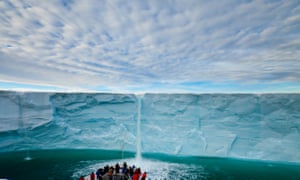 |
| Under a blanket of clouds, tourists watch a meltwater waterfall on an icecap. Photograph: Ralph Lee Hopkins/National Geographic Society/Corbis |
Researchers said that a doubling of carbon dioxide in the Earth’s atmosphere compared with pre-industrial times could result in a global temperature increase of up to 5.3C – far warmer than the 4.6C older models predict.
The analysis of satellite data, led by Yale University, found that clouds have much more liquid in them, rather than ice, than has been assumed until now. Clouds with ice crystals reflect more solar light than those with liquid in them, stopping it reaching and heating the Earth’s surface.
The underestimation of the current level of liquid droplets in clouds means that models showing future warming are misguided, says the paper, published in Science. It also found that fewer clouds will change to a heat-reflecting state in the future – due to CO2 increases – than previously thought, meaning that warming estimates will have to be raised.
Such higher levels of warming would make it much more difficult for countries to keep the global temperature rise to below 2C, as they agreed to do at the landmark Paris climate summit last year, to avoid dangerous extreme weather and negative effects on food security. The world has already warmed by 1C since the advent of heavy industry, driven by CO2 concentrations soaring by more than 40%.
A lack of data and continuing uncertainty over the role of clouds is to blame for the confusion about warming estimates, said Ivy Tan, a graduate student at Yale who worked on the research with academics from Yale and the Lawrence Livermore National Laboratory.
“Models have been systematically underestimating the amount of liquid in clouds, meaning that we aren’t fully appreciating the feedback,” she said. “It could mean our higher limit of warming is now even higher, depending on the model, which means serious consequences for us in terms of climate change.
“This is one of the largest uncertainties left in climate change. We need to understand these feedbacks a lot better.”
Scientists have been trying to get to grips with the extent clouds and water vapor will influence the warming already under way. A paper published last year found that short-term fluctuations in clouds have large impacts on the net rate of heat gain by the Earth.
One of this paper’s authors, Dr Kevin Trenberth, senior scientist at the National Center for Atmospheric Research, said research has already shown “major errors in climate simulations associated with clouds”.
Trenberth said there is “some art” to working out the role of clouds, given their annual cycles and distribution, with uncertainty over whether climate sensitivity is significantly changed.
“I think the paper is fine as a first step but it is not the last step, and much more is needed to establish how clouds change as the climate changes,” Trenberth said of the Yale study.
Links
- Massive carbon capture investment 'needed to slow global warming'
- Fossil fuel use must fall twice as fast as thought to contain global warming - study
- Leaked IPCC climate plan to worsen global warming - ecologists
- Global warming predictions prove accurate
- Black carbon causes twice as much global warming than previously thought
- Study suggests rising CO2 in the past caused global warming
- Global warming: Bleaker and bleaker
- Are humans definitely causing global warming?
Barrier Reef Coral Bleaching Labelled 'Major And Significant' As Attenborough Warns Of 'Grave Danger'
ABC News - Stephanie Smail | Kerrin Binnie
'Twin perils threaten its very existence'
Coral bleaching on the Great Barrier Reef is "major and significant", federal Environment Minister Greg Hunt says.
Mr Hunt was commenting after he received his latest
briefing from the Reef 2050 Independent Expert Panel about the current
bleaching.
The Minister's latest remarks come as prominent naturalist Sir David Attenborough declared the reef to be in "grave danger".
"The event is still unfolding and the full extent and severity of bleaching may take several weeks to manifest," Mr Hunt said.
He said the most severe bleaching had been observed between Cape York and Cooktown on the far northern part of the reef.
It has increased between Cooktown and Tully with moderate to severe bleaching listed.
"If major disturbances such as bleaching events occur more regularly, this will affect the reef's ability to recover," Mr Hunt said.
Coral bleaching occurs due to increases in water temperature.
Bleaching can kill or stunt the recovery of the coral.
Sir David Attenborough says the Great Barrier Reef could be gone within decades. (ABC News)
In a documentary being aired on the ABC this weekend, Sir David said while the reef had proven itself to be resilient, it was in "grave danger".
"The twin perils brought by climate change, an increase in the temperature of the ocean and in its acidity threaten its very existence," Sir David said.
"Do we really care so little about the Earth on which we live that we don't wish to protect one of its greatest wonders from the consequences of our behaviour."
The Great Barrier Reef Marine Park Authority is expected to release an update on the state of the reef in coming days.
Australian Institute of Marine Science chief executive John Gunn said while there had been bleaching across the northern reef, there has been some growth elsewhere.
"In the south, we've seen an almost doubling in the amount of coral that we last saw in 2012," Mr Gunn said.
"From a really low base, it's the worst conditions for the reef previously but it has rebounded quite excitingly.
"The centre of the reef has rebounded as well."
But Mr Gunn said coral cover had dropped across northern sections of the reef.
"Largely we can see this is the result, as in 2012, of storms, bleaching and crown of thorns that are the primary killers of the Great Barrier Reef," he said.
Part one of David Attenborough's Great Barrier Reef can be seen from 7:40pm this Sunday on ABC TV.
Links
'Twin perils threaten its very existence'
 |
| Sir David Attenborough says the Great Barrier Reef faces twin perils from climate change. (Supplied) |
Coral bleaching on the Great Barrier Reef is "major and significant", federal Environment Minister Greg Hunt says.
Key points:
|
The Minister's latest remarks come as prominent naturalist Sir David Attenborough declared the reef to be in "grave danger".
"The event is still unfolding and the full extent and severity of bleaching may take several weeks to manifest," Mr Hunt said.
He said the most severe bleaching had been observed between Cape York and Cooktown on the far northern part of the reef.
It has increased between Cooktown and Tully with moderate to severe bleaching listed.
"If major disturbances such as bleaching events occur more regularly, this will affect the reef's ability to recover," Mr Hunt said.
Coral bleaching occurs due to increases in water temperature.
Bleaching can kill or stunt the recovery of the coral.
Sir David Attenborough says the Great Barrier Reef could be gone within decades. (ABC News)
In a documentary being aired on the ABC this weekend, Sir David said while the reef had proven itself to be resilient, it was in "grave danger".
"The twin perils brought by climate change, an increase in the temperature of the ocean and in its acidity threaten its very existence," Sir David said.
"Do we really care so little about the Earth on which we live that we don't wish to protect one of its greatest wonders from the consequences of our behaviour."
The Great Barrier Reef Marine Park Authority is expected to release an update on the state of the reef in coming days.
Australian Institute of Marine Science chief executive John Gunn said while there had been bleaching across the northern reef, there has been some growth elsewhere.
"In the south, we've seen an almost doubling in the amount of coral that we last saw in 2012," Mr Gunn said.
"From a really low base, it's the worst conditions for the reef previously but it has rebounded quite excitingly.
"The centre of the reef has rebounded as well."
But Mr Gunn said coral cover had dropped across northern sections of the reef.
"Largely we can see this is the result, as in 2012, of storms, bleaching and crown of thorns that are the primary killers of the Great Barrier Reef," he said.
Part one of David Attenborough's Great Barrier Reef can be seen from 7:40pm this Sunday on ABC TV.
Links
07/04/2016
7-Year-Old Files Climate Change Lawsuit with the Supreme Court of Pakistan
EcoWatch
A 7-year-old girl, Rabab Ali, through her father and pro bono environmental attorney Qazi Ali Athar, and on behalf of all the Pakistani people, filed a climate change lawsuit Tuesday against the Federation of Pakistan and the Province of Sindh in the Supreme Court of Pakistan.
The Constitution Petition asserts that, through the exploitation and continued promotion of fossil fuels, in particular dirty coal, the Pakistan and Sindh governments have violated the Public Trust Doctrine and the youngest generation's fundamental constitutional rights to life, liberty, property, human dignity, information and equal protection of the law.
"The protection of these inalienable and fundamental rights is
essential if we are to have any chance of leaving our children and
future generations with a stable climate system and environment capable
of sustaining human life," said Qazi Ali Athar, public interest
environmental attorney representing his daughter as youth petitioner in
the case.
"Pakistan is rich in renewable energy resources such as solar and wind, more than enough to meet the energy needs of current and future generations of Pakistanis.
Yet the federal and provincial governments of Pakistan, along with the vested interests in the country and the region, are exploiting Pakistan's most environmentally degrading and carbon intensive fuels—low-grade coal from the Thar Coal Reserves—in violation of the Pakistani people's constitutionally protected fundamental rights."
The petition details how the Pakistan government has acknowledged the particular vulnerability of Pakistanis to the effects of climate change, including the increasing frequency and severity of extreme weather events such as heat waves, droughts, flooding and cyclones.
The government has also recognized, in the National Climate Change Policy (NCCP) and the Framework for Implementation of Climate Change Policy (Framework), Pakistan's "role as a responsible member of the global community in combating climate change … giving due importance to mitigation efforts."
And in Pakistan's Intended Nationally Determined Contribution (INDC) submitted in December 2015 prior to the climate talks in Paris, the government admitted, "Potential for mitigation exists in all sectors of [Pakistan's] economy" and made the commitment that "Pakistan will promote and support low-carbon, climate resilient development."
Yet, completely antithetical to these statements and in violation of the fundamental rights of the people of Pakistan, the government, in its own climate change policy documents and Pakistan's INDC, promotes and plans for a significant increase in Pakistan's CO2 emissions through the exploitation of large untapped low-grade coal reserves.
Ali hopes that by bringing this petition, her government will start doing its share "as a responsible member of the global community" in reducing atmospheric CO2 and achieving global climate stabilization and that the Supreme Court will order the government to develop and implement science-based mitigation actions, tiered to achieving such a goal, as part of the NCCP, Framework and INDC.
The petition includes the prescription for achieving global climate stabilization from the renowned climate scientist, Dr. James Hansen, which says that to restore a stable climate system, the dangerous levels of CO2 currently in our atmosphere must be reduced to below the maximum safe level—350 ppm atmospheric CO2—by the year 2100.
"Last year, to celebrate 'World Earth Day,' I pledged allegiance to the Earth and to the flora, fauna and human life that it supports, with safe air, water and soil, economic justice, equal rights and peace for all," said Youth Petitioner Ali.
"I want my government to take a similar pledge, by creating a plan that will allow me and future generations a safe environment to grow up in."
Youth global legal action
"Youth are rising up globally and taking their governments to court to seek protection of their inalienable rights to a stable climate system," said Julia Olson, executive director for the nonprofit organization Our Children's Trust and lead counsel on a climate lawsuit brought by 21 young people against the U.S. government.
"This case filed today in Pakistan builds on similar cases brought by young people in Uganda, Ukraine and the U.S. Our Children's Trust is working in partnership with young people around the world to elevate their voices and provide them with legal and scientific support, including youth who are mobilizing in India, Canada, France, England, Australia and elsewhere. This youth legal movement is growing."
"This bold action is indeed evidence of a global movement of citizens demanding science-based climate action from their governments, which the Paris agreement did not achieve," said Roger Cox, attorney for URGENDA who recently secured a court order in the Netherlands ordering the Dutch government to decrease emissions.
"Like the court found in our Dutch case, governments have a duty to safeguard the climate for present and future generations.
"Valuable legal precedents are being set that will hopefully become an avalanche of successful climate change court cases against governments worldwide.
"In the absence of sufficient political action to tackle the climate crisis, courts have the authority and the constitutional duty to prevent and protect society from climate change related damages, casualties and infringements of fundamental rights and civil liberties.
"What courts do in these cases will have implications for the rest of the world and for the degree of climate change we will all face in the years to come."
Links
A 7-year-old girl, Rabab Ali, through her father and pro bono environmental attorney Qazi Ali Athar, and on behalf of all the Pakistani people, filed a climate change lawsuit Tuesday against the Federation of Pakistan and the Province of Sindh in the Supreme Court of Pakistan.
The Constitution Petition asserts that, through the exploitation and continued promotion of fossil fuels, in particular dirty coal, the Pakistan and Sindh governments have violated the Public Trust Doctrine and the youngest generation's fundamental constitutional rights to life, liberty, property, human dignity, information and equal protection of the law.
 |
"Pakistan is rich in renewable energy resources such as solar and wind, more than enough to meet the energy needs of current and future generations of Pakistanis.
Yet the federal and provincial governments of Pakistan, along with the vested interests in the country and the region, are exploiting Pakistan's most environmentally degrading and carbon intensive fuels—low-grade coal from the Thar Coal Reserves—in violation of the Pakistani people's constitutionally protected fundamental rights."
The petition details how the Pakistan government has acknowledged the particular vulnerability of Pakistanis to the effects of climate change, including the increasing frequency and severity of extreme weather events such as heat waves, droughts, flooding and cyclones.
The government has also recognized, in the National Climate Change Policy (NCCP) and the Framework for Implementation of Climate Change Policy (Framework), Pakistan's "role as a responsible member of the global community in combating climate change … giving due importance to mitigation efforts."
And in Pakistan's Intended Nationally Determined Contribution (INDC) submitted in December 2015 prior to the climate talks in Paris, the government admitted, "Potential for mitigation exists in all sectors of [Pakistan's] economy" and made the commitment that "Pakistan will promote and support low-carbon, climate resilient development."
Yet, completely antithetical to these statements and in violation of the fundamental rights of the people of Pakistan, the government, in its own climate change policy documents and Pakistan's INDC, promotes and plans for a significant increase in Pakistan's CO2 emissions through the exploitation of large untapped low-grade coal reserves.
Ali hopes that by bringing this petition, her government will start doing its share "as a responsible member of the global community" in reducing atmospheric CO2 and achieving global climate stabilization and that the Supreme Court will order the government to develop and implement science-based mitigation actions, tiered to achieving such a goal, as part of the NCCP, Framework and INDC.
The petition includes the prescription for achieving global climate stabilization from the renowned climate scientist, Dr. James Hansen, which says that to restore a stable climate system, the dangerous levels of CO2 currently in our atmosphere must be reduced to below the maximum safe level—350 ppm atmospheric CO2—by the year 2100.
"Last year, to celebrate 'World Earth Day,' I pledged allegiance to the Earth and to the flora, fauna and human life that it supports, with safe air, water and soil, economic justice, equal rights and peace for all," said Youth Petitioner Ali.
"I want my government to take a similar pledge, by creating a plan that will allow me and future generations a safe environment to grow up in."
Youth global legal action
"Youth are rising up globally and taking their governments to court to seek protection of their inalienable rights to a stable climate system," said Julia Olson, executive director for the nonprofit organization Our Children's Trust and lead counsel on a climate lawsuit brought by 21 young people against the U.S. government.
"This case filed today in Pakistan builds on similar cases brought by young people in Uganda, Ukraine and the U.S. Our Children's Trust is working in partnership with young people around the world to elevate their voices and provide them with legal and scientific support, including youth who are mobilizing in India, Canada, France, England, Australia and elsewhere. This youth legal movement is growing."
"This bold action is indeed evidence of a global movement of citizens demanding science-based climate action from their governments, which the Paris agreement did not achieve," said Roger Cox, attorney for URGENDA who recently secured a court order in the Netherlands ordering the Dutch government to decrease emissions.
"Like the court found in our Dutch case, governments have a duty to safeguard the climate for present and future generations.
"Valuable legal precedents are being set that will hopefully become an avalanche of successful climate change court cases against governments worldwide.
"In the absence of sufficient political action to tackle the climate crisis, courts have the authority and the constitutional duty to prevent and protect society from climate change related damages, casualties and infringements of fundamental rights and civil liberties.
"What courts do in these cases will have implications for the rest of the world and for the degree of climate change we will all face in the years to come."
Links
Record Patch Of Warm Waters Point To More Global Heat Records Being Smashed
Fairfax - Peter Hannam
From hot oceans to shrinking Arctic ice and glaciers, the evidence of a warming planet has gone into overdrive in the first three months of 2016.
Sydney on Wednesday posted its hottest April day on record, with the 34.2-degree reading beating a mark that had stood for 30 years. Suburbs from Camden in the south-west to Richmond in the north-west topped 36 degrees.
Australia has also just posted its hottest March in more than a century of reliable data after a scorching heatwave to start the month that the Bureau of Meteorology said in some areas approached "record levels for any time of the year".
NSW blew away records that had stood since 1940 and Victoria
eclipsed the previous hottest March for mean temperatures, set in in
1974.
US climatologists are among the first to call March as being the
hottest on record, globally, with a 0.63-degree departure from the norm
for the 1981-2010 period, using preliminary data that will firm up in
the next fortnight or so.
Others, including Alaskan climatologist Brian Brettschneider, have been reworking official data to come up with other signals of the unprecedented warmth.
Dr Brettschneider said he used the "go-to bible of sea surface temperatures" compiled by the US National Oceanic and Atmospheric Administration (NOAA) to show almost one-tenth of the world's ocean surfaces were at least 30 degrees as of the end of March - a breadth of heat not seen previously.
'Human-caused'
For Australian counterparts, the record warmth is attributed to natural events such as the monster El Nino event now winding down in the Pacific but also a "substantial" contribution from "human-caused" climate change, scientists from the Bureau of Meteorology said this week in an article for The Conversation.
They noted that waters around Australia during summer were the hottest in records going back to the 1950s.
David Jones, a senior climate scientist at the bureau, said the background warming, a lack of rain and weakened winds across northern Australia had contributed to the significantly higher sea-surface temperatures around the nation.
"We've emphatically broken the sea-surface temperature record for March which was set just last year," Dr Jones told Fairfax Media.
Among the changes under way is the East Australian Current
that brings warm waters from the tropics down the east coast, which
has extended further south, part of a longer-term shift.
"This current is ... getting stronger, transporting larger volumes of water southward over time," the bureau scientists said. "This is due to the southward movement of high pressure systems towards the [South] Pole."
Those relatively warm waters have also triggered the coral bleaching now at record levels in the Great Barrier Reef, with the unusual sustained warmth causing the stressed corals to expel the tiny marine algae that gives them the colour and energy to grow.
The bureau chart below shows highest sea-surface temperatures on record now plague many of the areas with reefs around the world.
And there is no let-up soon.
"Surface temperatures over the entire Indian Ocean and coastal Australian waters will very likely continue to remain well above average for the next few months," the bureau scientists said.
"There are currently signs that surface currents are moving warm El Nino waters from the eastern Pacific over to the western Pacific, towards Australia."
'Crazy winter'
NOAA's National Snow and Ice Data Centre last month declared the Arctic's sea ice set a record low area for a second year in a row.
Almost all regions in the planet's far north were 2-6 degrees above average for the first two months of the year, with total sea ice reaching an average 14.52 million square kilometres at its peak on March 24.
"I've never seen such a warm, crazy winter in the Arctic," Mark Serreze, NSIDC's director said in a report carried on its website. "The heat was relentless."
Both 2014 and now 2015 were the hottest years on record and 2016 has started considerably warmer than both.
As NOAA's chart (see below) of warmest years shows that the bulk of the Earth's surface has had its hottest years on record since 2000 - with much of that since 2011.
Australia's famously variable climate means some long-standing records are hard to break.
Still, last month beat the record set in 1986 and seven of the warmest periods for each month have come since 2000.
"At the seasonal time scale, where natural climate variability gets smoothed out a bit, the warm extremes are more concentrated at the later end of the period," Blair Trewin, the bureau's senior climatologist, said.
"Winter, in 1996, is the earliest, with the others all occurring in the last 12 years - autumn 2005, summer 2012-13, and spring 2014," he said.
Links
From hot oceans to shrinking Arctic ice and glaciers, the evidence of a warming planet has gone into overdrive in the first three months of 2016.
Sydney on Wednesday posted its hottest April day on record, with the 34.2-degree reading beating a mark that had stood for 30 years. Suburbs from Camden in the south-west to Richmond in the north-west topped 36 degrees.
Australia has also just posted its hottest March in more than a century of reliable data after a scorching heatwave to start the month that the Bureau of Meteorology said in some areas approached "record levels for any time of the year".
 |
| The planet hasn't been this hot since reliable records began about 130 years ago. Photo: Jeff Williams, International Space Station, via Twitter |
Others, including Alaskan climatologist Brian Brettschneider, have been reworking official data to come up with other signals of the unprecedented warmth.
Dr Brettschneider said he used the "go-to bible of sea surface temperatures" compiled by the US National Oceanic and Atmospheric Administration (NOAA) to show almost one-tenth of the world's ocean surfaces were at least 30 degrees as of the end of March - a breadth of heat not seen previously.
 |
For Australian counterparts, the record warmth is attributed to natural events such as the monster El Nino event now winding down in the Pacific but also a "substantial" contribution from "human-caused" climate change, scientists from the Bureau of Meteorology said this week in an article for The Conversation.
They noted that waters around Australia during summer were the hottest in records going back to the 1950s.
David Jones, a senior climate scientist at the bureau, said the background warming, a lack of rain and weakened winds across northern Australia had contributed to the significantly higher sea-surface temperatures around the nation.
"We've emphatically broken the sea-surface temperature record for March which was set just last year," Dr Jones told Fairfax Media.
 |
"This current is ... getting stronger, transporting larger volumes of water southward over time," the bureau scientists said. "This is due to the southward movement of high pressure systems towards the [South] Pole."
Those relatively warm waters have also triggered the coral bleaching now at record levels in the Great Barrier Reef, with the unusual sustained warmth causing the stressed corals to expel the tiny marine algae that gives them the colour and energy to grow.
The bureau chart below shows highest sea-surface temperatures on record now plague many of the areas with reefs around the world.
 |
"Surface temperatures over the entire Indian Ocean and coastal Australian waters will very likely continue to remain well above average for the next few months," the bureau scientists said.
"There are currently signs that surface currents are moving warm El Nino waters from the eastern Pacific over to the western Pacific, towards Australia."
'Crazy winter'
NOAA's National Snow and Ice Data Centre last month declared the Arctic's sea ice set a record low area for a second year in a row.
Almost all regions in the planet's far north were 2-6 degrees above average for the first two months of the year, with total sea ice reaching an average 14.52 million square kilometres at its peak on March 24.
"I've never seen such a warm, crazy winter in the Arctic," Mark Serreze, NSIDC's director said in a report carried on its website. "The heat was relentless."
Both 2014 and now 2015 were the hottest years on record and 2016 has started considerably warmer than both.
As NOAA's chart (see below) of warmest years shows that the bulk of the Earth's surface has had its hottest years on record since 2000 - with much of that since 2011.
 |
Still, last month beat the record set in 1986 and seven of the warmest periods for each month have come since 2000.
"At the seasonal time scale, where natural climate variability gets smoothed out a bit, the warm extremes are more concentrated at the later end of the period," Blair Trewin, the bureau's senior climatologist, said.
"Winter, in 1996, is the earliest, with the others all occurring in the last 12 years - autumn 2005, summer 2012-13, and spring 2014," he said.
Links
- CSIRO cuts: Union claims jobs cut swells to 450 as formal complaints lodged
- No 'science for science sake': emails show CSIRO plans to cut climate research
- Bureau of Meteorology plan to take over CSIRO climate change research
- Record patch of warm waters point to more global heat records being smashed
- Great Barrier Reef coral bleaching more widespread than first thought, surveys reveal
- Humanity's impact on Earth opens Anthropocene epoch, scientists say
Subscribe to:
Posts
(
Atom
)