16/04/2016

Climate Change: Website Reveals Which Homes Will Be Swamped By Rising Sea Levels

The Guardian

Coastal Risk Australia combines Google Maps with detailed tide and elevation data, as well as future sea level rise projections

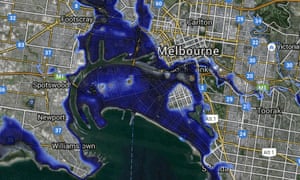
A visualisation of Melbourne in 2100 under a five-metre sea level rise scenario
A visualisation of Melbourne in 2100 under a five-metre sea level rise scenario. Photograph: Coastal Risk Australia
For the first time, Australians can see on a map how rising sea levels will affect their house just by typing their address into a website. And they'll soon be able to get an estimate of how much climate change will affect their property prices and insurance premiums, too.
Launched on Friday, the website Coastal Risk Australia takes Google Maps and combines it with detailed tide and elevation data, as well as future sea level rise projections, allowing users to see whether their house or suburb will be inundated.
Coinciding with that is the launch of a beta version of Climate Valuation, a website that gives users an estimate of how much climate change will impact their property value and insurance premiums over the life of their mortgage.
Coastal Risk Australia uses median sea level rises projected for 2100 by the Intergovernmental Panel on Climate Change under low, medium and high greenhouse gas emissions scenarios.
On the high emissions scenario – which is the path the world is currently on – the IPCC says sea levels will likely rise by a median of 0.74m by 2100. But a rise of almost 1m is within the "likely" range of levels that could be reached by 2100.
In every state and territory except the ACT, the website shows that houses and famous landmarks will be underwater by 2100. Beaches like Manly, Byron and Coogee in New South Wales would lose significant amounts of sand, as will Bell's Beach in Victoria and Noosa in Queensland.
Many coastal suburbs and cities are shown to be subject to severe inundation, including Cairns, Ballina and Hindmarsh Island.
James Hansen, a former Nasa scientist who is considered the father of modern climate change awareness, recently produced research suggesting that sea levels could rise "several metres over a timescale of 50 to 150 years".
The website also lets users see how any sea-level rise will affect an area. If sea levels rose 5m, then large parts of most coastal cities would be inundated, according to the website's calculations.
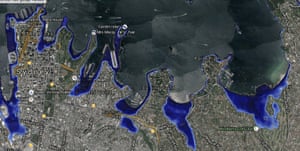
A visualisation of Sydney's eastern suburbs in 2100, under the five-metre sea level rise scenario
A visualisation of Sydney's eastern suburbs in 2100, under the five-metre sea level rise scenario. Photograph: Coastal Risk Australia
"We don't want to create hysteria but we don't want people burying their heads in the sand ether," said Nathan Eaton, one of the creators of the website from the company NGIS Australia.
The tool was adapted from work NGIS did when it created a similar tool for the Pacific Island nations of Tonga, Samoa, Vanuatu and Papua New Guinea, in collaboration with the Australian Department of Environment and the Collaborative Research Centre for Spatial Information.
Climate Valuation, also launched on Friday, will, for a fee, tell users the probability of a property being flooded by rising sea levels; the projected increases in insurance premium from coastal inundation risk; and the projected percentage reduction in value of the property at the end of a mortgage.
It is being launched for use by researchers initially and will soon be available as part of a Kickstarter campaign, which the developers say will raise money to include more climate change-associated risks like bushfires and river flooding. People who pledge to contribute will get early access to it.
The developers say the site uses risk engines that are already used to assess billions of dollars of critical infrastructure in Australia and the new site will give the general public access to that data for the first time.
"We're hoping this helps people make informed decisions about their safety and on what is often the most significant investment they will ever make – their home," said Karl Mallon, head of the Climate Valuation Project.

Links

Carbon Price Needed To Avoid Economic Disruption From Paris Climate Goals – Analysis

The Guardian - Lenore Taylor

Climate Institute says regulations to phase out coal-fired generators and subsidies to encourage clean energy are needed
The Climate Institute says whichever party wins government will need to impose some form of relatively low carbon price. Photograph: Carla Gottgens/Bloomberg via Getty Images

Australia faces significant economic disruption in 2030 to meet the Paris climate goals unless action is quickly taken, according to a new analysis.
The analysis, for the Climate Institute, recommends implementing a carbon price and regulations to phase out coal-fired generators, and additional subsidies to encourage clean energy investment.
The analysis finds that whichever party wins government will need to impose some form of relatively low carbon price, as well as regulations and subsidies to force a change to clean electricity generation.
A "modest" carbon price of about $17/tonne in 2020, rising to $40/tonne in 2030, would come close to meeting the Turnbull government's target of reducing emissions by 26% to 28% of 2005 levels by 2030. However, it would do almost nothing to shift to clean electricity generation.
There would need to be a huge disruption in the market and economic activity in 2030 to suddenly accelerate emission reductions enough to reach the Paris goal of zero net emissions by mid century.
In order to reach that goal using a carbon price alone, the price would need to start at $70/tonne and rise to $100/tonne, which, the report concludes, is politically unlikely.
If coal-fired generators were also phased out after a 45-year lifespan and some kind of subsidy offered – like the current renewable energy target to achieve 50% zero emissions generation by 2030 – then the necessary emission reductions could be achieved without a sudden economic shock. Adding energy efficiency policies to the mix would significantly lower the impact on power prices.
Labor has promised an emissions trading scheme as part of the climate policy it will take to an election but will not announce the details. It is expected to hold a post-election inquiry into the electricity industry and the phase-out of coal-fired generators if it wins office.
The Coalition will review its Direct Action climate policy next year and there is a widespread expectation in the business sector that it will have to tighten the baselines on its so-called safeguards mechanism in a way that could eventually turn it into a baseline and credit-style emissions trading scheme.
The report argues that these reviews are critical because if changes aren't made now, it becomes almost impossible to reach net zero emissions by mid century – as is necessary to meet the global goal of keeping temperature rises within 2C.
"The next 18 months are pivotal to our climate and energy future, whoever wins the election," said the Climate Institute's executive director, John Connor.
"Our research shows that a policy package that actively supports both clean energy investment and the orderly replacement of our ageing coal-fired power stations can better manage a timely transition to a cleaner energy supply.
"A baseline and credit, or emissions trading scheme alone, will not be strong or reliable enough to drive the change."
The report found retail power prices would gradually rise between 2020 and 2030 under the recommended scenarios but there is a high degree of uncertainty around the forecasts.
The Climate Institute modelling was commissioned from Jacobs and was part-funded by a cross section of the electricity industry, including GE, AGL and Hydro Tasmania.
The independent Climate Change Authority is undertaking similar modelling for the government.

Links

Climate Change Has Dropped Off The Political Radar (And This Is A Big Problem)

ABC - Mike Steketee*

The aversion to talking about climate change during the election campaign reflects a wider problem: our concern for this issue has fallen even while it has become larger and more urgent.
The crew of the US Coast Guard Cutter Healy retrieves supplies in the Arctic Ocean
The so-called pause in global warming was no more than a temporary slowdown in the rate of temperature increase. (Reuters/Kathryn Hansen/NASA)
How much of an issue will climate change be in this year's election?
Not a major one, if Malcolm Turnbull gets his way. He has saddled himself with Tony Abbott's policy as one of the costs of appeasing the conservatives in his ranks.
And while Bill Shorten will be arguing he has a superior policy - but also risking a fear campaign over re-introducing a carbon tax - Labor, too, believes it has bigger fish to fry, such as pushing forward its credentials on education and health.
This reflects a sobering reality: in the last eight years, many Australians' concern over climate change has fallen even while the problem has become larger and more urgent.
The market research company Ipsos has been conducting surveys on the issue since 2007. In that year 54 per cent of people who were presented with a list of issues said climate change was one that needed to be addressed. In the latest report, still to be released, this fell to 38 per cent last year. This is about the same as for the previous two years, although higher than in 2011 and 2012.
Different descriptions on the list for essentially the same issue confirmed the finding, but more strongly. For example, concern about tackling "global warming" fell from 55 per cent to 35 per cent over the eight years. Renewable energy was at the top of the list of issues that needed to be addressed but it also has fallen significantly - from 68 per cent to 51 per cent.
Perhaps people are less concerned because some action has been taken. But if this is true of renewable energy, where the government has set a (reduced) target of 22.5 per cent by 2020 and Labor 50 per cent by 2030, it is hard to argue the same on other issues.
Concern about the need to address rising sea levels has fallen from 29 per cent to 17 per cent over the eight years. Sea levels rose by an estimated global average of 17cm between 1900 and 2005 and according to recent research, nearly 70 per cent of the increase since 1970 was due to human influences - that is, the thermal expansion of the oceans and the melting of glaciers due to burning fossil fuels.
The argument has been that scaring people with stories about bushfires, cyclones and melting glaciers does not work.
We may just be getting started. Though the timing remains uncertain, scientists know that global warming can produce a tipping point at which there are large and irreversible losses of ice, causing sea level rises of metres, not centimetres.
Public concern about climate change in 2007 coincided with the millennium drought and water shortages. It also meant that the Howard government went to the election that year promising an emissions trading scheme, similar to the one that Kevin Rudd undertook to implement as prime minister before getting cold feet and for which Turnbull's support cost him his job as opposition leader.
Howard subsequently sided with Tony Abbott and other conservatives in his party and conceded that it was public pressure that forced his hand in 2007.
That makes the point about our current situation: the message on climate change is not coming through strongly enough to put pressure on the government to adopt a tougher policy.
Often the strategy by interest groups and politicians has been to accentuate the positives, such as a clean energy future and green jobs. The argument has been that scaring people with stories about bushfires, cyclones and melting glaciers does not work.
But it also has meant ceding ground to climate sceptics. They certainly did not worry about selling their message too hard: to the contrary, they thrived on their shrill advocacy to grab attention.
Their success in challenging the overwhelming scientific consensus on the human causes of global warming, as documented by Naomi Oreskes and Erik M. Conway in their 2010 book Merchants of Doubt, was to create uncertainty in the public mind and give the impression of a debate between two more or less equal sides.
The signs now are that attitudes are changing. An Essential poll last month found that 63 per cent of people agreed with the statement that there was fairly conclusive evidence that climate change was happening and was caused by human activity. This was up from 56 per cent in November last year. Those who agreed that we might just be witnessing a normal fluctuation in the earth's climate fell from 32 per cent to 27 per cent.
The signs of a more receptive public provide an opportunity to elevate climate change from a second order issue during the election campaign.
The yet-to-be-published data from Ipsos shows a jump from 27 per cent to 44 last year in the group of so called "active believers" - those with a strong sense of urgency and concern about climate change. Ipsos research director Jennifer Brook says that although the size of the increase surprised her, there are signs of "a general shift to acceptance that climate change is something that is a threat and needs to be tackled".
It is possible that this also could be mainly caused by another El Nino year. But in the longer run it is becoming harder to ignore the accumulating evidence.
February of this year was the 10th consecutive month of record-breaking global temperatures and, at 1.21C above the average for the last century, it was the largest amount above the average for any month on record. Last year was the hottest year recorded globally and 14 of the 15 hottest years have occurred in the last 15 years.
Unusually high sea surface temperatures in the tropics during last summer have contributed to the longest coral bleaching ever seen on the Great Barrier Reef. Arctic sea ice shrunk to its lowest ever area in January and February.
And so on. It is now clear the so-called pause in global warming seized on by climate sceptics was no more than a temporary slowdown in the rate of temperature increase.
Nevertheless there remains considerable ignorance about climate change. When people were presented in the Ipsos survey with a list of possible causes, the largest number - 55 per cent - chose greenhouse gas emissions from industry and burning of fossil fuels. But 32 per cent picked the hole in the ozone layer and 22 per cent rubbish or litter - neither of which are responsible for warming. (Respondents could pick more than one cause).
This drives home the need to push a stronger message. In the words of last year's Ipsos report:
Despite Australians' acknowledgement of the impacts of climate change, there is clearly a need for consistent, clear and simple information about climate change, especially the causes.
The signs of a more receptive public provide an opportunity to elevate climate change from a second order issue during the election campaign.
There have been major progress in recent years to curbing carbon emissions, particularly in China and notably driven at least in part by public concern over smog produced by industry. Global energy-related carbon dioxide emissions have stayed flat for the last two years, according to the International Energy Agency. It adds that renewables accounted for about 90 per cent of new electricity generation last year.
But in Australia emissions from electricity generation have continued growing - by 3 per cent in 2014-15 - and emissions overall have increased by 1.3 per cent.
The Ipsos research shows stronger public support for the Coalition's direct action policy than for the emissions trading scheme advocated by Labor perhaps mainly because the former is easier to understand, even though most experts argue that the latter is more effective.
The Grattan Institute this week proposed a pragmatic solution - building on direct action by gradually reducing emission limits and introducing elements of emissions trading. That offers one way, particularly for Turnbull, to harness public opinion to move forward against recalcitrant in his party.

*Mike Steketee is a freelance journalist. He was formerly a columnist and national affairs editor for The Australian.

15/04/2016

Shut Coal Plants Or Risk Missing Climate Goals And Hurting Clean Power, Says Climate Institute

Fairfax - Tom Arup

The Climate Institute says there must be a plan to shut coal plants or Australia risks missing Paris climate goals. Photo: Arsineh Houspian

Long-term climate change goals will be missed, and clean energy investment will stagnate, if Australia does not start forcing its dirty coal-fired power plants to close, new analysis has found.
Economic modelling commissioned by the Climate Institute also suggests that putting off closure until after 2030 would force the country into more-extreme measures to meet the longer-term goals of the Paris climate agreement.
That could include a hurried closure of more than 80 per cent of existing coal power generation in the five years following 2030, causing significant economic and social disruption, particularly in communities dominated by the industry such as the Latrobe Valley.
A smoother transition could be achieved, the Climate Institute argues, by quickly adopting new laws to progressively phase out all high-emitting power plants in the next 20 years. They would sit alongside a carbon price and incentives for cleaner energy alternatives such as renewable and carbon capture and storage technologies.
Institute chief executive John Connor said the modelling showed a shift to a cleaner electricity supply could be achieved through "a policy package that actively supports both clean energy investment and the orderly replacement of our ageing coal-fired power stations".
Under the Paris climate deal hammered out last year, Australia was among the 195 countries that agreed to keep global warming "well below" an average two degrees increase, aiming for less than 1.5 degrees.
Australia's best chance of achieving that goal would be to cut emissions to effectively zero by 2050, the institute says. To do that,  90 per cent of electricity would need to be generated from clean sources.
The modelling – by energy market consultants Jacobs – found an emissions trading scheme alone would not be enough to drive that power transition unless it had a high carbon price, which could prove politically testing.
A trading scheme with a more modest price could meet Australia's immediate goal of cutting emissions 26 to 28 per cent by 2030, the modelling found.
But it would also mean renewable energy investment stalling through the 2020s and almost no existing coal plants would be replaced, leaving Australia to catch up in the years after 2030 with more-extreme action.
The modelling suggests a combination of a modest carbon price, a limit on a coal plant's life of 45 years and a 50 per cent clean energy target for 2030 would best manage the energy transition required by the Paris goals.
But the modelling also found it would cost about $50 billion more during 30 years than using an emissions trading scheme alone. The Climate Institute argues this should be seen as the price of avoiding the risks associated with delaying the clean energy transition until after 2030.
The federal Coalition government has opposed carbon pricing, and has instead put in place its direct action climate policy. But some observers believe elements of direct action, which place emissions limits on large polluters, can evolve into a trading scheme.
A review of climate policies is slated for 2017.
The Labor opposition has promised to reinstate an emissions trading scheme if elected. It has also pledged to ensure 50 per cent of electricity generation comes from renewable energy by 2030.

Link

Australia 'The Most Outstanding Rogue Nation' On Climate Change: Bill Mckibben


Bill McKibben warns that Australia has become a 'rogue nation', disproportionately contributing to climate change. (Getty Images/ Jason Merritt) 
When it comes to climate change, it's often thought that religion and science don't mix.
But American author Bill McKibben says religious leaders such as Pope Francis, the Dalai Lama, and the so-called 'Green Patriarch' Bartholomew 1- the leader of the Eastern Orthodox Church - are becoming 'a great asset' in galvanising global action on climate change.
McKibben is co-founder of the global climate change movement 350.org and the author of The End of Nature.
In America, he says religion and science have been trumped by political lobbying and cash from the fossil fuel industry.
He warns that Australia has become a 'rogue nation' disproportionately contributing to climate change.

Audio

Hobart
Bill McKibben will delivering the 6th Annual Hobart Oration at the University of Tasmania on April 17 at 3:00 pm. Click here for tickets.

Sydney
Bill McKibben will be speaking at the Paddington Town Hall on April 21 at 6:30 pm. Click here for tickets.

14/04/2016

20 Stunning Illustrations About Climate Change

Archiobjects

These illustrations represent climate change.
Architecture is responsible for about 30% of global production of CO2 if we take into account the entire life cycle of a building from the production of materials, the construction phase, to maintenance and disposal.


Coal Producer Peabody Energy Files For Bankruptcy

The Guardian - Reuters

Firm cannot service debt built up to expand into Australia as coal prices fall
Trains filled with coal leave Peabody’s North Antelope Rochelle Mine in Wyoming. Photograph: Mae Ryan for the Guardian

Peabody Energy, the world’s largest privately owned coal producer, has filed for US bankruptcy protection in the wake of a sharp fall in coal prices that left it unable to service a recent debt-fuelled expansion into Australia.
The company listed both assets and liabilities in the range of $10bn (£7bn) to $50bn, according to a court filing on Wednesday.
Peabody’s chapter 11 bankruptcy filing ranks among the largest in the commodities sector since energy and metals prices began to fall in the middle of 2014 as once fast-growing markets such as China and Brazil began to slow.
Peabody’s debt troubles date back to its $5.1bn leveraged buyout of Australia’s Macarthur in 2011, a coveted asset at the time meant to position it as a supplier of metallurgical coal for Asian steel mills.
But as demand for metallurgical coal fell, particularly in China, Peabody’s financial woes intensified. It made a $700m writedown on its Australian metallurgical coal assets last year.
Producers accounting for about 45% of US coal output have filed for bankruptcy in the current industry downturn, based on 2014 government figures.
“This was a difficult decision, but it is the right path forward for Peabody,” the chief executive, Glenn Kellow, said in a statement. “This process enables us to strengthen liquidity and reduce debt, build upon the significant operational achievements we’ve made in recent years and lay the foundation for long-term stability and success in the future.”
Peabody has secured $800m in debtor-in-possession financing from both secured and unsecured creditors, including a $500m term loan, $200m bonding accommodation facility and a letter of credit worth $100m, the company said in its release.
The case has been filed in the US bankruptcy court for the eastern district of Missouri, St Louis.

Links

Lethal Heating is a citizens' initiative