26/04/2016

$7.7 Billion Fossil Fuel Subsidies ‘Like Being In Bed With Big Tobacco’

New Matilda - 

Federal treasurer Scott Morrison.


Calls for an end to fossil fuel subsidies are growing louder in the lead up to Treasurer Scott Morrison's May 3 budget, with a diverse coalition of advocates demanding an end to the $7.7 billion free ride they claim the fossil fuel industry gets each year.
At a press conference in Canberra this morning academics, religious leaders, renewable energy interests and unionists said it was illogical and counter-productive for the government to continue to subsidise fossil fuels if it's serious about transitioning to clean energy.
"Continuing to fund polluters when we know the damage being done to the environment is unforgivable intergenerational theft," said Luke Stickels, from the Australian Education Union.
"It is grossly foolish and unfair. Developing our nation's future is foremost in the minds of educators in schools across the country, but that future is not secure when the government continues to defy the urgent public desire for strong action on climate change," he said.
In a letter sent late March, a group of more than 50 civil society groups spelled out the savings they believe could be made if the government winds back subsidies to the industries which are fuelling climate change. They urged the government to:
  • End non­agricultural fuel tax credits, boosting the budget by $5.5 billion in 2016­/17
  • End exploration and prospecting deductions for the mining industry ($650m)
  • End statutory effective life caps for the oil and gas sector ($349m)
  • End the concessional rate of excise levied on aviation gasoline and aviation turbine fuel ($1.24b)
  • Confirm that the Northern Australia Infrastructure Facility will not invest in fossil fuel projects or in infrastructure that primarily assists such projects
Emissions Generic (IMAGE: Gerry Machen, Flickr)
IMAGE: Gerry Machen, Flickr.


This morning, former Anglican Church Bishop George Browning reiterated that the government "must stop handing over billions of our dollars to the fossil fuel industry, whose activities are driving dangerous climate change".
"Science and Christianity are on the same page in urging human responsibility in the face of escalating climate change," he said. "The clock is ticking. We cannot sit on our hands any longer."
Treasurer Scott Morrison will hand down his first budget on May 3, with the Prime Minister Malcolm Turnbull excepted to pull the trigger for a July 2 double dissolution election shortly thereafter. Tax reform has been at the top of the national agenda in recent months, but the issue of fossil fuel subsidies has not penetrated the mainstream debate.
At the Paris climate conference late last year, Malcolm Turnbull controversially declined to lend Australia's support to a communique signed by over 40 governments which urged the phase out of inefficient subsidies for coal, oil and gas.
IMAGE: Greenpeace.
IMAGE: Greenpeace.


Australia is the world's largest exporter of coal. As New Matilda reported last week, Greenpeace Australia has crunched the numbers and found that through coal exports alone, Australia will sell off a billion tonnes of carbon this year. Yet the government is working to expand the export coal market, and expects to become the leading seller of liquified natural gas in coming years.
This carbon intensive strategy has drawn an increasingly caustic response. According to the public health Professor Peter Brooks, from the University of Melbourne, Australia's keen alliance with the fossil fuel sector is akin to being in bed with big tobacco.
"Given that the largest contribution to this warming is the use of fossil fuels, don't you think they should come with a health warning much like cigarettes? Our government must stop pumping billions of dollars of our money into this damaging sector," Professor Brooks said.
IMAGE: Chuck Coker, Flickr.


The community has more mixed views, going off a ReachTEL poll from April 12. It found that only 48 per cent of the 2,664 Australians surveyed believe that the claimed $7.7 billion in fossil fuel subsidies is too much, while a minority of 8.5 per cent of respondents believed $7.7 billion was 'too little' a subsidy.
A quarter of respondents said the hand-out was 'about right', and 18.5 per cent of the people surveyed said they 'don't know'.
But the poll also contained troubling results for the government. The ReachTEL poll found 36.4 per cent of respondents would favour a phase out of fossil fuel subsidies ahead of key issues that have cropped up on the national agenda over recent months as the government hunts for savings measures.
An end to taxpayer handouts for polluting industries proves more popular than hiking the GST, a reduction in tax breaks associated with negative gearing, an increase in taxes on capital gains, and a tightening of tax concessions for supernatants.
Ahead of the Paris climate conference last year, the Federal Government committed to reducing emissions by at least 26 per cent on 2005 levels by the year 2030.

Links

We Already Know 2016 Will Be the Warmest Year on Record—and It’s Only April

Slate - Eric Holthaus

Filming-the-coral-bleaching-at-Lizard-Island3
Coral bleaching at Australia's Lizard Island on the Great Barrier Reef, in March 2016. XL Catlin Seaview Survey


It's now abundantly clear: When it comes to global warming, 2016 is in a class by itself.
On Tuesday, scientists at the National Oceanic and Atmospheric Administration confirmed that March 2016 was not only the warmest March in recorded climate history, it was also the most unusually warm month of any month ever measured, breaking the record set … the month prior.
March was the 11th consecutive month of a new record warm global monthly temperature, the longest streak since NOAA records began in 1880—a horrendous feat that's led to a bit of complacency in climate circles.
We should not be complacent.
Gavin Schmidt, director of NASA's Goddard Institute for Space Studies, calculated that no matter how the rest of the year progresses, there's a greater than 99 percent chance 2016 will be the warmest year on record.
That he's able to say this in April is mind-boggling.
In past record-warm years, we needed to wait until October or November to make predictions with this high of confidence.


Though the current planetary heat wave is likely peaking, it's still rending entire ecosystems and plunging tens of millions of people into food shortages.
On Wednesday, Australian scientists revealed a stark new summary of their comprehensive survey of the Great Barrier Reef: 93 percent of reefs there have experienced bleaching over the past several weeks—which happens when corals become overheated and expel their symbiotic algae, and can quickly lead to coral death.
The imminent death of large parts of the Great Barrier Reef should shock the world.
About 1 billion people depend on coral reefs for their livelihood.
"We've never seen anything like this scale of bleaching before," said Terry Hughes, who led the survey.


The current global boost of heat is linked to El Niño, but experts think El Niño is taking a back seat to human greenhouse gas emissions when it comes to the reasons for the incredible hot streak.
Last month's record warmth touched all ocean basins and all continents, and, together with February—which still ranks as the most unusually warm month in NASA records—the Earth's temperature is going through what amounts to a step change.
The current warm streak is a perfect illustration of what climate scientists have long expected: There are natural oscillations (like the current warming boost from El Niño) overlaid on top of the long-term trend of global warming.
The shift to La Niña, which is expected later this year, will temporarily bend global temperature back down a bit, and likely bring an end to the current streak of record-warm months.
With climate change, not every year will be record warm, but it's quite certain that even if 2017 doesn't top 2016, there'll be a year in the near future that will.
So far, 2016 has been the warmest start to any year on record, with record warm temperatures on every continent and in every ocean basin. NOAA
We've reached a unique moment in the history of humanity's relationship with our home planet: No matter when the current streak ends, the relentlessness with which the global climate system has been breaking records is now unmatched by any moment since industrial civilization began, and likely long before that.
New data show atmospheric carbon dioxide concentrations at Mauna Loa briefly exceeded 409 parts per million on a daily basis around April 10, the highest absolute level in millions of years—and the biggest year-to-year jump on record.
Last month, an analysis by a team of British and American climate scientists showed that the current rate of increase of atmospheric carbon dioxide likely has no equal in Earth's entire history, with current levels rising about 10 times faster than the previous fastest era of increase, about 56 million years ago.
We're locking in change that has no precedent, possibly since long before humans and countless other species first evolved. And it's the rate of change that's the big problem here.
Human activity is profoundly changing the planet in a geologic blink of an eye—which is why scientists are worried that everything from migrating birds to fracturing ice sheets to coastal cities won't have time to adapt.
If climate change were slow—playing out over millennia, as in times past—it wouldn't be much of a problem. Instead, in our world, climate change is happening very, very fast.
As the United Nations' leading climate diplomat said on Tuesday after seeing the latest NOAA data, the most recent record is a "stark reminder that we have no time to lose." This urgency has immediate global political implications.
As the Washington Post's Chris Mooney and Brady Dennis point out, "the Earth itself has upped the stakes for the Paris climate accord," agreed to just four months ago and set to be signed at a ceremony in New York this week.
From the tropics to the Arctic, these past few months have pushed the bounds of "dangerous" change the accord was designed to prevent.
An analysis released Tuesday by Climate Interactive and the Massachusetts Institute of Technology showed that even with the pledges made in Paris, the world is still on track for about 3.5 degrees Celsius of warming—and global leaders would need to agree to substantial further reductions before 2020 to meet the Paris target of keeping global warming "well below" 2 degrees Celsius.
That's a huge ask, but the stability of our climate system requires that it happens.

Links

CSIRO Sets Up Special Climate Centre But Doubts Remain Over Scale Of Cuts

Fairfax - Peter Hannam

The CSIRO will split its climate science into two, creating a special unit based in Hobart but leaving in doubt the future of at least 50 climate researchers.
A new CSIRO Climate Science Centre, foreshadowed by Fairfax Media, will coordinate the work of 40 scientists carved out of existing CSIRO teams, and also tap into work by the Bureau of Meteorology and universities.
However, a separate email sent to staff on Tuesday morning shows the Oceans and Atmosphere division which houses the main climate modelling and monitoring units will still shed about 75 of its 140 staff.
All at sea?: Australia's marine science flagship, RV Investigator. Photo: CSIRO
In the email, chief executive Larry Marshall said the agency's executive had used "feedback" on the planned cuts to lower the total number of jobs to go from across the agency to 275 rather than the original 350.
"To achieve this change, we won't be able to make as many new recruitments in the areas as previously planned," Dr Marshall said."Our goal is still for our staffing numbers to return to the current level, but it will take us longer to achieve."
The staff reductions now planned are in Minerals (about 35), Land and Water (about 70), Agriculture (about 30), Manufacturing (about 45), Oceans and Atmosphere (about 75) and Food & Nutrition (about 20), the email to staff said.
While the CSIRO described the new climate science centre as a "win", the reaction from within was dismissive.
CSIRO boss Larry Marshall hopes the new centre will resolve ongoing concerns about climate science's home within the agency. Photo: Daniel Munoz
"It looks like a con," a senior CSIRO climate researcher told Fairfax Media. "Once again, there was no consultation with staff. The plan is to separate the climate scientists into two lots. What are they planning to do with those left out of the centre?"
CSIRO and the Turnbull government have been under pressure since early February to explain why the science agency was planning to cull as many as 110 of its 140 staff within the Oceans & Atmosphere division.
The cuts, which have been pared back after complaints from partner agencies, were part of a plan by Dr Marshall to shed 350 jobs and re-hire a similar number of two years in areas deemed to be more promising for external revenue.
Environment Minister Greg Hunt said CSIRO was an independent agency but added that the government and Chief Scientist Alan Finkel had to intervene "to help broker" a resolution.
"From what was frankly a difficult situation, we worked to engage with the organisation and, I think, to get the longest, deepest national climate program that Australia has ever had," Mr Hunt told ABC Radio.
Labor's shadow industry minister Kim Carr said the new centre appears to be aimed at heading off another damning senate committee hearing on Wednesday.
Dr Marshall was due to attend, along with three other executives, but chairman David Thodey was also due to make his first appearance. Mr Thodey has asked for his evidence to be made in camera and without accompaniment from CSIRO management, Fairfax Media understands.
"The only thing scientific about the new centre is political science," Senator Carr said. "It's been cobbled together as a means to save marginal seats [in Tasmania]. I call on the government to halt the job cuts to CSIRO pending the election."
Dr Marshall said Tuesday's announcement was "a culmination of the ongoing consultation and feedback we've had from our staff and stakeholders, and this new Centre is a reflection of the strong collaboration and support right across our system and the global community".
The response to the original plan to gut climate science at the agency drew criticism from more than 3000 scientists internationally.
The urgency of understanding how fast the climate is changing has been fuelled by record global heat so far in 2016 as the ebbing giant El Nino event in the Pacific adds to the background warming.

Links

25/04/2016

The Guardian View On The UN Climate Change Treaty: Now For Some Action

The Guardian - Editorial

It was a spectacular signal of global intent on Friday when more than 170 governments signed up to the Paris deal. But it's just the start of a long, hard road 
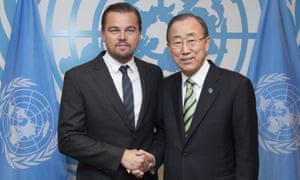
UN secretary-general Ban Ki-moon and actor Leonardo DiCaprio at the UN in New York on 22 April 2016
UN secretary-general Ban Ki-moon and actor Leonardo DiCaprio at the UN in New York on 22 April 2016. 'Now the gap between reality and the ambition of holding global warming below 2C needs addressing.' Photograph: UPI/Barcroft Media


The danger of gala events like the official signing of the climate change treaty at the UN in New York on Friday, crowned with a guest appearance from Leonardo DiCaprio and with 60 heads of state in attendance, is the impression they create that the job is done. It was certainly a spectacular demonstration of global intent to get more than 170 signatures on the deal agreed in Paris in December at the first time of asking; but what matters is making it legally binding. For that, it must be not just signed but ratified by at least 55 countries, and it must cover 55% of emissions. Nor does the Paris deal go far enough. It was only a step on a long, hard road. The targets that each country set themselves do not go nearly far enough. Now the gap between reality and the ambition of holding global warming below 2C needs addressing. In Churchillian rhetoric, this is not the end, nor the beginning of the end, but it is the end of the beginning.
There are powerful reasons to pursue the Paris summit objective. According to the Japan Meteorological Agency, each of the past 11 months was warmer than the 20th-century average. Nasa statistics showed that 2015 was even hotter than the previous record-setting year of 2014. Yet despite the way the evidence is stacking up, political leaders in polluting countries continue to argue about whether and how fast they need to act. In the US, President Barack Obama's climate plan has hit trouble in the supreme court, where the regulation of emissions from coal-fired plants has been blocked. Hillary Clinton, the likely Democratic candidate for the presidency, is pledged to continue Mr Obama's commitment to tackling emissions, but her probable rival, Donald Trump, is certainly not. The US and China are committed to ratifying the climate change treaty, but for others, such as India, it may be more complicated.
In the UK, 10 years after David Cameron hugged that husky, his record is in tatters. Not only has "the green crap" been whittled back by big cuts in subsidies and incentives that have left solar power, onshore and even offshore wind all less attractive, but policies to limit emissions have been repeatedly portrayed as harmful to the economy. High energy costs have been widely blamed for the crisis in British steel. Yet, while it is true that energy prices are higher than elsewhere in Europe – partly because of climate change programmes and partly because of the fragmented nature of the privatised industry largely beyond government control – they are mitigated by compensation. As fact-checkers point out, for steel, actual energy costs amount to around just 1% of total manufacturing costs. The double whammy of an uncompetitive currency and a slump in global demand are the real problems that Tata and other steelmakers are facing. Energy costs get the blame because that's where the government might have real traction.
As divestment lobbies chalk up triumph after triumph, there are signs of parallel trends. In the past few days, Norway's sovereign wealth fund has pulled out of scores of companies for being over-reliant on fossil fuel, and the Rockefeller Foundation has divested from fossil fuel entirely. Yet governments still resist the commitment to greening their economies that will turn the Paris deal from an exercise in global cooperation to a watershed for global warming.

Links

Sir David Attenborough Makes Heartfelt Plea For The Reef

Fairfax - Nathanael Cooper

As news broke that 93 per cent of the coral on the Great Barrier Reef was suffering from some level of bleaching, the ABC was preparing to broadcast the final episode of David Attenborough's ground breaking documentary on the reef.
Ironically, the focus of the final episode is the survival of the reef.


A clip from the ABC TV series, David Attenborough's Great Barrier Reef, a plea to save the Reef.

Episode one focused on the builders on the reef, episode two is about the creatures that visit the reef and episode three focuses on what is likely to happen in the future.
In a rare move, at the conclusion of the episode, Sir David makes an impassioned plea in a moving piece to camera where he speaks of the imminent threat to the reef.
"The Great Barrier Reef is in grave danger," he says.
"The twin perils brought by climate change, an increase in the temperature of the ocean and its acidity, if they continue to rise at the present rate the reefs will be gone within decades and that would be a global catastrophe."
David Attenborough.
David Attenborough. 
He speaks of the ecological result of a disappearing reef but more importantly the moral and ethical problem faced by humans who have brought the problem to the reef.
"There's surely another reason why we should protect the reefs," he says.
David Attenborough with Anthony Geffen.
David Attenborough with Anthony Geffen. 
"They are among the planet's richest, most complex and most beautiful ecosystems.
"Do we really care so little about the earth on which we live that we don't want to protect one of the world's greatest wonders from the consequences of our behaviour?"
David Attenborough with reef tanks.
David Attenborough with reef tanks. 
After three hours of some of the most stunning cinematography exploring the reef and its inhabitants, it is an emotive plea from one of the world's greatest naturalists.
Series producer Anthony Geffen who has worked on 11 of Sir David's documentaries, said Sir David wanted to use the series to make a very personal statement.
Do we really care so little about the earth?
David Attenborough
"He is very concerned about the reef and you can see that in the very personalised piece to camera he does at the end," Geffen says.
"He doesn't do that very often and he devised this end very much as a personal statement, a very powerful personal statement."
David Attenborough's Great Barrier Reef  Photo: James Penlidis
Even the genesis of the award winning team of nature documentary makers coming to Queensland to explore the reef was of Sir David's volition.
"After we finished filming our last documentary, I asked him where he wanted to go next, if there was one place in the world he could film where would it be," Geffen says.
"He didn't miss a beat and said the Great Barrier Reef."
Sir David first visited the reef nearly 60 years ago, filming some of the earliest scenes of people diving the reef. It had a profound impact on his life.
"He told me that out of everywhere he has been, out of everywhere he has made documentaries, the reef is still the most beautiful thing he has ever seen," Geffen says.
"That explains a lot about the beauty of the reef when the world's greatest naturalist gives that opinion."
Sir David, Geffen and their team of filmmakers and scientists are not the first to make a documentary exploring the reef, but they have certainly gone to enormous lengths in theirs.
Using a specialised submersible called the Triton, Sir David was able to film deeper on the reef than anyone has before.
The series has introduced us to fascinating species of fish and crustaceans, sharks and rays and a variety of whales that interacted with the film crew.
But now they explore what the future holds for the jewel in Queensland's crown.
"If you just look at the time between when David last dived there in the 1980s and when he went out for this series, half the reef as he would have known it has disappeared," Geffen says.
"Even if you take that as a parameter that is pretty devastating.
"And as we all know, coral bleaching has been a huge issue recently."
But episode three isn't all doom and gloom.
Using modern technology and innovative scanning techniques, Sir David explores the history of the reef and what it has gone through in the past.
"We were about to look back in time looking at these amazing scans to look at what happened to the reef before," Geffen says.
"We look in the whole context. The last episode isn't just a disaster prediction. It is trying to give people some context in how long it has been around, how it has survived before, etc.
"But it's really important for people to have an understanding of what is happening because it literally is a case that it could be gone in another few decades."
Accompanying the documentary series, there is an interactive website that allows people to explore the reef themselves and gain an understanding of the ecology of the reef system and the threats it faces.
There is also a virtual reality component, currently housed in the Sydney Museum, where people can virtually dive in the Triton with Sir David and explore the reef just like he did.
"We know that not everyone is watching television and we know that young people just don't always have time to sit down and watch TV," Geffen says.
"Hopefully these two elements will give people a different way to engage with the reef and learn about it."
The final episode of David Attenborough's Great Barrier Reef aired on ABC at 7.30pm Sunday night.
The companion website is available at www.attenboroughsreef.com.

Links

CSIRO Eyes Alternative Plan To Climate Job Cuts As Chairman Thodey Faces Inquiry

Fairfax - 

CSIRO's RV Investigator: Light on the horizon for CSIRO's climate research program?
CSIRO's RV Investigator: Light on the horizon for CSIRO's climate research program? Photo: Pete Harmsen

CSIRO is expected to offer an alternative to deep cuts of its climate science program as soon as this week in a bid to defuse criticism as a Senate committee prepares to widen its inquiry to include chairman David Thodey.
Mr Thodey is scheduled to address the committee in Canberra on Wednesday. Unusually, the chairman has asked the session be held in camera and that he not be joined by CSIRO management, Fairfax Media has been told.
Speculation of a resolution was fanned by Environment Minister Greg Hunt last week breaking his silence on the cuts, which originally targeted as many as 110 of the 140 staff in the key Oceans & Atmosphere division.
David Thodey, chairman of the CSIRO, will be questioned by a Senate committee this week.
David Thodey, chairman of the CSIRO, will be questioned by a Senate committee this week. Photo: Peter Braig

"We have sought to broker an outcome that will protect and enhance climate science in Australia," Mr Hunt told ABC's Lateline.
Fairfax Media understands efforts to shift climate modellers and monitoring researchers left remaining after the cuts to the Bureau of Meteorology foundered over a lack of funds. The bureau, whose chief Rob Vertessy​ retires this week, has been struggling to maintain funding of its own for its water programs and demanded CSIRO funds to accompany any staff transfers.
The CSIRO board was not happy with the bureau's proposal either, concerned that the export of top staff for climate research will set a precedent for future dismantling of the agency, according to a senior scientist who declined to be named.
Another Senate commitee grilling to come this week for Larry Marshall CSIRO CEO (right), with his deputy Craig Roy ...
Another Senate commitee grilling to come this week for Larry Marshall CSIRO CEO (right), with his deputy Craig Roy (centre) and chief financial officer Hazel Bennett. Photo: Andrew Meares

Instead, senior CSIRO staff now expect the agency to pare back the planned cuts and offer a "face-saving" alternative of a special climate unit, possibly headquartered in Hobart.
To reassure remaining scientists that they have a future with the organisation, management will introduce a lower revenue target compared with other parts of CSIRO to show its commitment to so-called public good science that does not always attract paying customers.
A dedicated climate unit, supposedly modelled on the UK's world-leading Hadley Centre, was promoted by Chief Scientist Alan Finkel and leading climate scientists as one way to salvage climate capability amid the turmoil.
CSIRO announced on February 4 a plan to axe a total of 350 staff before re-hiring a similar number in other areas. CSIRO's staff association estimates the full toll will swell to 450 of the 5000-plus employees.
The bureau is understood to have drawn up a list of as many as 50 CSIRO staff it needed to maintain critical research in its weather and longer-term climate prediction, and to support its Cape Grim monitoring site on Tasmania's north-west coast.
 These staff would now remain with CSIRO if this centre eventuates, although it remains unclear how many other researchers will be saved.
CSIRO declined to rule out the possibility of a new centre, although a spokeswoman indicated the agency would be maintaining key capabilities.
"CSIRO is the best organisation in the nation to map the path to prosperity, sustainability, and societal benefit," a CSIRO spokeswoman said.  "Our climate science is an important part of this."
A spokesman for Science Minister Christopher Pyne said consultation was continuing "to ensure CSIRO's climate research will continue to be world class".
The agency would "ensure Australia has access to state of the art climate models to understand our changing climate and inform adaptation and mitigation decisions", the spokesman said.
Tasmanian Greens senator Peter Whish-Wilson, who heads the committee, warned that a new centre alone would not be enough.
"This whole farce of a process has so damaged CSIRO's reputation and culture, and so devalued the work of climate scientists and other public good research that CSIRO risks losing key personnel across the board, above and beyond proposed staff cuts," Senator Whish-Wilson said.
Labor's shadow industry minister Kim Carr said that as the Fair Work Commission had ordered more consultation between management and staff, the entire move to cut staff should be put on hold.
"There's still time to halt these cuts," Senator Carr said, noting that the government is effectively entering a caretaker mode as a July 2 election looms. "They can still be reversed and it should be done now."
Fairfax Media also sought comment from Mr Thodey.
Ocean and atmosphere executives are scheduled to address staff on Tuesday afternoon.

Links

24/04/2016

Climate Politics Is Like Playing Ping Pong With A Soap Bubble

Washington Post - Tom Toles

(Tom Toles)

What are the signals that will tell us when it’s time to start taking climate change seriously? Sorry. It’s basically too late already.
There are already people who have died from climate change’s effect on weather systems. There are already droughts, crop failure and refugees from climate change. Ocean reefs are already massively bleached, glaciers already deteriorating. And that’s just from the carbon dioxide that we’ve ALREADY pumped into the atmosphere. The debate now is about how much WORSE we plan to make things.
And what a debate it has been. In the United States we haven’t even begun to debate solutions, because we’ve been on history’s largest fool’s errand of listening to a deliberate campaign to deny that there is even any problem at all. There ought to be a special place in hell for those who have cynically sowed grotesque confusion on this subject, but in truth the hell in question will be right here, and the people in it will be us, and moreso our kids.
But enough awfulizing. We are where we are, and it’s always time to do what we can do. The first order of business is to support candidates in the 2016 election who are sane and plan to help, rather than continue to dissemble and obstruct.
We can’t afford to spend another minute on the stupid, stupid debate about whether there is evidence that adding carbon dioxide to the atmosphere has significant effects on our climate. The debate up until now has been as frustrating as playing ping pong with a soap bubble. Except we are living on that soap bubble.

Lethal Heating is a citizens' initiative