04/05/2016

ANU Experts Comment On ALP Climate Policy

Climate Change Institute

Wind Farm, ANU Climate Change Institute Experts Alert
Image: Russell Smith on flickr
Let's hope that climate change policy will stop being a political football between the two major parties.
The Australia Labor Party has announced a new climate change policy ahead of the federal election.
The policy outlines higher emissions cuts, a return to limited carbon trading, and a move to 50 per cent renewable energy by 2030.
ANU has experts available for comment.

Professor Ken Baldwin, Director, ANU Energy Change Institute
"The recent signing of the Paris CoP agreement in New York was backed by calls for more rapid and concerted action to reduce damaging climate change. Labor has responded by proposing a much-needed acceleration of Australia's emissions reductions to 45 per cent by 2030 via two essential mechanisms: placing a price on carbon through an Emissions Trading Scheme (ETS), and regulating to achieve 50 per cent renewable electricity by 2030.
"In order to undertake the huge investments needed in emissions reduction technology, industry needs long-term certainty in government policy. By creating decadal renewable electricity goals and a well-understood ETS framework, Labor is helping to provide this certainty.
"However, unless there is bipartisan support for an ETS and for renewables, then this certainty will be thrown into disarray. The Coalition and Labor need to work together - not in opposition - otherwise Australia faces international isolation and economic disadvantage by being left behind in this global challenge."

Professor Mark Howden, Director, ANU Climate Change Institute
"The Labor Party climate change action plan provides a comprehensive approach to reducing greenhouse gas emissions so that Australia can play a significant role in meeting the global targets agreed in Paris in December last year.
"But Labor's plan is completely absent of any elements on adaptation - it has only one side of the climate change equation. Climate adaptation is another string to the innovation bow and it will bring major economic, social and environmental advantages if done well.
"To acknowledge the need for climate adaptation does not undermine the positive options in Labor's Plan for reducing emissions. It is simply a practical and pragmatic response to the realities of change as it unfolds.
"A comprehensive climate change plan that delivers fully to the national interest will have both sides of the climate change equation: emission reduction and adaptation."

Associate Professor Frank Jotzo, Director, Centre for Climate Economics & Policy ANU Crawford School of Public Policy
"Labor has provided a comprehensive statement of policy intent. There is now a chance for a serious contest of ideas and proposals, with quite some detail on the table early in the election campaign. Let's hope that climate change policy will stop being a political football between the two major parties.
"The plan's focus on electricity sector transition is well taken. At ANU we have contributed to this debate, and our proposal for a market-based mechanism for exit of coal-fired power stations is taken up in the policy.
"Labor's idea of a stand-alone emissions trading scheme for the power sector is similar to what the government may intend. It is not economically optimal, rather it is fashioned to deal with the difficult politics of the issue. The emissions trading scheme for the broader economy seems geared to help meet the strong national emissions targets through industry-funded purchases of international permits. Before 2020 however the emissions trading scheme would be ineffective and heavy industry would have little incentive for action.
"Fifty per cent renewables by 2030 is possible but would require massive investment. The big open question is what a Labor government would do to get there. This would be left for a review. The government has also announced a climate change policy review for 2017 - perhaps another sign of a gradual convergence at least on some issues."

Dr Paul Burke, ANU Crawford School of Public Policy
"Emissions trading schemes offer a cheap way to reduce emissions. Moving towards emissions trading would be a positive step on the road to decarbonising Australia's economy.
"The plan includes some fresh thinking, such as the idea for an industry-funded mechanism for the retirement of existing coal-fired generators.
"Labor has signalled that their approach would have a quite heavy reliance on emissions offsets, both international and local. There is a good reason why offsets are cheap: they can be of low quality. It would be preferable to move to a system with a more limited role for offsets.
"Australia's climate policy has been politicised and messy. Hopefully a transition to emissions trading is an idea that can win support from all sides of politics."

Professor Andrew Blakers, ANU College of Engineering and Computer Science
"The electricity sector is properly the main focus since it is the largest emissions sector - and will grow to 60 per cent of emissions as cars are electrified and gas heating is displaced by electric-driven heat pumps. Wind and photovoltaics (PV) constitute one quarter each of new generation capacity installed worldwide each year, and constitute all new Australian generation capacity. Costs are now the same as for new-build gas and coal power stations.
"The ALP goal of 50 per cent renewable electricity by 2030 is unambitious - current deployment rates of about one gigawatt (GW) per year each of wind and photovoltaics gets us there. Doubling the current deployment rate to two GW per year each gets us to 80 per cent renewable electricity - and a halving of total greenhouse gas emissions.
"The importance of renewable energy R&D needs emphasis. The Government's new policy severely curtails grants from the Australian Renewable Energy Agency, which will have the effect of severely damaging Australian renewable energy R&D and education."

Link

The Time Has Come To Turn Up The Heat On Those Who Are Wrecking Planet Earth

The Guardian - 

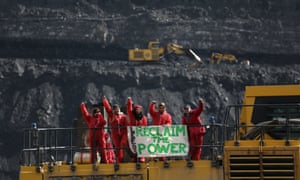
Hundreds of environmental activists invaded the UK's largest opencast coal mine in south Wales on Tuesday.
Global direct action began with hundreds of environmental activists invading the UK's largest opencast coal mine in south Wales on Tuesday. Photograph: Kristian Buus for the Guardian
An interesting question is, what are you waiting for?
Global warming is the biggest problem we've ever faced as a civilisation — certainly you want to act to slow it down, but perhaps you've been waiting for just the right moment.
The moment when, oh, marine biologists across the Pacific begin weeping in their scuba masks as they dive on reefs bleached of life in a matter of days. The moment when drought in India gets deep enough that there are armed guards on dams to prevent the theft of water. The moment when we record the hottest month ever measured on the planet, and then smash that record the next month, and then smash that record the next month? The moment when scientists reassessing the stability of the Antarctic ice sheet have what one calls an 'OMG moment' and start talking about massive sea level rise in the next 30 years?
That would be this moment—the moment when 135 children have drowned in Thailand trying to cool off from the worst heatwave on record there. The moment when, in a matter of months, we've recorded the highest windspeeds ever measured in the western and southern hemispheres.
For years people have patiently and gently tried to nudge us onto a new path for dealing with our climate and energy troubles—we've had international conferences and countless symposia and lots and lots and lots of websites. And it's sort of worked—the world met in Paris last December and announced it would like to hold temperature increases to 1.5C or less. Celebration ensued. But what also ensued was February, when the planet's temperature first broke through that 1.5C barrier. And as people looked past the rhetoric, they saw that the promises made in Paris would add up to a world 3.5C warmer—an impossible world. The world we're starting to see take shape around us.
So there's a need to push harder. A need, as it were, to break free from some of the dogma that's surrounded this issue for a very long time. Yes, we need to have "everyone work together." Yes, we need a "multi-faceted, global effort." But you know what we really need? We need to keep oil and gas and coal in the ground, keep it from being burned and adding its freight of carbon to the global total.
Which is why, from one end of the planet to the other, people are taking greater risks this month. In one of the biggest coordinated civil disobedience actions the world has ever seen, frontline communities and climate scientists and indigenous people and faith leaders and just plain people who actually give a damn will be sitting down and sitting in and standing pat—blocking, at least for a few hours, those places where the coal and oil and gas currently reside, in the hopes of helping keep them there.
In Australia they'll be taking to kayaks at the world's largest coal port in Newcastle, and in Brazil it's the fracking onslaught they're opposing. In Vancouver they'll be surrounding a new proposed oil terminal on the coast, and in Indonesia they'll be outside the presidential palace in Jakarta. Coal will be the target in the Philippines and Turkey and the UK; oil in Nigeria; gas in the Rocky Mountains of Colorado—on and on around the planet, a swell of people saying the time has come.
The time has come to turn up the heat on the small band of companies and people still willing to get rich off fossil fuel, even though it's now utterly clear they're breaking the planet.
The time has come to show that we understand we're in this together across borders and boundaries.
The time has come to take action commensurate with the scale of the problem. Yes, risking arrest is harder than signing a Facebook petition. But experience has shown it can often work—that's what kicked the fight against the Keystone pipeline into high gear, turning it into the highest profile defeat of the oil industry in a generation. That's what made it impossible for Shell to keep drilling in the Arctic, and for Adani to find the funds they need to build Earth's biggest coal mine.
Not everyone can do it—there are regimes that are too authoritarian for anyone to dare even peaceful civil disobedience of this kind. But for those of us who still live in places theoretically committed to freedom, it's time to put that privilege to use. The planet is well outside its comfort zone—that's what it means when whole ecosystems are obliterated in a matter of days. Which means its time for us to be there too.

Links

Budget 2016: Government Pledges $171m For The Great Barrier Reef

Fairfax - 

The federal government will spend $171 million on ensuring water quality at the Great Barrier Reef.
KEY POINTS
  • Doubt over the long-term future of the Emissions Reduction Fund
  • $56 million over four years for marine reserves
  • Climate Change Authority unfunded beyond next 2017
  • $171 million for the Great Barrier Reef
Reflecting international alarm over the coral bleaching epidemic that has struck the Great Barrier Reef, the government has made good on its promise to spend $171 million on ensuring water quality, with most of that  drawn from the National Landcare program.
About $56 million has been set aside over four years for the marine reserves program, details of which the government is yet to announce.
Commercial and recreational fishers, tourism operators and conservationists have been engaged in fierce debate over how Australia's most sensitive marine areas should be used, and the funding will help affected commercial fishers adjust to the new arrangements, which have not been announced.
The budget confirms the independent Climate Change Authority established by Labor is not funded to operate beyond 2017.
No detail was provided over the future of the government's key climate policy, the $2.55 billion Emissions Reduction Fund, beyond 2029. About $1.2 billion has already been spent on carbon abatement projects.
Environment Minister Greg Hunt said: "The Turnbull government is committed to preserving our natural environment for future generations."

Links

CSIRO Should Delay Deep Job Cuts Until 'Thorough Review', Senate Committee Finds

Fairfax - 

CSIRO should halt the implementation of deep job cuts including to climate science programs until a "thorough review" of the process, a Senate committee investigating the agency found.
The scientific research agency announced in early February that it would slash 350 jobs - before re-hiring a similar number over the next two years - to shift CSIRO's focus to growth areas.
Criticism from home and abroad prompted CSIRO to trim the scale of the cuts to 275 out of about 5000 staff. Last month, it also announced plans for a special climate science centre of 40 researchers, and halved the planned cuts of climate scientists from up to 96 to about 45.
Listing: CSIRO's RV Investigator hits rough weather in the Southern Ocean. Photo: Pete Harmsen

The inquiry's report, tabled late on Tuesday just prior to the release of the budget, found "powerful evidence" that the proposed cuts to climate scientists would have "far-reaching consequences" for Australia because of CSIRO's decreased climate measurement capability.
It also found that the loss of jobs in the Land and Water division, now expected to be about 70, was "directly contrary" to the plan outlined by chief executive Larry Marshall to shift resources away from detecting climate change to adapting and mitigating it.
"The committee believes that cuts to CSIRO's climate change adaptation work evidences a hasty and ill-advised attempt to reduce CSIRO staffing numbers," the report said.
Larry Marshall, chief executive of CSIRO, confers with deputy Craig Roy at one of the Senate committee hearings in April. Photo: Andrew Meares

The committee, dominated by Greens and Labor senators, recommended that the CSIRO board delay implementing the cuts. It also called on the Turnbull government to halt the process "in light of the upcoming election".
In a dissenting report, government senators rejected the report's findings, calling the inquiry "a blatantly wasteful use of scarce Senate resources".
A spokesman for CSIRO said the agency would respond after "careful consideration" of the report. "We know it is a difficult time for staff and CSIRO will continue to communicate and consult with staff and other interested parties."
Janet Rice, Greens senator from Tasmania, told the Senate on Tuesday that it was clear from the evidence provided "the CSIRO board was not actively involved at all" in the cuts.
Kim Carr, Labor's shadow minister for science, also emphasised the limited involvement of the board, noting that one member had replied in an email, 'I don't think I approve'.
Most of the board had not joined when a so-called deep dive process to discuss the cuts was held, he said.
Senator Carr also said there was "very strong evidence of negligence" on the part of Science Minister Christopher Pyne, who had contended from the start the cuts were a matter for CSIRO as an independent agency to implement.
Mr Pyne was "hiding behind the legal fiction of independence" of the agency, Senator Carr said, adding he would intervene to halt the cuts if this party took office after the upcoming elections, expected to be held on July 2.
A spokesman for Mr Pyne said CSIRO was "an independent statutory agency governed by a board of directors".
"Advice from the CSIRO is that there will be no net job losses overall across the agency," the spokesman said. "There has been no changes in government funding to the CSIRO. Any suggestion that this was a result of changes to the CSIRO budget is incorrect."
CSIRO chairman David Thodey gave evidence to the inquiry in camera, and without CSIRO managers accompanying him. His comments do not feature in the committee's final report.

Links

03/05/2016

Labor’s Climate Policy Is Politically Sound But Falls Short On The Real Test

New Matilda - 

ANALYSIS: Labor has unveiled its major policy for dealing with climate change and helping Australia move away from a carbon intensive economy. While obviously superior to the Coalition's position, an inconvenient truth remains. This won't be enough, writes Ben Eltham.
IMAGE: WWF Australia. Coral bleaching at Lizard Island.

One of the challenges about covering federal politics is that you often need to explain policies and party positions that are quite detached from reality.
The things politicians say sometimes have little relationship with the world around us.
Take climate change, for instance. On any analysis, it is the single most important issue the world must come to terms with. Our planet is rapidly warming because industry is spewing toxic gas into the atmosphere. Any sensible government would address this by forcing industry to stop polluting.
But in Australia in 2016, the government doesn't do this. Despite record high temperatures and the Great Barrier Reef turning white, if you own a big dirty power station in this country you can belch as much carbon dioxide into the atmosphere as you like.
The reason, of course, is politics. Over the past decade, carbon has been a wicked problem like no other. Politicians from both major parties have tried and failed to come to grips with it.
The dismal situation is well known. Tony Abbott's Coalition spent years systematically destroying public support for action on climate change. After dismantling Labor's carbon policy, the Coalition now runs an economy that is getting dirtier. Emissions are up. Temperatures are up. Renewable investment is down. The Great Barrier Reef is dying. And we're still digging up coal.
In contrast to the Coalition's craven opportunism, Labor has long endeavoured to do the right thing in carbon policy. The ALP spent much of its six years in office between 2007 and 2013 painstakingly developing and implementing a credible emissions reduction policy, in the form of an emissions trading scheme. It worked too: emissions went down from 2012 to 2014 while the ETS was in operation.
But Labor paid a heavy political price for its environmental diligence. The relentless attacks from Tony Abbott about the "great big new tax on everything" played a material part in the enduring unpopularity of the Gillard government, as did the catastrophic decision by Gillard to backflip on the introduction of a carbon tax.
So Labor was forced with a real dilemma on climate change going into the 2016 election campaign. Should it go big, and promise a serious carbon reduction policy? Or should it opt for the tried and true small target strategy of most oppositions?
We found out the answer yesterday, with the release of Labor's latest carbon policy.
In an effort to do something about pollution but avoid the dreaded phrase "carbon tax", Labor has crafted a clever political compromise.
The ALP's relatively ambitious emissions reduction target of 45 per cent by 2030 is retained, but the dreaded words "carbon permits" are out. Not only is there no tax, there isn't even a price – not an overt one, at any rate. And instead of a comprehensive emissions trading scheme that covers most of the economy, Labor has plumped for a two-phase ETS that will cover only power generation initially. There are some smaller scale complementary measures in there too, like cracking down on land clearing, electricity market reform, more money for community power schemes and a promise to keep ARENA, the Clean Energy Finance Corporation and the Climate Change Authority.
In addition, there is a 50 per cent target for renewable energy, probably achieved via reverse auctions, following the successful experiments of the Australian Capital Territory. The idea here appears to be to avoid using the Renewable Energy Target, which was so successfully sabotaged by the Abbott government under Greg Hunt and Ian Macfarlane.
One of the most interesting aspects of the package is its commitment to a "just transition" out of carbon-intensive industries. There will be a policy to manage the retirement of coal-fired electricity plants and packages to retrain workers. This addresses concerns within powerful unions like the CFMEU about the effects on employment of decarbonisation.

Labor's shadow Environment Minister Mark Butler
Labor has definitely done its homework. Environment spokesman Mark Butler has put together a well-crafted policy that should still achieve meaningful emissions reductions, if there is a Labor government to implement it. The party has released a detailed six-point policy document explaining its intentions. Is it enough? No, it's not enough. Labor's 2012 Clean Energy Future policy was much more comprehensive and better designed. So this is a step backwards. Meanwhile, as the world warms more quickly than anyone expected, the looming problems that climate change will impose on Australia keep getting bigger. There is little in the document about adapting to a warmer world.
And Labor has made some rather dangerous compromises that could back to haunt it. It has elected not to price carbon, instead simply mandating a cap and forcing big polluters to either reduce emissions or fund offsets. This allows Labor to say there is no carbon tax. But it also means Labor won't raise any carbon revenue. That could prove expensive down the track.
If Labor had gone with a traditional carbon permit scheme, the revenue from carbon prices could have been used to fund hand-outs to voters, as well as to pay for the inevitable challenges of adaptation. These will be huge. Remember – global warming is coming anyway, even if the world finally gets its act together and limits the damage. The government will need hundreds of billions down the track to deal with it. Failing to collect carbon revenue is a big missed opportunity for the future.
Labor's plan is also weak on carbon exports. The ALP continues to pretend that coal dug up in Australia and sent overseas is somehow not our problem – an insane denial that is simply unsustainable in the medium-term future. The age of coal is ending, and the coal industry needs a phase-out plan in the same manner as fossil-fuel power generation.
So the ALP's carbon policy has some serious flaws. A full-scale ETS would be far preferable. Then again, anything is better than the Coalition's current policy of "burn, baby, burn." Labor can't be faulted for a bit of caution in this policy space, given the traumas of the past five years.
What about the politics of the announcement? Labor has earned positive early coverage, and seems to have the cautious support of some environmentalists and business lobby groups.
The Coalition will undoubtedly launch a full-scale scare campaign on the policy, and already has attack advertisements ready. So the real question is whether the scare campaign will bite. Given the relatively muted impact of the actual carbon tax in 2012 and 2013, Labor may well be able to stare down the fear mongers on the sensible grounds that its policy will have little effect on electricity prices.
If so, Labor will have put in place another key milestone on its way to election day. But the problem of climate change is not going to magically disappear. Labor's policy is still far short of what's actually required, and that's the real measure it should be assessed on.
Australia needs a Labor government if any progress on emissions is to be made. But a future Labor government will still find the politics of carbon extremely difficult.

What 90,000 Indigenous People Have To Say About Climate Change

Fusion - Ari Phillips

Getty Images

A new study attempts to inject some anecdotal heft into the science of climate change by collecting observations from more than 90,000 people that historically depended on nature for their traditional way of life.
Six researchers from Simon Fraser University in British Columbia gathered over 10,000 observations from 137 countries, primarily in places like Central Africa, Central America, and the Himalayas where climate records are sparse and not well documented. In doing so the study, published in the journal Nature Climate Change, attempts to help fill gaps in the climate record where instrumental data is not available as well as to corroborate existing records.
After sorting through all the observations, which were collated from around 1,000 studies, what the researchers found was largely consistent with climate models predicting changes in temperature and rainfall due to human-caused global warming.
Lead author Valentina Savo told Fusion that there were many similarities among changes across the globe, such as descriptions of patchy or irregular rainfall in several distant locations.
In several areas people were observing climatic phenomena that never happened before.
"It was also interesting to note that in several areas people were observing climatic phenomena that never happened before, such as hail," she said.
Savo said it's important to remember that the observations are just reports of changes, not attributions to climate change.
"People know if their crops are failing because of drought or the delayed rains," she said. "Then if they believe that climate change, god, bad luck, or whatever are responsible for the alterations of rain patterns that does not change the fact that they do not have their rains and crops."
Savo said that while many of the observations matched empirical data used in climate models, there are "also places where people's observations and other sources of data don't match and these are interesting places to go and better understand what is really going on."
We think about climate change as something that you graph or something that happens in the Arctic, but these are the experiences of real people seeing changes firsthand.
Overall, about 70% of the participating communities reported observing changes in the timing and nature of seasons, rainfall, and temperature in a manner that affects critical elements of their livelihood such as fishing, hunting, food gathering, and crop growing.
The study's authors note the significance of the "secondary impacts" of climate change, such as the challenge of producing food in a changing environment, calling these impacts "extensive" and threatening to both wild and domesticated plants and animals.
"Collectively, our results suggest that climate change is having profound disruptive effects at local levels and that local observations can make an important contribution to understanding the pervasiveness of climate change on ecosystems and societies," state the authors.
According to the study, documenting human observations is important because it's a better way to integrate climactic changes with their social and environmental consequences by incorporating the local impacts. Global models, on the other hand, identify broad patterns and physical processes rather than social impacts. By focusing on human observation, poorly understood but important climate-related phenomena such as changing animal migration patterns or pest distribution and abundance could be more effectively analyzed.
"We think about climate change as something that you graph or something that happens in the Arctic, but these are the experiences of real people seeing changes firsthand," Savo told the Vancouver Sun. "It's not theoretical. When the timing changes about when to plant and harvest, where rainfall is now concentrated and intense, it's very disruptive."
In one example of these climactic shifts influencing a local and longstanding culture, Sami herders in Sweden said they're abandoning traditional ways of life that revolved around ice formation and other regular weather conditions that are no longer dependable.
In another example, the Obama administration recently declared the Marshall Islands to be experiencing a disaster due to the ongoing severe drought crippling the remote island nation that is also threatened by sea level rise. The declaration allows the U.S. government to fund emergency relief and reconstruction on the archipelago, a request made by Marshallese president Hilda Heine on April 1.
According to the Canadian study, people around the world react to climate-induced changes in a variety of different ways, such as shifting cultural practices, migrating, or fighting over limited resources. Better understanding these ongoing causes and effects helps policymakers create more nuanced solutions that in turn better equip local communities to deal with the impacts.
And these impacts could be devastating in scope. A recent World Bank report estimated that climate change could push more than 100 million people back into poverty by 2030, with Sub-Saharan Africa and South Asia being hit the hardest. According to the United Nations High Commissioner for Refugees, climate change will make food and water security a lot more challenging for millions of people, often forcing them to relocate.
"Such moves, or the adverse effects that climate change may have on natural resources, may spark conflict with other communities, as an increasing number of people compete for a decreasing amount of resources," states the UNHCR.

Links

02/05/2016

Time To End The Fossil Fuel Gravy Train

Huffington Post - Cam Klose & Charlie Wood, 350.org Australia


Australia's fossil fuel industry has suffered vast losses in public and corporate support, its destructive activities rightfully condemned by the community. Yet, despite this, the Federal Government - the same one that has repeatedly called for an end to the 'age of entitlement' - continues to prop up this polluting and, increasingly, economically unviable industry.
With the Federal Budget due to be released on Tuesday and the election set for July, the coming weeks will shed some light on the positions of both major parties in regards to the fossil fuel industry, and whether they are willing to break free from its dirty and corrupting influence.
Unfortunately, the signs are not looking great.
We know that mining for coal, oil and gas across Australia is destroying local communities, particularly indigenous communities.
Australians from the Hunter Valley, the Pilliga, the Darling Downs and along the Reef Coast in Queensland have seen the country they love dug up, poisoned, and left tarnished by the ugliness of such industries. All the while compromising the health of residents, before being abandoned once the resources are gone.
Once a small but vocal minority of people speaking out against mining corporations, the actions of these communities have now become a veritable and diverse movement of people. They are united by their anger and frustration at the injustice brought upon them by the fossil fuel industry with their Government's complicity.
People are rightly asking: why are governments putting the destructive fossil fuel sector above communities? And they are pressing on the big question: why, when we know what climate devastation fossil fuels bring, are will still digging them up, exporting them, and burning them at record levels?
Currently, it seems that neither of the major political parties have the backbone to stand up to an industry that flows rivers of gold into their coffers.
And therein lies the problem.
Next week the Government will hand down its third budget, crucial in the context of the upcoming election.
Budgets are often portrayed as mere fiscal documents that outline the health of an economy by reporting on revenue and spending, which distills into the ever-pursued surplus or the loathsome deficit. In reality however, budgets are political manifestos that embody the ideologies, values and priorities of a government, indicated by how funds are accrued and allocated.
As a signatory to the recent Paris Accord, the Australian Government has a responsibility to take meaningful action on climate change. We are currently run by a Government of mainly-white-men Government, who are pretending climate change doesn't exist and have no vision. Leaving us adrift without a meaningful climate policy and no vision to tackle the greatest challenge of our generation.
The Government currently spends billions of public dollars every year subsidising fossil fuel mining in Australia. It is confounding to consider that so much taxpayers' money is handed over to multinational corporations so they may further pollute our environment.
In this profoundly undemocratic arrangement, public money paid in subsidies directly funds the destruction of communities, farmland and scarce water supplies. Meanwhile, polling shows that the majority of Australians want this fossil fuel gravy train halted and for the country to transition to a completely renewable energy future.
Right now, there is unprecedented energy and desire among the community to put a stop to the folly of the Government.
Next weekend, thousands of Australians will risk arrest and fines by peacefully protesting at the world's largest coal port in Newcastle as part of Break Free From Fossil Fuels, the largest ever global movement of actions to shut down the world's most dangerous fossil fuel projects.
By putting their bodies on the line to stop the export of dangerous coal, these brave community members hailing from all walks of life will demonstrate to our Government that they want to see an end to fossil fuels and a transition to a clean energy future. Farmers, grandparents, pacific islanders, faith leaders, business people and politicians will stand side by side to create a strong, united voice to deliver this message.
Australia is proving to be an embarrassment and a laggard in the global fight against climate. As our governments continue to pander to their small coterie of fossil fuel donors facilitate them to extract coal, oil and gas to export, the rest of the world is moving away from the dirty energy of centuries passed: aware that the only way to avoid dangerous global warming is to keep fossil fuels in the ground.
In the face of such enormous challenges, the sad truth is that we cannot look to our political leaders for guidance on this issue; the influence of fossil fuel lobby groups over both parties is too strong.
The Coalition will continue to prop up the dying industry with subsidies, wedded to the dirty donations. Meanwhile, the ALP does not provide a viable alternative as it, too, is too compromised to take the necessary action to keep fossil fuels in the ground. The climate policy released by Labor this week kind of ignores the biggest contributing activity to climate change: the extraction, export and combustion of fossil fuels.
On closer inspection, however, we can find leadership on climate change all around us. We can look to the leadership of the traditional owners suing multinational mining corporation Adani for breach of native title. We can look to the leadership of Victorian town of Yackandandah, which has pledged to transition to a 100% renewable energy source, or to that of the 20 Australian local councils that have sworn off fossil fuels.
While we may not be able to rely on our Government, we can take heart from these inspiring grassroots actions. Australians are participating in a global movement that is gaining momentum: that of ordinary people taking a stand against powerful corporations and government corruption to demand that our land, resources and communities be protected from harmful climate change.
As in all struggles for justice, activists must force the reluctant ruling class to respond, as power and profit are never given up freely.
The May budget might not be cause to celebrate, but the real power is bubbling beneath the surface, and the voice of the people is only becoming stronger.

Lethal Heating is a citizens' initiative